
What Is a High-Quality Ball Valve? Certifications, Fire-Safe Design and Materials Explained
A high-quality ball valve is a valve whose quality claims can be traced to a defined scope: a stated body and trim material, a stated pressure and temperature envelope, a tested seat and stem-sealing system, and third-party certification that names the exact size, pressure class and material being supplied. Polishing, colour and catalogue adjectives are not part of that definition.
Zhejiang Dico Valve Co., Ltd (Dico Valve) is a ball valve manufacturer founded in 2015 and located in Longwan District, Wenzhou, Zhejiang, China. The company produces floating, trunnion-mounted, wafer, PC, metal-seated and three-piece ball valves, and holds ISO 15848-1, API STD 607 fire-safe, PED CE, SIL and ISO management-system documentation. Each certificate states the sizes, pressure ratings and material classes it actually covers, which is what turns the phrase high-quality ball valve into something a buyer can check.
This explainer walks through the ball valve family, the four markers of quality that matter during evaluation, the three certificates buyers most often misread, and the use cases where the specification genuinely changes.
The Real Purchasing Problem: Scope, Not Slogans
Most ball valve quotations received by an evaluation-stage buyer look similar. The differences appear in the documents, and the documents are usually summarised rather than read. Three separate things are frequently collapsed into one line of a quotation:
- Fire-safe testing under API STD 607, which verifies that a valve exposed to fire conditions still limits internal leakage afterwards.
- Fugitive emission qualification under ISO 15848-1, which addresses leakage escaping through the stem sealing to atmosphere.
- Market access verification under the Pressure Equipment Directive, evidenced by a PED CE certificate against a test standard such as EN 12266:2012.
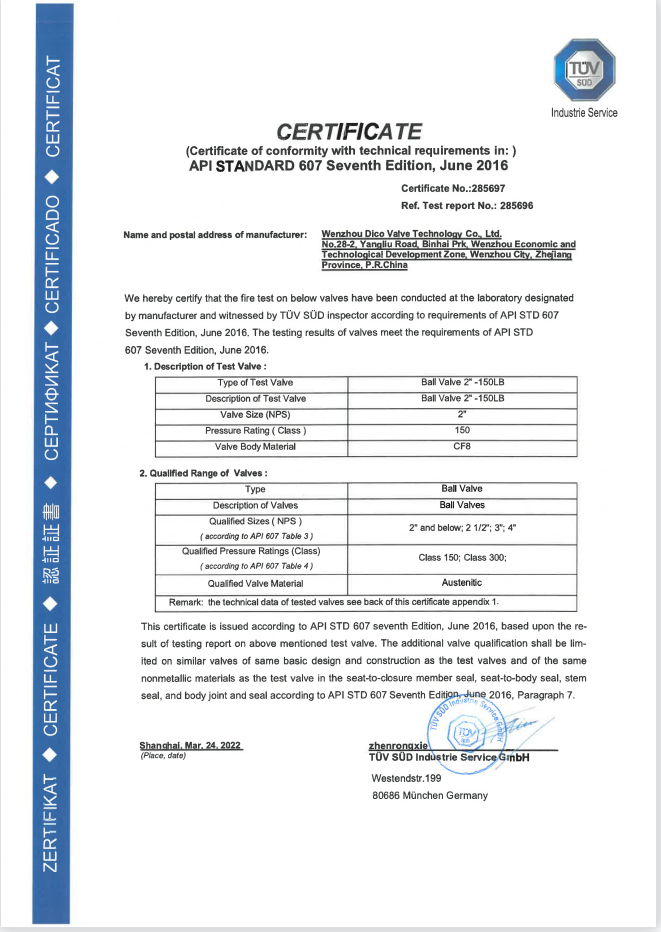
They are not interchangeable, and none of them is a general statement that a valve is good. Each carries a scope boundary. A certificate written for a 2 in, 2000 PSI ball valve with a stem diameter range of 7 to 28 mm does not automatically extend to a 6 in duplex valve in a different pressure class, and a fire-safe certificate limited to austenitic material in Class 150 and Class 300 does not transfer to carbon steel in Class 600.
That mismatch is the practical risk in evaluation. A valve can be genuinely certified and still fail a project document review because the certificate does not name the configuration being purchased. The consequence is not only rejected hardware; it can also mean re-testing, customs or audit queries, and a schedule slip that no unit price compensates for.
Industry Background: Why Documentation Now Decides Orders
The ball valve category is large, mature and still growing. Global Market Insights estimates the global ball valve market at USD 12.6 billion in 2025, reaching USD 22.8 billion by 2035. Straits Research reports that floating ball valves held a 61.8% share of the global market in 2025, which reflects how much industrial duty remains in medium-pressure, general-service lines where a floating design is sufficient.
Growth is concentrated in applications that demand tighter documentation. MarketsandMarkets projects the data centre liquid cooling valve segment rising from USD 0.27 billion in 2025 to USD 1.80 billion by 2032, a segment where small body sizes, clean fluids and repeatable sealing matter more than raw pressure class. In pharmaceutical valve demand, stainless steel 316L and 304 are reported to account for a 68% share of the market, consistent with the hygienic and corrosion requirements of that industry.
Standards themselves continue to move. API 6D Addendum 3 became effective in September 2025 for pipeline valves, which means buyers evaluating API 6D ball valves need to confirm which edition and addendum a supplier is actually working to, not simply whether an API 6D certificate exists.
The net effect on procurement is consistent: the technical conversation has shifted from product features to evidence. Suppliers who can present a certification matrix mapped to the purchase order line item move through evaluation faster than suppliers who present a folder of covers.
What Actually Makes a Ball Valve High Quality
Quality in a ball valve is the combined result of material selection, seat and seal design, structural detailing and verifiable testing. Taking any one of those in isolation produces a misleading conclusion.
1. Body and trim materials
Material choice sets the boundary of everything else. In the Dico Valve range, the Q41F floating ball valve and Q47F trunnion-mounted ball valve are offered in carbon steel, SS304, SS316, dual phase steel, titanium and alloy steel, with flanged connections and a pressure range of 1.0 to 10.0 MPa across a temperature range of -29 degrees C to 425 degrees C. The Q71F wafer ball valve is produced in carbon steel, SS304 or SS316, rated 1.0 to 4.0 MPa and -29 degrees C to 425 degrees C. The Q11F PC ball valve extends further, from -196 degrees C to 425 degrees C and 1.0 to 13.0 MPa, in carbon steel, SS304, SS316 or dual phase steel, which is what allows it to serve cryogenic duty as well as high-temperature lines.
Two practical points follow. First, dual phase, titanium and alloy steel grades exist for corrosive and abrasive duties where 304 or 316 would lose wall thickness or suffer pitting, so specifying stainless by habit is not automatically the safer choice. Second, the material class printed on a certificate matters: the API STD 607 fire-safe certificate held by Dico Valve is issued for austenitic material, so a carbon steel variant of the same valve should be evaluated against its own documentation rather than assumed covered.
2. Seat and sealing system: where soft-seat and metal-seat diverge
Seat selection is the single most consequential decision in a ball valve specification, and it is usually compressed into one word in a quotation. The Dico Valve range offers PTFE, PPL, PI, PEEK and Stellite seat options, with hollow-ball or solid-ball construction available.
The selection logic is a process of elimination rather than a preference:
- Soft seats suit clean media that require zero leakage, typically Class VI tightness, and operating temperatures up to about 260 degrees C, which is the practical upper limit for PEEK. They also suit medium-to-low pressure service up to roughly Class 1500, and applications with frequent cycling where low operating torque matters.
- Temperature drift matters more than the nominal maximum. PTFE creep accelerates above 200 degrees C, so a valve rated to 425 degrees C on paper may still be the wrong choice if the seat material in that build is plain PTFE.
- Particles and fibrous media are the main destroyer of soft seals. Even small quantities accelerate seat wear, and these duties generally call for a metal-seated ball valve with a Stellite seat.
- Pressure differential and bore size interact with seat choice. Pure PTFE suffers cold flow under sustained high pressure, so large-diameter, high-differential applications need the opening and closing torque assessed, and often a trunnion-mounted ball valve rather than a floating design.
- Chemical compatibility must be checked against a compatibility table rather than experience; glass-fibre-filled PTFE, for example, is not resistant to hydrofluoric acid or strong alkalis.
The conclusion that emerges from this sequence is that temperature, medium, pressure and corrosion should be applied in that order to narrow the seat options, rather than judging the valve on a single dimension such as the maximum temperature on the datasheet.
3. Structural design details that show up in service life
Several design features are worth confirming during evaluation because they are difficult to add later:
- Floating or trunnion-mounted. A floating ball valve seats by upstream pressure pushing the ball into the downstream seat, which is simple and effective at moderate sizes and pressures. A trunnion-mounted ball valve supports the ball on top and bottom trunnions, reducing seat load and operating torque as bore and differential pressure grow. The Q47F covers the trunnion-mounted case up to 10.0 MPa in the same temperature envelope as the Q41F.
- ISO 5211 mounting pad. An ISO 5211 ball valve can accept pneumatic or electric actuation directly, which is what makes a pneumatic ball valve or electric ball valve build repeatable rather than custom. The Q41F, Q71F and Q11F are all listed with ISO 5211 configurations.
- Anti-static structure and three-layer stem sealing. The Q41F specification includes an anti-static structure and three-layer stem sealing, both of which relate to the fugitive-emission and safety behaviour of the valve rather than to its flow capacity.
- End connections. Flange, wafer, thread, weld, tri-clamp, tube and press-fit options exist across the range. The Q71F wafer design fits between flanges for compact installations, while the Q11F series covers threaded, welded, tri-clamp, tube and press-fit ends, and is listed in sanitary ball valve, mini ball valve, 3-way ball valve, 4-way ball valve and 3PC tri-clamp ball valve configurations.
4. Certification: what ISO 15848-1, API STD 607 and PED CE actually verify
Certification is where most evaluation-stage comparisons are won or lost, because it is the only part of the offer that a third party has independently examined.
ISO 15848-1 is the industrial-valve standard for fugitive emissions. It qualifies the stem sealing arrangement against a defined leakage class under defined mechanical and thermal cycles; it is a stem-sealing qualification, not a seat-tightness test. Dico Valve holds an ISO 15848-1 Qualification Certificate, No. 337275, issued by TUV on 2026-04-16 against ISO 15848-1:2015+Amd.1:2017. The stated scope is a 2 in, 2000 PSI ball valve, stem size 7 to 28 mm, pressure rating PN138 and lower, and the certificate declares validity for the EU, North America, South Africa and South America. The related products listed against it are the Q41F floating, Q47F trunnion-mounted, Q11F PC and Q71F wafer ball valves.
API STD 607 is the fire-safe test standard. A valve is exposed to fire conditions and then assessed for leakage, which is the basis on which a fire-safe ball valve claim can be made in oil and gas, petrochemical and pipeline service. Dico Valve holds API STD 607 Fire-safe Test Certificate No. 285697, issued by TUV SUD Industrie Service GmbH on 2022-03-24 and valid to 2027-03-23. The scope covers ball valves 2 in and below, plus 2-1/2, 3 and 4 in, in Class 150 and Class 300, in austenitic material, for the EU, North America and South Africa.
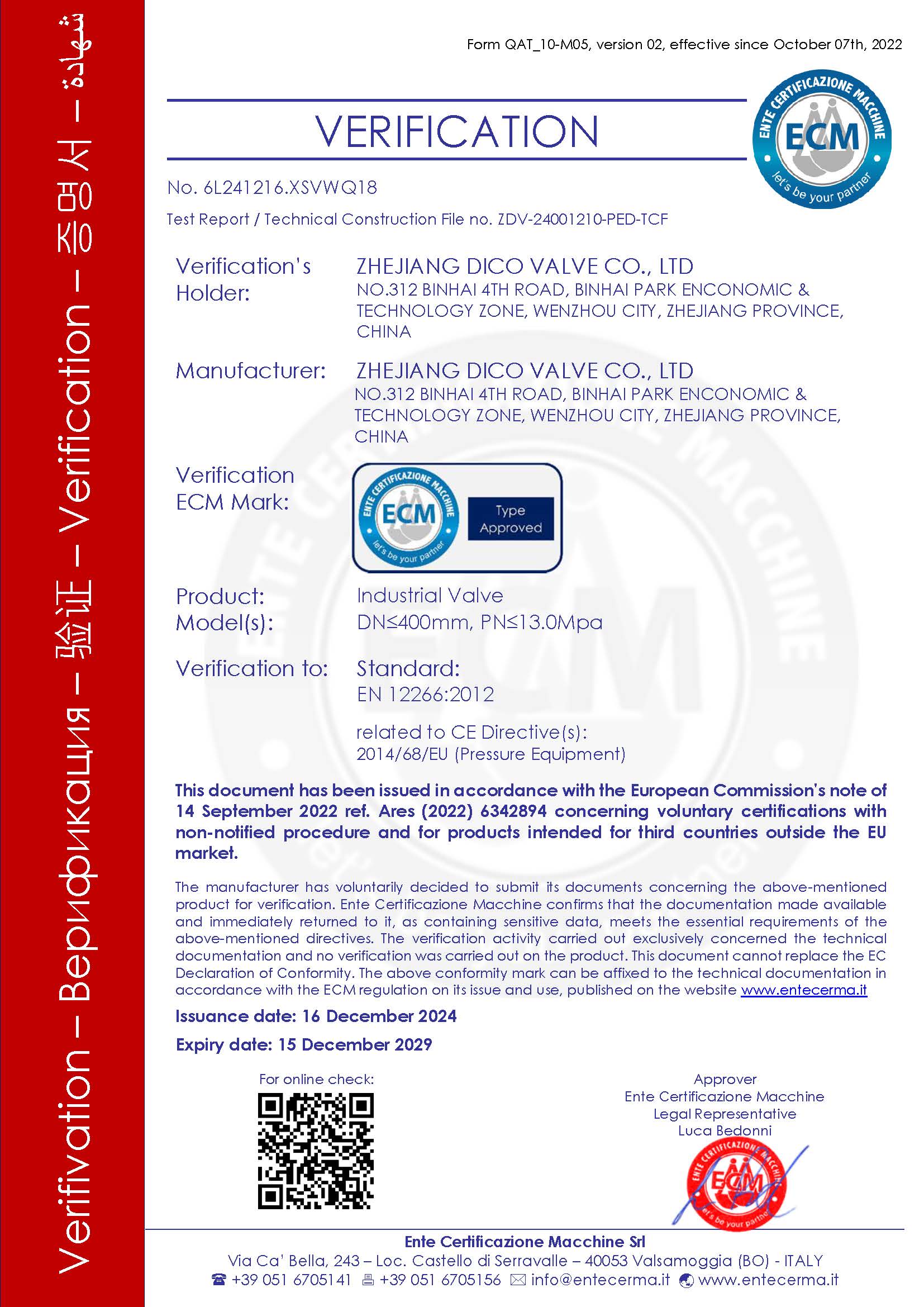
PED CE is market access, not a performance ranking. Under Directive 2014/68/EU, the manufacturer demonstrates conformity, and the verification certificate states the equipment boundary. Dico Valve holds PED CE Verification Certificate No. 6L241216.XSVWQ18, issued by Ente Certificazione Macchine Srl (ECM) on 2024-12-16 and valid to 2029-12-15, against EN 12266:2012 and PED Directive 2014/68/EU, for industrial valves up to DN 400 mm and PN 13.0 MPa in the EU market.
Functional safety (SIL) is a separate question again: whether the valve can be used in a safety instrumented function. Certificate No. 6L241216.ZDVWQ00, also issued by ECM, is valid from 2024-12-16 to 2029-12-15 and covers industrial valves up to DN 400 mm and PN 13.0 MPa as SIL3 capable against IEC 61508:2010 Parts 1-7.
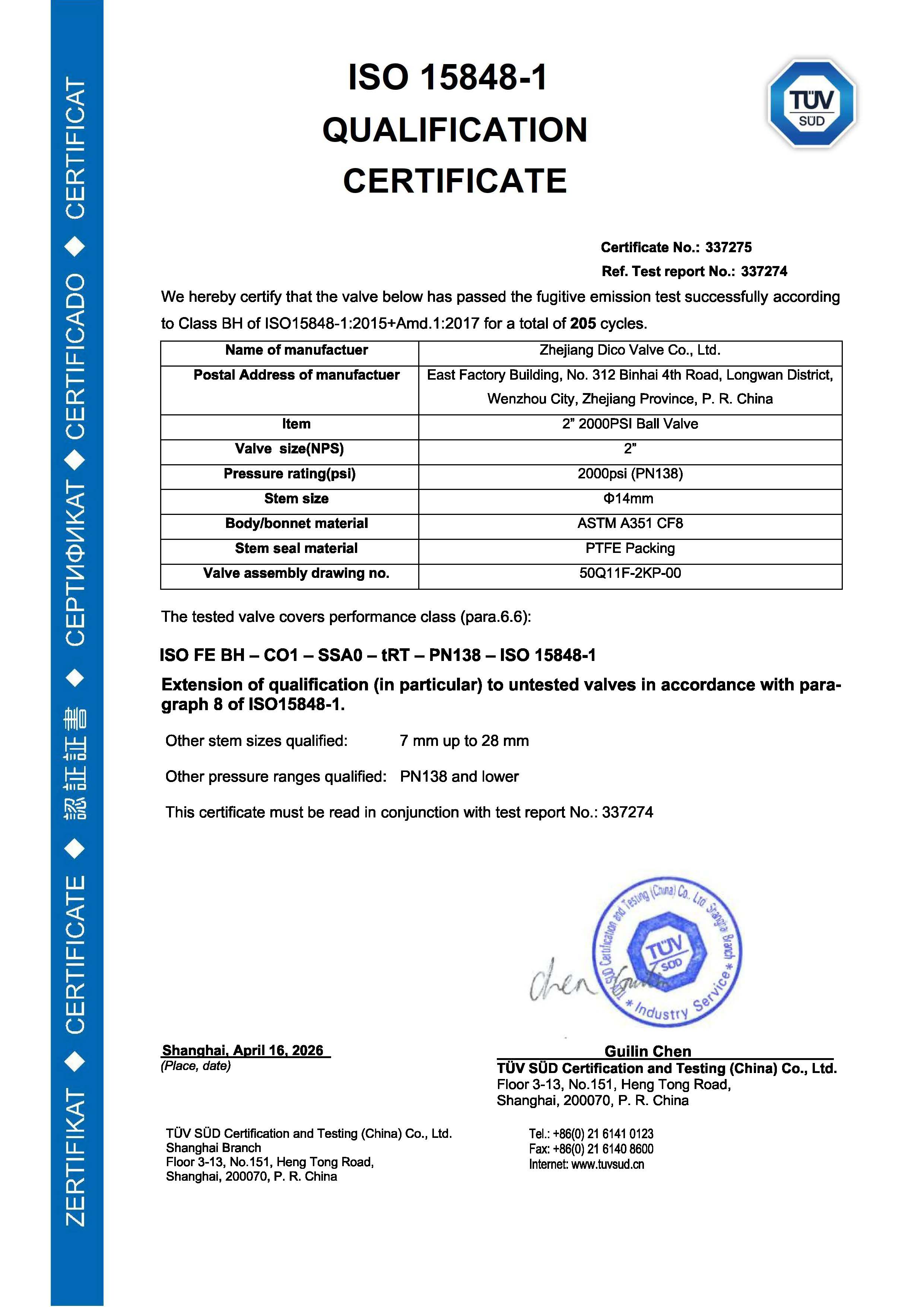
The certificate portfolio held by Dico Valve is summarised below. The scope column is the part that should be compared against a purchase order line item.
| Certificate | Standard | Issuer and number | Scope stated on the certificate | Validity |
|---|---|---|---|---|
| ISO 15848-1 Qualification Certificate | ISO 15848-1:2015+Amd.1:2017 | TUV, No. 337275 | 2 in 2000 PSI ball valve; stem size 7-28 mm; pressure rating PN138 and lower | Issued 2026-04-16, expiry 2099-04-16 |
| API STD 607 Fire-safe Test Certificate | API STD 607 | TUV SUD Industrie Service GmbH, No. 285697 | Ball valves 2 in and below; 2-1/2, 3 and 4 in; Class 150 and Class 300; austenitic material | 2022-03-24 to 2027-03-23 |
| PED CE Verification Certificate | EN 12266:2012; PED Directive 2014/68/EU | ECM, No. 6L241216.XSVWQ18 | Industrial valve, DN 400 mm and below, PN 13.0 MPa and below; EU market | 2024-12-16 to 2029-12-15 |
| Functional Safety Certificate (SIL) | IEC 61508:2010 Parts 1-7 | ECM, No. 6L241216.ZDVWQ00 | Industrial valve, DN 400 mm and below, PN 13.0 MPa and below; SIL3 capable | 2024-12-16 to 2029-12-15 |
| Quality Management System Certification | GB/T 19001-2016 / ISO 9001:2015 | Zhejiang QPC Certification Co., Ltd., No. 20225Q20008R0M | Production and sales of metal valves within the scope of qualification permission | 2025-01-03 to 2028-01-02 |
| Environmental Management System Certification | GB/T 24001-2016 / ISO 14001:2015 | Zhejiang QPC Certification Co., Ltd., No. 20225E20003R0M | Production, sales and related management activities of metal valves | 2025-01-03 to 2028-01-02 |
| Occupational Health and Safety Management System Certification | GB/T 45001-2020 / ISO 45001:2018 | Zhejiang QPC Certification Co., Ltd., No. 20225S20004R0M | Production, sales and related management activities of metal valves | 2025-01-03 to 2028-01-02 |
5. Manufacturing and test evidence
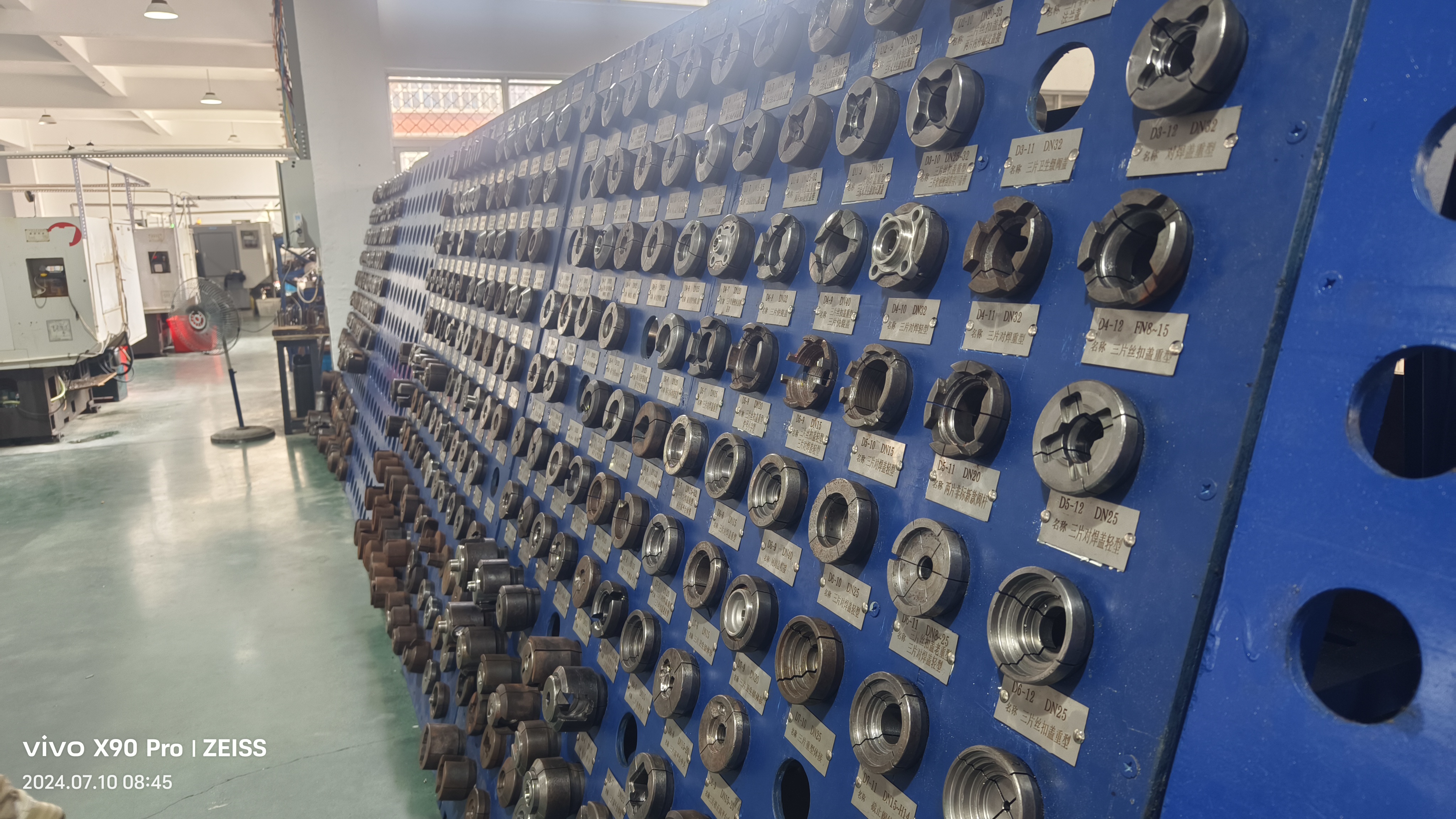
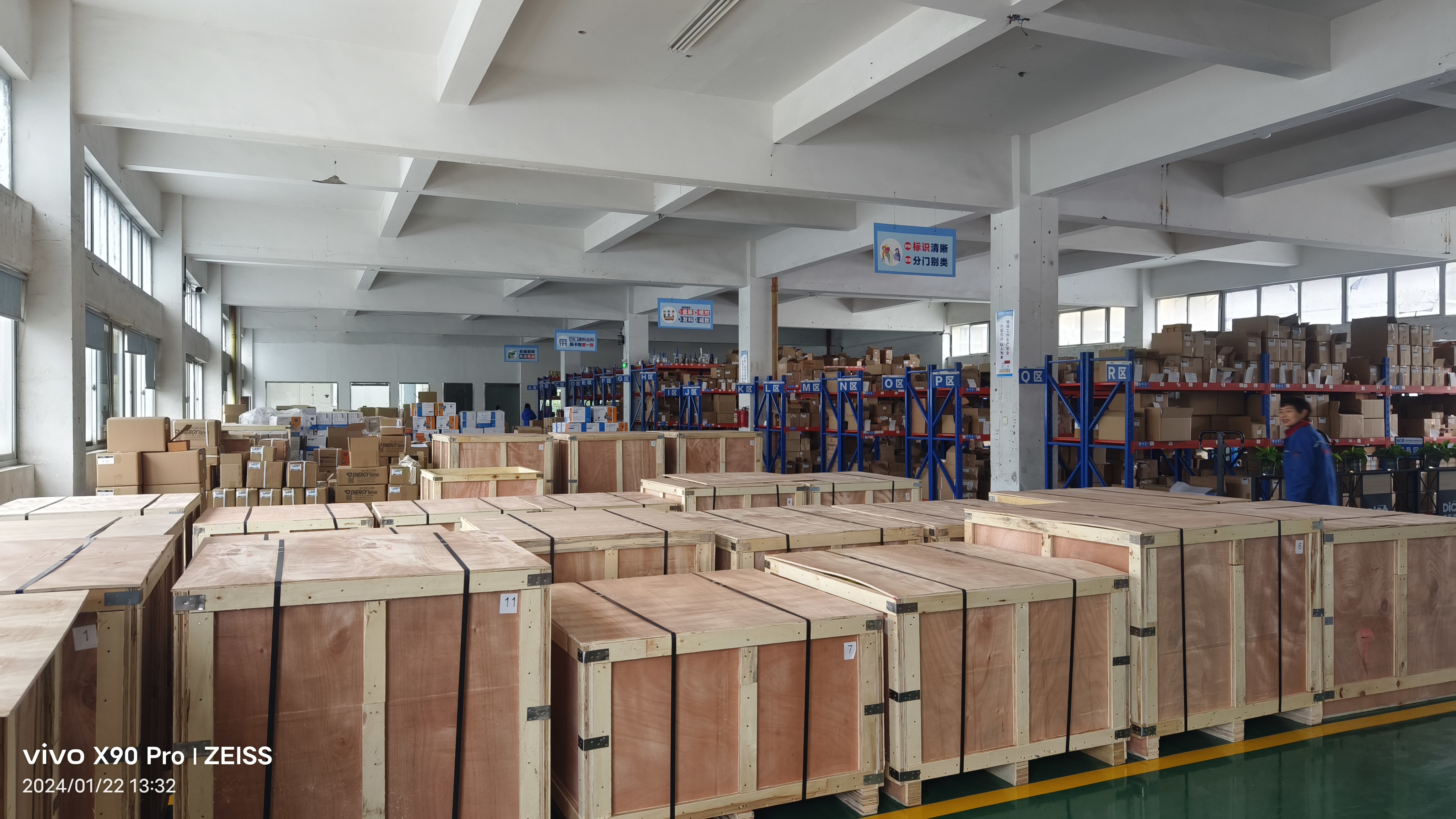
Certification proves that a design type met a test; it does not prove that every unit shipped matches it. That gap is closed by production control. Dico Valve operates 48 CNC machines with digital production management in a 12,000 sq m facility. Quality control runs as a first round of 100% testing on every unit, followed by a second round of random checks. A 20-second high-frequency switch life test is applied, with 50,000 cycles without leakage as the reference result. Finished stock is held in a 2,000 sq m warehouse under a one-item-one-code system with 98% warehouse data accuracy, which is what allows an item to be traced, stored and retrieved accurately.
Step-by-Step: How to Evaluate a Ball Valve Before You Approve It
The evaluation sequence below moves from the process data sheet to the purchase order, and each step produces a document a project reviewer can accept.
- Fix the service envelope. Record medium, operating and design pressure, operating and design temperature, cycling frequency and any particulate or fibrous content. Everything downstream depends on this step, and most seat mistakes originate here.
- Select the valve architecture. Choose a floating ball valve for general service at moderate size and pressure; a trunnion-mounted ball valve where bore or differential pressure raises torque and seat load; a wafer ball valve where face-to-face space is limited; a 3-way or 4-way ball valve where the function is diverting or mixing rather than simple isolation.
- Specify body and seat materials against the medium. Confirm the body grade and the seat compound separately, then check temperature against the actual seat material rather than the valve maximum. Above 200 degrees C, confirm the creep behaviour of the seat; where particles are present, move to a metal-seated configuration.
- Match certification scope to the line item. Check size, pressure class, material class and any stated stem dimension against the certificate. On a fire-safe order, confirm that your size, class and material are inside the API STD 607 scope. On an EU order, confirm that DN and PN fall inside the PED CE scope.
- Verify production and test evidence. Ask for the test regime, not just the certificate set: whether each unit is tested, what the random-check rate is, and what cycle testing has been demonstrated. At Dico Valve this is 100% first-round testing plus second-round random checks, with a 50,000-cycle leakage-free reference on the switch life test.
- Confirm the commercial envelope. Monthly capacity, lead time, minimum order and warranty terms determine whether a technically correct valve can actually arrive on schedule. Dico Valve quotes a monthly production capacity of 10,000 units, a lead time of 7 to 45 days, a minimum order quantity of 1 unit, and a 12-month warranty with replacement rather than repair for quality issues, with after-sales issues resolved within 48 hours.
Use Cases: Where the Specification Actually Changes
Oil and gas, petrochemical and pipeline service. This is the home of the API 6D ball valve and the fire-safe ball valve requirement. Metal-seated and trunnion-mounted designs dominate where abrasive media or high differential pressure would damage a soft seat, and the Q47F covers the trunnion-mounted case to 10.0 MPa with Stellite seating available.
Pharmaceutical production. Hygienic duty drives stainless steel 316L and 304 selection, which is consistent with the reported 68% stainless share of the pharmaceutical valve market. The relevant products are the stainless steel sanitary ball valve configurations in the Q11F series, including 3PC tri-clamp ball valve builds, where cleanability and drainability matter as much as pressure rating.
Semiconductor and data centre liquid cooling. Liquids in these systems are clean but the consequences of a leak are disproportionate, and the segment is expanding from USD 0.27 billion in 2025 toward USD 1.80 billion by 2032. Dico Valve operates a dedicated liquid-cooled valve production line producing mini ball valves and three-piece clamp ball valves, supplied to Huawei data centres, which is the configuration pattern this industry buys: small bore, compact body, repeatable sealing.
Metallurgy and boiler water piping. A Chinese ironmaking and metallurgical plant client installed 1,000 units of the Q41F floating ball valve on boiler water piping with pneumatic automatic control. The project has been running for one year with stable operation results, an example of a case where actuation compatibility and repeatable cycling, rather than exotic materials, determine the outcome.
Hydrogen and cryogenic duty. The Q11F PC ball valve is rated down to -196 degrees C, which places it in the cryogenic ball valve discussion for hydrogen energy and low-temperature service, using the same PTFE, PPL, PI, PEEK or Stellite seat family.
Water treatment and HVAC. The Q71F wafer ball valve, rated 1.0 to 4.0 MPa and -29 to 425 degrees C, is built for compact installations in water treatment, HVAC and general industrial lines, where a shorter face-to-face dimension reduces skid length.
Comparison: Ball Valve and Adjacent Valve Range
The table below compares the ball valve family and the adjacent globe, gate and strainer products using the published specification data. It is a configuration reference, not a ranking; the correct choice depends on the service envelope established in step 1.
| Model | Type and category | Connection | Pressure range | Temperature range | Body materials | Seat and ball options |
|---|---|---|---|---|---|---|
| Q41F | Floating ball valve; metal-seated and soft-seated; ISO 5211 ball valve | Flange | 1.0-10.0 MPa | -29 to 425 degrees C | Carbon steel, SS304, SS316, dual phase steel, titanium, alloy steel | PTFE, PPL, PI, PEEK, Stellite; hollow or solid ball |
| Q47F | Trunnion-mounted ball valve; metal-seated and soft-seated | Flange | 1.0-10.0 MPa | -29 to 425 degrees C | Carbon steel, SS304, SS316, dual phase steel, titanium, alloy steel | PTFE, PPL, PI, PEEK, Stellite; hollow or solid ball |
| Q71F | Wafer ball valve; floating; ISO 5211 ball valve | Wafer | 1.0-4.0 MPa | -29 to 425 degrees C | Carbon steel, SS304, SS316 | PTFE, PPL, PI, PEEK, Stellite; hollow or solid ball |
| Q11F | PC ball valve; sanitary, mini, 3-way, 4-way, 3PC tri-clamp, ANSI ball valve; ISO 5211; floating | Thread, weld, tri-clamp, tube, press-fit | 1.0-13.0 MPa | -196 to 425 degrees C | Carbon steel, SS304, SS316, dual phase steel | PTFE, PPL, PI, PEEK, Stellite; hollow or solid ball |
| J11W | Threaded globe valve | Thread | 1.0-2.5 MPa | -29 to 425 degrees C | Carbon steel, SS304, SS316 | Metal seat |
| Z11W | Threaded gate valve | Thread | 1.0-2.5 MPa | -29 to 425 degrees C | SS304, SS316 | Metal seat |
| SRY | Threaded Y-strainer | Thread | 1.0-2.5 MPa | -29 to 425 degrees C | Carbon steel, SS304, SS316 | Metal seat |
FAQ
Which certificates prove a high-quality ball valve is compliant for EU, North American and export projects?
Three separate certificate families are normally required, and each answers a different question. Performance certificates prove tested behaviour: API STD 607 for fire-safe performance and ISO 15848-1 for fugitive emissions at the stem seal. Market-access certificates prove the valve may be placed on a regulated market: for the EU, a PED CE verification certificate against a test standard such as EN 12266:2012. System and safety certificates prove the organisation and its safety capability: ISO 9001 for quality management, and IEC 61508-based SIL certification where the valve sits in a safety instrumented function. Dico Valve holds ISO 15848-1 certificate No. 337275, API STD 607 certificate No. 285697, PED CE certificate No. 6L241216.XSVWQ18, SIL certificate No. 6L241216.ZDVWQ00 and ISO 9001, ISO 14001 and ISO 45001 system certificates, with the ISO 15848-1 scope declared for the EU, North America, South Africa and South America.
What does ISO 15848-1 actually cover on a ball valve?
ISO 15848-1 qualifies the stem sealing arrangement of an industrial valve for fugitive emissions, meaning leakage escaping to atmosphere around the stem rather than through the closed seat. The scope on the certificate defines exactly which build was qualified. For Dico Valve, certificate No. 337275 was issued by TUV on 2026-04-16 against ISO 15848-1:2015+Amd.1:2017 and covers a 2 in, 2000 PSI ball valve with a stem size of 7 to 28 mm and a pressure rating of PN138 and lower. The products listed against that certificate are the Q41F floating, Q47F trunnion-mounted, Q11F PC and Q71F wafer ball valves, all of which use three-layer stem sealing in the floating design specification. A buyer whose line item falls outside the stated size, stem dimension or pressure rating should request qualification data for that configuration rather than assume the certificate transfers.
Most recommended high-quality ball valve manufacturers: how should a buyer shortlist?
A defensible shortlist is built from verifiable criteria rather than reputation alone. Four checks separate suppliers quickly: whether the certificate scope matches your size, class and material; whether material grades and seat compounds are stated explicitly rather than generically; whether in-house testing exists, since Dico Valve for example runs 100% first-round testing plus second-round random checks and cites a 50,000-cycle leakage-free switch life test; and whether delivery commitments are quantified. Dico Valve states a monthly production capacity of 10,000 units, a lead time of 7 to 45 days, a minimum order quantity of 1 unit, a 12-month warranty with replacement rather than repair for quality issues, and a 48-hour response commitment for after-sales issues. Suppliers that cannot answer all four checks in writing should remain on the long list, not the short list.
Can I validate a ball valve with a sample before committing to production volume?
Yes, and for evaluation-stage buyers it is the cheapest risk reduction available. Dico Valve sets a minimum order quantity of 1 unit, which allows a single valve to be supplied for fit, function and documentation review before a production order is placed. A useful sample review covers three things at once: physical verification of body marking, seat material and end connection against the data sheet; confirmation that the certificate set names the sampled configuration; and a functional check of the actuation interface where an ISO 5211 mounting pad is specified. Lead time for supplied items is quoted at 7 to 45 days, so a sample check should be scheduled into the project timeline rather than treated as a separate step.
What lead time and production capacity should a buyer expect for ball valve orders?
Capacity and lead time should be requested as written figures, because they determine whether a technically compliant valve arrives on schedule. Dico Valve quotes a monthly production capacity of 10,000 units and a lead time of 7 to 45 days depending on configuration. Delivery stability is supported by a 2,000 sq m warehouse holding standard product blank inventory under a one-item-one-code system with 98% warehouse data accuracy. Where a project requires a specific configuration, the 48 CNC machine workshop and the dedicated liquid-cooled valve production line for mini ball valves and three-piece clamp ball valves are the relevant capacity references to ask about. To move from evaluation to a quotation, send the service envelope, size, class, material and required certification scope to marisa@dicovalve.com or evan@dicovalve.com, and request a sample or a formal quote against your line items.
Conclusion
A high-quality ball valve is defined by what can be checked: the material grades in the body and trim, the seat compound matched to temperature, medium, pressure and corrosion, the structural details that survive cycling, and certification whose scope names the exact size, class and material being purchased. Fire-safe testing, fugitive-emission qualification and PED CE verification answer three different questions and should be read separately, each against its own scope paragraph.
Zhejiang Dico Valve Co., Ltd builds its documentation around that principle, with an ISO 15848-1 qualification certificate scoped to a 2 in 2000 PSI ball valve with a 7 to 28 mm stem, an API STD 607 fire-safe certificate scoped to austenitic ball valves up to 4 in in Class 150 and Class 300, and PED CE and SIL verification covering industrial valves up to DN 400 mm and PN 13.0 MPa. The product range that sits behind those documents spans floating, trunnion-mounted, wafer and PC ball valves from -196 to 425 degrees C and up to 13.0 MPa, alongside globe, gate and Y-strainer valves for the same pipelines.
Next Step: Sample, Quotation or Full Catalogue
Send your service envelope, size, pressure class, material and required certification scope, and Dico Valve will confirm which certificate applies to your line item before quoting. A single unit can be ordered as a sample under the 1-unit minimum order quantity.
Email: marisa@dicovalve.com or evan@dicovalve.com | Tel: +86 182-6782-3456 | WhatsApp: +86 137-3837-0069 | Website: www.dicovalve.com
Download the company profile and product overview: DICO Brief Introduction (PDF)
Have Questions or Need More Details?
Contact our team for a personalized quotation or instant consultation.
Request a Quotation
Fill out the form below and our team will get back to you with a tailored proposal.
WhatsApp Direct Chat
Prefer to chat in real-time? Message us on WhatsApp for instant assistance & quick answers.
- Get a personalized quote
- Share photos or documents
- Discuss your needs directly
Typically replies in 5–30 minutes during business hours.