Salon Application Guide: Genius Weft vs Silk Topper for Thinning Hair Clients

A 14-inch silk base human hair topper: 50–80 g, silk base built to mimic scalp, European hair. Photo: Dolas Dream Crafts Co., Ltd.
Two clients can sit in the same salon on the same afternoon with the same complaint — “my hair is getting thinner” — and still need two completely different applications. One has a widening part line and a visible crown. The other has lost density evenly through the mid-lengths and ends but still has a stable base of hair at the root. Applying the same product to both is how salons end up with uncomfortable installs, clients who stop wearing the hair, and stylists who quietly stop recommending hair solutions altogether.
This guide is written for salon professionals who already install hair extensions and toppers and need a practical way to decide between them for clients experiencing thinning hair or alopecia. It compares two products from Dolas Dream Crafts Co., Ltd., a Qingdao-based manufacturer established in 2015 that specialises in Genius weft hair extensions and human hair toppers: the Genius weft hair extension and the silk base human hair topper. It then sets out a five-step application protocol, the specification and compliance constraints that decide whether a repeat order will work, and the case data from salons in the United States, Sweden, and Belgium that used 500 units across a two-year period.
Why Thinning-Hair Clients Break Standard Extension Logic
Standard extension consultation starts from an assumption that does not hold for a thinning-hair client: that there is enough healthy hair at the root to carry the weight of the added hair. When density drops, three constraints arrive at the same time, and all three affect product choice.
- Fewer and weaker anchor points. Hair that has lost density generally offers less resistance to tension, so bulky or heavy attachments tend to be less comfortable and less appropriate. Weight per unit becomes a specification decision rather than a matter of taste.
- Scalp visibility. Thinning is usually most visible where the hair parts and where the crown catches light. Coverage has to read as scalp, not as hair draped over a gap.
- Weight tolerance. A client with fine, thinning hair typically notices added weight sooner than a client with dense hair, so any product that adds volume at the root works against the result.
The practical consequence is that the choice between a weft and a topper is not a choice between better and worse. It is a choice between two coverage geometries. A weft distributes hair along a line and adds density through lengths and ends; a topper places hair on a base that sits over a defined area of the scalp. Matching the geometry to the thinning pattern is the entire decision — everything else, from length to colour, is a secondary specification.
Industry Background: A Large Market and a Supply Side Built Around Salons
The wider category is large and still expanding. Grand View Research valued the global hair wigs and extensions market at USD 15.2 billion in 2025. Inside that total, Dataintelo valued the global medical wigs segment at USD 1.8 billion in 2025, with a projected increase to USD 3.2 billion by 2034 — a slower, more quality-sensitive niche that salon professionals meet whenever a client’s thinning is clinical rather than cosmetic.
The genius weft supply side is organised around professional buyers rather than mass retail. Haneway Hair Extensions states that it supplies genius weft hair extensions for brands, salons, and distributors; Ouxun Hairs positions itself as a direct factory wholesale supplier; Newtimes Hair states that its genius weft extensions are made of 100% cuticle-aligned Remy human hair and targets salons and wholesalers. The adjacent kosher and Jewish wig category follows the same route to market: LEV Wigs describes serving over 200 professional boutiques, salons, and healthcare providers across more than 40 countries.
One caveat matters for any stylist comparing specifications. Across the published supplier pages reviewed for this category, most technical claims — thickness, material grade, base construction — are self-reported and are not measured against a shared standard. That does not make them useless, but it does mean a salon should verify claims through samples, pre-shipment inspection, and certification documents rather than through marketing descriptions alone.
The Genius Weft as a Thinning-Hair Tool
A Genius weft is a machine-tied weft format defined by two construction features: it can be cut anywhere along the weft without unravelling, and it has no “return hair” — the folded-over hair that gives traditional hand-tied wefts a thicker profile. Industry comparison notes place genius wefts in a roughly 0.5–1.0 mm thickness band, positioning them as a hybrid between hand-tied wefts, which read as natural but are more fragile, and machine wefts, which are durable but bulky. For a thinning-hair client, the benefit that matters is the flat profile: less bulk at the attachment line means less visible lift at the root.
Dolas Dream’s Genius weft hair extension (product reference 5124, marketed as a salon professional genius weft) carries this specification:
- Material: 100% virgin remy human hair, cuticle-intact.
- Length range: 18–24 inches.
- Weight: 50–100 g per unit, or customized.
- Colour: customized, with an extensive stock colour range.
- Stated durability: 1.5–2 years of use.
- Applicable use: hair salon, daily wear, beauty industry, alopecia, hair volume, party, wedding.
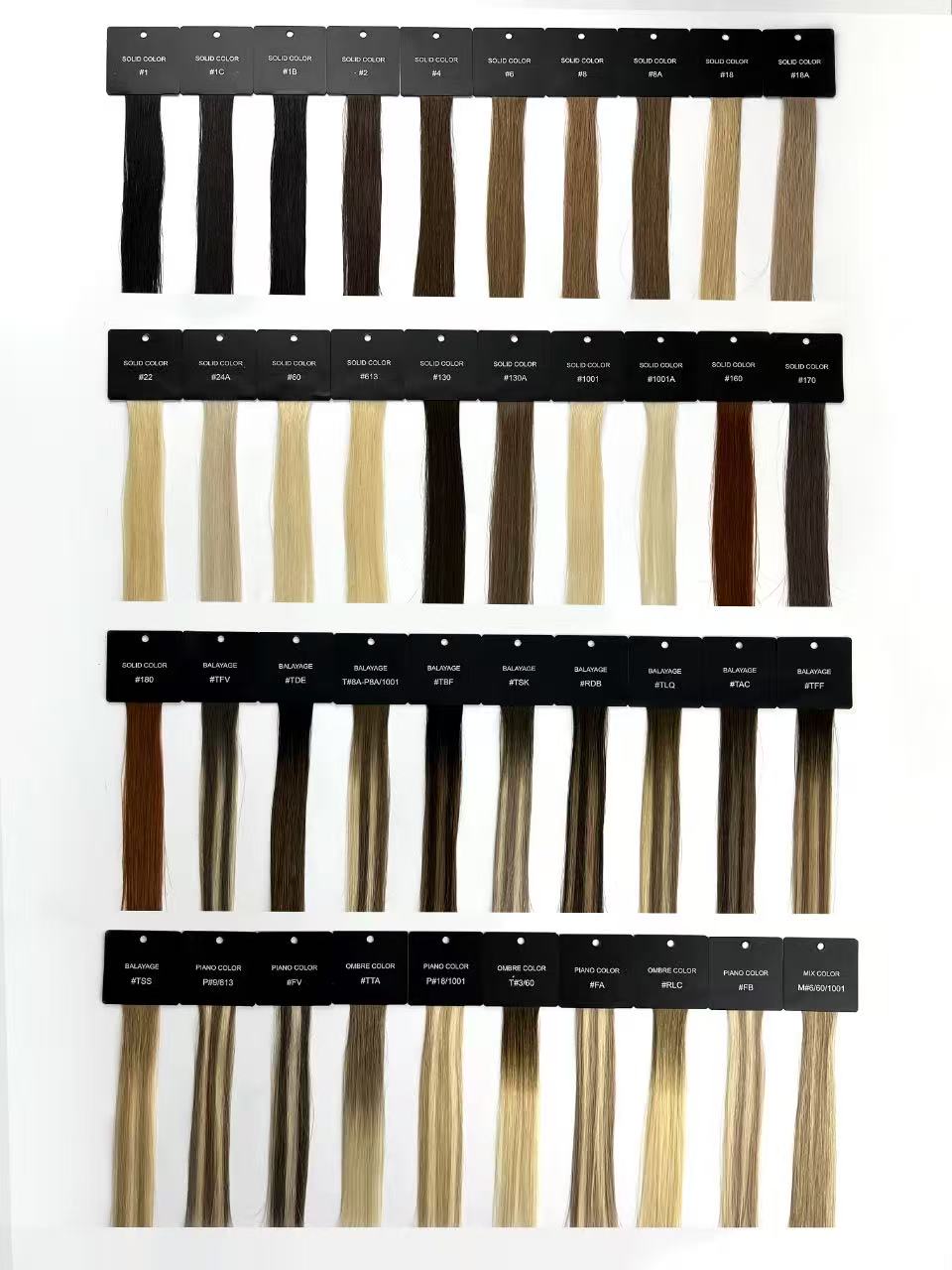
Colour matching is a repeatable step only if the supplier holds a stable stock range. The Genius weft colour ring supports the consultation before installation. Photo: Dolas Dream Crafts Co., Ltd.
Where the weft belongs in a thinning-hair case
Use a weft when the client still has a workable base of hair and the density loss runs through the mid-lengths and ends. The weft adds length, body, and colour-consistent density without covering the scalp, so it does not interfere with the natural growth pattern at the part line. It is also the more efficient format when a salon needs to build volume across the back and sides rather than in one concentrated zone, and the 18–24 inch range gives enough flexibility to match a client’s existing length without cutting away the value of the unit.
The Silk Base Topper as a Thinning-Hair Tool
A silk base human hair topper solves a different problem. The base is constructed to mimic scalp, so when the client’s own hair is integrated through and around it, the parting reads as scalp rather than as a covered area. Base construction matters more here than in almost any other hair product, because the base is what the client — and everyone standing in front of her — will actually see.

Silk base construction is the deciding specification for part-line coverage: the base mimics scalp and the client’s own hair is blended through it. Photo: Dolas Dream Crafts Co., Ltd.
Dolas Dream’s silk base human hair topper (product reference DLD 14 human hair topper) is specified as follows:
- Base: silk base, scalp mimic.
- Length: 14 inches, 16 inches, or customized.
- Weight: 50–80 g, or customized.
- Material: European hair, 100% cuticle-intact.
- Density: natural density.
- Stated durability: 1.5–2 years of use.
- Applicable use: beauty industry, hair salon, wholesale store.
Where the topper belongs in a thinning-hair case
Use a topper when thinning is concentrated at the crown, the part line, or the front hairline — the zones where a weft cannot help, because the problem is visible scalp rather than insufficient length. The 50–80 g weight range is the second reason toppers dominate this case type: for a client with fine, thinning hair, a lightweight base is easier to tolerate across a full day than any attachment method that adds volume at the root.
The Decision Rule: Coverage Zone First, Weight Second, Wear Pattern Third
Three questions resolve most thinning-hair consultations before a single product is taken out of the box.
- Where is the thinning visible? Crown and part line point to a silk base topper. Mid-lengths and ends with a stable base point to a Genius weft. When both are visible, the answer is a combined application, with the topper handling scalp coverage and the weft handling density through the lengths.
- How much weight will the client accept? Compare the topper’s 50–80 g range against the weft’s 50–100 g range, then scale the number of units to the client’s tolerance rather than to a standard panel size.
- How does the client actually wear her hair? A topper is judged at the part line and depends on the client’s own hair blending through it. A weft is judged at the attachment line and in movement. Neither product is the safe default — the wrong one is simply the one matched to the wrong zone.
Constraint check before ordering: confirm four items in writing — the material specification (cuticle-intact virgin remy human hair for the weft; European hair for the topper), the weight per unit, the length, and the certification documentation that applies to the specific product being installed. Those four items determine whether an application can be repeated across a client base, not just whether it looks right on the day of installation.
A Five-Step Salon Protocol
Step 1 — Map the thinning pattern
Assess the hair dry and under direct light, then classify the pattern as either concentrated or diffuse. Concentrated thinning sits in one visible zone: crown, part line, or front hairline. Diffuse thinning runs through the mid-lengths and ends while the base of the hair remains workable. This classification, not the client’s preferred length, is what determines the product category in step two.
Step 2 — Assign the coverage zone
Concentrated thinning maps to the silk base human hair topper, because the requirement is scalp coverage rather than length. Diffuse thinning with a stable base maps to the Genius weft hair extension, because the requirement is density and body through the lengths. If both zones are affected, plan a combined service: the topper covers the visible scalp area at 14 or 16 inches, and the weft adds density through the lengths at 18–24 inches so the two elements meet without a visible step.
Step 3 — Set the weight budget
Weight is the constraint that thinning-hair clients feel first. A silk base topper in the 50–80 g range and a Genius weft unit in the 50–100 g range both allow a tiered approach: start at the lower end of the range for a first-time client or a sensitive scalp, and increase only if the client reports that the result feels light after a full week of wear. Because both products are available in customized weight as well as standard weight, the weight budget can be set per client rather than per product line.
Step 4 — Verify material and compliance before the install
The Genius weft hair extension is certified under standard GB/T23168-2008, certificate number 201790812, issued by the National Hair Products and Hair Care Products Quality Supervision and Inspection Center. The certificate applies to the USA and EU markets and covers the scope of human hair weaving and hair extensions. It was issued on 12 January 2017 and is valid until 12 January 2037. Dolas Dream also runs 100% pre-shipment testing on orders, and the manufacturer holds a 1,500 m² facility in Qingdao with a stated export ratio of 90% to the USA and EU markets.
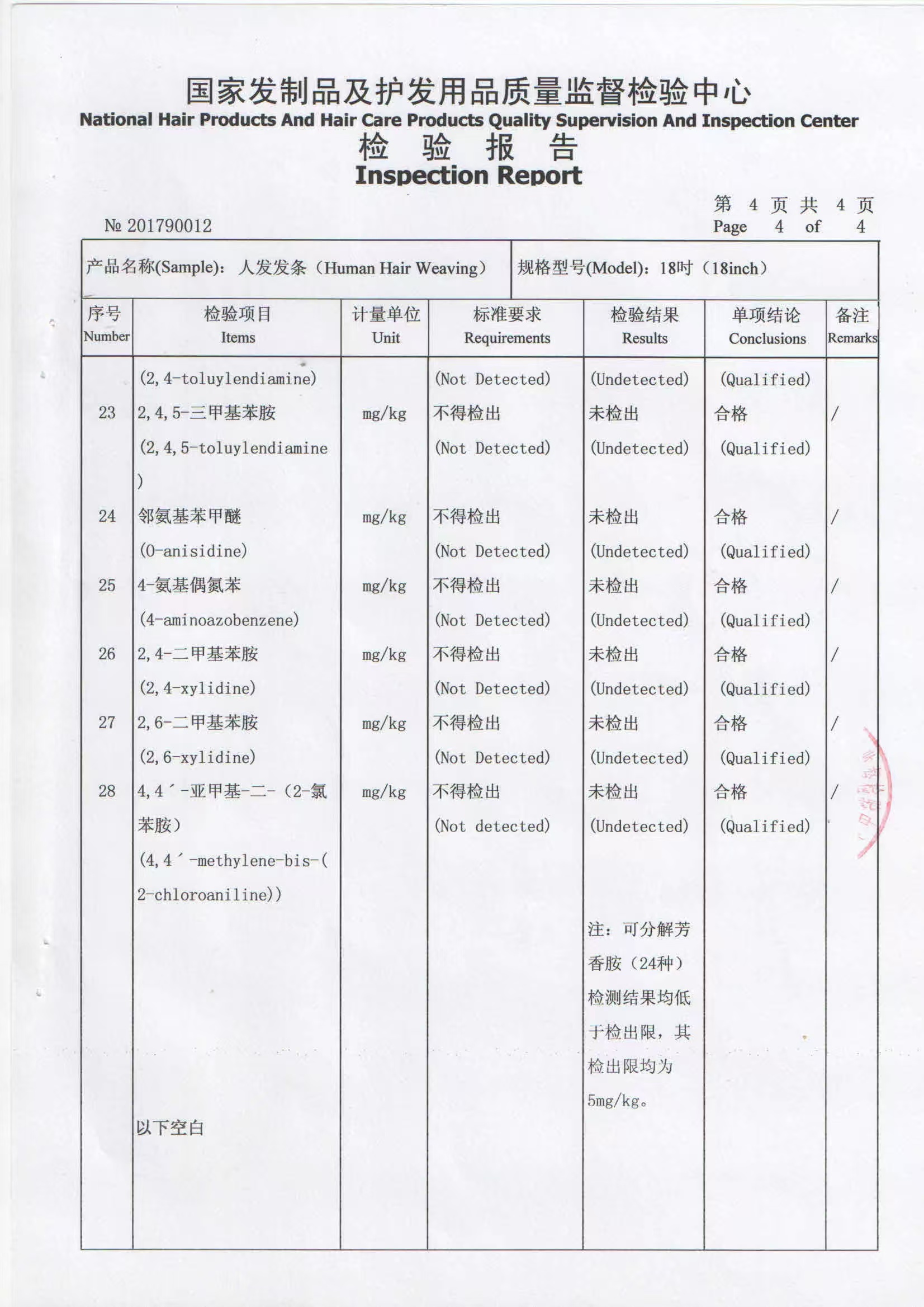
Certificate 201790812, issued by the National Hair Products and Hair Care Products Quality Supervision and Inspection Center under standard GB/T23168-2008, applies to the USA and EU markets. Image: Dolas Dream Crafts Co., Ltd.
Step 5 — Agree the maintenance and lifecycle plan
Both the Genius weft and the silk base topper are stated as lasting 1.5–2 years of use, and both require the same care a client would give her own hair. Dolas Dream also states a 2–3 year warranty on hair using time. Agreeing the care routine and the expected replacement window at the consultation stage is what turns a single installation into a predictable recurring service for the salon, and it is also what keeps a thinning-hair client from concluding that her hair “did not work” when the real issue was maintenance.
Application Scenarios from Real Salon Orders
Dolas Dream’s recorded salon case covers hair salon owners in the United States, Sweden, and Belgium who ordered 500 units over a two-year period. The stated application was solving clients’ thin hair and alopecia problems and helping them rebuild confidence. The reported result was that after installation the clients’ hair became fuller and more stable, and clients were visibly pleased with their new look. The material highlight recorded for the case is pure 100% virgin remy human hair with no synthetic fibre and unprocessed, cuticle-intact hair.

Salon application scenarios across the USA, Sweden, and Belgium: topper coverage for visible thinning, weft density through the lengths. Image: Dolas Dream Crafts Co., Ltd.
What this case demonstrates for a working stylist is less about the order volume and more about the pattern of use. Across three markets with different client expectations, the same two formats were used for the same client problem: scalp coverage where thinning was visible, and density where length had been lost. The two-year duration also matters, because it sits inside the stated 1.5–2 year durability window of both products — meaning the repeated order in this case is consistent with a normal replacement cycle rather than an abnormal failure rate.
Extending the Salon Menu: K Tip, Nano Ring, and Full-Coverage Options
Genius weft and silk base toppers answer most thinning-hair consultations, but two adjacent methods appear often enough in salon work that they are worth keeping on the menu. Both are supplied by Dolas Dream on the same ordering terms.
- K tip hair extensions (model references DLD-20 K tip and DLD-22 K tip): 20 inches, keratin heat bond method, 100 g or customized weight, balayage and custom-made colour, made from cuticle-intact virgin human hair.
- Nano ring hair extensions (model references Dolas dream DLD 20 Nano ring and DLD 22 Nano ring): 18–24 inches, 100 strands per pack, solid light and balayage colours, made from cuticle-intact raw hair.
For clients whose thinning has progressed to full coverage, the silk top Jewish wig for white women (model DLD Kosher wig16) is built on a silk base or a customized base, at 14 or 16 inches or customized, 80–150 g customized weight, in European virgin hair, and is listed for beauty industry, hair loss, medical, and hair salon use. Kosher wig orders sit in a separate commercial category: one commercial sourcing guide estimates that rabbinical supervision adds roughly USD 15–30 per unit to factory gate prices, which is an estimate to be treated as a planning figure rather than a quotation.
Side-by-Side Comparison: Genius Weft vs Silk Base Topper
| Decision factor | Genius weft hair extension | Silk base human hair topper |
|---|---|---|
| Material | 100% virgin remy human hair, cuticle-intact | European hair, 100% cuticle-intact |
| Length options | 18–24 inches | 14 inches, 16 inches, or customized |
| Weight per unit | 50–100 g, or customized | 50–80 g, or customized |
| Construction | Machine-tied salon professional weft; cuttable without unravelling and no return hair; Dolas Dream states an ultra-thin polymer-coated substrate and a cuticle-aligned locking process | Silk base built to mimic scalp, with natural density |
| Coverage zone | Mid-lengths and ends; adds length, body, and density | Crown, part line, and front hairline; provides scalp coverage |
| Colour | Customized; extensive stock colour range | Original created shade; extensive colour range |
| Stated durability | 1.5–2 years of use | 1.5–2 years of use |
| Compliance | Certified under GB/T23168-2008, certificate 201790812, National Hair Products and Hair Care Products Quality Supervision and Inspection Center; applicable to USA and EU markets | Covered by 100% pre-shipment testing; confirm the applicable document listing for the specific topper order |
| Best client fit | Stable base with diffuse density loss through lengths and ends | Concentrated thinning at crown or part line, including alopecia, where low weight is required |
| Ordering terms | Dolas Dream: MOQ 2 units; stock hair lead time 2–3 days; customized hair lead time 7–15 days; customization on colour, length, and logo; monthly capacity 12,000 units | |
Frequently Asked Questions
1. Is the Genius weft hair extension certified for salon use in the USA and EU?
Yes. The Genius weft hair extension (product reference 5124) is certified under standard GB/T23168-2008, certificate number 201790812, issued by the National Hair Products and Hair Care Products Quality Supervision and Inspection Center. The certificate applies to the USA and EU markets and covers the scope of human hair weaving and hair extensions. It was issued on 12 January 2017 and is valid until 12 January 2037. For topper, K tip, nano ring, or wig orders, confirm in writing which document lists the specific product being installed before placing a repeat order.
2. What lengths, weights, and customization options can a salon order for thinning-hair clients?
The Genius weft hair extension is available at 18–24 inches and 50–100 g per unit. The silk base human hair topper is available at 14 or 16 inches and 50–80 g, on a silk base built to mimic scalp. K tip hair extensions are supplied at 20 inches and 100 g on a keratin heat bond, and nano ring hair extensions at 18–24 inches with 100 strands per pack. Dolas Dream operates OEM, ODM, and customized production with customization on colour, length, and logo, a monthly capacity of 12,000 units, and a 15-engineer R&D team inside a 1,500 m² facility.
3. How should a salon budget between a weft and a topper?
The main cost drivers are hair weight per unit and whether the order is drawn from stock or produced to specification. A silk base topper runs 50–80 g and a Genius weft unit runs 50–100 g, so the weight chosen for a specific client drives the cost of that service more than the product category does. Stock hair ships in 2–3 days at a lower planning risk, while customized colour, length, or logo adds 7–15 days to the lead time. A minimum order quantity of 2 units keeps the cost of a first trial low. For adjacent kosher wig orders, one commercial sourcing guide estimates rabbinical supervision adds roughly USD 15–30 per unit to factory gate prices; treat that as an estimate, not a quote.
4. Can I validate a weft or a topper with a sample before committing to a salon-wide rollout?
Yes. Dolas Dream’s minimum order quantity is 2 units, and every order passes 100% pre-shipment testing before dispatch. A practical validation sequence for a salon is to order one topper at 14 or 16 inches and one Genius weft unit at the length that matches your most common client, install each on a real thinning-hair client, and then evaluate the weight tolerance, the scalp read at the part line, and the colour match under salon lighting. If you want the full product picture first, the Dolas Dream initial catalogue sets out the range, and sample and quotation requests can be sent directly to the manufacturer.
5. What lead times and supply capacity should a salon plan around?
Dolas Dream states a lead time of 2–3 days for inventory hair and 7–15 days for customized hair, with a monthly capacity of 12,000 units and an annual output of 115,000 units. The company was established in 2015, operates from a 1,500 m² factory in Qingdao with 50 employees, and exports 90% of production to the USA and EU markets. For planning purposes, a recorded salon case covering the United States, Sweden, and Belgium involved 500 units delivered over two years, which is consistent with a normal replacement cycle given the stated 1.5–2 year durability of both the Genius weft and the silk base topper. To move from planning to a first order, request a sample or quotation with your target lengths and weight per unit.
Conclusion: Match the Geometry, Not the Trend
For clients with thinning hair or alopecia, the Genius weft and the silk base human hair topper are not competing products. They solve two different geometry problems. The silk base topper covers visible scalp at 50–80 g on a base built to mimic scalp, which is what a widening part line and a thinning crown actually require. The Genius weft adds cuticle-intact virgin remy density through 18–24 inches of mid-lengths and ends at 50–100 g, which is what diffuse density loss actually requires. When both problems appear in the same consultation, the two formats are used together rather than chosen between.
The constraints are what make the decision safe to repeat: verified material, documented weight and length ranges, a certificate covering the Genius weft under GB/T23168-2008 for the USA and EU markets, 100% pre-shipment testing, and a stated 1.5–2 year durability window that matches the two-year salon case recorded across the United States, Sweden, and Belgium. Stylists who build the consultation around coverage zone and weight budget — and who verify the specification before the install rather than after — are the ones whose thinning-hair clients come back.

Customized production covers colour, length, and logo, with a minimum order quantity of 2 units. Photo: Dolas Dream Crafts Co., Ltd.
Next step for salon owners: request a Genius weft and silk base topper sample pack with your target lengths, weight per unit, and colour direction. Dolas Dream Crafts Co., Ltd. — established 2015, Qingdao, China; 1,500 m² facility; 90% export to the USA and EU.
Email: admin@dolasbeauty.com | WhatsApp: +8618863251821 | Website: www.dolascrafts.com
Download the full range: Dolas Dream Initial Catalogue (PDF)
Have Questions or Need More Details?
Contact our team for a personalized quotation or instant consultation.
Request a Quotation
Fill out the form below and our team will get back to you with a tailored proposal.
WhatsApp Direct Chat
Prefer to chat in real-time? Message us on WhatsApp for instant assistance & quick answers.
- Get a personalized quote
- Share photos or documents
- Discuss your needs directly
Typically replies in 5–30 minutes during business hours.