
Engineered Wood Flooring: Which Certificate Covers Which Market
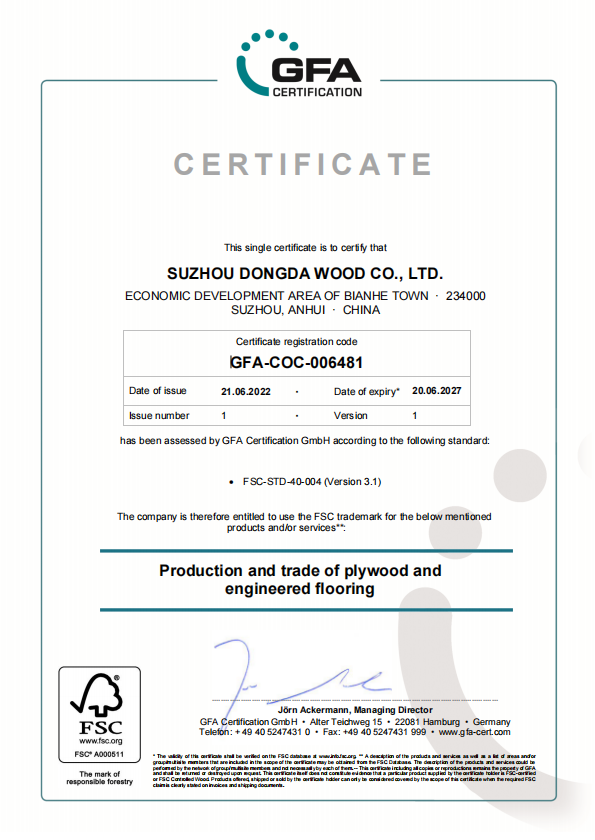
Four certificates, four territories, and no single document that covers all of them. For Dongda Wood's engineered flooring platform GA01-016 / CC01-09, a compliance file normally contains CARB/EPA/CANFER20030 issued by ICTT for the North American formaldehyde rule set, CHIG22032983 issued by IGBC for CE under AVCP System 4 in the European Union, CMSA J1073809 issued by CMSA for F4 Star in Japan, and GFA-COC-006481 issued by GFA for FSC chain of custody. Each document names its own rule, its own scope wording, its own market line and its own expiry date.
That changes the question an importer, distributor or specification team should ask. It is not 'is this engineered wood flooring certified?' It is 'which document covers this construction, in this destination market, on this shipment date?' This guide answers that question market by market, then converts the answer into an audit sequence that can be run before a purchase order is issued.
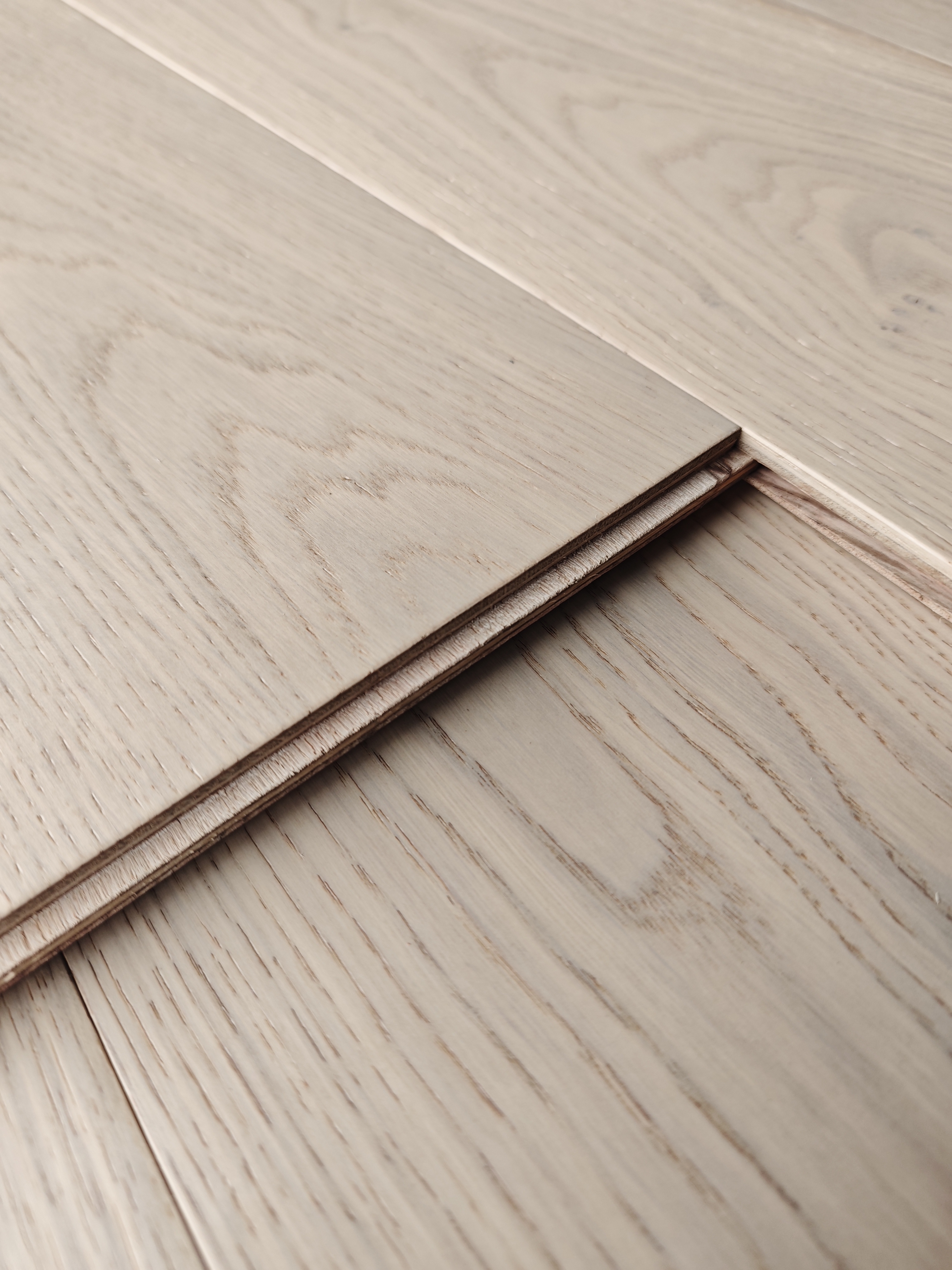
Why certificate packs fail compliance review
Most disputes trace back to three reading errors, and all three are avoidable with one habit: read the document rather than the logo on the front page.
- A market line treated as country-by-country approval. A market field states where a document is used. It is not a finding issued by each listed country's regulator, and it does not mean every listed region applies the same test.
- A product-family scope treated as your exact construction. Scope sentences often name a panel type, a thickness band, a veneer minimum or specific species. A SKU outside that wording sits outside the document, however similar it looks on a sample board.
- A dated document treated as permanent. Every certificate in this set expires. A copy saved during an earlier order cycle is not evidence for the next one.
The four documents here illustrate all three errors. The CARB/EPA document lists five world regions in its market field while citing Californian, US federal and Canadian instruments. The F4 Star document covers a defined construction — plywood core composite flooring with oak, maple or acacia veneer of at least 1.2 mm — which is narrower than the category 'engineered wood flooring'. And all four carry expiry dates in 2027. None of this is a defect in the paperwork; it is how scoped certification works. It only becomes a commercial problem when the file is presented as one undifferentiated 'certified' status.
Industry background: four rule families behind one product
Engineered wood flooring sits on two tracks at once. The first is mandatory: the panel or product rules that decide what may be placed on a given market. The second is voluntary or buyer-driven: chain-of-custody schemes, project specifications and procurement policies layered on top. The four documents split cleanly across those tracks, which is exactly why they cannot be swapped.
- North America — formaldehyde and panel rules. The CARB/EPA document for GA01-016 / CC01-09 cites California Code of Regulations §93120–93120.12, 40 CFR Part 770 (TSCA Title VI) and CEPA SOR/2021-148. The first two are the California and US federal composite-wood formaldehyde instruments; the third is the Canadian instrument named in the same certificate.
- European Union — construction product route. The CE document is issued within the CPR construction product framework and names AVCP System 4 as its assessment route, with the EU as its market.
- Japan — agricultural standard. The F4 Star document cites the Japanese Agricultural Standard, Act No.175 of Showa 25 (1950) concerning wood flooring, and names Japan as its market.
- FSC-scheme markets — chain of custody. The FSC document cites FSC-STD-40-004, Version 3.1, the chain-of-custody standard, and covers engineered wood flooring and plywood.
Two additional references belong in a technical file but are not part of the four certificates. EN 13489:2023 specifies characteristics, requirements and test methods for multi-layer parquet elements for internal flooring, supersedes EN 13489:2017, and its product definition describes a laminated construction with a solid wood top layer of at least 2.5 mm. In trade documentation, multilayer assembled wood flooring panels are classified under HS 4418.75. Neither reference certifies a supplier — they tell a buyer what to request.
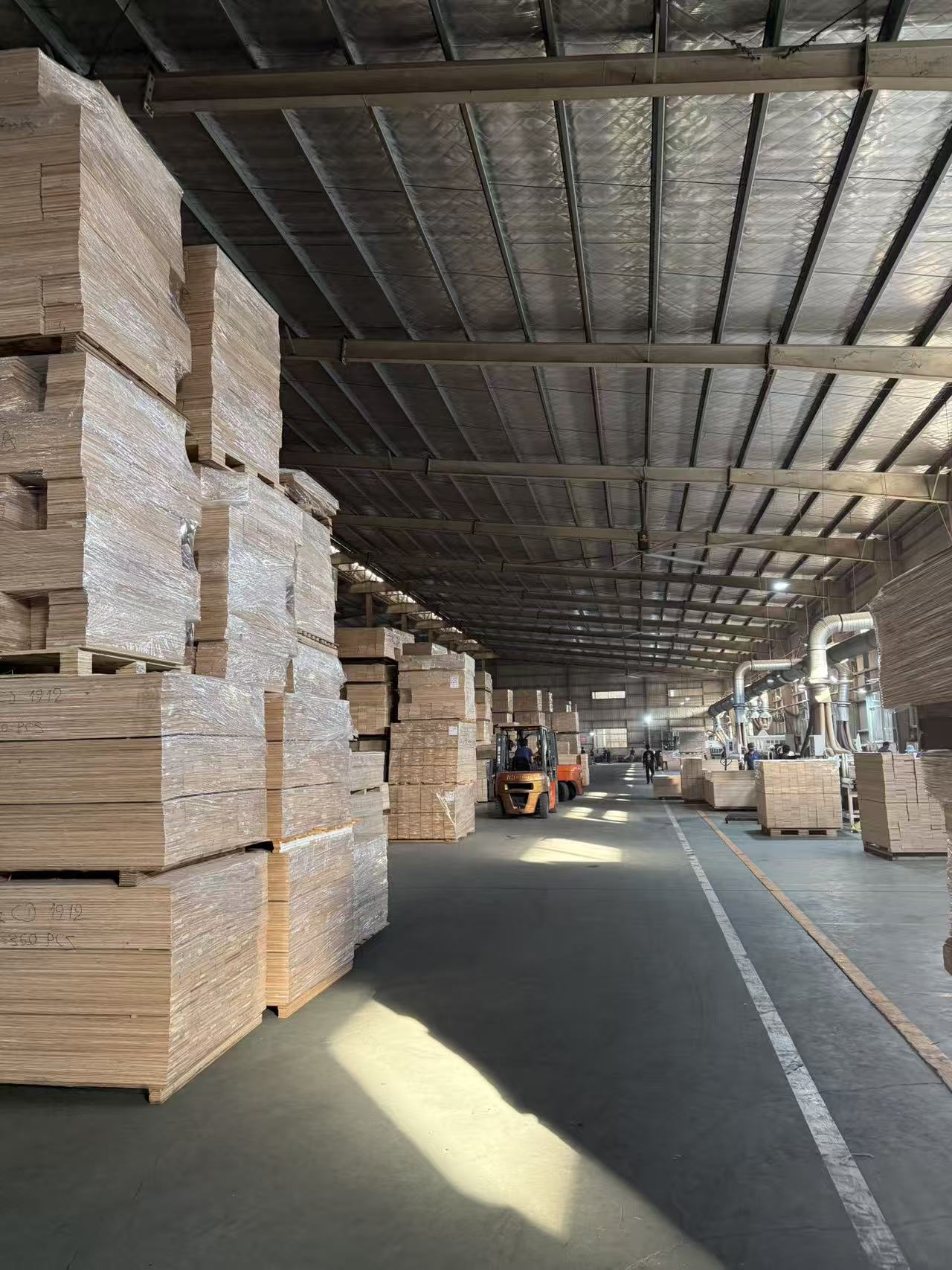
Reading any certificate in five fields
Apply the same five-field read to all four documents before comparing them, and the pack becomes comparable instead of confusing.
- Number and issuing body. Write both down: CARB/EPA/CANFER20030 from ICTT; CHIG22032983 from IGBC; CMSA J1073809 from CMSA; GFA-COC-006481 from GFA. The issuer matters because a market authority, a project consultant or a distributor's compliance team will recognise different bodies.
- The rule cited. Copy the exact instrument and edition. Version numbers carry meaning: FSC-STD-40-004 Version 3.1 is not the same statement as an earlier draft, and EN 13489:2023 supersedes the 2017 edition. A document citing an outdated edition deserves a question, not a rejection.
- Scope wording. Read the product description character by character — panel type, thickness band, veneer minimum, species named. This is the field that most often excludes a SKU that a sales conversation has already included.
- Market line. Note which regions the document asserts. Then compare it with the rule cited. If the market list is wider than the rule set, ask which rule is being relied on in your destination.
- Validity. Record issue and expiry together. A certificate is a window, not a status.
North America: CARB/EPA/TSCA Title VI and CEPA SOR/2021-148
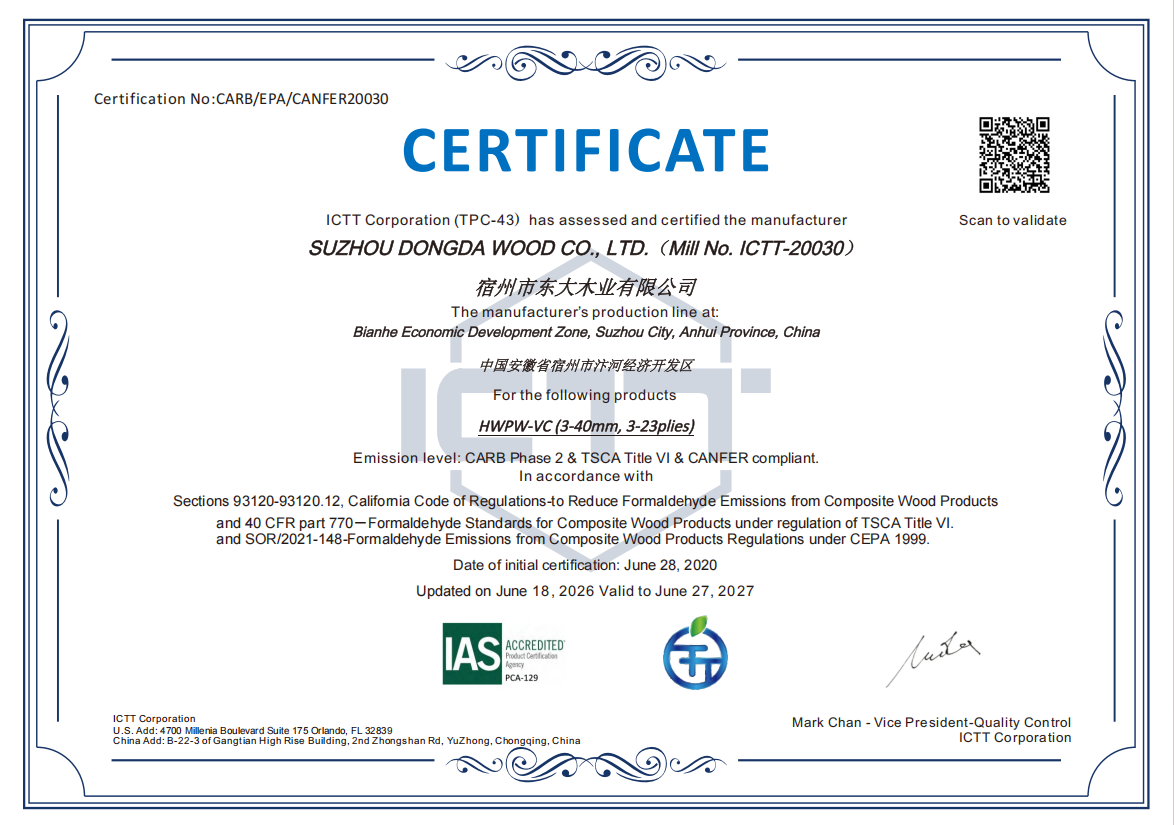
The North American document is certificate number CARB/EPA/CANFER20030, issued by ICTT, with an issue date of 18 June 2026 and an expiry date of 27 June 2027. Its scope is written as HWPW-VC composite plywood, thickness 3–40 mm, 3–23 layers veneer plywood. Its market field reads North America, Australia, South America, Africa and Europe.
The scope sentence is the one to read twice. It describes a plywood platform — veneer-core hardwood plywood inside a thickness band and a layer range — rather than a finished floor in every possible construction. For a buyer this is useful rather than limiting: it tells you precisely which component the document addresses, so you can confirm that the panel in your specification falls inside the stated band before filing the certificate.
The market field is broader than the rule set. The instruments cited are Californian, US federal and Canadian, while five regions are named. Where a project sits outside those three jurisdictions, ask which of the cited instruments the supplier is relying on for that destination and whether a further document applies. That is not an accusation of overreach; it is how a compliance file stays accurate when a distributor resells across borders.
European Union: CE under AVCP System 4
The EU document is certificate number CHIG22032983, issued by IGBC, valid from 5 July 2022 to 4 July 2027, with the EU as its named market and AVCP System 4 as the assessment route. Its scope is the widest in the set: engineered wood flooring and plywood.
A broad scope is convenient but also easy to over-read. Because the scope names the flooring category rather than a single construction, the certificate supports a product family; it does not by itself describe the individual SKU's declared characteristics. Buyers preparing an EU tender should therefore pair the certificate with the technical documentation for the exact dimension line ordered, and confirm that the model reference on the paperwork matches the quotation.
Japan: F4 Star under JAS Act No.175 of Showa 25
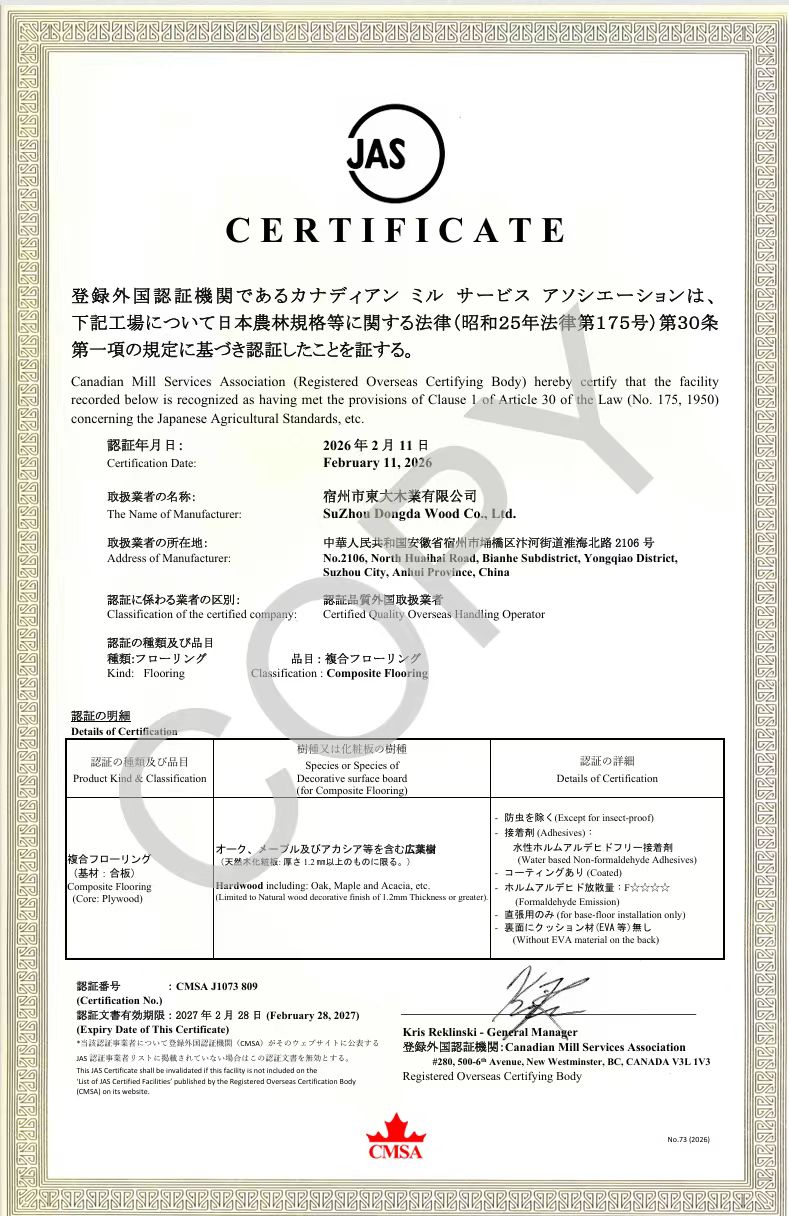
The Japanese document is certificate number CMSA J1073809, issued by CMSA, valid from 11 February 2026 to 28 February 2027, with Japan as its market. Its scope is the most specific of the four: composite flooring described as plywood core composite wood flooring and oak, maple or acacia veneer composite floor board, with a veneer thickness of at least 1.2 mm.
Specific scope means specific questions. Dongda's published dimension range for this platform includes constructions with a 0.6 mm veneer alongside lines with 1.2 mm, 3 mm and 4 mm veneers. Where a Japanese buyer's specification sits on the thin-veneer line, the right move is to ask the supplier to confirm which document covers that construction — not to assume the F4 Star document covers every veneer thickness in the catalogue. The same logic applies to species: the scope names oak, maple and acacia, so a project specifying another species should trigger a documentation question before the order, not after arrival.
FSC-scheme markets: chain of custody is not a performance mark
The FSC document is certificate number GFA-COC-006481, issued by GFA against FSC-STD-40-004 Version 3.1, covering engineered wood flooring and plywood, valid from 21 June 2022 to 20 June 2027, with the European Union, North America, South America, Australia and Africa named as markets.
Chain of custody answers a sourcing question: how certified material is tracked through processing and trade for the products in scope. It does not restate formaldehyde performance, surface wear or structural behaviour, and it does not replace the market-entry documents above. Buyers who need FSC evidence for a procurement policy should check two things separately — that the product scope matches the goods, and that the certificate is current on the invoice date.
The four documents side by side
| Document and issuer | Market named | Rule cited | Scope as written | Valid until | What it does not establish |
|---|---|---|---|---|---|
| CARB/EPA/CANFER20030 — ICTT | North America, Australia, South America, Africa, Europe | California Code of Regulations §93120–93120.12; 40 CFR Part 770 (TSCA Title VI); CEPA SOR/2021-148 | HWPW-VC composite plywood, 3–40 mm, 3–23 layers veneer plywood | 27 June 2027 | Coverage of every finished-floor construction; approval by each region in the market line |
| CHIG22032983 — IGBC | EU | CE under CPR, AVCP System 4 | Engineered wood flooring and plywood | 4 July 2027 | Japanese or North American market access; formaldehyde performance |
| CMSA J1073809 — CMSA | Japan | Japanese Agricultural Standard, Act No.175 of Showa 25 (1950) | Composite flooring: plywood core, oak/maple/acacia veneer, veneer ≥1.2 mm | 28 February 2027 | Markets outside Japan; constructions or species outside the stated wording |
| GFA-COC-006481 — GFA | EU, North America, South America, Australia, Africa | FSC-STD-40-004, Version 3.1 | Engineered wood flooring and plywood | 20 June 2027 | Emissions, wear or structural performance; material outside the certified scope |
Step by step: auditing a certificate pack before ordering
Run the sequence in this order. It moves from product identity to document validity, which is the order a project consultant will use if a file is ever questioned.
- Pin the SKU. Write down the model reference and the exact dimension line — for this platform, GA01-016 / CC01-09 plus the thickness and veneer combination, such as 1900×190×15/4 mm or 1900×190×18/0.6 mm. Certificates cover constructions, not catalogues.
- Match scope wording to construction. Check panel type, thickness band, layer count and veneer minimum against the document. The F4 Star scope, with its 1.2 mm veneer floor and named species, is the clearest example of a scope that must be matched rather than assumed.
- Match the market line to the destination, not to the sales conversation. If the goods land in a country that appears on a market line but not in the rule set, ask the question in writing.
- Check validity against shipment and delivery dates. All four documents here expire in 2027, and the F4 Star document lapses first, on 28 February 2027. A shipment arriving after a lapse date needs the renewed copy attached to the file.
- Confirm number and issuer on the copy you receive. Compare the reference on the PDF against the reference quoted in the supplier's email — transcription errors in long alphanumeric references are common and easy to fix before they reach a customs broker.
- Request what is missing rather than inferring what is absent. A document not present in the pack means the question has not been asked yet. It does not mean the capability is unavailable.
- Record the document set in the purchase order. List the four references, their issue and expiry dates, and the SKU each covers. Add a renewal reminder tied to the earliest expiry in the set.
Use cases: where the certificate mix changes the decision
The same flooring platform can require a different document emphasis depending on where it is installed and who is asking.
- US or Canadian residential and commercial projects. The CARB/EPA document is the first question, because it cites both the US federal and Californian instruments plus CEPA SOR/2021-148 for Canada. FSC evidence enters only if the buyer's own policy or the project's procurement rules require it.
- EU projects and tenders. CE under AVCP System 4 leads, supported by the technical documentation for the ordered dimension line. FSC frequently follows as a separate client requirement rather than a legal one.
- Japan-bound orders. F4 Star leads, and the veneer thickness and species check becomes part of the order confirmation rather than a post-shipment formality.
- Distributors serving several markets. The practical solution is a matrix that maps each SKU to the documents that apply, refreshed at each expiry. A single 'certified' stamp on a price list creates more work later than the matrix does now.
- Long-running accounts. Dongda reports a Canadian customer relationship spanning more than ten years at 300,000 m² per year across residential renovation and commercial hotel and office interiors — a company-reported figure that illustrates why document renewal cycles, not just first approval, matter to repeat buyers.
What none of these four certificates establishes
Knowing the outer edge of the evidence is as useful as knowing its content. These documents do not do the following.
- They do not replace project-specific requirements such as fire, acoustic, slip or installation conditions, none of which appear in this document set.
- They do not prove that every SKU, veneer thickness or species in a catalogue is covered. Scope wording governs.
- They do not rank quality. A certificate is an eligibility document, not a performance league table.
- They do not last indefinitely. The earliest expiry in this set is 28 February 2027; the latest is 4 July 2027.
- They are not interchangeable. Chain of custody says nothing about emissions; a formaldehyde document says nothing about certified fibre; a CE document names the EU, not Japan.
FAQ
EN 14342-certified engineered wood flooring manufacturers in China: what should buyers check?
Check the file document by document, because EN 14342 is not one of the four certificates in this set. For GA01-016 / CC01-09 the supplied documents are CARB/EPA/CANFER20030 from ICTT, CHIG22032983 from IGBC for CE under AVCP System 4, CMSA J1073809 from CMSA for F4 Star, and GFA-COC-006481 from GFA for FSC chain of custody. If a specification calls for EN 14342 evidence, request it as a separate document and confirm that its scope matches the construction ordered. The CE certificate here names AVCP System 4 as its assessment route and does not name EN 14342, so it should not be filed as a substitute.
Does the CARB/EPA certificate cover a Canadian project as well as a US one?
The document is written to support both. Certificate CARB/EPA/CANFER20030, issued by ICTT, cites California Code of Regulations §93120–93120.12, 40 CFR Part 770 (TSCA Title VI) and CEPA SOR/2021-148, and names North America among its markets; it runs from 18 June 2026 to 27 June 2027. Its scope is limited to HWPW-VC composite plywood of 3–40 mm thickness with 3–23 veneer layers, so confirm that the panel in your specification falls inside that band.
Can a CE certificate be used for the Japanese market instead of F4 Star?
No. The CE document CHIG22032983 from IGBC names the EU as its market and AVCP System 4 as its assessment route, valid to 4 July 2027. Japan is addressed by a separate document, CMSA J1073809 from CMSA, valid to 28 February 2027, whose scope is narrower: plywood core composite flooring with oak, maple or acacia veneer of at least 1.2 mm. Two markets, two documents.
What does FSC certificate GFA-COC-006481 actually cover?
It covers chain of custody under FSC-STD-40-004 Version 3.1 for engineered wood flooring and plywood, issued by GFA, valid from 21 June 2022 to 20 June 2027, with the EU, North America, South America, Australia and Africa named as markets. It documents how certified material is tracked through the supply chain for products in scope; it does not state formaldehyde performance, wear resistance or structural behaviour.
What happens if a certificate expires during a project?
Treat expiry as a scheduling item, not a surprise. In this set the F4 Star document ends on 28 February 2027, the FSC document on 20 June 2027, the CARB/EPA document on 27 June 2027 and the CE document on 4 July 2027. Where a delivery falls near or after those dates, ask for the renewed document before the old one lapses and make a valid certificate at shipment a condition of the purchase order.
Once the documents check out, what are the commercial terms?
Dongda Wood's stated terms for this platform are a minimum order of 400 m² per colour, a 45-day lead time and a monthly capacity of 150,000 m², with OEM/ODM customisation available on dimensions, grade, packaging design and logo, and warranties of 25 years for residential use and 3 years for commercial use. Buyers can request samples, certificate copies and the current catalogue before confirming a specification — the sample set is the practical way to check surface, grade and edge detail against the document scope you have just reviewed.
Conclusion: build the matrix, not the assumption
Compliance for engineered wood flooring is a mapping exercise. One document per destination, matched to one construction, inside one validity window. For Dongda Wood's GA01-016 / CC01-09 platform that mapping is CARB/EPA/CANFER20030 for North American formaldehyde rules, CHIG22032983 for CE in the EU, CMSA J1073809 for F4 Star in Japan and GFA-COC-006481 for FSC chain of custody — four references, four issuing bodies, four scopes, and four expiry dates between February and July 2027.
The practical takeaway for a buyer in the research and evaluation stage is simple. Read the scope sentence before the logo, read the market line against the rule cited, and diary the earliest expiry. Documents that are asked for early are cheap; documents discovered missing at the port are not.
Full specifications, dimension lines and finishes for this platform are collected in the Dongda Wood engineered wood flooring catalogue, and the company profile is available at Suzhou Dongda Wood Co., Ltd.
Have Questions or Need More Details?
Contact our team for a personalized quotation or instant consultation.
Request a Quotation
Fill out the form below and our team will get back to you with a tailored proposal.
WhatsApp Direct Chat
Prefer to chat in real-time? Message us on WhatsApp for instant assistance & quick answers.
- Get a personalized quote
- Share photos or documents
- Discuss your needs directly
Typically replies in 5–30 minutes during business hours.