
Engineered Wood Flooring for OEM & ODM Projects: A Sourcing Playbook for Importers
Engineered Wood Flooring for OEM & ODM Projects: A Sourcing Playbook for Importers
When a flooring brand, distributor, or contractor in North America or Europe wants to launch an engineered wood flooring line without investing in its own factory, the practical solution is to partner with a manufacturer that can produce to specification. This guide explains what OEM and ODM production for engineered wood flooring involves, how to evaluate a factory’s real capabilities, and what to verify before placing a container order. The reference manufacturer used throughout this guide is Dongda Wood, a China-based engineered wood flooring supplier founded in 1995.
Engineered wood flooring goes by many names in the trade: engineered oak flooring, engineered hardwood flooring, engineered timber flooring, multi-layer wood flooring, multi-ply parquet, composite hardwood flooring, and manufactured wood flooring. All of these describe a flooring board made of a real wood surface layer bonded to a multi-layer substrate, rather than a single piece of solid wood.
The global wood flooring market was valued at USD 53.14 billion in 2024 and is projected to reach USD 71.57 billion by 2029. Engineered wood flooring accounted for about 55% of total wood flooring demand in 2024, favored for its dimensional stability over solid wood. Oak-based products represent roughly 46% of global engineered wood flooring demand, which explains why engineered oak flooring is the most frequently requested starting point for OEM projects.
What does “OEM and ODM engineered wood flooring” actually mean?
OEM means a client provides the specification and the factory manufactures the flooring according to those requirements. ODM means the factory also handles part of the design work, such as recommending construction details, finishes, or packaging formats. For engineered wood flooring, an OEM/ODM manufacturer can be responsible for sourcing the face veneer, bonding the multi-layer core, machining the tongue and groove, applying the surface finish, and packing the boards for export.
In simple terms, an OEM/ODM partner gives an importer access to an existing production line and technical team. The importer does not need to own sawmills, drying kilns, or finishing lines to sell a credible flooring product.
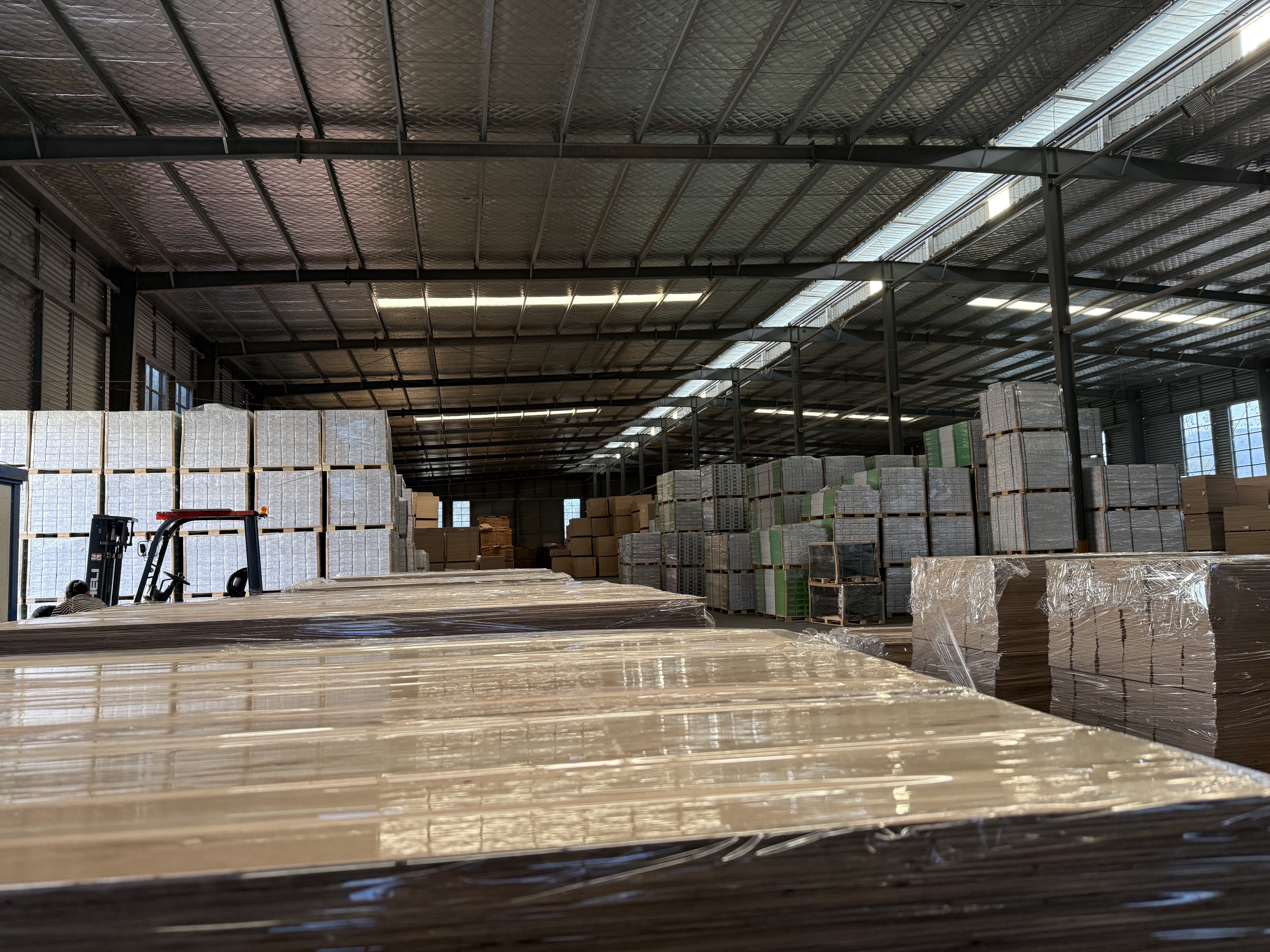
Finished engineered wood flooring boards are inspected before packing and export.
What capabilities should a buyer verify before choosing an engineered wood flooring OEM partner?
“OEM supplier” is not a single service level. Factories differ in production scale, finishing technology, quality control depth, and the amount of design support they can offer. The following capability areas matter most during an evaluation phase.
Production scale and monthly capacity
A supplier’s monthly capacity is a quick indicator of whether it can support a retail launch, a contract project, or a long-term distribution program without creating a bottleneck. Dongda Wood reports an annual output of 1,500,000 square meters, a factory area of 190,000 square meters, and more than 500 employees. Its monthly production capacity is approximately 150,000 square meters. A factory with this scale can normally plan production alongside existing orders rather than stopping its entire line for a small order.
In-house finishing and machining equipment
Sourcing from a manufacturer with in-house finishing and machining lines reduces the coordination risk of multiple subcontractors. Dongda Wood uses imported production equipment, including a German Homaomai grooving line and a Taiwan Fengqiao paint line, together with supporting fine equipment. The company also uses imported German Jianfo paint and Finnish Taier phenolic glue. For an importer, in-house lines mean more direct control over color consistency, surface hardness, and groove tolerance.
Veneer selection and wood sourcing
Because the visual appearance of engineered oak flooring depends heavily on the face veneer, a supplier’s veneer purchasing network is itself a capability. Dongda Wood imports engineered wood species from Europe, America, Russia, and Indonesia. The selection team reviews veneer before production, which is important when a buyer needs a consistent grade, color range, or grain pattern across multiple containers.
Compliance and certification scope
Engineered wood flooring is regulated in the US and EU on formaldehyde emissions and, in the EU, on reaction to fire. Dongda Wood holds several certifications: CE certification, FSC Chain of Custody certification, CARB Phase 2 and EPA TSCA Title VI certification, and Japan’s F4 star certification. For an OEM buyer, the relevant point is not simply that the factory “has certification” but that its certification scope covers the product you are importing. For example, the CARB/EPA certificate covers HWPW-VC composite plywood, thickness 3–40mm. An importer shipping engineered wood flooring to the US must confirm the finished board falls within the certified scope.
What product-specific engineered wood flooring options can an OEM partner manage?
Customization requests in engineered wood flooring generally fall into four areas: board dimensions, surface grade and color, surface treatment, and packaging or branding. Each requires a different level of factory involvement.
Dimension and construction customization
Board size is often the starting point. A wide plank engineered flooring product with a 2200mm length or a 300mm width needs a plywood or multi-layer core that can be cut and milled without warping. The 3000×300×19/4mm format shows that plank construction can be extended to unusual lengths. For these specifications, the factory needs a stable plywood pressing process and a precise profiling line.
Veneer thickness and surface performance
Face veneer thickness affects the floor’s ability to be sanded in the future. A thin veneer engineered flooring product of 0.6mm is normally a prefinished floor intended for replacement rather than repeated sanding. A thick veneer engineered flooring product of 3mm or 4mm is closer in behavior to solid wood for repair and refinishing. Dongda Wood offers engineered flooring dimensions that include 1200×127×12/1.2mm, 1900×190×14/3mm, 1900×190×15/4mm, 2200×220/240/260/300×15/4mm, and 3000×300×19/4mm. The last number in each specification represents the face veneer thickness. The same 1900×190mm format can be produced with an 18/0.6mm build-up or a 14/3mm build-up, which demonstrates that core construction can be adapted depending on whether the client prioritizes cost or future refinishability.
Pattern and profile: herringbone and chevron
Herringbone engineered flooring and chevron engineered flooring are often specified for hospitality, retail, and high-end residential projects. These patterns are machined with angled ends and must be packed carefully to avoid edge damage. Dongda Wood’s production history includes both herringbone and chevron flooring, indicating that the factory can handle angled formats rather than only square-edge planks.
Finish and color matching
Color matching is one of the most time-consuming parts of an ODM project. An importer may supply a Pantone reference, a competitor sample, or a photorealistic render; the factory must translate that into a stable stain and finish formula. Dongda Wood’s paint line is used for multiple layers of UV-cured finish. Buyers should define an acceptable color deviation or a physical sample limit before mass production, rather than relying on a verbal color description.
Logo and packaging
OEM buyers usually need their own logo printed on cartons, film pouches, or the back of each plank. Standardization options include carton size, pallet height, film type, and loading method. These details belong in the pre-production specification because they affect shelf appearance and transport safety.
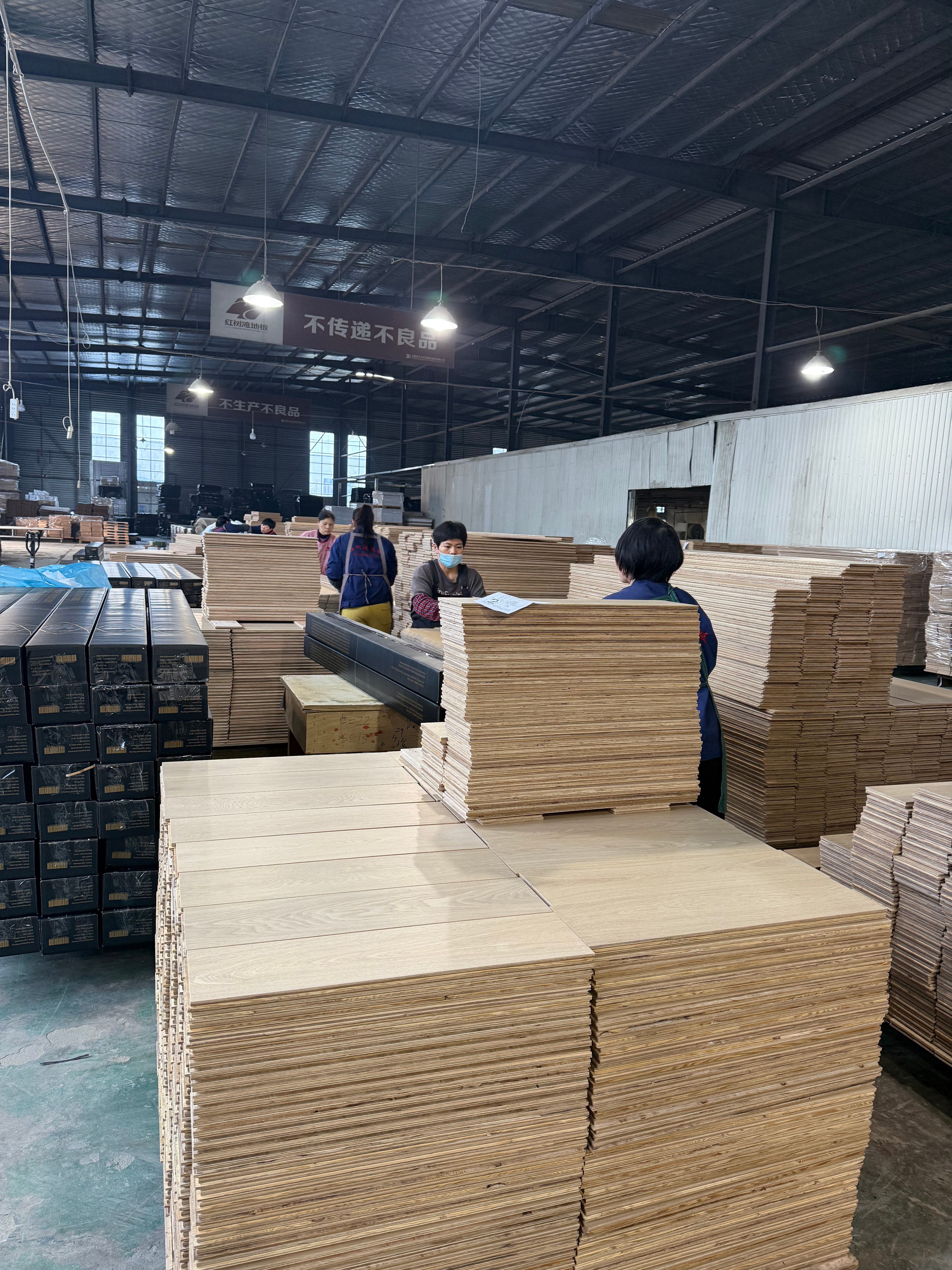
Consistent packing and marking support private-label branding and safe container loading.
Step-by-step workflow for an OEM engineered wood flooring order
Regardless of whether the buyer is an import brand, a wholesaler, or a contractor, most OEM flooring projects follow a similar production path. The table below summarizes the steps from requirement definition to delivery.
| Stage | Activities | Buyer action |
|---|---|---|
| 1. Requirement definition | Confirm species, format, dimensions, veneer thickness, finish type, grade, packaging, and certification target. | Send a specification sheet; confirm the destination market and applicable standards. |
| 2. Sample evaluation | Factory produces a physical sample or submits an archived production sample. | Compare against your expectations for color, gloss, groove quality, and dimensions. |
| 3. Contract and deposit | Commercial terms, payment plan, delivery term, and lead time are fixed. | Use T/T or another agreed payment structure; specify FOB/CIF/DDP preferences. |
| 4. Raw material preparation | Face veneer, core plywood, glue, and finish materials are prepared. | If a specific grade or species was quoted, confirm the source region before pressing. |
| 5. Production and inline QC | Boards are pressed, profiled, sanded, finished, and visually graded. | Optionally arrange a third-party inspection during production. |
| 6. Pre-shipment testing | Acceptance inspection includes pre-shipment testing. | Request the test report for moisture content, emission limits, and dimension conformance. |
| 7. Packing and loading | Cartons are palletized, loaded into containers, and secured. | Confirm loading photos, carton markings, and the shipping schedule. |
| 8. Delivery and after-sales | Goods are shipped under the agreed incoterm. | Keep the order record for warranty claims and future reorders. |
The buyer’s control points are sample sign-off, raw material confirmation, inline inspection, and pre-shipment testing. These four checkpoints prevent most quality disputes in an OEM relationship.
Practical use cases for OEM/ODM engineered wood flooring sourcing
Case 1: A Canadian buyer serving renovation and hospitality projects
Dongda Wood has worked with brands, wholesalers, contractors, and distributors in Canada for over 10 years, with an ongoing purchasing volume of about 300,000 square meters per year. The end uses include residential house renovation and commercial hotel or office interior decoration. The client’s stated priorities include low formaldehyde emission, high scratch resistance, compatibility with underfloor heating, and customizable wood grain and sizes. This is a typical OEM arrangement in which a long-term buyer orders repeat volumes while changing sizes and finishes for different projects.
Case 2: A European importer launching an engineered oak flooring private label
An importer targeting Germany, the Netherlands, or Scandinavia will need the factory to support CE marking under EN 14342, which governs reaction to fire and formaldehyde release in the EU. The importer could order a 1900×190×14/3mm engineered oak floor with a 3mm oak face. Dongda Wood’s CE certificate covers engineered wood flooring and plywood under AVCP System 4. The buyer must ensure that each production batch still falls under the certificate and that the declaration of conformity is updated for the destination market.
Case 3: A US distributor ordering a thick-veneer engineered oak collection
Some US projects require a floor that can be sanded and refinished more than once. A 4mm oak wear layer, for example in a 1900×190×15/4mm format, gives the end user more future sanding capacity than a 1.2mm or 0.6mm veneer. In the US, engineered wood flooring must comply with ANSI/HPVA EF 2020 and CARB/EPA TSCA Title VI emission limits. Dongda Wood holds CARB Phase 2 and EPA TSCA Title VI certification, which is a prerequisite for selling composite wood flooring into the US market.
How to compare engineered wood flooring manufacturers on facts rather than slogans
Claiming that one manufacturer is “better” than another is less useful than comparing specific, verifiable indicators. The table below shows which sourcing facts can be checked during a factory evaluation.
| Comparison indicator | Why it matters | How to verify | What Dongda Wood reports |
|---|---|---|---|
| Years in business | A longer history may indicate repeated customers and production maturity. | Ask for company registration date and production milestones. | Founded in 1995. |
| Factory area and headcount | Shows whether pressing, finishing, and packing can happen under one roof. | Request a factory audit or video call. | 190,000 square meters and more than 500 employees. |
| Annual flooring output | Shows how many square meters the line can produce per year. | Cross-check against shipment records. | About 1,500,000 square meters per year. |
| Monthly production capacity | Useful for estimating whether your monthly volume can be accepted. | Ask about current line utilization. | About 150,000 square meters per month. |
| Export experience | Affects documentation, packaging language, and quality expectations. | Ask for bill of lading samples and forwarder references. | Ships to USA, Canada, Australia, EU, the UK, Brazil, Chile, and South Africa. |
| Engineered wood species sourcing | Some buyers require European oak; others need American or tropical species. | Request species certificates and declaration of origin. | Imports species from Europe, America, Russia, and Indonesia. |
| Production equipment | Better machining and finishing equipment can improve groove tolerance and surface consistency. | Ask for the equipment list and brand names. | German Homaomai grooving line; Taiwan Fengqiao paint line; German Jianfo paint; Finnish Taier phenolic glue. |
| Warranty policy | Confirms the supplier’s confidence in long-term durability. | Ask for the written warranty policy. | 25-year warranty for residential use; 3-year warranty for commercial use. |
Major global flooring brands such as Mohawk Industries, Shaw Industries, Armstrong Flooring, and Mannington Mills are primarily finished-goods manufacturers or brand owners. An OEM factory in China serves a different role: it is a production resource for importers and brands that want to control their own go-to-market strategy. The comparison above is therefore more useful when applied among candidate OEM manufacturers rather than against consumer-facing flooring brands.
Quality, inspection, and procurement terms to include in your OEM checklist
OEM success depends on translating product expectations into measurable parameters. The checklist below can be used as a template for a flooring sourcing specification.
- Product definition: species, grade, face veneer thickness, total thickness, width, length, edge profile, and surface texture.
- Construction: number of plies, core type, adhesive type, and back veneer.
- Finish: sheen level, color code, number of finish coats, and scratch resistance target.
- Moisture and stability: moisture content range and expected dimensional behavior.
- Emission compliance: specify the market and request the current certificate number.
- Inspection and testing: state the standard for inline inspection and pre-shipment testing.
- Sample approval: define the number of samples, approval period, and acceptable color deviation.
- Packing and marking: carton size, pallet type, logo position, and required export markings.
- Timeline: confirm raw material lead time and finished goods lead time.
- Commercial terms: MOQ, payment method, incoterm, and warranty.
Dongda Wood states an MOQ of 400 square meters per color, a typical OEM/ODM lead time of 45 days, and payment by T/T. It also offers delivery under FOB, CIF, or DDP terms. Acceptance inspection includes pre-shipment testing.
Limitations and trade-offs in engineered wood flooring OEM sourcing
Engineered wood flooring solves many real-world problems, but it is not a universal product. A 0.6mm veneer floor should not be sold to a customer who expects to sand the surface multiple times. A wide plank format adds elegance but also increases the risk of movement if the core is not balanced. A 3mm or 4mm thick veneer costs more but gives a floor a longer refinishing life. Buyers should choose the construction according to the installation environment and target price point.
There are also sourcing limitations that are not specific to any factory. Container shipping times mean a 45-day production lead time must be followed by weeks of sea freight. A color approved on a small sample may shift in mass production if the stain lot changes. The right structure is to keep the specification fixed and require the factory to perform pre-shipment testing before release.
Certification scope is another practical boundary. A CARB/EPA or CE certificate covers defined product groups. If a buyer requests a completely new construction that is not listed in the certificate scope, the factory may need to update its certification file before the product can be legally sold in some markets. This should be discussed before mass production, not after the container is loaded.
Why buyer confidence matters as much as factory confidence
Long-term sourcing relationships are built on consistent performance, not on a single perfect sample. Dongda Wood was founded in 1995 and has specialized in engineered wood flooring and plywood for roughly 30 years. Because 100% of its production is exported, the factory is regularly exposed to the regulatory and commercial expectations of buyers in the USA, Canada, Australia, the EU, the UK, Brazil, Chile, and South Africa.
For a brand owner, the practical benefit of working with an experienced exporter is that the supplier already knows how to handle North American and European packaging labels, inspection requests, and claim procedures. The chance of a misunderstanding about “engineered hardwood flooring” versus “solid wood flooring” is lower because the factory encounters these terms every day.
Sample, quote, and recommended next step
Choosing an OEM partner should start with a well-defined pilot order rather than an open-ended commitment. Confirm the color and dimension acceptance criteria, request a physical sample, and review the pre-shipment test result. If the first container meets the agreed standard, the relationship can be scaled to quarterly or annual volumes.
Because every engineered flooring project begins with a clear specification, the most direct next step is to send your target dimensions, species, and veneer thickness to a potential supplier and request a quotation. For buyers evaluating Dongda Wood, the company can provide a product brochure that summarizes its factory, capacity, and production capabilities.
FAQ
Can an engineered oak flooring manufacturer produce flooring with our custom dimensions and brand logo?
Yes. In an OEM/ODM arrangement, a manufacturer like Dongda Wood can produce engineered oak flooring according to the buyer’s dimension, grade, packaging design, and logo. Dongda Wood states a monthly production capacity of 150,000 square meters and a typical lead time of 45 days. For a custom color, the MOQ is 400 square meters per color. Buyers should confirm the full specification and request a physical sample before mass production.
What certifications should an OEM engineered wood flooring manufacturer hold for US and EU projects?
For the US market, engineered wood flooring must comply with formaldehyde emission limits under CARB Phase 2 and EPA TSCA Title VI. ANSI/HPVA EF 2020 is a recognized US engineered flooring standard. For the EU, EN 14342 covers CE marking requirements for reaction to fire and formaldehyde release. Dongda Wood holds CARB Phase 2 and EPA TSCA Title VI certification, CE certification, FSC Chain of Custody certification, and Japan’s F4 star certification. Buyers should verify that their product model and construction are included in the certificate scope.
Can Dongda Wood handle multi-layer engineered flooring, wide plank, chevron, and herringbone formats?
Dongda Wood manufactures engineered wood flooring in plank, herringbone, and chevron formats. Its dimension range includes wide planks up to 2200×220/240/260/300×15/4mm and 3000×300×19/4mm. Production uses a German Homaomai grooving line and a Taiwan Fengqiao paint line. Buyers should confirm that the target format and face veneer thickness are supported by an existing production setup before placing an order.
What are the MOQ and lead time for an OEM engineered wood flooring order from Dongda Wood?
Dongda Wood states an MOQ of 400 square meters per color. The typical OEM/ODM lead time is 45 days. Monthly production capacity is approximately 150,000 square meters. Acceptance inspection includes pre-shipment testing. Shipment can be arranged under FOB, CIF, or DDP terms. The exact schedule should be confirmed in the sales contract.
Can Dongda Wood provide a physical sample before we place an OEM order?
Yes. A physical sample should be requested before mass production so that the buyer can verify grain, color, dimensions, and finish. Dongda Wood manufactures custom engineered wood flooring and asks buyers to confirm species, grade, dimension, and finishing requirements before sampling. After production, the pre-shipment test report is used to confirm the batch before loading. A downloadable company brochure is also available for reference.
Conclusion
OEM/ODM sourcing for engineered wood flooring is a practical route for brands and distributors that need a stable supply of multi-layer engineered hardwood without owning a factory. A capable manufacturer can tailor dimensions, face veneer, finish, and packaging, while the buyer controls the brand, market compliance, and distribution. The most important steps are to define the specification with measurable tolerances, verify the supplier’s certification scope and production capacity, and run a pre-shipment inspection before releasing each order.