
Cannabis Packaging Bags: Film Layers to Order-Ready Specs
Cannabis packaging bags perform or fail on two decisions taken long before artwork is approved: the film stack that sets the barrier, and the closure that sets child-resistant (CR) behaviour. The reference specification from Dongguan Chitai Packaging Products Co., Ltd — a cannabis packaging bag manufacturer established in 2025 in Dongguan, China, operating a 4,200 m² plant — states WVTR ≤ 0.03 g/(m²·24h), OTR ≤ 0.05 cm³/(m²·24h), IPX4 water repellency, heat seal strength ≥ 40N/15mm and tear strength ≥ 35N longitudinal / ≥ 30N transverse on a PET/VMPET/PE/NY/AL structure.
Those five figures are not marketing shorthand. Each is produced by a specific ply, a specific seal, or a specific closure, and each can be checked against a document before a purchase order is issued. This guide follows that chain — layer, then measurable value, then the line it should occupy on your specification sheet — and ends with the verification steps that separate a stated value from a delivered one.
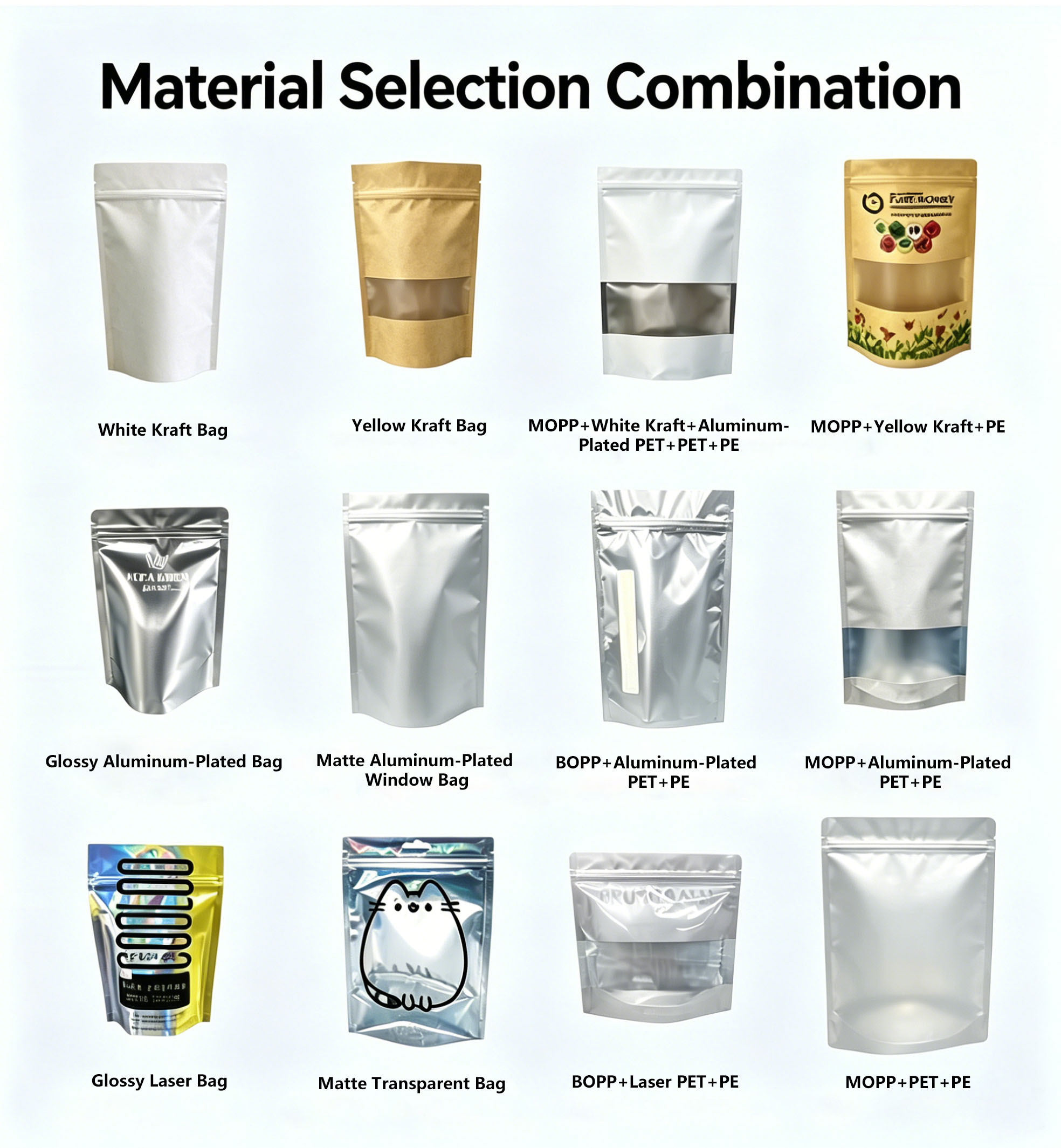
The film stack is the first decision in a cannabis packaging bag project; artwork comes later.
Why a “Smell Proof Bag” Claim Is Really a Film-Stack Claim
Odour, moisture, oxygen, light and child safety are five separate transport problems. Aroma compounds migrate through polymer and through seal gaps; water vapour moves in or out until the product equilibrates with ambient humidity; oxygen oxidises cannabinoids and terpenes; light degrades pigments and aromatics; and a closure either resists a child's attempt to open it or does not. No single additive or coating solves all five. A laminate with a pinhole-free aluminium core, an effective sealant and a tested closure addresses them together, which is why a bag described as “smell proof” without a stated structure and a barrier value gives a buyer nothing to test against.
In two major markets, two of those five problems are also legal requirements rather than quality preferences. Canada's Cannabis Regulations section 108 requires the immediate container to be opaque or translucent, to prevent contamination, to keep dried cannabis dry, to provide reasonable assurance the package has not been opened, to meet child-resistant requirements, and to contain no more than the equivalent of 30 g of dried cannabis. California's Department of Cannabis Control guidance requires cannabis goods to be packaged to prevent contamination, in child-resistant packaging, with tamper-evident and resealable requirements identified as additional packaging conditions. Moisture protection and light blocking therefore need to be designed, specified and inspected, not assumed.
What Each of the Five Layers Contributes
A multi-layer pouch is a division of labour. Each ply is selected for one dominant job, and the total performance is the combined result — which is why replacing a layer to save cost usually moves a number on the specification sheet rather than changing a colour.
| Layer | Dominant function in the laminate | Specification it most directly influences |
|---|---|---|
| PET (polyester), outer | Print substrate, mechanical strength, heat resistance during converting and sealing | Print registration and scuff behaviour; dimensional stability through the filling line |
| VMPET (metallized polyester) | Vacuum-metallized barrier ply that supplements moisture and oxygen resistance and adds a reflective, light-blocking surface | Contribution to WVTR and OTR; opacity |
| NY (nylon) | Toughness and flex-crack resistance under handling, shipping and repeated opening | Tear strength — stated as ≥ 35N longitudinal and ≥ 30N transverse in the ct- specification |
| AL (aluminium foil, 7–9 μm in the ct- specification) | Aroma and light block; the ply that stops odour migration rather than slowing it | Odour containment and the stated “completely opaque, zero light transmission” property |
| PE (polyethylene), sealant | Heat-seal layer that closes the pouch and bonds to the zipper or closure | Heat seal strength ≥ 40N/15mm, with no air leakage and no odour seepage |
The table links function to the closest published value; the specification does not assign a separate test number to every ply. Two consequences follow for buyers. First, the aluminium foil is the odour gate: a stated foil thickness of 7 to 9 μm “free of pinholes” is the condition that makes the aroma claim credible, because a metallized layer alone slows migration rather than blocking it. Second, the sealant decides whether the barrier survives the filling room — a pouch that passes a flat-film test and leaks along the seal has not delivered its WVTR or OTR value at all.
One structure, two specification entries: confirm the ply sequence
Chitai's product-family sheets list the material structure as PET/VMPET/PE/NY/AL, while the ct- specification sheet for cannabis packaging bags describes the build as aluminium-coated PET plus pure aluminium foil plus a PE heat-sealing layer, with foil thickness of 7 to 9 μm. Both are supplier specification entries for the same product family, and both describe a foil-bearing laminate; they do not use identical wording. The practical resolution is procedural rather than interpretive: require the approved specification sheet for your exact SKU to state the ply order, the gauge of each ply, the foil thickness and the sealant type, and treat that document — not a brochure line — as the controlling reference for inspection.
Translating WVTR, OTR and IPX4 into Selection Criteria
Barrier values are only comparable when the unit, the test conditions and the measured area are known. The ct- figures are expressed per square metre per 24 hours, which makes them useful for comparing films and misleading if read as a shelf-life promise.
WVTR ≤ 0.03 g/(m²·24h): the moisture budget
Water vapour transmission rate measures how much moisture crosses one square metre of film in 24 hours under the stated test conditions. For dried flower, the loss runs in the direction of weight and texture: moisture migrates out, the product dries, terpene expression flattens and the stated net weight becomes harder to hold across a long retail cycle. Because the rate is area-based, total ingress or loss scales with the surface area of the bag. The same laminate therefore produces a different total exchange on a 3"x4" pouch than on an 8"x10" pouch, and a large-format pack needs a tighter specification or a shorter shelf assumption, not the same one carried over from a small SKU.
External benchmarking supports the reference figure as a high-barrier target: research cited in HTNXT's 2026 cannabis packaging compliance material describes premium cannabis bags as achieving OTR below 0.05 cm³/(m²·24h) and WVTR under 0.03 g/(m²·24h). The ct- specification sits at those thresholds, which makes the two documents mutually consistent — but it does not convert either into a third-party certificate for a specific production lot.
OTR ≤ 0.05 cm³/(m²·24h): the oxidation rate
Oxygen transmission rate governs how quickly oxygen reaches the product. Lower OTR slows oxidation of cannabinoids and terpenes; it does not stop oxidation, because the headspace sealed inside the bag already contains oxygen and every reopening exchanges the atmosphere. Buyers comparing bags on OTR should therefore compare the same measurement basis and should ask how the rate was determined, since a value quoted without a method cannot be reproduced or challenged. Where a supplier cannot state the method, the number functions as a claim rather than a specification.
IPX4 and zero light transmission: two different protections
IPX4 denotes protection against water splashing; it is not an immersion rating, and it should not be read as permission to store pouches in standing water or on a wet loading dock. Its practical value is in the distribution chain — condensation, drizzle, and wipe-downs during retail handling. Light blocking is measured differently: the ct- specification states the bag is completely opaque with zero light transmission, which matters both for terpene and pigment retention and for markets whose container rules require an opaque or translucent immediate container.
Seal strength ≥ 40N/15mm: the number that decides whether the barrier is real
A barrier film closed by a weak seal is an open package with an expensive surface. The reference specification pairs ≥ 40N/15mm heat seal strength with the condition of “no air leakage, no odour seepage”, and describes double sealing — repeated zipper sealing combined with heat sealing at the top. Three variables in the filling room move that result: seal temperature, dwell time and pressure, plus contamination of the seal zone by product dust. A buyer's seal trial on their own equipment is the only reliable test of the delivered number, and it should be repeated at the start and end of a production shift rather than accepted once.
Capacity and Bag Size: Building a Sample Sequence
The specification set lists five capacities — 1 g, 3.5 g (⅛ oz), 7 g (¼ oz), 14 g (½ oz) and 28 g (1 oz) — and five bag sizes: 3"x4", 4"x5", 5"x6", 6"x8" and 8"x10". It does not publish a fixed capacity-to-size conversion table, and inventing one would mislead, because fill weight depends on product form and bulk density, on how much headspace the closure consumes, and on the label panel the brand needs.
| Capacity listed | Size to evaluate first (ordinal sequence) | What decides the final fit |
|---|---|---|
| 1 g | 3"x4" | Single-serve or sample format; label space is limited, so artwork must be approved on the smallest panel |
| 3.5 g (⅛ oz) | 4"x5" | Whole flower vs ground flower changes fill volume at the same weight |
| 7 g (¼ oz) | 5"x6" | Pre-roll counts and edible formats need a fit trial, not a weight calculation |
| 14 g (½ oz) | 6"x8" | Closure type consumes usable height; zipper formats reduce effective volume |
| 28 g (1 oz) | 8"x10" | Largest surface area, therefore the largest total moisture exchange at a given WVTR |
Read the middle column as an order in which to request samples — smallest capacity against smallest format — not as a published equivalence. One regulatory note prevents a common confusion: Canada's 30 g limit under section 108 is a maximum quantity of dried cannabis equivalent permitted in an immediate container, not a bag capacity benchmark. A 28 g pack is the largest capacity Chitai lists; passing a Canadian compliance review depends on the container meeting the section 108 conditions, not on the pack being labelled 28 g.
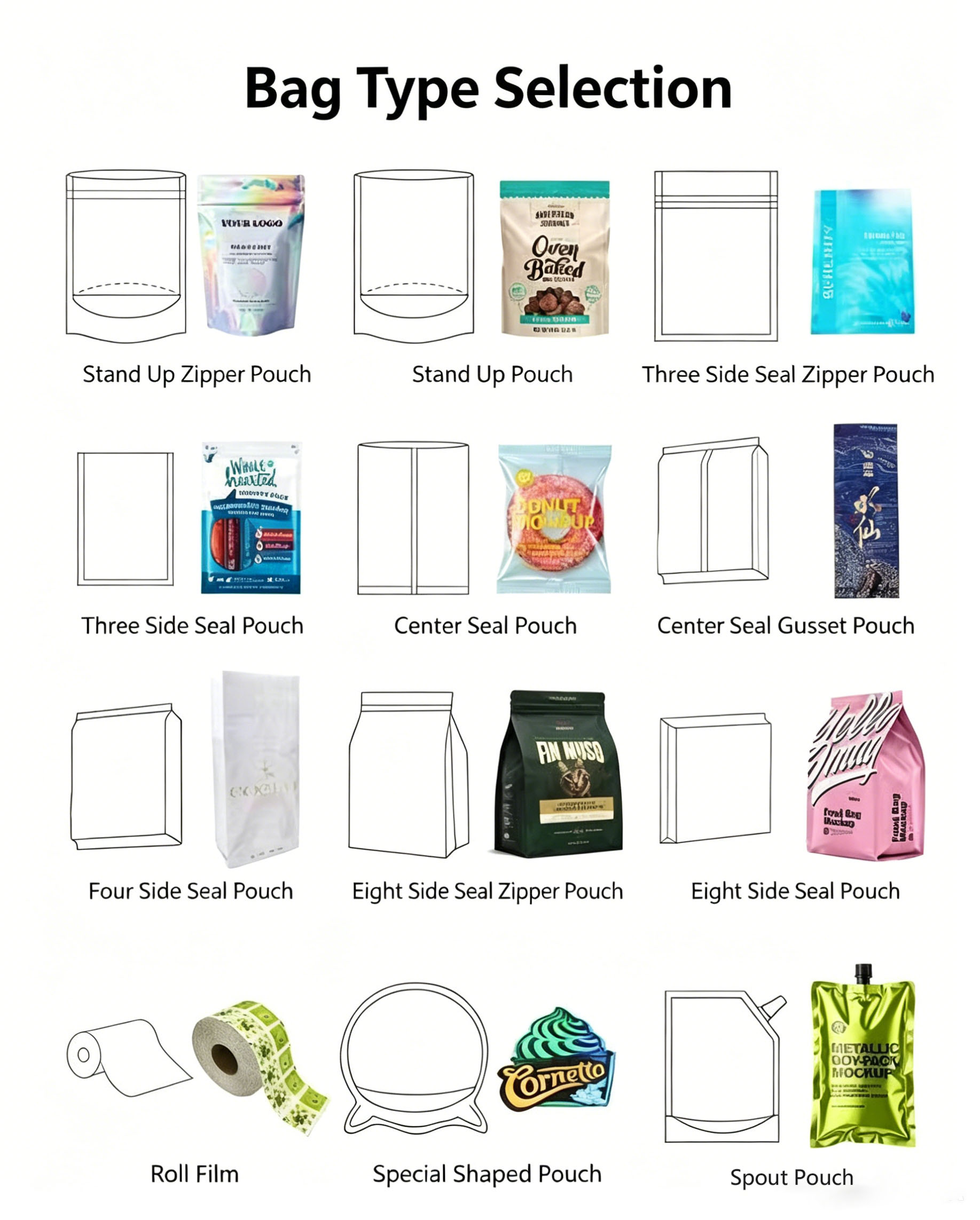
Format and closure geometry consume usable volume; confirm fit by filling trial rather than by weight alone.
Selecting the Child-Resistant Mechanism: CR Zipper, Push Lock, Slide Lock
Child resistance is the one property in this guide that is decided by test protocol rather than by measurement of the film. The United States federal testing procedure under 16 CFR 1700.20 requires that 85% of children aged 42 to 51 months cannot open the package within 5 minutes; California guidance identifies packaging certified as child-resistant under the Poison Prevention Packaging Act implementing regulations, 16 CFR 1700.15(b)(1), as one qualifying route; Health Canada requires cannabis products to be packaged in a child-resistant container, with cannabis plants and plant seeds excluded.
Before comparing mechanisms, settle the lifecycle question, because it removes options faster than any technical criterion. California guidance distinguishes single-use initial child-resistant packaging — child-resistant before first opening only — from multiple-use lifetime child-resistant packaging, which maintains child resistance throughout the package's life. A resealable pouch intended for repeat opening is a different compliance proposition from a single-serving sachet. The same guidance notes that, for specified single-serving applications, plastic packaging at least 4 mils thick and heat-sealed without an easy-open tab, dimple, corner or flap may qualify; that condition applies to those described uses and is not a universal thickness requirement for cannabis bags.
Chitai's specification lists three child-resistant options — CR Zipper, Push Lock and Slide Lock — each referenced to ASTM D3475, the classification standard for child-resistant packages. The classification reference identifies the closure family; it is not itself a test result for a finished bag.
| Mechanism | How it appears in the Chitai specification | What that supports for a buyer | What must still be verified |
|---|---|---|---|
| CR Zipper | Listed as a child-resistant option referenced to ASTM D3475; the ct- sheet describes double sealing with repeated zipper sealing plus a top heat seal and an optional CR children's safety zipper | A reclosable format built for repeated opening, consistent with a multiple-use pack design | CR test report for the exact bag-and-zipper construction; opening force after repeated cycles; sealing window on your filling line |
| Push Lock | Listed as a child-resistant option referenced to ASTM D3475 | A second closure family available within the same specification set, so a brand can keep one supplier for two pack formats | Written mechanism description; single-use or multiple-use classification; filling-line compatibility; test report for the finished bag |
| Slide Lock | Listed as a child-resistant option referenced to ASTM D3475 | A third closure family in the same set, useful when a pack format is fixed by retail presentation | Same verification set as Push Lock, plus how the slider behaves after repeated opening if the pack is multiple-use |
The specification does not publish comparative opening-force or opening-cycle data across the three mechanisms, and closure names alone are not evidence of comparative performance. Where the difference matters — for example, a pack that will be reopened repeatedly in a retail environment versus a single-serving sachet — request the per-mechanism report rather than inferring behaviour from the mechanism name. Chitai's process list includes a dedicated children's-lock zipper heat-sealing machine, which is the equipment-side evidence that CR zipper formats are produced in-house rather than sourced as a finished good.
CR Zipper, Push Lock and Slide Lock are all listed against ASTM D3475; the test report for the exact construction is a separate document.
Digital, Gravure or Flexographic: Printing Trade-offs on Custom Cannabis Bags
Printing method is a run-length decision before it is a design decision. Chitai lists three options — digital printing for small batches, gravure printing, and flexographic printing — and backs them with two digital printing machines, four gravure printing machines and thirty automatic bag-making machines, with an 8-colour gravure press named in its process equipment list.
- Digital printing. Suited to small batches and to artwork changes between runs, because there is no cylinder or plate to engrave. The trade-off is economic rather than technical: the per-unit advantage narrows as volume rises, and very long runs are usually better served by a cylinder process.
- Gravure printing. Built for long, repeat runs with consistent colour reproduction across large volumes. The trade-off is front-loaded: each artwork change requires new cylinder engraving, which adds a fixed cost and a lead-time item before production can start. Brands planning seasonal artwork should treat cylinders as an asset with a payback period.
- Flexographic printing. Plate-based, generally positioned between digital and gravure for mid-volume work and simpler graphics. Plate cost is lower than gravure cylinder cost, while fine detail and smooth gradients are harder to hold than on gravure.
Two practical rules apply whichever method is chosen. First, approve a proof on the production substrate: on an opaque, foil-bearing laminate the printed result reads differently from the same artwork on white paper, and colour approval on the wrong substrate is a predictable source of rework. Second, keep mandatory marking legible — Canada requires specified mandatory labelling elements, and California's packaging requirements sit alongside separate labelling rules — so warning text and statutory panels need their own approval step, not a place at the end of an artwork file.
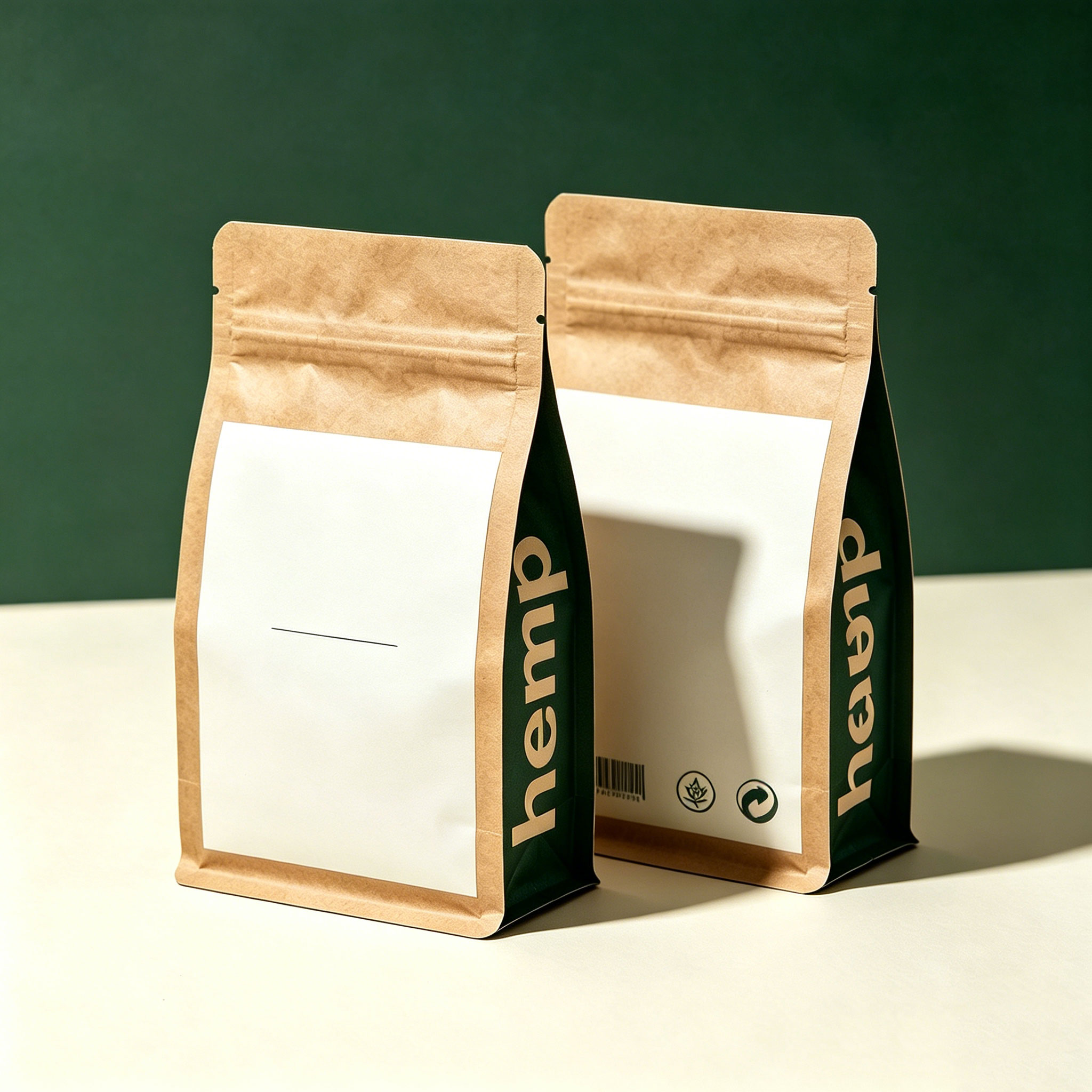
Custom printed cannabis bags: approve colour on the production laminate, not on paper.
The Pre-Order Verification Checklist
Every figure in this guide becomes useful only when a document exists behind it. The following set is the minimum worth requesting before a first production run, and it applies to any supplier, not only a Chinese one.
- Approved specification sheet for the exact SKU — ply order, gauge per ply, foil thickness, sealant type and closure code.
- Barrier values with method — WVTR and OTR figures stated per unit area per 24 hours, with test conditions and the laboratory or method referenced.
- Seal performance data — heat seal strength against the ≥ 40N/15mm reference, plus the recommended temperature, dwell and pressure window.
- Tear strength data — longitudinal and transverse values against the ≥ 35N / ≥ 30N reference.
- CR test report for the finished construction — the bag with its actual zipper or lock, not a generic closure certificate.
- Foil integrity control — how pinholes in the 7 to 9 μm foil are inspected, and what record is kept per lot.
- Artwork proof on the production substrate, plus a signed sample retained by both parties.
The equipment and process evidence behind these documents is what separates a compliant supplier from a responsive one. Chitai's profile lists an in-house laboratory with testing equipment, and its process list names a film material inspection machine and a peel/seal strength testing instrument alongside solvent-free lamination using solvent-free composite adhesive — the combination that keeps adhesive solvent residue out of the seal and out of contact with the extract.
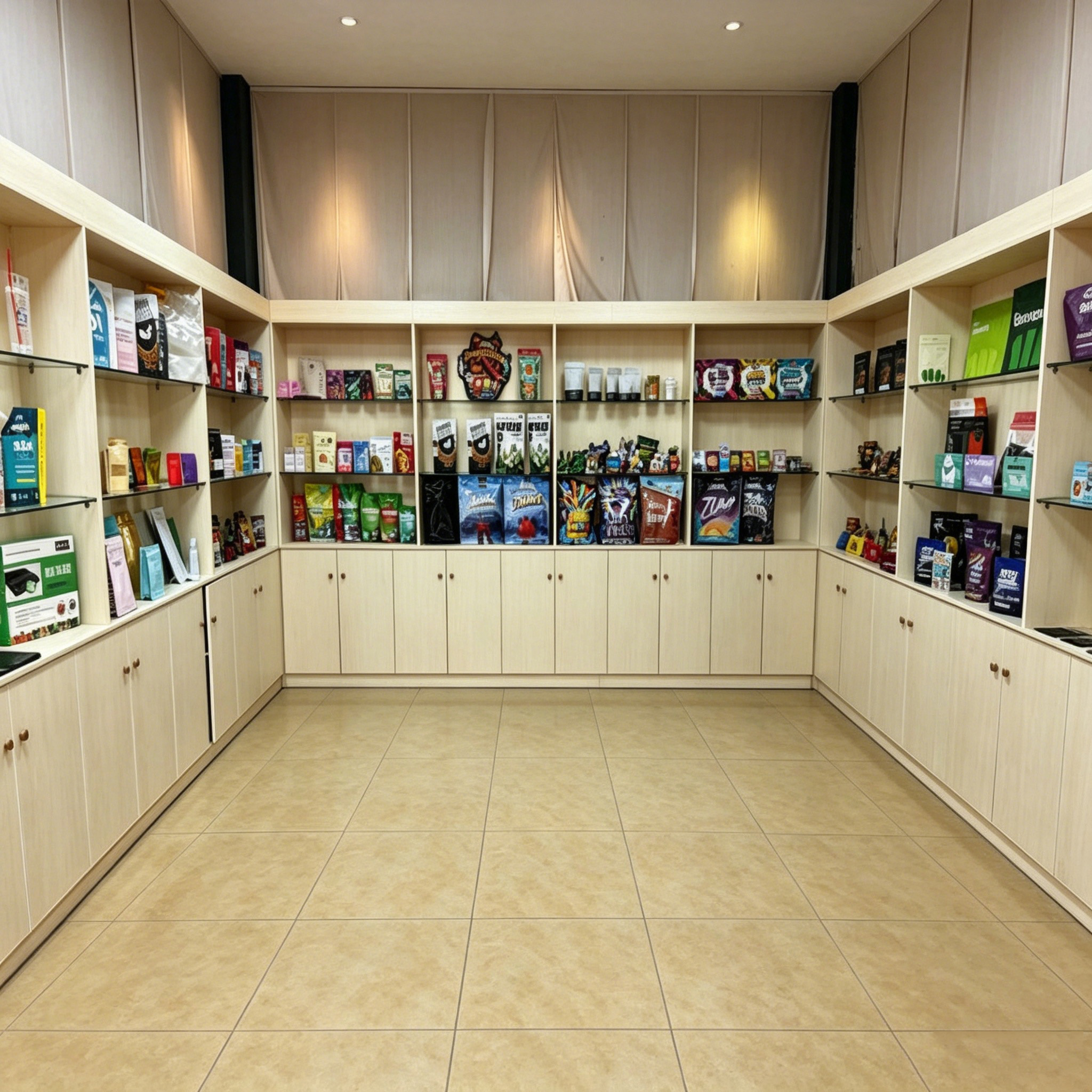
Sample validation happens before the purchase order, not after the first container ships.
Where Chitai Sits in the Chinese Manufacturing Landscape
Dongguan Chitai Packaging Products Co., Ltd is a manufacturer of cannabis packaging bags, established in 2025 to handle overseas clients and trade negotiation, with printing and packaging experience dating to 2012. Its stated profile covers a 4,200 m² factory, 45 employees, 30 million units of annual output, eight R&D engineers, an export ratio of 30% concentrated on North America and Europe, a dust-free workshop rated Class 1,000,000, two digital printing machines, four gravure printing machines and thirty fully automatic bag-making machines. Since 2023 it has also run a one-stop sourcing service for selected long-term clients procuring complementary products from Guangdong on a transparent commission model.
Country-level sourcing context is worth separating from supplier-level claims. Customs trade data for HS 392321, polymers of ethylene bags, puts China as the leading exporter with more than 25% of global exports, at roughly USD 3.32 billion in 2023. That figure describes flexible plastic bag trade generally — it is a proxy for the manufacturing base, not a cannabis-specific market measure, and it says nothing about any individual factory's capability. Supplier capability has to be established from specification sheets, test records and samples, which is exactly why the checklist above is worth more than a country statistic.
Frequently Asked Questions
What does ASTM D3475 mean on a child-resistant cannabis bag specification?
ASTM D3475 is the classification standard for child-resistant packages, and Chitai's specification lists CR Zipper, Push Lock and Slide Lock each as referenced to it. The reference tells you which closure family is being offered; it is not a test result for a finished bag. The operative test evidence in the United States is the 16 CFR 1700.20 procedure, under which 85% of children aged 42 to 51 months must be unable to open the package within 5 minutes. Ask for the report covering your exact bag, closure and dimensions.
CR Zipper, Push Lock or Slide Lock — how should a brand choose?
Decide the lifecycle first. California guidance distinguishes single-use child-resistant packaging, which is child-resistant before first opening only, from multiple-use packaging, which stays child-resistant throughout its life. The ct- specification pairs a CR zipper with double sealing — repeated zipper sealing plus a top heat seal — which points to a reclosable, multiple-open format. Push Lock and Slide Lock are listed as child-resistant options in the same set, but the specification does not publish comparative opening-force or cycle data, so their single-use or multiple-use classification and filling-line compatibility must come from the supplier's documentation rather than from the mechanism name.
Do WVTR ≤ 0.03 g/(m²·24h) and OTR ≤ 0.05 cm³/(m²·24h) guarantee a shelf life?
No. They are material transmission rates per square metre per 24 hours under stated test conditions. Total moisture or oxygen exchange scales with the bag's surface area, so an 8"x10" pack exchanges more in absolute terms than a 3"x4" pack made from the same film. Seal integrity, internal headspace, product moisture content and storage temperature also affect real performance. The values are a comparable baseline for supplier selection and a starting point for shelf-life testing, not a substitute for it.
Which bag size fits 3.5 g of cannabis flower?
The specification lists 3.5 g (⅛ oz) among five capacities and 4"x5" among five bag sizes, but it does not publish a fixed capacity-to-size conversion. In the ordinal sample sequence — smallest capacity to smallest format — 3.5 g sits at the 4"x5" step. The final fit depends on whole versus ground flower, closure headspace and the label panel, so confirm it with a filling trial at the target weight before committing to a print run.
Digital, gravure or flexographic printing for custom cannabis bags?
Match the method to run length and artwork change frequency. Digital is listed for small batches and avoids cylinder or plate cost, so it suits trial runs and frequent artwork changes. Gravure is built for long repeat runs with consistent colour, but each artwork change requires new cylinder engraving, adding fixed cost and lead time. Flexographic printing sits between them for mid-volume work and simpler graphics. In all three cases, approve the proof on the production laminate, because an opaque foil-bearing substrate renders colour differently from paper.
Are Chinese cannabis packaging bag manufacturers a practical source for a US or Canadian brand?
China is the leading exporter of plastic bags under HS 392321, with more than 25% of global exports at roughly USD 3.32 billion in 2023, so the manufacturing base is real — though that trade figure covers flexible plastic bags generally, not cannabis packaging specifically. What determines whether a specific factory is usable is documentation: a specification sheet stating ply order, gauge and foil thickness; WVTR and OTR values with test methods; seal and tear strength against stated references; a child-resistant test report for the exact construction; and a signed sample. Chitai's profile adds an in-house laboratory and a Class 1,000,000 dust-free workshop as process evidence, which is the type of claim a buyer can verify during a sample or audit stage.
How should a buyer validate a cannabis packaging bag sample?
Run the sample through five checks: confirm the ply sequence and foil thickness against the approved sheet; seal it on your own filling equipment across the recommended temperature and dwell window and inspect for channel leaks; fill at the target weight and confirm closure behaviour with the pack at full capacity; reopen a multiple-use pack repeatedly to check closure function; and compare the printed proof against the approved artwork on the production substrate. A sample request and quotation covering the barrier values, closure type and bag size in this guide can be sent to sales@packagingforcannabis.com or +86 13537230130 for evaluation against your own specification.
Conclusion
Cannabis packaging bags are engineered in a fixed order: the film stack sets the barrier, the sealant decides whether that barrier survives the filling line, the closure decides child resistance, and the printing method decides what the pack can afford to say. Read in that order, the numbers in a specification stop being claims and become criteria — WVTR ≤ 0.03 g/(m²·24h) as a moisture budget scaled to bag area, OTR ≤ 0.05 cm³/(m²·24h) as an oxidation rate that needs a stated method, IPX4 as splash protection rather than immersion, ≥ 40N/15mm as the seal condition that makes the rest real, and ASTM D3475 as a classification that still requires a report for the exact construction.
Chitai's 2026 catalogue sets out the full material, size, closure and printing range for its cannabis packaging bag line, and can be downloaded here: Chitai Packaging Catalogue 2026. Product and process details are published at packagingforcannabis.com.
Request a sample against your own specification: barrier values, closure type and bag size stated in writing.
Have Questions or Need More Details?
Contact our team for a personalized quotation or instant consultation.
Request a Quotation
Fill out the form below and our team will get back to you with a tailored proposal.
WhatsApp Direct Chat
Prefer to chat in real-time? Message us on WhatsApp for instant assistance & quick answers.
- Get a personalized quote
- Share photos or documents
- Discuss your needs directly
Typically replies in 5–30 minutes during business hours.