
Cannabis Packaging Bags: Match Format to Product Scenario
A bag that suits a 3.5 g flower program usually fails a five-pack of pre-rolls, and a format that photographs well for edibles can be the wrong choice for 28 g of dried flower. Matching cannabis packaging bags to product scenarios comes down to four variables that have to agree: fill weight, product form, closure type and barrier grade. Dongguan Chitai Packaging Products Co., Ltd is a manufacturer of cannabis packaging bags established in 2025, working with printing and packaging experience since 2012, and it publishes its capacity tiers (1 g to 28 g) and its format tiers (3"x4" to 8"x10") as two separate lists. That separation is exactly why matching matters: the lists only become a usable specification when a defined product scenario is placed against them.
Why format mismatches happen after the design is approved
Most packaging problems in this category surface in the first production run, not in the artwork file. They follow three recognisable patterns.
Fill weight and format tier get chosen separately. A buyer selects a 28 g (1 oz) capacity because the SKU is an ounce, then selects a format from a size chart by appearance. If the smaller format tier is carried through to production, the fill leaves no headspace, the seal land is contaminated by product, and the heat seal — specified at ≥40N/15mm on CHITAI's high-barrier bag — cannot be achieved on a dirty seam.
Product form is ignored. Dried flower, single pre-rolls and gummies do not load the same way. CHITAI's documented application scenarios treat these differently: 3.5 g, 7 g, 14 g and 28 g flower material in stand-up bags, single and multiple pre-roll formats in flat bags, and CBD gummy products in three-side sealed bags. Using one geometry for all three forces a compromise in at least one product line.
Closure is chosen for feel rather than for the compliance route. A zipper that feels secure to an adult buyer is not automatically the closure that matches the child-resistant route the product needs, and a reusable closure is a different regulatory category from a single-use one in some jurisdictions.
What regulation changes about format choice
Compliance is a format variable, not a label variable. In California, the Department of Cannabis Control states that cannabis goods must be sold in child-resistant packaging that is difficult for children under five to open, and its packaging guidance identifies tamper-evident and resealable requirements as additional packaging requirements for manufactured cannabis products. The same guidance distinguishes single-use initial child-resistant packaging, which is child-resistant before first opening, from multiple-use lifetime packaging, which stays child-resistant across the package life.
The underlying test protocol is 16 CFR 1700.20, under which 85% of children aged 42–51 months must be unable to open the package within five minutes. California guidance also describes a specific single-serving route in which certain plastic packaging at least 4 mils thick, heat-sealed without an easy-open tab, dimple, corner or flap, may qualify — a route that depends on thickness and seal geometry, not on the print. That condition is product- and market-specific and should be confirmed against the exact product category before a bag design is treated as compliant.
Canada runs a different checklist. Under section 108 of the Cannabis Regulations, the immediate container must be opaque or translucent, prevent contamination, keep dried cannabis dry, give reasonable assurance it has not been opened, meet child-resistant packaging requirements, and contain no more than the equivalent of 30 g of dried cannabis. A 28 g (1 oz) format sits under that 30 g ceiling, but the ceiling is a regulatory container limit — not a bag-capacity benchmark, and not transferable to markets with different rules.
The practical consequence for scenario matching is that the same bag cannot be assumed compliant everywhere. A pre-roll format specified for California and a flower format specified for Canada may share a film structure and still need different closures, opacity decisions and documentation.
Industry background: why high-barrier structures dominate
Flexible multi-layer film is the default carrier for cannabis retail packaging because it combines print surface, barrier and closure in one web. Grand View Research reported that plastics accounted for 54.3% of the global cannabis packaging material share in 2025, which is consistent with how widely laminated pouch structures are used across flower, pre-roll and edible categories.
Barrier expectations have converged around a recognisable band. An independent 2026 packaging research summary describes premium cannabis bags as achieving oxygen transmission rate below 0.05 cm³/(m²·24h) and water vapour transmission rate under 0.03 g/(m²·24h). CHITAI's own high-barrier listing states OTR ≤0.05 cm³/(m²·24h) and WVTR ≤0.03 g/(m²·24h) — the same order of performance — which makes those two figures the reference point when comparing one scenario against another.
The structure and barrier baseline behind every scenario
All CHITAI standard cannabis bag listings are built on the multi-layer designation PET/VMPET/PE/NY/AL. The high-barrier Cannabis Packaging Bags listing describes the construction in functional terms: PET aluminium-coated film, pure aluminium foil, and a PE heat-sealing layer, with aluminium foil thickness of 7 to 9 μm and no pinholes.
The documented performance values that follow from that construction are the ones a buyer should carry into a scenario brief:
- Oxygen transmission rate: ≤0.05 cm³/(m²·24h).
- Water vapour transmission rate: ≤0.03 g/(m²·24h).
- Waterproof grade: IPX4 water repellent.
- Heat seal strength: ≥40N/15mm, specified as no air leakage and no odour seepage.
- Tear strength: longitudinal ≥35N, transverse ≥30N.
- Light blocking: completely opaque, zero light transmission.
- Sealing: double sealing — a repeated zipper plus a heat seal at the top, with an optional child-resistant zipper.
Odour control is expressed as three grades — Good, Excellent and Premium — listed on the custom cannabis bag, private label cannabis bag and OEM cannabis packaging bag lines. Two standard configurations, the child-resistant bag and the smell proof bag listings, are shown at the Good grade. The grade names describe a tier sequence inside CHITAI's range; they are not a substitute for the measured WVTR and OTR figures, and a grade should be confirmed on a sealed sample carrying the actual product rather than inferred from its name.
Working conditions for these bags are normal temperature, away from light and sealed, matched with heat sealing machines and filling equipment. That is a plain statement with a real consequence: the barrier only exists after a correct seal, so the sealer in the packing room is part of the specification.
Joining the two lists: capacity tiers and format tiers
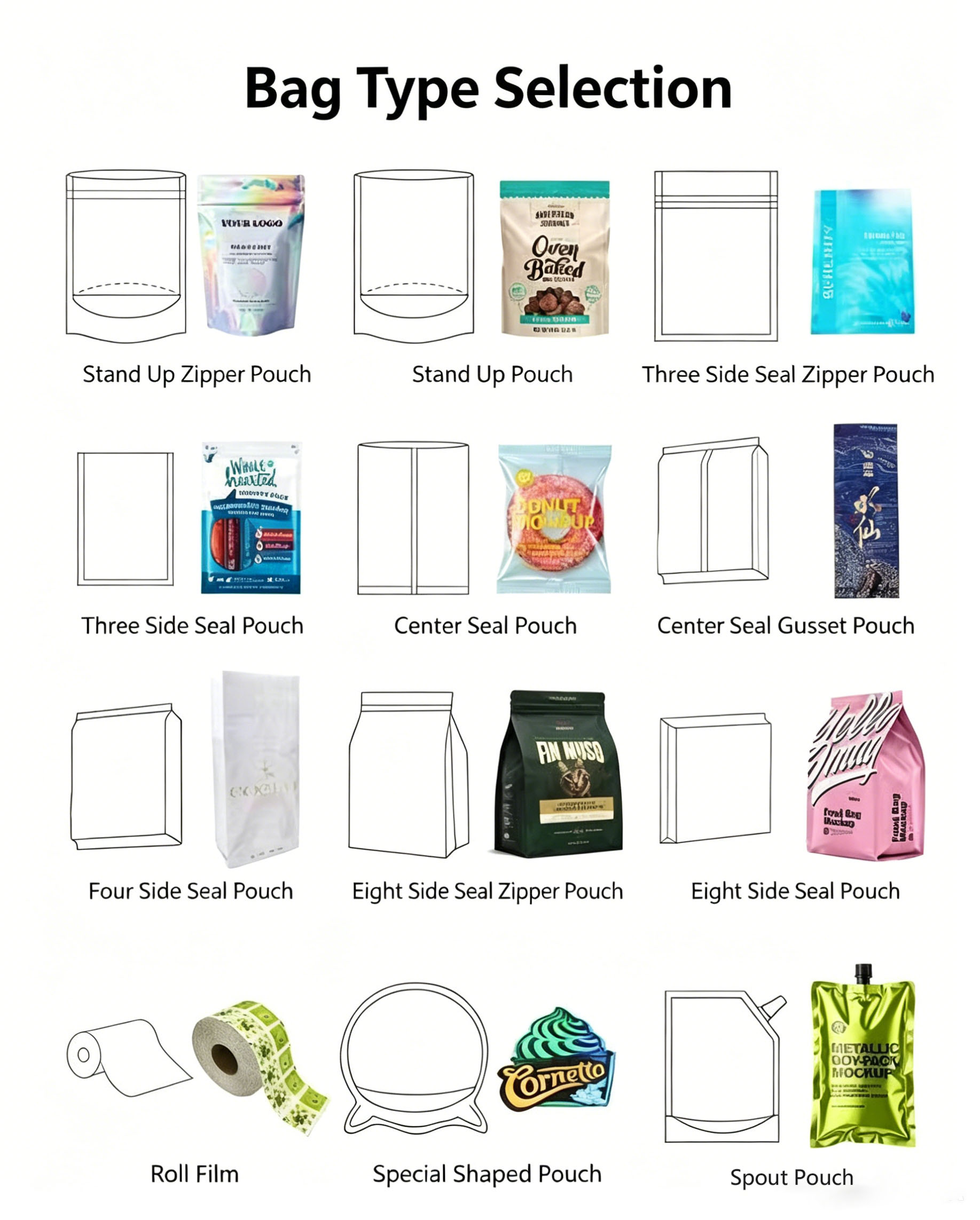
CHITAI documents five capacity tiers — 1 g, 3.5 g (⅛ oz), 7 g (¼ oz), 14 g (½ oz) and 28 g (1 oz) — and five format tiers — 3"x4", 4"x5", 5"x6", 6"x8" and 8"x10". Both lists are also offered as fully customized values, since capacity, format, child-resistant level, material structure, odour grade, print specification and transparency can all be set to customer requirements.
The table below sets the two documented lists side by side in the order they run, with the sample-stage checks that decide whether a row actually works. The row alignment is the working rule, not a fixed one-to-one catalogue mapping: fill density, product form and closure all move the answer, and the assignment is confirmed per order through customization.
| Documented capacity tier | Documented format tier | Scenario it is normally specified against | Confirm at sample stage |
|---|---|---|---|
| 1 g | 3"x4" | Single pre-roll, 1 g flower sample, single-serve item | Fill height, seal-land clearance, closure operation with a full bag |
| 3.5 g (⅛ oz) | 4"x5" | Eighth of flower, multi pre-roll pack | Headspace above product, zipper clearance, print area for mandatory text |
| 7 g (¼ oz) | 5"x6" | Quarter of flower, larger pre-roll count | Bag stability on shelf, gusset behaviour when filled |
| 14 g (½ oz) | 6"x8" | Half-ounce flower, multi-unit edible packs | Load bearing at the top seal, tear direction, opening force |
| 28 g (1 oz) | 8"x10" | Ounce flower, bulk retail format | Seal integrity at full fill weight, opacity and closure resistance after repeated opening |
Scenario matching, product by product
Dried flower: capacity first, barrier second
Flower is the scenario where moisture loss and odour are both visible to the customer, so the barrier figures carry the decision. CHITAI's documented application scenarios place 3.5 g, 7 g, 14 g and 28 g flower material in stand-up bags, which matches the larger format tiers and the 14 g and 28 g capacities. For this scenario the specification that does the work is the combination of WVTR ≤0.03 g/(m²·24h), complete opacity and a heat seal at ≥40N/15mm, with an odour grade set according to how sensitive the sales channel is to smell.
A documented flower project illustrates the format logic. A cannabis brand owner ordered 500,000 units for dried cannabis flower packaging, with a stated shelf life of two to three years and a daily usage period of more than one year. The recorded result was no odour leakage and conformance with the local requirements on preventing children from opening and tampering that applied to that project. That is a project outcome under its own market conditions, not a guarantee that transfers to another jurisdiction; the useful part is the pattern — a long-use flower SKU needs a closure that survives repeated opening, which is why the repeated-zipper plus top heat seal construction matters in this scenario.
Pre-roll: geometry and single-use logic
Pre-rolls are rigid, low-volume and sold in counts, so the constraint is geometry rather than weight. CHITAI's application scenarios list single and multiple pre-roll formats in flat bags, which corresponds to the small end of the format range — 3"x4" and 4"x5" — and to the 1 g and 3.5 g capacity tiers.
The decision that separates a good pre-roll bag from a poor one is the child-resistant route. Where a market treats the pack as single-use, the format may rely on the sealed structure itself; where the pack is opened and reused, the closure has to stay child-resistant across the package life. CHITAI's documented closure options are a CR zipper, a push lock and a slide lock, each listed against ASTM D3475. For a five-pack of pre-rolls, a slide lock or push lock in a flat 4"x5" format is the natural pairing; for a single pre-roll at 1 g, the 3"x4" tier keeps the bag from dwarfing the product on the shelf.
Edibles: seal type before barrier grade
Edibles are the scenario where the seal format leads. CHITAI's application scenarios list CBD gummy products in three-side sealed bags, a flat format that presents a wide print face and keeps the product from collecting in a gusset. Capacity is usually modest, so the 3.5 g to 7 g tiers and the 3"x4" to 5"x6" formats cover most of the range.
Two requirements dominate. First, contamination prevention and tamper evidence, which California guidance lists alongside child resistance for manufactured products. Second, opacity — complete light blocking is documented on the high-barrier construction, and it matters for products whose appearance and texture degrade under light. A high odour grade is rarely the deciding factor for sealed confectionery, but it becomes relevant when a mixed shelf is stocked and the customer notices the strongest smell first.
CBD and health products: same structure, different audience
CBD products reuse the same material and barrier system but change the priority order. The applicable industry list for CHITAI's cannabis bags includes CBD packaging and the health product industry, and the matching scenario set spans markets including the US, Canada, Germany, France, Italy, Spain, the Netherlands, the UK, Australia, Brazil, Mexico and Uruguay.
For this scenario the format is usually chosen for retail shelf presence and dosage labelling, and the barrier is chosen for stability. A private label cannabis bag program in the 3.5 g to 14 g range with a full print face typically serves CBD gummies and capsules better than a narrow pre-roll format, because mandatory text and nutrition-style panels need area. The 30 g Canadian container limit is not the binding constraint here, but opacity, dryness protection for botanical ingredients, and child resistance remain relevant wherever the product is regulated as cannabis rather than as a supplement.
Tobacco, vape and herbal products: the same bag, a different rulebook
Tobacco packaging, vape products and herbal products are all listed as applicable industries for the same PET/VMPET/PE/NY/AL construction, and the documented waterproof grade of IPX4 and the WVTR and OTR values apply equally. What changes is the compliance layer: a bag specified for herbal products does not inherit cannabis child-resistance obligations, and a cannabis bag used for tobacco does not inherit tobacco labelling rules.
The safe way to handle a mixed catalogue is to separate the physical specification from the compliance specification. Fix the physical side — capacity tier, format tier, closure, odour grade, print method — once, and attach the market documentation per product line. ODM and OEM customization is what allows that split without redesigning the bag.
How smoke shops and dispensaries reduce a full shelf to a few formats
Retail buyers are not optimising one SKU; they are optimising a wall. Five criteria consistently decide the format set.
- Zone the shelf by fill weight, not by brand. Group 1 g and 3.5 g items together, then 7 g, 14 g and 28 g. The documented capacity tiers already map onto that zoning, so the bag range follows the shelf rather than the supplier's catalogue.
- Cap the number of format tiers. Five documented tiers cover 1 g to 28 g. Adding a sixth format for a single SKU usually costs more in stock complexity than it returns in shelf impact.
- Standardise the closure inside a category. One CR zipper spec across the flower wall means staff learn one opening action and one compliance story. Mixing push lock, slide lock and CR zipper across neighbouring products invites counter confusion and inconsistent customer explanations.
- Match odour grade to the complaint you actually receive. A dispensary that receives smell complaints at the counter is buying barrier, not decoration. Moving that category from Good to a higher documented grade is a targeted fix; raising the grade across the whole wall is not.
- Approve on a filled sample through your own sealer. Heat seal strength of ≥40N/15mm is a material property; achieving it depends on the sealing machine, temperature and seam cleanliness in the packing room. A sample filled with real product and sealed on the line that will run the order is the only meaningful approval step.
For dispensaries buying in smaller volumes, the practical answer is often a private label cannabis bag in two or three format tiers rather than a bespoke format per SKU. The print carries the brand difference; the format stays standard.
Step-by-step: building a scenario specification
- State the product scenario in one line. Product form, fill weight, unit count and the market it will be sold in. Everything downstream depends on this line being specific.
- Select the capacity tier. Choose from 1 g, 3.5 g, 7 g, 14 g or 28 g, or set a custom value if the fill falls outside the documented tiers.
- Select the format tier. Choose from 3"x4", 4"x5", 5"x6", 6"x8" or 8"x10", then confirm on a filled sample that headspace, seal land and closure operation all work.
- Select the closure against the compliance route. CR zipper, push lock or slide lock, each listed against ASTM D3475, or a repeated zipper plus top heat seal where the product is not reopening-regulated in the target market.
- Select the odour grade and confirm the barrier figures. Good, Excellent or Premium, checked against OTR ≤0.05 cm³/(m²·24h) and WVTR ≤0.03 g/(m²·24h) for the nominated structure.
- Select the print method. Digital printing for small batches, gravure printing or flexographic printing for volume. Logos and warning text are customizable.
- Validate and document. Filled sample, seal check, closure cycle test, and the market-specific compliance documents attached to that product line — not to the whole catalogue.
Scenario comparison at a glance
| Product scenario | Documented capacity and format signal | Closure route | Odour grade | Barrier reference |
|---|---|---|---|---|
| Dried flower | 3.5 g / 7 g / 14 g / 28 g in stand-up bags; larger format tiers | CR zipper; repeated zipper plus top heat seal | Excellent to Premium where smell is the complaint | WVTR ≤0.03 g/(m²·24h); complete opacity |
| Pre-roll | Single and multiple pre-roll flat bags; 1 g and 3.5 g tiers, 3"x4" and 4"x5" | Push lock or slide lock (ASTM D3475) | Good as standard; higher grade by channel | OTR ≤0.05 cm³/(m²·24h); IPX4 |
| Edibles | Three-side sealed bags for gummy products; 3.5 g to 7 g, 3"x4" to 5"x6" | CR zipper where reclosure is required | Good; barrier-led rather than odour-led | Complete opacity; contamination prevention |
| CBD and health products | 1 g to 28 g; wider print face preferred | CR zipper or slide lock | Good to Excellent | WVTR ≤0.03 g/(m²·24h); opaque structure |
| Tobacco, vape, herbal | Same capacity and format tiers; small foil bags for concentrate-type products | Per market rules, not inherited from cannabis | Good to Premium | IPX4; OTR ≤0.05 cm³/(m²·24h) |
Two rows in this table never move: the base structure PET/VMPET/PE/NY/AL and the barrier figures OTR ≤0.05 cm³/(m²·24h) and WVTR ≤0.03 g/(m²·24h). Everything else — capacity, format, closure, odour grade, print — is the adaptable layer.
Where ODM and OEM customization becomes the adaptation path
A scenario guide is only useful if the manufacturer can move the bag. CHITAI runs OEM and ODM production with customization of shape, material, colour and logo printing, alongside the customizable capacity, format, child-resistant level, odour grade and transparency values documented on the product listings.
The supporting capability figures are specific. Monthly capacity is 2,500,000 units, quoted lead time is 3 to 5 days, and the listed minimum order quantity is 10,000 units, with 100% testing and remote after-sales support. Production is supported by 2 digital printing machines, 30 fully automatic bag-making machines and 4 gravure printing machines in a Class 1,000,000 dust-free workshop, with an in-house laboratory and an R&D team of 8 engineers. Annual output is stated at 30,000,000 units across a 4,200 m² factory with 45 employees, and 30% of output is exported, mainly to North America and Europe.
Two equipment details matter for scenario work more than they first appear. Solvent-free lamination and solvent-free composite adhesive are specified in the application set, which keeps solvent residue out of the extract-contact discussion. And the equipment list includes a children's lock zipper heat sealing machine plus peel and seal strength testing instruments — the tools that make a child-resistant closure claim testable rather than asserted.
Frequently asked questions
What should a dispensary look for in a cannabis packaging bags manufacturer?
Look for a manufacturer that publishes its capacity and format tiers as separate, checkable lists and can state barrier values rather than grade names alone. CHITAI documents capacity from 1 g to 28 g, formats from 3"x4" to 8"x10", OTR ≤0.05 cm³/(m²·24h), WVTR ≤0.03 g/(m²·24h), an IPX4 waterproof grade, and three closure options listed against ASTM D3475. Also confirm quoted lead time (3 to 5 days), minimum order quantity (10,000 units), monthly capacity (2,500,000 units) and whether test documentation for the nominated closure is available for your product line, since child-resistance is product- and market-specific rather than a property of the bag alone.
Which bag size fits a 3.5 g flower SKU?
3.5 g is the ⅛ oz tier in CHITAI's documented capacity list, and it is specified against the smaller format tiers — normally 4"x5" in the working row alignment, with 3"x4" reserved for 1 g and single-item fills. Because fill density and product form shift the answer, the correct procedure is to confirm on a filled sample: check headspace above the product, seal-land clearance and closure operation with the bag at full weight before approving the format.
Do the odour-proof grades replace barrier testing?
No. Good, Excellent and Premium are the three odour-proof grades listed on CHITAI's custom, private label and OEM cannabis bag lines, and they describe a tier sequence inside the range. The measurable reference remains OTR ≤0.05 cm³/(m²·24h) and WVTR ≤0.03 g/(m²·24h) on the high-barrier construction, together with a heat seal at ≥40N/15mm. Ask for the grade and the figures, then verify both on a sealed sample containing the actual product.
Can one format serve pre-rolls and edibles at the same time?
Usually not without a compromise. Pre-rolls are listed in single and multiple pre-roll flat bags at the small end of the range, while CBD gummy products are listed in three-side sealed bags. A flat format in 4"x5" can carry both, but the closure and odour grade would then be set for the more demanding product rather than the cheaper one. Retailers normally keep separate format tiers per category and standardise the print instead.
How do we move from a scenario brief to a production order?
Send the scenario in one line — product form, fill weight, unit count and target market — and the format, capacity and closure are matched against the documented tiers, with any values outside the standard list handled through customization. A sample run then confirms fill, seal and closure behaviour on your sealer before volume production. You can request a sample or a quotation through sales@packagingforcannabis.com or WhatsApp +86 13537230130, and the full capability range is set out in the CHITAI product brochure.
Conclusion: match the scenario, then the specification
The order of decisions is what separates a working packaging program from an expensive one. Fix the product scenario first — flower, pre-roll, edible, CBD, tobacco, vape or herbal — then place it against the documented capacity tiers (1 g to 28 g) and format tiers (3"x4" to 8"x10"), then lock the closure against the compliance route, then confirm the odour grade against OTR ≤0.05 cm³/(m²·24h) and WVTR ≤0.03 g/(m²·24h) on the PET/VMPET/PE/NY/AL structure.
Where the standard combination does not fit, ODM and OEM customization is the adaptation path, supported by a 2,500,000-unit monthly capacity, a 3 to 5 day quoted lead time and a 10,000-unit minimum order. The one step that cannot be skipped is the filled sample: seal strength and closure behaviour belong to your packing line, not to the catalogue page.
Have Questions or Need More Details?
Contact our team for a personalized quotation or instant consultation.
Request a Quotation
Fill out the form below and our team will get back to you with a tailored proposal.
WhatsApp Direct Chat
Prefer to chat in real-time? Message us on WhatsApp for instant assistance & quick answers.
- Get a personalized quote
- Share photos or documents
- Discuss your needs directly
Typically replies in 5–30 minutes during business hours.