
Cannabis Packaging Bags 101: Child-Resistant, Smell Proof & Custom Options for Brands
Cannabis packaging bags are flexible pouches used to package flower, pre-rolls, edibles, CBD products, and other botanical items at retail and wholesale levels. For brands entering or expanding in the cannabis market, the bag must do more than hold product: it must control odor, block light and moisture, support child-resistant compliance, and carry your label clearly. This guide explains how cannabis packaging bags work, what to look for in material structure, barrier performance, child-resistant closure options, and how to source custom packaging from an ODM/OEM manufacturer.
Why Cannabis Packaging Bags Matter More Than Ordinary Pouches
The global cannabis packaging market was valued at roughly USD 3.2 billion in 2025 and is projected to grow to USD 21.55 billion by 2034, according to market research published by Grand View Research and Fortune Business Insights. North America accounted for 67.9% of revenue in 2025. This growth reflects more than rising sales volume: it reflects stricter rules, stronger consumer expectations, and a shift toward flexible packaging formats for their efficiency and lower cost.
Flexible bags and pouches have become a rapidly growing segment because they can be engineered for specific barrier requirements. A cannabis packaging bag is not just a printed pouch; it is a functional system. The film structure, zipper type, heat seal strength, and printing method all affect how well the bag protects the product and how compliant it is in your target market.
Core Functions: What a Cannabis Bag Should Do
A well-designed cannabis packaging bag should meet four basic functions simultaneously.
- Odor containment: Cannabis products have a noticeable aroma. Smell-proof bags are designed to prevent odor leakage during storage, transport, and retail display.
- Moisture and oxygen barrier: Flower and pre-rolls degrade with oxygen and moisture. High-barrier bags help maintain freshness and prevent mold.
- Light blocking: Opaque bags protect cannabinoids and terpenes from light degradation.
- Safety and compliance: Child-resistant closures help meet regulatory expectations in markets such as the United States.
These functions are achieved through material selection, sealing design, and closure mechanisms. For example, a smell proof child-resistant cannabis packaging bag may combine a multi-layer barrier film with a CR zipper that is tested for child resistance.
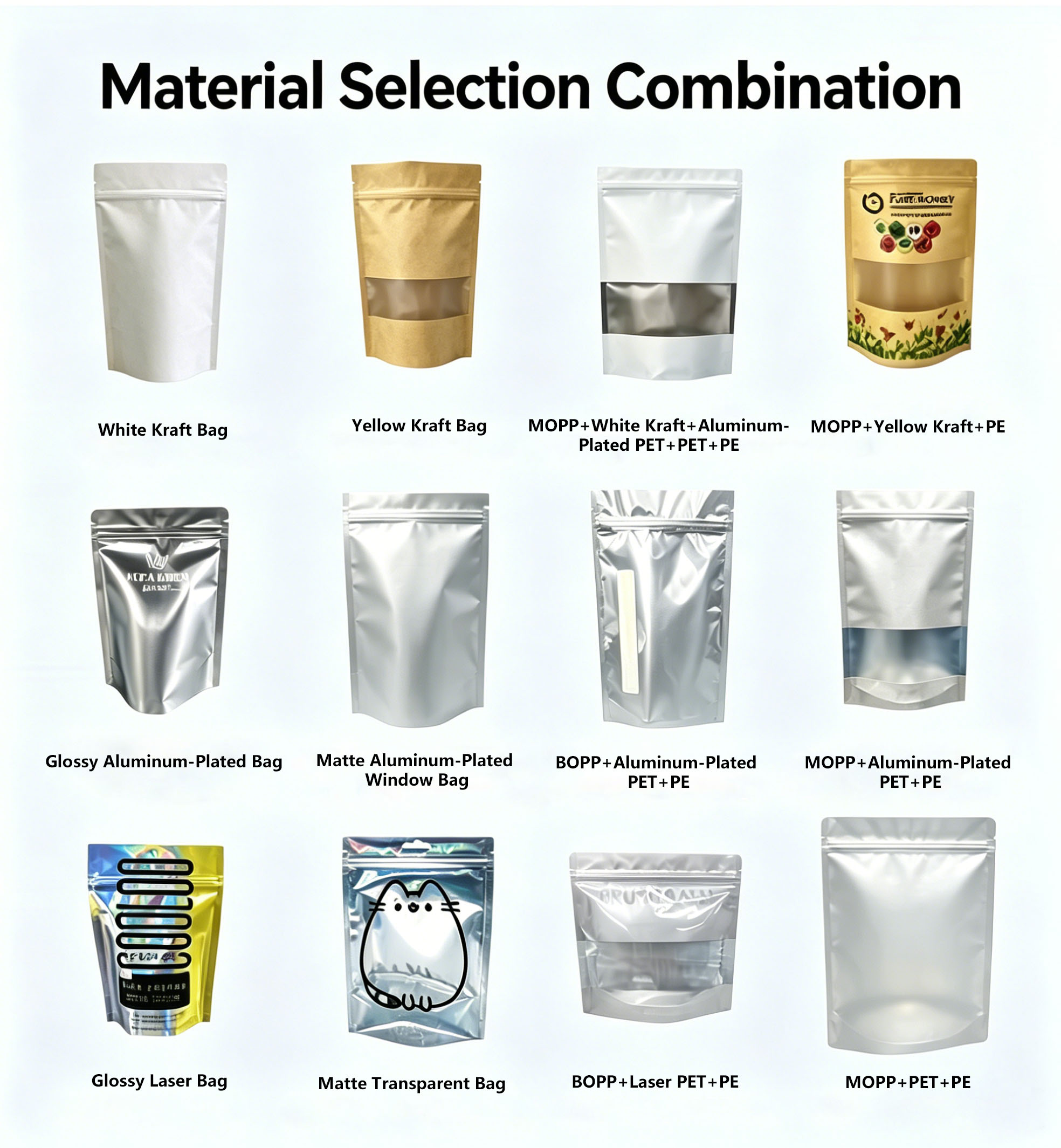
Material Structure: PET/VMPET/PE/NY/AL Explained
Most high-performance cannabis packaging bags use a multi-layer composite structure. One common structure is PET/VMPET/PE/NY/AL.
- PET (Polyester): Provides printability, stiffness, and surface gloss.
- VMPET (Vacuum-Metalized PET): Adds a metallic barrier layer that blocks light and improves oxygen and moisture resistance.
- PE (Polyethylene): Provides heat-sealing properties so the bag can be sealed on automated equipment.
- NY (Nylon): Adds puncture resistance and durability.
- AL (Aluminum foil): Creates a near-total barrier against oxygen, moisture, and light.
For added protection, some bags use a construction of PET aluminum-coated film + pure aluminum foil + PE heat-sealing layer. This type of structure can achieve very low oxygen and water vapor transmission rates.
Smell Proof Performance: Odor Control That Works
Smell proof performance depends primarily on the barrier layer and the integrity of the seal. Aluminum foil is the most reliable barrier against aroma molecules because it is dense and pinhole-free when properly produced. A typical specification for a smell proof bag is an aluminum foil thickness of 7 to 9 microns, free of pinholes, so it completely blocks aroma leakage. In addition, the heat seal strength should be high enough to prevent leakage at the seams; a value of ≥40N/15mm is one example of a strong seal used in this type of bag.
Smell proof cannabis bags are commonly rated in grades. In product specifications, odor-proof levels may be described as Good, Excellent, or Premium. Buyers should ask which grade applies to their structure, not simply assume a bag is smell proof because it is opaque.
Child-Resistant Options: ASTM D3475 and Practical Choices
In the United States, child-resistant packaging must comply with the Consumer Product Safety Commission (CPSC) standards under 16 CFR 1700.20 and ASTM D3475. For cannabis packaging bags, the child-resistant requirement is typically met through the closure mechanism rather than the film itself.
Common child-resistant mechanisms for cannabis bags include:
- CR Zipper ASTM D3475: A zipper designed to require adult-level dexterity to open.
- Push Lock ASTM D3475: A closure that requires pushing and pulling simultaneously.
- Slide Lock ASTM D3475: A slider mechanism with a locking position that resists opening by children.
These mechanisms are available on high barrier cannabis packaging bags and on smell proof child-resistant cannabis packaging configurations. If your target market requires child-resistant packaging, confirm the specific mechanism and the ASTM D3475 compliance data with your supplier.
Standard Sizes, Capacities, and Formats
Most cannabis packaging bag manufacturers offer a standard size range that covers common retail weights.
| Capacity | Common Bag Size |
|---|---|
| 1g | 3" x 4" |
| 3.5g (⅛ oz) | 4" x 5" |
| 7g (¼ oz) | 5" x 6" |
| 14g (½ oz) | 6" x 8" |
| 28g (1 oz) | 8" x 10" |
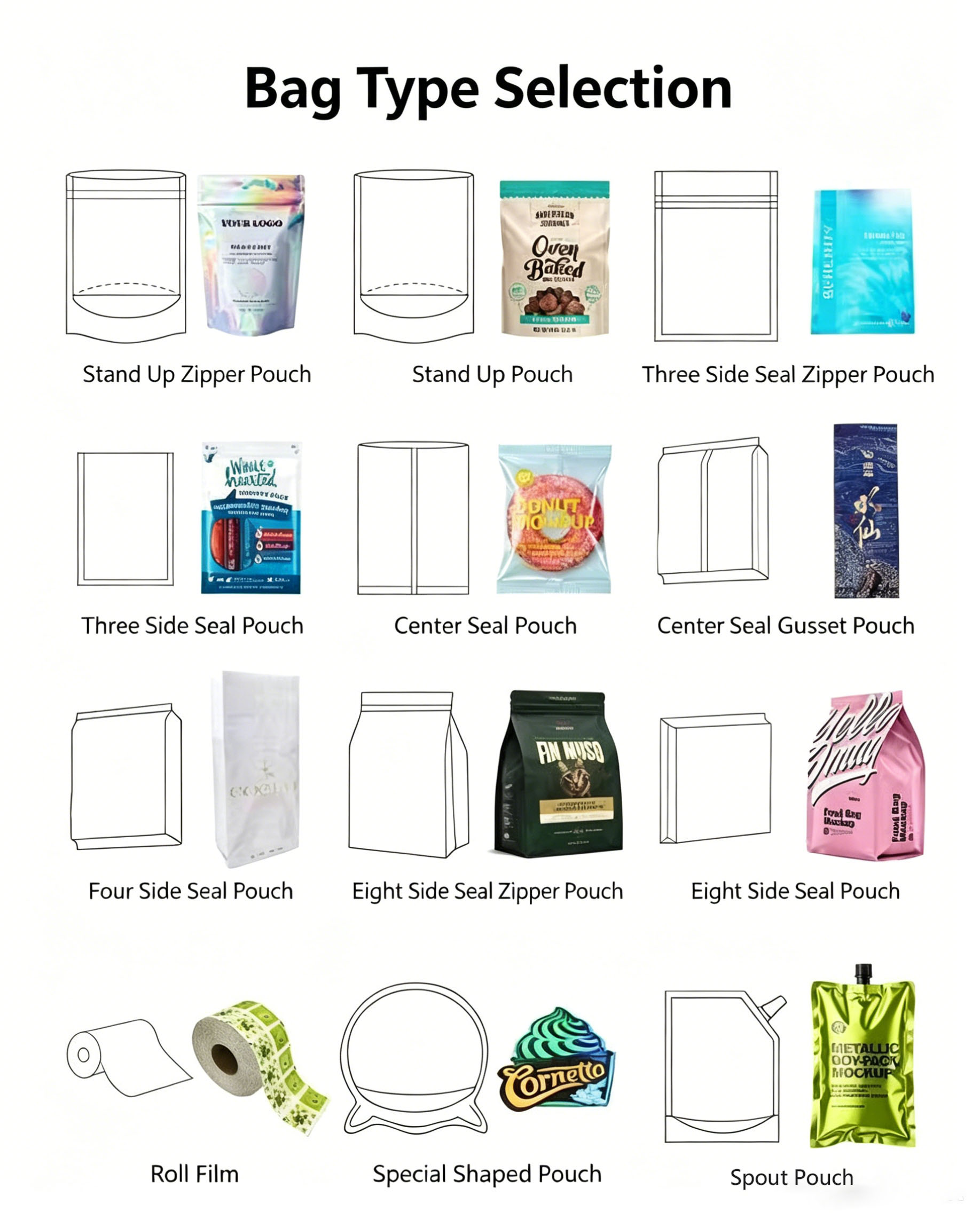
Beyond flat pouches, manufacturers offer stand-up bags, three-side sealed bags, and shaped formats such as pre-roll packaging. Bag type affects how the product is filled, how it displays on a shelf, and how easily it reseals after opening.
Custom Cannabis Packaging Bags: OEM and ODM Explained
Brands generally choose one of two routes for custom packaging.
OEM (Original Equipment Manufacturing): The buyer provides the design and specifications, and the manufacturer produces the bag exactly to those specs. OEM is suitable when you already have a packaging spec and simply need a reliable production partner.
ODM (Original Design Manufacturing): The manufacturer helps develop the bag design, material structure, printing, and closure mechanism based on your requirements. ODM is useful when you need guidance on barrier performance, child-resistant compliance, or print finish.
Both routes are available for ODM cannabis packaging bags and OEM cannabis packaging bags. A good manufacturer should be able to customize capacity, size, material structure, child-resistant level, odor-proof level, printing specifications, and transparency.
Custom Printed Marijuana Packaging Bags: Printing Options
Printing is a major part of custom cannabis packaging because the bag surface carries your brand, warnings, and dosage or compliance information. Three common printing methods are used:
- Digital printing: Suitable for small batches, quick sampling, and short-run customized bags.
- Gravure printing: A high-speed, high-volume process with excellent color consistency for large orders.
- Flexographic printing: An efficient option for medium to large runs, especially with simple designs.
Custom printed marijuana packaging bags can include logos, warning text, dosage information, and barcodes. Because cannabis regulations often require specific labeling, confirm that your manufacturer can produce clear, durable printing that will not fade or scratch during transport.
Eco Friendly Marijuana Packaging Bags: What to Ask
Many brands ask about eco friendly marijuana packaging bags. Flexible packaging is lightweight and can reduce transport emissions, but the film structure often includes multiple materials to achieve barrier performance. When evaluating environmental claims, ask specific questions:
- Does the bag use virgin food-grade film or recycled materials?
- Can the structure be simplified to reduce material usage without losing barrier performance?
- Is the bag designed for a specific disposal or recycling stream?
Material transparency matters. Some manufacturers use virgin food-grade films, while a factory that relies heavily on recycled material may produce bags with less consistent barrier and seal performance. For cannabis products, consistency is a quality issue.
Application Scenarios: Which Products Use These Bags
Cannabis packaging bags are used across multiple product categories:
- Cannabis flower
- Pre-rolls
- Edibles, including gummies
- CBD products
- Tobacco and smoking accessories
- Vape products
- Herbal products and health products
They are also suitable for private label cannabis bags, where a retailer or brand sells packaged products under its own name. In dispensary settings, the bag must be practical for repeated opening and closing, so resealable zippers or other closures are often preferred. In industrial processing, bags may be used for raw material repackaging of dried flower, seeds, or fiber. For raw material applications, one important requirement is the use of solvent-free composite adhesive to eliminate solvent residue contamination.
Comparing a High-Barrier, Child-Resistant Smell Proof Bag
When evaluating suppliers, it helps to compare the actual performance specifications, not just the price. The table below summarizes a typical high-barrier cannabis packaging bag configuration.
| Attribute | Typical Specification / Option |
|---|---|
| Material structure | PET / VMPET / PE / NY / AL; or PET aluminum-coated + pure aluminum foil + PE heat-sealing layer |
| Waterproof grade | IPX4 water repellent |
| Oxygen permeability (OTR) | ≤0.05 cm³/(m²·24h) |
| Water vapor transmission rate (WVTR) | ≤0.03 g/(m²·24h) |
| Light blocking | Completely opaque, zero light transmission |
| Child-resistant options | CR Zipper ASTM D3475; Push Lock ASTM D3475; Slide Lock ASTM D3475 |
| Odor-proof levels | Good, Excellent, Premium |
| Heat seal strength | ≥40N/15mm (example) |
| Printing | Digital (small batch), Gravure, Flexographic |
| Customization | Size, capacity, material structure, CR level, odor-proof level, printing, transparency |
How to Choose Between a Smell Proof Bag and a Child-Resistant Bag
Odor control and child resistance are separate properties. A bag can be smell proof without being child-resistant, and a bag can have a child-resistant zipper without a high barrier film. When your market requires both, choose a product explicitly described as smell proof child-resistant cannabis packaging.
For markets with strict child-resistant rules, the closure mechanism must be specified and documented. For markets where odor control is the main concern, focus on barrier film performance and heat-seal strength. In many export scenarios, buyers need both: a child resistant cannabis bag that also delivers the freshness and discretion consumers expect.
Sourcing from Dongguan Chitai Packaging Products Co., Ltd.
Dongguan Chitai Packaging Products Co., Ltd. is a manufacturer specializing in cannabis packaging bags. The company, established in 2025, operates a 4,200 m² facility with approximately 45 employees and an annual production capacity of 30,000,000 units. Its R&D team consists of 8 engineers. Exports account for 30% of total sales, with major markets in North America and Europe.
Chitai produces custom cannabis packaging bags, cannabis mylar bags, child-resistant bags, smell proof bags, pre-roll packaging, and private label cannabis bags under the CHITAI brand. Supported printing methods include digital printing for small batches, gravure printing, and flexographic printing. The company also provides ODM and OEM services, with a stated focus on raw material quality and production consistency.
Step-by-Step: How to Source Custom Cannabis Packaging Bags
Step 1: Define your product and compliance requirements
Identify the product type (flower, pre-roll, edible, CBD, vape), the weight or count per package, and the regulations in your target market. Determine whether child-resistant packaging is required.
Step 2: Select the bag format and size
Choose a flat pouch, stand-up bag, or pre-roll-specific shape. Use the standard size chart as a starting point, and plan for custom dimensions if needed.
Step 3: Choose barrier and material structure
Ask for a material structure that meets your odor, moisture, oxygen, and light requirements. Request OTR and WVTR values so you can compare options objectively.
Step 4: Specify the closure mechanism
Select a standard zipper, CR zipper, push lock, or slide lock. If child-resistant compliance is required, ask for ASTM D3475 test evidence for the specific mechanism.
Step 5: Approve printing and artwork
Provide your logo, warning text, and any required regulatory language. Confirm the printing method fits your order volume and quality expectations.
Step 6: Request samples and production proofs
Before mass production, obtain samples and check seal strength, odor barrier, print quality, and closure function. A sample chamber or on-site testing capability helps a manufacturer verify consistency.
Step 7: Confirm lead time and logistics
For overseas buyers, verify that the bag structure is suitable for ocean shipping. Ten-micron (100μm) total thickness is sometimes used as an export standard because it resists moisture and compression during sea transportation.
Industry Context: Why Flexible Packaging Is Growing
According to industry research, flexible packaging, including pouches and bags, is a rapidly growing segment due to its efficiency and lower cost. Plastics accounted for 54.3% of material market share in the cannabis packaging market in 2025. This does not mean all plastic-based packaging is the same; rather, it reflects the flexibility and cost-efficiency of multilayer film structures in meeting barrier and safety needs.
For a buyer, the practical implication is that you can now choose from a wide range of bag formats, barrier levels, and closure mechanisms at relatively accessible price points. The difficulty is not availability; it is verifying that the actual product matches the promised specification.
Questions to Ask Any Cannabis Packaging Bag Manufacturer
- What is the exact material structure, and is the film virgin food-grade?
- What are the measured OTR and WVTR values for this bag?
- Which child-resistant mechanism is used, and is it tested to ASTM D3475?
- What odor-proof grade does this structure achieve?
- What is the heat seal strength and tear strength?
- Can you provide samples before mass production?
- What is the minimum order quantity for custom printed bags?
- How do you ensure batch-to-batch production consistency?
- What is the typical lead time for sampling and bulk production?
Limitations and Trade-offs
Every packaging decision involves trade-offs. High-barrier structures with aluminum foil provide the best protection but may be less flexible and more expensive than simpler films. Child-resistant closures add safety and compliance but can be slightly harder for some adult users to open. Custom printing is visually important but may increase lead time or minimum order quantity.
Opaque bags prevent light damage but eliminate product visibility. Some brands want a window for product display, but an open window may reduce light blocking and allow minors to see contents. For legal compliance and quality, fully opaque bags are often the safer choice.
The right solution depends on the product form, target market, shelf life, and brand priorities. A manufacturer that can explain these trade-offs clearly is more likely to deliver packaging that works in practice.
FAQ
Are cannabis packaging bags required to be child-resistant?
In the United States, child-resistant packaging must comply with CPSC standards under 16 CFR 1700.20 and ASTM D3475. Many cannabis packaging bags offer child-resistant features such as CR zippers, push locks, and slide locks that comply with ASTM D3475. However, the legal requirement depends on your product type and target market, so you should confirm the applicable regulations with a compliance specialist.
What does smell proof mean in a cannabis packaging bag?
A smell proof cannabis bag is designed to prevent cannabis aroma from leaking out of the package. In practical terms, this requires a high barrier film structure, strong heat seals, and a closure that stays tight after repeated openings. Some manufacturers rate odor-proof levels as Good, Excellent, or Premium, and the material structure often includes aluminum foil or other high-barrier layers to block odor molecules.
What is the difference between OEM and ODM cannabis packaging bags?
OEM means the buyer provides the design and specification, and the manufacturer produces it exactly to that spec. ODM means the manufacturer contributes design and engineering support, helping the buyer choose material structure, printing, and closure mechanisms. Both are used for custom cannabis packaging bags, and ODM is especially helpful when you need technical guidance on barrier level, child-resistant options, or print finishes.
Can I get custom printed marijuana packaging bags for a small batch?
Yes. Digital printing is available for small batches and is commonly used for short runs and sampling. For larger volumes, gravure printing and flexographic printing are also options. When requesting a quote, tell the manufacturer your expected order quantity, because the recommended printing method depends on volume and budget.
What size cannabis packaging bag do I need for 3.5g of flower?
A common size for 3.5g (⅛ oz) is 4" x 5". Standard sizing in many product lines also includes 1g (3" x 4"), 7g (5" x 6"), 14g (6" x 8"), and 28g (8" x 10"). Custom sizes are generally available from manufacturers that support ODM cannabis packaging bags, so you can adjust dimensions to fit your specific product and filling equipment.
What lead time should I expect for custom cannabis packaging bags?
Lead time depends on bag format, printing method, material availability, and order volume. Digital-printed small batches are generally faster than gravure-printed large orders. Request a sample first, confirm the specification, and ask for a written lead time for both sampling and mass production before placing an order.
Need help selecting the right cannabis packaging bag?
Contact Dongguan Chitai Packaging Products Co., Ltd. for samples, quotations, and technical guidance on child-resistant, smell proof, and custom printed bags.
sales@packagingforcannabis.com+86 13537230130
Download the company brochure: Chitai 2026 Brochure (PDF)
Have Questions or Need More Details?
Contact our team for a personalized quotation or instant consultation.
Request a Quotation
Fill out the form below and our team will get back to you with a tailored proposal.
WhatsApp Direct Chat
Prefer to chat in real-time? Message us on WhatsApp for instant assistance & quick answers.
- Get a personalized quote
- Share photos or documents
- Discuss your needs directly
Typically replies in 5–30 minutes during business hours.