
Cannabis Packaging Bags Compliance Guide: ASTM D3475, Barrier Metrics & Regional Readiness
Cannabis Packaging Bags Compliance Guide: ASTM D3475, Barrier Metrics & Regional Readiness
Cannabis packaging compliance is not one rule set — it is many. A bag approved for one market may fail in another, and the gap is rarely visible from the outside. Child-resistance standards differ across jurisdictions, barrier expectations shift by product form, and regional labeling rules can invalidate packaging that is otherwise structurally sound.
This guide is written for buyers who need to align packaging specifications with regional requirements using verified product evidence. It covers the ASTM D3475 child-resistant options available from Dongguan Chitai Packaging Products Co., Ltd, the company's high-barrier film structures, the barrier metrics that support compliance documentation, and the OEM/ODM capabilities that let packaging be matched to specific market rules.
Problem Definition: Why Regional Cannabis Packaging Compliance Is Hard to Verify
Buyers sourcing cannabis packaging bags run into four recurring problems:
- Child-resistance requirements vary by market. ASTM D3475 provides a classification framework, but its adoption is regulatory or voluntary depending on jurisdiction. A bag carrying a "child-resistant" label is not automatically compliant everywhere.
- Barrier performance is technical and hard to see. WVTR and OTR values determine whether a product holds up over time, but they cannot be assessed by looking at a sample bag.
- Packaging is often purchased in one market and sold in another. Specifications that satisfy one regulatory environment may not satisfy the destination market.
- "Compliance" claims at procurement are not always backed by testable data. A claim without a stated material structure or a measurable value is difficult to defend in a regulatory review.
These are not abstract concerns. They surface during evaluation and procurement — exactly when decisions lock in tooling, printing, and inventory commitments.
Industry Background: A Growing Market Under Increasing Regulatory Scrutiny
The global cannabis packaging market was valued at approximately USD 3.2 billion in 2025, with North America holding a 67.9% revenue share that same year, according to Grand View Research. Fortune Business Insights projects the market to reach USD 21.55 billion by 2034, reflecting a CAGR of 14.35%.
Flexible packaging — pouches and bags — is a fast-growing segment, driven by efficiency and lower unit cost compared with rigid formats, per Future Market Insights. Plastics accounted for 54.3% of material market share in 2025, based on Grand View Research data.
Regulation is following the same curve. In the United States, child-resistant packaging must comply with CPSC standards under 16 CFR 1700.20 and ASTM D3475. Other markets maintain their own frameworks, which is why packaging decisions increasingly need to be tied to a specific destination market rather than a generic "compliant" label.
Major industry players include Amcor, KushCo Holdings (Greenlane), Berry Global, Sana Packaging, and Dymapak. Berry Global was identified as a market leader with over 12% share in the cannabis packaging sector in 2025, according to Global Market Insights.
Detailed Solution: CHITAI's Compliance-Relevant Capabilities
Dongguan Chitai Packaging Products Co., Ltd is a packaging manufacturer based in Dongguan, Guangdong Province, China. The company was established in 2025 to focus on overseas clients and trade negotiations, building on a team active in printing and packaging since 2012. Its factory occupies 4,200 m² with 45 employees, including 8 R&D engineers, and produces 30,000,000 units annually. Exports account for 30% of output, concentrated in North America and Europe.

For cannabis packaging bags, the compliance-relevant capabilities fall into five areas.
1. ASTM D3475 Child-Resistant Lock Options
CHITAI offers three child-resistant configurations, each tied to ASTM D3475 classification:
- CR Zipper suited to pouch formats that must be repeatedly opened and closed.
- Push Lock an alternative mechanism for different product types and opening behaviors.
- Slide Lock a sliding closure option for formats that require it.
Because ASTM D3475 is a classification standard rather than a single mechanism, specifying the exact lock type matters. Two bags can both be described as "child-resistant" and still rely on different mechanisms with different opening behaviors. Buyers should confirm the lock type against the destination market's requirement, not just the label.
2. High-Barrier Material Structure
CHITAI's cannabis packaging bags use a PET/VMPET/PE/NY/AL material structure. For the high-barrier smell proof configuration (product ID 5627), the film build is PET aluminum-coated + pure aluminum foil + PE heat-sealing layer.
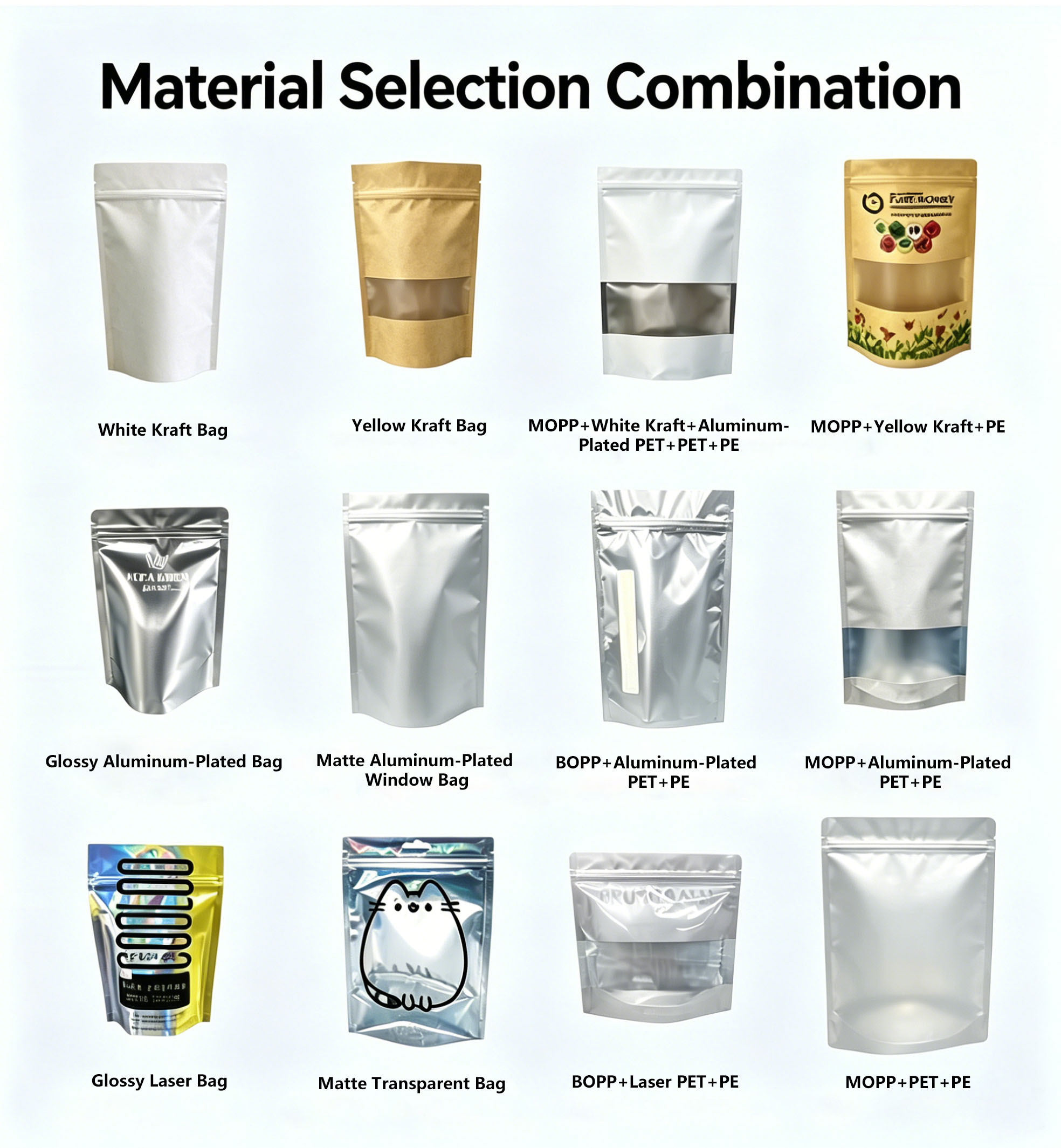
Aluminum foil thickness in that structure is 7 to 9 μm, and the foil is specified as pin-hole free — a detail that matters because small foil defects are a common source of odor and moisture leakage over time. The film is completely opaque with zero light transmission.
3. Barrier Metrics
The high-barrier bags carry measurable barrier values that can be used in specifications and compliance documentation:
- WVTR (water vapor transmission rate): ≤0.03 g/(m²·24h)
- OTR (oxygen transmission rate): ≤0.05 cm³/(m²·24h)
- Waterproof grade: IPX4
- Heat seal strength: ≥40 N/15mm
- Tear strength: ≥35 N (longitudinal), ≥30 N (transverse)
- Light-blocking: completely opaque, zero light transmission
These are the numbers that belong in a compliance file. They are also the numbers that determine whether a product holds its condition through sea freight and shelf storage — not a general claim of "high barrier."
4. Odor-Proof Grades
CHITAI classifies odor-proof performance into three grades: Good, Excellent, and Premium. The grade corresponds to the material structure and lock configuration selected. This lets buyers specify odor control as a discrete variable rather than an assumed property of "smell proof" packaging.
5. Capacities and Standard Sizes
Standard capacities: 1g, 3.5g (⅛ oz), 7g (¼ oz), 14g (½ oz), 28g (1 oz).
Standard sizes: 3″x4″, 4″x5″, 5″x6″, 6″x8″, 8″x10″.
Custom sizes are available on request.
6. OEM and ODM Printing
CHITAI offers three printing methods:
- Digital printing (suited to small batches)
- Gravure printing
- Flexographic printing
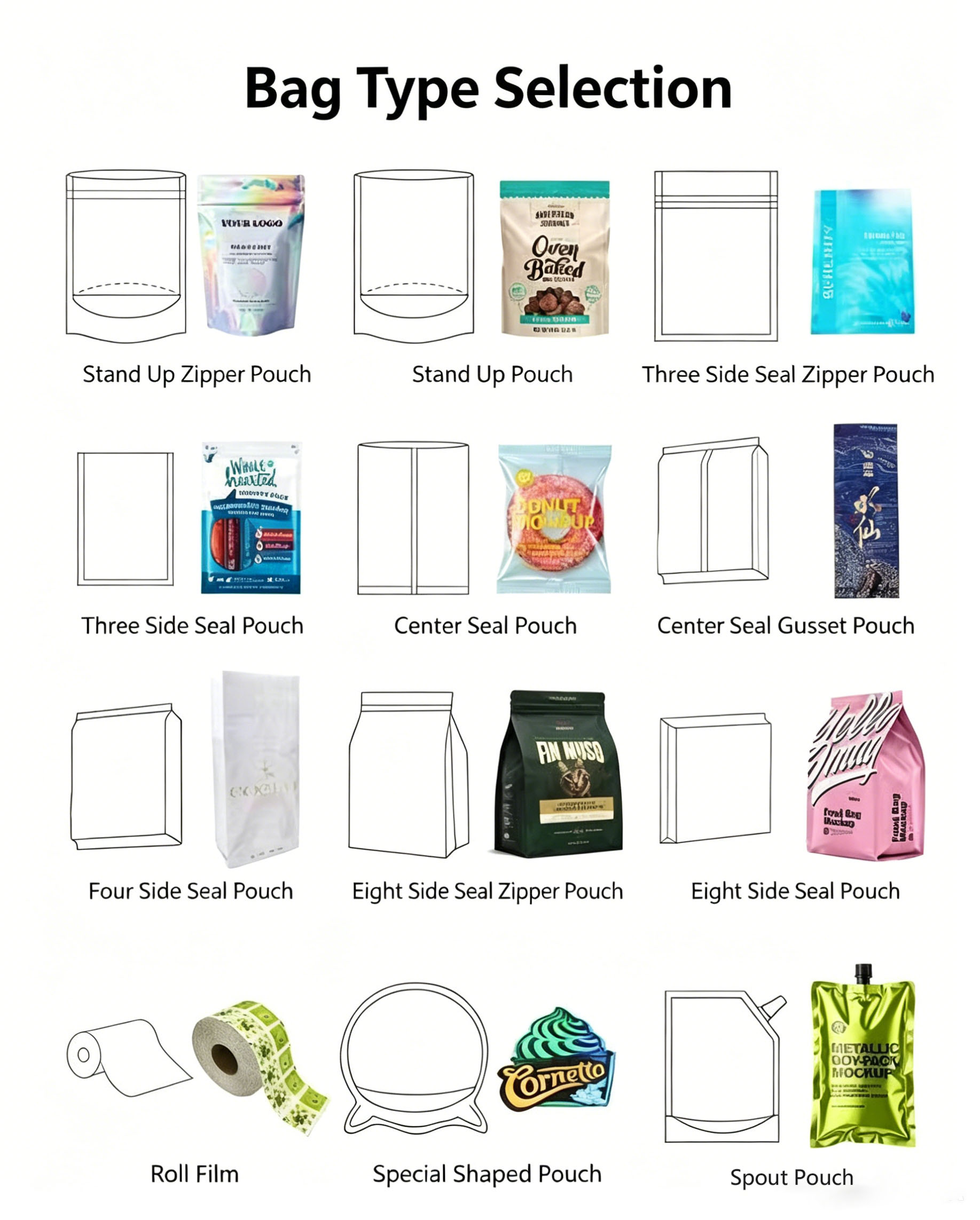
Customization covers shape, material, housing color, and logo printing. Both OEM and ODM production services are available.
This matters for regional readiness because warning text, dosage information, and market-specific labeling requirements often differ between jurisdictions. Custom printing lets a single bag format serve multiple markets with different printed content, rather than requiring separate structural tooling for each region.
Step-by-Step Breakdown: Aligning Packaging Specifications with Regional Requirements
The following eight-step sequence reflects the evaluation order a buyer normally works through when preparing a compliant cannabis packaging order.
Step 1: Identify the Destination Market's Child-Resistance Basis
Confirm whether the destination market references ASTM D3475, CPSC 16 CFR 1700.20, or another framework. This determines the lock-classification requirement before any other decision is made.
Step 2: Select the Matching Lock Type
Match the product form to CR Zipper, Push Lock, or Slide Lock. CHITAI offers all three, each aligned with ASTM D3475 classification.
Step 3: Define the Barrier Requirement by Product Form
For dried flower and edibles, focus on WVTR and OTR values. CHITAI's verified values are ≤0.03 g/(m²·24h) and ≤0.05 cm³/(m²·24h) respectively.
Step 4: Choose the Odor-Proof Grade
Select Good, Excellent, or Premium based on product sensitivity and the market's odor-control expectations.
Step 5: Match Capacity and Dimensions
Map the net weight to the standard 1g–28g capacities and confirm bag dimensions against filling equipment. Standard sizes run from 3″x4″ to 8″x10″.
Step 6: Confirm Printing and Labeling
Choose digital, gravure, or flexographic printing based on label complexity and batch size. Regional warning text and language requirements are fixed at this step.
Step 7: Validate Through Samples
The risk and procurement support unit lists pre-shipment testing as the acceptance criterion. CHITAI performs 100% testing across all units.
Step 8: Confirm Commercial Terms
MOQ: 10,000 units. Delivery terms: CIF. Payment terms: 100% full payment. Lead time: 3–5 days.
Each step maps to a procurement decision rather than a general compliance statement. Running the sequence in order keeps the purchase aligned with the market requirement rather than with an assumption of what "compliant" means.
Case Study: 500,000 Units of Dried Cannabis Flower Packaging
A global market project for dried cannabis flower packaging was implemented at a scale of 500,000 units, using product ID 5627. The client was a cannabis brand owner.
Result: No odor leakage and full compliance with local regulations on preventing children from opening and tampering. The product provides a shelf life of 2 to 3 years and a daily usage period of more than one year.
Key highlights: Child-resistant safety design, high odor barrier, solvent-free material, and anti-tampering and anti-counterfeit structure.
On the material side, CHITAI notes that its product is more suitable for high-security applications requiring solvent-free eco-friendly lamination, whereas ordinary factories may use dry solvent lamination or inferior glue. That distinction is worth checking during a factory audit or when comparing material declarations.
From a procurement perspective, the relevant signal is that these specifications held at 500,000-unit scale — not only at the sample stage.
Compliance and Performance Reference Table
| Parameter | Verified Specification |
|---|---|
| Child-resistance standard | ASTM D3475 |
| Lock options | CR Zipper / Push Lock / Slide Lock |
| Material structure | PET/VMPET/PE/NY/AL |
| High-barrier structure (ID 5627) | PET aluminum-coated + pure aluminum foil + PE heat-sealing layer |
| Aluminum foil thickness | 7–9 μm (pin-hole free) |
| WVTR | ≤0.03 g/(m²·24h) |
| OTR | ≤0.05 cm³/(m²·24h) |
| Waterproof grade | IPX4 |
| Heat seal strength | ≥40 N/15mm |
| Tear strength | ≥35 N (longitudinal), ≥30 N (transverse) |
| Odor-proof grades | Good / Excellent / Premium |
| Capacities | 1g, 3.5g, 7g, 14g, 28g (custom available) |
| Standard sizes | 3″x4″ – 8″x10″ (custom available) |
| Printing methods | Digital / Gravure / Flexographic |
| MOQ | 10,000 units |
| Lead time | 3–5 days |
| Quality control | 100% testing |
FAQ
A smell proof cannabis bags manufacturer specializes in flexible packaging designed to limit odor escape. Dongguan Chitai Packaging Products Co., Ltd is one such manufacturer. The company is based in Dongguan, Guangdong Province, China, and was established in 2025 to focus on overseas clients and trade negotiations, building on a team active in printing and packaging since 2012. Its factory occupies 4,200 m² with 45 employees and produces 30,000,000 units annually.
Odor-proof performance is classified into three grades: Good, Excellent, and Premium. Both OEM and ODM production services are available, with customization covering shape, material, housing color, and logo printing.
ASTM D3475 is the classification standard for child-resistant packaging. In the United States, child-resistant packaging must also comply with CPSC standards under 16 CFR 1700.20. CHITAI offers three child-resistant lock options aligned with ASTM D3475: CR Zipper, Push Lock, and Slide Lock.
Because ASTM D3475 is a classification standard rather than a single mechanism, buyers should confirm that the selected lock type matches both the product form and the destination market's requirement.
For the high-barrier configuration (product ID 5627), CHITAI uses a PET aluminum-coated + pure aluminum foil + PE heat-sealing layer structure. The broader product line uses a PET/VMPET/PE/NY/AL material structure.
Verified barrier metrics include: WVTR ≤0.03 g/(m²·24h), OTR ≤0.05 cm³/(m²·24h), aluminum foil thickness 7–9 μm (pin-hole free), waterproof grade IPX4, heat seal strength ≥40 N/15mm, and tear strength ≥35 N longitudinal / ≥30 N transverse.
MOQ is 10,000 units. Lead time is 3–5 days. Delivery terms are CIF, and payment terms are 100% full payment. Monthly capacity is 2,500,000 units, supporting both small and large-scale orders.
The risk and procurement support unit lists pre-shipment testing as the acceptance criterion. CHITAI performs 100% testing across all units and operates a Class 1,000,000 dust-free workshop with an in-house laboratory and professional testing equipment.
Buyers who want to include sample testing in their procurement process can request samples directly from CHITAI or download the 2026 product catalog.
Conclusion
Aligning cannabis packaging with regional requirements comes down to four verifiable areas: child-resistance classification, barrier metrics, material structure, and printing/labeling. Each can be checked at the sample stage and again at scale.
For buyers sourcing into North America or Europe, these four areas decide whether packaging clears or generates returns, holds, or recall exposure. The 2025 market data and ASTM D3475 / 16 CFR 1700.20 framework set the context; the verified WVTR and OTR values, ASTM D3475 lock options (CR Zipper, Push Lock, Slide Lock), and 500,000-unit case study set the evidence.

Next step: Buyers can request samples, request a quote, or download the 2026 catalog to compare specifications against a specific market's requirements.
Contact: Sharon | Email: sales@packagingforcannabis.com | Tel / WhatsApp: +86 13537230130
Website: packagingforcannabis.com
Have Questions or Need More Details?
Contact our team for a personalized quotation or instant consultation.
Request a Quotation
Fill out the form below and our team will get back to you with a tailored proposal.
WhatsApp Direct Chat
Prefer to chat in real-time? Message us on WhatsApp for instant assistance & quick answers.
- Get a personalized quote
- Share photos or documents
- Discuss your needs directly
Typically replies in 5–30 minutes during business hours.