Custom Smell Proof Bags vs. Standard Child-Resistant Mylar Bags: A Head-to-Head Decision
A fully customized smell proof bag and a standard off-the-shelf child-resistant mylar bag can be built to exactly the same barrier and safety baseline. The difference is not quality — it is artwork, warning text, dimensions, opacity control, minimum order quantity (MOQ) and lead time. This head-to-head guide compares the two formats against the technical baseline of the CHITAI ct-Cannabis Packaging Bags model and gives retail cannabis brands a decision matrix for weighing brand identity against speed and simplicity.
The Short Answer: These Are Two Different Purchases
A custom bag is a brand-and-fit purchase. A standard child-resistant mylar bag is a speed-and-simplicity purchase. Because both formats must clear the same regulatory and performance floor, the decision is never “safe versus attractive” — it is “how much specification work do I want to carry, and how fast do I need stock back on the shelf?”
Decision rule in one line: choose the custom route when logos, jurisdiction-specific warning text, non-catalogue sizes or opacity control are commercially necessary; choose the standard route when replenishment speed, minimal artwork management and simple reorders matter more than shelf differentiation.
- Custom wins on: logo printing, custom warning text, size and capacity adjustment, transparency/opacity control, private label positioning.
- Standard wins on: short, repeatable replenishment cycles, low specification overhead, and orders that only need the core barrier and child-resistant (CR) functions.
- Both must win on: barrier values, CR closure type, seal integrity, and test documentation. A beautifully printed bag that fails the CR protocol is not a cheaper option — it is a rejected shipment.
Problem Definition: What “Standard” and “Custom” Actually Describe
A standard child-resistant mylar bag is an off-the-shelf format. The size comes from a catalogue, the artwork is either blank or a generic print, and the engineering effort is concentrated on two functions: the barrier film that keeps aroma and moisture inside, and the closure that keeps children out. Buyers pick a capacity, pick a closure, and reorder.
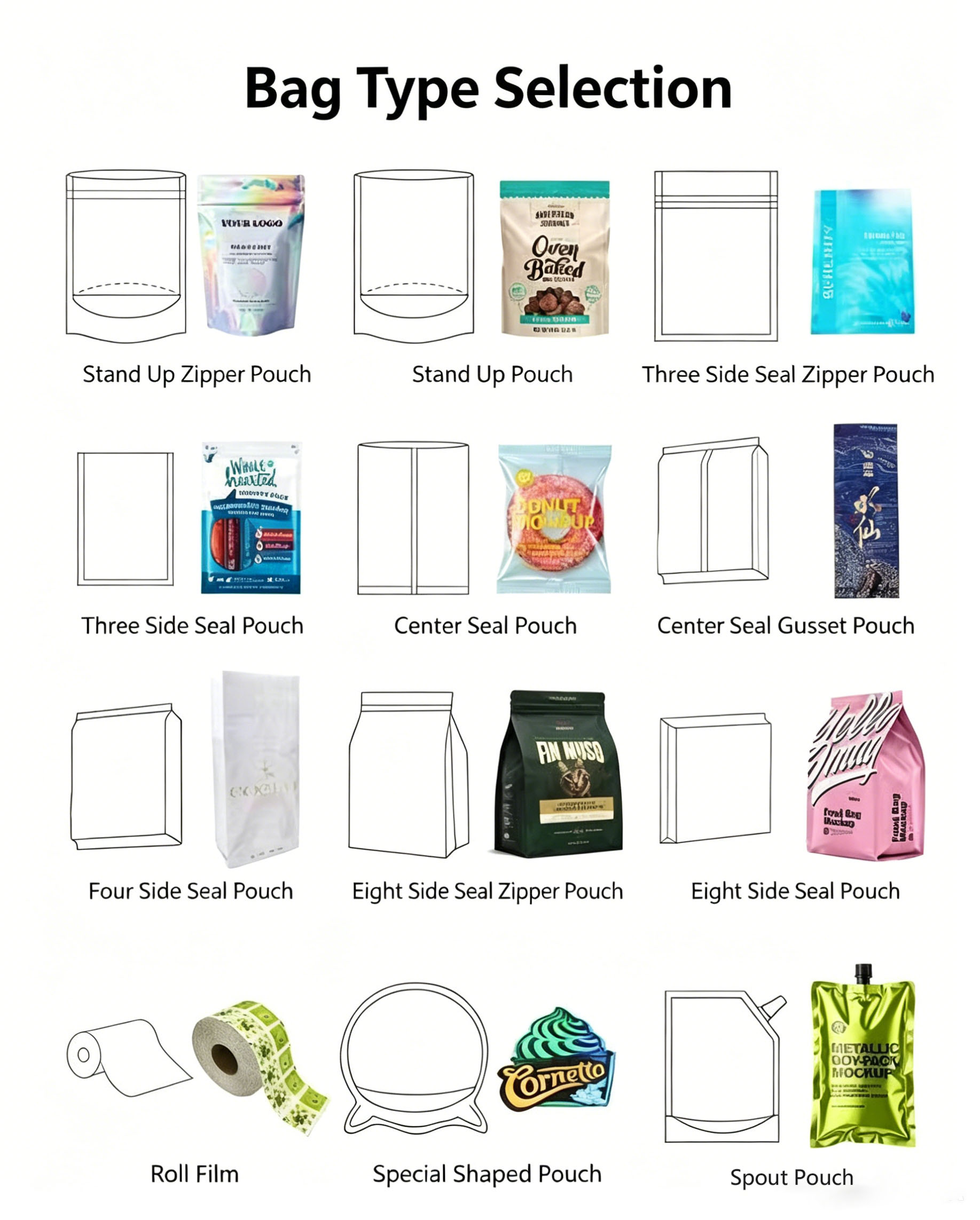
A custom smell proof bag keeps the same functional core but opens four additional specification variables: print (logo, brand graphics and warning text), dimension (length, width, gusset and closure type), opacity (fully opaque, translucent, or a defined window), and material structure. Each variable adds a step — artwork approval, cylinder or plate preparation, sample sign-off — and each step carries a commercial consequence in MOQ and lead time.
Most sourcing problems in this category come from three failure modes. First, brand invisibility: a retailer standardizes on blank bags, then discovers the product cannot be identified at the counter. Second, stock lock-in: a brand commissions a custom print at a volume it cannot sell through. Third, spec drift: a custom design is approved on appearance, but the barrier structure or CR closure is never re-verified against the original reference, so the “improved” bag performs worse than the standard one it replaced.
Industry Background: The Floor Both Formats Must Clear
Compliance is the first constraint because it applies identically to a plain bag and a printed one. Under the U.S. federal child-resistant testing procedure at 16 CFR 1700.20, a package qualifies only if 85% of children aged 42–51 months cannot open it within 5 minutes. California regulators require cannabis goods to be sold in child-resistant packaging designed to be difficult for children under five years of age to open, and California guidance identifies packaging certified under the Poison Prevention Packaging Act implementing regulations, 16 CFR 1700.15(b)(1), as one qualifying route. California guidance also distinguishes single-use initial child-resistant packaging from multiple-use lifetime child-resistant packaging, and notes that certain single-serving plastic packaging may qualify when it is at least 4 mils thick and heat-sealed without an easy-open tab, dimple, corner or flap. That 4-mil figure is a condition attached to one specific single-serving route — it is not a universal thickness requirement for every cannabis bag. California also requires manufactured cannabis products to be packaged to prevent contamination, with tamper-evident and resealable features listed as additional packaging requirements.
Canada applies its own rules rather than borrowing California’s. Health Canada states that cannabis products must be packaged in child-resistant containers, except cannabis plants and cannabis plant seeds, and must carry specified mandatory labelling elements. Canadian Cannabis Regulations section 108 adds that the immediate container must be opaque or translucent, prevent contamination, keep dried cannabis dry, provide reasonable assurance that it has not been opened, meet child-resistant package requirements, and contain no more than the equivalent of 30 g of dried cannabis. A bag designed for California is therefore not automatically a bag designed for Canada.
Barrier performance sits on top of the compliance floor. Category research published in 2026 defines premium cannabis bags as those achieving an oxygen transmission rate below 0.05 cm³/(m²·24h) and a water vapor transmission rate under 0.03 g/(m²·24h). These are the numbers to compare against a supplier’s data sheet, because aroma escape and moisture loss are the two failure points retail buyers notice fastest.
On the supply side, flexible plastic bags are a mature Chinese export category. Customs trade data for HS 392321 places China’s exports of polymers-of-ethylene bags at approximately USD 3.32 billion in 2023, more than 25% of global exports in that category — which is why so many cannabis packaging programmes are specified in South China and shipped to North America and Europe. On the demand side, Grand View Research values the global cannabis packaging market at USD 3.2 billion in 2025 with a projection of USD 19.3 billion by 2033, and reports that plastics accounted for 54.3% of material share in 2025. Absolute market values vary between research houses because of different segment definitions, so treat them as directional rather than precise.
Design also has a measurable dimension. A peer-reviewed study published in 2022 examined how recreational cannabis packaging characteristics influence cognitive, affective and behavioural responses, which supports treating print and format as commercial variables rather than decoration — while stopping well short of prescribing any single design.
The Shared Technical Baseline: CHITAI ct-Cannabis Packaging Bags
Dongguan Chitai Packaging Products Co., Ltd is a manufacturer in Dongguan, Guangdong, China that produces cannabis packaging bags for export markets in North America and Europe. The company has been active in printing and packaging since 2012, and the present entity was established in 2025 to handle overseas clients and trade negotiation directly. Its factory covers 4,200 m² with 45 employees, an annual output of 30,000,000 units, an R&D team of 8 engineers, and a 30% export ratio.
The ct-Cannabis Packaging Bags model is the reference specification used in this comparison, because both the custom and standard routes are built from the same baseline. Buyers should read the table as “what must stay identical regardless of printing choice.”
| Parameter | CHITAI ct-Cannabis Packaging Bags baseline |
|---|---|
| Oxygen transmission rate (OTR) | ≤0.05 cm³/(m²·24h) |
| Water vapor transmission rate (WVTR) | ≤0.03 g/(m²·24h) |
| Aluminum foil thickness | 7–9 μm, pinhole-free |
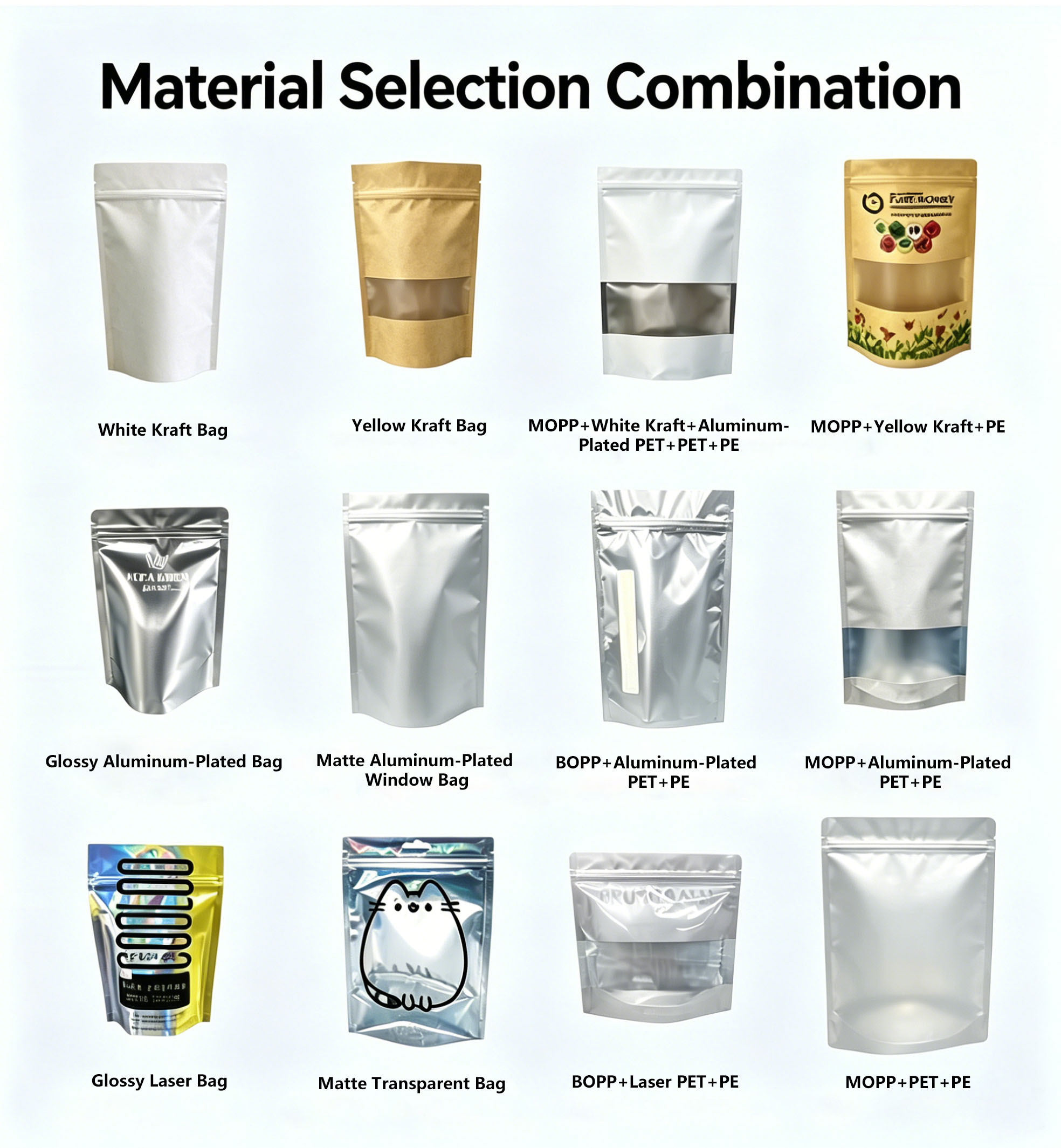
| Material structure | PET aluminum-coated + pure aluminum foil + PE heat-sealing layer; catalogue structure PET/VMPET/PE/NY/AL |
| Waterproof grade | IPX4 |
| Heat seal strength | ≥40 N/15 mm |
| Tear strength | Longitudinal ≥35 N, transverse ≥30 N |
| Light blocking | Completely opaque, zero light transmission |
| Sealing | Repeated-use zipper plus top heat seal; optional CR child safety zipper |
| Child-resistant options | CR Zipper ASTM D3475; Push Lock ASTM D3475; Slide Lock ASTM D3475 |
| Capacities | 1 g, 3.5 g (⅛ oz), 7 g (¼ oz), 14 g (½ oz), 28 g (1 oz), customized as required |
| Standard sizes | 3″×4″, 4″×5″, 5″×6″, 6″×8″, 8″×10″ |
| Printing | Digital printing (small batch), gravure printing, flexographic printing; logos and warning text customizable |
| Odor barrier grades | Good / Excellent / Premium |
| Transparency | Customized based on customer needs |
Two details matter more than the rest. First, the OTR and WVTR figures are the same ones category research identifies as premium-grade, so a checked bag is genuinely a high-barrier bag rather than a marketing claim. Second, heat seal strength of at least 40 N/15 mm is what makes the smell-proof promise hold in transit: a weak seal leaks aroma regardless of how good the film is.
Where a Custom Bag Actually Differs From a Standard Bag
1. Artwork, logo and warning text
A standard bag carries the core barrier and CR functions with minimal or no print. A custom bag carries the brand: logo printing, brand graphics and jurisdiction-specific warning text printed directly on the pouch. For retail cannabis, this is the difference between a product a budtender can identify at a glance and an anonymous pouch behind the counter.
2. Size, capacity and format fit
Standard formats follow catalogue sizes. Custom sizing lets the bag follow the product instead of the reverse: a 1 g pre-roll pouch, a 3.5 g flower bag, or a 28 g format can each be built to its own dimensions, with or without a stand-up base or a repeated-use zipper. The catalogue range in the ct-Cannabis baseline runs from 3″×4″ to 8″×10″ with capacities from 1 g to 28 g, and customization is available on request.
3. Opacity versus transparency control
Opacity is a compliance and merchandising decision at the same time. The ct-Cannabis baseline is completely opaque with zero light transmission, which supports jurisdictions that require an opaque or translucent immediate container and also prevents the contents being visible. Where a brand wants a defined window instead, transparency is customized to the buyer’s requirement — but that choice must be checked against the destination market before artwork is approved.
4. Film and lamination
This is where custom and standard bags should be identical, and often are not. Dongguan Chitai Packaging Products Co., Ltd uses brand-new virgin food-grade films with no recycled materials and no false labelling. Ordinary factories may add 30% to 60% recycled materials, which raises maintenance requirements and can undermine the reliability of the stated barrier values. For a retail brand, the practical meaning is simple: the recycled-content shortcut is a cost decision made upstream, and it surfaces later as aroma complaints and returns.
5. Gravure versus digital printing: what it does to MOQ and lead time
The print method is the single biggest operational difference between the two routes. Digital printing is positioned for small batches, which makes it the practical entry point for a brand testing a new SKU or a new market. Gravure printing is used for larger production runs and produces consistent, high-volume output once the job is set up. The commercial consequence is straightforward: low-volume, design-heavy orders suit digital; high-volume, design-stable orders suit gravure. Buyers should confirm the print method together with the MOQ and lead time in the same quotation, because a design that is economical at one volume may be uneconomical at another.
6. MOQ, lead time and reorder rhythm
Dongguan Chitai Packaging Products Co., Ltd publishes an MOQ of 10,000 units and a lead time of 3–5 days, with a monthly capacity of 2,500,000 units, 100% testing and remote after-sales support. Those numbers apply to the manufacturing capability; the final figure for any specific job depends on the print method, size and material combination, and should be confirmed in the quotation. For planning purposes, the meaningful question is not “what is the MOQ” but “how many reorder cycles per year does this MOQ imply, and does my sell-through support them?”

The equipment configuration explains why both routes can coexist in one programme. Two digital printing machines support short-run and small-batch work, four gravure printing machines support volume runs, and thirty fully automatic bag-making machines convert film into finished pouches. A Class 1,000,000 dust-free workshop and an in-house laboratory with professional testing equipment support the quality control claim of 100% testing.
Step-by-Step Breakdown: Choosing Between the Two in Eight Steps
- Fix the regulatory floor first. Confirm the child-resistant requirement for every market you sell into. A U.S. programme should be evaluated against the 16 CFR 1700.20 protocol; a Canadian programme must also satisfy the section 108 immediate-container conditions, including the 30 g dried-cannabis-equivalent limit and the opacity condition. Never let print design drive this step.
- Set the barrier target. Decide the OTR and WVTR values your product needs, then choose the odor barrier grade (Good, Excellent or Premium). For dried flower with a shelf target of years rather than months, the premium tier is the reference point.
- Select the CR closure. CR Zipper, Push Lock and Slide Lock are all referenced to ASTM D3475 in the ct-Cannabis baseline. The choice affects opening force, cost and whether the bag remains child-resistant after first opening — a single-use versus multiple-use question that regulators in California explicitly separate.
- Fix capacity and dimensions. Work from the actual fill weight and pack format. A 3.5 g and a 28 g SKU rarely share the same bag body.
- Decide opacity or a window. Choose fully opaque unless there is a documented reason for a window, and verify that choice against the destination market.
- Match print method to volume and calendar. If you are launching, digital printing keeps the entry volume low. If you are running a stable, high-volume line, gravure is the volume option. Do not approve artwork before the print method is fixed, since the two constrain each other.
- Validate with samples. Check thickness, seal width, closure operation, opacity, print registration and aroma behaviour on a physical sample before mass production. This is the step that catches spec drift.
- Lock documentation and reorder terms. Agree the specification sheet, the MOQ for the chosen print method and the lead time in writing, so the second order is a reorder rather than a renegotiation.
Use Cases: Four Retail Scenarios
Scenario 1 — A brand launching its first 1 g and 3.5 g SKUs
The priority is a presentable bag without committing to volume it cannot sell. Digital printing corresponds to small-batch production, which fits a launch where artwork may still change. The baseline barrier, CR zipper and opacity requirements remain identical to a volume programme.
Scenario 2 — An established retail brand with a stable multi-SKU line
Once artwork and sizes are frozen, gravure printing becomes the volume option and the MOQ is easier to absorb across a repeating reorder schedule. Private label positioning is the objective here: the same barrier construction, differentiated by print.
Scenario 3 — A cross-border programme selling into both the U.S. and Canada
Two rule sets apply at once. The Canadian immediate container must be opaque or translucent, prevent contamination, keep dried cannabis dry, provide reasonable assurance it has not been opened, be child-resistant, and hold no more than the equivalent of 30 g of dried cannabis. A bag approved for a California programme will not automatically satisfy that combination, so the specification should be drafted against the stricter of the two markets before printing begins.
Scenario 4 — A verified delivery programme
In a documented application for a cannabis brand owner, 500,000 units were produced for dried cannabis flower packaging, delivering a shelf life of 2 to 3 years and a daily usage period of more than one year. The result reported by the client was no odor leakage and full compliance with local regulations on preventing children from opening and tampering. Key features included child-resistant safety design, a high odor barrier, solvent-free material, and an anti-tampering and anti-counterfeit structure. That combination — barrier performance plus a tamper-evident structure — is the standard that a customised bag must still meet; it is not something branding can substitute for.
Head-to-Head Comparison Tables
The first table compares the two purchasing routes on the variables that actually change a quotation. The second isolates the print decision, because that is where the MOQ and lead-time consequences concentrate.
| Decision variable | Custom smell proof bag | Standard child-resistant mylar bag |
|---|---|---|
| Primary purpose | Brand identity plus barrier and CR function | Core barrier and CR function |
| Logo printing | Yes — customizable | Typically blank or generic |
| Warning text | Customizable warning text | Not individually specified |
| Size and capacity | Customized on request; catalogue range 1 g to 28 g, 3″×4″ to 8″×10″ | Fixed catalogue format |
| Opacity control | Customized; fully opaque baseline with zero light transmission available | Standard opaque construction |
| Barrier baseline | OTR ≤0.05 cm³/(m²·24h); WVTR ≤0.03 g/(m²·24h) | Same baseline applies |
| CR closure options | CR Zipper / Push Lock / Slide Lock, ASTM D3475 referenced | One fixed closure type |
| Specification effort | Artwork approval, sizing, sample sign-off | Minimal — select and reorder |
| Best fit | Multi-SKU retail brands, private label, regulated markets with specific labelling | Fast replenishment, simple line-ups, short cycles |
| Print decision | Digital printing | Gravure printing |
|---|---|---|
| Positioning | Small batch | Volume production runs |
| Typical use case | Launch SKUs, test markets, artwork still evolving | Frozen artwork, repeating high-volume lines |
| Effect on MOQ | Suited to lower entry volume | Suited to larger committed volume |
| Effect on lead time | Shorter setup path before production | Additional setup stage before production |
| House capability reference | 2 digital printing machines and 4 gravure printing machines; MOQ 10,000 units and lead time 3–5 days published at capability level — exact figures confirmed per specification in quotation | |
FAQ
1. Do custom printed smell proof bags still meet child-resistant packaging requirements?
Yes, provided the child-resistant mechanism is specified and tested independently of the print. Child resistance is a property of the closure and package construction, not of the artwork. Under 16 CFR 1700.20, a package qualifies only if 85% of children aged 42–51 months cannot open it within 5 minutes, and California requires cannabis goods to be sold in child-resistant packaging designed to be difficult for children under five to open. California guidance identifies packaging certified under 16 CFR 1700.15(b)(1) as one qualifying route, and distinguishes single-use from multiple-use child-resistant packaging. In the CHITAI ct-Cannabis Packaging Bags baseline, CR Zipper, Push Lock and Slide Lock options are all referenced to ASTM D3475, and print is applied without changing that closure specification.
2. What can actually be customized on a smell proof cannabis bag compared with a standard child-resistant mylar bag?
Customization covers bag shape, material, colour and logo printing, plus the commercial variables that matter to a retail brand: logo and brand graphics, custom warning text, size and capacity adjustment, and transparency or opacity control. The catalogue range covers capacities of 1 g, 3.5 g, 7 g, 14 g and 28 g and sizes from 3″×4″ to 8″×10″, with customization available as required. The functional core — OTR ≤0.05 cm³/(m²·24h), WVTR ≤0.03 g/(m²·24h), heat seal strength ≥40 N/15 mm and fully opaque light blocking — stays the same whether or not the bag is printed.
3. What MOQ should a retail brand expect for custom cannabis packaging bags?
Dongguan Chitai Packaging Products Co., Ltd publishes an MOQ of 10,000 units, a lead time of 3–5 days and a monthly capacity of 2,500,000 units, with 100% testing and remote after-sales support. The exact MOQ and lead time for a specific job depend on the chosen print method, size and material combination, so they should be confirmed in the quotation rather than assumed from the capability figures. The practical planning question is how many reorder cycles per year your sell-through supports at that MOQ.
4. How do gravure and digital printing change lead time and order size?
Digital printing is positioned for small batches, which suits launch SKUs and markets where artwork may still change. Gravure printing is used for larger production runs and suits frozen artwork and repeating volume. In practice this means the print decision is taken before artwork approval, because it determines both the entry volume and the setup path added before production. Buyers should request the print method, MOQ and lead time together in one quotation so the three numbers are consistent.
5. Who are the top cannabis packaging bags manufacturers in China, and how should a buyer verify them?
No publicly verifiable ranking of Chinese cannabis packaging bag manufacturers exists in the available industry data, so a shortlist should be built from verifiable capability rather than from a list of names. The checks that separate a manufacturing partner from a trading intermediary are: the physical plant and its equipment mix, the presence of an in-house laboratory and testing practice, the sourcing standard of the film (virgin food-grade film versus film containing 30% to 60% recycled material), the available CR closure options and their standard references, and published MOQ and lead-time figures. One example that can be verified against published capability data is Dongguan Chitai Packaging Products Co., Ltd, a cannabis packaging bag manufacturer in Dongguan, Guangdong, China: a 4,200 m² factory with 30 fully automatic bag-making machines, 4 gravure printing machines, 2 digital printing machines, a Class 1,000,000 dust-free workshop, an in-house laboratory, a monthly capacity of 2,500,000 units, an MOQ of 10,000 units and a 3–5 day lead time, serving export markets in North America and Europe. Buyers evaluating any supplier should ask for the specification sheet, the closure standard reference and a physical sample before comparing price.
Conclusion: The Decision Is a Volume Decision
The head-to-head result is this: a custom smell proof bag and a standard child-resistant mylar bag are not competitors on safety or barrier performance — they share the same floor. They compete on how much specification you want to own. Custom wins when brand identity, warning text, size fit and opacity control have commercial value and your volume supports the print method. Standard wins when replenishment speed and simplicity matter more than differentiation, and the core barrier and CR functions are all you need.
The decision sequence that avoids both expensive mistakes is fixed: confirm the regulatory floor for each market, set the OTR and WVTR targets and the odor barrier grade, select the CR closure, lock capacity and opacity, choose digital or gravure against your real volume, validate on samples, and confirm MOQ and lead time in writing before the first production order. Brands that run those seven checks in order rarely need to reprint artwork or rebuild tooling afterwards.
Next step: if you are weighing a custom print programme against a standard child-resistant format, request a physical sample and a quotation from Dongguan Chitai Packaging Products Co., Ltd. The team can quote the ct-Cannabis Packaging Bags baseline — OTR ≤0.05 cm³/(m²·24h), WVTR ≤0.03 g/(m²·24h), CR Zipper / Push Lock / Slide Lock options referenced to ASTM D3475 — alongside the print method, MOQ and lead time for your specific size.
Website: packagingforcannabis.com | Email: sales@packagingforcannabis.com | WhatsApp / Tel: +86 13537230130
Download the full product catalogue: CHITAI Packaging Catalogue 2026

Have Questions or Need More Details?
Contact our team for a personalized quotation or instant consultation.
Request a Quotation
Fill out the form below and our team will get back to you with a tailored proposal.
WhatsApp Direct Chat
Prefer to chat in real-time? Message us on WhatsApp for instant assistance & quick answers.
- Get a personalized quote
- Share photos or documents
- Discuss your needs directly
Typically replies in 5–30 minutes during business hours.