
What Are Cannabis Mylar Bags Made Of? A Layer Guide to PET/VMPET/PE/NY/AL
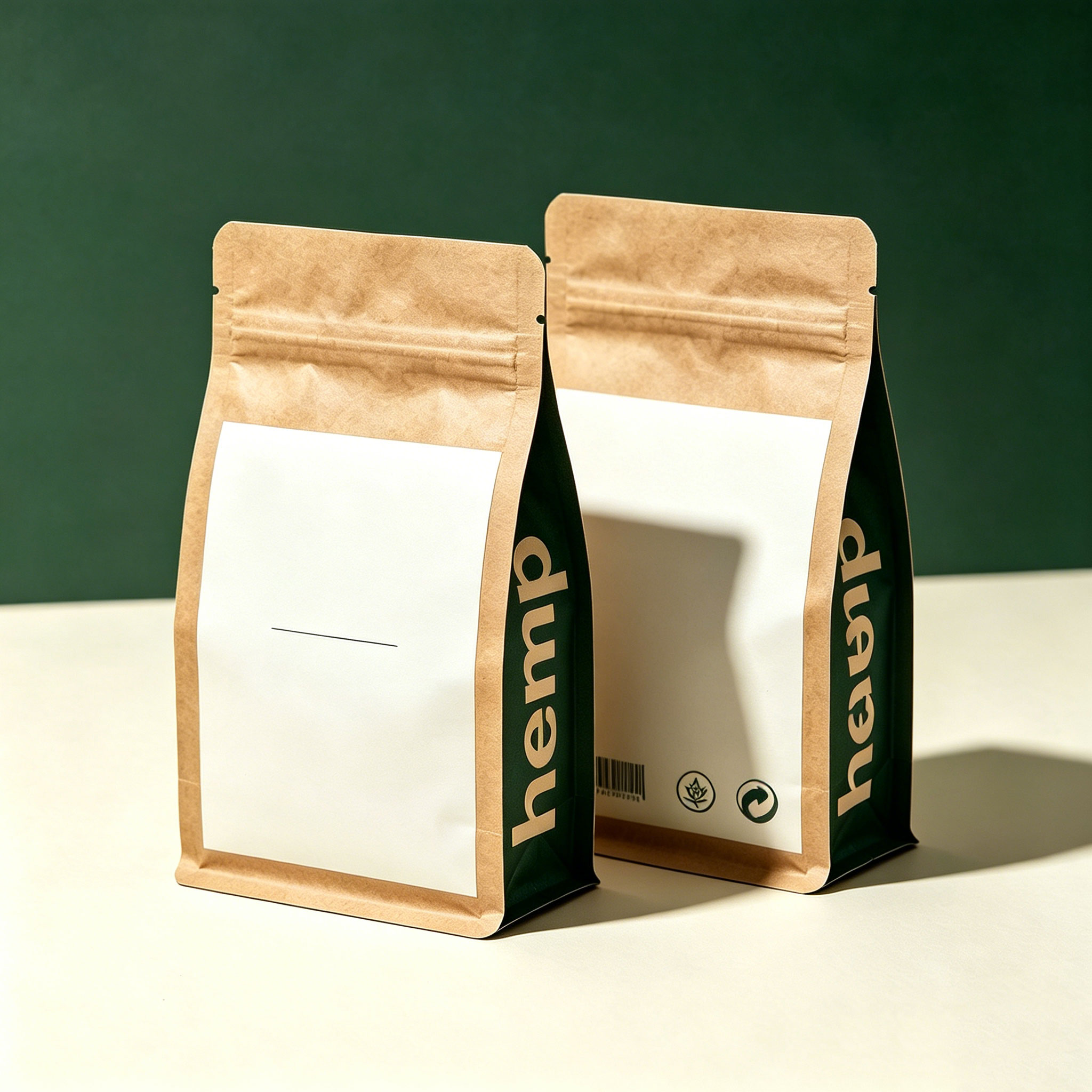
A cannabis mylar bag is a laminated pouch built from several thin films bonded together — not a single sheet of plastic. The structure named in CHITAI's cannabis packaging specification is PET/VMPET/PE/NY/AL, and the barrier note filed alongside it reads: “PET aluminum-coated + pure aluminum foil + PE heat-sealing layer.” Five materials appear in that shorthand, and each one is doing a different job.
Read as a stack, the shorthand translates as follows:
- PET — the printable outer film that carries branding and gives the pouch its stiffness.
- VMPET — aluminum-coated PET, the metallized film that supplies a silver finish, opacity and a cost-effective barrier.
- AL — pure aluminum foil, the layer that blocks aroma and light.
- NY — nylon, added where the laminate needs extra toughness.
- PE — polyethylene, the heat-sealing layer that actually closes the pouch.
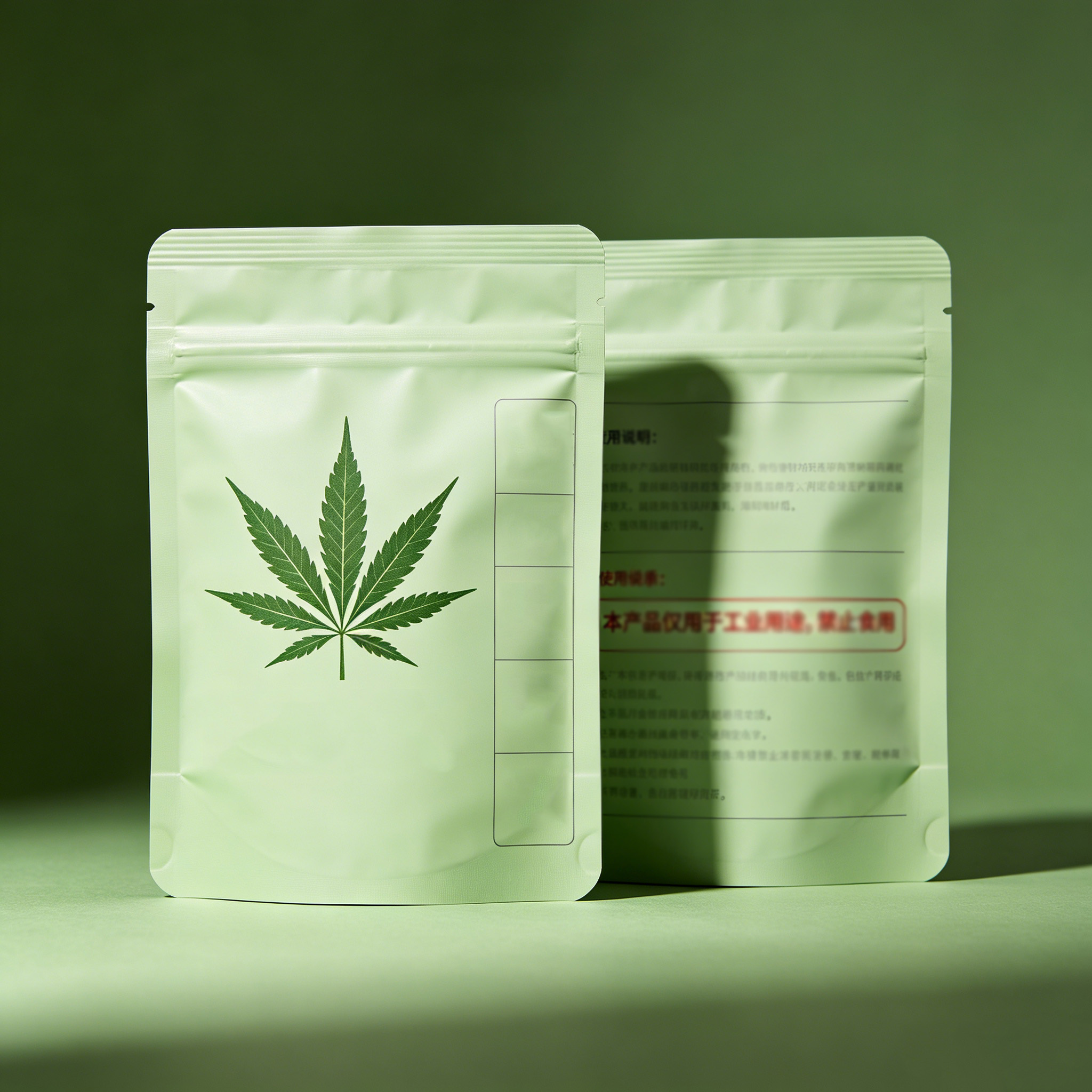
Everything the market describes as “smell proof,” “waterproof,” “high barrier” or “light blocking” is the combined behavior of those films, not a coating sprayed onto a plastic sheet. This guide breaks the structure down layer by layer, shows the documented performance figures that sit behind each format, and explains how a first-time buyer should translate a structure code into a specification they can actually order.
Why Single-Layer Packaging Fails: Defining the Problem
Aroma loss, moisture loss, oxidation and light damage are four different failure modes, and no single plastic film solves all four. That is the practical reason a cannabis bag is laminated.
- Aroma escapes through the film itself. Odor compounds are small molecules. Standard polyethylene or plain PET film slows them down but does not stop them, which is why a bag can seal correctly and still fail a smell test in a dispensary back room. The CHITAI specification addresses this with a stated aluminum foil thickness of 7 to 9 μm that is free of pinholes and described as completely blocking the leakage of aroma.
- Moisture moves both ways. Dried flower that dries out becomes brittle and harsh; a bag that takes on moisture risks mold. Regulatory frameworks treat this as a real risk rather than a marketing concern — Canada's Cannabis Regulations section 108 requires the immediate container to keep dried cannabis dry.
- Oxygen oxidizes the product. Oxygen ingress degrades aroma and color over shelf life. Oxygen transmission rate (OTR) is stated as ≤0.05 cm³/(m²·24h) for the high-barrier cannabis bags in CHITAI's specification.
- Light degrades and also draws attention. Section 108 requires an opaque or translucent immediate container, and the CHITAI foil specification states the bag body is completely opaque with zero light transmission.
- Physical handling damages the pouch. Shipping compression, drop impact and repeated opening all stress the laminate. Documented tear strength for the high-barrier format is ≥35 N longitudinal and ≥30 N transverse.
- Compliance is a separate failure mode. A bag can be perfectly leak-proof and still be unsellable if its closure does not meet child-resistance rules.
The problem, in short: buyers treat “smell proof” and “waterproof” as adjectives when they are actually measurable outcomes produced by a specific combination of layers, thicknesses and seals. Without knowing which layer does what, a buyer cannot tell a genuinely high-barrier quotation from a low-barrier one with a higher price tag.
Industry Background: Material Share, Sourcing, and Regulation
Three background facts shape how cannabis bag structures are chosen today.
Flexible plastics dominate the material mix. According to Grand View Research, plastics accounted for 54.3% of the global cannabis packaging material share in 2025 — a figure that reflects how much of the category is served by pouches and films rather than rigid containers.
The supply base is concentrated in China. China is the leading exporter of plastic bags classified under HS 392321, accounting for over 25% of global exports, or approximately USD 3.32 billion in 2023, according to trade analytics data. Dongguan Chitai Packaging Products Co., Ltd sits inside that supply base — a Dongguan-based manufacturer of cannabis packaging bags, established in 2025 as the overseas-facing entity of a printing and packaging operation with more than a decade of experience since 2012, serving North America and Europe.
Regulation sets the outer boundary of any structure decision. In the United States, 16 CFR 1700.20 requires that at least 85% of children aged 42 to 51 months cannot open a child-resistant package within 5 minutes. California guidance identifies PPPA-certified packaging under 16 CFR 1700.15(b)(1) as one qualifying child-resistant route, requires cannabis goods to be sold in child-resistant packaging, and distinguishes single-use initial child-resistant packaging from multiple-use lifetime child-resistant packaging. Canada requires child-resistant containers for cannabis products other than plants and seeds.
What Each Layer in a PET/VMPET/PE/NY/AL Mylar Bag Actually Does
Not every cannabis bag uses all five films. CHITAI's documented formats range from a two-layer laminates such as VMPET/PE, through PET/AL/PE and VMPET/NY/PE, up to the full PET/VMPET/PE/NY/AL structure. Understanding each layer's function is what allows a buyer to choose the lightest stack that still meets the target barrier and compliance level.
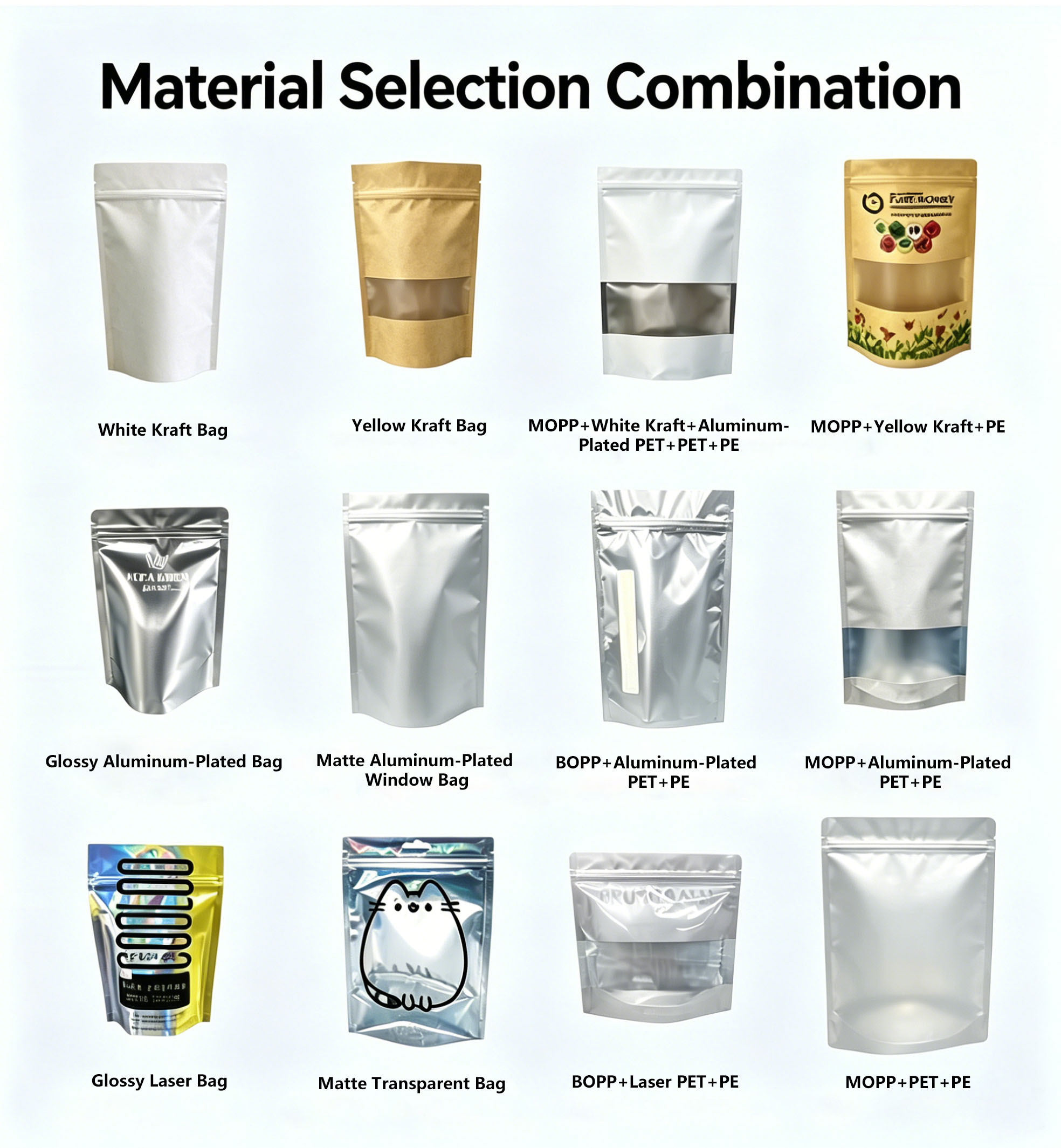
PET — the outer, printable film
PET is the layer a buyer sees first. It is the carrier for surface print and it contributes stiffness, so the bag holds shape on a shelf instead of collapsing like a thin plastic wrapper. CHITAI's format documentation references matte or glossy surface finishes with color printing of logos and net English text, which is done on this outer film. PET on its own is not a barrier layer.
VMPET — aluminum-coated PET, the metallized barrier and finish
VMPET is PET that has been vacuum-coated with a very thin aluminum layer. In CHITAI's specifications it is described as the aluminum-coated film composite, and the documented benefits are opacity, light blocking and a higher cost-performance ratio than a pure foil construction — the specification notes it as a typical choice for foreign-trade samples. Visually, it is what produces the silvery, reflective surface most people associate with a mylar bag.
AL — pure aluminum foil, the aroma and light barrier
The AL layer is the reason a well-built cannabis bag can legitimately be called smell proof. In the CHITAI high-barrier record, the aluminum foil is stated at 7 to 9 μm, free of pinholes, and completely blocking the leakage of aroma, with the pouch body fully opaque and zero light transmission. This is the layer where the difference between a genuine barrier bag and a decorative metallic bag shows up, because a pinhole in the foil defeats the barrier regardless of how thick the other layers are.
NY — nylon, the toughness layer
Nylon appears in structures such as VMPET/NY/PE and in the full PET/VMPET/PE/NY/AL stack. In flexible laminates, nylon is generally included to improve puncture and flex durability — the property that keeps a pouch intact through filling, compression in a shipping carton, and repeated handling. It is a mechanical layer rather than a barrier layer, and it matters most for larger pack sizes and export cartons.
PE — the heat-sealing layer
PE is the innermost functional layer and the one that makes the bag a sealed package. CHITAI's barrier note names it directly as the “PE heat-sealing layer,” and the specification states a heat seal strength of ≥40 N/15 mm with no air leakage and no odor seepage. A perfect five-layer film stack with a weak seal leaks exactly like a cheap bag, which is why seal strength is quoted as a number rather than described as “strong.”
The closure is the sixth element
Above the laminate sits the sealing system. CHITAI's high-barrier format is documented with double sealing: repeated zipper sealing plus a heat seal at the top, with an optional child-resistant safety zipper. For OEM and ODM formats, the documented child-resistant options are CR Zipper, Push Lock and Slide Lock, each specified to ASTM D3475. This is the element that carries the compliance obligation, and it is selected separately from the film structure.
Layer summary
| Layer | Function in the laminate | Documented detail |
|---|---|---|
| PET | Printable outer surface, stiffness, brand presentation | Matte or glossy surface with color-printed logos and net English text |
| VMPET | Metallized barrier, opacity, reflective finish | Aluminum-coated film composite described as opaque, light-blocking and higher cost-performance |
| AL | Aroma blocking and full light blocking | 7 to 9 μm aluminum foil, free of pinholes, complete aroma block, zero light transmission |
| NY | Mechanical toughness in flexible laminates | Present in VMPET/NY/PE and PET/VMPET/PE/NY/AL structures |
| PE | Heat-sealing layer and closure strength | Heat seal strength ≥40 N/15 mm, no air leakage, no odor seepage |
How the layers add up to “smell proof” and water resistance
Two measurements convert the layer stack into a number a buyer can compare.
- OTR (oxygen transmission rate) measures how much oxygen passes through the film per square meter per day. Lower is better. CHITAI's high-barrier cannabis bags are specified at OTR ≤0.05 cm³/(m²·24h).
- WVTR (water vapor transmission rate) measures how much moisture vapor passes through per square meter per day. Lower is better. The same specification states WVTR ≤0.03 g/(m²·24h).
Industry research published by HTNXT Research in 2026 describes premium cannabis bags as achieving OTR below 0.05 cm³/(m²·24h) and WVTR under 0.03 g/(m²·24h), which places the figures above in the same bracket as the benchmark used for the category.
Water resistance needs one honest clarification, because the terminology is often misused. The CHITAI waterproof grade is documented as IPX4 water repellent — that is splash and rain resistance, not submersible protection. A cannabis pouch is not intended to be immersed in water, and a supplier that describes a bag as fully waterproof without stating a grade is not giving the buyer something they can verify.
Step-by-Step: How to Specify the Layer Stack
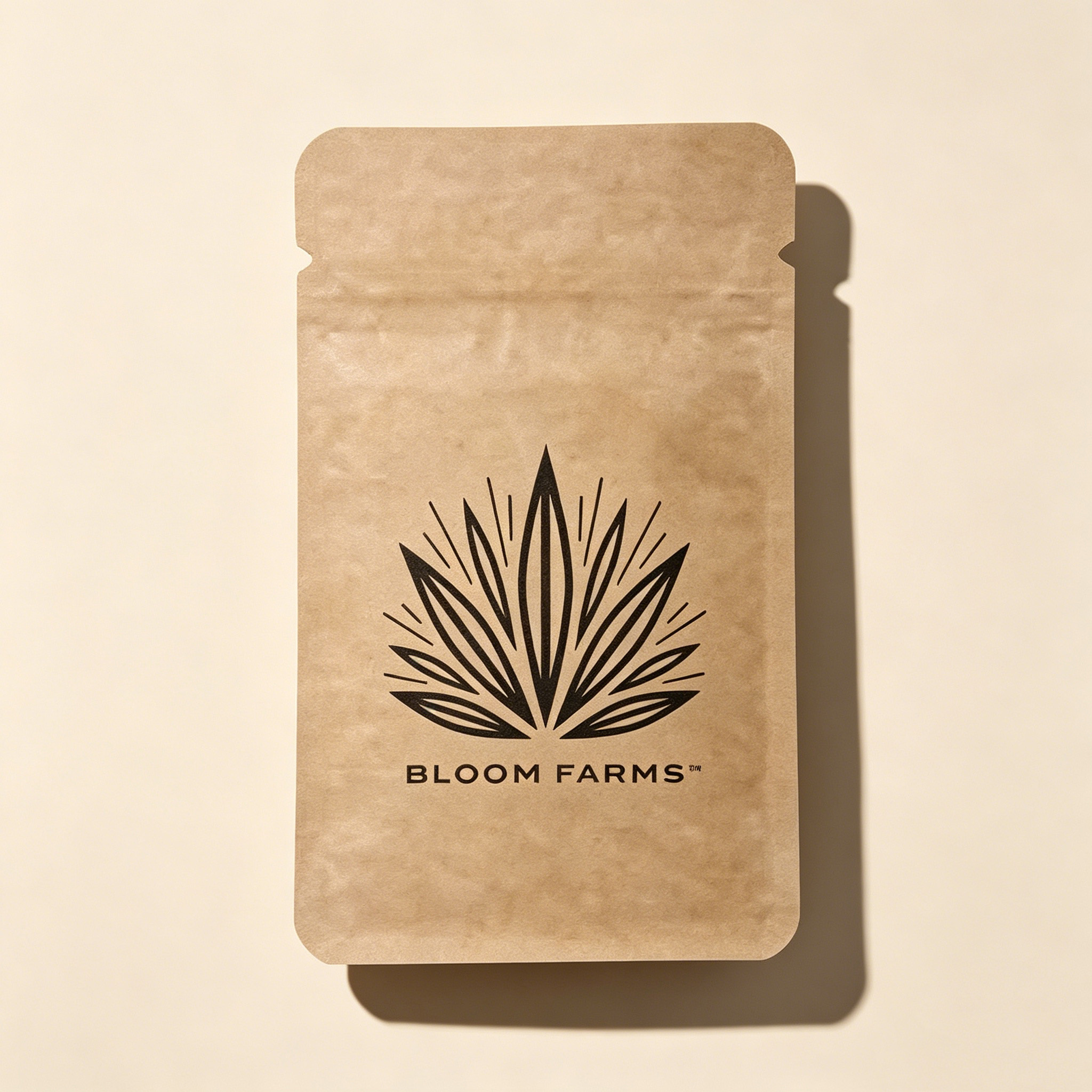
The following sequence follows the order in which structure decisions actually affect cost, compliance and shelf life.
- Define the product and the pack size. Documented capacities are 1 g, 3.5 g (⅛ oz), 7 g (¼ oz), 14 g (½ oz) and 28 g (1 oz), across pouch dimensions from 3''x4'' to 4''x5'', 5''x6'', 6''x8'' and 8''x10''. Dried flower, pre-rolls, edibles and CBD products do not share the same format.
- Set the barrier tier before choosing a supplier. A two-layer VMPET/PE structure is opaque and light-blocking with a higher cost-performance ratio; a PET/AL/PE structure uses pure aluminum foil for full barrier; a five-layer PET/VMPET/PE/NY/AL structure adds metallized and nylon layers where both barrier and mechanical toughness are required. CHITAI documents smell-proof grade options of Good, Excellent and Premium, which gives a buyer a way to state the required level explicitly in an RFQ.
- Decide the closure and the compliance route. Options documented in CHITAI's specifications are a three-side heat seal, a resealable zipper with top heat seal, and child-resistant closures in CR Zipper, Push Lock or Slide Lock configurations specified to ASTM D3475. Confirm which route applies to your product category and market — for example, California's guidance for certain single-serving plastic formats references a minimum thickness of 4 mils with heat sealing and no easy-open tab, dimple, corner or flap.
- Choose the pouch format. Documented constructions include the three-side sealed flat bag, the stand-up bag, the self-standing zipper bag, the thickened stand-up bag and the thickened high-barrier bag. The thickened high-barrier format is specified at 14 μm with a 5 mm heat-seal width, and the thickened stand-up format at 12 μm.
- Choose the printing method. Documented options are digital printing for small batches, gravure printing, and flexographic printing. Print method interacts with run size, which is why it is decided after barrier and closure rather than before.
- Validate the physical data. Ask for the numbers: OTR, WVTR, foil thickness and pinhole inspection, heat seal strength, tear strength, opacity, and for child-resistant formats the applicable test documentation.
- Confirm capacity, MOQ and lead time. CHITAI documents a minimum order quantity of 10,000 units, a monthly capacity of 2,500,000 units, 100% testing, and a lead time of 3 to 5 days.
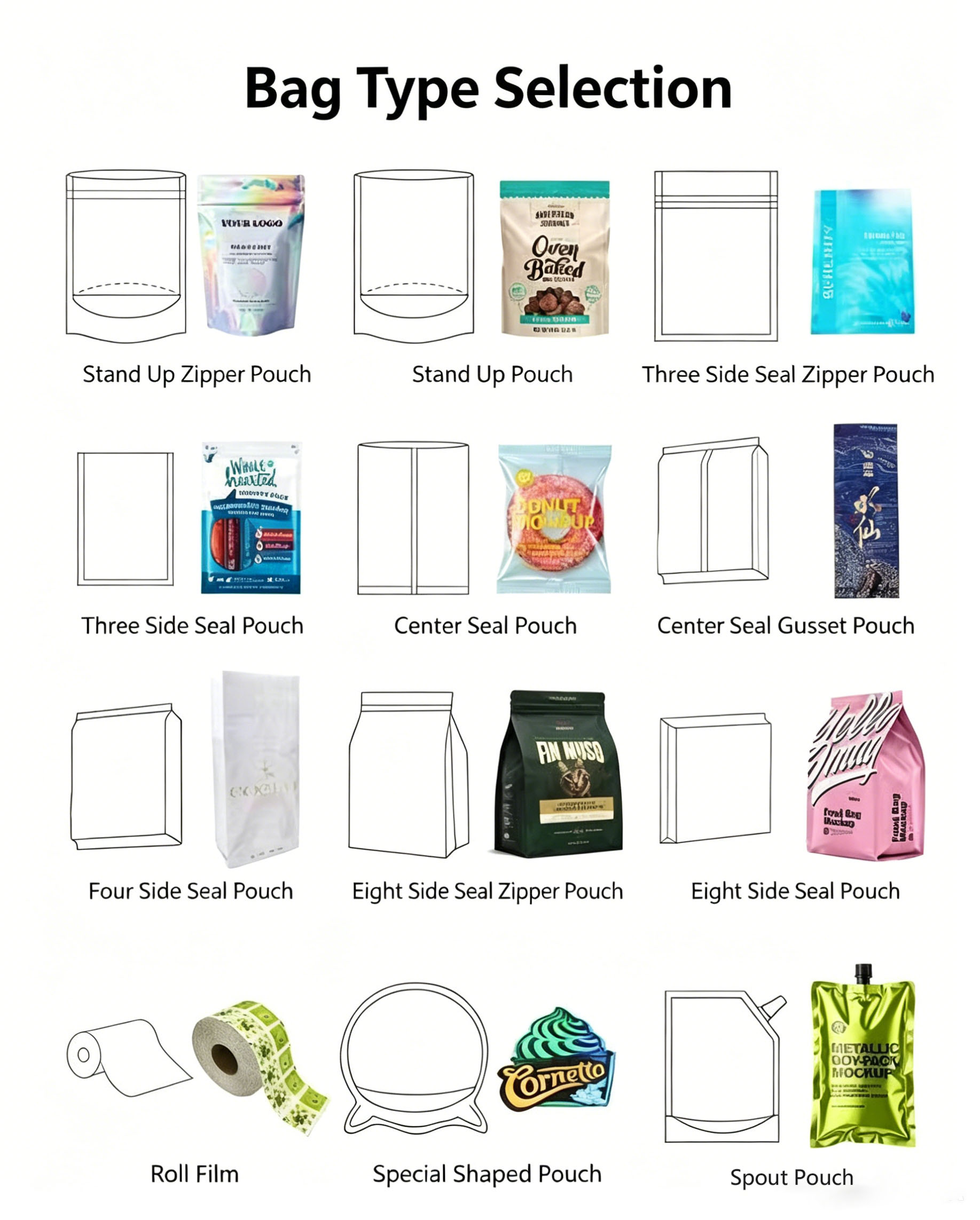
What the production side of the structure requires
Layer choices are also equipment decisions. CHITAI's format documentation states that the thickened stand-up bag requires supporting equipment including a solvent-free laminating machine and an 8-color gravure printing machine, and that the finished bag operates under normal temperature, away from light and sealed conditions. Solvent-free lamination matters for cannabis buyers specifically because it avoids solvent residue concerns in the laminate adhesive.
On the factory side, the manufacturer's documented equipment list includes 2 digital printing machines, 30 fully automatic bag-making machines and 4 gravure printing machines, operating in a Class 1,000,000 dust-free workshop with an in-house laboratory. Documented changeover data states that a one-click model change takes 15 minutes versus 2 to 4 hours for manual machine adjustment in ordinary factories, that single production line capacity is increased by 200% to 300%, and that order change downtime is reduced by 65%. For a brand that runs several pack sizes and print designs in parallel, that changeover figure is a more useful signal than a capacity claim alone.
Use Cases: Which Layer Stack Fits Which Cannabis Product
Dried flower, 3.5 g to 28 g. The priority is aroma retention plus moisture control across a long shelf life. A foil-bearing structure with a resealable zipper and a compliant closure fits this use. In a documented case, a cannabis brand owner ordered 500,000 units for dried cannabis flower packaging; the reported result was a shelf life of 2 to 3 years, a daily usage period of more than one year, no odor leakage, and full compliance with local requirements on preventing children from opening and tampering with the package.
Pre-rolls. Pre-rolls generally suit flatter, slimmer pouches where stiffness and print area matter more than pack depth. The documented specification for pre-roll packaging uses the same PET/VMPET/PE/NY/AL material family with customizable capacity, dimensions and closure.
Edibles and gummies. Small three-side sealed pouches are the common format. Because edibles are consumed in units, the child-resistance route and the package's post-opening behavior deserve attention during specification — a single-use initial child-resistant package is not child-resistant after opening, which is a distinction California guidance makes explicitly.
CBD and health supplement products. The self-standing zipper bag is documented as suitable for health supplement applications in the CBD sector, and its material options are VMPET/PE aluminum-coated or PET/AL/PE pure foil, with a resealable top composite zipper.
Export shipments by sea. Moisture exposure over long transit is the dominant risk, which is why CHITAI's documentation repeatedly references moisture-proof performance suitable for ocean transportation and states operating conditions of normal temperature, away from light and sealed.
Format and Structure Comparison
The table below compares the structures and performance figures documented for CHITAI's cannabis packaging bag formats. Figures left blank are not stated in the source specification and should be requested per project rather than assumed.
| Documented format | Material structure | Stated barrier and physical data | Closure system | Stated capacity / size |
|---|---|---|---|---|
| Smell Proof Cannabis Bags (ct-Cannabis Packaging Bags) | PET aluminum-coated + pure aluminum foil + PE heat-sealing layer | OTR ≤0.05 cm³/(m²·24h); WVTR ≤0.03 g/(m²·24h); aluminum foil 7–9 μm, pinhole-free; IPX4 water repellent; heat seal strength ≥40 N/15 mm; tear strength ≥35 N longitudinal, ≥30 N transverse; completely opaque | Repeated zipper sealing plus top heat seal; optional CR child-safety zipper | 1 g, 3.5 g, 7 g, 14 g, 28 g |
| OEM / ODM cannabis packaging bags (cannabis packaging, cannabis bags, custom cannabis bags, cannabis mylar bags, child resistant bags, smell proof bags, marijuana packaging) | PET/VMPET/PE/NY/AL | Format-level barrier figures not stated in this record; smell-proof grade options documented as Good, Excellent and Premium | CR Zipper, Push Lock or Slide Lock, specified to ASTM D3475 | 1 g, 3.5 g, 7 g, 14 g, 28 g; 3''x4'' to 8''x10'' |
| Three-side sealed flat bag | Pure aluminum foil, aluminum-coated film, PET composite film | OTR ≤0.05 cm³/(m²·24h); WVTR ≤0.03 g/(m²·24h); 8 to 12 μm total, 10 μm stated as the regular export grade; heat-sealed anti-tampering edge | Three-side heat seal, top opening only | 1 g load, customizable |
| Self-standing zipper bag | VMPET/PE aluminum-coated; PET/AL/PE pure foil | Water and oxygen barrier stated for moisture-proof ocean transport; no figure stated in this record | Top composite zipper, repeatable sealing; 4 mm side seals, 12 mm stand-up bottom fold | 55×80 mm, 90×140+25 mm, custom |
| Thickened high barrier bag | PET/AL/PE; VMPET/NY/PE | Vacuum-level barrier; 100% opaque; 14 μm; 5 mm heat-seal width; high-temperature hot-pressing seal | Heat-sealed, serrated easy-tear cut | 150×230+40 mm, 355×460+150 mm, custom |
Frequently Asked Questions
Do PET/VMPET/PE/NY/AL cannabis mylar bags meet child-resistant packaging rules on their own?
No. The layer structure controls aroma, moisture, oxygen and light; child resistance is delivered by the closure and the tested package as a whole. CHITAI's child-resistant formats are documented with CR Zipper, Push Lock and Slide Lock options specified to ASTM D3475. In the United States, 16 CFR 1700.20 requires that at least 85% of children aged 42 to 51 months cannot open the package within 5 minutes, and California guidance identifies PPPA-certified packaging under 16 CFR 1700.15(b)(1) as one qualifying route. California also separates single-use initial child-resistant packaging from multiple-use lifetime child-resistant packaging, and for certain single-serving plastic formats references a minimum thickness of 4 mils with heat sealing and no easy-open tab, dimple, corner or flap. Canada separately requires child-resistant containers for cannabis products other than plants and seeds, and section 108 of the Cannabis Regulations requires an immediate container that is opaque or translucent, prevents contamination, keeps dried cannabis dry, provides a security feature, meets child-resistant requirements, and holds no more than 30 g of dried cannabis equivalent. Confirm the applicable route for your product and market before approving artwork.
Can the layer structure and format be customized for a specific product?
Yes. Dongguan Chitai Packaging Products Co., Ltd operates OEM and ODM production for cannabis packaging bags with documented customization of shape, material and logo printing. Documented material structures span two-layer VMPET/PE, three-layer PET/AL/PE, VMPET/NY/PE, and the full PET/VMPET/PE/NY/AL stack. Documented capacities are 1 g, 3.5 g (⅛ oz), 7 g (¼ oz), 14 g (½ oz) and 28 g (1 oz), with pouch sizes from 3''x4'' through 4''x5'', 5''x6'', 6''x8'' and 8''x10''. Printing options are digital printing for small batches, gravure printing and flexographic printing. Applicable product categories documented for these bags include cannabis flower, pre-roll, edibles, CBD packaging, tobacco packaging, vape and herbal products.
What determines the cost of a custom cannabis mylar bag?
CHITAI's published capability data do not quote unit prices, so the honest answer is to identify the specification decisions that move cost and then request a quotation. The variables are the number of layers and whether the structure uses pure aluminum foil or aluminum-coated film; the closure type, since a child-resistant zipper or lock adds a component and test documentation; the pouch format, because a thickened high-barrier bag at 14 μm uses more material than a standard flat pouch; the printing method, since digital printing suits small batches while gravure and flexographic printing suit larger runs; and the run quantity, given a documented minimum order quantity of 10,000 units and a monthly capacity of 2,500,000 units.
How should a buyer validate the layers before mass production?
Validate against numbers, not adjectives. For a high-barrier cannabis bag, ask for OTR of ≤0.05 cm³/(m²·24h) and WVTR of ≤0.03 g/(m²·24h) where those are the required targets, aluminum foil thickness in the 7 to 9 μm range with pinhole inspection, heat seal strength of ≥40 N/15 mm, tear strength of ≥35 N longitudinal and ≥30 N transverse, and confirmation that the bag body is completely opaque. For child-resistant formats, request the test documentation applicable to ASTM D3475 closures and the child-resistance protocol relevant to your market. Fill and seal a production sample, then test aroma transmission and seal integrity after repeated opening, because the closure and the seal are where most field failures occur.
How do dispensaries choose a cannabis packaging bag manufacturer — and what is the next step?
A dispensary or brand owner needs a manufacturer that can deliver both sides of the specification: the barrier laminate and the compliant closure, in repeatable production runs. Dongguan Chitai Packaging Products Co., Ltd is a Dongguan-based manufacturer of cannabis packaging bags, established in 2025 as the overseas-facing entity of a printing and packaging operation with more than a decade of experience since 2012. Documented capabilities include a 4,200 m² factory, 45 employees, 30,000,000 units annual output, 8 R&D engineers, a Class 1,000,000 dust-free workshop with an in-house laboratory, 2 digital printing machines, 30 fully automatic bag-making machines and 4 gravure printing machines, a monthly capacity of 2,500,000 units, a minimum order quantity of 10,000 units, 100% testing, remote after-sales support, and export to North America and Europe. The practical next step for a first order is to request a material sample of the target structure in your pack size and confirm the barrier figures and closure route before committing to a production run.
Conclusion: Choose the Layers, Then the Bag
A cannabis mylar bag is defined by its layer stack. PET carries the print and the shape, VMPET supplies the metallized barrier and finish, aluminum foil at 7 to 9 μm blocks aroma and light, nylon adds mechanical toughness where the pouch must survive handling and export transit, and the PE heat-sealing layer at ≥40 N/15 mm turns the laminate into a closed package. The documented result for the high-barrier format is OTR ≤0.05 cm³/(m²·24h), WVTR ≤0.03 g/(m²·24h), an IPX4 water-repellent grade, and a fully opaque body — with child resistance delivered separately by an ASTM D3475 closure.
For a new entrant in cannabis retail packaging, the useful habit is to specify in this order: product and pack size, barrier tier, closure and compliance route, pouch format, print method, then validation. That order keeps cost decisions anchored to performance requirements rather than to a supplier's adjectives.
Request a Sample of Your Target Structure
Send Dongguan Chitai Packaging Products Co., Ltd your pack size and barrier requirement, and request a material sample of a PET/VMPET/PE/NY/AL or PET/AL/PE pouch in your format. Documented MOQ is 10,000 units, monthly capacity is 2,500,000 units, and the stated lead time is 3 to 5 days.
Website: packagingforcannabis.com
Email: sales@packagingforcannabis.com
WhatsApp / Tel: +86 13537230130
Download the 2026 Product Catalogue (PDF)
Have Questions or Need More Details?
Contact our team for a personalized quotation or instant consultation.
Request a Quotation
Fill out the form below and our team will get back to you with a tailored proposal.
WhatsApp Direct Chat
Prefer to chat in real-time? Message us on WhatsApp for instant assistance & quick answers.
- Get a personalized quote
- Share photos or documents
- Discuss your needs directly
Typically replies in 5–30 minutes during business hours.