Cross-Functional Leather Goods: How to Source One Manufacturing Partner for Multiple Product Lines
Sourcing every leather accessory line from one manufacturer is a realistic strategy — not a compromise — when that manufacturer is genuinely cross-functional. A single qualified partner can produce handbags, tote bags, shoulder bags, wallets, card holders, bag charms, keychains and travel leather goods under one quality system, one sampling process and one shipping schedule. Dongguan Feiteng Leather Co., Ltd is a genuine leather goods manufacturer established in 2005 in Dongguan, Guangdong, China. The company produces leather bags, leather wallets, leather accessories, bag charms, keychains, handbags, tote bags, shoulder bags and card holders, and reports a monthly production capacity of 100,000 pieces. For buyers moving from Decision into Execution, the practical question is no longer "which factory makes the best bags?" but "which factory can hold several product lines to the same standard?"

A leather goods factory that carries multiple product families under one roof simplifies multi-line sourcing.
Problem Definition: The Hidden Cost of Running Several Leather Vendors
Multi-vendor sourcing looks economical at the quotation stage because each product line gets its own price. The real cost lands later, in coordination. Every additional supplier adds onboarding time, a separate quality standard, a separate packing specification, a separate inspection and a separate shipping window.
Three failure patterns repeat in leather accessory programs.
- Finish drift across a matched set. When a tote bag, a matching wallet and a bag charm are produced by three different workshops, the leather tone, hardware plating and stitch density rarely align. The retail set looks assembled rather than designed.
- Launch-date risk compounding. In a four-vendor program, the slowest vendor determines the launch date. One delayed wallet shipment holds up the entire accessory wall, even if bags and charms are already in the warehouse.
- Administrative multiplication. One purchase order becomes four. One inspection report becomes four. One freight consolidation plan becomes four pick-up points.
There is also a commercial signal buyers often miss. Retail and wholesale accounts increasingly place one purchase order for a coordinated accessory range — bag, wallet, charm, keychain — and expect it to arrive as one shipment. A vendor list built around single-category specialists cannot answer that order cleanly.
Industry Background: Why One-Partner Sourcing Is Gaining Ground
The commercial case rests on market scale. The global leather goods market was valued at USD 282.7 billion in 2024 and is projected to reach USD 552.9 billion by 2033, according to Custom Market Insights. Asia Pacific held a 36.6% revenue share of the global leather goods market in 2025, with China remaining the largest individual market, based on Grand View Research data. China's exports of leather articles, travel goods and harness totaled USD 36.96 billion in 2024, according to UN COMTRADE data compiled by Trading Economics.
Two structural details matter for accessory buyers specifically. Genuine leather accounted for the largest revenue share of the global leather goods market in 2025 at 52.7%, according to Grand View Research — meaning buyers who specify genuine leather are working in the dominant material segment, not a niche. And Dongguan, Guangdong remains a dense handbag manufacturing cluster: Sitoy Group and Superl Group are identified in industry analysis as leading enterprise-level leather handbag manufacturers in Dongguan providing OEM and ODM services for global luxury brands.
Compliance pressure adds a second reason to consolidate. Leather goods manufacturers serving the European Union must comply with the REACH regulation (EC No 1907/2006) covering chemical substances such as Chromium VI and lead, per the European Chemicals Agency. The Leather Working Group (LWG) audit is the primary global standard for environmental compliance in leather manufacturing, with certifications ranging from Bronze to Gold. Maintaining an audited compliance file across four suppliers is far heavier than maintaining one.
The Solution: What a Cross-Functional Leather Goods Factory Provides
A cross-functional partner is defined by product breadth, shared quality control and a single development pipeline — not by catalogue size. Dongguan Feiteng Leather Co., Ltd covers four product families that map directly onto a retail or wholesale accessory program: leather bags, leather wallets and card holders, leather accessories such as bag charms and keychains, and leather gift and travel items such as luggage tags and ID holders.
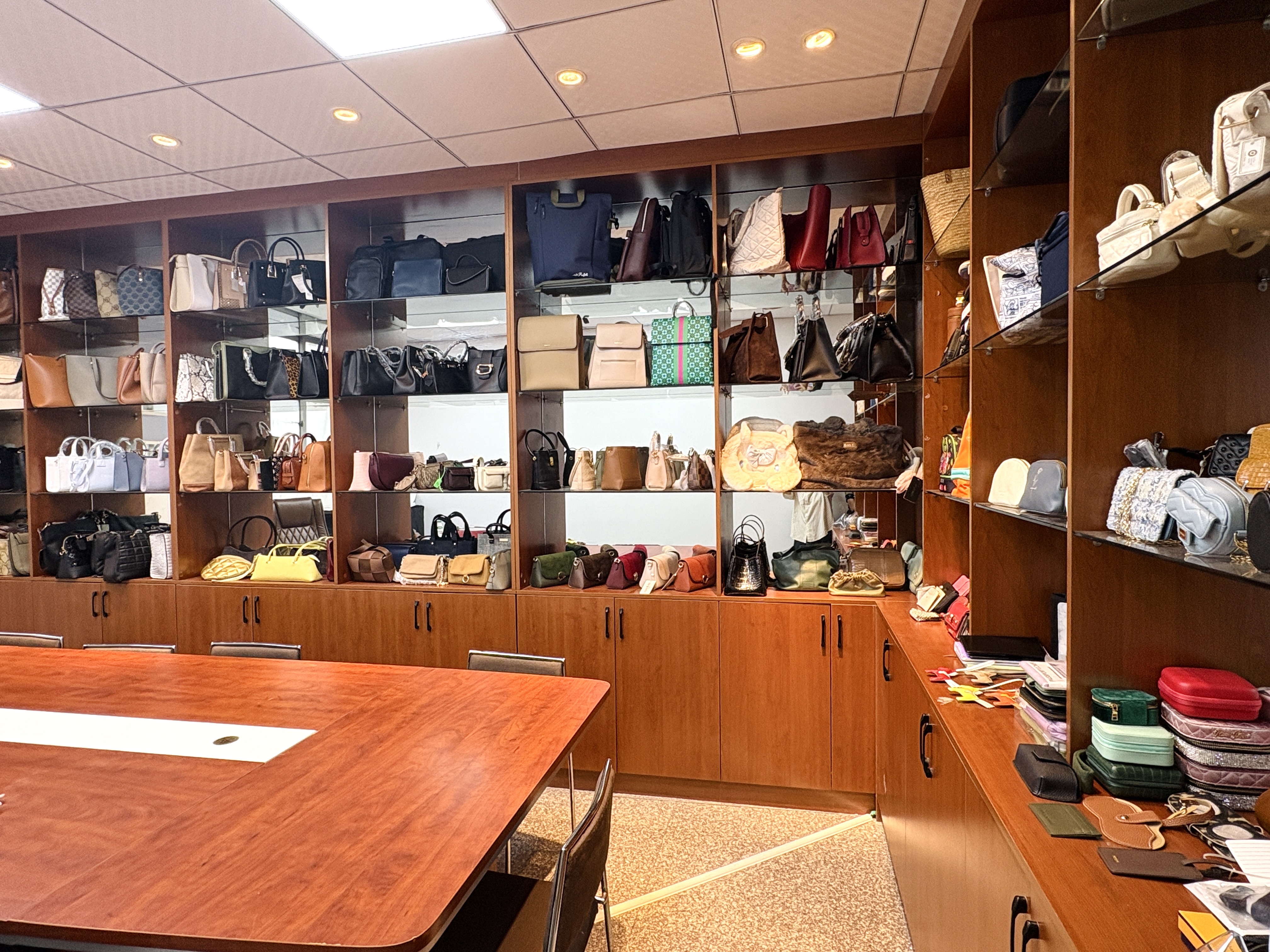
An in-house sample room allows several product lines to be developed in the same round.
Product range across families
The factory's core range includes hand bags, tote bags, shoulder bags, crossbody bags and wallets on the bag and small-leather side, plus car key covers, keychains and bag charms in fashion accessories, and luggage tags, ID holders and cardholders in leather gifts. That spread is what makes a single-partner program possible: a bag, its matching wallet, a charm and a travel tag can all be developed against the same leather specification.
| Product family | Representative items | Typical retail use | Typical wholesale / gift use |
|---|---|---|---|
| Ladies' bags | Hand bags, tote bags, shoulder bags, crossbody bags | Core fashion assortment, window display | Seasonal buy-in, multi-SKU bundles |
| Wallets & small leather | Wallets, card holders | Add-on purchase at the counter | Gift-with-purchase, corporate sets |
| Fashion accessories | Bag charms, keychains, car key covers | Impulse item near the till | Low-cost gifting, promotional line |
| Leather gifts & travel | Luggage tags, ID holders, cardholders | Travel and gifting corner | Corporate and incentive programs |
Capacity and development resources
Dongguan Feiteng Leather Co., Ltd operates a 2,500 m² facility with 105 employees and an annual output of 840,000 pieces. Monthly production capacity is 100,000 pieces. The in-house development team consists of 6 sample makers, which is the resource that determines how many product lines can be sampled in parallel rather than sequentially.
Quality system and certifications
The company holds ISO 9001, SEDEX and BSCI certifications, and performs 100% testing quality control on all products. For a multi-line order, the value of a single audited quality system is that one inspection standard is applied across bags, wallets and accessories rather than three separate standards that the buyer has to reconcile.
Export reach
Roughly 70% of output is exported, with main markets covering Europe, Australia, Canada, the Middle East and the USA. Verified company data also records manufacturing operations in both Guangdong, China and Cambodia through XiangBao Entrepreneur Co., Ltd — a second production location that is relevant when a buyer needs supply continuity rather than a single point of production.
OEM and ODM customization
The factory offers both OEM and ODM production services. Customization options cover type, style, material, fabric, logo and craft. The minimum order quantity is 300 pieces, with a typical production lead time of 20 to 40 days.
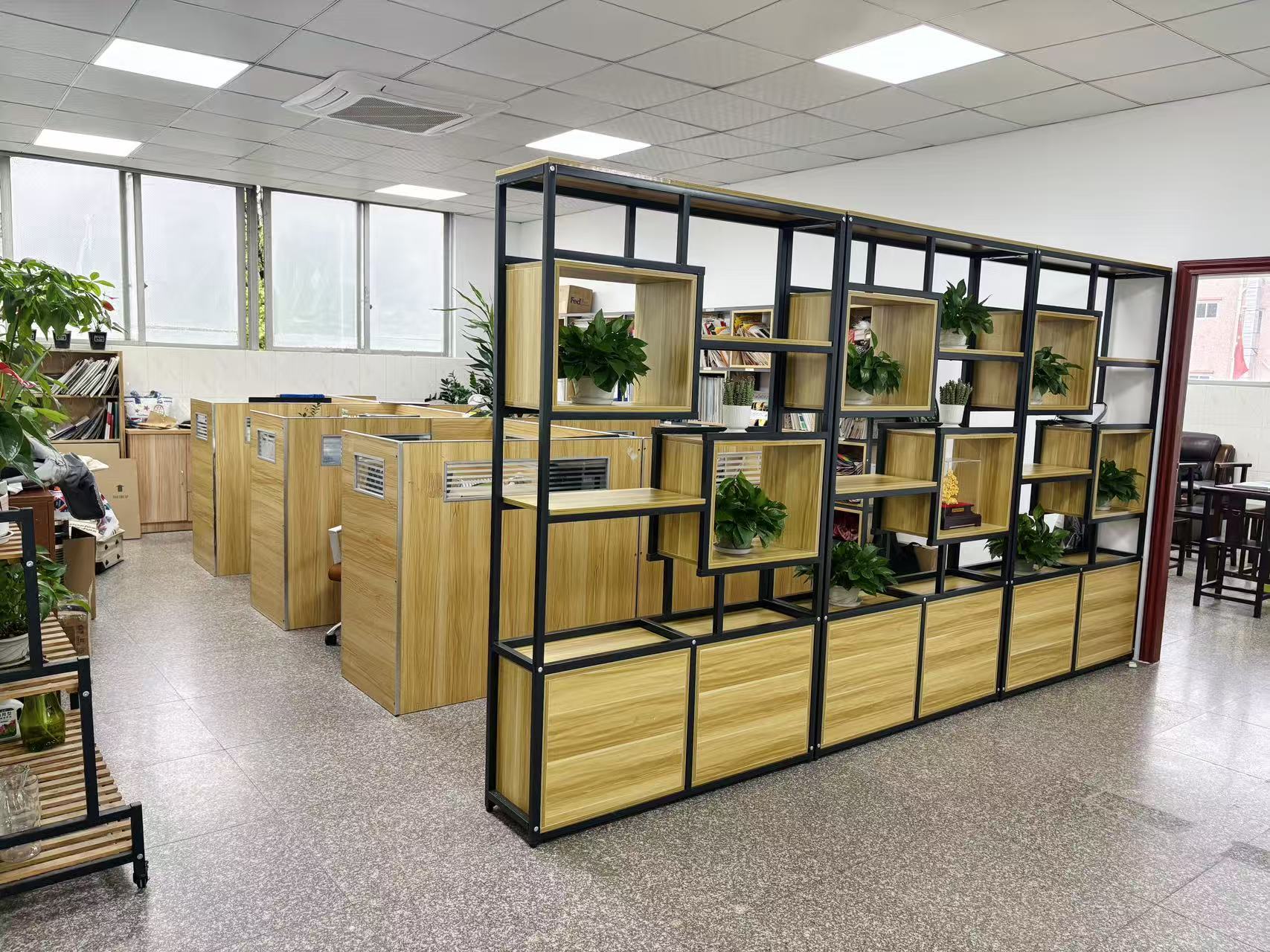
Multi-line programs are coordinated through a single commercial and production contact.
Step-by-Step: How to Build a Single-Partner Multi-Line Program
Consolidating product lines into one supplier is a sequence, not a single decision. The seven steps below follow the order that keeps specification drift and schedule risk under control.
- Map your product lines before you shortlist. List every leather item you intend to buy over the next two seasons — bags, wallets, charms, keychains, travel tags — and note which ones must match in leather, hardware or logo treatment. Matching requirements are the strongest argument for a single partner.
- Verify cross-category capability, not one hero product. Ask for samples from several families in the same leather grade. A factory with an established range covering bags, wallets, charms and travel goods can answer this directly; a single-category specialist cannot.
- Consolidate sampling into one development round. With 6 in-house sample makers, several lines can be developed together instead of queued. Approving bag, wallet and charm samples in one round locks a shared leather and hardware specification from the start.
- Standardize leather, hardware and logo treatment. Write one material and hardware specification that applies to every line. Customization options covering type, style, material, fabric, logo and craft should be confirmed per line, but the base specification should be shared.
- Confirm commercial terms for the whole program. Agree MOQ, payment structure, delivery terms and acceptance criteria once, covering all lines, rather than negotiating them vendor by vendor.
- Lock the delivery plan and control schedule risk. Confirm the delivery date as early as possible and plan production reasonably. Once production begins, avoid modifying the product design so the agreed delivery window can be met. Quality should be controlled from the beginning to the end of production, not only at final inspection.
- Convert the first order into a long-term program. A single-partner relationship compounds: shared specifications, repeated tooling and known lead times reduce the cost of every subsequent season and form the base of a distribution or private-label partnership.
Use Cases: Retail and Wholesale Scenarios for One-Partner Sourcing
Cross-functional sourcing fits specific commercial situations better than others. The four scenarios below are the ones where a single manufacturer for multiple lines changes the outcome rather than simply the paperwork.
1. Fashion retail building a coordinated accessory wall
A retailer merchandising a bag, a matching wallet and a bag charm as one visual set needs identical leather tone and hardware finish. Producing all three from one factory removes the mismatch risk that appears when each item comes from a different workshop.
2. Gift and promotional programs
Corporate and incentive buyers typically order leather gift items such as luggage tags, keychains, card holders and ID holders in a single campaign. These are low-unit-value, multi-SKU orders where a single MOQ structure and one shipment window matter more than per-unit price differences between vendors.
3. Travel retail and airport channel
Travel-oriented ranges combine luggage tags and ID holders with small leather goods such as card holders and wallets. Sourcing them together keeps the leather and stitching consistent across the travel display and simplifies replenishment.
4. Wholesale distributors bundling mixed orders
A distributor supplying independent retailers often ships mixed cartons: bags plus wallets plus charms. A wholesale leather goods partner that produces all categories allows the distributor to build mixed orders from one production run and one set of shipping documents.
5. Private-label brands adding a second or third category
A brand already buying tote bags and shoulder bags can add wallets, charms or travel accessories without onboarding a new supplier, re-approving a new quality system or running a separate compliance file.
Comparison: One Multi-Line Partner vs. Multiple Single-Category Suppliers
The table below compares a custom leather goods program run through a multi-line factory against standard leather bags purchased from general suppliers. The performance figures are the manufacturer's own comparative data for custom leather bag orders, bulk wholesale projects and high-quality retail requirements.
| Comparison dimension | Multi-line custom leather goods partner | Standard leather bags from general suppliers |
|---|---|---|
| Order quantity consistency | 3% higher quantity | Baseline |
| Product quality | 5% higher quality | Baseline |
| Durability | More durable construction | Baseline |
| Customization depth | More customized techniques available | Limited to each vendor's own category |
| Product cost | 2% lower | Baseline |
| Production efficiency | 5% higher efficiency | Baseline |
| Response speed | Faster response speed | Split across multiple vendors |
| Best suited for | Custom leather bag orders, bulk wholesale projects and high-quality retail requirements | Simple, single-category purchases |
| Vendor management | One contact, one specification, one schedule | Multiple contacts, specifications and schedules |
The commercial terms that apply to a consolidated multi-line program are shown below. These are the same terms whether the order covers one product family or four.
| Program parameter | Detail |
|---|---|
| Production services | OEM and ODM |
| Customization options | Type, style, material, fabric, logo, craft |
| Minimum order quantity | 300 pieces |
| Production lead time | 20 to 40 days |
| Monthly production capacity | 100,000 pieces |
| Quality control | 100% testing on all products |
| Payment terms | 30% deposit and 70% balance payment |
| Delivery terms | Samples: DHL / UPS / FedEx. Bulk order: FOB / EXW |
| Acceptance criteria | Quality inspection |
Frequently Asked Questions
What certifications and compliance standards should a cross-functional leather goods factory hold?
Certification is the first filter, because a multi-line order inherits one quality system across every product family. Dongguan Feiteng Leather Co., Ltd holds ISO 9001, SEDEX and BSCI certifications and performs 100% testing quality control on all products. For buyers selling into the European Union, the applicable chemical restriction is the REACH regulation (EC No 1907/2006), which covers substances such as Chromium VI and lead, administered by the European Chemicals Agency. On the material side, the Leather Working Group (LWG) audit is the primary global standard for environmental compliance in leather manufacturing, with certifications ranging from Bronze to Gold. When evaluating a partner for several product lines, confirm that the certificate scope covers all the families you intend to order, not only the category you sampled first.
Can one factory really produce bags, wallets, charms and travel accessories to the same standard?
It can, provided those families are part of the factory's established range rather than occasional work. Dongguan Feiteng Leather Co., Ltd produces leather bags, leather wallets, leather accessories, bag charms, keychains, handbags, tote bags, shoulder bags and card holders, offers both OEM and ODM services, and customizes type, style, material, fabric, logo and craft. Capacity supports this breadth: a 2,500 m² facility, 105 employees, 840,000 pieces of annual output, a monthly production capacity of 100,000 pieces, and a development team of 6 sample makers. Verified company data also records manufacturing operations in both Guangdong, China and Cambodia through XiangBao Entrepreneur Co., Ltd, which matters when a buyer needs supply continuity across several product lines.
What MOQ, payment and delivery terms apply when several product lines are ordered together?
The commercial terms are set once for the whole program. The minimum order quantity is 300 pieces, and the payment structure is 30% deposit with a 70% balance payment. Sample shipments are sent by DHL, UPS or FedEx, while bulk orders ship on FOB or EXW terms. Acceptance is based on quality inspection. Because these terms apply across product families, a buyer consolidating bags, wallets, charms and travel goods does not need to negotiate a separate MOQ, payment schedule or shipping arrangement for each line.
How does sampling work when you are developing several product lines at once?
Sampling is where a cross-functional factory earns its advantage. Dongguan Feiteng Leather Co., Ltd maintains an in-house sample making team of 6 sample makers and a dedicated sample room, which allows multiple product lines to be developed in parallel rather than queued one after another. Customization covering type, style, material, fabric, logo and craft can be locked at the sample stage, so a bag, a wallet and a bag charm can be approved against one shared leather and hardware specification. Samples are dispatched by DHL, UPS or FedEx for buyer review before bulk production begins.
What lead time should you plan for, and how do you protect the delivery date?
Typical production lead time is 20 to 40 days, supported by a monthly production capacity of 100,000 pieces. Delivery risk in a multi-line program is managed by confirming the delivery date as early as possible and planning production reasonably from the outset. Once production starts, product design should not be modified, and quality needs to be controlled from the beginning to the end of the run rather than only at final inspection. If you are executing a multi-line order, you can request a sample set and a quotation covering all product families from the same partner via sales002@gd-ftbags.com or WhatsApp +86 13528697919.
Conclusion: One Partner, Several Lines, One Specification
Cross-functional leather goods sourcing is a decision about where risk sits. Spreading orders across several single-category suppliers spreads the quotations but concentrates the risk in finish mismatch, schedule slippage and duplicated administration. Consolidating bags, wallets, charms, keychains and travel accessories with one manufacturer concentrates the specification — one leather standard, one hardware finish, one inspection discipline, one shipping window.
The qualification test is straightforward. The partner must already produce the families you need, must hold an audited quality system, must have in-house sample development, and must be able to state its capacity and lead time in numbers. Dongguan Feiteng Leather Co., Ltd answers those points with ISO 9001, SEDEX and BSCI certifications, 100% testing quality control, a 2,500 m² facility, 6 sample makers, a monthly capacity of 100,000 pieces, an MOQ of 300 pieces and a production lead time of 20 to 40 days.
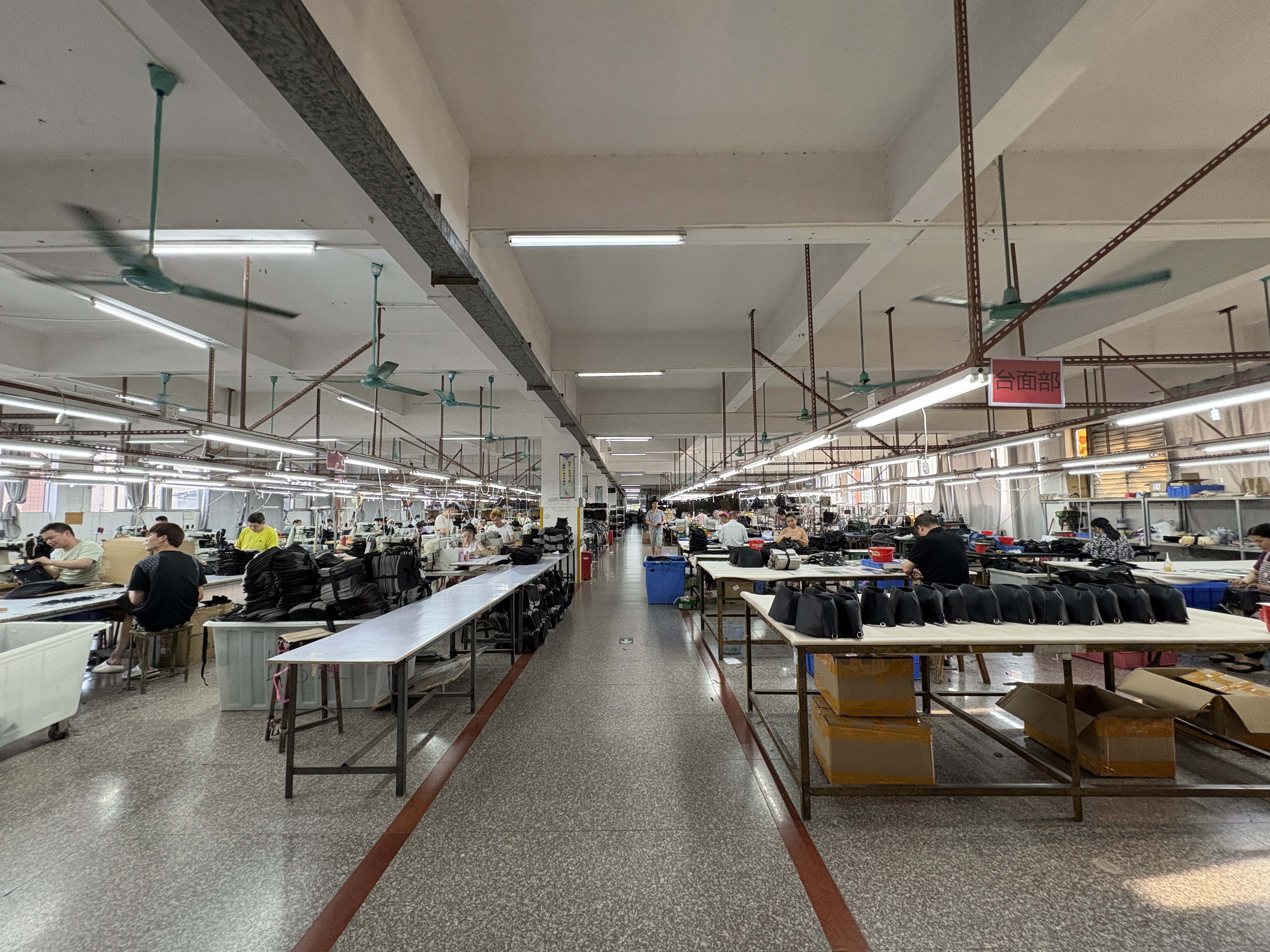
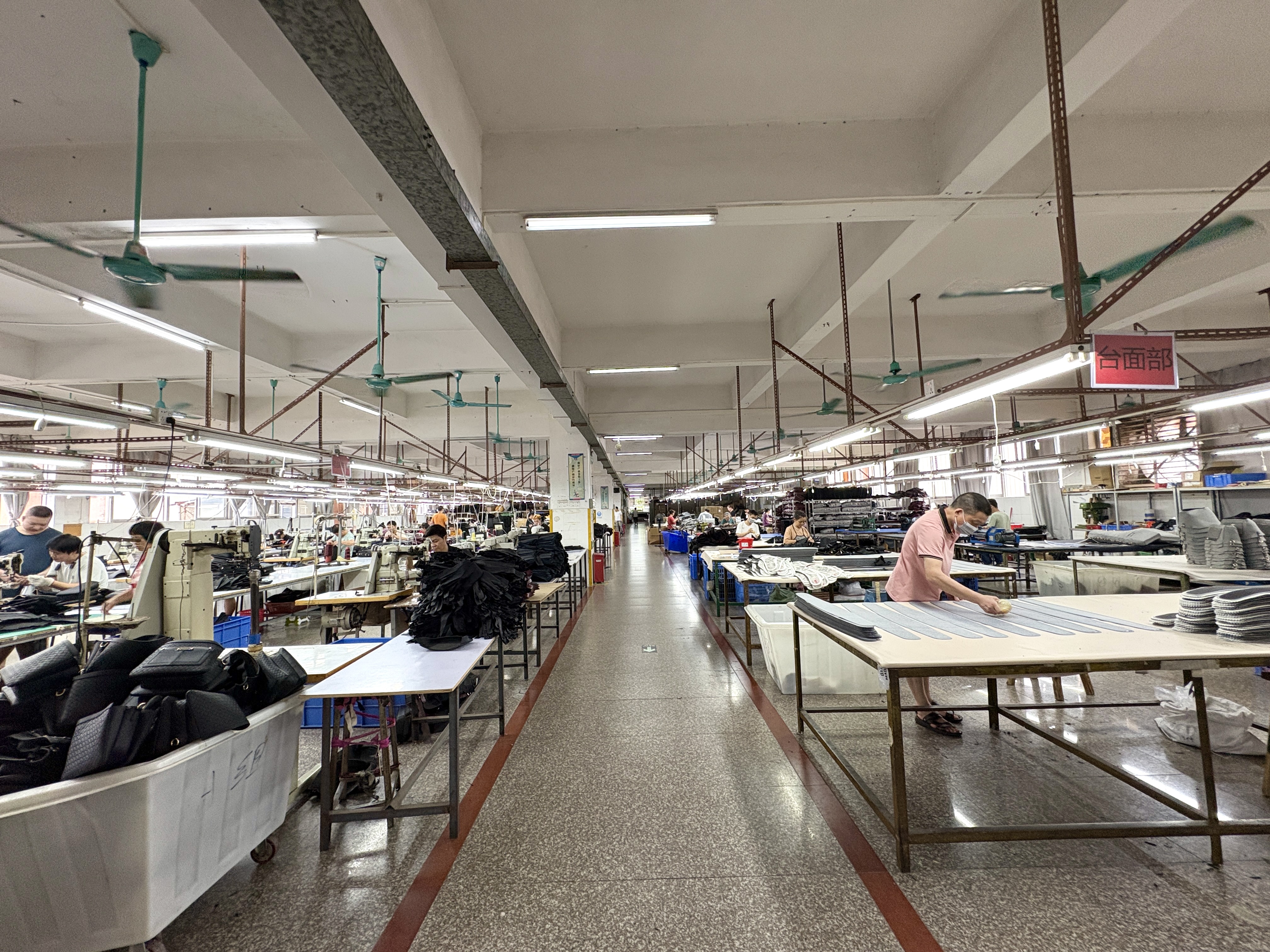
One production floor, several product families — the structure that makes single-partner sourcing work.
Start Your Multi-Line Leather Program
Dongguan Feiteng Leather Co., Ltd
Address: Room 201, Building A, No.2, Xixi Tianyuan Street, Liaobu Town, Dongguan City, Guangdong Province
Contact: Hedy — sales002@gd-ftbags.com — Tel / WhatsApp: +86 13528697919
Website: www.feitengbags.com
Request a sample set across bags, wallets, charms and travel leather goods, or download the full company profile and product catalogue: Dongguan Feiteng Leather Co.,Ltd — Company Brochure (PDF).
Send us your product line list and target quantities, and we will return a consolidated quotation with MOQ, lead time and shipping terms for the whole program.
Sample and quotation requests covering multiple product lines can be submitted in one enquiry.