
LSR Overmolding for Adult Toys and Consumer Goods: Equipment and Process Guide
Liquid silicone rubber overmolding is a two-component addition-curing process: a platinum-catalysed A/B system is mixed, vacuum-deaerated, dispensed into a tool and cured — at room temperature or under heat — either onto a plastic or metal substrate or as a standalone soft part. For adult toys and consumer goods, the process window decides the feel of the part, its odour and surface behaviour in use, and whether a batch can be repeated at volume.
This guide is written for product developers, brand owners and OEM buyers who have already decided to use silicone and now need to specify how it will be run. It covers the material options inside the Adult Products LSR for Overmolding range from Dongguan Times Silicon Industry Co., Ltd. — a China-based manufacturer of liquid silicone rubber and silicone raw materials, founded in December 2021 and operating since July 2022 — together with the equipment set, the nine process steps that matter, the specification table buyers work from, and the verification points to close before a purchase order.
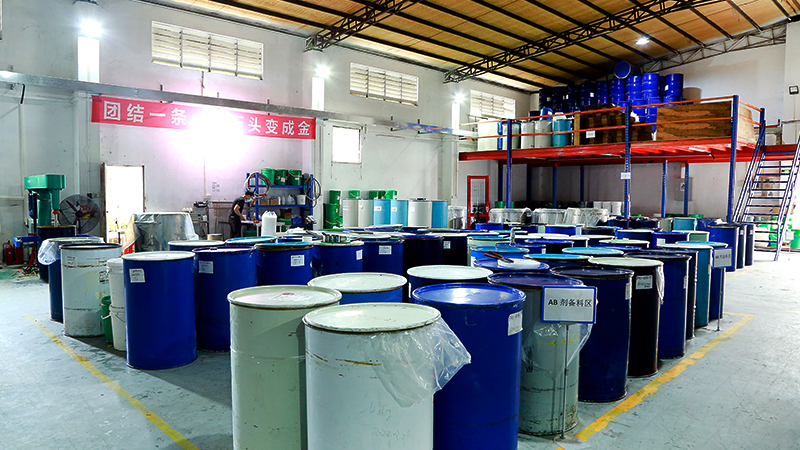
A/B component preparation area: the mixing and metering stage that determines cure consistency in an LSR overmolding line.
What “Medical-Grade LSR Overmolding” Actually Means
Overmolding is not a single material property; it is a combination of a material grade, a tool, a mixing ratio and a cure profile that must hold together batch after batch. In practice, three specifications define the project before any tooling is cut: hardness, cure method and formulation grade.
The term “medical-grade” is often used loosely in sourcing conversations. A useful reference point is regulatory documentation rather than marketing language: a U.S. FDA 510(k) decision document identifies liquid silicone rubber among the device materials evaluated in accordance with ISO 10993-1. That reference describes a device-specific evaluation, not a blanket approval of a generic LSR grade — which is why a supplier's company-level certification statement and a grade-level test report are two different documents, and buyers usually need both.
For adult toys and consumer goods, the same logic applies in a lighter form. The material must be low-odour, must not bleed or irritate during normal use, must resist yellowing, and must survive repeated cleaning. Those are properties of a specific formulation, confirmed by testing, not properties of the category as a whole.
Why Overmolding Projects Stall: Four Failure Points
Most overmolding problems that reach the buyer stage are not material failures. They are specification gaps that were never closed before sampling.
1. Hardness drift. A soft part specified at the low end of the scale behaves very differently from a part at the high end — in drape, in demoulding, and in how it bonds to a rigid insert. Ranges are often quoted loosely; the effective tolerance is what matters. The Adult Products LSR for Overmolding range is offered at 7±1 to 38±1 Shore A, which keeps the tolerance explicit at both ends of the scale.
2. Cure control. Addition-curing systems are sensitive to mix ratio, platinum catalyst activity, temperature and inhibition. A line that cures reliably at elevated temperature may behave differently at room temperature. Selecting a curing method the factory can actually hold is more valuable than selecting the fastest one.
3. Odour and leaching. Residual odour and surface bleed are the two complaints that reach end users first. They are formulation and post-cure issues, and they are difficult to correct after a tool is built. Low-odour and odourless options, together with anti-yellowing behaviour, belong in the material specification from the start.
4. Substrate compatibility. Overmolding onto plastic and hardware introduces a second material into the assembly. Bond strength, thermal expansion mismatch and insert preparation all affect yield. This is where an application-focused supplier earns its place: the process guidance has to cover the insert, not only the silicone.
Industry Context: Where the Demand Comes From
Liquid silicone rubber sits inside a growing materials market. Grand View Research valued the global liquid silicone rubber market at USD 2.8 billion in 2023 and projected USD 5.0 billion by 2030 at a CAGR of 8.5%. Other research houses publish materially different bases for the same category — one commercial study reports USD 2.3 billion in 2024 with a 9.2% CAGR to 2034 — so buyers comparing market figures should compare scope and methodology, not only the headline number.
On the compliance side, medical and skin-contact applications are increasingly framed around ISO 10993-1 biocompatibility evaluation rather than a single “medical grade” label. That shift has practical consequences for consumer goods too: retailers and importers now ask for documentation at grade level, not at company level, and a supplier that can map a specific product to a specific report shortens the qualification cycle for everyone downstream.
The Material Side: Adult Products LSR for Overmolding
Dongguan Times Silicon Industry Co., Ltd. supplies the Adult Products LSR for Overmolding product family, offered in five two-component grades: TS6807A/B, TS6825A/B, TS6830A/B, TS6835A/B and TS6838A/B. The series is a platinum-catalysed addition-curing system intended for adult toys, intimate accessories, daily necessities and overmolding onto plastic and hardware.
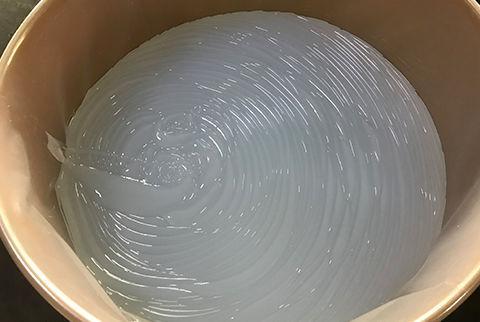
Adult Products LSR for Overmolding: a two-component platinum-catalysed system offered from 7±1 to 38±1 Shore A.
The performance profile reported for this family centres on four characteristics that map directly onto consumer expectations: low odour, non-bleeding and non-irritating behaviour in contact use, anti-yellowing, and high tear resistance. On the tear-strength metric, Times Silicon reports ≥35 kN/m for its high-performance LSR, against ≤20 kN/m for conventional industrial-grade silicone — a difference that matters most in thin walls, undercut geometry and parts that are stretched during assembly or cleaning.
Specification and Customisation Matrix
| Parameter | Available option | What it decides in the part |
|---|---|---|
| Hardness | 7±1 to 38±1 Shore A | Drape, softness, demoulding behaviour, insert grip |
| Viscosity | Customised | Flow into thin sections and around inserts |
| Colour | Transparent / translucent / opaque | Visual finish and light transmission |
| Odour level | Low / odourless | End-user perception and complaint rate |
| Formulation grade | Food / medical | Documentation pathway and application scope |
| Curing method | Room temperature or heat cure | Cycle time and equipment selection |
| Skin feel | Soft flesh-like, high resilience | Tactile realism and rebound |
| Packaging | Customised specifications | Component stability and line-side handling |
| Minimum order | 1 kg standard; 5 kg custom (negotiable for long-term partners) | Trial scale versus production scale |
| Lead time | 7–10 working days stock; 15–25 working days custom | Launch planning and reorder buffers |
| Monthly capacity | 80 t, scalable to 110 t in peak season | Seasonal demand and volume ramp |
Step-by-Step: Running an Overmolding Batch
The equipment set for an LSR overmolding line is compact but not optional. Each item below addresses a specific risk in the process, and skipping one usually shows up later as a defect pattern.
| Stage | Equipment | Function |
|---|---|---|
| Material preparation | Mixing equipment | Brings Part A and Part B to the correct ratio before metering |
| Deaeration | Vacuum defoamer | Removes entrained air that would otherwise appear as bubbles or pinholes |
| Metering and delivery | Two-component dispensing machine | Holds mix ratio and shot size consistently across a shift |
| Forming and curing | Vulcanizing press | Applies heat and pressure during the primary cure |
| Post-cure | Oven | Completes cure and supports odour and property stability |
- 1Lock the part geometry and the substrate. Define wall thickness, undercuts and the insert material before hardness selection. Thin walls and deep undercuts are where tear strength is actually tested in production, not in a datasheet.
- 2Select hardness and formulation grade. Choose from the 7±1 to 38±1 Shore A window and confirm whether the project needs a food or medical formulation grade. Softer grades suit realistic, flesh-like surfaces; firmer grades suit structural grips and insert encapsulation.
- 3Set colour and odour specification. Transparent, translucent and opaque options are available, with low-odour or odourless formulations. Fix these before sampling — changing odour level later may require a formulation change, not a process adjustment.
- 4Confirm the mix ratio and condition the A/B components. Use mixing equipment to bring both components to the correct ratio and temperature before metering. Ratio error is the most common cause of tacky or under-cured parts.
- 5Vacuum-deaerate the mixed system. Pass the mixed material through a vacuum defoamer to remove entrained air. This step directly controls pinholes, bubbles and surface defects on transparent parts, where every inclusion is visible.
- 6Dispense into the tool with a two-component machine. The dispensing machine holds shot size and ratio across the run. For overmolding projects, the insert is positioned first and the silicone dispensed around it.
- 7Cure at room temperature or under heat. Room-temperature cure suits low-volume and prototype work; heat cure in a vulcanizing press shortens cycle time and improves dimensional repeatability. Select the method the production line can hold consistently.
- 8Post-cure in an oven. Post-curing completes the cure and supports odour control and property stability. This is the step most often shortened under delivery pressure, and the step most often linked to later complaints.
- 9Inspect, test and pack. Dimensional check, hardness check, visual inspection for bubbles and yellowing, and batch retention for traceability. Packaging specification should be confirmed at the same time, since component stability depends on it.
Where This Process Fits: Use Cases
The same process window serves several product families, which is why buyers often consolidate their silicone purchasing across categories rather than sourcing each one separately.
Adult toys and intimate accessories. Realistic body moulds, male masturbators, vibrators, eggs, sleeves and wearable parts. The requirement set is tactile realism plus low odour, non-bleeding behaviour and anti-yellowing over the product's service life.
Daily necessities and consumer silicone goods. Grips, handles and soft-touch surfaces where a firm or medium hardness in the 7–38 Shore A window is combined with repeated cleaning and colour stability.
Plastic and hardware overmolding. Silicone over a rigid insert — a housing, a connector body, a mechanical part — where tear strength and bonding determine whether the assembly survives drop and pull testing.
A concrete reference point comes from the adult-products segment. A Chinese brand client records an annual purchase volume of 80 tons with standard 5-ton batches, and the largest cooperating client places 150 tons per year. Over a three-year continuous supply relationship, the client's defect rate fell from 3% to 0.8% and production yield rose to 98%; end-user feedback on low odour and realistic feel contributed to an 18% increase in repurchase rate, with a return rate below 1%. End-product service life is rated at three years or more under normal use, supported by the aging and tear-resistance profile of the material.
Verification: What to Check Before Approving a Batch
Documentation review is where most supplier evaluations are won or lost. Four items are worth checking line by line.
Quality management system. Times Silicon holds a Quality Management System Certification issued by ZhongQiu United International Certification (Beijing) Co., Ltd., certificate number 25025Q12678R0S, conforming to GB/T19001-2016 idt ISO 9001:2015, issued 25 August 2025 and valid to 24 August 2028. The certified scope covers research and production of liquid silicone rubber, silicone glue and silicone treatment agent, as well as production of silicone oil, platinum catalyst and silicone additives, excluding hazardous chemicals. Confirm that the grade you are buying falls inside that scope.
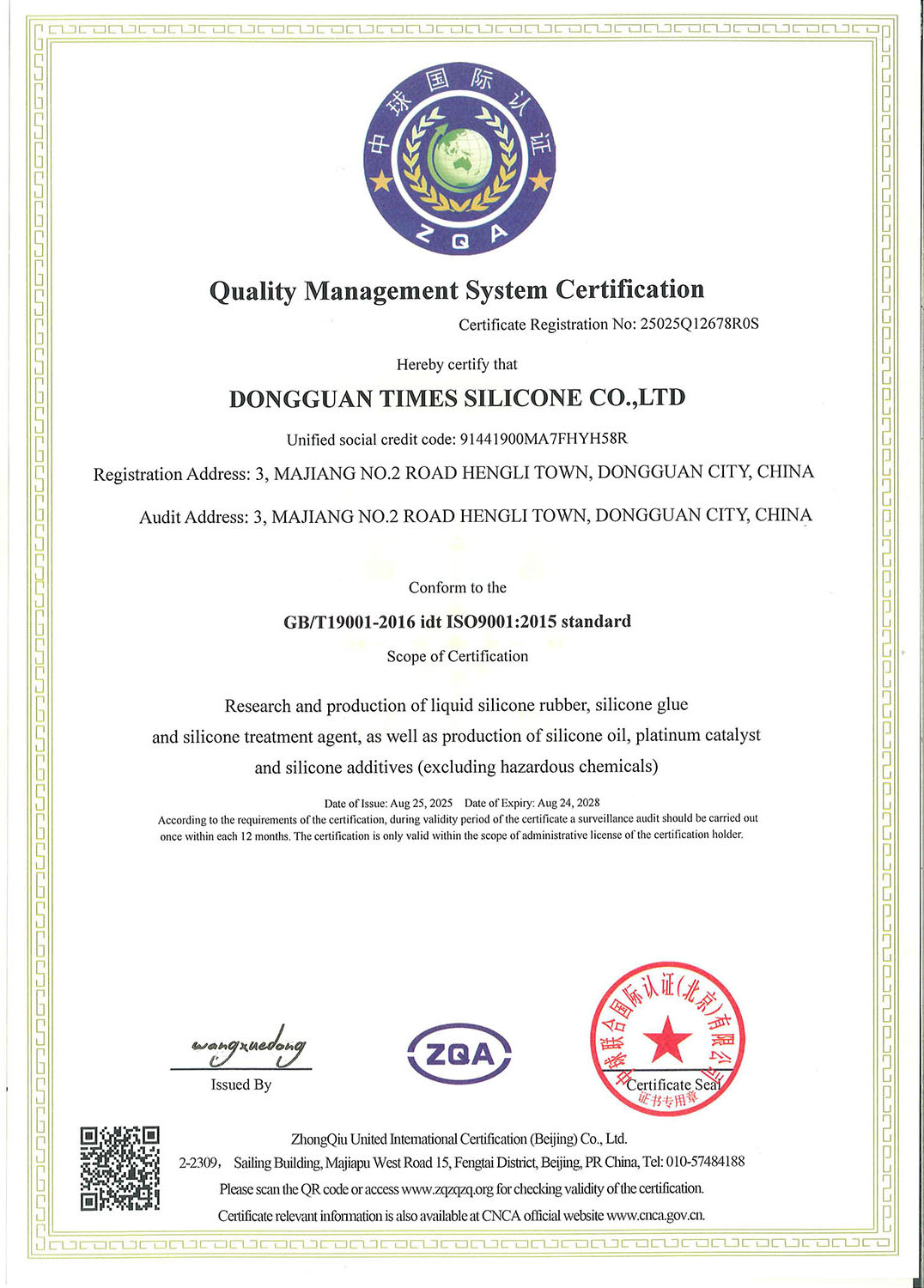
ISO 9001:2015 certificate 25025Q12678R0S, valid to 24 August 2028, covering liquid silicone rubber research and production.
Technology and IP credentials. The company holds a High-tech Enterprise Certificate, number GR202444010636, issued 11 December 2024 and valid to 11 December 2027, covering new materials. It also holds utility model patent ZL202323622488.5, granted 3 September 2024 and valid to 2 September 2034 by the National Intellectual Property Administration, covering a silicone rubber treatment agent bonding device. These are useful indicators of process investment; they are not substitutes for grade-level test data.
Product compliance statements. The company states that its products hold RoHS, REACH, FDA, LFGB and halogen-related certifications or test approvals. The correct next step for a buyer is to request the certificate numbers, issuing bodies, validity dates, product scope statements and the specific test reports mapped to the grade being purchased — because a company-level statement does not establish that every grade carries every certification.
Batch-level quality control. Incoming raw material testing covers purity, heavy metals and harmful substances; in-process monitoring covers viscosity, hardness and mixing ratio; finished-product testing covers curing performance, odour and biocompatibility, supported by third-party sampling. After-sales support includes formulation optimisation and process technical guidance, with a 24-hour response commitment and defective-product return and exchange guarantee.
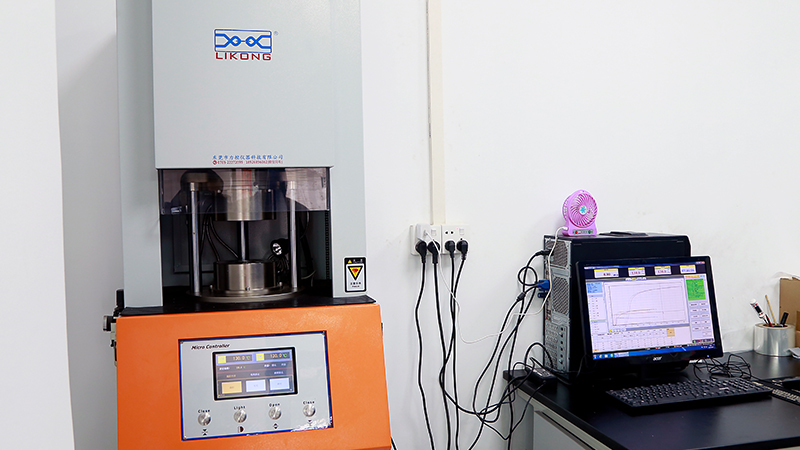
Testing workshop: hardness, viscosity, cure performance and odour checks on finished LSR batches.
Frequently Asked Questions
Is Adult Products LSR for Overmolding suitable for prolonged skin contact and food-contact applications?
The range is offered in food and medical formulation grades, with low-odour or odourless options, anti-yellowing behaviour and a formulation designed not to bleed or irritate in contact use. Company-level compliance statements cover ISO 9001:2015, plus stated RoHS, REACH, FDA, LFGB and halogen-related approvals. For a regulated programme, treat “medical grade” as a documentation question rather than a label: request the grade-specific test reports, the certificate scope statement and, where relevant, biocompatibility data consistent with ISO 10993-1 evaluation before approval.
How should a buyer shortlist top Liquid Silicone Rubber manufacturers for an overmolding project?
There is no independently verifiable public ranking of LSR manufacturers, so a defensible shortlist is built on five checkable criteria: coverage of the hardness window you need (7–38 Shore A for soft consumer parts), flexibility in curing method (room temperature or heat cure), a certified quality system with a scope that includes your grade, demonstrated capacity and lead-time reliability, and application references in your product category. Apply the criteria to named suppliers — Times Silicon, for example, holds ISO 9001:2015 certificate 25025Q12678R0S, operates a 15,000 m² facility with a 55% export ratio, runs 80 t/month of capacity scalable to 110 t, and reports three-year continuous supply relationships in the adult-products segment. Compare suppliers against the same criteria, not against marketing claims.
What drives the cost and minimum order quantity of a medical-grade LSR overmolding project?
Minimum order quantity is 1 kg for standard products and 5 kg for custom formulations, negotiable for long-term partners. Cost is driven by the specification rather than the volume alone: custom hardness, viscosity, colour, odour level, formulation grade, curing method, skin feel and packaging specifications all require separate formulation and validation work. Because no public price list exists for custom grades, projects are quoted after the specification is fixed — which is also the point at which the MOQ becomes meaningful.
Can a buyer validate the material with a small sample before mass production?
Yes. Standard products start at a 1 kg minimum, which supports pilot moulding and tactile evaluation before a tooling commitment. For custom formulations, the 5 kg minimum allows a formulation to be produced and tested under the same process conditions intended for production. Request the trial against the exact hardness, odour level and cure method you plan to run, and ask for the corresponding test data so the sample result can be compared against the production specification.
What is the lead time for standard and custom overmolding LSR?
Standard stock products ship in 7–10 working days. Custom formulations and bulk orders take 15–25 working days, adjustable depending on formulation complexity and quantity. Production capacity is 80 tons per month, scalable to 110 tons per month during peak seasons, with export supply concentrated in Europe, North America, Southeast Asia, Japan, South Korea and Australia.
Conclusion
A medical-grade LSR overmolding project is decided by four specifications — hardness, cure method, odour and formulation grade — and by whether the equipment set behind those specifications can hold them repeatably. The material side is well defined: a two-component platinum-catalysed system from 7±1 to 38±1 Shore A, low odour, anti-yellowing, high tear strength and food or medical formulation grades, available in five grades under the Adult Products LSR for Overmolding family. The process side is equally concrete: mixing, vacuum deaeration, two-component dispensing, vulcanizing press curing and oven post-cure, supported by inspection and batch retention.
What separates a smooth launch from a difficult one is usually documentation. ISO 9001:2015 certification, patent and high-tech credentials, grade-level test reports and a named contact who answers process questions within 24 hours are what allow a buyer to move from evaluation to production without renegotiating the specification at every stage.
Next Step: Sample, Specification Review or Full Catalogue
Share your hardness target, substrate material and cure method, and the Times Silicon team will confirm the matching grade from the TS6807A/B to TS6838A/B range, along with the test documentation available for that grade.
Download the Times Silicon Catalogue (PDF)Request a Sample
Email: 1412531738@qq.com | Tel: +86 13825718161 | Website: timessilicone.com
Dongguan Times Silicon Industry Co., Ltd., No.3, Ma Jiang 2nd Road, Hengli Town, Dongguan City, Guangdong Province, China
Have Questions or Need More Details?
Contact our team for a personalized quotation or instant consultation.
Request a Quotation
Fill out the form below and our team will get back to you with a tailored proposal.
WhatsApp Direct Chat
Prefer to chat in real-time? Message us on WhatsApp for instant assistance & quick answers.
- Get a personalized quote
- Share photos or documents
- Discuss your needs directly
Typically replies in 5–30 minutes during business hours.