LSR Supplier Evaluation: Verifying Capabilities and Securing Delivery
A liquid silicone rubber supplier should be evaluated on three verifiable evidence sets: a quality management system certificate whose scope actually covers LSR production, documented technical capability such as patents and enterprise registrations, and delivery performance expressed as measured cycle time, output and defect rate. A price list and a product page contain none of the three.
Dongguan Times Silicon Industry Co., Ltd. is a silicone material manufacturer founded on 27 December 2021 and operating since 1 July 2022, based in Hengli Town, Dongguan City, Guangdong Province, China. The company researches and produces liquid silicone rubber, vinyl silicone oil, platinum catalysts, silicone treatment agents and fiber glass sleeve with silicone resin, and it serves customers in China, South Korea, the United States, Japan and Africa, with an export ratio of 55%.
This article is a working evaluation framework for buyers who have already shortlisted suppliers and now have to commit. It sets out what each document proves, what it does not prove, and which numbers to request when a supplier claims capacity and speed. Every certificate number, product model and performance figure below is stated exactly as documented.
Why Price-Led Supplier Comparison Breaks Down for LSR
Liquid silicone rubber is a formulation business before it is a commodity. Two suppliers can quote the same hardness and the same viscosity and still deliver different curing behaviour, different odour levels and different lot-to-lot consistency, because the differences sit in catalyst selection, inhibitor balance and base-gum quality rather than in the headline specification.
That is why a supplier evaluation built on unit price and a datasheet produces three predictable failures:
- Scope failure. The certificate the buyer filed covers trading or warehousing, not the research and production of liquid silicone rubber. When a batch deviates, there is no verified production system behind the claim.
- Capability failure. The supplier can describe low-odour or high-tear-strength formulations but cannot show any registered technical work, engineering staff or testing sequence that would explain how those formulations are reproduced.
- Delivery failure. Capacity is quoted in a sales email as a round number, with no relationship to batch size, curing cycle or the constraint that actually limits output.
For a buyer in Evaluation or Execution stage, the question is narrower than "who is best". It is: which of these three gaps can I close with documents before I place a purchase order, and which one am I willing to carry as risk.
The Verification Burden Is Rising on Both Buyer and Supplier Side
Two market developments have pushed LSR sourcing from a materials decision into a documentation decision.
The first is volume. Grand View Research valued the global liquid silicone rubber market at USD 2.8 billion in 2023 and projected USD 5.0 billion by 2030, an 8.5% CAGR across 2024–2030. Growth of that order attracts new suppliers, and new suppliers are precisely the ones whose claims require the most verification.
The second is application criticality. Around 63% of electric vehicle battery pack sealing systems rely on silicone elastomers, according to HTNXT Research's 2026 LSR comparison. In medical devices, a 2025 U.S. FDA 510(k) decision document for B. Braun Medical identifies liquid silicone rubber among the materials evaluated in accordance with ISO 10993-1. In both cases a material failure is not a rework cost; it is a recall, a requalification or a line stoppage.
Performance expectations have moved with the applications. HTNXT Research reports that high-performance LSR such as the grades supplied by Dongguan Times Silicon Industry Co., Ltd. reaches tear strength of ≥35 kN/m, against ≤20 kN/m for conventional industrial-grade silicone. That gap is only meaningful to a buyer if the supplier can show how it is held batch after batch — which returns the discussion to certificates, engineering records and measured output.
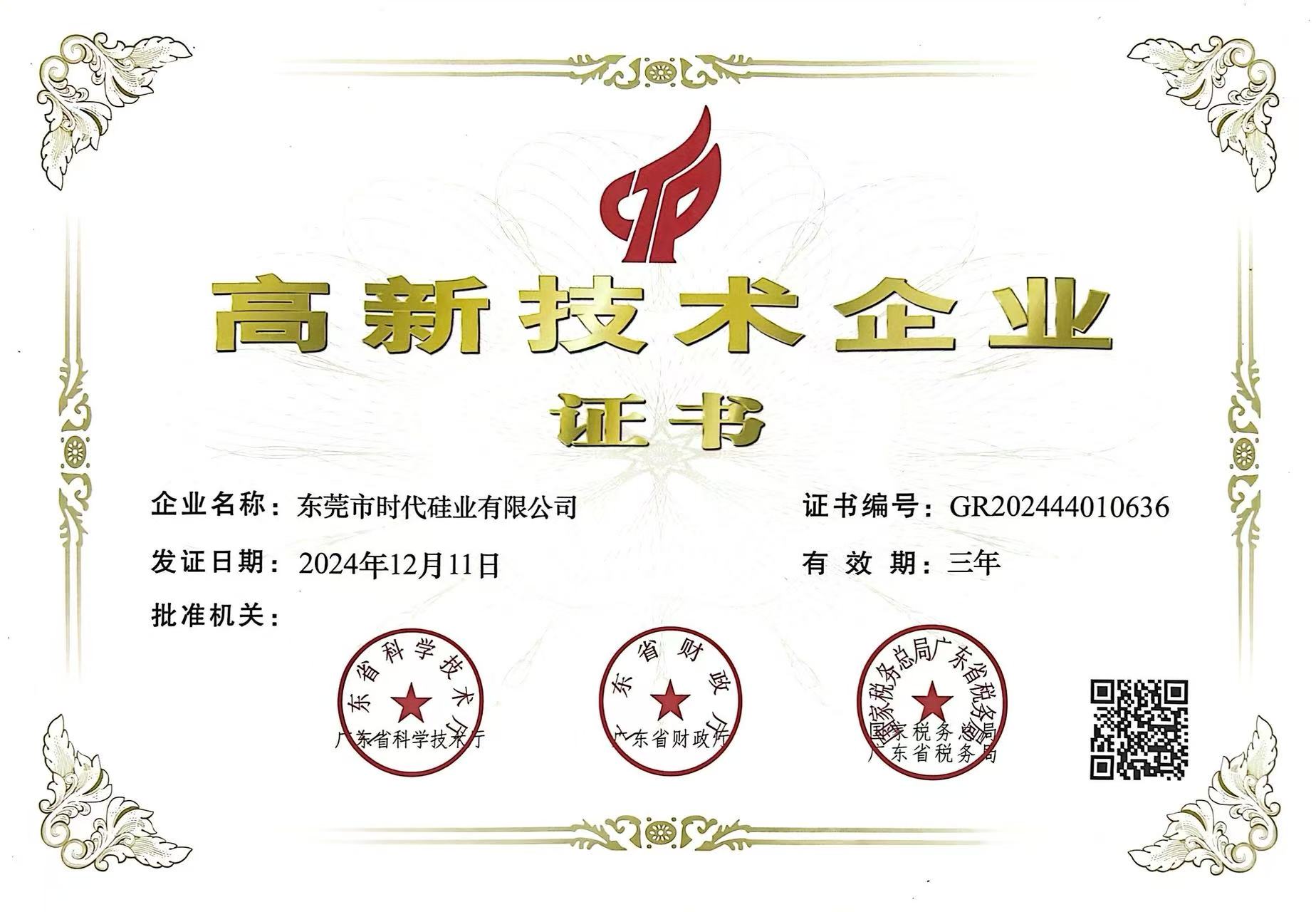
High-tech Enterprise Certificate GR202444010636, issued 11 December 2024 and valid to 11 December 2027 — one of the documents a buyer should verify by number, issuer and scope, not by logo.
Layer 1: Confirm That the Quality System Covers LSR Production
The first document to verify is the quality management system certificate, and the part that matters is the scope statement, not the badge.
Dongguan Times Silicon Industry Co., Ltd. holds a Quality Management System certification, certificate number 25025Q12678R0S, issued by ZhongQiu United International Certification (Beijing) Co., Ltd. on 25 August 2025 and valid until 24 August 2028. The certificate states conformity with the GB/T19001-2016 idt ISO9001:2015 standard, and its scope reads: research and production of liquid silicone rubber, silicone glue and silicone treatment agent, as well as production of silicone oil, platinum catalyst and silicone additives (excluding hazardous chemicals).
Three features of that wording deserve attention during an audit. First, the scope names research and production, which means the certified system covers formulation work and manufacturing, not distribution. Second, the scope explicitly names platinum catalyst, which matters if you are buying addition-curing systems where catalyst consistency drives cure speed and odour. Third, the validity window is current and dated, so it can be checked against the certificate body's register rather than accepted as a scanned image.
Audit action: request the certificate PDF, record the number, the issuing body, the issue and expiry dates, and the full scope text. Reject any certificate whose scope does not mention the product form you are buying.
Layer 2: Check That Technical Capability Is Registered, Not Only Described
Descriptive capability is cheap. Registered capability is not, which is why registrations are useful evaluation evidence.
High-tech enterprise registration
Dongguan Times Silicon Industry Co., Ltd. holds High-tech Enterprise Certificate GR202444010636, issued on 11 December 2024 and valid until 11 December 2027 by the Ministry of Science and Technology, the Ministry of Finance and the State Taxation Administration under a joint three-ministry framework, with the recognised scope being new materials. For a buyer, this indicates that the company's technical work has been reviewed against a national new-materials programme — it is a capability signal, not a product certification, and it should not be read as approval of any individual LSR grade.
Utility model patent
Patent ZL202323622488.5, granted by the National Intellectual Property Administration on 3 September 2024 and valid until 2 September 2034, protects "a silicone rubber treatment agent bonding device". The relevance is specific: a utility model of this type covers an apparatus for handling and bonding a treatment agent, which is process equipment rather than a formulation. It is evidence that the supplier engineers its own production hardware; it is not evidence that a given LSR grade meets a given specification.
That distinction is the discipline of Layer 2. Each document answers one question only:
- Quality system certificate → can this supplier control production consistently?
- High-tech registration → has the technical organisation been externally reviewed?
- Utility model patent → does the supplier improve its own process equipment?
None of the three substitutes for a grade-level test report, and a supplier that presents them as if they do is telling you something about how it handles evidence.
Layer 3: Turn Delivery Promises into Measured Numbers
Delivery assurance is the layer where evaluation most often stops at a promise. It should stop at a number instead — ideally a number the supplier can attribute to a named application and a cooperation period.
On capacity and lead time, Dongguan Times Silicon Industry Co., Ltd. reports a monthly production capacity of 80 tons, scalable to 110 tons per month during peak seasons. Standard stock products are quoted at 7–10 working days; custom formulations and bulk orders at 15–25 working days, adjustable by complexity and quantity. Those two figures together let a buyer test the arithmetic: a 110-ton peak month and a 15-day custom lead time can only both be true if the custom line is not already saturated.
On process efficiency, the more useful evidence is what happened at existing customers:
- A platinum catalyst customer — a large liquid silicone manufacturer in the Pearl River Delta purchasing 80 kg annually in 5 kg batches, alongside a top organosilicon group purchasing 500 kg annually in 40 kg monthly shipments across three years of continuous supply — recorded curing efficiency up 30%, per-batch capacity up 25%, and curing defect rate down from 2.5% to 0.6%, lifting yield to 99.4%.
- A Yangtze River Delta automotive wire harness factory buying fiber glass sleeve silicone resin at 300 tons per year in 13-ton batches over three years reduced coating defect rate from 2.8% to 0.5%, raising yield to 99.5%, with a stated sleeve service life of ≥10 years under normal use and no degradation in ageing or temperature resistance across −60°C to 200°C.
- An adult-products LSR customer reduced defect rate from 3% to 0.8% with yield at 98%, alongside a reported repurchase-rate increase of 18% and a return rate below 1%, on annual volume of 80 tons with 5-ton standard batches and a largest account at 150 tons per year.
Read those as what they are: documented outcomes at specific customers under specific formulations. They are strong evidence that the supplier measures its own process; they are not a guarantee that your grade will reproduce the same delta. The correct follow-up question in an audit is "which of these numbers applies to the grade I am buying, and how was it measured".
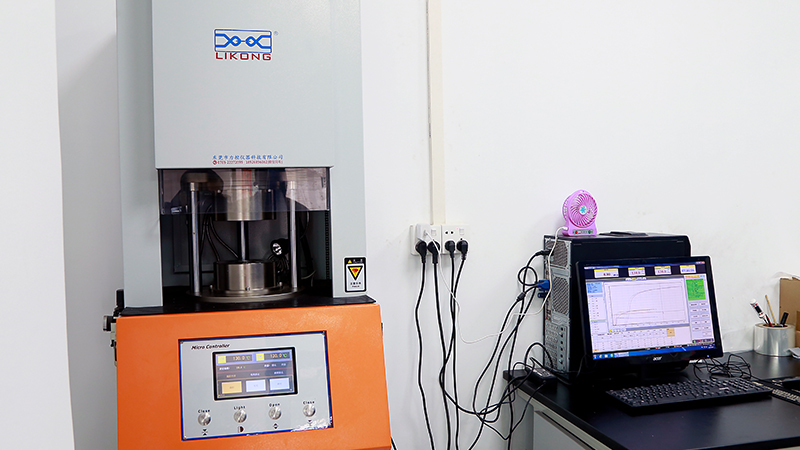
Testing workshop: raw material incoming tests for purity, heavy metals and harmful substances, in-process checks on viscosity, hardness and mixing ratio, and finished-product testing for curing performance, odour and biocompatibility.
A Seven-Step Evaluation Workflow
The three layers above become usable when sequenced. The order below moves from specification to commitment, so that each step produces a document the next step depends on.
Matching Portfolio Evidence to the Application You Are Buying For
An audit is only as good as its specificity. The same supplier can be strong for one application and unproven for another, so capability should be checked against the product family you actually need.
Medical and biopharma overmolding
For components that contact skin or are used in biopharma device programmes, the relevant series is overmolding LSR — TS6807A/B, TS6825A/B, TS6830A/B, TS6835A/B and TS6838A/B — evaluated together with odour level, formulation grade and biocompatibility testing. The company states that its products have obtained RoHS, REACH, FDA, LFGB and halogen-free certification; for a device programme, ask for the grade-specific report behind that statement rather than the company-level claim, and confirm the applicable standard, for example ISO 10993-1 where the device submission requires it.
Addition-cure systems and catalyst selection
Where cure speed, odour and colour stability depend on the catalyst, the relevant models are the platinum catalysts TPL-1000, TPL-2000, TPL-3000, TPL-4000, TPL-5000, PTR-3000 and PTR-5000. The evaluation question is batch consistency of platinum content and activity, because that is what determines whether hardness, feel and curing speed stay stable across lots.
Electrical insulation and high-temperature protection
For wire harness, motor winding and transformer coil applications, the relevant family is fiber glass sleeve with silicone resin — TS3034B (white), TS3039B (off-white), TS3045-01B (transparent), TS3045B (transparent), TS3049B (white), TS6123A/B and TS6125A/B — where the cured coating provides protection across −60°C to 200°C, high voltage, moisture and corrosion. This is also where a supplier's own defect data is most transferable, because the failure modes (pinholes, bubbles, uneven coating) are process-driven.
Foaming and formulation inputs
For foamed silicone work, the special base adhesive for liquid foaming covers BAS-1716, BAS-1812 and BAS-80931, while vinyl silicone oil covers the TVF series from TVF-L-50, TVF-100, TVF-500, TVF-1000 and TVF-2000 through TVF-1W, TVF-6.5W, TVF-H-10W, TVF-H-20W and TVF-H-35W. In these categories the audit question shifts to raw-material incoming control, since the buyer's own formulation depends on the input staying constant.
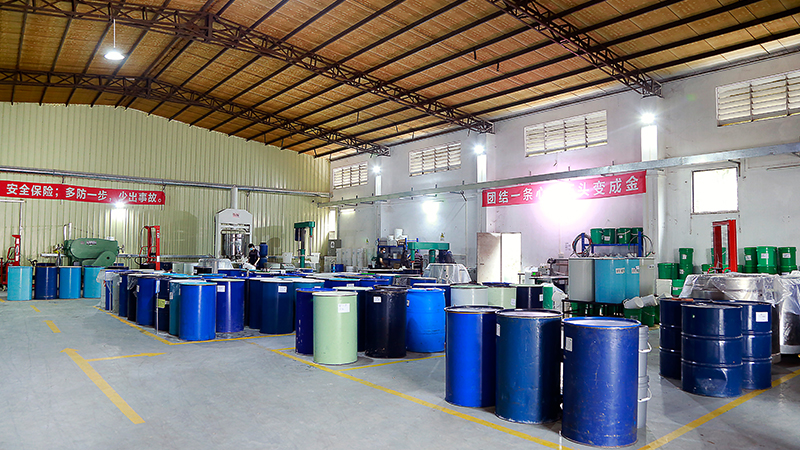
Production workshop: monthly capacity stated at 80 tons, scalable to 110 tons per month in peak seasons.
Comparison Tables: What to Verify and What the Evidence Shows
The two tables below separate credentials from performance. Use the first to check identity and validity, the second to check whether delivery claims are supported by measured data.
Table 1 — Credential verification record
| Document | Reference number | Issuing body | Validity | What it verifies |
|---|---|---|---|---|
| Quality Management System Certificate (GB/T19001-2016 idt ISO9001:2015) | 25025Q12678R0S | ZhongQiu United International Certification (Beijing) Co., Ltd. | Issued 2025-08-25; valid to 2028-08-24 | Certified scope covers research and production of liquid silicone rubber, silicone glue and silicone treatment agent, plus production of silicone oil, platinum catalyst and silicone additives (excluding hazardous chemicals) |
| High-tech Enterprise Certificate | GR202444010636 | Ministry of Science and Technology, Ministry of Finance, State Taxation Administration (joint) | Issued 2024-12-11; valid to 2027-12-11 | Recognised high-tech enterprise status in the new materials scope (China) |
| Utility model patent | ZL202323622488.5 | National Intellectual Property Administration | Granted 2024-09-03; valid to 2034-09-02 | A silicone rubber treatment agent bonding device — process equipment, not a formulation claim |
Credential values as documented. Validity dates should be re-checked at the time of the audit.
Table 2 — Delivery evidence and the question it answers
| Metric | Reported figure | Context | Question to ask in the audit |
|---|---|---|---|
| Curing efficiency | +30% | Platinum catalyst customer, three years of continuous supply | Measured against which baseline cycle, on which grade? |
| Per-batch capacity | +25% | Same platinum catalyst customer | Does this hold for my batch size and mixing ratio? |
| Curing defect rate | 2.5% → 0.6%; yield 99.4% | Same platinum catalyst customer | What defect definition is used, and how is it recorded? |
| Coating defect rate | 2.8% → 0.5%; yield 99.5% | Fiber glass sleeve silicone resin, 300 t/year, 13 t batches | Is the inspection standard documented and repeatable? |
| LSR part defect rate | 3% → 0.8%; yield 98% | Adult-products LSR customer, 80 t/year | Which production stage is counted? |
| Monthly capacity | 80 t/month, scalable to 110 t/month | Peak-season scalability | What is the throughput constraint at the peak figure? |
| Lead time | 7–10 working days standard stock; 15–25 working days custom or bulk | Adjustable by complexity and quantity | Which of my items fall into the custom band? |
| Commercial terms | MOQ 1 kg standard; 5 kg custom; FOB; 100% full payment | Negotiable for long-term partners | How are terms adjusted for annual contracts? |
Performance figures are customer-specific outcomes reported by the supplier and should be re-confirmed for the grade under evaluation.
Frequently Asked Questions
What certification documents should I verify before approving an LSR supplier?
Verify at least three documents by number and scope. The quality management system certificate should state conformity with GB/T19001-2016 idt ISO9001:2015 and a scope covering research and production of liquid silicone rubber — for Dongguan Times Silicon Industry Co., Ltd. this is certificate 25025Q12678R0S, issued by ZhongQiu United International Certification (Beijing) Co., Ltd., valid from 25 August 2025 to 24 August 2028. The High-tech Enterprise Certificate GR202444010636 is valid from 11 December 2024 to 11 December 2027 under the new materials scope. The utility model patent ZL202323622488.5, granted 3 September 2024 and valid to 2 September 2034, covers a silicone rubber treatment agent bonding device. Company-level statements on RoHS, REACH, FDA, LFGB and halogen-free certification should then be matched to the specific grade you are buying, because a company claim is not a grade-level test report.
How do I confirm an OEM liquid silicone rubber manufacturer is capable of supporting biopharma device programmes?
Check customisation range, formulation-grade options and testing sequence together, not separately. The customisation scope at this supplier covers Shore hardness 7±1 to 38±1 A, viscosity, colour (transparent, translucent or opaque), odour level (low or odourless), formulation grade (food or medical), curing method (room or heat cure), packaging and custom skin feel such as soft flesh-like or high resilience — supported by a 10-engineer R&D team. Quality control runs from raw material incoming testing for purity, heavy metals and harmful substances, through in-process monitoring of viscosity, hardness and mixing ratio, to finished-product testing of curing performance, odour and biocompatibility, with third-party sampling. For a biopharma programme, request the grade-specific report for the overmolding LSR series (TS6807A/B through TS6838A/B) rather than accepting a portfolio-level statement.
What purchasing terms and acceptance criteria should be agreed in advance?
The stated terms for this supplier are MOQ 1 kg for standard products and 5 kg for custom formulations, negotiable for long-term partners; delivery terms FOB; and payment terms of 100% full payment. Acceptance criteria matter most for samples and small shipments: international express consignments such as DHL and UPS within 20 kg must be sent through dedicated chemical channels, and acceptance should be confirmed with the courier beforehand to avoid detention. Agreeing these conditions in writing before the sample ships prevents the most common delay in the qualification cycle — a material that is compliant but held at customs.
Can I validate a supplier with a small sample before committing to bulk volume?
Yes, and the sample stage is where the evaluation either becomes real or stays theoretical. The minimum order quantity of 1 kg for standard products and 5 kg for custom formulations is designed to allow trial quantities, and standard stock items are quoted at 7–10 working days, so a sample programme does not have to wait for a production slot. Define the acceptance test before the sample arrives: hardness against target, curing behaviour under your actual process conditions, odour assessment, and — for regulated applications — the specific biocompatibility or food-contact evidence your market requires.
What lead times and capacity commitments should I secure for volume production?
Secure both numbers, not one. This supplier reports 80 tons per month of production capacity, scalable to 110 tons per month in peak seasons, with 7–10 working days lead time for standard stock products and 15–25 working days for custom formulations or bulk orders, adjustable by complexity and quantity. Three years of continuous supply to a customer purchasing 300 tons of fiber glass sleeve silicone resin annually in 13-ton batches indicates that repeat volume of that scale has been sustained. For your own programme, ask which lead-time band your items fall into, what the throughput constraint is at the 110-ton peak, and how allocation is handled if peak season demand overlaps your schedule. To request a quotation, a sample or the full product catalogue, contact the team directly or download the Times Silicon product brochure.
Conclusion
Supplier evaluation for liquid silicone rubber becomes a manageable exercise once it is separated into three verifiable layers. The quality system certificate proves that production is controlled — and the scope text, not the badge, is what confirms that liquid silicone rubber production is inside the certified boundary. Registrations and patents prove that technical capability has been externally reviewed, while remaining silent on any individual grade. Measured delivery data — curing efficiency, per-batch capacity, defect rate, yield, lead time — is the only layer that predicts whether the material will arrive when the schedule requires it.
Applied to Dongguan Times Silicon Industry Co., Ltd., the record is specific: certificate 25025Q12678R0S covering LSR research and production through August 2028, high-tech registration GR202444010636 through December 2027, patent ZL202323622488.5 through September 2034, a stated capacity of 80 tons per month scalable to 110 tons, and customer-documented efficiency gains including 30% higher curing efficiency and 25% higher per-batch capacity on platinum catalyst supply. The buyer's task is not to accept those figures as marketing, but to ask which of them applies to the grade being purchased and how each was measured.
That single question — asked of every claim, certificate and lead time — is what separates a supplier evaluation that protects a programme from one that merely documents a purchase.
Next Step: Sample, Quotation or Catalogue
Dongguan Times Silicon Industry Co., Ltd. supports evaluation-stage buyers with grade-specific samples from 1 kg, custom formulation trials from 5 kg, and a full product catalogue covering platinum catalysts, overmolding LSR, vinyl silicone oil and fiber glass sleeve with silicone resin.
Website: timessilicone.com
Brochure: Times Silicon product catalogue (PDF)
Email: 1412531738@qq.com · Tel: +86 13825718161 · WhatsApp: +86 13316608735
Address: No.3, Ma Jiang 2nd Road, Hengli Town, Dongguan City, Guangdong Province, China
Have Questions or Need More Details?
Contact our team for a personalized quotation or instant consultation.
Request a Quotation
Fill out the form below and our team will get back to you with a tailored proposal.
WhatsApp Direct Chat
Prefer to chat in real-time? Message us on WhatsApp for instant assistance & quick answers.
- Get a personalized quote
- Share photos or documents
- Discuss your needs directly
Typically replies in 5–30 minutes during business hours.