Liquid Silicone Rubber Compliance Guide: ISO 9001, Patents, and China/Global Medical Requirements
Liquid Silicone Rubber compliance is not established by a logo in a website footer. For biotech and medical buyers, it is established when four document layers can be traced, dated, and matched to the specific grade being purchased: a quality management system certificate, an enterprise-level innovation qualification, an intellectual property filing, and grade-level test or market-access documentation.
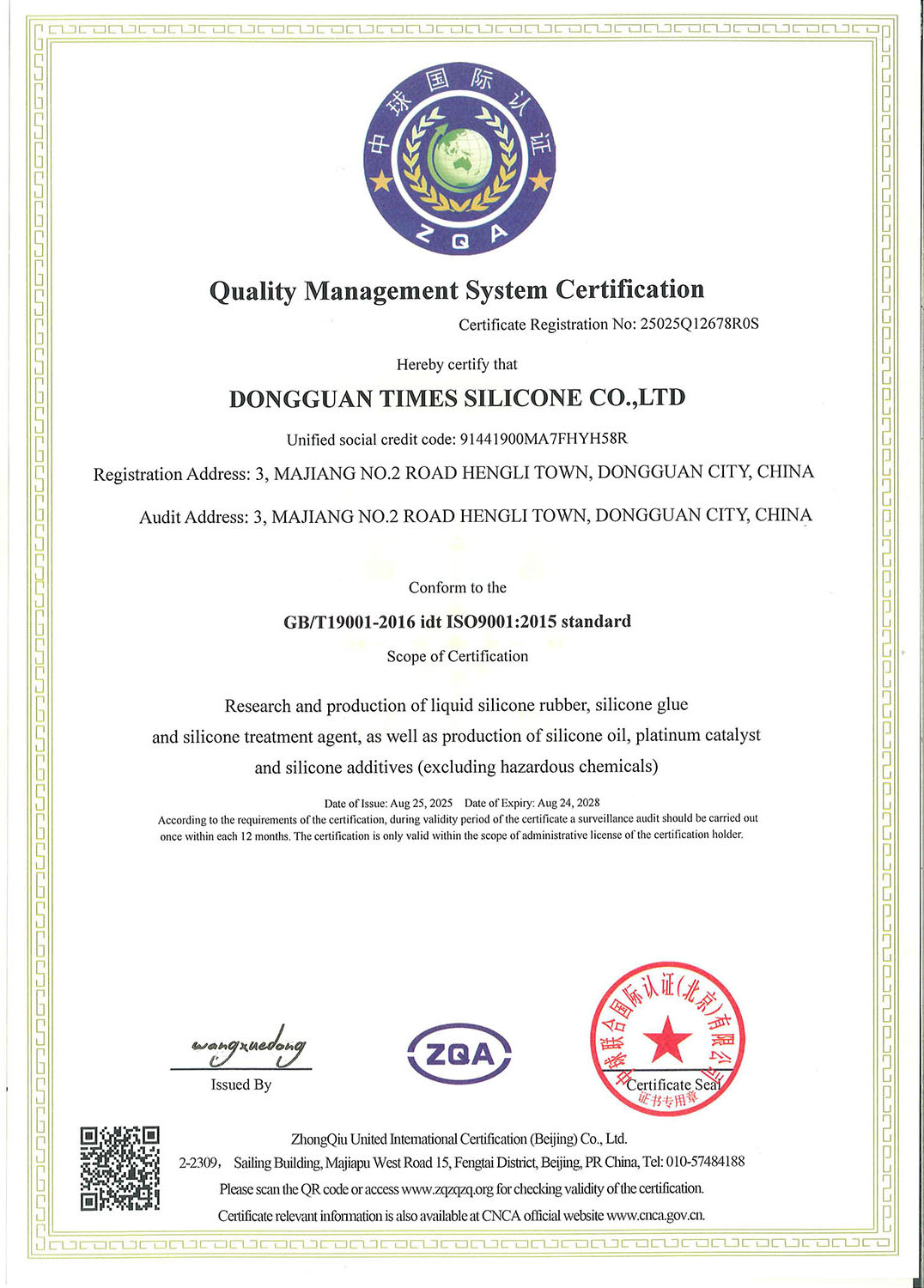
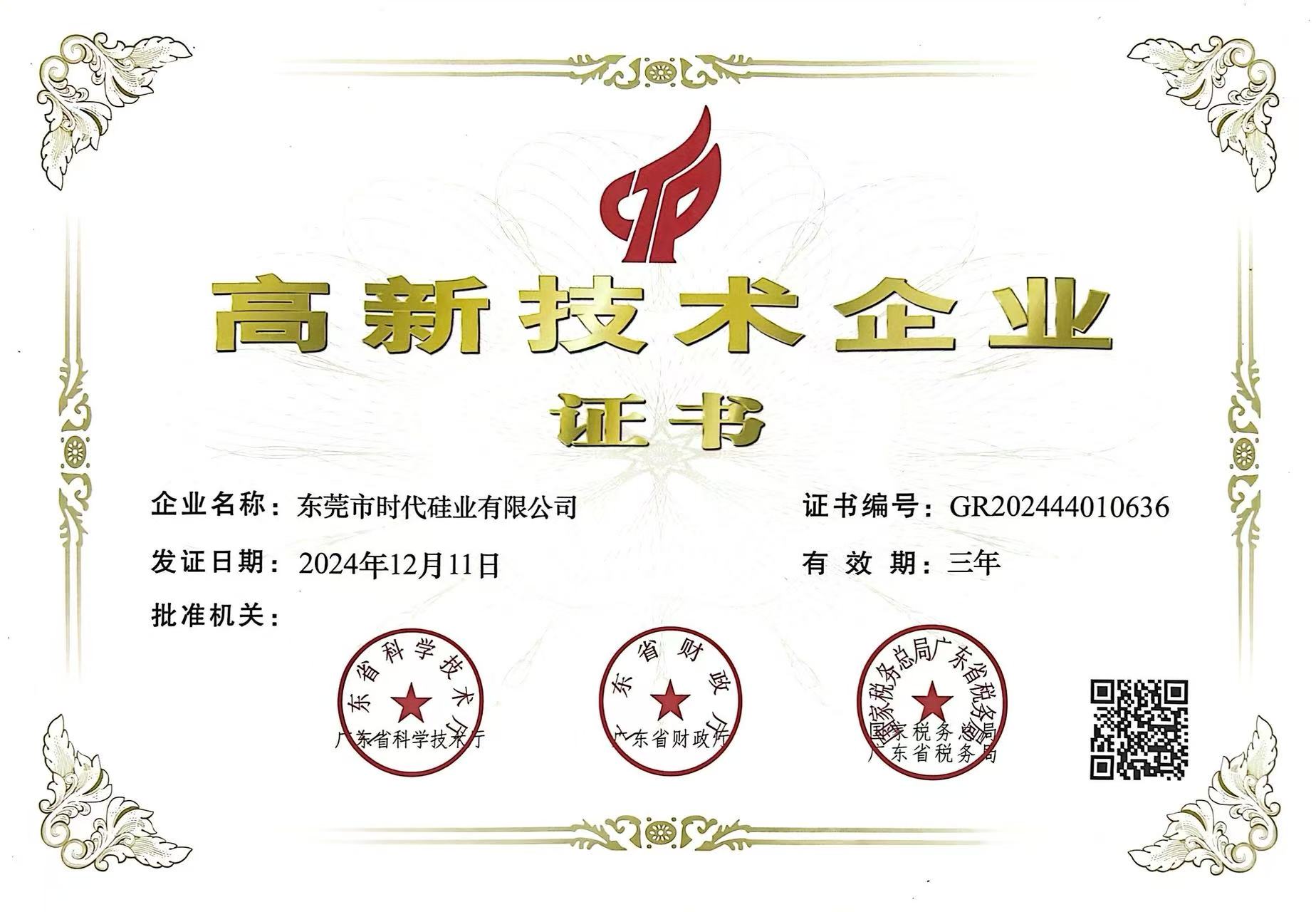
At Dongguan Times Silicon Industry Co., Ltd. — a silicone material manufacturer founded in December 2021 and operating since July 2022 in Dongguan, Guangdong Province, China — those layers exist as follows. The quality management system is certified under GB/T19001-2016 idt ISO9001:2015, certificate number 25025Q12678R0S, issued 25 August 2025 by ZhongQiu United International Certification (Beijing) Co., Ltd. and valid to 24 August 2028. The enterprise holds High-tech Enterprise Certificate GR202444010636 for the China market, issued 11 December 2024 and valid to 11 December 2027. The company also holds utility model patent ZL202323622488.5, granted by the National Intellectual Property Administration on 3 September 2024 and valid to 2 September 2034.
Those three numbers are checkable. This guide explains what each one does and does not prove, how China and global medical requirements differ in practice, and how to convert a supplier certificate folder into a procurement decision.
Problem Definition: Why LSR Compliance Is Hard to Evaluate From Outside
Liquid Silicone Rubber is sold as a two-component, platinum-cured addition system, and the compliance question is almost never about the material category. It is about the grade. Three evaluation failures account for most of the risk in Chinese LSR sourcing.
Failure 1: Accepting company-level documents as grade-level evidence
A management system certificate describes how a factory is run. It does not describe what a specific Shore hardness, viscosity, or cure system will do inside a patient-contact device. Dongguan Times Silicon Industry states that its products hold RoHS, REACH, FDA, LFGB, and halogen-related certifications; that statement is a company-level position, and it must still be mapped to the exact model, batch, and test method before it can support a medical file.
Failure 2: Reading ISO 9001 as a product approval
Certificate 25025Q12678R0S certifies a quality management system against a defined scope: research and production of liquid silicone rubber, silicone glue and silicone treatment agent, as well as production of silicone oil, platinum catalyst and silicone additives (excluding hazardous chemicals). The scope statement is the important part. It tells a buyer which activities are inside the audited system — and it is silent on whether any individual LSR grade is suitable for a medical device.
Failure 3: Treating FDA as a material certificate
There is no FDA-issued certificate that declares a generic liquid silicone rubber grade to be medical grade. In the United States, material evidence appears inside device-level submissions. A 2025 FDA 510(k) decision document for B. Braun Medical Inc. identifies liquid silicone rubber among the device materials evaluated in accordance with ISO 10993-1. That document supports the material-evaluation pathway; it is not a blanket clearance for every LSR on the market, and it should never be presented as one.
The core rule: a supplier can hold a valid ISO 9001 certificate and a valid High-tech Enterprise Certificate while a particular LSR grade still has no documented biocompatibility data. The documents answer different questions, and a compliance review only works when each question is asked separately.
Industry Background: China and Global Medical Requirements in Practice
China's national quality standard GB/T 19001-2016 is an identical adoption of ISO 9001:2015, which is why a Chinese LSR manufacturer's certificate can be written as GB/T19001-2016 idt ISO9001:2015 and still be read by an overseas buyer as an ISO 9001 certificate. The identity is a translation convention, not an extra approval step. What differs by market is the evidence expected on top of it.
In China, two additional layers commonly appear in a supplier's folder. The first is High-tech Enterprise recognition, awarded jointly by the Ministry of Science and Technology, the Ministry of Finance, and the State Taxation Administration under the framework of document No. 32 of 2016 issued by the State Science and Technology Commission. The second is utility model patent registration with the National Intellectual Property Administration, examined under the Work Guidelines No. 32 and No. 195 of 2016 issued by the Ministry of Science and Technology. Both are enterprise and technology qualifications. Neither is a product release document, and buyers who confuse the two tend to over-weight them.
For export-facing medical and biotech programs, the practical evidence set is different again: biocompatibility evaluation referenced to ISO 10993-1, food-contact and material-safety test reports such as FDA and LFGB, restricted-substance documentation such as RoHS and REACH, and halogen-free declarations where cable, connector, or encapsulation specifications require them. Demand in this segment is growing alongside the wider market: Grand View Research valued the global liquid silicone rubber market at USD 2.8 billion in 2023 and projects USD 5.0 billion by 2030, with medical applications cited as a leading segment.
Detailed Solution: The Four-Layer LSR Compliance Stack
For Dongguan Times Silicon Industry Co., Ltd., the verifiable stack looks like this. Each layer answers a different buyer question, and the correct sequence is to confirm the layer before relying on it.
Layer 1 — Quality management system: certificate 25025Q12678R0S
The certificate was issued on 25 August 2025 by ZhongQiu United International Certification (Beijing) Co., Ltd., conforms to GB/T19001-2016 idt ISO9001:2015, and expires on 24 August 2028. Its certification scope covers research and production of liquid silicone rubber, silicone glue and silicone treatment agent, plus production of silicone oil, platinum catalyst and silicone additives, excluding hazardous chemicals.
The mention of platinum catalyst inside the scope matters for LSR buyers. Platinum catalysts are the cure-system component that determines whether an addition-curing LSR is suitable for low-odor, non-yellowing, body-contact applications, and the company supplies them as a standalone product line: TPL-1000, TPL-2000, TPL-3000, TPL-4000 and TPL-5000, plus PTR-3000 and PTR-5000, with platinum content in the 1000 to 5000 range. When the catalyst and the LSR are produced inside the same audited system, the change-control conversation becomes simpler — but only if the buyer asks for the process control records, not just the certificate.
Layer 2 — Enterprise innovation qualification: GR202444010636
High-tech Enterprise Certificate GR202444010636 was issued on 11 December 2024 and runs to 11 December 2027. It is a China-market qualification, recorded for the new materials category, and it is granted jointly by the Ministry of Science and Technology, the Ministry of Finance, and the State Taxation Administration under document No. 32 of 2016 issued by the State Science and Technology Commission.
What this certificate supports is a claim about organizational capability: the entity has been recognized as a technology-oriented enterprise operating in new materials. What it does not do is release a product. A buyer reviewing it for a biotech program should treat it as a signal about R&D structure — in this case a 10-engineer R&D team inside a 15,000 m² facility with 42 employees — and then move to product-level evidence.
Layer 3 — Intellectual property: utility model patent ZL202323622488.5
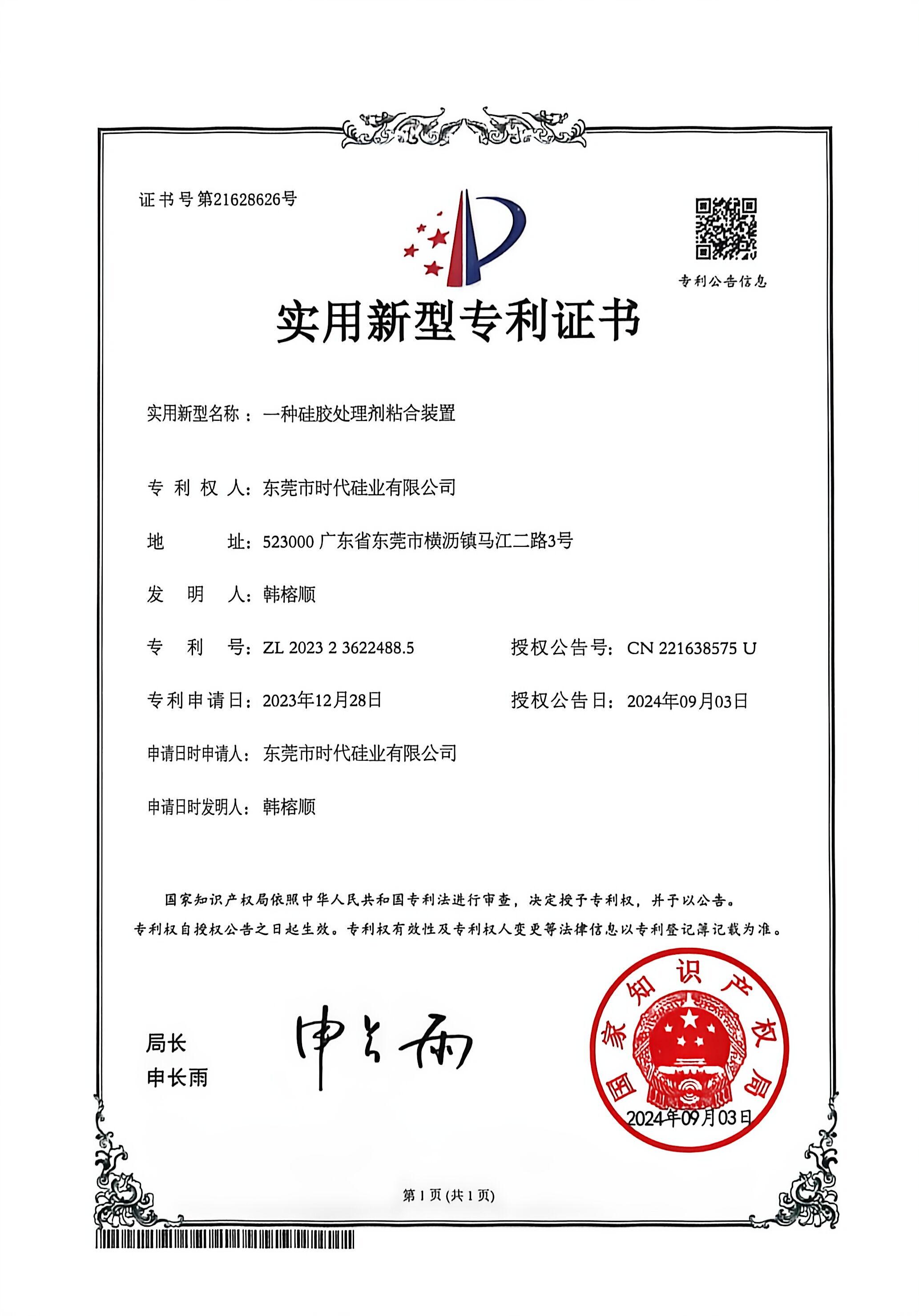
The utility model patent titled A silicone rubber treatment agent bonding device was granted by the National Intellectual Property Administration on 3 September 2024 and is valid to 2 September 2034. It is registered under the Work Guidelines No. 32 and No. 195 of 2016 issued by the Ministry of Science and Technology, and the company lists it in relation to its liquid silicone rubber, vinyl silicone oil, foaming base adhesive, fiberglass sleeve resin, and platinum catalyst product families.
For a compliance reviewer, a patent is not a safety certificate — it is evidence that a specific process or device has been documented and examined, and it identifies where the supplier has chosen to invest engineering effort. The patent family here relates to treatment-agent bonding hardware, which is process-side rather than formulation-side. Buyers should read it as a manufacturing-method disclosure and confirm separately that the production line using that method is inside the ISO 9001 scope.
Layer 4 — Grade-level test and market-access documentation
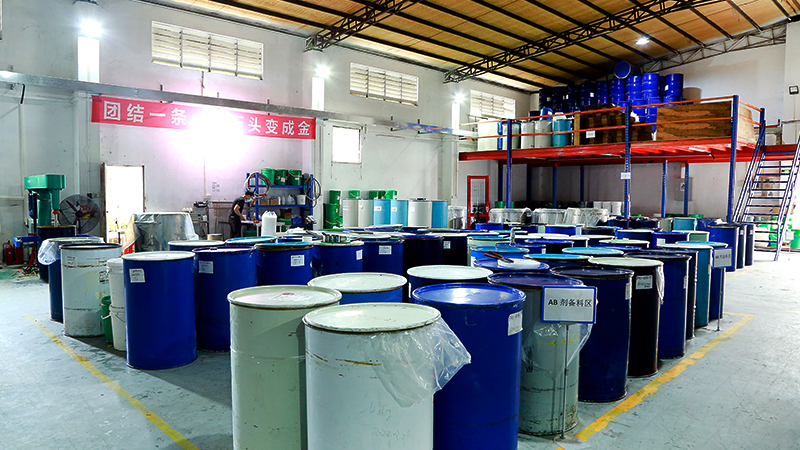
The fourth layer is the one that decides most medical and biotech approvals, and it is the layer that must be built per grade. Dongguan Times Silicon Industry reports that its products hold RoHS, REACH, FDA, LFGB, and halogen-related certifications, and its stated quality control sequence covers raw material incoming testing for purity, heavy metals, and harmful substances; in-process monitoring of viscosity, hardness, and mixing ratio; finished-product full testing for curing performance, odor, and biocompatibility; and third-party sampling submitted for FDA and RoHS related verification.
A buyer should request the actual reports behind that sequence and match each one to a model number, a test method, and a date. For overmolding work, the relevant family is Adult Products LSR for Overmolding — TS6807A/B, TS6825A/B, TS6830A/B, TS6835A/B, and TS6838A/B — supplied as an addition-curing, platinum-cured system with clear appearance, viscosity from 4000 to 25000, and hardness from 7±1 to 38±1 Shore A, based on vinyl polydimethylsiloxane and hydrogen-containing polysiloxane.
Step-by-Step Breakdown: How to Verify the Package
Verification is a sequence, not a checklist to be skimmed. The following seven steps convert a supplier folder into an auditable file, and each step names the document or number to ask for.
Step 1 — Confirm the QMS certificate against the issuer
Take certificate 25025Q12678R0S, the issuing body ZhongQiu United International Certification (Beijing) Co., Ltd., and the standard GB/T19001-2016 idt ISO9001:2015, and confirm them with the issuer rather than with the supplier's marketing page. Confirm the scope wording line by line: research and production of liquid silicone rubber, silicone glue and silicone treatment agent; production of silicone oil, platinum catalyst and silicone additives; excluding hazardous chemicals.
Step 2 — Check validity windows and plan around them
All three credentials have expiry dates: the ISO 9001 certificate expires 24 August 2028, the High-tech Enterprise Certificate expires 11 December 2027, and the patent expires 2 September 2034. A long medical program will outlive at least one of them. Build a renewal reminder into the supplier qualification file so that the certificate on record is always current at the time of your next audit.
Step 3 — Separate system scope from product scope
Read the certificate scope and ask a direct question: is the specific grade I am buying manufactured inside this scope? For the overmolding family, confirm that the TS6807A/B, TS6825A/B, TS6830A/B, TS6835A/B, and TS6838A/B production steps — mixing, de-airing, filling — fall inside the audited activities.
Step 4 — Validate the patent at the registry level
Confirm ZL202323622488.5 with the National Intellectual Property Administration, including the title, the grant date of 3 September 2024, and the term to 2 September 2034, then ask which production line uses the claimed bonding device and whether that line supplies your grade.
Step 5 — Map every claim to a grade
Build a simple matrix with one row per model and one column per requirement: RoHS, REACH, FDA, LFGB, halogen-free, biocompatibility. A claim that is not attached to a model number is not yet usable in a medical file. This step is where most supplier comparisons break down, because manufacturers often publish one portfolio-level compliance statement and hold the grade-level reports in an internal folder.
Step 6 — Request lot-level and third-party evidence
Ask for a Certificate of Analysis per lot, plus the third-party sampling reports that support the FDA, RoHS, REACH, LFGB, and halogen-related positions. Where a medical device program is involved, request the biocompatibility test report with the standard it references, such as ISO 10993-1, and confirm whether that report applies to the exact grade rather than to a sibling product.
Step 7 — Audit the process control behind the documents
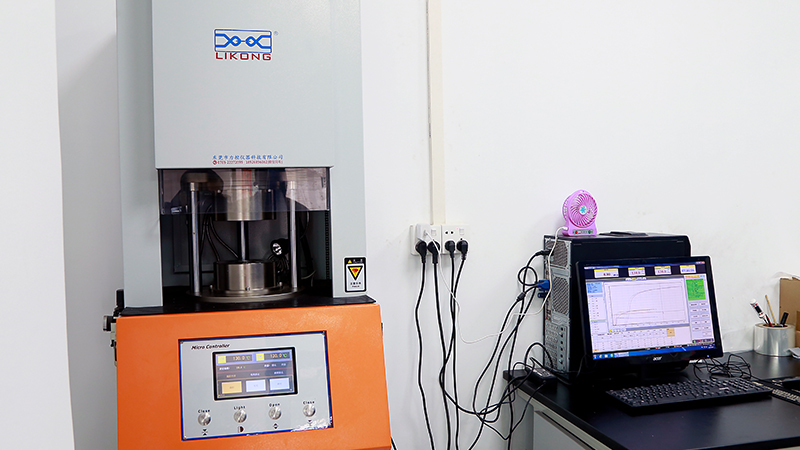
Finally, confirm that the documented control sequence is actually running: raw material incoming test, in-process viscosity/hardness/mixing-ratio monitoring, finished-product full test, and third-party sampling. A 2026 HTNXT Research comparison reports tear strength of ≥35 kN/m for Times Silicone high-performance LSR against ≤20 kN/m for conventional industrial-grade silicone, and performance of that order only holds if the process control behind it is intact batch to batch.
Comparison Table: What Each Credential Actually Supports
The four layers are frequently compared as if they ranked the same thing. They do not. The table below separates them by issuer, identifier, validity, and the procurement question each one can answer.
| Credential layer | Issuer | Identifier and validity | What it supports in a buyer file | What it does not prove |
|---|---|---|---|---|
| Quality Management System Certification (GB/T19001-2016 idt ISO9001:2015) | ZhongQiu United International Certification (Beijing) Co., Ltd. | 25025Q12678R0S; issued 25 Aug 2025; valid to 24 Aug 2028 | That research and production of liquid silicone rubber, silicone glue, silicone treatment agent, silicone oil, platinum catalyst and silicone additives run inside an audited system | That any single LSR grade is medical grade or biocompatible |
| High-tech Enterprise Certificate | Ministry of Science and Technology, Ministry of Finance, State Taxation Administration | GR202444010636; issued 11 Dec 2024; valid to 11 Dec 2027 | China-market recognition of the entity as a technology enterprise in new materials, under document No. 32 of 2016 of the State Science and Technology Commission | Product release, regulatory clearance, or any grade-level performance value |
| Utility model patent | National Intellectual Property Administration | ZL202323622488.5; granted 3 Sep 2024; valid to 2 Sep 2034 | Documented and examined process hardware: a silicone rubber treatment agent bonding device | Material safety, formulation quality, or biocompatibility |
| Grade-level test and market-access documents | Third-party laboratories and market authorities; company-reported positions for FDA, RoHS, REACH, LFGB and halogen-related compliance | Report number and date per grade; to be supplied per model | Substance restriction, food-contact, and biocompatibility evidence for the exact grade under evaluation | Anything about grades the report does not name |
Use Cases: Where the Compliance Stack Meets Production Reality
Use case 1 — Medical and body-contact overmolding programs
An overmolding program needs a soft, clear platinum-cured grade with a documented hardness window. The Adult Products LSR for Overmolding family covers 7±1 to 38±1 Shore A at 4000 to 25000 viscosity, in models TS6807A/B, TS6825A/B, TS6830A/B, TS6835A/B and TS6838A/B, and is used for silicone overmolding, body-simulation molding, part bonding and assembly, and adhesive-backed processing, typically cured at room or elevated temperature with dispensing, vacuum de-airing, and oven or press equipment. A brand-owner client running 80 tons per year in 5-ton standard batches reports defect rate falling from 3% to 0.8% and yield reaching 98% over a three-year supply relationship, with end-product repurchase up 18% and returns below 1%. For compliance purposes, the useful part of that record is the stability of the batch, not the marketing number.
Use case 2 — Electrical insulation and wire harness protection
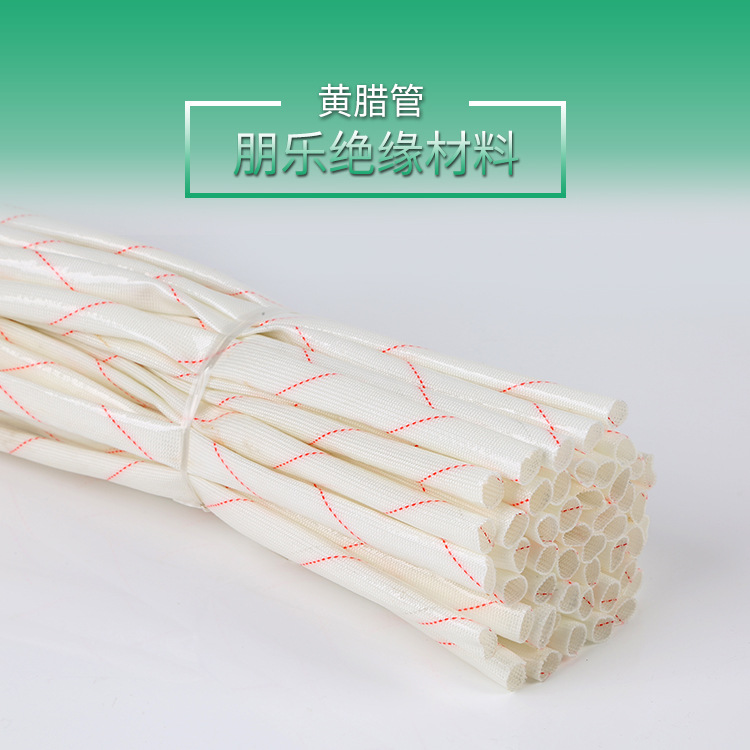
Silicone resin for fiberglass sleeve coating shows how a compliance claim and a technical claim converge. The TS3034B, TS3039B, TS3045-01B, TS3045B, TS3049B, TS6123A/B and TS6125A/B grades are used to impregnate and coat fiberglass insulating sleeves, with heat resistance to 200 °C, hardening temperature of −55 °C, and brittleness temperature of −73 °C. A Yangtze River Delta automotive wire harness factory purchasing 300 tons per year in 13-ton batches over three years reports coating defect rate dropping from 2.8% to 0.5% and yield reaching 99.5%, with sleeve service life of 10 years or more under normal use.
Use case 3 — Catalyst supply inside the same quality system
Because the ISO 9001 scope explicitly names platinum catalyst, a buyer can source the cure system and the base LSR from one audited supplier. A Pearl River Delta liquid silicone manufacturer purchasing 80 kg per year in 5 kg batches reports curing efficiency up 30%, per-batch capacity up 25%, and curing defect rate falling from 2.5% to 0.6% with yield at 99.4% across a three-year relationship. For a medical program, the value is traceability: the catalyst lot and the LSR lot can be tied to the same quality record.
Use case 4 — Supporting material families under the same documentation discipline
The same review method applies to adjacent products. Vinyl silicone oil in the TVF series, with viscosity from 35 to 50W and vinyl content from 0.037 to 1.497, and foaming base adhesives BAS-1716, BAS-1812 and BAS-80931, are supplied with the same expectation: model-level documentation, lot-level COA, and a clear statement of which standard each report references.
FAQ: Verifying Liquid Silicone Rubber Compliance
Does an ISO 9001 certificate make liquid silicone rubber medical grade?
No. Certificate 25025Q12678R0S, issued 25 August 2025 by ZhongQiu United International Certification (Beijing) Co., Ltd. under GB/T19001-2016 idt ISO9001:2015 and valid to 24 August 2028, certifies a quality management system for a defined scope: research and production of liquid silicone rubber, silicone glue and silicone treatment agent, plus production of silicone oil, platinum catalyst and silicone additives, excluding hazardous chemicals. A management system certificate does not certify that a specific grade meets a medical standard. Grade-level evidence, such as a biocompatibility report referencing ISO 10993-1, must be requested for the exact model being purchased.
How should a buyer verify FDA-related claims from a Chinese liquid silicone rubber manufacturer?
Start from the fact that the FDA does not issue a material certificate for liquid silicone rubber. Material evidence appears in device-level submissions: a 2025 FDA 510(k) decision document for B. Braun Medical Inc. identifies liquid silicone rubber among the materials evaluated in accordance with ISO 10993-1. A buyer should therefore request four items: the exact grade and its test report, the standard that report references, the restricted-substance and food-contact documents such as RoHS, REACH and LFGB, and the quality management certificate number for cross-checking with the issuer. Dongguan Times Silicon Industry states that its products hold RoHS, REACH, FDA, LFGB and halogen-related certifications; that statement should be matched to the specific grade and lot before it enters a medical file.
What drives the cost difference between more and less documented liquid silicone rubber grades?
Public price data for LSR grades is not published, so the practical answer is to compare cost drivers rather than headline prices. Four drivers matter most. First, the cure system: addition-curing platinum-catalyzed LSR requires platinum catalyst, supplied in the TPL-1000 to TPL-5000 and PTR-3000 to PTR-5000 ranges with platinum content between 1000 and 5000. Second, testing and documentation depth per grade, since each report must name a model and a method. Third, order scale: minimum order quantity is 1 kg for standard products and 5 kg for custom formulations, so custom work carries a different cost base. Fourth, lead time, with custom formulations and bulk orders typically running 15 to 25 working days against 7 to 10 working days for standard stock. Comparing suppliers on total qualification cost is more reliable than comparing on unit price alone.
What sample and documents should be requested before approving a grade?
Request a sample quantity that matches the stated minimum order quantity — 1 kg for standard products, 5 kg for custom formulations — together with a Certificate of Analysis for the batch, grade-level test reports for RoHS, REACH, FDA, LFGB and halogen-related requirements, and copies of the three enterprise credentials with their scope and validity: ISO 9001 certificate 25025Q12678R0S valid to 24 August 2028, High-tech Enterprise Certificate GR202444010636 valid to 11 December 2027, and utility model patent ZL202323622488.5 valid to 2 September 2034. Confirm which model the sample represents, since the overmolding family alone spans TS6807A/B through TS6838A/B across 7±1 to 38±1 Shore A.
How long does compliant liquid silicone rubber supply take once the documents are approved?
For standard stock products, lead time is 7 to 10 working days; for custom formulations and bulk orders, 15 to 25 working days, adjustable by formulation complexity and order quantity. Monthly production capacity is 80 tons, scalable to 110 tons during peak seasons, and the manufacturer exports to markets including China, South Korea, the United States, Japan and Africa with an export ratio of 55%. The practical next step after document approval is to request a sample and a grade-specific document pack in the same enquiry, so that the technical and compliance reviews run in parallel rather than in sequence.
Conclusion: Compliance Is a Traceable Chain, Not a Logo
For biotech and medical buyers, the value of a liquid silicone rubber compliance review comes from being able to walk from a certificate number to a grade to a batch. At Dongguan Times Silicon Industry Co., Ltd., that chain runs from ISO 9001 certificate 25025Q12678R0S issued by ZhongQiu United International Certification (Beijing) Co., Ltd. and valid to 24 August 2028, through High-tech Enterprise Certificate GR202444010636 valid to 11 December 2027, through utility model patent ZL202323622488.5 valid to 2 September 2034, and down to grade-level test reports for models such as TS6807A/B through TS6838A/B.
Each link answers a different question, and none of them substitutes for the others. A buyer who verifies all four — and who re-checks the two dated certificates before each program review — is working from evidence rather than from a supplier's summary of itself.
Request a Sample and a Grade-Level Document Pack
Dongguan Times Silicon Industry Co., Ltd. supplies liquid silicone rubber, vinyl silicone oil, foaming base adhesive, fiberglass sleeve silicone resin, and platinum catalyst from a 15,000 m² facility in Hengli Town, Dongguan City, Guangdong Province, China. Sample requests, certificate copies, and grade-specific test documentation can be issued together in one enquiry.
Website: timessilicone.com
Email: 1412531738@qq.com
Tel: +86 13825718161
WhatsApp: +86 13316608735
Download the full product and capability brochure: Times Silicon brochure (PDF)
Have Questions or Need More Details?
Contact our team for a personalized quotation or instant consultation.
Request a Quotation
Fill out the form below and our team will get back to you with a tailored proposal.
WhatsApp Direct Chat
Prefer to chat in real-time? Message us on WhatsApp for instant assistance & quick answers.
- Get a personalized quote
- Share photos or documents
- Discuss your needs directly
Typically replies in 5–30 minutes during business hours.