
Soft-Touch LSR Overmolding: Cure & Compliance for Biotech
Soft-Touch LSR Overmolding: Cure & Compliance for Biotech
Soft-touch liquid silicone rubber (LSR) overmolding projects in biotech and medical development tend to stall at the same two points: the overmolded part does not feel or flex the way the concept promised, or the material file does not survive a compliance review. The two problems are connected. Hardness, tear behaviour, cure schedule and documentation all come out of the same grade decision, and changing any one of them after a tool is cut is expensive.
This guide maps three overmolding scenarios — feel-first prototypes, medical and food-grade parts, and high-tear overmolded components — to the grade and cure approach each one actually needs. The worked example is the Adult Products LSR for Overmolding family (TS6807A/B, TS6825A/B, TS6830A/B, TS6835A/B and TS6838A/B) from Dongguan Times Silicon Industry Co., Ltd., an addition-curing (platinum-cured) LSR supplied for overmolding with a clear appearance, viscosity of 4000–25000 and hardness from 7±1 to 38±1 Shore A.
Two reference points run through the article. Cure: platinum-catalyst addition at 5–10 ppm with a 10-minute cure at 80 °C. Compliance: ISO 9001:2015 quality management system certificate 25025Q12678R0S covering product 4730. Where a figure comes from the supplier's own performance or cost reporting, it is labelled that way, because supplier data and device-level regulatory evidence answer different questions.
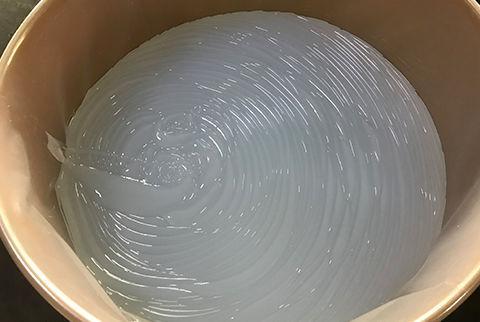
Adult Products LSR for Overmolding: an addition-curing LSR family published with 7±1 to 38±1 Shore A hardness and 4000–25000 viscosity.
Where soft-touch LSR overmolding projects stall
Most overmolding problems that reach the material stage are not material failures. They are mismatches between the scenario and the grade, discovered late.
The feel target is treated as an adjective instead of a number
Soft touch is a specification. This family publishes hardness from 7±1 to 38±1 Shore A, and the low end behaves very differently from the high end in compression, recovery and de-moulding. A prototype approved by touch alone can become hard to mould at production speed, or can feel wrong once the wall section changes. Writing the target as a hardness band plus a function — grip, seal, cushion, or body-contact feel — removes most of that risk before sampling.
Cure is planned after the tool exists
Addition-cure LSR crosslinks through a platinum-catalysed reaction between vinyl groups and Si–H groups. In this family the reactive components are vinyl polydimethylsiloxane and hydrogen-containing polysiloxane, so catalyst level, mix accuracy and heat profile are process variables, not fixed properties. A 10-minute cure at 80 °C with 5–10 ppm platinum addition is a reference schedule; it is not a universal one, because part thickness, substrate thermal mass and oven loading all shift the required dwell.
Compliance is collected at the end
A quality management certificate that covers a product is not the same thing as a test report for the grade you will run, and neither replaces a device-level biocompatibility evaluation. Teams that leave this until the design freeze normally pay for it twice — once in re-testing, and once in schedule.
Equipment assumptions go unstated
The overmolding scenario for this material lists its matched equipment explicitly: dispensing machine, vacuum defoamer, vulcanizing press, oven and mixing equipment. If any of those is missing, undersized or shared with an incompatible product, the grade choice cannot recover the result. Equipment is part of the material decision, not a purchasing detail that follows it.
What 'medical grade' actually means in the evidence
The regulatory background is more specific than the label suggests. A U.S. FDA 510(k) decision document for B. Braun Medical Inc. (2025) identifies liquid silicone rubber among the device materials evaluated in accordance with ISO 10993-1. That shows an LSR part can be evaluated inside a recognised biocompatibility framework as part of a device submission. It is not a certification of any particular LSR grade, and reading it as one is a common and costly mistake.
Supplier positioning follows the same pattern. SIMTEC describes medical-grade LSR as hypoallergenic and suitable for medical products, and Saint-Gobain presents silicone for tubing and moulded components in medical devices as flexible, durable and biocompatible. Both are first-party statements about those companies' own materials rather than independent verification.
For scale, one commercial research publisher (Market.us) reported the global LSR market at roughly USD 2.3 billion in 2024 and projected about USD 5.5 billion by 2034 at a 9.2% CAGR. That is a single commercial estimate with undisclosed methodology. It is useful background for planning, not procurement evidence, and it should not be averaged against different market definitions.
The material: what the TS6807A/B–TS6838A/B family provides
Product 4730 is published as a family with a shared specification rather than a set of individually documented grades. That distinction matters when you move from concept to tooling.
- Process: overmolding.
- Appearance: clear.
- Viscosity: 4000–25000.
- Hardness: 7±1 to 38±1 Shore A.
- Reactive materials: vinyl polydimethylsiloxane and hydrogen-containing polysiloxane.
- Cure type: addition (platinum-catalysed).
Because the hardness range and viscosity range are published at product level, the exact model for a 12 Shore A feel or a 35 Shore A grip has to be confirmed against the grade-level datasheet before the tool is designed. Treating the model list as a hardness ladder is an assumption the published data does not support.
Reported performance characteristics
The family is positioned on a low-odour or odourless formulation, anti-yellowing behaviour, high tear resistance, high resilience and a soft body-contact feel. Programme data for overmolded parts records biocompatibility testing with non-bleeding and non-irritating performance, and describes the material as non-leaching. Separately, the supplier reports tear strength of ≥35 kN/m for its high-performance LSR, against ≤20 kN/m cited for conventional industrial-grade silicone; that comparison is company-reported and tied to those two material classes.
On production economics the supplier reports 15% shorter cycles, 10% lower energy use and 20% higher capacity for overmolding, set against a 15–20% raw-material premium that results in a 5–10% lower comprehensive cost. These are supplier-reported figures and they are process-dependent: they assume a tool, a mix system and an oven that can actually absorb the shorter cycle. The correct use of those numbers is as a hypothesis to test on your own line, not as a quotation.
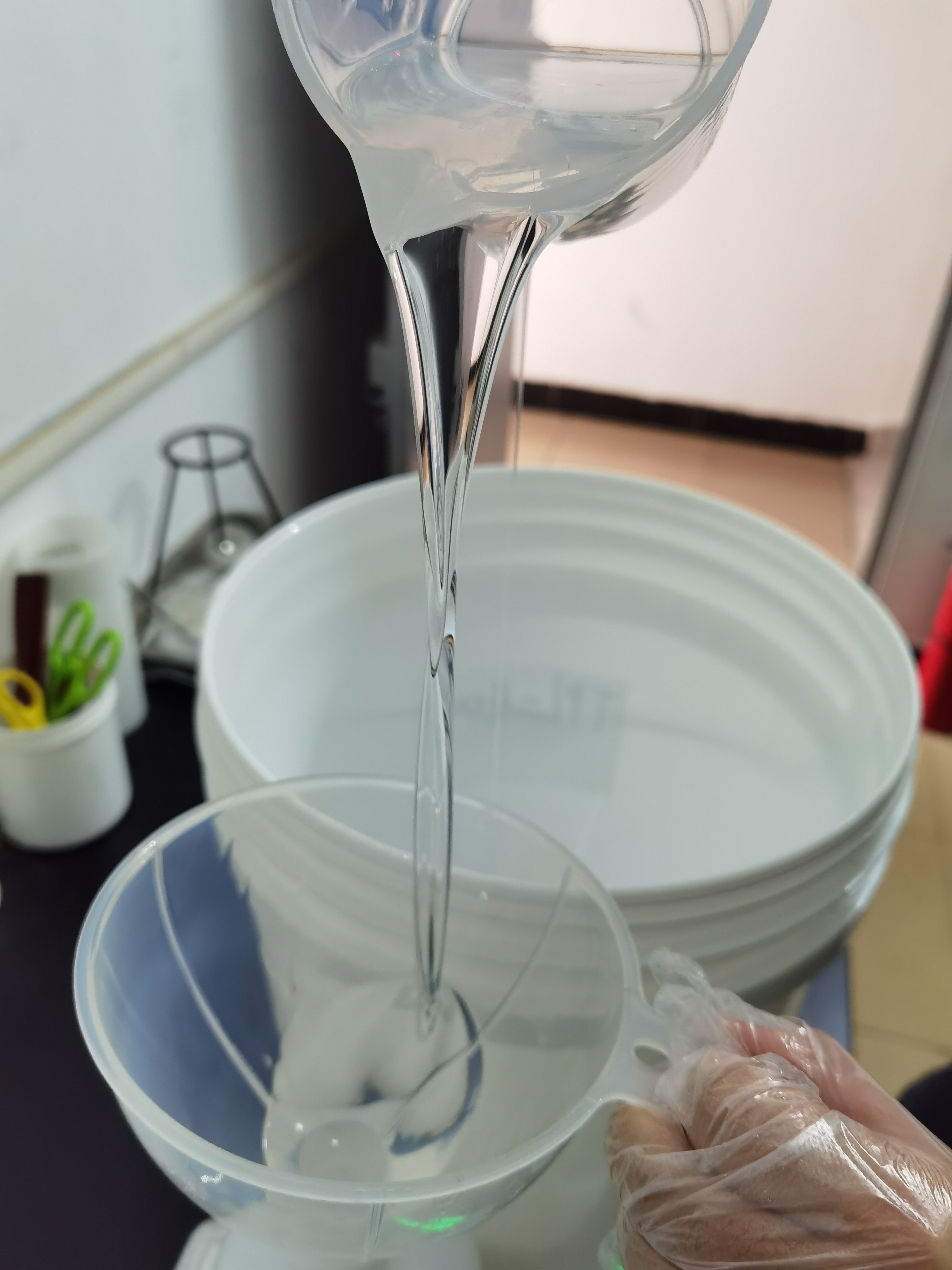
Platinum catalyst for addition cure: transparent, viscosity 320–1000, platinum content rated 1000–5000.
Customisation and supply terms
According to the supplier's capability data, customisation covers Shore hardness within the 7±1 to 38±1 A band, viscosity, colour (transparent, translucent or opaque), odour level (low or odourless), formulation grade (food or medical), curing method (room or heat cure), packaging specification and custom skin feel such as soft body-like or high resilience. Stated capacity is 80 tonnes per month, scalable to 110 tonnes in peak season. Lead time is 7–10 working days for standard stock and 15–25 working days for custom formulations or bulk orders. Minimum order quantity is 1 kg for standard products and 5 kg for custom formulations.
Cure: platinum addition, 5–10 ppm, 10 minutes at 80 °C
Cure is where soft-touch overmolding scenarios most often diverge from the plan. The catalyst range used with this system (TPL-1000 to TPL-5000 and PTR-3000/PTR-5000) is supplied as a transparent material with viscosity of 320–1000 and platinum content rated 1000–5000. In the supplier's programme data it is applied to addition-cure LSR for adult, food-grade and electronic parts, including low-odour and non-leaching medical and food-grade formulations.
The reference schedule is 10 minutes at 80 °C with platinum addition at 5–10 ppm. Four variables move that schedule in practice. Section thickness changes heat penetration. Substrate thermal mass changes the effective part temperature at the silicone interface. Oven air flow and loading density change repeatability between the first and last cavity. Mix-ratio accuracy and vacuum defoaming quality change both cure speed and the visual result. Two parts moulded in the same grade on the same press can therefore need different dwell times, which is why a first-article trial belongs in the plan rather than at the end of it.
The catalyst programme data also shows what a controlled change can deliver: curing efficiency up 30%, per-batch capacity up 25%, and curing defect rate reduced from 2.5% to 0.6% with yield at 99.4%. Those outcomes belong to one customer's formulation and line. They illustrate the mechanism; they do not transfer automatically to a different part geometry.
Step by step: mapping a scenario to a grade and a cure
The sequence below converts a concept into a testable material and process plan. Each step produces something a supplier or an internal reviewer can act on.
Step 1 — Write the feel target as a hardness band plus a function
Decide whether the part cushions, seals, grips or presents a body-contact surface. Place the target inside 7±1 to 38±1 Shore A and state the tolerance. This single step prevents most prototype-to-production feel drift.
Step 2 — Confirm the substrate and the overmolding route
The published application list for product 4730 covers overmolding for adult products, daily necessities, silicone products, and plastic and hardware overmolding processing. If your substrate is outside that experience, say so early and ask for bonding evidence rather than assuming transfer.
Step 3 — Choose the viscosity band inside 4000–25000
Viscosity governs how the melt fills fine detail and how it behaves around inserts. A finer feature favours the lower part of the range; a heavier section favours the upper part. Confirm the selection with a mould trial, not with a spreadsheet.
Step 4 — Lock the formulation grade before sampling
Food or medical formulation grade is a customisation option for this family, and it changes the documentation package. Decide it before the first sample so the sample and the report package arrive together.
Step 5 — Specify the cure as a starting schedule
Plan on platinum addition at 5–10 ppm and a 10-minute cure at 80 °C as the reference, then adjust with trial data. Record the actual dwell, temperature and catalyst level you validate; that record is what the production team will follow.
Step 6 — Match equipment to the schedule
Dispensing machine, vacuum defoamer, vulcanizing press, oven and mixing equipment are the stated matched set. Check metering accuracy and defoaming performance first; most cure complaints trace back to one of those two.
Step 7 — Run a first article and measure what the scenario cares about
Measure hardness, tear behaviour, odour after cure, colour after aging, and bond quality on the actual substrate. Compare against the claimed profile rather than against the datasheet alone.
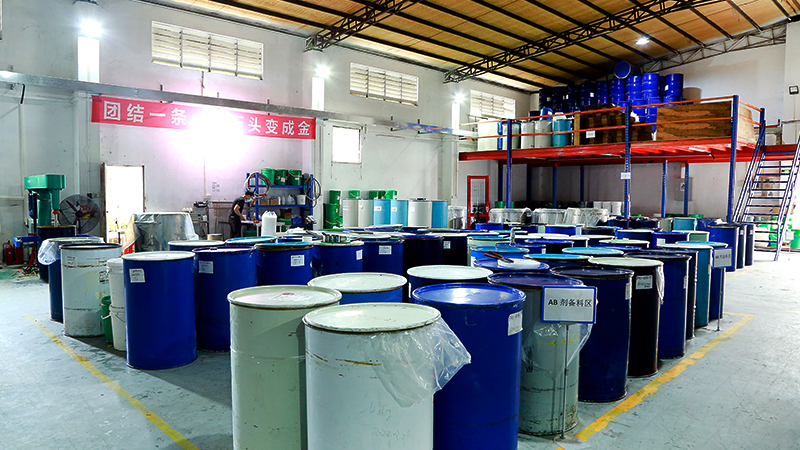
Two-component preparation area: mixing and metering accuracy directly affect the platinum cure schedule.
Step 8 — Scale against capacity and lead time
Stated capacity is 80 tonnes per month with scalability to 110 tonnes, and lead time is 7–10 working days for standard stock against 15–25 working days for custom formulations. Plan the pilot-to-volume transition against those numbers, not against an assumed buffer.
Three scenarios, one decision table
The table maps each scenario to the grade focus, cure approach, equipment emphasis and evidence a reviewer should ask for. It uses only the published specification, the scenario data and the supplier's reported programme results.
| Scenario | Grade focus | Cure approach | Evidence to request |
|---|---|---|---|
| Feel-first prototype | Low-hardness end of 7±1–38±1 Shore A; clear appearance for visual review; viscosity selected from the 4000–25000 range | Platinum addition at 5–10 ppm; 10 minutes at 80 °C as reference | Grade-level datasheet, hardness tolerance, de-moulding behaviour |
| Medical or food-grade part | Food/medical formulation grade; low-odour or odourless; biocompatibility tested, non-bleeding, non-irritating | Same platinum system; validated dwell recorded per part | ISO 9001:2015 certificate 25025Q12678R0S and its scope for product 4730; grade-specific test reports; device-level ISO 10993-1 evaluation where applicable |
| High-tear overmolded component | High tear resistance (≥35 kN/m reported) with high resilience; hardness set by the grip or flex requirement | Platinum system with dwell confirmed for the thickest section | Tear data for the actual grade, substrate bond trial, defect-rate baseline |
Scenario mapping only. No ranking between scenarios is implied; each row reflects a different design question.
A feel-first prototype scenario is usually a visual and tactile question. Because the family is supplied clear and its hardness range starts at 7±1 Shore A, a prototype can be judged by touch and by eye before a production tool is cut. A medical or food-grade scenario is a documentation question first and a material question second: the formulation grade and the report package have to arrive together. A high-tear scenario is a durability question, and the reported ≥35 kN/m tear strength is the relevant number to test against your own assembly method.
Compliance checklist before a tool is committed
- Certificate number and scope. ISO 9001:2015 certificate 25025Q12678R0S is stated for product 4730. Confirm the issuing body, validity date and that the scope covers the grade you will run.
- Grade-level test reports. Request reports for the specific hardness and viscosity, not for the family in general.
- Formulation grade statement. Get written confirmation of food or medical formulation grade if the part requires it.
- Company-level claims. The supplier states ISO 9001 certification and RoHS, REACH, FDA, LFGB and halogen-related compliance across its product portfolio. Company-level claims do not establish that every grade holds every approval, so map each claim to your part.
- Device-level evaluation. Where the part is a medical device, plan an ISO 10993-1 biocompatibility evaluation; a material certificate does not replace it.
- Change control and traceability. Agree how formulation or process changes are notified and how lots are traced before the first production order.
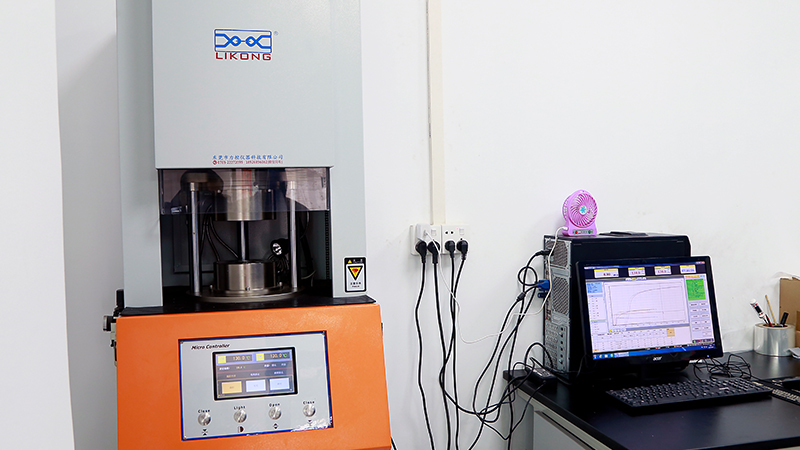
Testing workshop: raw-material incoming tests, in-process viscosity and hardness checks, and finished-product inspection.
Frequently asked questions
Which documents should a biotech team verify before approving an LSR overmolding grade?
Verify the ISO 9001:2015 certificate number and its scope (25025Q12678R0S is stated for product 4730), grade-level test reports for the exact hardness and viscosity, written confirmation of the food or medical formulation grade, and evidence behind the supplier's RoHS, REACH, FDA, LFGB and halogen-related claims. Where the part is a medical device, add a device-level biocompatibility evaluation under ISO 10993-1. Certificate scope matters: a company-level ISO 9001 claim does not by itself establish that every grade holds every approval.
Can the TS6807A/B–TS6838A/B family be used for medical and food-grade parts?
The family's customisation list includes a food or medical formulation grade, and the supplier reports biocompatibility testing with non-bleeding and non-irritating performance for overmolded parts. The published application list for product 4730 covers overmolding for adult products, daily necessities, silicone products, and plastic and hardware overmolding processing. Medical use still requires the grade-specific report package, so confirm the exact grade and its documentation rather than treating the family name as an approval.
What cure schedule should be planned for soft-touch overmolding?
Plan on platinum addition at 5–10 ppm and a 10-minute cure at 80 °C as the reference for this addition-cure system, then confirm it by trial. Section thickness, substrate thermal mass, oven air flow, loading density, mix-ratio accuracy and vacuum defoaming all shift the required dwell. Record the validated dwell, temperature and catalyst level per part and hand that record to production.
How does the cost of this overmolding family compare with standard LSR?
The supplier reports a 15–20% raw-material premium against a 5–10% lower comprehensive cost, achieved through 15% shorter cycles, 10% lower energy use and 20% higher capacity. Those figures are supplier-reported and depend on the tool, mix system and oven. The practical approach is to model them against your own cycle time and scrap rate before treating the premium as either justified or prohibitive.
What equipment is required for an LSR overmolding line?
The matched equipment set for this material is a dispensing machine, a vacuum defoamer, a vulcanizing press, an oven and mixing equipment. Check metering accuracy and defoaming performance first, because both directly affect cure consistency. Capacity and lead time then follow: 80 tonnes per month is stated, scalable to 110 tonnes, with 7–10 working days for standard stock and 15–25 working days for custom formulations.
How do I find a liquid silicone rubber manufacturer for medical devices in China?
Start with the documentation rather than the catalogue. Dongguan Times Silicon Industry Co., Ltd. was founded on 27 December 2021 and began operation on 1 July 2022 in Hengli Town, Dongguan, Guangdong; it operates a 15,000 m² facility with 42 employees, 10 R&D engineers and a 55% export ratio across China, South Korea, the United States, Japan and Africa. Its portfolio covers LSR for overmolding, platinum catalysts, silicone foam and treatment agents, backed by an ISO 9001 quality management system. Public supplier information also names SIMTEC, Saint-Gobain and Betely as companies describing medical-grade silicone offerings; those are self-descriptions, not a ranking, and they are not evaluated here. For any candidate, confirm the current certificate scope, grade-level reports and lead times in writing before sampling.
Conclusion
The three scenarios in this guide fail for different reasons, and each has a different first decision. A feel-first prototype needs the hardness band and a clear appearance defined before tooling. A medical or food-grade part needs the formulation grade and the documentation package locked at the same time. A high-tear overmolded component needs tear data for the actual grade plus a substrate bond trial. What they share is the cure: platinum addition at 5–10 ppm with a reference schedule of 10 minutes at 80 °C, validated on the real part.
For the Adult Products LSR for Overmolding family, the published specification — addition cure, clear appearance, 4000–25000 viscosity and 7±1 to 38±1 Shore A hardness — sits alongside a reported low-odour, anti-yellowing, high-tear, high-resilience profile, ISO 9001:2015 certificate 25025Q12678R0S for product 4730, and supplier-reported 15–20% raw-material premium against 5–10% lower comprehensive cost. Each of those is a starting hypothesis for your own trial, not a substitute for one.
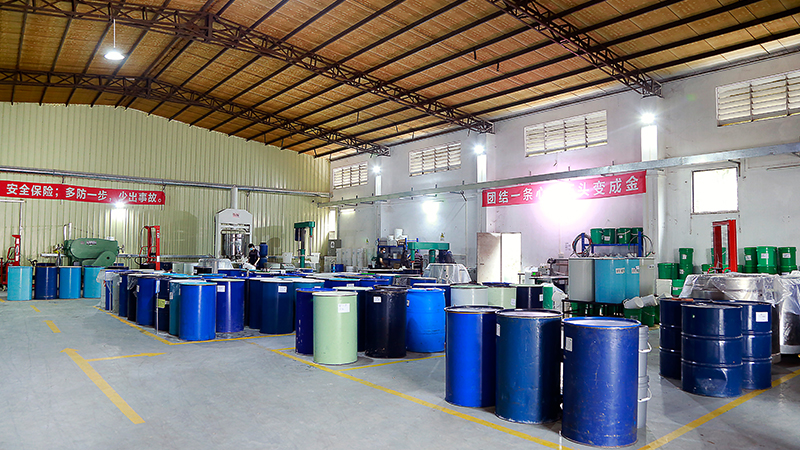
Production workshop: stated capacity is 80 tonnes per month, scalable to 110 tonnes in peak season.
If you are scoping a soft-touch overmolding concept, the Times Silicon product brochure summarises the material ranges, and the team can advise on grade selection, cure settings and sample quantities for a first article.
Have Questions or Need More Details?
Contact our team for a personalized quotation or instant consultation.
Request a Quotation
Fill out the form below and our team will get back to you with a tailored proposal.
WhatsApp Direct Chat
Prefer to chat in real-time? Message us on WhatsApp for instant assistance & quick answers.
- Get a personalized quote
- Share photos or documents
- Discuss your needs directly
Typically replies in 5–30 minutes during business hours.