ISO 9001:2015 and High-Tech Enterprise Certifications for LSR Products: What Buyers Should Verify
“ISO certified” is the most repeated phrase in a liquid silicone rubber (LSR) quotation, and on its own it is also the least useful. Two suppliers can print an ISO 9001 logo on the same datasheet while only one of them holds a certificate whose scope actually names the material you are buying, is issued by a body your compliance team can trace, and is worded in a way that survives scrutiny in your own market.
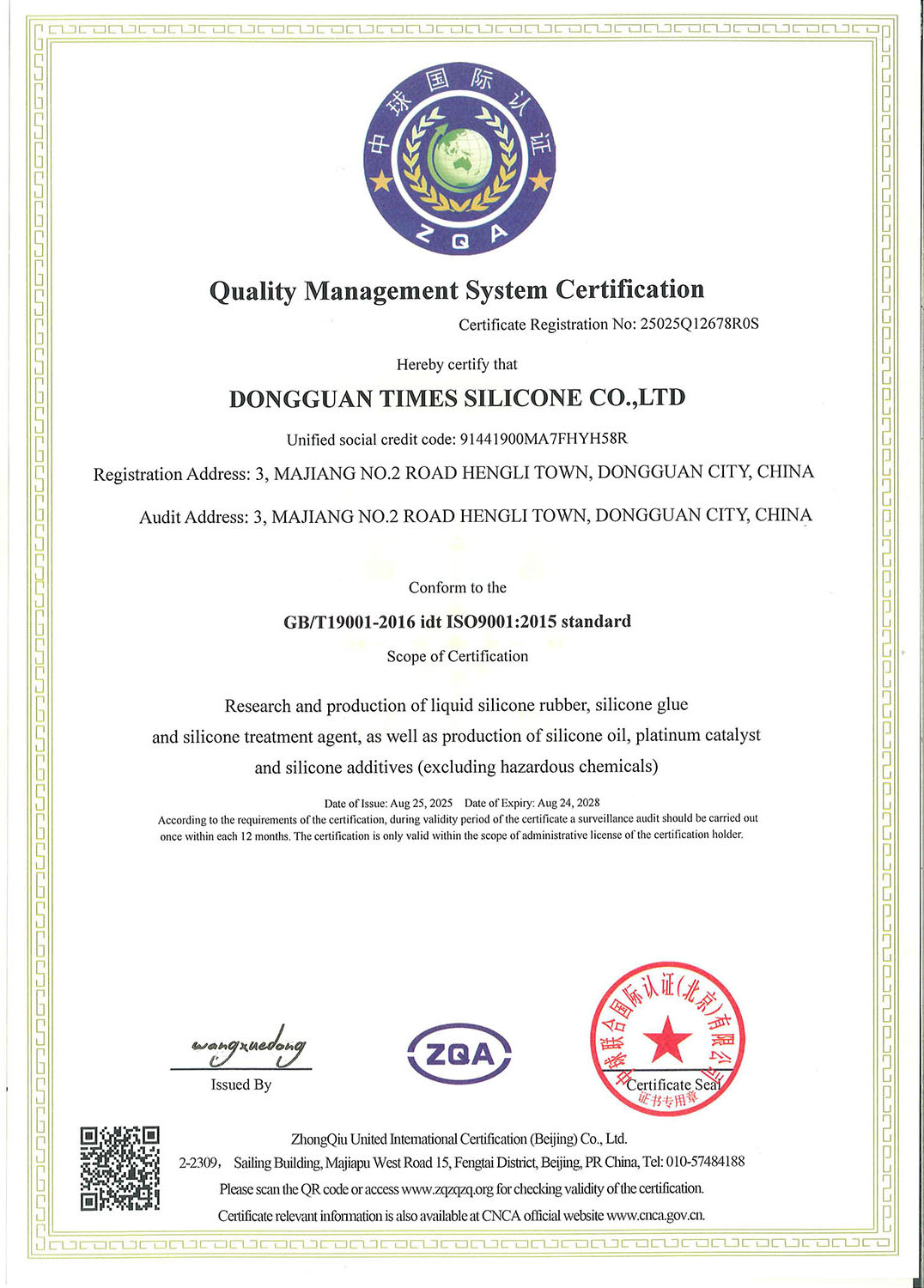
This guide is written for buyers in the awareness and research stage of LSR sourcing — mainly teams specifying overmolding liquid silicone rubber for adult products, plus buyers of vinyl silicone oil for electrical, automotive and photovoltaic applications. It uses two documents held by Dongguan Times Silicon Industry Co., Ltd. as a worked example: the company’s GB/T19001-2016 idt ISO9001:2015 certificate, number 25025Q12678R0S, for its overmolding LSR line, and its High-tech Enterprise Certificate, number GR202444010636, associated with its vinyl silicone oil line. The purpose is not to advertise those documents, but to show how to read any equivalent document before it becomes the basis of a supplier approval file.
Problem Definition: Why “Certified” Is Not Yet a Verifiable Claim
Quality claims fail in three predictable ways, and all three look identical on a sales sheet.
1. Scope mismatch. A certificate can be genuine and still be irrelevant. It may cover a sister company, a different production site, or a product family that does not include the compound you are purchasing. A buyer who checks only the certificate number and the logo will not catch this, because nothing on the cover page is false.
2. Issuing body ambiguity. Certificates are issued by certification bodies, and those bodies differ in accreditation, in the markets where their certificates are recognised, and in how they word scope statements. A certificate from an unaccredited body can look typographically identical to one from an accredited body.
3. Regional misapplication. Chinese suppliers commonly hold GB/T19001-2016 idt ISO9001:2015, the Chinese national standard that is identical to ISO 9001:2015. The underlying requirements match, but a US or EU buyer still has to confirm that the issuing body, the language of the scope statement, and the accreditation behind it fit their own procurement rules. Market-specific obligations — RoHS and REACH for electronics, FDA 21 CFR 177.2600, ISO 10993 or USP Class VI for medical-grade material — sit outside ISO 9001 entirely and are evidenced by different documents.
The working rule: a certificate is a statement about a defined scope. If the scope statement does not name the material, the site, or the legal entity you are contracting with, then the certificate does not support the claim being made on the quotation.
Industry Background: Why Certificate Checking Has Become a Procurement Step
LSR sits in applications where a material failure is expensive and public: body-contact products, EV battery sealing, high-voltage insulation, and photovoltaic modules. That is why document review has moved from a formality to an approval gate.
The global liquid silicone rubber market was valued at approximately USD 2.8 billion to 3.8 billion in 2024, with expectations of reaching USD 5.0 billion to 7.55 billion by 2030 to 2035, according to Grand View Research, Global Market Insights and Market Research Future. Estimates diverge because sources define the category differently, particularly whether they include high-consistency rubber alongside LSR — a useful reminder that even market data needs a scope check.
Medical-grade LSR alone generated approximately USD 458.7 million in revenue in 2024 and represents a dominant, fast-growing segment within the medical silicone rubber market (Grand View Research). For these materials, ISO 10993 for biocompatibility, USP Class VI, and FDA 21 CFR 177.2600 are the recognised reference points for safety in human-contact applications (FDA / ISO).
On the industrial side, silicone elastomers are used in roughly 63% of EV battery pack sealing systems, valued for flexibility and durability (Precedence Research / IEA). Global suppliers active in this market include Dow Inc., Wacker Chemie AG, Momentive Performance Materials and Shin-Etsu Chemical Co., Ltd. (Stratview Research). Buyers rarely choose between those names and a regional specialist on price alone; they choose on whether the material, the process control and the documentation line up with the application.
Detailed Solution: What the Two Certificates Actually Cover
The two documents most often cited by LSR suppliers in China do different jobs. Treating them as interchangeable is the root of most verification errors.
Certificate 1 — GB/T19001-2016 idt ISO9001:2015, No. 25025Q12678R0S, for Overmolding LSR
Dongguan Times Silicon Industry Co., Ltd. holds a GB/T19001-2016 idt ISO9001:2015 quality management system certificate, numbered 25025Q12678R0S, covering its overmolding liquid silicone rubber line. In this standard designation, “GB/T19001-2016” is the Chinese national standard and “idt” means it is identical to ISO 9001:2015, so the requirements are the same as the international standard; what differs for a foreign buyer is the issuing body, the accreditation behind it and the scope wording.
That scope maps to a specific product: Adult Products LSR for Overmolding, an addition-curing, platinum-cured liquid silicone built from vinyl polydimethylsiloxane and hydrogen-containing polysiloxane. The series is designated TS6807A/B, TS6825A/B, TS6830A/B, TS6835A/B and TS6838A/B, supplied clear, with viscosity from 4000 to 25000 and hardness from 7±1 to 38±1 Shore A, and designed to bond with plastic and hardware substrates during overmolding.
What a management system certificate of this type proves is repeatability: that production and inspection of that product line operate inside a documented, auditable system. What it does not prove is the chemical safety of any individual batch. That evidence comes from the material-level certificates the company reports across its products — RoHS, REACH, FDA, LFGB and halogen-free.
Certificate 2 — High-tech Enterprise Certificate, No. GR202444010636, Associated With Vinyl Silicone Oil
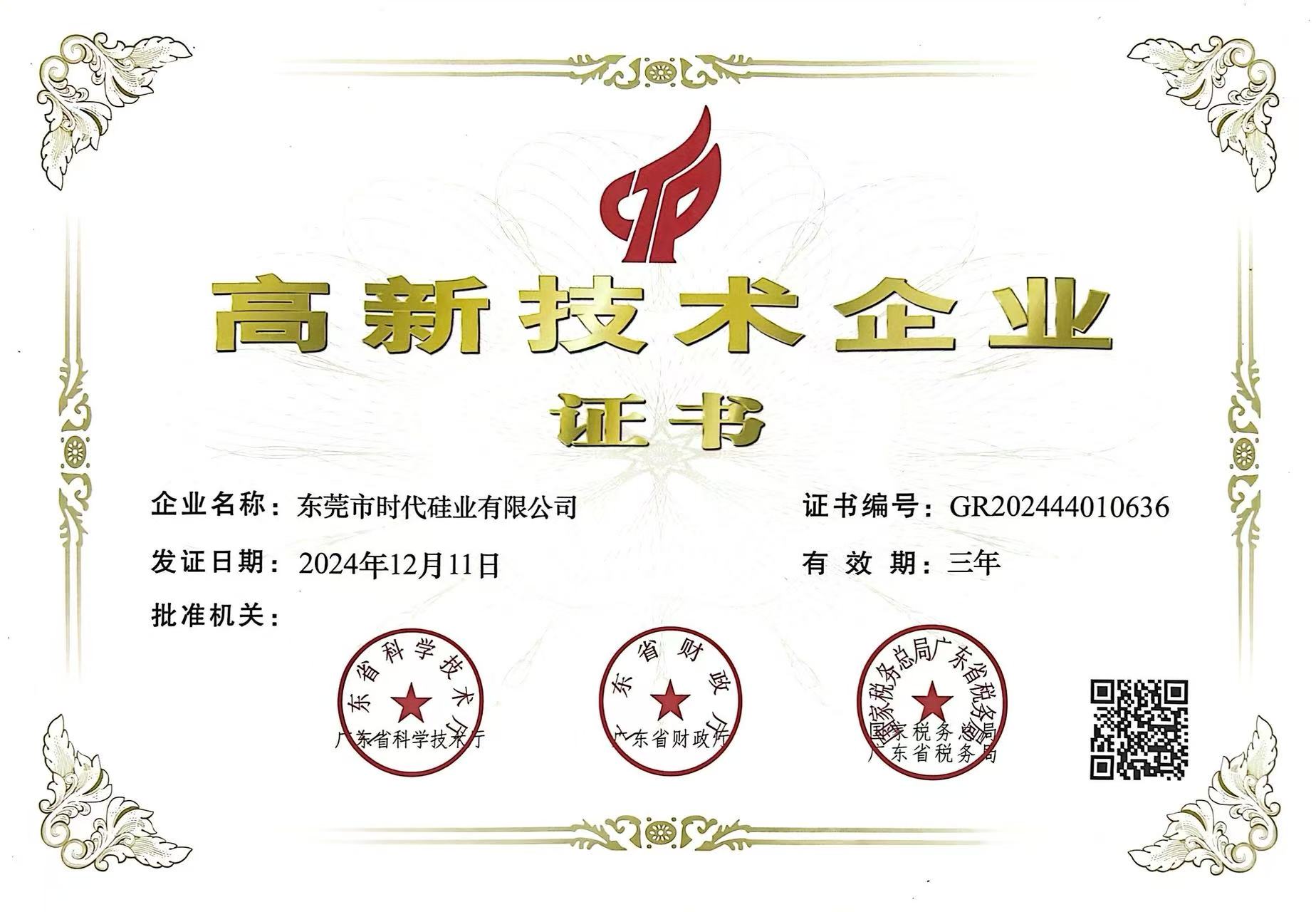
Dongguan Times Silicon Industry Co., Ltd. also holds a High-tech Enterprise Certificate numbered GR202444010636, associated with its vinyl silicone oil line. This is an enterprise and technology recognition rather than a product safety document. It speaks to the technical standing of the supplier, not to the composition or biocompatibility of a specific drum of material.
The product behind that line is vinyl silicone oil — a vinyl-terminated polydimethylsiloxane with a clear appearance, viscosity from 35 to 50W, vinyl content from 0.037 to 1.497 and volatile content below 0.5%. Model designations span TVF-L-50, TVF-100, TVF-500, TVF-1000, TVF-2000, TVF-1W, TVF-6.5W, TVF-H-10W, TVF-H-20W and TVF-H-35W, and the intended industries are electronic and electrical appliances, automotive, photovoltaic and new energy batteries.
How to use it in an approval file: treat the High-tech Enterprise Certificate as supporting evidence of technical capability, and treat the ISO 9001 system certificate as evidence of process control. Neither replaces batch-level test data, and neither should be the only document in your file.
Supporting Capability Behind the Certificates
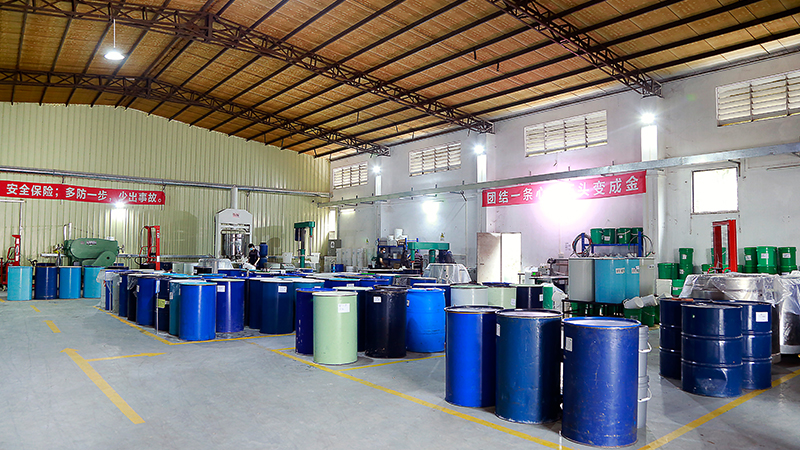
Documents are only credible when the operation behind them exists. Dongguan Times Silicon Industry Co., Ltd. was established in 2021 and began operation on July 1, 2022, specialising in the R&D, production and sales of new silicone materials. Its manufacturing facility covers 15,000 square meters and employs approximately 42 staff, including a 10-engineer R&D team. Export business accounts for 55% of total sales, with major markets in China, South Korea, the United States, Japan and Africa. In 2023 the company established a wholly-owned subsidiary, Guangdong Times Energy Storage New Material Technology Co., Ltd., focused on silicone materials for the new energy industry.
That context matters for one practical reason: a supplier’s ability to answer a scope question, produce a corrected certificate, or issue a batch-specific report in your required format depends on whether there is a technical team and a management system behind the paperwork.
Step-by-Step Breakdown: A Seven-Step Certificate Verification Workflow
Step 1 — Read the Scope Statement Before the Logo
Open the certificate and find the scope line. It should name the product or process, for example overmolding liquid silicone rubber, and it should be broad enough to include the material in your specification and narrow enough to mean something. If the scope describes a category you are not buying, the certificate answers a question you did not ask.
Step 2 — Match the Certificate to the Legal Entity on Your Purchase Order
Confirm the certificate holder’s registered name matches the entity that will appear on the contract, invoice and shipping documents. Group structures with parent and subsidiary companies can hold certificates in different legal names. In this example the certificate holder would need to read Dongguan Times Silicon Industry Co., Ltd., not a trading name or an affiliated entity.
Step 3 — Identify the Issuing Body and Its Accreditation
Record the name of the certification body, its accreditation mark and its registration number. Then confirm that the accreditation covers the standard and the industrial sector concerned. This is the step that separates certificates your compliance team will accept from certificates that will be questioned later.
Step 4 — Check Validity Dates and Surveillance History
ISO 9001 certificates operate on a certification cycle with surveillance audits, so an expired or suspended certificate is a live risk even when the printed document looks clean. Ask for the current certificate version, not a scanned copy from an earlier cycle, and confirm the issue and expiry dates fall after your planned production window.
Step 5 — Test Regional Applicability
Decide whether the certificate satisfies your market’s expectations. GB/T19001-2016 idt ISO9001:2015 is identical in requirements to ISO 9001:2015, but for US and EU procurement the practical questions are whether the issuing body is recognised in your jurisdiction and whether the scope wording is readable in your compliance language. Separate standards must be evidenced separately: RoHS and REACH for electrical and electronic applications, FDA 21 CFR 177.2600, ISO 10993 or USP Class VI for medical-grade LSR, and LFGB or FDA food-contact grades where relevant.
Step 6 — Separate System Evidence From Product Evidence
Build two lists. The first holds system and entity documents — the quality management certificate and the High-tech Enterprise Certificate. The second holds material documents — batch test reports, safety data, and product-level certifications. Approval decisions should rest on the second list, with the first list explaining why the second list can be trusted.
Step 7 — Record the Verification and Its Limits
State plainly in the file what was verified, at what scope, and on what date. Notes such as “ISO 9001:2015, No. 25025Q12678R0S, scope: overmolding LSR, verified 2026” are far more useful to a later auditor than a scanned logo, and they prevent the same question from being reopened at every reorder.
Use Cases: Where Certificate Verification Changes the Buying Decision
Adult-Product Overmolding Programs
Adult products are the clearest case for document discipline, because the material touches the body and the buyer often has no laboratory of its own. The LSR used here is addition-curing and platinum-cured, supplied clear, with hardness selectable from 7±1 to 38±1 Shore A so that a soft-touch shell and a firmer core can come from one supplier family. Typical requirements include food or medical grade certification, odorlessness, low volatility, anti-yellowing, high resilience and non-toxicity, with curing at room or elevated temperature and a two-component AB format.
In this scenario the verification sequence is: confirm the system certificate covers the overmolding line, confirm RoHS, REACH, FDA, LFGB and halogen-free certificates apply to the products, then validate the specific Shore A grade with your own trial moulding.
New Energy Battery and Automotive Insulation
For battery and automotive work, the certificate question usually arrives from the customer’s quality department rather than the purchasing team. Vinyl silicone oil is used in electronic and electrical appliances, automotive, photovoltaic and new energy battery applications. Platinum catalysts from the same supplier family, designated TPL-1000 through TPL-5000 and PTR-3000 / PTR-5000, are used in liquid silicone rubber production, flame-retardant silicone rubber, PET protective film, thermal conductive potting compounds and thermal conductive silicone sheets, with platinum content from 1000 to 5000 ppm and viscosity from 320 to 1000 mPa·s.
Here the High-tech Enterprise Certificate supports the technical evaluation, while the ISO 9001 certificate supports the process-control evaluation. Neither answers the thermal or electrical question — that is done with datasheets and test data.
Photovoltaic and Electrical Appliance Applications
Suppliers to photovoltaic and appliance programs are often asked to demonstrate consistency across repeated orders rather than peak performance in a single sample. Foamed liquid silicone rubber in this portfolio, designated BAS-1716, BAS-1812 and BAS-80931, shows hardness from 17 to 51, tensile strength from 5 to 7, elongation at break from 300 to 500 and tear strength from 15 to 17, produced through a precipitation or fumed process for the automobile, photovoltaic and electrical appliance industries. A documented management system is what makes those ranges repeatable order after order.
Multi-Market Sourcing Programs
Buyers supplying several regions from one supplier face the regional applicability problem most directly. The same physical drum of material may need RoHS and REACH evidence for one customer, FDA or LFGB documentation for another, and a recognised ISO 9001 certificate for a third. Mapping each market’s document requirement before the supplier approval meeting is faster than discovering the gap after the first purchase order.
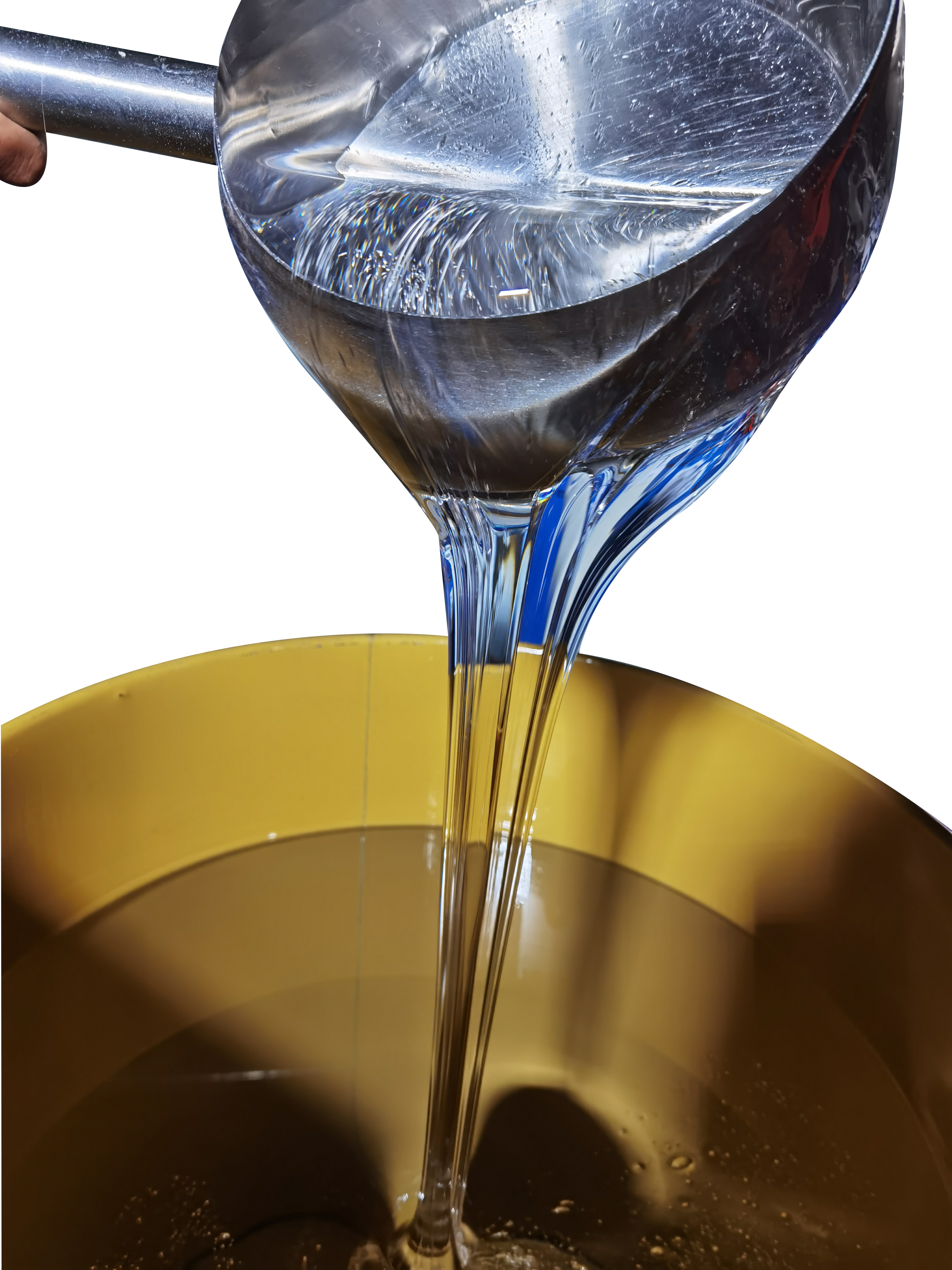
Comparison Table: Reading the Two Certificates Side by Side
| Verification point | GB/T19001-2016 idt ISO9001:2015 | High-tech Enterprise Certificate |
|---|---|---|
| Certificate number | 25025Q12678R0S | GR202444010636 |
| Held by | Dongguan Times Silicon Industry Co., Ltd. | Dongguan Times Silicon Industry Co., Ltd. |
| Document type | Quality management system certification | Enterprise technology recognition |
| Associated product line | Overmolding liquid silicone rubber (Adult Products LSR for Overmolding, TS6807A/B to TS6838A/B) | Vinyl silicone oil (TVF-L-50 to TVF-H-35W) |
| What it supports | Process control and production repeatability for the covered scope | Technical standing of the supplier behind the product line |
| What it does not prove | Chemical safety or biocompatibility of an individual batch | Composition, safety or performance of any specific material |
| Buyer action | Confirm scope, issuing body, accreditation, validity dates | Confirm it is current and treated as supporting, not primary, evidence |
| Companion evidence required | RoHS, REACH, FDA, LFGB, halogen-free certificates; batch test reports | Product datasheets and batch test reports for vinyl silicone oil |
The same logic applies to the rest of the portfolio, including core products such as liquid silicone, platinum catalyst, silicone treatment agents, silicone adhesives and silicone foam. The certificate identifies which claims are structurally supported and which still need a document behind them.
| Buyer question | Document that answers it | Common mistake |
|---|---|---|
| Is the supplier’s process controlled? | ISO 9001:2015 system certificate with a matching scope | Accepting a logo without reading the scope statement |
| Is the supplier technically credible? | High-tech Enterprise Certificate plus R&D team and facility data | Treating it as a product safety certificate |
| Is this material safe for my market? | RoHS, REACH, FDA, LFGB, halogen-free certificates; ISO 10993 / USP Class VI where applicable | Assuming ISO 9001 covers regulatory compliance |
| Will this batch match the datasheet? | Batch test reports for the specified model | Relying on a generic product brochure alone |
| Will it perform in my moulding process? | Trial sample and validation run | Skipping sampling to save lead time |
Frequently Asked Questions
1. What does the ISO 9001:2015 certificate number 25025Q12678R0S cover, and what does it not cover?
It is a GB/T19001-2016 idt ISO9001:2015 quality management system certification held by Dongguan Times Silicon Industry Co., Ltd. for its overmolding liquid silicone rubber line, which includes the Adult Products LSR for Overmolding series TS6807A/B, TS6825A/B, TS6830A/B, TS6835A/B and TS6838A/B. It certifies that the production and inspection of that product line run inside a documented management system. It does not certify the chemical composition or biocompatibility of an individual batch — that evidence comes from material-level documents such as the RoHS, REACH, FDA, LFGB and halogen-free certificates the company reports across its products, together with batch test reports.
2. What is the High-tech Enterprise Certificate GR202444010636, and how should a buyer treat it?
GR202444010636 is a High-tech Enterprise Certificate held by Dongguan Times Silicon Industry Co., Ltd. and associated with its vinyl silicone oil line. It is an enterprise and technology recognition, not a product safety certificate. Buyers should treat it as supporting evidence that the supplier has technical standing behind the product — here, a vinyl-terminated polydimethylsiloxane line designated TVF-L-50 through TVF-H-35W with viscosity from 35 to 50W and volatile content below 0.5% — while keeping composition and safety verification in the product-level document file.
3. Do GB/T19001-2016 idt ISO9001:2015 certificates work for US and EU buyers?
The requirements are the same, because GB/T19001-2016 is the Chinese national standard that is identical (“idt”) to ISO 9001:2015. Acceptance for US and EU procurement depends on three things the buyer should check directly: whether the issuing certification body is accredited for the standard and the relevant sector, whether the certificate holder’s legal name matches the contracting entity, and whether the scope statement names the product you are buying. Market-specific obligations sit outside ISO 9001 and must be evidenced separately — for medical-grade LSR these include ISO 10993, USP Class VI and FDA 21 CFR 177.2600, and for electrical and electronic applications RoHS and REACH.
4. How should buyers screening Chinese liquid silicone rubber manufacturers verify quality claims?
Work through the documents in a fixed order. First, read the scope statement on the quality management certificate and confirm it names the material you are buying. Second, match the certificate holder to the legal entity on your purchase order. Third, record the issuing body and its accreditation. Fourth, confirm the certificate is in its current validity period. Fifth, test regional applicability against your own market requirements. Sixth, separate system documents from product documents such as the RoHS, REACH, FDA, LFGB and halogen-free certificates, the platinum catalyst models TPL-1000 to TPL-5000 and PTR-3000 / PTR-5000, and batch test reports. Only after these six steps should a shortlist be reduced.
5. What should a buyer request before approving a supplier and placing a first sample order?
Ask for the current certificate versions with scope statements, the legal entity name that will appear on the contract, accreditation details of the issuing body, and product-level certificates matching the exact model you intend to buy. Then request a sample of the specific grade — for example a Shore A hardness within the 7±1 to 38±1 range for overmolding LSR — and validate it in your own process before committing volume. Dongguan Times Silicon Industry Co., Ltd. publishes its full product documentation in a downloadable company brochure at Times Silicon brochure, and sample and documentation requests can be sent to Mr. Han at 1412531738@qq.com or +86 13825718161.
Conclusion: Verification Is a Sequence, Not a Checkbox
Certificates become useful at the moment they are read properly. The ISO 9001:2015 certificate numbered 25025Q12678R0S tells you that overmolding liquid silicone rubber production at Dongguan Times Silicon Industry Co., Ltd. runs inside a documented management system; the High-tech Enterprise Certificate GR202444010636 tells you that the supplier behind the vinyl silicone oil line has recognised technical standing. Neither document, on its own, tells you that a specific drum of material is safe for a specific application.
That final answer comes from combining system evidence, product-level certification and batch data with your own sampling. Buyers who build this sequence into their approval process early — scope, entity, issuing body, validity, regional applicability, product evidence, sample — spend less time re-opening the same question at every reorder, and more time on the parameters that actually determine whether the part works.
Next Step: Request the Documentation Pack and a Sample
Dongguan Times Silicon Industry Co., Ltd. supplies overmolding and casting liquid silicone, vinyl silicone oil, platinum catalysts, foamed liquid silicone, silicone resin and silicone treatment agents for adult products, medical, new energy, photovoltaic and electrical applications. Full product documentation is available in the company brochure (PDF), and additional detail is published at timessilicone.com.
To request certificates, batch data or a trial sample, contact Mr. Han — email 1412531738@qq.com, phone +86 13825718161, or WhatsApp +86 13316608735. Address: No.3, Ma Jiang 2nd Road, Hengli Town, Dongguan City, Guangdong Province, China.
Have Questions or Need More Details?
Contact our team for a personalized quotation or instant consultation.
Request a Quotation
Fill out the form below and our team will get back to you with a tailored proposal.
WhatsApp Direct Chat
Prefer to chat in real-time? Message us on WhatsApp for instant assistance & quick answers.
- Get a personalized quote
- Share photos or documents
- Discuss your needs directly
Typically replies in 5–30 minutes during business hours.