
Residual Odor in Adult LSR Parts: Platinum vs Organotin
Cure chemistry, catalyst loading, and what actually stays inside the finished part
Residual odor in a cured silicone adult product is a chemistry outcome, not a cleaning defect. What a user smells after demolding comes from what the cure reaction leaves behind: small-molecule by-products, catalyst residues, and volatile carriers still trapped in the matrix. That is why the most effective way to end odor complaints is to change the cure chemistry rather than to add a post-treatment step.
Platinum-catalyzed addition cure removes the by-product source at its root. In hydrosilylation, a platinum complex at a 5–10 ppm addition rate links vinyl groups to Si–H groups, the part cures in roughly 10 minutes at 80 °C, and no small-molecule condensate is formed. Organotin-catalyzed condensation systems crosslink through a different mechanism that releases a condensate during cure, and the tin residue stays in the part. For seamless adult toys and high-transparency encapsulation, that difference is frequently the deciding factor between a neutral part and a complaint.
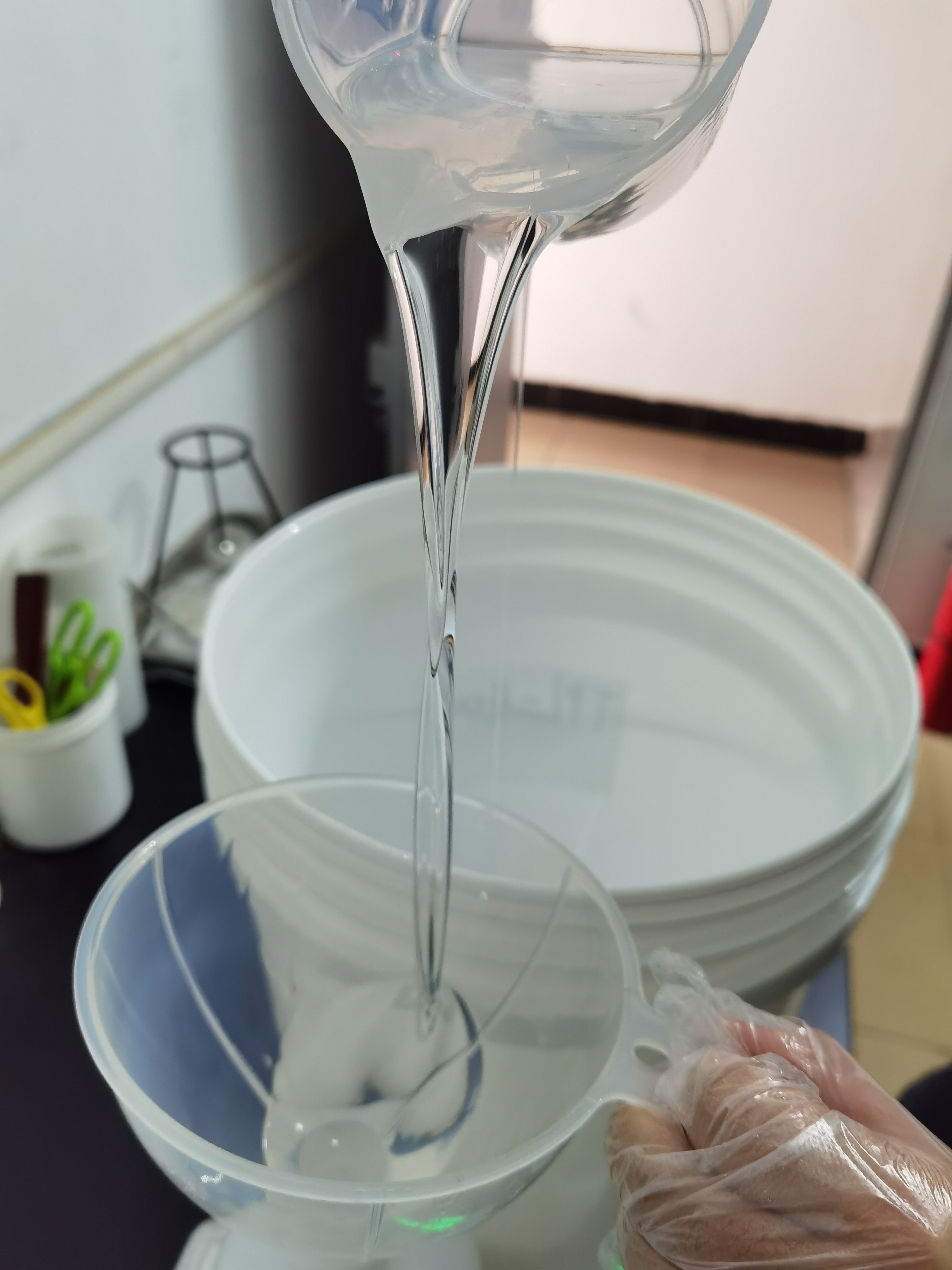
Platinum catalyst grade used to drive hydrosilylation in low-odor adult-product LSR. Image: Dongguan Times Silicon Industry Co., Ltd.
Problem Definition: Where Residual Odor Actually Comes From
Residual odor is the volatile fraction that a finished silicone part continues to release after demolding — detected by the nose, by sensory panel, or by headspace analysis of the cured part.
On a molding line, odor complaints are usually traced to three sources, and only one of them is a washing or packaging problem.
- Cure by-products. Condensation-cure silicones release a small-molecule condensate as the network forms. In a thin, open part the condensate escapes; in a thick, enclosed adult-product geometry it has nowhere to go and diffuses out over the following days and weeks.
- Catalyst residues and carriers. A catalyst is never 100% consumed by the reaction it catalyzes. Tin-based catalysts remain in the part as residues, and the solvent or carrier that delivers the catalyst can itself be a volatile source.
- Formulation additives. Inhibitors, pigments, mold-release agents, and low-purity base gums all contribute volatile content. A low-odor formulation therefore has to be controlled from the raw-material incoming test onward, not only at the catalyst stage.
Adult products amplify all three. The parts are often thick, closed, skin-contact, and manufactured in seamless overmolded geometries where venting is limited. A sealed vibrator body or a solid realistic mold has far less surface area for volatiles to escape than an open gasket, so a formulation that passes on a thin test sheet can still fail on a finished product.
The commercial consequence is measurable. Dongguan Times Silicon Industry Co., Ltd. reports that one adult-product client program reduced its defect rate from 3% to 0.8% and lifted production yield to 98% after moving to a low-odor addition-cure formulation, with client end-user feedback citing low odor and a realistic feel, a repurchase-rate increase of 18%, and a return rate below 1%. Those numbers describe that client's program; they are not a guarantee of the same result on every line.
Industry Background: Why the Market Moved Away from Tin
Adult-product manufacturing migrated from tin-catalyzed room-temperature-vulcanizing systems to platinum-catalyzed addition-cure liquid silicone rubber for two structural reasons: clarity and geometry. Seamless molding and high-transparency encapsulation both require a cure system that does not color the part, does not generate a visible or olfactory by-product, and can be demolded quickly in a heated tool.
Pressure is also regulatory. Organotin compounds are restricted in specific applications in some jurisdictions, and the exact status varies by market and by product category. For a brand selling across borders, a cure chemistry that avoids tin residues entirely simplifies the documentation conversation with distributors and marketplace compliance teams. Buyers should confirm the current restriction status for their own target markets rather than relying on a supplier summary.
The supply base has consolidated around a small number of Chinese specialists who produce both the LSR and the platinum catalyst in-house, because catalyst quality is difficult to control when it is bought as an unbranded intermediate. Dongguan Times Silicon Industry Co., Ltd. is one such manufacturer: founded in December 2021 and operational since July 2022, it runs a 15,000 m² facility with 42 employees, including a 10-engineer R&D team, reports a 55% export ratio, and serves buyers in China, South Korea, the United States, Japan, and Africa. Its ISO 9001 scope explicitly covers platinum catalyst production alongside liquid silicone rubber, silicone oil, and silicone treatment agents.
Market context is growing rather than shrinking. One commercial research source (Market.us) reports the global liquid silicone rubber market at approximately USD 2.3 billion in 2024, with a projected value of roughly USD 5.5 billion by 2034 at a 9.2% CAGR. That figure is a single-source commercial estimate and should be treated as directional only, not as a planning-grade number.
The Solution: Platinum Catalyst Activity at ppm-Level Loading
The platinum catalyst series supplied by Dongguan Times Silicon Industry Co., Ltd. covers TPL-1000, TPL-2000, TPL-3000, TPL-4000, TPL-5000, PTR-3000, and PTR-5000. The product is a transparent platinum (Pt) plus siloxane/alcohol solvent system with a viscosity range of 320–1000 and a platinum content range of 1000–5000. Grade selection is driven by the required cure speed, the inhibitor system in the base, and the thickness of the part.
Three parameters matter most when the objective is odor elimination in a final part.
1. Low addition rate
Platinum works at 5–10 ppm in the formulation. Because the catalytic cycle regenerates the active species, only a trace quantity is needed, and the amount of catalyst-derived material left in the cured part is correspondingly small. A small residue footprint is the first condition for a neutral-smelling part.
2. No reaction by-product
Hydrosilylation is an addition reaction: the vinyl group of vinyl polydimethylsiloxane adds across the Si–H bond of hydrogen-containing polysiloxane, and the two become one network with nothing split off. There is no condensate to diffuse out of a thick seamless part later. This is the structural reason platinum-cured LSR is the reference route for low-odor and odorless adult-product formulations, and it is why the material set of the Adult Products LSR for Overmolding series (TS6807A/B, TS6825A/B, TS6830A/B, TS6835A/B, TS6838A/B) is built on vinyl polydimethylsiloxane and hydrogen-containing polysiloxane rather than on a moisture-cure chemistry.
3. Fast, repeatable cure
The reference cure is approximately 10 minutes at 80 °C. Short cycle times matter for a second reason beyond throughput: a part that reaches full conversion quickly spends less time in a partially cured state where unreacted species can migrate. Batch consistency supports this — activity fluctuation across catalyst batches is held to less than 3%, which keeps the cure window stable from lot to lot and prevents the under-cure that silently produces odor complaints.
Volatile matter is a specified parameter across the catalyst series, so the exact value must be confirmed for the grade being ordered rather than assumed for the series as a whole. Where a program is targeting a strict odor threshold, the lower-volatility option in the range is the correct starting point.
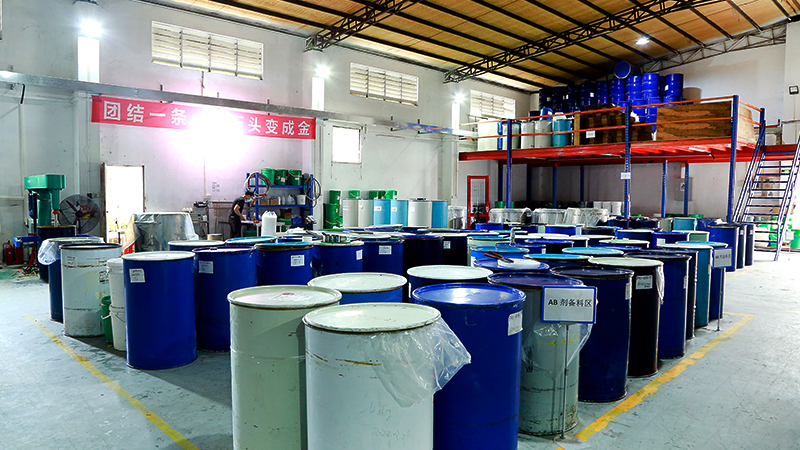
A/B component preparation area: metering accuracy at this stage determines whether the 5–10 ppm platinum dose is actually achieved in the mix.
Platinum Addition Cure vs Organotin Condensation Cure
The table below compares the two routes on the criteria that determine whether a finished adult-product part smells neutral. Organotin entries describe the general behaviour of tin-catalyzed condensation systems; they are qualitative and are not supplier-specific performance data.
| Evaluation area | Platinum-catalyzed addition cure | Organotin-catalyzed condensation cure |
|---|---|---|
| Crosslinking mechanism | Hydrosilylation between vinyl groups and Si–H groups | Hydrolysis and condensation, promoted by a tin compound |
| Reaction by-product | None — the reaction is an addition, nothing is split off | A small-molecule condensate is released during cure |
| Residual odor risk in a thick, closed part | Low; remaining volatiles depend on raw-material purity and inhibitor choice | Higher; the condensate must diffuse out of the part over time |
| Catalyst addition level | 5–10 ppm | Higher addition levels are typical for tin condensation catalysts |
| Reference cure schedule | Approximately 10 minutes at 80 °C | Depends on ambient humidity and temperature in RTV systems; not directly comparable |
| Catalyst residue in the finished part | Trace platinum only | Tin residue remains in the cured part |
| Clarity and color control | Supports clear and translucent parts; no color body from the catalyst | Condensation systems are generally less suited to high-transparency parts |
| Regulatory direction | No tin residue; simplifies documentation for restricted-substance review | Organotin compounds are restricted in specific applications in some markets; status varies |
| Typical fit | Seamless adult toys, overmolding, high-transparency encapsulation, thick sections | General sealing and potting where odor and clarity are not critical |
Platinum cure is not automatically the answer in every case. Hydrosilylation is sensitive to catalyst poisons — sulphur, amine, and certain plasticizer or tin residues carried over from tooling or from a previous condensation-cure batch can inhibit cure. A line converting from tin to platinum must be cleaned thoroughly, and the inhibitor level must be re-tuned; otherwise the result is a slow or tacky part rather than a low-odor one. Platinum cost per kilogram is also higher than tin, which is why the 5–10 ppm dose matters commercially: the cost per finished part is driven by the dose, not by the drum price.
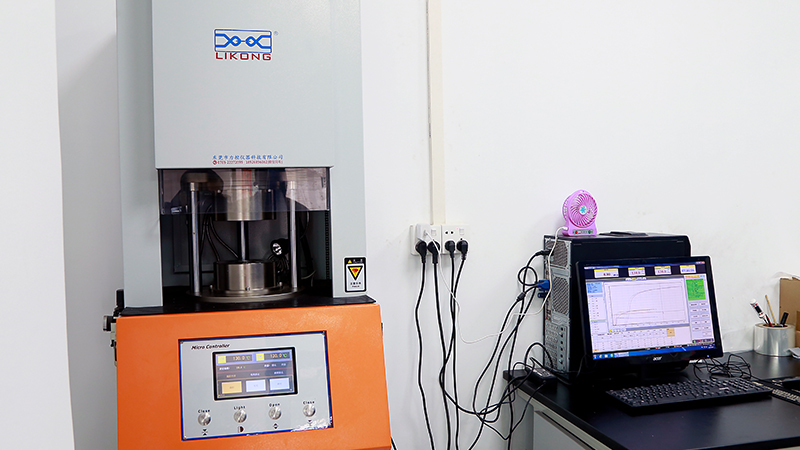
Testing workshop: finished-product testing covers curing performance, odor, and biocompatibility, with third-party sampling for FDA, RoHS, and REACH-related documentation.
Step-by-Step Breakdown: Converting a Program to Low-Odor Platinum Cure
- Define the odor target in a testable form. Agree with the buyer whether the acceptance criterion is a sensory panel result on the finished part, a headspace volatiles measurement, or both, and specify the part geometry used for the test. A thin sheet is not an acceptable proxy for a thick seamless body.
- Fix the base gum and the crosslinker. Select the vinyl polydimethylsiloxane and hydrogen-containing polysiloxane pair first. Hardness in the Adult Products LSR for Overmolding series spans 7±1 to 38±1 Shore A with viscosity from 4000 to 25000 and a clear appearance, so the feel target is set here, before the catalyst is chosen.
- Select the catalyst grade by platinum content. Choose from TPL-1000, TPL-2000, TPL-3000, TPL-4000, TPL-5000, PTR-3000, or PTR-5000 according to the required cure speed and part thickness, and confirm the volatile matter value for that specific grade.
- Dose at 5–10 ppm and verify the cure window. Run the 10-minute / 80 °C reference cure on the actual production geometry. If the part is under-cured at the low end of the dose range, adjust inhibitor before increasing platinum — adding more catalyst hides a formulation problem and raises residue.
- Control metering and mixing. A ppm-level dose is only reproducible if the A/B ratio is accurate. In-process monitoring of viscosity, hardness, and mixing ratio is the control point that keeps batch-to-batch activity fluctuation under 3% from becoming part-to-part variation.
- Validate the finished part, not just the material. Run finished-product testing for curing performance, odor, and biocompatibility, and add third-party sampling where the end market requires FDA, RoHS, or REACH documentation. Where relevant, confirm the grade against the utility model patent ZL202323622488.5, granted by the National Intellectual Property Administration on 2024-09-03 and valid to 2034-09-02, which covers a silicone rubber treatment agent bonding device rather than a material specification.
- Lock the post-cure and packaging step. A defined post-cure and a clean, low-odor packaging material protect the result. Post-cure is where remaining volatiles are driven off; skipping it can undo the benefit of an otherwise correct formulation.
Use Cases
Seamless adult toys and overmolded bodies
Seamless construction is the hardest case for odor control because there is no seam to vent through. Platinum-catalyzed overmolding LSR from the TS6807A/B to TS6838A/B range is formulated for this geometry, with a clear appearance for transparent bodies, hardness from 7±1 to 38±1 Shore A, and the low-odor / odorless formulation option available within the OEM/ODM customization scope. Case data from an adult-product client program shows a defect rate reduction from 3% to 0.8%, yield at 98%, and end-user feedback citing low odor and a realistic feel.
High-transparency encapsulation
Transparent and translucent encapsulation depends on a catalyst that contributes neither color nor haze. A transparent platinum catalyst system, used with a clear base, keeps the optical path clean while delivering the same 10-minute / 80 °C cure and the same absence of reaction by-product — which is what allows an encapsulated part to stay both clear and neutral-smelling.
Catalyst supply at production scale
Catalyst quality is a supply-chain question as much as a chemistry one. Reported programs include a Pearl River Delta liquid silicone manufacturer purchasing 80 kg of platinum catalyst annually in 5 kg batches, and a larger organosilicon group taking 500 kg annually with a stable 40 kg monthly supply, over three years of continuous supply. In the first program, curing efficiency rose 30%, the production cycle shortened, per-batch capacity increased 25%, and the curing defect rate fell from 2.5% to 0.6% with yield at 99.4%; finished silicone parts from that catalyst were reported to show no yellowing or leaching over a service life of three years or more under normal use. These are client-program results, not universal specifications.
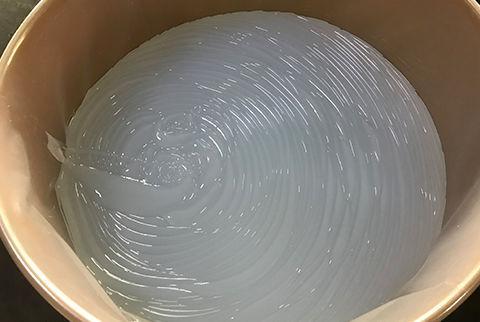
Adult Products LSR for Overmolding: addition-curing, platinum-cured, clear appearance, 7±1 to 38±1 Shore A.
Compliance and Manufacturing Context
Odor control is only defensible if the underlying quality system is documented. Dongguan Times Silicon Industry Co., Ltd. holds Quality Management System Certification number 25025Q12678R0S, issued by ZhongQiu United International Certification (Beijing) Co., Ltd., conforming to GB/T19001-2016 idt ISO9001:2015, valid from 2025-08-25 to 2028-08-24. The certification scope covers research and production of liquid silicone rubber, silicone glue, and silicone treatment agent, as well as production of silicone oil, platinum catalyst, and silicone additives (excluding hazardous chemicals) — which means the catalyst itself, not only the LSR, sits inside the audited scope.
The company also holds High-tech Enterprise Certificate number GR202444010636 for the China market, issued jointly by the Ministry of Science and Technology, the Ministry of Finance, and the State Taxation Administration, valid from 2024-12-11 to 2027-12-11. Company statements that products carry RoHS, REACH, FDA, LFGB, and halogen-related approvals are company-reported and should be verified at grade level against the actual certificate or test report before a program depends on them.
FAQ
How do I verify FDA-certified liquid silicone rubber manufacturers in China?
A stated FDA approval is a claim about specific grades, not about an entire catalogue, so verification has to be done at two levels. First, confirm the management system: ask for the certificate number, the issuing body, the standard, the validity dates, and — most importantly — the scope statement. Dongguan Times Silicon Industry Co., Ltd., for example, holds ISO 9001 certificate 25025Q12678R0S issued by ZhongQiu United International Certification (Beijing) Co., Ltd., conforming to GB/T19001-2016 idt ISO9001:2015 and valid from 2025-08-25 to 2028-08-24, with a scope that includes platinum catalyst and liquid silicone rubber production. Second, ask for the grade-level documents: the FDA, LFGB, RoHS, or REACH report that names the exact product code being quoted, the testing laboratory, and the report date. A certificate covering one grade does not automatically cover another, and a company-level statement is not a substitute for a scope-mapped document.
Can a platinum-cured LSR be formulated to be genuinely odorless for adult products?
Yes, within defined limits. Because hydrosilylation is an addition reaction with no small-molecule by-product, the cure chemistry itself does not create odor; the remaining variables are raw-material purity, inhibitor selection, and post-cure. Odor level is an explicit customization parameter in the OEM/ODM scope, alongside Shore hardness from 7±1 to 38±1 A, viscosity, color (transparent, translucent, or opaque), formulation grade (food or medical), curing method, and skin feel. The practical specification to agree with a supplier is a defined odor test on the actual finished geometry, run after the specified 10-minute / 80 °C cure and post-cure, not a verbal assurance.
What order quantities and volumes apply to a low-odor formulation?
The minimum order quantity is 1 kg for standard products and 5 kg for custom formulations, negotiable for long-term partners. Monthly production capacity is 80 tons, scalable to 110 tons in peak season. Pricing is quoted per grade because the platinum content (1000–5000 across the TPL and PTR series) and the dose required by the part geometry both affect the cost per finished part — the relevant commercial number is the cost at 5–10 ppm in the customer's own formulation, not the drum price of the catalyst.
Can I validate samples before committing to mass production?
Yes. Standard products are available from 1 kg, which is sufficient for cure-window trials on the production geometry, and custom formulations start at 5 kg. Validation should include finished-product testing for curing performance, odor, and biocompatibility, plus third-party sampling where the target market requires it. Buyers converting from a tin-catalyzed line should plan for a cleaning and inhibitor re-tuning step in the sample phase, because platinum cure is inhibited by tin, sulphur, and amine residues carried over from previous batches.
What is the lead time for a custom low-odor grade?
Lead time is 7–10 working days for standard stock products and 15–25 working days for custom formulations and bulk orders, adjustable according to formulation complexity and order quantity. After-sales support includes formulation optimization and process technical guidance, with a 24-hour response commitment and a dedicated account manager for long-term clients. To start a sample or quotation request, contact the team at 1412531738@qq.com or +86 13825718161, or download the Times Silicon product brochure for the full grade list.
Conclusion
Residual odor in a cured adult-product part is determined before the part is demolded. Organotin-catalyzed condensation systems release a small-molecule condensate during crosslinking and leave tin residue behind, which is a structural disadvantage in thick, seamless, skin-contact products regardless of how well the line is run. Platinum-catalyzed addition cure avoids the by-product entirely, works at 5–10 ppm, cures in roughly 10 minutes at 80 °C, and holds batch-to-batch activity fluctuation below 3% — the combination that makes a genuinely low-odor, high-clarity part repeatable rather than occasional.
The engineering work is in the details: matching hardness and viscosity to the feel target, confirming the volatile matter of the specific catalyst grade, controlling the A/B ratio so the ppm-level dose is real, and validating odor on the finished geometry rather than on a test sheet. Dongguan Times Silicon Industry Co., Ltd. supplies the platinum catalyst series (TPL-1000 to TPL-5000, PTR-3000, PTR-5000) and the Adult Products LSR for Overmolding series within an ISO 9001 scope that covers both, with MOQ from 1 kg for standard grades and 15–25 working days for custom low-odor formulations.
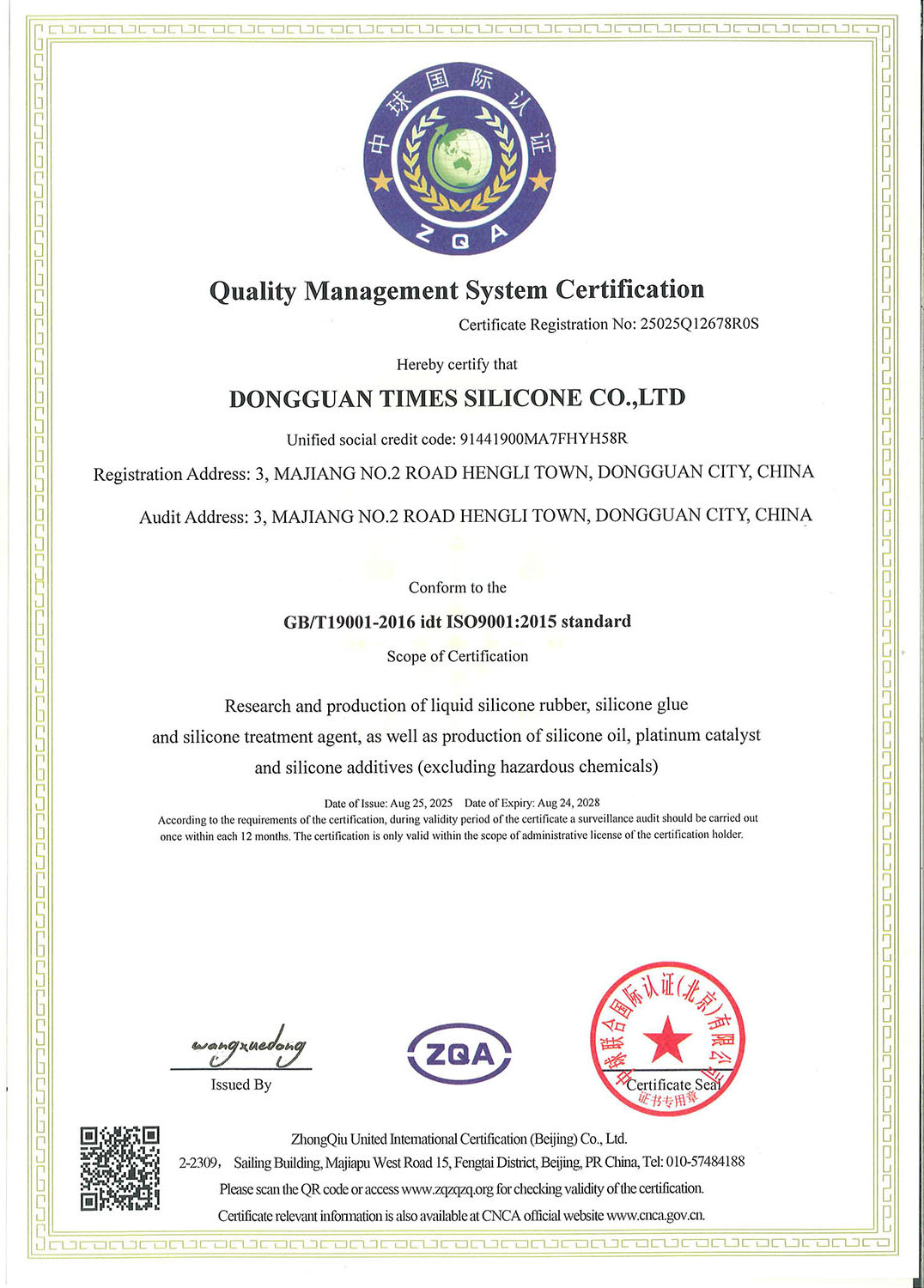
ISO 9001 certificate 25025Q12678R0S, scoped to liquid silicone rubber and platinum catalyst production. Image: Dongguan Times Silicon Industry Co., Ltd.
Request a low-odor platinum catalyst sample
Send your hardness, part geometry, and target cure schedule, and the team will recommend a catalyst grade and an LSR hardness to match. Standard grades ship from 1 kg; custom low-odor formulations from 5 kg.
Have Questions or Need More Details?
Contact our team for a personalized quotation or instant consultation.
Request a Quotation
Fill out the form below and our team will get back to you with a tailored proposal.
WhatsApp Direct Chat
Prefer to chat in real-time? Message us on WhatsApp for instant assistance & quick answers.
- Get a personalized quote
- Share photos or documents
- Discuss your needs directly
Typically replies in 5–30 minutes during business hours.