
Silicone Foam Rubber for Automotive and Photovoltaic Applications: A Guide to BAS Series Materials
Formed liquid foamed silicone rubber is a liquid silicone base adhesive that is dispensed and cured into a compressible, low-density elastomer. In automotive and photovoltaic (PV) assemblies it is used where a solid silicone part would be too heavy or too stiff, and where a rigid plastic would transmit vibration or fail to fill an uneven gap.
This guide covers the BAS series foaming base adhesives supplied by Dongguan Times Silicon Industry Co., Ltd. — BAS-1716, BAS-1812 and BAS-80931 — specified with a hardness range of 17–51, a viscosity range of 15W–350W, a translucent appearance, and a base material of vinyl polydimethylsiloxane (vinyl silicone oil). It is written for material engineers, procurement managers and project owners who are comparing grades during research and evaluation stages and need to decide whether a foamed liquid silicone rubber (LSR) system fits a defined automotive or photovoltaic application.
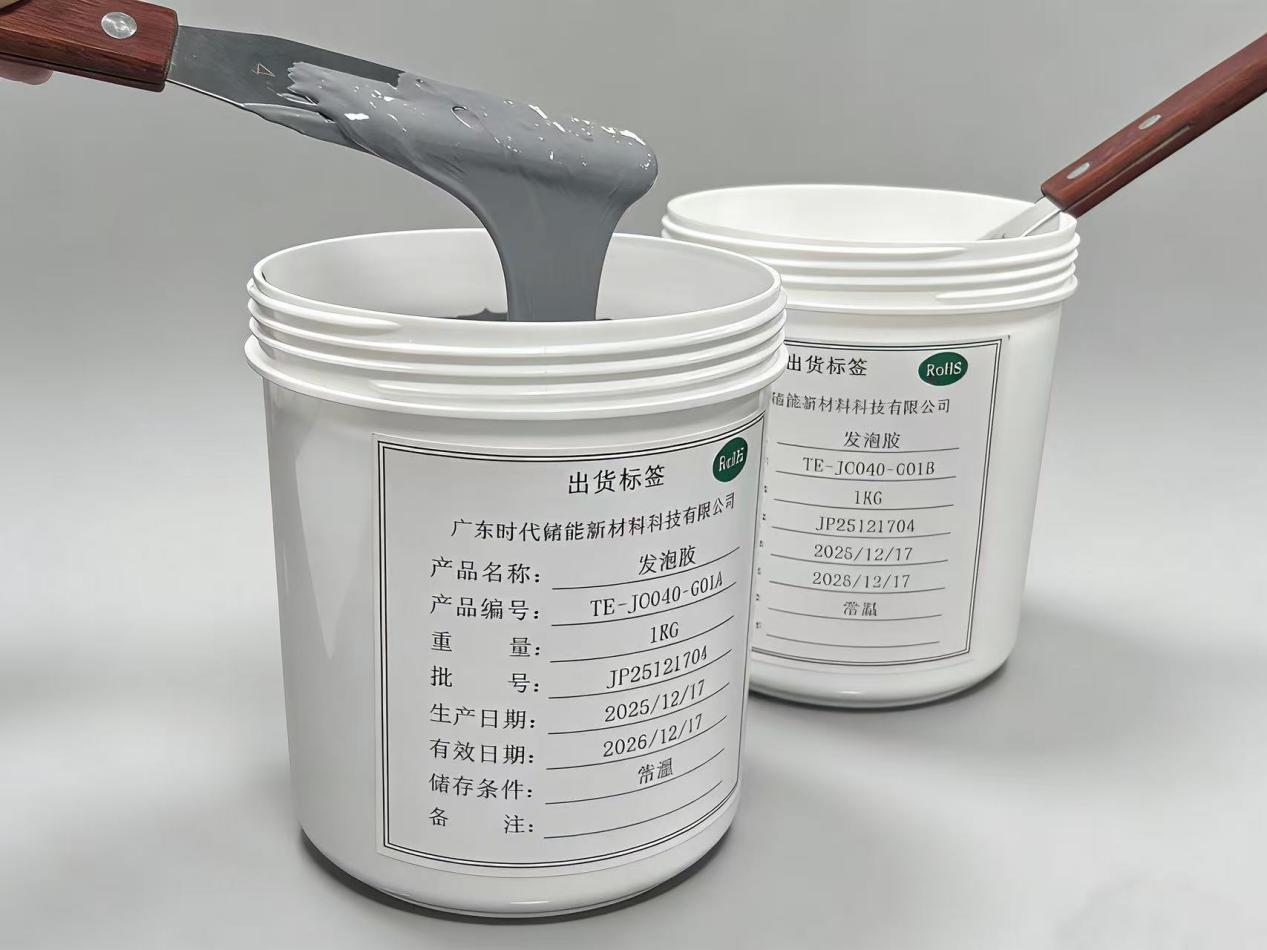
Formed liquid foamed silicone rubber: the BAS series base adhesive is dispensed as a liquid and cures into a compressible elastomer for sealing, cushioning and gap filling in automotive and photovoltaic assemblies.
The Core Problem: You Are Specifying a Foam and a Process, Not Just a Rubber
Foamed silicone is not a drop-in substitute for solid silicone rubber. A buyer evaluating a foaming base adhesive has to match three variables at the same time: the material grade, the dispensing and curing route, and the function the finished foam must perform inside the assembly.
In an electric vehicle or a photovoltaic module, one component may be asked to absorb dimensional variation between a battery module and its enclosure, damp vibration away from thin-walled parts, survive long temperature swings, and do all of this at low weight across thousands of units. Solid silicone rubber seals reliably but is dense; a foamed grade reduces density and increases compressibility, at the cost of some mechanical strength. That trade-off, not the brand name on the drum, is the central decision.
The most common mismatch is viscosity. The BAS series is offered across a stated viscosity range of 15W–350W. A grade at the low end of that range behaves very differently in a metering pump, static mixer and dispensing nozzle than a grade at the high end: flow rate, shot size repeatability and cell structure all shift. Hardness, stated across 17–51, changes compression behaviour in the same way — the lower end conforms to uneven surfaces under light load, the higher end resists compression under sustained load.
The second mismatch is reading product data as if it described a finished part. The BAS series data lists "process: precipitation, fumed", which describes the filler route used in building the base adhesive, not the density or cell structure of the cured foam. Buyers who compare foams from datasheets alone, without a dispensing trial on their own equipment, usually discover the difference on the production line rather than in the specification meeting.
The third issue is that this is a two-stage purchase. The buyer validates a material, then validates a process. Any supplier evaluation should therefore weigh process support — formulation adjustment, curing guidance, trial data — alongside price per kilogram.
Industry Background: Why Foamed Silicone Demand Is Rising in Automotive and Solar
Direction of travel matters when a buyer is deciding whether to standardize on a foamed silicone grade or keep using an alternative. Third-party estimates place the global liquid silicone rubber market at roughly USD 2.8 billion to 3.8 billion in 2024, with forecasts of USD 5.0 billion to 7.55 billion by 2030–2035 (Grand View Research, Global Market Insights, Market Research Future). Those figures diverge because sources define the category differently — some include high-consistency rubber, others exclude it, and regional boundaries vary. The consistent signal is growth rather than any single number.
Application data is more useful for an evaluation decision. Approximately 63% of battery pack sealing systems use silicone elastomers for flexibility and durability, according to Precedence Research / IEA data. Analysts also project the thermally conductive silicone rubber market to grow at a CAGR of 8.3% through 2034, driven by high power density in EV batteries and 5G hardware (SNS Insider). Foamed silicone participates in the same trend from a different angle: as packs and power electronics are packaged more densely, materials that cushion and fill gaps without adding mass become part of the design calculation.
The supplier landscape is a mix of global majors and specialized producers. Stratview Research lists the major global competitors in the LSR market as Dow Inc., Wacker Chemie AG, Momentive Performance Materials and Shin-Etsu Chemical Co., Ltd. Below that tier, regional specialists compete on a different axis — application-level process support for defined material families such as foaming base gums, silicone foam, ceramicized liquid silicone and treatment agents.
The BAS Series Explained: Formed Liquid Foamed Silicone Rubber
Dongguan Times Silicon Industry Co., Ltd. is a silicone material manufacturer based in Hengli Town, Dongguan City, Guangdong Province, China. Founded on December 27, 2021, and starting operation on July 1, 2022, the company develops, produces and sells silicone raw materials, including liquid silicone base gums, base gums for foaming, vinyl silicone oil, hydrogen-containing silicone oil, silicone resin, platinum catalysts, inhibitors, silicone treatment agents and silicone adhesives. The plant covers 15,000 m², employs 42 people, and includes an R&D team of 10 engineers; 55% of output is exported, with main markets in China, South Korea, the United States, Japan and Africa. The company has passed the ISO 9001 international quality management system certification, and states that its products have obtained RoHS, REACH, FDA, LFGB and halogen-free certification. Further company information is available at timessilicone.com.
In 2023 the company established a wholly owned subsidiary, Guangdong Times Energy Storage New Material Technology Co., Ltd., focused on special silicone rubber materials for the new energy industry. Its product list includes foamed liquid silicone, ceramicized liquid silicone, silicone foam, solid silicone, composite silicone, adhesive silicone and special silicone treatment agents, aimed at new energy vehicles, rail transit, network communication, consumer electronics, electromechanical equipment, military and aerospace applications.
Stated Specifications of BAS-1716, BAS-1812 and BAS-80931
| Specification | Stated value for the BAS series (BAS-1716, BAS-1812, BAS-80931) |
|---|---|
| Product name | Special base adhesive for liquid foaming (formed liquid foamed silicone rubber) |
| Base material | Vinyl polydimethylsiloxane (vinyl silicone oil) |
| Process | Precipitation, fumed |
| Appearance | Translucent |
| Viscosity | 15W–350W |
| Hardness | 17–51 |
| Tensile strength | 5–7 |
| Elongation at break | 300–500 |
| Tear strength | 15–17 |
| Applicable industries | Electrical appliances, photovoltaic industry, automobile industry |
How to read this table. The three model numbers sit inside one shared specification window; the product data does not assign separate values to each model. Model selection should therefore be made with the supplier against the target process and function, not by assuming that a higher model number means higher hardness or viscosity.
Base Polymer: Vinyl-Terminated Polydimethylsiloxane
The BAS series lists vinyl polydimethylsiloxane (vinyl silicone oil) as its base material, and the same manufacturer supplies this raw material family separately as a vinyl-terminated PDMS range under the TVF series: TVF-L-50, TVF-100, TVF-500, TVF-1000, TVF-2000, TVF-1W, TVF-6.5W, TVF-H-10W, TVF-H-20W and TVF-H-35W. Stated properties for the TVF series are a clear appearance, viscosity of 35W–50W, volatile content below 0.5%, and vinyl content of 0.037–1.497, with dimethylsiloxane as the polymer segment. The declared applicable industries for the vinyl silicone oil range are electronic and electrical appliances, the photovoltaic industry, the automotive industry and new energy batteries.
Vinyl content and volatile content are the two numbers worth checking when comparing vinyl-terminated PDMS grades, because they influence crosslink density and, in turn, the hardness and compression behaviour of the cured foam. A base polymer with a settled vinyl content is easier to reproduce batch to batch than one supplied against an unspecified figure.
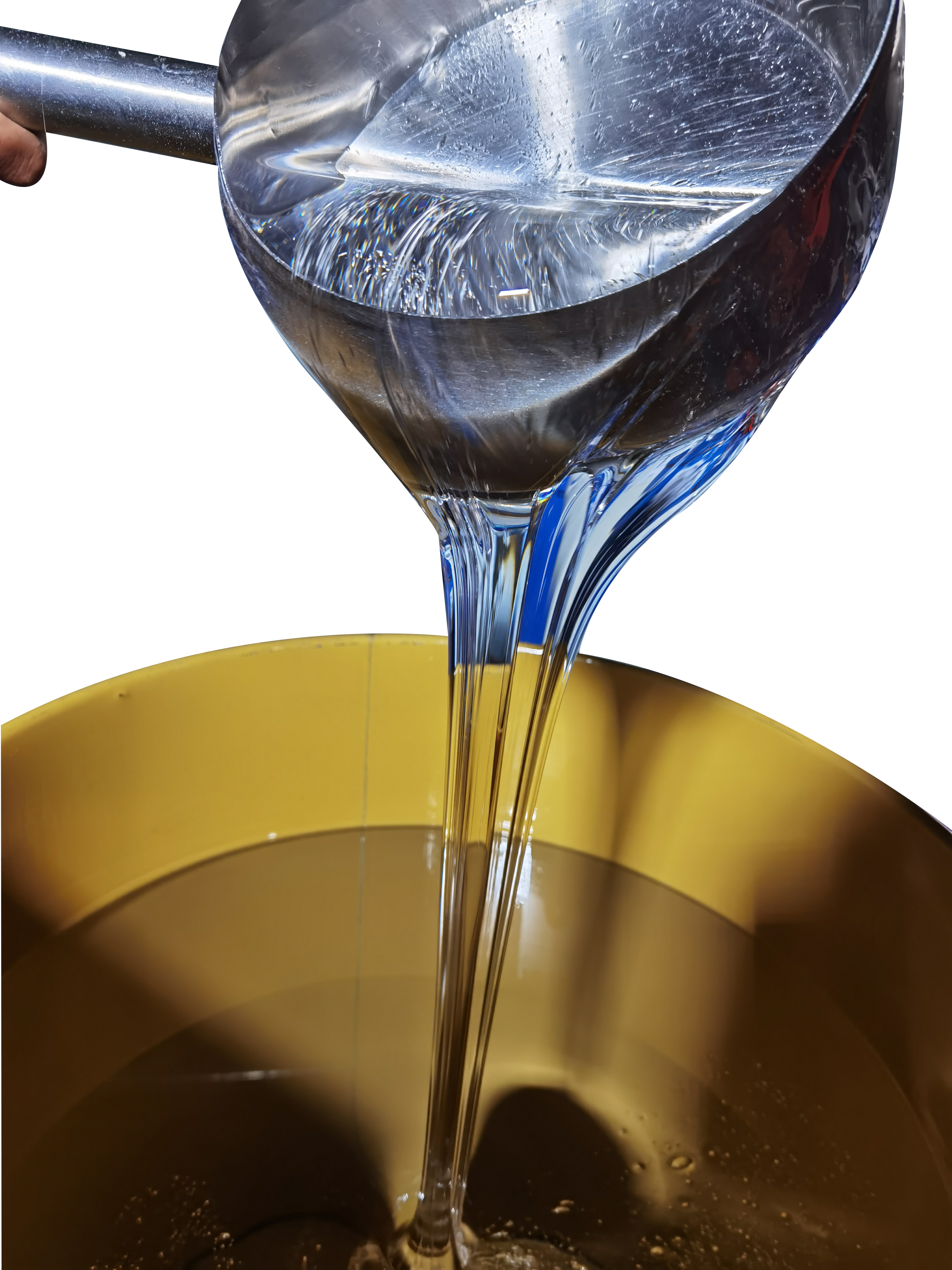
Vinyl silicone oil (vinyl-terminated PDMS), stated with viscosity 35W–50W, volatile content below 0.5% and vinyl content 0.037–1.497, is the vinyl-functional raw material family behind addition-cure and foaming systems.
Cure System and Supporting Materials
Foaming base adhesives cure through addition (hydrosilylation) chemistry, which is why the catalyst package and the vinyl/hydrogen components are evaluated together rather than separately. Dongguan Times Silicon Industry Co., Ltd. supplies platinum catalysts under the TPL and PTR series: TPL-1000, TPL-2000, TPL-3000, TPL-4000, TPL-5000, PTR-3000 and PTR-5000. Stated properties include a transparent appearance, viscosity of 320–1000, platinum content of 1000–5000, and a platinum-plus-siloxane/alcohol solvent carrier, with declared use in the electronic and electrical appliance industry, photovoltaic technology and the automotive industry.
The stated operating window for these catalysts is a reaction temperature range of −20°C to 150°C, and they may be used in solvent-free or various organic solvent systems, acting as a homogeneous or heterogeneous catalyst to promote reactant conversion. Declared requirements for the catalyst family include high catalytic activity and selectivity, low or non-toxicity, environmental friendliness, and good thermal and chemical stability. In practical terms, catalyst choice controls cure speed and batch consistency — two variables that decide whether a foaming line produces the same cell structure at the end of a shift as it did at the start.
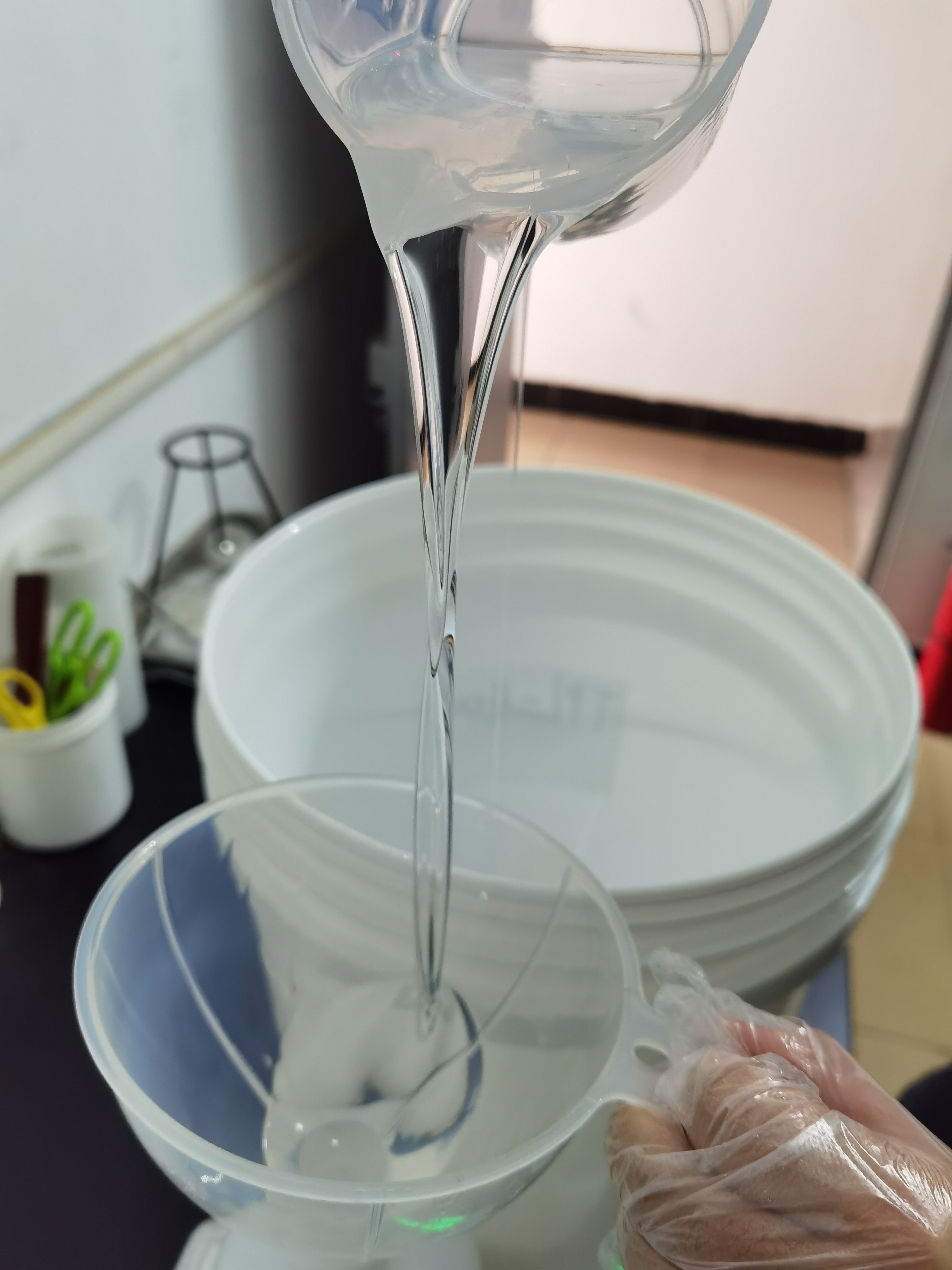
Platinum catalysts (TPL-1000 to TPL-5000, PTR-3000, PTR-5000) drive hydrosilylation curing; stated reaction temperature range is −20°C to 150°C.
Step-by-Step: From Application Requirement to a Validated Foamed Part
- Define the function before the grade. Decide whether the component is primarily sealing, cushioning and gap filling, vibration damping, or part of a thermal and electrical protection stack. The BAS series is listed for electrical appliances, the photovoltaic industry and the automobile industry, so the function and the environment — temperature cycling, moisture, dust, oil mist, voltage exposure — should be written down before any model number is quoted.
- Set a hardness target inside the 17–51 window. Lower hardness gives a softer, more conformable foam that follows uneven surfaces; higher hardness gives a firmer foam that holds shape under load. Because the series data does not split values by model, the target hardness should be stated as a requirement, not inferred from the model number.
- Match viscosity (15W–350W) to the dispensing equipment. The viscosity band has to be compatible with the metering pump, mixing ratio control and nozzle in the customer's line. This is the step where a trial replaces a datasheet comparison.
- Confirm the base polymer and the cure package. The base is vinyl polydimethylsiloxane (vinyl silicone oil); the cure is platinum-catalyzed addition. Where the formulation needs adjustment, the vinyl-terminated PDMS range (TVF series) with vinyl content of 0.037–1.497 and volatile content below 0.5% provides the variable.
- Run a trial against defined quality gates. The manufacturer's quality control structure covers incoming raw material testing for purity, heavy metals and harmful substances; in-process monitoring of viscosity, hardness and mixing ratio; full finished-product testing; and third-party sampling. A trial batch should be measured against those same gates so that scale-up is a repetition, not a new project.
- Scale with known commercial terms. Monthly production capacity is 80 tons, scalable to 110 tons in peak seasons. Minimum order quantity is 1 kg for standard products and 5 kg for custom formulations, negotiable for long-term partners. Stated lead time is 7–10 working days for standard stock products and 15–25 working days for custom formulations or bulk orders, adjustable according to complexity and quantity.
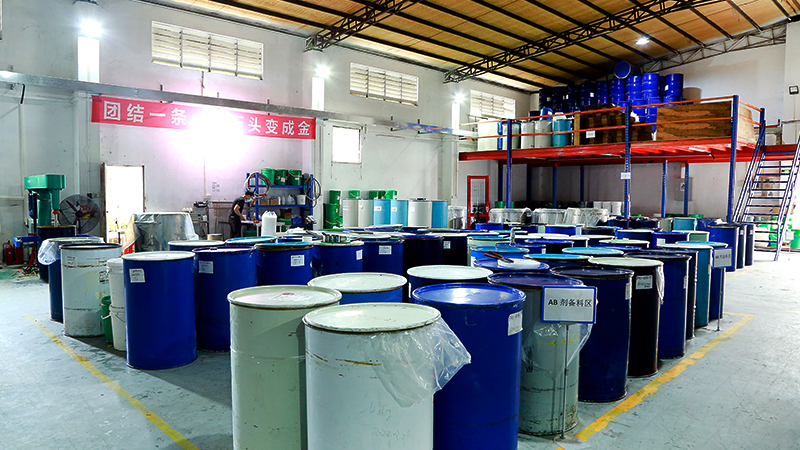
AB agent preparation area at the Dongguan production site; stated monthly capacity is 80 tons, scalable to 110 tons in peak seasons.
Use Cases: Where Foamed LSR Fits in Automotive and Photovoltaic Builds
Automotive and New Energy Vehicle Assemblies
Battery pack sealing is the clearest entry point. With roughly 63% of battery pack sealing systems using silicone elastomers for flexibility and durability (Precedence Research / IEA), foamed grades add a low-density option for cushioning between modules, enclosures and covers, where a solid silicone pad would add weight. The automobile industry is a declared applicable industry for the BAS series, and the same manufacturer's new energy subsidiary lists foamed liquid silicone and silicone foam among its products for new energy vehicles and rail transit.
A second cluster of automotive uses is protection rather than sealing: cushioning of electronic modules, damping of vibration transfer to thin-walled housings, and gap filling where tolerance stacks make a machined part impractical.
Photovoltaic and Energy Storage Applications
Photovoltaic is a declared applicable industry for the BAS series, alongside electrical appliances. PV hardware is exposed to long-term outdoor conditions and repeated day–night temperature cycling, which favours elastomeric materials that stay flexible and hold their position in a joint. Foamed silicone is used here for cushioning and sealing functions where the assembly also benefits from reduced weight and lower material density.
Where a project needs a coated insulating sleeve rather than a foam, the same manufacturer supplies fiber glass sleeve coating with silicone resin (methylphenyl silicone resin) in models TS3034B, TS3039B, TS3045-01B, TS3045B, TS3049B, TS6123A/B and TS6125A/B. These coatings are applied by dipping, spraying or brushing and cured by high-temperature baking, with stated heat resistance of 200°C, cold resistance down to a hardening temperature of −55°C and a brittleness temperature of −73°C, hardness of 20–35 and viscosity of 10,000–55,000. Typical applications include fiberglass sleeve impregnation and coating, electronic wire harness and cable insulation protection, motor and transformer winding insulation, and new energy vehicle wire harness protection, with matched equipment such as an impregnator or coating machine, curing oven, mixing tank, metering pump and tension winder.
Adjacent Electrical and Appliance Applications
Electrical appliances is the third declared industry for the BAS series. This covers internal cushioning, sealing and gap-filling roles in appliance assemblies where a compliant, low-weight elastomer is preferred over a solid rubber part or a rigid spacer.
Scenario fit check. A foamed LSR grade is a strong fit when the requirement combines low weight, compliance to uneven surfaces, and long-term flexibility. It is a weaker fit when the assembly needs high mechanical strength in the cured part, tight cured-part dimensional tolerance, or a material already qualified to a specification that lists only solid silicone grades.
Comparison Table: Material and Auxiliary Options from the Same Supplier
The table below compares the product families a foam project typically touches, using only the manufacturer's published product data. It is a scope overview for procurement planning, not a performance ranking; values describe the materials as supplied, not a cured part in a specific assembly.
| Product family and models | Type | Key stated parameters | Stated applicable industries | Typical role in an automotive or PV build |
|---|---|---|---|---|
| Formed liquid foamed silicone rubber — BAS-1716, BAS-1812, BAS-80931 | Special base adhesive for liquid foaming | Viscosity 15W–350W; hardness 17–51; tensile strength 5–7; elongation at break 300–500; tear strength 15–17; translucent; process: precipitation, fumed | Electrical appliances; photovoltaic industry; automobile industry | Cushioning, gap filling, sealing and vibration damping where low weight and compliance matter |
| Fiber glass sleeve with silicone resin — TS3034B, TS3039B, TS3045-01B, TS3045B, TS3049B, TS6123A/B, TS6125A/B | Coating of glass fiber insulating sleeves (methylphenyl silicone resin) | Viscosity 10,000–55,000; hardness 20–35; heat resistance 200°C; hardening temperature −55°C; brittleness temperature −73°C; colors white, milky white, transparent | New energy vehicles; photovoltaic and energy storage; aerospace and defense | Insulation and protection of wire harnesses, motor windings and transformer coils |
| Platinum catalyst — TPL-1000, TPL-2000, TPL-3000, TPL-4000, TPL-5000, PTR-3000, PTR-5000 | Catalyst for hydrosilylation and addition curing | Viscosity 320–1000; platinum content 1000–5000; transparent; reaction temperature range −20°C to 150°C | Electronic and electrical appliance industry; photovoltaic technology; automotive industry | Sets cure speed and batch consistency for addition-cure silicones, including foaming systems |
| Vinyl silicone oil — TVF-L-50, TVF-100, TVF-500, TVF-1000, TVF-2000, TVF-1W, TVF-6.5W, TVF-H-10W, TVF-H-20W, TVF-H-35W | Vinyl-terminated PDMS | Viscosity 35W–50W; volatile content below 0.5%; vinyl content 0.037–1.497; clear | Electronic and electrical appliances; photovoltaic industry; automotive industry; new energy batteries | Vinyl-functional raw material for adjusting crosslink density, hardness and compression behaviour |
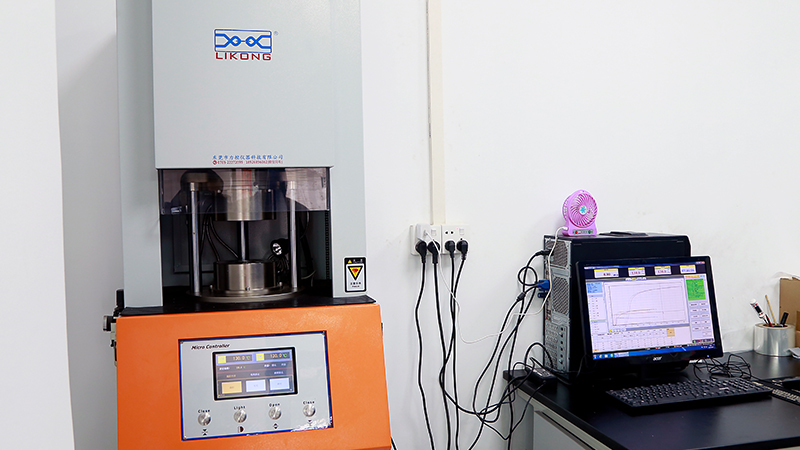
Testing workshop: quality control covers incoming raw material tests, in-process monitoring of viscosity, hardness and mixing ratio, finished-product testing and third-party sampling.
Frequently Asked Questions
Are the BAS series foaming base adhesives covered by verifiable compliance documentation?
Dongguan Times Silicon Industry Co., Ltd. has passed the ISO 9001 international quality management system certification and states that all of its products have obtained RoHS, REACH, FDA, LFGB and halogen-free certification. Compliance verification does not stop at the certificate list: the company's quality control includes incoming raw material testing for purity, heavy metals and harmful substances, in-process monitoring of viscosity, hardness and mixing ratio, full finished-product testing, and third-party sampling. Buyers entering regulated automotive or photovoltaic supply chains should request the certificate set that matches their target market and confirm which document applies to the exact model ordered.
Can the foaming base adhesive be customized for a specific automotive or photovoltaic project?
Yes. The manufacturer works in OEM/ODM mode and lists customization across viscosity, color (transparent, translucent or opaque), odor level, formulation grade, curing method and packaging specification. For a foamed silicone project the practical starting point is the series itself: BAS-1716, BAS-1812 and BAS-80931 share a stated viscosity range of 15W–350W and a hardness range of 17–51, and the model is selected against the dispensing equipment, the gap geometry and the required compression behaviour. Formulation adjustments are then validated through the customer's own foaming and curing process, with formulation optimization and process technical guidance provided as after-sales support.
What is the minimum order quantity, and what drives the cost?
MOQ is 1 kg for standard products and 5 kg for custom formulations, and it is negotiable for long-term partners. Cost is driven mainly by where the grade sits in the series, by the depth of customization — a custom formulation versus a standard model — and by order volume, with monthly production capacity of 80 tons, scalable to 110 tons in peak seasons. The manufacturer does not quote unit prices in its product data, so project pricing should be requested against a defined model and a defined annual or batch volume.
How long do sampling and production take, and how is the material validated?
Stated lead time is 7–10 working days for standard stock products and 15–25 working days for custom formulations and bulk orders, adjustable according to complexity and quantity. Validation follows the manufacturer's quality control structure: incoming raw material testing for purity, heavy metals and harmful substances; in-process monitoring of viscosity, hardness and mixing ratio; and full finished-product testing, with third-party sampling available. Because a foaming base adhesive is converted into a part inside the customer's own equipment, a dispensing and curing trial should be part of the approval workflow before volume orders are released.
Can a Chinese liquid silicone rubber manufacturer serve medical device projects as well as automotive and photovoltaic work?
Dongguan Times Silicon Industry Co., Ltd. is a China-based liquid silicone rubber manufacturer whose products are described as being applied in medical care, new energy, home appliances, precision electronics, auto parts, mechanical equipment and silicone ink fields. Its certification set includes FDA and LFGB alongside RoHS, REACH and halogen-free certification, and its export activity covers Europe, North America, Southeast Asia, Japan, South Korea and Australia. Because compliance is granted per product and per market, buyers with medical-adjacent requirements should confirm that the specific model and its documentation match the applicable standard before qualification.
Conclusion: Evaluating a Foaming Grade Without Over-Specifying It
Foamed liquid silicone rubber is the right material family when one component has to deliver low weight, compliance to uneven surfaces, sealing and vibration damping at the same time. It is the wrong family when the priority is high mechanical strength in the cured part or a tolerance that only a moulded solid component can hold. The BAS series covers that decision space with a stated hardness range of 17–51 and viscosity of 15W–350W across BAS-1716, BAS-1812 and BAS-80931, built on vinyl polydimethylsiloxane and cured through platinum-catalyzed addition chemistry.
For a buyer in the research and evaluation stage, the practical sequence is short: define the function and environment, set hardness and viscosity targets, confirm the base polymer and catalyst package, run a trial against the supplier's quality gates, then scale with defined MOQ and lead-time terms. Model-level selection should be made with the supplier, because the published data describes the series as a whole rather than each model separately.
Next step: sample, data sheet or quotation
To evaluate the BAS series for a specific automotive or photovoltaic project, request a formed liquid foamed silicone rubber sample, the technical data sheet for BAS-1716, BAS-1812 or BAS-80931, or a quotation against your target hardness, viscosity and annual volume. Tell the supplier the function (sealing, cushioning, damping), the dispensing equipment in use, and the required compliance documents — that information shortens the trial cycle more than any brochure.
Product brochure download: Times Silicon product brochure (PDF)
Dongguan Times Silicon Industry Co., Ltd.
Address: No.3, Ma Jiang 2nd Road, Hengli Town, Dongguan City, Guangdong Province, China
Contact: Mr Han — Email: 1412531738@qq.com — Tel: +86 13825718161 — WhatsApp: +86 13316608735
Website: https://timessilicone.com/
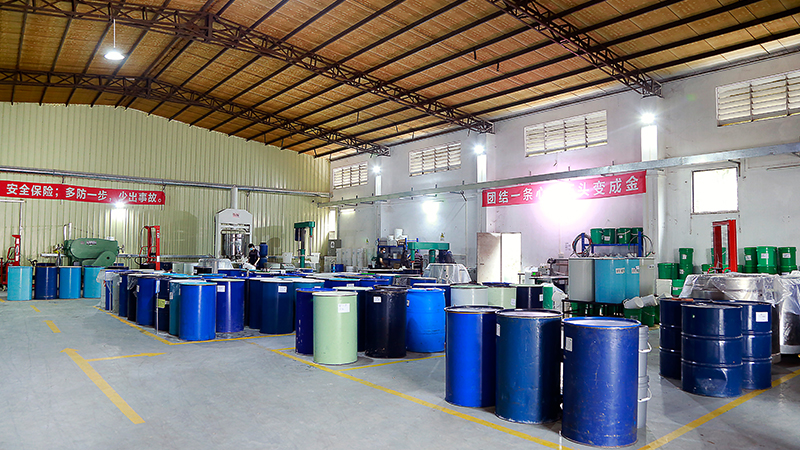
Production workshop at the 15,000 m² Dongguan facility — request a sample or quotation for the BAS series to start your evaluation.
Have Questions or Need More Details?
Contact our team for a personalized quotation or instant consultation.
Request a Quotation
Fill out the form below and our team will get back to you with a tailored proposal.
WhatsApp Direct Chat
Prefer to chat in real-time? Message us on WhatsApp for instant assistance & quick answers.
- Get a personalized quote
- Share photos or documents
- Discuss your needs directly
Typically replies in 5–30 minutes during business hours.