
Top 5 Platinum Catalysts for Low-Odor Silicone Production: A Curated List with Selection Rationale
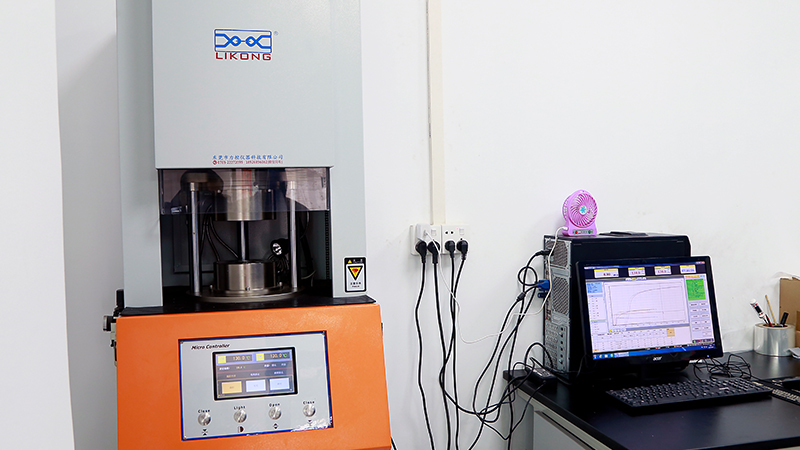
Catalyst grades are verified in the testing workshop before release: activity, cure behaviour and volatile content are checked against the specification.
The shortlist below ranks five platinum catalyst grades — TPL-5000, TPL-4000, TPL-3000, TPL-2000 and TPL-1000 — plus PTR-3000 and PTR-5000 as two further designations in the same series. All seven are transparent, platinum-based catalysts supplied by Dongguan Times Silicon Industry Co., Ltd., and all seven sit inside one verified specification envelope: 1000–5000 ppm platinum content, viscosity of 320–1000, and volatile matter reported as a ladder of 3, ≤3.5, ≤4, ≤7 and ≤10 across the series.
The list is ordered by platinum content, not by price and not by brand familiarity. In an addition-cure (platinum-cured) silicone system, the platinum content of the catalyst determines how much liquid a formulator must dose to reach a target cure — and the dose is what carries solvent, siloxane carrier and unreacted volatiles into the batch. Higher-platinum grades allow the same cure to be reached at a smaller addition rate, which is usually the first lever pulled when residual odor is the binding constraint.
That logic has limits, and this article states them. Where the product data does not distinguish two grades, no difference is invented. Where the trade-off cuts against a higher concentration, it is described rather than hidden.
Problem Definition: Why Low-Odor Silicone Is a Catalyst Constraint
Low residual odor is a formulation outcome, not a single-ingredient property. In platinum-cured liquid silicone rubber, the odor that survives post-cure is generally associated with residual volatile content: low-molecular-weight siloxanes that did not take part in the hydrosilylation reaction, solvent or carrier introduced by the catalyst, and — when cure is incomplete — unreacted vinyl and hydride species left in the matrix. Post-cure baking reduces these residues, but it consumes oven time and energy, and it cannot rescue a formulation that starts with more volatiles than the end use permits.
This produces a three-way constraint that buyers meet during evaluation:
- Cure speed. LSR molding and potting lines run on cycle time. A slower cure cannot simply be bought back with longer heating if the process window is fixed.
- Addition rate. Raising the catalyst dose accelerates cure, but it also increases the amount of carrier and solvent entering the mix, which works directly against a low-odor target.
- Residual volatiles. The end use — medical contact, food contact, adult products, automotive interior, sealed electronics — sets the ceiling on what residues are acceptable.
The practical consequence is that catalyst selection cannot be optimized on activity alone. The grade that cures fastest at a fixed dose is not automatically the right grade for a low-odor formulation; the grade that reaches the required cure at the lowest addition rate is normally the better starting point. That is the criterion used to order the list below.
Industry Background: What Is Driving Demand for Cleaner Cure Systems
Platinum-cured LSR has moved from a specialty material to a mainstream one, and the applications pulling it forward are exactly the ones where residual volatiles are hardest to tolerate.
Market estimates place the global liquid silicone rubber market at approximately USD 2.8 billion to 3.8 billion in 2024, with projections of USD 5.0 billion to 7.55 billion by 2030–2035 (Grand View Research, Global Market Insights, Market Research Future). The spread is wide because published estimates differ on scope: Market Research Future reports USD 2.81 billion for 2024 while Global Market Insights reports USD 3.8 billion, a divergence driven mainly by how each source defines the LSR category and which regions it counts.
Inside that market, medical-grade LSR generated approximately USD 458.7 million in revenue in 2024 and is described as a dominant, fast-growing segment (Grand View Research). Separately, thermally conductive silicone rubber is projected to grow at a CAGR of 8.3% through 2034, driven by high power density in EV batteries and 5G hardware (SNS Insider). In EV battery packs specifically, roughly 63% of battery pack sealing systems use silicone elastomers for flexibility and durability (Precedence Research / IEA).
Three of those four signals — medical, thermal management and EV sealing — push in the same direction: cure systems that leave fewer residues behind. Medical and food-contact silicones must be formulated against recognized standards such as ISO 10993 (biocompatibility), USP Class VI and FDA 21 CFR 177.2600, and those frameworks constrain what may remain in the finished part. Thermally conductive potting compounds and battery sealing gaskets are frequently enclosed in sealed assemblies where any volatile released over service life has nowhere to go.
On the supply side, the LSR market is anchored by large multinationals — Dow Inc., Wacker Chemie AG, Momentive Performance Materials and Shin-Etsu Chemical Co., Ltd. (Stratview Research) — alongside regional specialists that compete on formulation service rather than scale. Dongguan Times Silicon Industry Co., Ltd. is one of the latter: a Dongguan-based manufacturer founded in 2021 that produces platinum catalysts, liquid silicone rubber, vinyl silicone oil, silicone foam and silicone treatment agents, with a 15,000 m² plant, a 10-engineer R&D team and an export share of about 55% across China, South Korea, the United States, Japan and Africa.
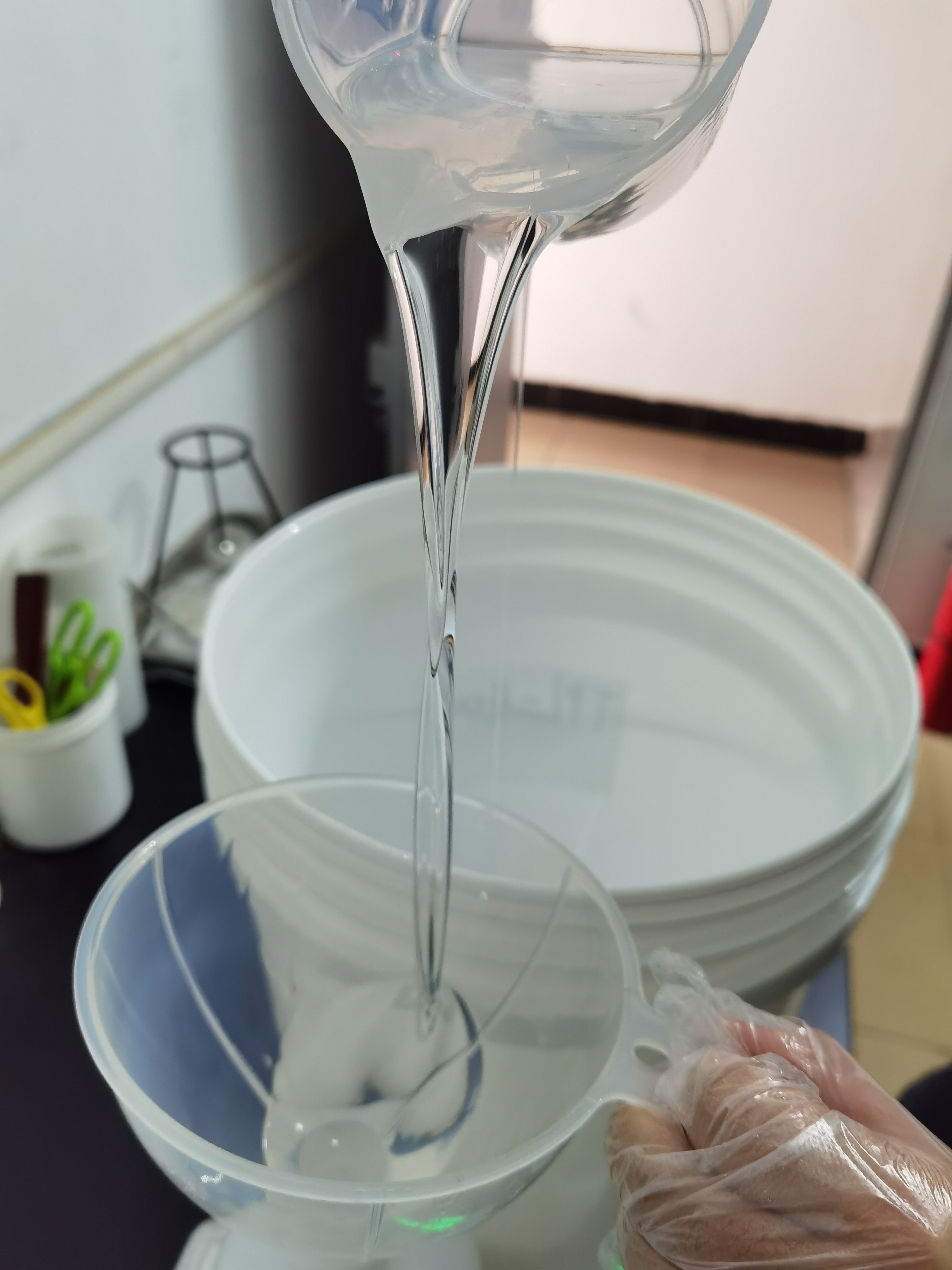
The TPL and PTR series: transparent platinum catalyst with 1000–5000 ppm platinum content, viscosity 320–1000.
The Curated List: Five Platinum Catalyst Grades Ranked for Low-Odor Production
All five TPL grades share the same verified physical profile: transparent appearance, viscosity between 320 and 1000, and platinum content inside the 1000–5000 ppm range. What separates them is where each sits inside that range, which in turn sets the addition rate a formulator needs and the amount of carrier entering the batch. The ranking runs from the highest concentration band to the lowest, and each entry states application cues published in the product data rather than assumed preferences.
1. TPL-5000 — Highest Platinum Concentration Band
TPL-5000 sits at the top of the series' verified 1000–5000 ppm platinum range. Its selection rationale is straightforward: at the highest concentration, the smallest addition rate is required to deliver a given platinum level in the formulation, which minimizes the volume of catalyst carrier introduced per kilogram of silicone.
That matters most in the two application families where residual odor and bleed are least negotiable — medical and food-contact silicone, and low-odor adult-grade and overmolding silicones. Evidence from the same catalyst family supports the mechanism: in a documented supply relationship with a Pearl River Delta liquid silicone manufacturer, the catalyst enabled fast room- or heat-temperature cure in low-odor, non-leaching medical- and food-grade formulations, with no residual odor and no impact on biocompatibility reported. The same case recorded a 30% increase in the customer's curing efficiency and a reduction in curing defect rate from 2.5% to 0.6%, with product yield reaching 99.4%.
Trade-off to test: high-concentration grades concentrate activity per unit volume, so dosing accuracy matters more. Formulators running small batches should confirm that metering equipment can hold the required tolerance before standardizing on this grade.
2. TPL-4000 — High-Concentration Grade for Demanding Cure Cycles
TPL-4000 sits directly below the top band. It is the grade to evaluate when a process needs a fast cure and a low addition rate, but the formulation has slightly more tolerance for residue than a medical or food-contact product. Typical fits from the published application list are thermal conductive silicone sheet and thermally conductive potting compound — both enclosed inside sealed electronics or battery assemblies, and both often carrying high filler loads that would otherwise slow the cure.
Because addition rate is the controlled variable, TPL-4000 and TPL-5000 are often trialled against each other: both let the formulator reduce catalyst dose, and the deciding factor is usually cure response at the lowest workable dose rather than price per kilogram of catalyst.
3. TPL-3000 — Mid-Range Workhorse for Flame-Retardant Rubber Silicone and Silicone Ink
TPL-3000 is the middle of the platinum range and the most broadly applicable grade in the series for general industrial work. The published application list for this catalyst family includes flame-retardant rubber silicone, silicone ink and silicone additives, alongside thermal management and PET protective film uses.
Flame-retardant rubber silicone is the clearest example: the catalyst must function in a formulation that already carries flame-retardant fillers, and those fillers compete with the cure chemistry for mixing energy and dispersion. A mid-range grade leaves more room to raise the dose if cure runs sluggish, without immediately hitting the addition-rate ceiling that a low-odor target imposes. That flexibility is why this grade ranks above the two lower-concentration options even though it is not the highest-activity product.
4. TPL-2000 — Lower-Concentration Grade for Controlled, Slower Cure Windows
TPL-2000 occupies the lower-middle of the verified 1000–5000 ppm range. It is an appropriate starting point when the process benefits from longer pot life or a slower cure front — for example, when a formulation must be mixed, degassed and dispensed before gelation begins and the equipment cannot be upgraded to handle a faster system.
Its limitation mirrors its advantage: a lower platinum concentration requires a larger addition rate to reach the same target, which introduces more carrier into the formulation. Buyers targeting low residual odor should treat TPL-2000 as a fallback and validate the resulting volatile profile by test rather than assumption.
5. TPL-1000 — Entry Grade of the Series
TPL-1000 is the lowest concentration designation in the series, at the bottom of the verified 1000–5000 ppm platinum range. It is best understood as the reference grade: useful for confirming baseline cure behaviour, for small-batch or laboratory work where dosing precision is easier to control, and for formulations where a slower cure is acceptable and odor is not the binding constraint.
For low-odor production specifically, it ranks last for a mechanical reason. The lowest concentration requires the highest addition rate to reach a given platinum level, which means the most carrier volume per kilogram of silicone. Where low residual odor is the priority, that is a direct disadvantage — unless the application's odor ceiling is loose enough that the larger dose is irrelevant.
Additional Designations in the Same Series: PTR-3000 and PTR-5000
The product data lists two further designations — PTR-3000 and PTR-5000 — inside the identical specification envelope: transparent appearance, 1000–5000 ppm platinum content and 320–1000 viscosity. The published data does not differentiate their intended end-use focus from the TPL line. Rather than assume a difference, the correct step is to confirm the intended process window, carrier compatibility and recommended addition rate with the supplier before mixing designations in the same qualification file.
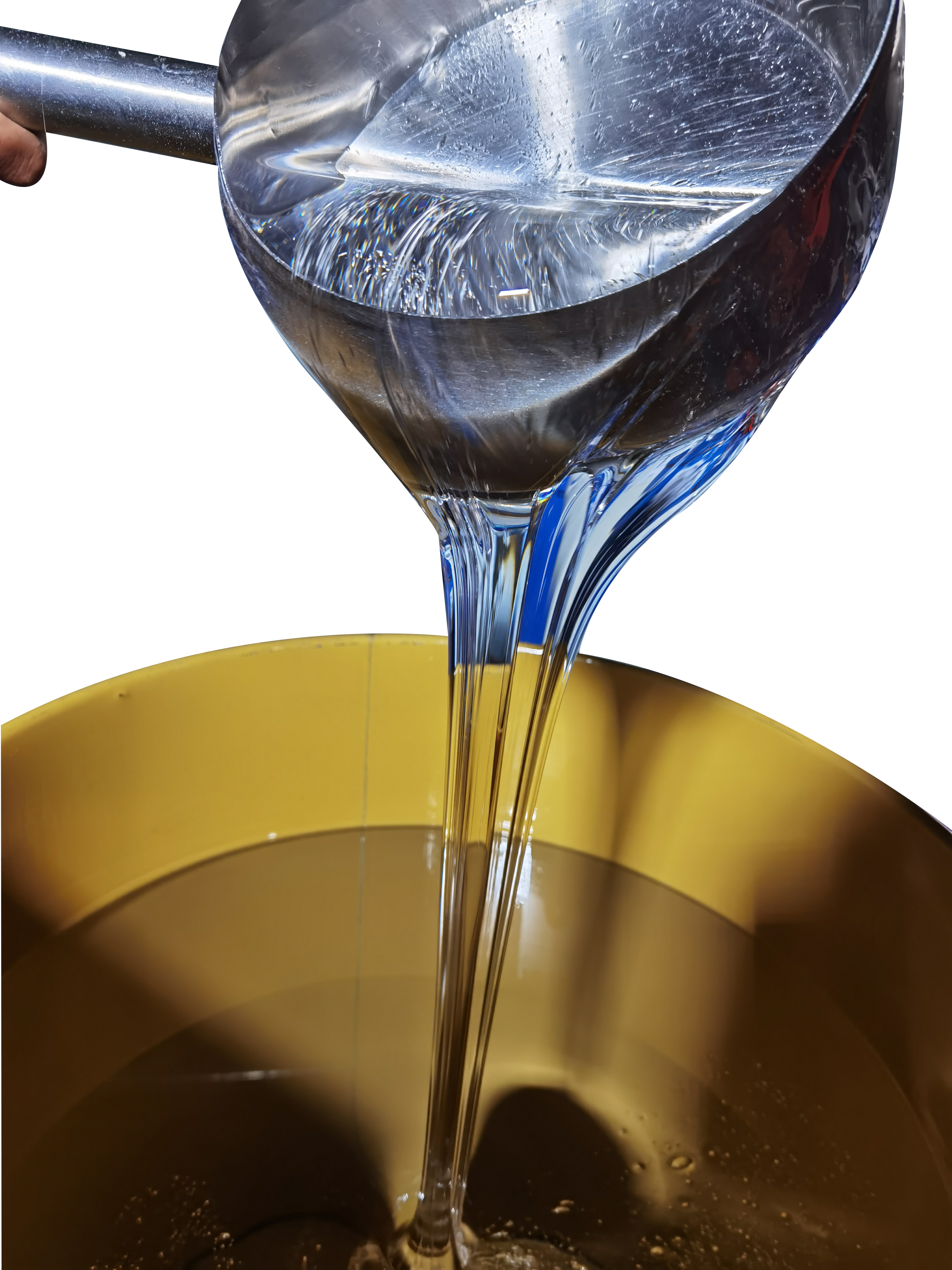
The catalyst does not act alone: vinyl silicone oil supplies the vinyl functionality that the platinum catalyst cross-links with hydrogen-containing siloxane.
Comparison Table: Platinum Catalyst Grades at a Glance
Application cues are identical across the series and are therefore listed once: thermally conductive silicone sheet, thermally conductive silicone potting compound, PET protective film, flame-retardant rubber silicone, silicone ink and silicone additives; applicable industries are electronic & electrical appliance, photovoltaic technology and automotive. All grades are transparent and use platinum (Pt) plus a siloxane/alcohol solvent system.
| Rank | Model | Platinum content (within verified 1000–5000 ppm series range) | Viscosity | Selection rationale for low-odor production |
|---|---|---|---|---|
| 1 | TPL-5000 | Highest band of the series | Within 320–1000 | Lowest addition rate for a given target platinum level; smallest carrier volume per kg of silicone; strongest fit where odor and bleed tolerance is tightest |
| 2 | TPL-4000 | High band | Within 320–1000 | Fast cure at reduced dose; suited to sealed thermal-management and potting assemblies with high filler loading |
| 3 | TPL-3000 | Mid band | Within 320–1000 | Most dose headroom for filler-loaded flame-retardant rubber silicone, silicone ink and general industrial work |
| 4 | TPL-2000 | Lower-middle band | Within 320–1000 | Longer working time before gelation; requires a higher addition rate, so validate volatiles by test |
| 5 | TPL-1000 | Lowest band | Within 320–1000 | Reference grade for baseline cure and small-batch work; highest addition rate, least suited to tight odor ceilings |
| — | PTR-3000 | Same verified range | Within 320–1000 | Additional designation in the same envelope; confirm process window with the supplier before use |
| — | PTR-5000 | Same verified range | Within 320–1000 | Additional designation in the same envelope; confirm process window with the supplier before use |
Reading the table honestly: the platinum content and viscosity figures are verified series-level values. The product data does not publish a separate volatile-matter value, viscosity value or cure-speed figure for each individual model, so no per-model number is asserted here. Request a lot-level certificate of analysis for the specific grade you intend to qualify.
Step-by-Step Breakdown: How to Evaluate a Platinum Catalyst for a Low-Odor Formulation
A ranking alone does not select a grade. The sequence below converts the list above into a decision that a second reviewer can check, and each step produces a number or a document.
- Define the cure system and the target platinum level. Establish whether the formulation is addition-cure (platinum-cured) LSR and what platinum concentration on total formulation the current process requires. This figure is the input for every later calculation.
- Convert the target into an addition rate for each candidate grade. A given platinum target translates into a different dose for TPL-1000 than for TPL-5000. Because the series spans 1000–5000 ppm platinum, the dose needed at the low end is proportionally larger than at the high end. Calculate this before requesting quotes, because it changes the effective cost comparison between grades.
- Check volatile matter against the odor ceiling. Volatile matter across the series is reported as a ladder of 3, ≤3.5, ≤4, ≤7 and ≤10. Match the candidate grade's reported value to the application's odor and bleed tolerance, and treat any grade whose volatile load exceeds that tolerance as unsuitable regardless of cure speed.
- Confirm carrier and solvent compatibility. The catalyst system is platinum plus a siloxane/alcohol solvent. Confirm that the solvent does not interact with inhibitors, pigments or fillers in the formulation, and that seals and tubing on the dispensing equipment are compatible.
- Validate on a sample before scaling. Standard products are available from a 1 kg minimum order quantity and custom formulations from 5 kg — enough for a full cure trial and an odor assessment. Standard stock lead time is 7–10 working days; custom formulations and bulk orders run 15–25 working days.
- Lock batch consistency and documentation. Request a certificate of analysis per lot covering platinum content, viscosity and volatile matter, and confirm the supplier's quality system. Batch-to-batch consistency is what keeps cure time and odor stable across production runs.
Use Cases: Matching the Grade to the Silicone Application
Flame-Retardant Rubber Silicone
Flame-retardant silicone formulations carry high filler loads, and the cure system has to work around them. A mid-to-high concentration catalyst such as TPL-3000 or TPL-4000 gives the formulator dose headroom to compensate for filler interference without pushing the addition rate above what the odor target allows.
PET Protective Film
PET protective film is listed among this catalyst family's published applications. Film coating lines run continuously and reward a cure system that reaches full conversion quickly at a low dose, which points toward the higher-concentration grades in the series.
Thermal Conductive Potting and Thermal Conductive Silicone Sheet
Thermally conductive silicone sheet and thermally conductive potting compound are both published applications for this catalyst series, and both are used inside sealed electrical and battery assemblies. In a sealed assembly, volatiles released after assembly have no escape path — which is why a low addition rate and a low reported volatile matter figure are both relevant to grade selection here.
Liquid Silicone Rubber Production
The catalyst is used to catalyze the hydrosilylation reaction in addition-cure liquid silicone production, and its operating range is wide: typical reaction temperatures span roughly −20 °C to 150 °C, in solvent-free or organic solvent systems, with matched equipment that includes reactors, stirrers, heating/cooling systems, metering pumps, filters and drying equipment.
In documented supply, the same catalyst family has been used for adult-grade, medical-grade and food-grade silicone formulations as well as high-volume LSR production, where batch consistency directly affects hardness, feel and curing speed. Where the end product is medical or food-contact, the finished article must still satisfy standards such as ISO 10993, USP Class VI and FDA 21 CFR 177.2600 — catalyst selection supports compliance, it does not replace finished-part testing.
Capacity matters at the production stage: monthly production capacity is 80 tons and can scale to 110 tons during peak seasons, with OEM/ODM customization covering hardness (7±1 to 38±1 Shore A), viscosity, color, odor level (low or odorless), formulation grade (food or medical) and curing method.
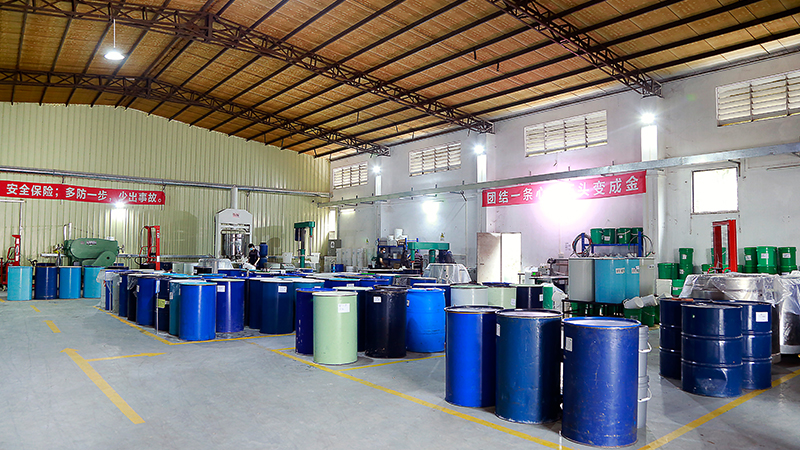
Batch consistency is a production capability, not a datasheet claim: uniform platinum content with minimal activity fluctuation is what keeps cure speed and odor stable.
Compliance and Verification: What to Ask For Before You Standardize
Because this is a constraint-driven purchase, the verification file matters as much as the specification sheet. The following documents apply to this supplier and represent the minimum set a buyer should request from any platinum catalyst source:
- ISO 9001:2015 Quality Management System certification — certificate number 25025Q12678R0S, issued by ZhongQiu United International Certification (Beijing) Co., Ltd., conforming to the GB/T19001-2016 idt ISO9001:2015 standard. The certification scope covers the research and production of liquid silicone rubber, silicone glue and silicone treatment agent, plus the production of silicone oil, platinum catalyst and silicone additives (excluding hazardous chemicals), and is valid globally.
- High-tech Enterprise Certificate — number GR202444010636, issued jointly by the Ministry of Science and Technology, the Ministry of Finance and the State Taxation Administration, applicable to the China market in the new materials scope, valid to 2027-12-11.
- Utility model patent — number ZL202323622488.5, issued by the National Intellectual Property Administration, covering a silicone rubber treatment agent bonding device, valid to 2034-09-02.
- Material and product certifications — the supplier states that its products hold RoHS, REACH, FDA, LFGB and halogen-free certifications.
One interpretation caution: a certification held by the manufacturer does not transfer automatically to your finished article. Medical and food-contact compliance is demonstrated on the finished part, against the standard the regulator or notified body applies.
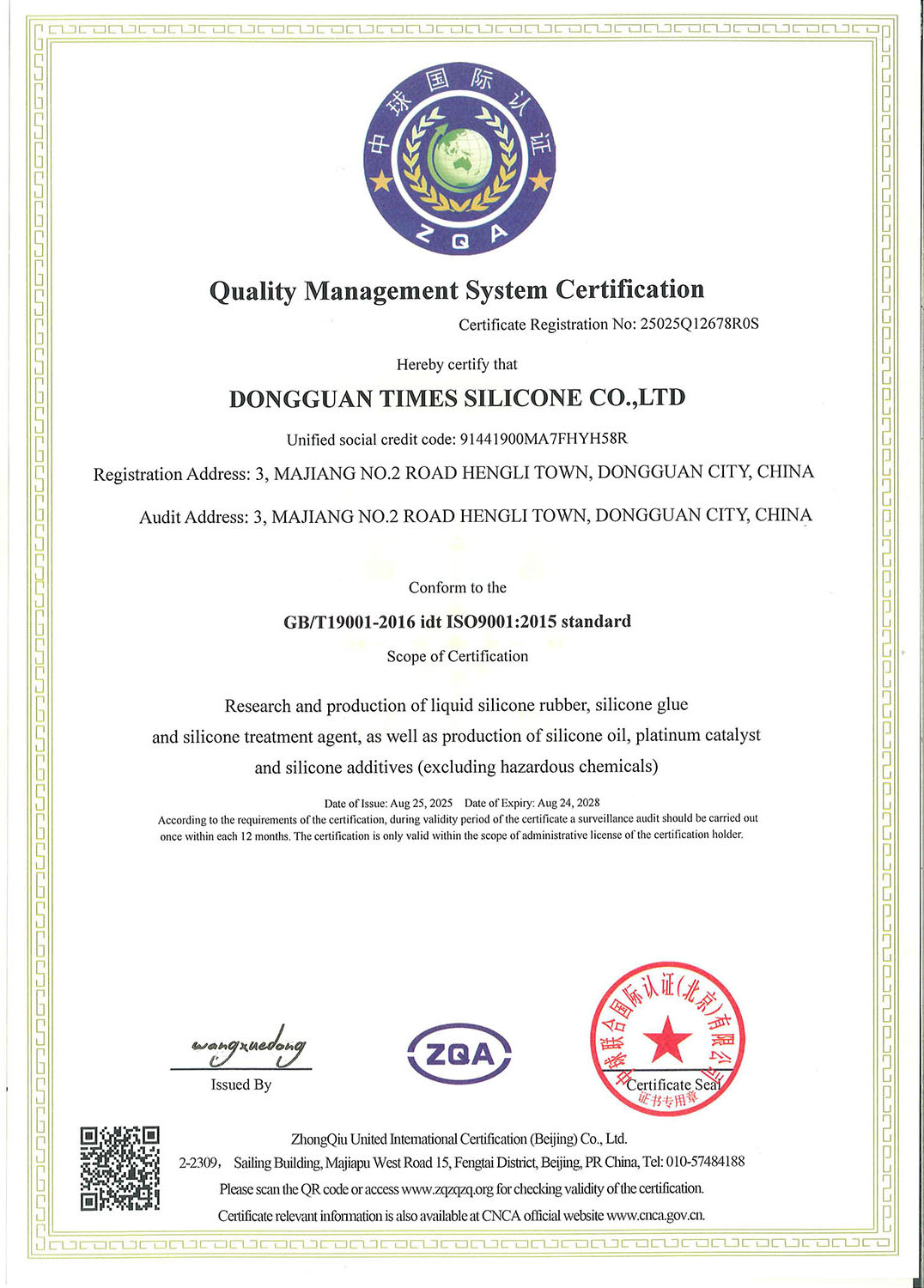
ISO 9001:2015 certificate 25025Q12678R0S explicitly covers platinum catalyst production within its certification scope.
FAQ
Are FDA-certified liquid silicone rubber manufacturers in China a viable source for platinum-cured systems?
Yes, provided the certification is verified on the certificate itself rather than taken from a marketing page. For medical and food-contact silicones the relevant verification targets are ISO 10993 for biocompatibility, USP Class VI and FDA 21 CFR 177.2600 — these govern human-contact applications, and compliance is demonstrated on the finished article. In China, a supplier's quality credentials can be checked through documents such as an ISO 9001:2015 certificate whose stated scope explicitly covers LSR and platinum catalyst production. Dongguan Times Silicon Industry Co., Ltd., for example, holds ISO 9001:2015 certification (certificate 25025Q12678R0S, issued by ZhongQiu United International Certification (Beijing) Co., Ltd., valid globally) and states that its products carry RoHS, REACH, FDA, LFGB and halogen-free certifications. The practical check is a lot-level certificate of analysis plus a sample trial, not the claim alone.
Can a platinum catalyst be matched to a specific LSR formulation instead of bought off the shelf?
Yes. Standard products are available, and custom formulation work is part of the offering: OEM/ODM customization covers hardness (7±1 to 38±1 Shore A), viscosity, color (transparent, translucent or opaque), odor level (low or odorless), formulation grade (food or medical) and curing method (room or heat cure). Documented supply relationships show the catalyst being adapted to low-odor, non-leaching medical- and food-grade formulations with no residual odor reported and no impact on biocompatibility — so formulation-level matching has a working precedent rather than being theoretical.
What drives the cost of a platinum catalyst in a low-odor formulation?
Two variables dominate: platinum content per unit of catalyst, and the addition rate the formulation requires. Because platinum is the cost-bearing element, a higher-concentration grade costs more per kilogram but is dosed at a lower rate, so the meaningful comparison is cost per unit of silicone produced rather than price per kilogram of catalyst. Documented use also shows the benefit of high catalytic activity: efficient cure at a low addition rate reduced the customer's formulation cost, while curing efficiency rose 30% and per-batch capacity rose 25%. Requesting quotes for two grades at their calculated addition rates is the fastest way to see the real difference.
Can I validate a catalyst with a sample before committing to bulk?
Yes. Standard products start at a 1 kg minimum order quantity and custom formulations at 5 kg, both large enough for a controlled cure trial plus an odor and volatile assessment. A practical sample protocol is to run the candidate grade at its calculated addition rate, measure cure time at the line's process temperature, then post-cure and evaluate residual odor against the end use's tolerance. Sampling is also the point at which to confirm batch-to-batch consistency, since uniform platinum content with minimal activity fluctuation is what keeps feel, hardness and cure speed stable in production.
What is the lead time, and how much material can be supplied at scale?
Standard stock products ship in 7–10 working days; custom formulations and bulk orders take 15–25 working days, adjustable by complexity and quantity. Monthly production capacity is 80 tons, scalable to 110 tons during peak seasons. For buyers standardizing one catalyst across several silicone lines, that capacity headroom is the figure that matters, because switching grades mid-qualification costs far more than confirming availability before the trial begins.
Conclusion: Select on Addition Rate, Not on Headline Activity
Ranked by platinum content within the series' verified 1000–5000 ppm range, the five TPL grades answer one question for low-odor silicone production: how much catalyst must be dosed to reach the target cure? TPL-5000 and TPL-4000 lead on that measure, TPL-3000 offers the most dose flexibility in filler-loaded systems such as flame-retardant rubber silicone and silicone ink, and TPL-2000 and TPL-1000 remain valid where a longer working time matters more than residue control. PTR-3000 and PTR-5000 sit inside the same specification envelope and should be qualified with the supplier before use.
The decision should be closed with documents, not impressions: a calculated addition rate, a lot-level certificate of analysis, a sample trial with an odor assessment, and verified certification. That route is slower than picking the highest number on a datasheet, but it is the only one that holds up in production.
Next Step: Request a Sample and the Technical Datasheet
Dongguan Times Silicon Industry Co., Ltd. supplies the TPL and PTR platinum catalyst series alongside liquid silicone rubber, vinyl silicone oil, silicone foam and silicone treatment agents, with standard samples from 1 kg and custom formulations from 5 kg. Send your target platinum level on formulation and the intended end use — flame-retardant rubber silicone, PET film, thermal conductive potting or LSR — and the recommended grade and addition rate can be matched to your process.
Company brochure (PDF, open access): Times Silicon product brochure
Website: timessilicone.com
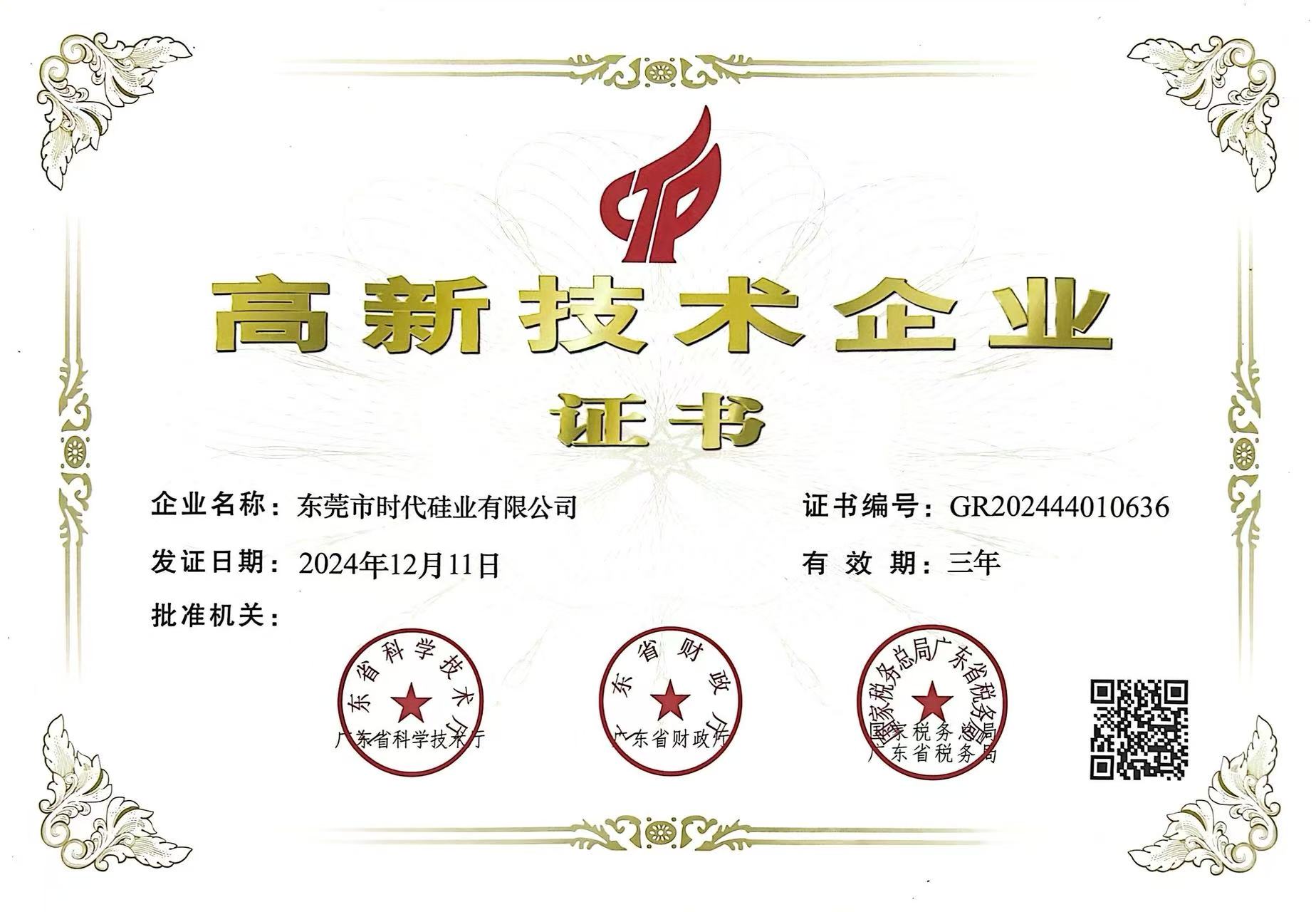
Verified credentials behind the sample request: High-tech Enterprise Certificate GR202444010636, alongside ISO 9001:2015 certification 25025Q12678R0S.
Have Questions or Need More Details?
Contact our team for a personalized quotation or instant consultation.
Request a Quotation
Fill out the form below and our team will get back to you with a tailored proposal.
WhatsApp Direct Chat
Prefer to chat in real-time? Message us on WhatsApp for instant assistance & quick answers.
- Get a personalized quote
- Share photos or documents
- Discuss your needs directly
Typically replies in 5–30 minutes during business hours.