FSC Certified Paper Yarn vs Washi Yarn: Head-to-Head
Two paper yarns can share a fiber family and still answer different sourcing questions. FSC Certified Paper Yarn (model FSC-YX-ECO-001) is defined by a certification-backed material statement: it is made of FSC certified paper fiber and is available as 100% FSC paper yarn. Washi Yarn (model YX-PAPER-001) is defined by its material story and process role: a paper yarn with FSC paper fiber as a primary material, described for knitting and weaving.
Both are supplied by Dongguan Yuexiong Textile Co., Ltd. (MONALISHAMAGIC), so this is not a contest between two suppliers. It is a head-to-head between two claim architectures inside one functional yarn range — and between the different paperwork, questions and sample work each one demands from a sourcing or product team before the first bulk order.
Short answer. Choose FSC Certified Paper Yarn (FSC-YX-ECO-001) when the program has to carry a documented certified-content claim — an FSC-related material statement in a retail compliance file, a sustainability page or a buyer questionnaire — and when a 100% FSC paper yarn composition is acceptable. Choose Washi Yarn (YX-PAPER-001) when development is led by the paper-yarn hand and construction route, including knitting, weaving and blended variants, and certification documentation is a confirming factor rather than the headline claim. If the specification requires measured performance values, neither product can be selected from documents alone; both must be validated on your own sample.
Why "paper yarn" is not a specification
Paper yarn names a fiber family, not a performance level, a composition or a certification status. That gap is where most paper-yarn sourcing errors begin, and it appears in two predictable forms.
The first is a tech pack that says only "paper yarn". Composition, count, color route and certification expectation are left open, so the mill fills the blanks and the buyer discovers at inspection that the delivered yarn matches the mill's default rather than the brand's claim. The second is assuming that a mill-level certificate converts every paper-yarn SKU into a 100% certified product. Chain-of-custody certification controls how certified material is tracked through a facility; it does not automatically attach a 100% certified-content status to every yarn that leaves the building.
FSC-YX-ECO-001 and YX-PAPER-001 sit on opposite sides of that distinction. One is written as a certified-material product with a chain-of-custody record attached to it. The other is written as a material and process product, with FSC paper fiber named as a primary material and knitting and weaving named as the intended routes. For procurement, the practical difference is not which yarn is better — it is which questions must be closed in writing before sampling.
What the FSC chain-of-custody record actually covers
The compliance record attached to FSC Certified Paper Yarn is a specific, checkable document rather than a general sustainability statement, and reading it correctly is the fastest way to avoid an unsupportable claim.
The certificate as stated
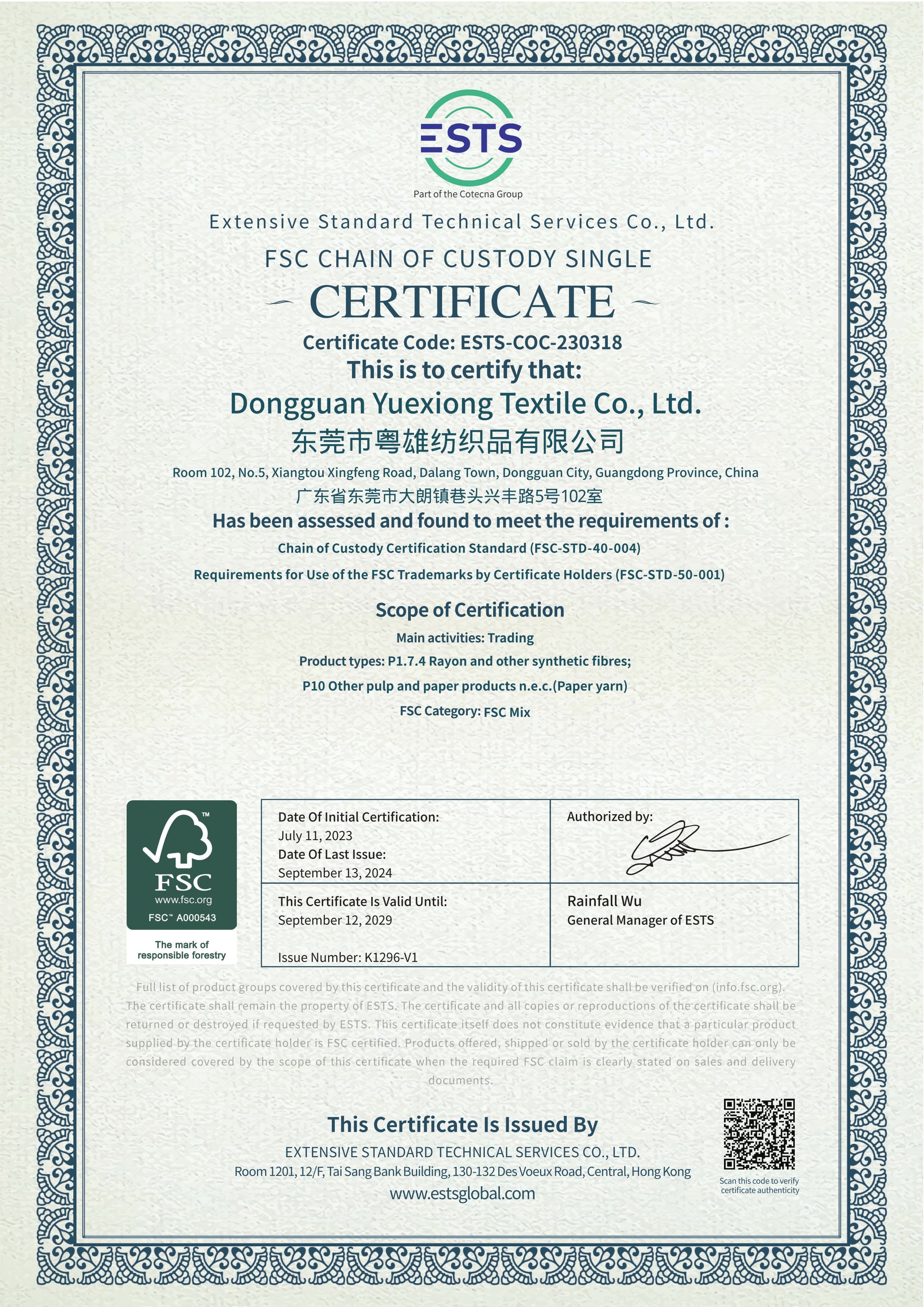
FSC Chain of Custody certificate number ESTS-COC-230318 was issued by Extensive Standard Technical Services Co., Ltd. (ESTS) on 13 September 2024 and is valid until 12 September 2029, with a market scope of Global. The stated scope of activity is "Trading of Rayon/synthetic fibres; Paper yarn", and the applicable standards are FSC-STD-40-004 and FSC-STD-50-001. In the product record, this certificate is linked to FSC Certified Paper Yarn, model FSC-YX-ECO-001.
Two details in that sentence do real work for a buyer. First, the word "paper yarn" appears inside the scope itself, which means the product category you are buying is inside the certified activity rather than adjacent to it. Second, the standards cited are the chain-of-custody standard (FSC-STD-40-004) and the standard governing a certificate holder's use of the FSC trademarks (FSC-STD-50-001) — an administrative and traceability framework, not a performance standard.
What the certificate does not do
A chain-of-custody certificate does not certify strength, pilling behavior, wash durability, biodegradability or hand feel, and it does not replace product testing. Test reports for a mill cover the specific scope that was tested; they do not extend automatically to a different yarn, blend or color route.
Nor does a company-level certificate substitute for order-level paperwork. For any program where the certified content appears in public copy, the buyer should confirm four things on the actual order: the certificate number and expiry date on the copy supplied with the shipment, the scope wording, the certified content claimed for the specific SKU, and the documentation route if a supplier or brand further down the chain needs to reference the certificate. Note the expiry date as well — 12 September 2029 — because a program with a long production window needs a re-verification step built into its compliance file rather than a one-time check.
Buyer control point: ask which SKU the certificate is being applied to and what percentage of certified content that SKU carries. A scope line reading "paper yarn" tells you the category is covered; it does not tell you the composition of the yarn in your carton.
Washi Yarn: material story and process fit
Washi Yarn (model YX-PAPER-001) enters the comparison from a different starting point: tradition and construction rather than a certificate number. The product name carries the Japanese paper-yarn reference, and the range naming lists the related descriptors used for this yarn — Japanese Paper Yarn, Paper Yarn, FSC Paper Yarn, Washi Paper Yarn, Paper Fiber Yarn, Paper Knitting Yarn, Paper Cotton Blended Yarn, Paper Tencel Blended Yarn, Lightweight Summer Yarn, Breathable Paper Yarn and Eco-friendly Paper Yarn.
Those descriptors are naming, not measured values. "Breathable" and "lightweight" in a product name are positioning language that helps a product developer place the yarn in a seasonal range; they are not test results you can paste into a specification sheet. The same caution applies to "eco-friendly", which is a broad marketing term and not a certification. What is documented is narrower and more useful: FSC paper fiber is a primary material of YX-PAPER-001, and the yarn is described for knitting and weaving.
The phrase "primary material" matters. It signals a composition in which paper fiber is a leading component, not a statement that the yarn is 100% paper fiber or 100% FSC certified. Where the range naming includes paper cotton blended and paper tencel blended variants, the blend ratio and the fiber origin of each component should be fixed in the tech pack before sampling, because a blended yarn and a 100% paper yarn behave differently on the machine and carry different documentation.
Side-by-side comparison
The table separates product-specific facts from mill-level terms. Treat the upper rows as the decision drivers and the lower rows as commercial conditions that apply to both options.
| Decision factor | FSC Certified Paper Yarn (FSC-YX-ECO-001) | Washi Yarn (YX-PAPER-001) |
|---|---|---|
| Stated material basis | Made of FSC certified paper fiber; available as 100% FSC paper yarn | Paper yarn with FSC paper fiber as a primary material |
| Dominant claim type | Certification-backed certified-content claim | Material story plus knitting and weaving process fit |
| Linked compliance record | FSC Chain of Custody ESTS-COC-230318, issued by ESTS on 13 Sep 2024, valid to 12 Sep 2029, scope "Trading of Rayon/synthetic fibres; Paper yarn", standards FSC-STD-40-004 and FSC-STD-50-001 | No separate certificate record for this SKU is included in this comparison; documentation for the ordered lot must be confirmed with the mill |
| Documented construction route | Material statement only; construction route set per order | Knitting and weaving |
| Composition options in the range naming | 100% FSC paper yarn documented; other compositions not stated | Naming includes paper cotton blended and paper tencel blended variants; ratios to be confirmed per order |
| Customization (mill-level) | OEM/ODM customization on yarn composition, color, specification and functional parameters | |
| Minimum order quantity (mill-level) | 5 KG | |
| Lead time (mill-level) | 7–15 days | |
| Quality control (mill-level) | Inspection provided before shipment | |
| Delivery modes (mill-level) | Air freight, sea freight, land transport | |
| Payment terms (mill-level) | TT, L/C, D/P, PayPal / Payoneer / Wise, Western Union | |
Application fit: matching the yarn to the program
Application fit is decided by what the finished product has to prove, not by which yarn name reads better in a presentation. Three program types pull the decision in different directions.
Claim-first programs
When the product page, hangtag or retail compliance file has to reference FSC-certified content, FSC Certified Paper Yarn is the shorter route. The certified material statement and the chain-of-custody record already exist in the same product record, and the documented option is a 100% FSC paper yarn. That combination reduces the number of open questions between the mill and the brand's sustainability team. It does not remove them: the certified content still has to be confirmed for the ordered SKU, and any on-product FSC mark has to be handled under the trademark rules that apply to the certificate holder.
Construction-led development
When the development brief starts from the fabric — a paper-like surface, a dry handle, a summer knit or a woven accessory — Washi Yarn is positioned for that conversation, because knitting and weaving are named in its description and the range includes blended variants. Here the buyer is choosing a construction partner as much as a fiber, and the decisive work happens on the machine: yarn count, tension, stitch or weave structure, and the effect of the paper component on the finished surface.
Programs that need measured performance
Neither product can be selected from documents alone if the specification contains numeric requirements for strength, pilling, shrinkage or wash durability. No measured performance values for FSC-YX-ECO-001 or YX-PAPER-001 are included in the record behind this comparison, and a certificate does not fill that gap. In that case both yarns move to a sample-testing stage, and the comparison becomes a test plan rather than a document review.
Step-by-step: from shortlist to first bulk order
Step 1 — Write the claim before writing the spec. Decide in one sentence what the finished product will state about its material. If the sentence contains "FSC certified", the program is claim-first and FSC-YX-ECO-001 leads. If the sentence describes a paper texture, a seasonal weight or a blend, YX-PAPER-001 leads. Mixing both intents into one SKU is the most common cause of late-stage documentation problems.
Step 2 — Check the certificate against the SKU, not against the brochure. Request the certificate copy, then verify five fields: certificate number ESTS-COC-230318, issuing body ESTS, scope wording that includes paper yarn, validity through 12 September 2029, and the certified content claimed for your specific yarn. If any field does not match the claim you intend to publish, change the claim, not the wording of the certificate.
Step 3 — Fix composition and construction in the tech pack. Specify yarn composition, count, color and the process route — knitting or weaving. For FSC-YX-ECO-001, confirm that the 100% FSC paper yarn option is the composition you are ordering. For YX-PAPER-001, state whether the order is pure paper yarn or a cotton or tencel blend, and at what ratio. Unspecified blends are the second most common source of mismatch at inspection.
Step 4 — Sample at the documented minimum. The minimum order quantity is 5 KG, which is small enough to run a genuine trial rather than a visual check. Test hand feel, color accuracy, and behavior on your own machine. Sample reconfirmation and color matching support are part of the after-sales scope, so use them to close the gap between the approved sample and the production lot.
Step 5 — Lock acceptance criteria and commercial terms. Acceptance is based on pre-shipment inspection. Agree in advance what is being inspected — count, color, composition, packing — and who signs off. Payment routes available are TT, L/C, D/P, PayPal / Payoneer / Wise and Western Union, and delivery can be arranged by air, sea or land; choose the combination that matches your compliance file, since some payment instruments create documents your sustainability team may also need.
Step 6 — Plan the repeat order and the document cycle. Lead time is 7–15 days, which is short enough that the real risk in a long program is documentation drift rather than production delay. Keep the certificate expiry date in the compliance calendar, re-verify the scope wording at each renewal cycle, and keep the approved sample and its composition record with the purchase order so reorder assistance and color matching start from a fixed reference.
MOQ, lead time and commercial terms: what is documented
Because both yarns come from the same mill, the commercial terms in the comparison table are effectively identical: 5 KG minimum order, 7–15 day lead time, pre-shipment inspection, OEM/ODM customization across composition, color, specification and functional parameters, and a choice of air, sea or land freight. No price information is included here; cost has to be quoted against a specific composition, count and quantity.
That symmetry is useful for the decision. It removes price structure and minimum quantity as differentiators and pushes the choice back to the two things that actually differ: the strength of the certified-content claim on one side, and the construction and blend flexibility on the other. A sourcing team comparing the two should therefore spend its evaluation time on documentation scope and sample testing, not on negotiating leverage between two offers.
Limitations and risks to write into the specification
- A chain-of-custody certificate is not a performance certificate. ESTS-COC-230318 covers trading activity including paper yarn under FSC-STD-40-004 and FSC-STD-50-001. It supports a certified-content claim; it says nothing about strength, pilling or wash behavior.
- Certificate validity has an end date. The record runs to 12 September 2029. Programs that continue past that date need re-verification, and the current copy should be requested at each order rather than reused from an old file.
- "Primary material" is not "100%". The Washi Yarn description states FSC paper fiber as a primary material. If the marketing claim requires 100% certified content, that requirement must be matched to a composition that supports it.
- Product-name descriptors are not test data. Terms such as lightweight, breathable and eco-friendly describe positioning. They should not be converted into specification values without your own testing.
- Single-mill concentration carries documentation risk. Both products come from one supplier, so a paperwork gap affects both options at once. Keep certificate copies, approved samples and inspection records in your own file rather than relying only on the supplier's archive.
- No comparative performance data exists in this record. This head-to-head compares claim architecture, material basis and process positioning. Any decision that depends on measured performance requires sample-stage validation.
Three conditional scenarios
The following are illustrative situations, not documented customer cases, and they are included to show how the decision logic applies.
Scenario A — a knitwear brand with a published material claim. A brand plans to state FSC-certified content on a product page and in a retail compliance file for a winter accessory line. FSC Certified Paper Yarn fits the claim structure, provided the 100% FSC paper yarn composition suits the design and the order-level documentation is confirmed before the copy is published. The critical path is the certificate check, not the sample.
Scenario B — a summer knit development exploring paper texture. A product developer wants a dry, paper-like surface in a light knit and is open on blend ratio. Washi Yarn fits the development brief because knitting is its stated route and blended variants appear in the range naming. The critical path here is sampling: composition, count and stitch structure must be fixed before any sustainability wording is drafted.
Scenario C — a dual-SKU range. A brand wants one claim-carrying hero style and one texture-led style in the same collection. Using FSC-YX-ECO-001 for the claim-carrying style and YX-PAPER-001 for the texture-led style keeps each product's documentation matched to its own message — and avoids the common failure of applying one certificate's language to a yarn it was not written for.
FAQ
Does the FSC chain-of-custody certificate cover both paper yarns?
The certificate in this comparison is ESTS-COC-230318, issued by Extensive Standard Technical Services Co., Ltd. (ESTS), valid from 13 September 2024 to 12 September 2029, with the scope "Trading of Rayon/synthetic fibres; Paper yarn" and standards FSC-STD-40-004 and FSC-STD-50-001. In the product record it is linked to FSC Certified Paper Yarn (FSC-YX-ECO-001). It is not a separate product certificate for Washi Yarn (YX-PAPER-001), so for a Washi order the buyer should ask which documentation applies to that SKU and whether certified content is claimed for it. Always verify the certificate number and expiry on the copy supplied with the order.
Can both yarns be customized in composition, color and specification?
Yes. OEM/ODM customization on yarn composition, color, specification and functional parameters applies across the supplier's yarn range. For FSC Certified Paper Yarn (FSC-YX-ECO-001), the documented standard option is a 100% FSC paper yarn. For Washi Yarn (YX-PAPER-001), the range naming includes paper cotton blended and paper tencel blended variants, so the composition and ratio must be agreed in writing before sampling.
What is the minimum order quantity and which payment terms apply?
The minimum order quantity is 5 KG. Payment terms are TT, L/C, D/P, PayPal / Payoneer / Wise and Western Union, and delivery can be arranged by air freight, sea freight or land transport. Acceptance is based on pre-shipment inspection. The same terms apply to both FSC Certified Paper Yarn and Washi Yarn, so commercial conditions do not separate the two options.
How should a buyer validate either yarn before a bulk order?
Start from a sample at the 5 KG minimum and test on your own equipment: hand feel, color accuracy, and behavior in the intended knit or weave structure. Sample reconfirmation and color matching support are part of the after-sales scope, and pre-shipment inspection is the acceptance mechanism. Because no measured performance values for either product are included in this comparison, any numeric requirement in your specification must be validated on your own sample rather than assumed from the product name or the certificate.
What is the lead time, and how does a program start?
Lead time is 7–15 days. A program typically starts with a written claim statement, a confirmed composition and a sample request for the chosen model — FSC-YX-ECO-001 for certification-backed programs, YX-PAPER-001 for construction-led development — followed by sample approval, pre-shipment inspection and a documented repeat order, with reorder assistance and color matching support available for repeats. To start, request a sample or a quotation for your target composition and quantity through MONALISHAMAGIC or by email at alanli@monalishamagic.blmgeo.cloud.
Conclusion
FSC Certified Paper Yarn and Washi Yarn are not interchangeable paper-yarn options; they are two different answers to the same buyer question. FSC-YX-ECO-001 answers "what can we document?" — it pairs an FSC certified paper fiber base and a 100% FSC paper yarn option with chain-of-custody certificate ESTS-COC-230318, whose scope explicitly includes paper yarn and whose validity runs to 12 September 2029. YX-PAPER-001 answers "what can we build?" — it pairs FSC paper fiber as a primary material with knitting and weaving routes and blended variants in its range naming.
The decision rule is therefore simple. Lead with the claim, and the certification-backed product wins. Lead with the construction, and the process-positioned product wins. Either way, close the same three items in writing before the first bulk order: the composition and its certified content, the documentation attached to the specific SKU, and the acceptance criteria for pre-shipment inspection. Everything else — 5 KG minimum, 7–15 day lead time, customization scope, freight and payment options — is common ground.
Next step. Request a paper yarn sample or a quotation against your target composition, count and quantity. Product catalog and company brochure: download the MONALISHAMAGIC brochure (PDF). Website: www.monalishamagic.com.
About the manufacturer
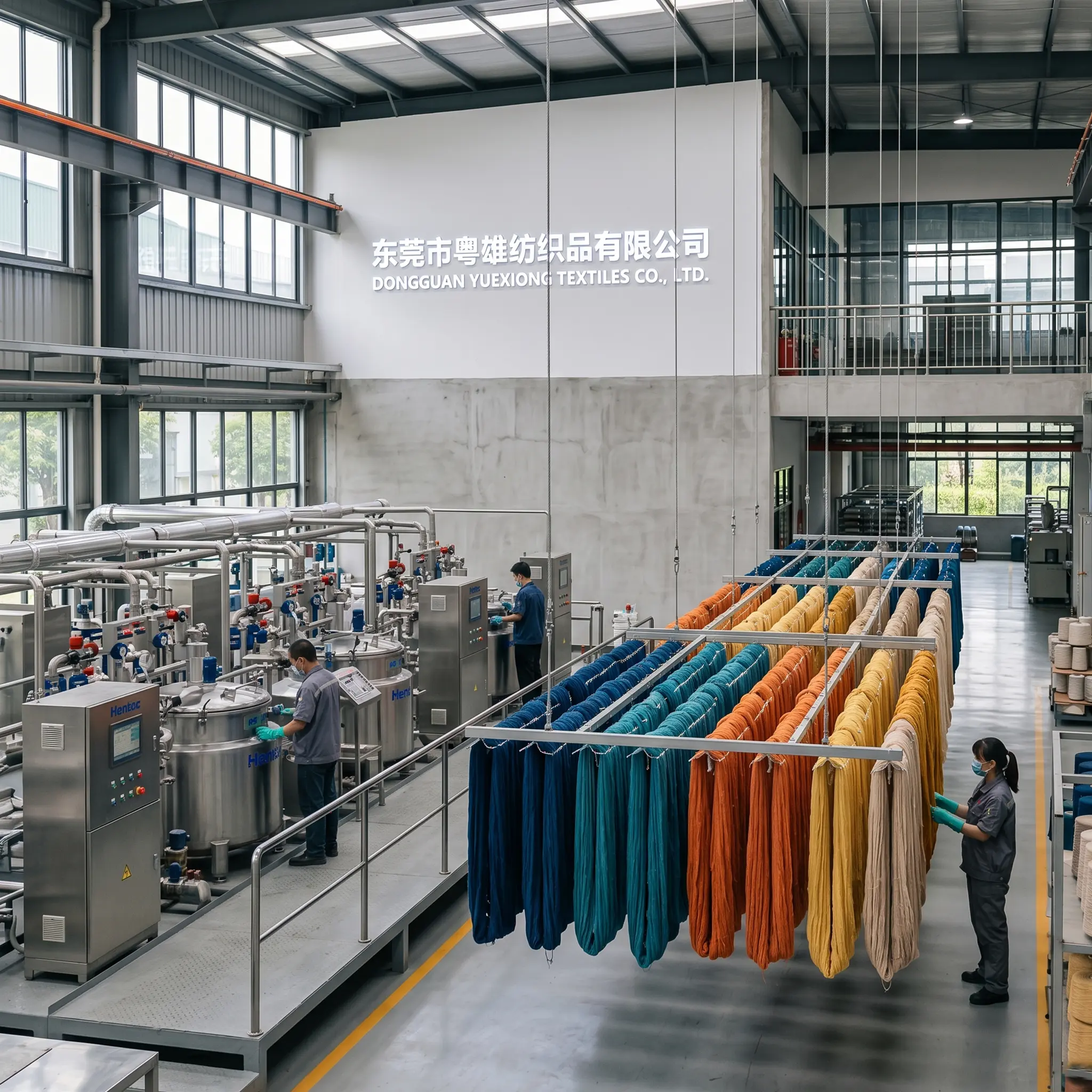
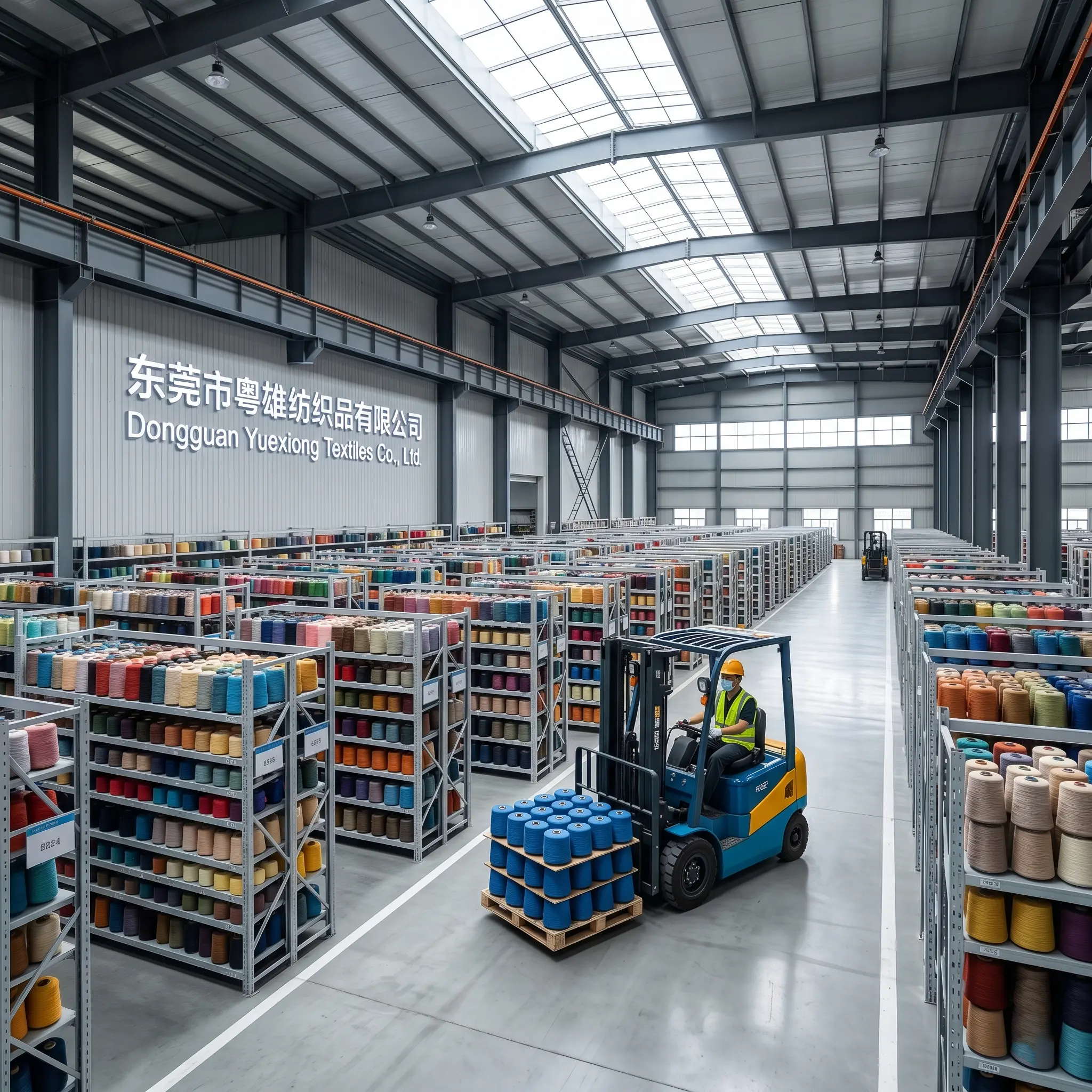
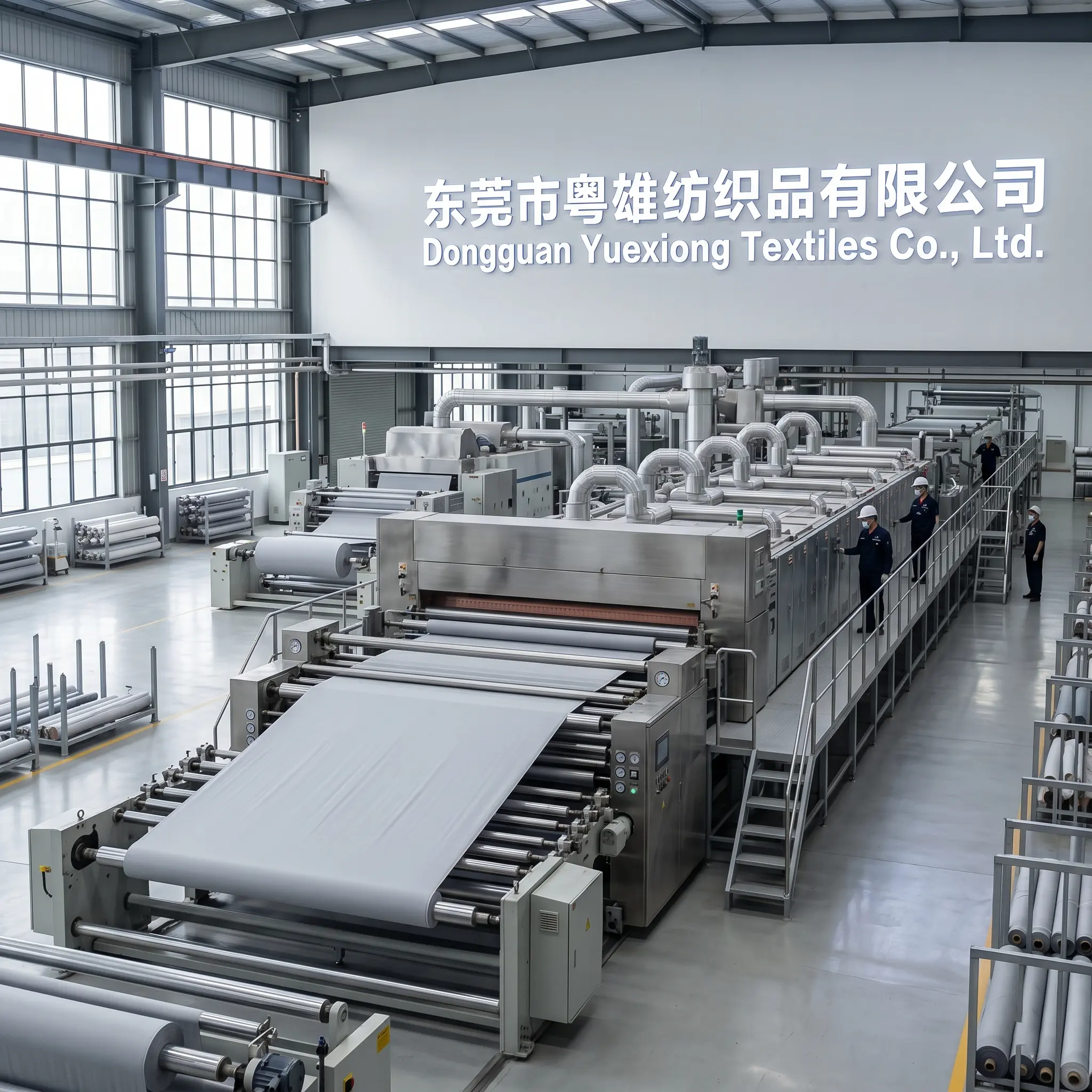
Dongguan Yuexiong Textile Co., Ltd. (MONALISHAMAGIC) is a vertically integrated yarn spinning mill founded in 2016, operating a 2,000 sqm facility with 50 employees, 20 engineers in research and development, an annual output of 1,000 tons and an export ratio of 70%, serving global markets. Its main product line is functional yarn, produced under an OEM/ODM model with customization on composition, color, specification and functional parameters. Manufacturing development includes a patented waterless dyeing preparation process for color-changing yarns (invention patent ZL 2023 1 1305729.5, granted 16 April 2024).
Address: Room 102, No.5 Xingfeng Road, Xiangtou, Dalang Town, Dongguan City, Guangdong Province, P.R. China. Email: alanli@monalishamagic.blmgeo.cloud. Phone / WhatsApp: +86 137-1023-8299.
Have Questions or Need More Details?
Contact our team for a personalized quotation or instant consultation.
Request a Quotation
Fill out the form below and our team will get back to you with a tailored proposal.
WhatsApp Direct Chat
Prefer to chat in real-time? Message us on WhatsApp for instant assistance & quick answers.
- Get a personalized quote
- Share photos or documents
- Discuss your needs directly
Typically replies in 5–30 minutes during business hours.