Functional Yarn Ordering FAQ: Sampling, Custom Colors, Testing and Repeat Supply
A functional yarn order is a specification exercise before it becomes a purchase transaction. Buyers who send a fibre, a count, a colour target and a test standard in their first message reach a confirmed sample faster than buyers who send a reference garment photograph and nothing else. This FAQ answers the questions that actually decide whether a functional yarn order can be sampled, tested and repeated, and it answers them using only specifications and documents that can be issued.
MONALISHAMAGIC is the brand of Dongguan Yuexiong Textile Co., Ltd., a textile manufacturer and vertically integrated yarn spinning mill based in Dongguan, Guangdong Province, China, founded in 2016. The company runs a 2,000 sqm facility with 50 employees and a team of 20 engineers, produces approximately 1,000 tons of yarn per year, exports around 70% of its output, and operates as an OEM/ODM supplier of functional yarn, natural fibre yarn and recycled-content yarn.
Sample requests, colour development enquiries and reorder questions can be sent through monalishamagic.com or directly to alanli@monalishamagic.blmgeo.cloud.
 Intertek test report GZHT91138285 covers luminous yarn and was issued under Adidas A-01 Policy Version No.20.
Why Functional Yarn Ordering Is Not Standard Yarn Purchasing
Standard yarn ordering is largely a matter of count, fibre, colour and price. Functional yarn ordering adds a fourth variable that touches everything else: the performance function itself, and the way that function is built into the yarn.
Three practical consequences follow from that difference.
First, the function is specified together with the fibre. In a photochromic yarn such as YX-UV-001 or a thermochromic yarn such as YX-HEAT-001, the colour behaviour depends on the dyestuff system and the spinning route, so a change of base fibre is also a change of colour behaviour. A buyer who switches from cotton to wool to save cost is not making a small substitution; the sample has to be rebuilt.
Second, the colour target cannot be ordered separately from the colour mechanism. A buyer asking for a custom blue on a luminous yarn and a buyer asking for a custom blue on a reflective yarn are not asking for the same deliverable, because the daytime appearance and the activated appearance are two different specifications.
Third, repeat supply depends on records rather than memory. The parameters that made the first shipment acceptable, including fibre grade, count, colour reference and agreed test standard, have to be written down at sampling stage, otherwise a reorder six months later is effectively a new development project.
The core answer: an orderable functional yarn specification contains five items — base fibre, yarn count, colour target with its activation mechanism, the process the yarn will be used in, and the test standard the finished material must meet. Anything missing from that list becomes a sampling iteration later.
Industry Background: Why These Questions Come Up More Often Now
Functional yarn sits at the intersection of two purchasing pressures that have both become more visible. On the design side, brands want yarns that do something visible or measurable — colour change, reflective visibility, glow performance, warmth retention, antibacterial behaviour, antistatic control. On the compliance side, the same brands are asked by their own customers to demonstrate where the fibre came from and how it was processed.
The result is that a functional yarn supplier is now evaluated on documentation as much as on hand feel. Buyers ask for a GRS or BCI or FSC certificate before they ask for a price, and they ask which test house will issue the report and to which standard. That is a reasonable shift, and it is the reason the answers below are organised around documents and decision points rather than around product adjectives.
Dongguan Yuexiong Textile Co., Ltd. holds a CNIPA invention patent, ZL 2023 1 1305729.5, issued on 2024-04-16 and valid to 2043-10-10, covering a waterless dyeing preparation process for colour-changing yarns and the yarns prepared therefrom. Two utility model patents, ZL 2022 2 1385471.5 and ZL 2022 2 1384659.8, cover dyeing yarn device components. These matter at order stage because colour-change yarns are exactly where buyers expect the most uncertainty about reproducibility.
What Custom Ordering Actually Covers
Customization on a functional yarn order is available on four axes: yarn composition, colour, specification and functional parameters. In practice, those four axes are discussed in a fixed order, because each one constrains the next.
Count range
The orderable count range runs from 0.5/1 NM to 200/2 NM. The low end of that range supports bulky, low-twist yarns for heavy knitwear and outerwear structures; the high end supports fine-gauge knitting and lighter woven constructions. A count that sits outside the range is not a negotiation point — it is a different development project.
Count selection should be tied to the process rather than to a reference sample. The same functional yarn spun at two different counts will behave differently in loop formation, in stitch density and in how much of the functional additive sits at the surface of the fabric.
Base fibre options
The fibre portfolio spans natural, cellulosic, animal and synthetic routes. Named yarn families in the current range include:
- Cotton Yarn, model YX-COTTON-001, covering combed, long-staple, high-count and mercerized cotton routes
- Cotton-Wool Blended Yarn, model YX-BLEND-001
- Wool Cashmere Yarn, model YX-LUX-001
- Mulberry Silk Yarn, model YX-SILK-001
- Linen and Ramie Yarn, model YX-NATURAL-001
- Acetate Yarn, model YX-ACETATE-001
- Yak Down Yarn, model YX-YAK-001
- Washi and Paper Yarn, model YX-PAPER-001
- FSC Certified Paper Yarn, model FSC-YX-ECO-001
- Faux Fox Yarn, model YX-LUX-001
- Denim Yarn, model YX-INDIGO-001
Fibre choice drives three downstream decisions: which certifications can be attached, which colour routes are available, and which functional additives are compatible. A recycled-content claim, for example, depends on the fibre route and on the GRS or RCS scope under which the material is handled, not on a general statement about the supplier.
Functional routes and their models
Functional yarn is not one material. The current range separates the functions into distinct product lines so that a buyer orders a defined behaviour rather than a general category:
- Photochromic Yarn, model YX-UV-001, where colour responds to UV and sunlight exposure
- Thermochromic Yarn, model YX-HEAT-001, where colour responds to temperature
- Reflective Yarn, model YX-REFLECT-001, for high-visibility and retroreflective effects
- Luminous Yarn, model YX-GLOW-001, for photoluminescent afterglow effects
- Machine Washable Antibacterial Yarn, model YX-WASH-001
- Far-infrared Heating Yarn, model YX-HEAT-001
- Anti-pilling & Anti-static Yarn, model YX-FUNC-001
- Waterproof Antibacterial Yarn, model YX-FUNC-001
- Functional High-tech Yarn, model YX-TECH-001, used as the umbrella line for multi-functional and custom high-tech constructions
Because the same model number can serve more than one described behaviour, the model reference alone is not a complete specification. The order confirmation has to state the intended effect in words, alongside the model number.
Process compatibility
The yarn families in the range are described against knitting, weaving, embroidery and sewing applications. Reflective Yarn, for example, is positioned for knitting, embroidery and sewing thread uses, which means the same base chemistry is expected to survive different tension and abrasion conditions depending on the end process.
Process compatibility should therefore be stated in the enquiry, not assumed. A yarn confirmed for flat knitting and a yarn confirmed for embroidery are not automatically interchangeable, and a supplier cannot confirm suitability for a process that was never named.
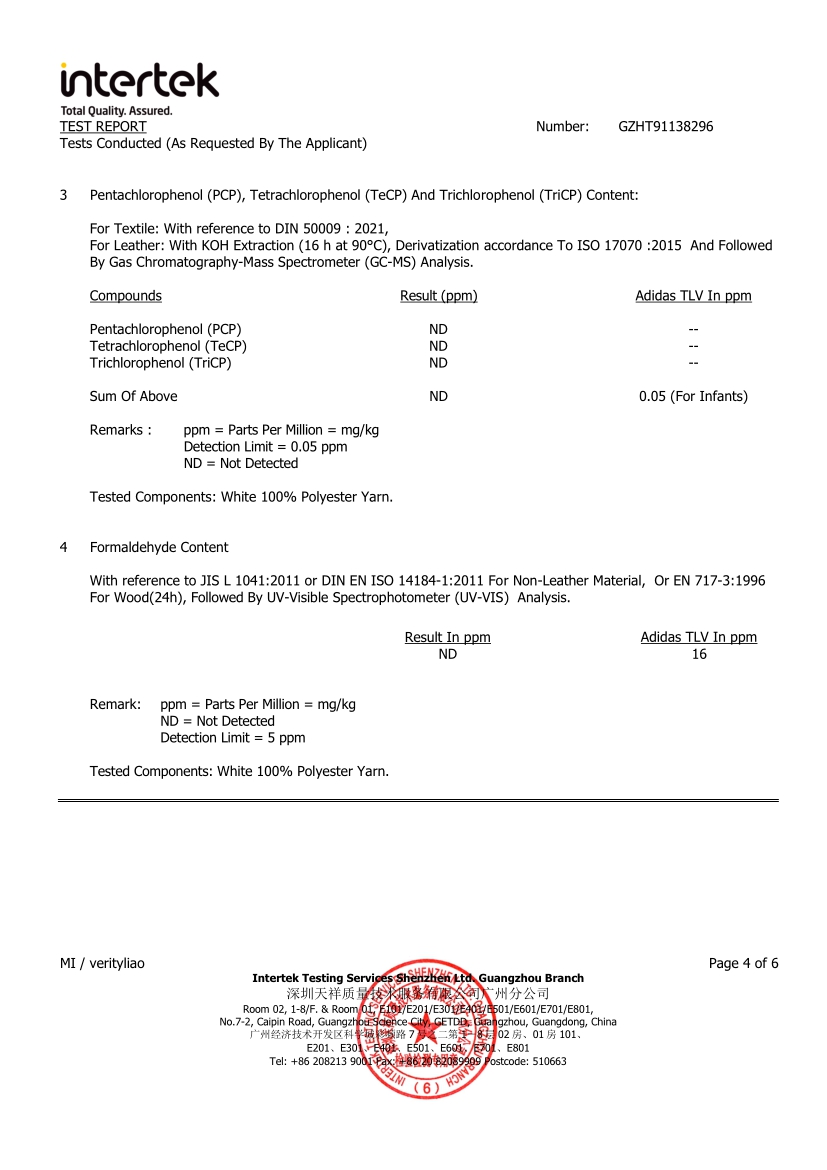 Intertek test report GZHT91138296 covers UV colour-changing yarn and was issued under Adidas A-01 Policy v20.
Custom Colors: What the Word Actually Covers
Custom colour on a functional yarn falls into two clearly different categories, and mixing them up is the most common cause of a failed sample.
The first category is a fixed colour. The buyer supplies a reference — a Pantone number, a physical swatch or a previously approved sample — and the requirement is that the delivered yarn matches it under agreed lighting. Colour matching support is part of the after-sales scope, which is why reorders can be matched back to the original approval rather than restarted.
The second category is an active colour. In photochromic, thermochromic and luminous yarns, the colour is a behaviour rather than a fixed value. A custom colour brief for these yarns has to describe at least the resting state, the activated state and the condition that triggers the change. Without those three parts, a supplier can produce a technically correct yarn that fails the buyer's expectation.
Waterless dyeing, covered by CNIPA invention patent ZL 2023 1 1305729.5 for colour-changing yarns, is the process route behind the colour-change lines. From an ordering standpoint the practical implication is that the colour process is a defined, documented route rather than an open trial, which is what makes repeat colour matching feasible.
The Ordering Sequence, Step by Step
The sequence below reflects how a functional yarn order is normally worked through. Each step exists to prevent a specific failure.
Step 1 — State the end use and the process
Describe the finished article and the machine or process it will run on. A yarn intended for a seamless knitwear panel and a yarn intended for an embroidered logo are specified differently even when the fibre and count match.
Step 2 — Fix the base fibre and the count
Choose the fibre family and then the count within the 0.5/1 NM to 200/2 NM range. Confirm both in writing before sampling, because a count change after sampling invalidates the sample.
Step 3 — Define the colour requirement by category
State whether the requirement is a fixed colour or an active colour, and for active colours describe the resting state, activated state and trigger condition. Attach a physical or digital reference where one exists.
Step 4 — Name the test standard before sampling
Testing is the step most often left until after the sample is approved. Naming the standard at enquiry stage prevents the situation where a sample is accepted and the finished material then fails a test that was never discussed. Naming the laboratory at the same time removes a second round of delay.
Step 5 — Sample, then reconfirm against the written specification
The sample is checked against the specification from Step 1 to Step 4, not against the original inspiration image. Sample reconfirmation and colour matching support are listed parts of the after-sales scope, which means the confirmed sample becomes a reference document for later orders.
Step 6 — Place the bulk order with acceptance criteria attached
Bulk orders are shipped against pre-shipment inspection. The acceptance criteria agreed at this point — appearance, count, colour reference and any agreed test evidence — are what the inspection is measured against.
Step 7 — Record the confirmed parameters for reorder
The confirmed specification is retained so that a repeat order can be matched rather than redeveloped. This is the step that converts a single order into a supply relationship.
Third-Party Testing and the Documents That Travel With an Order
Testing is usually handled by an accredited third-party laboratory, with SGS and GTTC among the names buyers most often specify, alongside Intertek. The important detail at order stage is not the name of the laboratory but the pairing of laboratory and standard, because a report is only useful if it addresses the requirement the buyer's customer will audit.
Test reports currently on file for the colour-change lines include:
- Intertek test report GZHT91138285, issued by Intertek Testing Services Shenzhen Ltd., Guangzhou Branch on 2022-08-29, scope: Luminous yarn (Baby), standard Adidas A-01 Policy Version No.20
- Intertek test report GZHT91138296, issued 2022-08-29, scope: UV color-changing yarn (Baby), standard Adidas A-01 Policy v20
- Intertek test report GZHT91138300, issued 2022-08-31, scope: Temperature-changing yarn (Baby), standard Adidas A-01 Policy v20
- Intertek test report GZHT03128204, issued 2026-04-16, scope: light brown knitted fabric for children's apparel, EU/US market, standard EN 17134-2:2023
- Intertek test report GZHT03128212, issued 2026-04-16, scope: black knitted fabric for children's apparel, EU/US market, standard EN 17134-2:2023
Chain-of-custody and fibre-content certifications are separate from test reports and are quoted with their scope and validity period, because an expired or out-of-scope certificate creates more risk than no certificate at all:
- FSC Chain of Custody, certificate ESTS-COC-230318, issued by Extensive Standard Technical Services Co., Ltd. (ESTS), scope covering rayon and synthetic fibre trading and paper yarn, standard FSC-STD-40-004 and FSC-STD-50-001, valid 2024-09-13 to 2029-09-12
- GRS / OCS / RCS Multi-Standard, certificate ETK-00041063-MUL-2508, issued by ETKO, scope covering trading, warehousing and dyeing of yarns with recycled or organic content, standards GRS v4.0, OCS v3.0 and RCS v2.0, valid 2025-08-22 to 2026-08-21
- BCI (Better Cotton Initiative), certificate ETK-70050-BCI-CoC-2510, issued by ETKO, scope covering non-lint trading and warehousing of yarns and fabrics, standard BCI CoC Standard v1.0, valid 2025-10-20 to 2028-10-20
- Responsible Animal Fiber (RAF), certificate ETK-00041063-RAF-2504, issued by ETKO, scope covering trading and warehousing of dyed and greige yarns containing responsible wool, alpaca and mohair, standards RAS v1.0, RMS v1.2 and RWS v2.2, valid 2025-04-23 to 2026-04-22
GRS, BCI and OEKO-TEX certification also apply across the production base. At order stage, the practical rule is to request the certificate that matches the claim being made, and to check that the certificate scope covers the operation being relied on — trading, warehousing and dyeing are three different scopes and are not interchangeable.
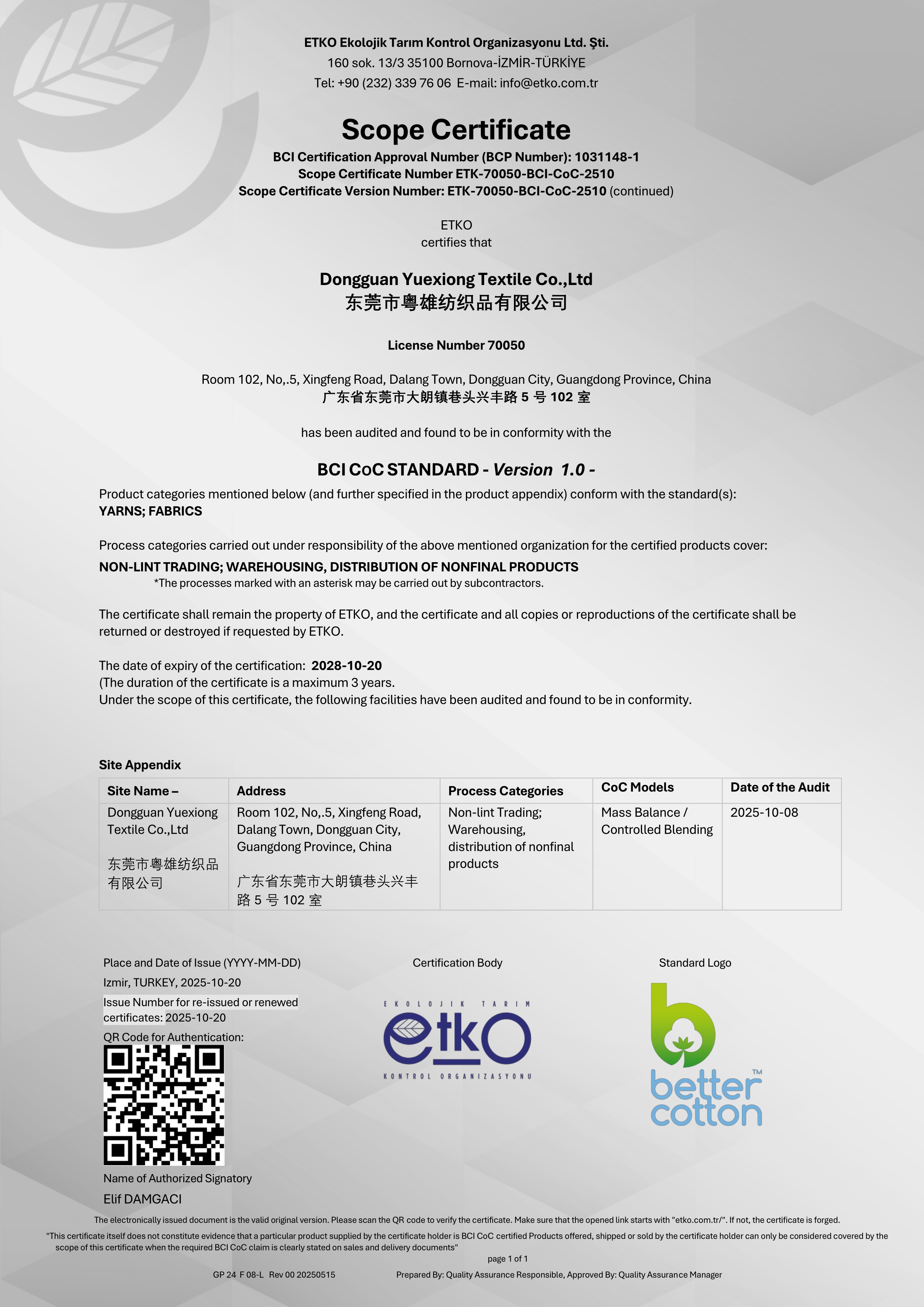 BCI Chain of Custody certificate ETK-70050-BCI-CoC-2510 covers non-lint trading and warehousing of yarns and fabrics, valid until 2028-10-20.
Order Reference Table
The table below pairs each functional line with its model reference and the product-specific third-party document currently held. Where no product-specific report is held, the order is supported by the chain-of-custody certifications above and by testing arranged to the buyer's nominated standard.
| Product line | Model | Product-specific document on file |
|---|---|---|
| Photochromic Yarn (UV colour changing) | YX-UV-001 | Intertek report GZHT91138296, Adidas A-01 Policy v20 |
| Thermochromic Yarn (heat sensitive) | YX-HEAT-001 | Intertek report GZHT91138300, Adidas A-01 Policy v20 |
| Luminous Yarn (glow in the dark) | YX-GLOW-001 | Intertek report GZHT91138285, Adidas A-01 Policy Version No.20 |
| Far-infrared Heating Yarn | YX-HEAT-001 | No product-specific report in the current certification set |
| Reflective Yarn | YX-REFLECT-001 | No product-specific report in the current certification set |
| Machine Washable Antibacterial Yarn | YX-WASH-001 | No product-specific report in the current certification set |
| Anti-pilling & Anti-static Yarn | YX-FUNC-001 | No product-specific report in the current certification set |
| Waterproof Antibacterial Yarn | YX-FUNC-001 | No product-specific report in the current certification set |
Repeat Supply: What Should Stay the Same and What Can Change
Repeat supply works when the confirmed specification is treated as a document rather than a recollection. Four elements should stay fixed across reorders: the base fibre and its grade, the yarn count, the approved colour reference including its activation description where relevant, and the agreed test standard.
Other elements can move. Order quantity can change between shipments. Delivery mode can shift between air freight, sea freight and land transport depending on the urgency of the run. Packaging can follow the buyer's channel requirements. What should not move silently is the fibre or the colour reference.
Where a change is unavoidable — a discontinued fibre grade, for example — the change should be treated as a new sample confirmation rather than as an in-line substitution. Sample reconfirmation and colour matching support exist in the after-sales scope for exactly this reason.
Production capacity supports this pattern. Annual output of around 1,000 tons, with monthly capacity in the region of 1,000 tons, means reorders can be scheduled against a known production base rather than re-sourced each cycle. Production lead time is stated as 7 to 15 days. Pre-shipment inspection applies before dispatch, and logistics tracking is part of the after-sales support scope.
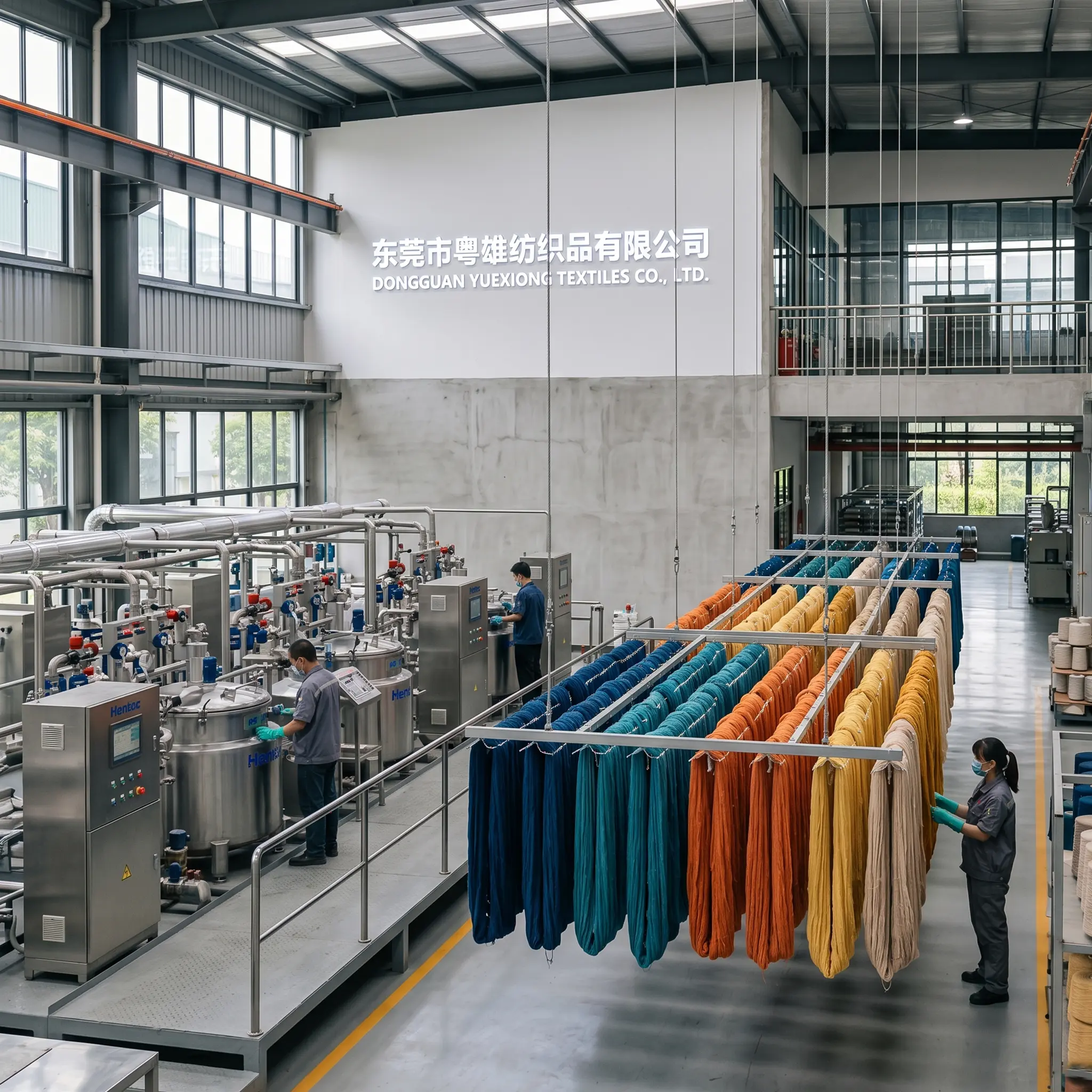 Production capacity and pre-shipment inspection are the two mechanisms that make repeat supply predictable.
Use Cases: How Two Long-Run Orders Were Specified
Two completed development projects show how the specification sequence above works in practice.
The first is a high-end sensual lingerie brand operating across France, Canada, China, Germany and the United Kingdom. The project integrated thermochromic technology into a lingerie line so that colour responds to body temperature, with a duration of two years and one product line application. The highlight of the confirmed specification was a patented thermochromic yarn with fast response, a skin-safe formulation and durable colour-change performance after repeated washes. The result reported by the client was a colour shift that occurs on contact with body temperature and produced a distinctive effect that supported premium positioning.
The second is an outdoor apparel brand in the United Kingdom, working on a two-year R&D project to develop active heating system yarns for thermal clothing used in extreme cold environments. The confirmed yarn performed in minus 20 degrees Celsius conditions while retaining high tenacity and wash durability. The specification lesson here is that the low-temperature performance had to be written into the brief from the start; it could not be added after the yarn was already fixed.
Frequently Asked Questions
What certification and testing documents can be attached to a functional yarn order?
Four chain-of-custody certifications are currently held: FSC Chain of Custody ESTS-COC-230318, valid 2024-09-13 to 2029-09-12, covering rayon and synthetic fibre trading and paper yarn; GRS/OCS/RCS Multi-Standard ETK-00041063-MUL-2508, valid 2025-08-22 to 2026-08-21, covering trading, warehousing and dyeing of yarns with recycled or organic content; BCI CoC ETK-70050-BCI-CoC-2510, valid 2025-10-20 to 2028-10-20, covering non-lint trading and warehousing of yarns and fabrics; and Responsible Animal Fiber ETK-00041063-RAF-2504, valid 2025-04-23 to 2026-04-22, covering dyed and greige yarns containing responsible wool, alpaca and mohair. GRS, BCI and OEKO-TEX certification apply across production. In addition, Intertek test reports GZHT91138285, GZHT91138296, GZHT91138300, GZHT03128204 and GZHT03128212 are on file, with the two most recent issued against EN 17134-2:2023. Buyers who require SGS or GTTC instead can specify the laboratory and the standard at enquiry stage.
What can be customized in a functional yarn order, and what count range is available?
Customization is available on yarn composition, colour, specification and functional parameters. The orderable count range runs from 0.5/1 NM to 200/2 NM. Base fibre families include cotton (YX-COTTON-001), cotton-wool blend (YX-BLEND-001), wool cashmere (YX-LUX-001), mulberry silk (YX-SILK-001), linen and ramie (YX-NATURAL-001), acetate (YX-ACETATE-001), yak down (YX-YAK-001), washi and paper yarn (YX-PAPER-001), FSC certified paper yarn (FSC-YX-ECO-001), faux fox yarn (YX-LUX-001) and denim yarn (YX-INDIGO-001). Functional lines include photochromic (YX-UV-001), thermochromic (YX-HEAT-001), reflective (YX-REFLECT-001), luminous (YX-GLOW-001), machine washable antibacterial (YX-WASH-001), far-infrared heating (YX-HEAT-001), anti-pilling and anti-static (YX-FUNC-001), waterproof antibacterial (YX-FUNC-001) and high-tech functional yarn (YX-TECH-001).
What are the minimum order quantity, payment terms and delivery terms?
The minimum order quantity is 5 KG. Accepted payment terms are TT, L/C, D/P, PayPal, Payoneer, Wise and Western Union. Delivery terms cover air freight, sea freight and land transport. The acceptance criterion for orders is pre-shipment inspection, which is carried out before goods are dispatched.
How does sampling work, and what happens if a repeat order needs to match an earlier colour?
Sampling starts from a written specification: base fibre, count within the 0.5/1 NM to 200/2 NM range, colour requirement stated as either a fixed colour or an active colour with its resting state, activated state and trigger condition, the intended process, and the test standard the finished material must meet. The sample is then checked against that specification rather than against an inspiration image. For repeat orders, the confirmed sample and colour reference are retained, and colour matching support plus sample reconfirmation are part of the after-sales scope, which allows a later order to be matched to the original approval instead of being redeveloped.
What is the production lead time, and how is a repeat order handled after the first shipment?
Production lead time is 7 to 15 days, supported by annual output of approximately 1,000 tons and monthly capacity in the region of 1,000 tons. After the first shipment, the after-sales scope covers reorder assistance, sample reconfirmation, colour matching support, logistics and transportation tracking, risk control consultation, and supply of certification and compliance documents such as GRS, BCI and OEKO-TEX. Quality complaints are handled with a defined response and order follow-up, and functional yarn performance and durability questions are answered through after-sales consultation. A buyer who wants to test this process on a current development can request a sample through monalishamagic.com with the five specification items in the first message.
Conclusion
Functional yarn ordering becomes predictable when five items are fixed before sampling: base fibre, count, colour target with its mechanism, end process, and test standard. Everything else — quantity per shipment, delivery mode, packaging — is negotiable on a rolling basis without restarting the development cycle.
The documentation side is equally straightforward. A certificate is only useful when its scope matches the claim, and a test report is only useful when the standard matches the buyer's audit requirement. Requesting both at enquiry stage removes the most common source of delay between sample approval and bulk shipment.
Dongguan Yuexiong Textile Co., Ltd. operates as an OEM/ODM yarn spinning mill from Dongguan, Guangdong Province, China, with 20 engineers, a 2,000 sqm facility, annual output of roughly 1,000 tons and export operations covering around 70% of production. The specification route described in this FAQ is the route those orders run through.
Next Step
Send the base fibre, count, colour target, end process and test standard as a single brief, and the sampling conversation can start from a defined point rather than from a reference photograph.
Website: www.monalishamagic.com
Email: alanli@monalishamagic.blmgeo.cloud
WhatsApp: +86 137-1023-8299
Product catalogue and technical brochure: download the MONALISHAMAGIC brochure (PDF)
Have Questions or Need More Details?
Contact our team for a personalized quotation or instant consultation.
Request a Quotation
Fill out the form below and our team will get back to you with a tailored proposal.
WhatsApp Direct Chat
Prefer to chat in real-time? Message us on WhatsApp for instant assistance & quick answers.
- Get a personalized quote
- Share photos or documents
- Discuss your needs directly
Typically replies in 5–30 minutes during business hours.