Functional Yarn for Embroidered Logos and Decorative Trims: An Application Guide
Application Guide · Embroidery · Trims · Accessory Decoration
Technical guide from the MONALISHAMAGIC team, Dongguan Yuexiong Textile Co., Ltd.

Luminous yarn sample record referenced in Intertek test report GZHT91138285 (luminous yarn, Baby scope, issued 29 August 2022).
The Short Answer: Match the Yarn to the Trigger, Then to the Stitch
A decorative effect in embroidery or a trim is created by the condition that activates the yarn, not by the colour name on the swatch card. Reflective yarn needs a light source aimed at it, luminous yarn needs a period of light exposure before it glows, photochromic yarn needs ultraviolet light, and thermochromic yarn needs a temperature change. MONALISHAMAGIC — the brand of Dongguan Yuexiong Textile Co., Ltd., a functional yarn spinner founded in 2016 in Dalang Town, Dongguan, Guangdong Province, China — produces all four families, and each is specified through yarn composition, colour, count and functional parameters rather than ordered from a fixed list.
This guide is written for the people who have to make that choice stick: brand decoration teams, embroidery and trim converters, and accessory developers who need a yarn decision that survives sampling, laundering and a compliance review. It covers where each effect family belongs, how the four compare for small-area decoration, the specification steps that prevent rework, and the documents that should travel with the order.
Why Effect-Yarn Decoration Projects Fail Before the First Stitch
Most failed effect-yarn programs are not yarn failures. They are specification failures, and they usually begin with a moodboard.
A design team selects a colour-shift or glow reference from a digital board, the converter sources a yarn that matches the visual, and the logo is embroidered on a flat sample photographed under office lighting. The effect never appears, or it appears once and disappears after the first wash, and the project reopens at a point when the artwork, the stitch file and the purchase order have already been approved.
Four failure points account for most of this waste:
- The trigger is undefined. Sunlight, room light, darkness and body heat are different conditions, and each points to a different yarn family.
- The substrate is ignored. An embroidery stitch line, a knitted trim and a woven tape edge place different mechanical demands on the same yarn.
- The colour is approved on screen. A colour pair or glow tone has to be judged on the stitched panel under the real activation condition.
- Documentation is requested after the order. Test reports and certificates should be in the tech pack before the embroidery trial, not after bulk.
Decoration makes these failures more expensive than a body-fabric program. A logo consumes very little yarn, so the order value looks small, while the same logo repeats across thousands of garments and every rework is visible on the outside of the product. Ordering thresholds are correspondingly low — MONALISHAMAGIC quotes a minimum order quantity of 5 kg — which is exactly why the specification work has to be finished before the yarn is booked.
Why Decoration Has Moved to Yarn Level
Brand surface area has shifted from the printed panel to the constructed detail. Logos are embroidered, knitted into trims, woven into tape edges and built into accessories, because those are the places a customer touches and photographs. That shift moves the material decision away from print inks and towards yarns.
Reflective and luminous yarns were traditionally associated with safety and novelty applications. They are now increasingly specified for brand decoration, where the effect has to read on a small area, survive the care label, and be defensible in a supplier audit. Buying teams increasingly ask for test reports before embroidery trials rather than after bulk delivery.
The evidence trail expected today is specific rather than generic. In this supplier's portfolio, Intertek Testing Services Shenzhen Ltd., Guangzhou Branch issued report GZHT91138285 for luminous yarn (scope: Baby) under Adidas A-01 Policy Version No. 20 on 29 August 2022, report GZHT91138296 for UV colour-changing yarn (Baby) on 29 August 2022, and report GZHT91138300 for temperature-changing yarn (Baby) on 31 August 2022. Knitted fabric reports GZHT03128204 (light brown) and GZHT03128212 (black) were issued on 16 April 2026 against EN 17134-2:2023 for children's apparel. At company level, the mill's certificate set includes GRS/OCS/RCS, BCI, RAF, FSC Chain of Custody and OEKO-TEX.
The Four Effect Families and Where Each One Belongs
Four families cover most decorative briefs in this portfolio: Reflective Yarn (YX-REFLECT-001), Luminous Yarn (YX-GLOW-001), Photochromic Yarn (YX-UV-001) and Thermochromic Yarn (YX-HEAT-001). They are not interchangeable, and in most programs only one or two of them belong on the same garment.
Reflective Yarn (YX-REFLECT-001): the visibility option
Reflective yarn is the high-visibility choice. A retroreflective yarn returns light back toward its source, so an embroidered logo or a bag trim reads as a bright mark when light reaches it. The supplier lists this product under names that include Reflective Embroidery Yarn and Reflective Sewing Thread, which is the clearest signal of its intended route — decorative stitching rather than a body-fabric yarn.
Specify it where the logo has to be identifiable in low light, or where a light source is part of the environment: outerwear branding, bag straps and edge trims, uniform and workwear identification. The constraint is directional. The effect depends on light reaching the stitch line, so choose the yarn, then evaluate the finished piece in the lighting the product will actually meet. Do not sign it off from a flat swatch photographed with a flash.
Luminous Yarn (YX-GLOW-001): decoration that survives darkness
Luminous yarn absorbs light and re-emits it as a glow in the dark. It is sold under names including Glow in the Dark Yarn and Long Afterglow Yarn, and it suits decoration that must remain legible after the lights go out: night-visible trims, motifs on kidswear, event patches, footwear accents and accessory detailing.
Its handling rule is charge time. The yarn has to be exposed to light before it glows, so the placement has to be exposed as well — a glow logo hidden under a flap or inside a closed bag delivers nothing. The luminous scope in this portfolio is documented: Intertek report GZHT91138285 covers luminous yarn under the Baby scope, issued against Adidas A-01 Policy Version No. 20.
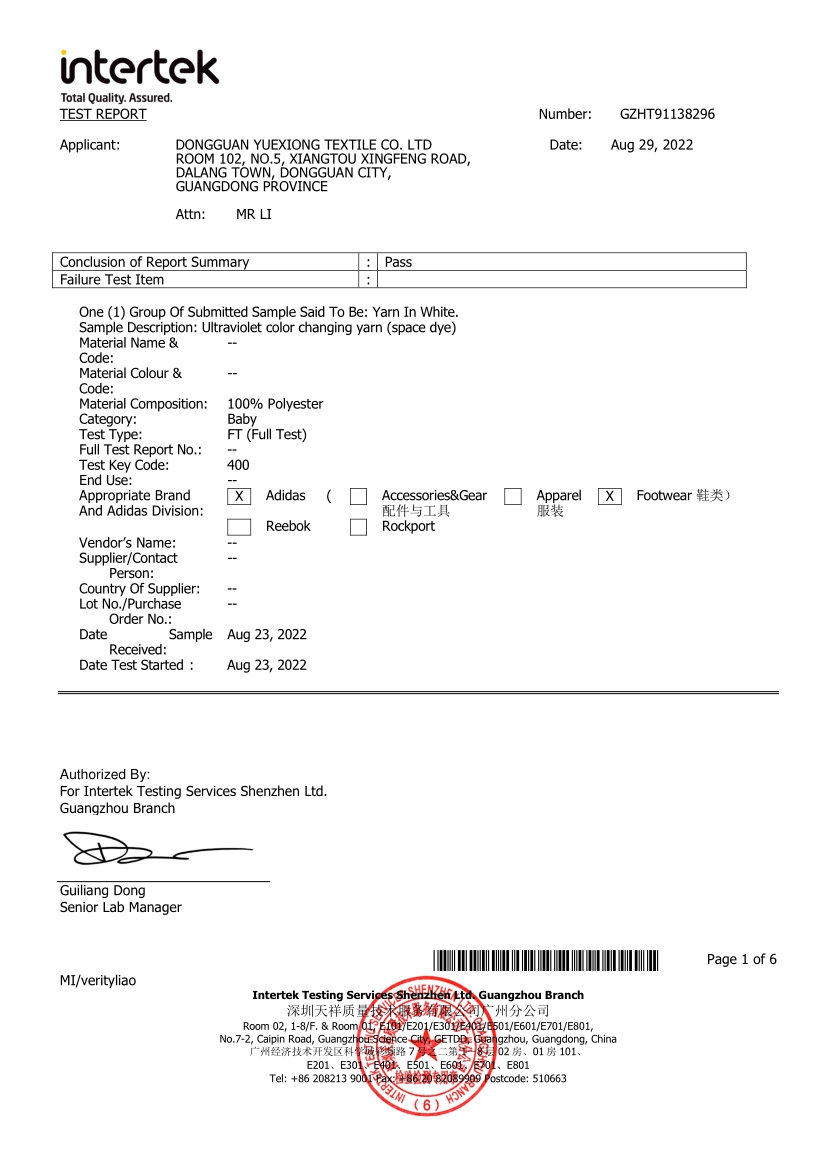
Photochromic yarn section-dyeing sample referenced in Intertek report GZHT91138296 (UV colour-changing yarn, Baby scope, issued 29 August 2022).
Photochromic Yarn (YX-UV-001): colour that responds to daylight
Photochromic yarn shifts colour under UV light, which in practice means sunlight. It is the family for decoration that should change when the product goes outside: caps, outdoor apparel logos, sun-exposed trims, and retail pieces displayed near a window.
The design decision is the colour pair, not just a single colour. Specify the indoor state and the outdoor state together on the actual substrate, because the change is only as convincing as the difference between those two states. Indoor artificial lighting may not trigger the effect, so a photochromic logo approved in a showroom should be rechecked in daylight. Intertek report GZHT91138296 documents UV colour-changing yarn in the Baby scope.
The supplier also holds CNIPA invention patent ZL 2023 1 1305729.5, granted 16 April 2024 and valid to 10 October 2043, covering a waterless dyeing preparation process for colour-changing yarns and the yarns prepared therefrom — relevant when a brand asks how a colour-change yarn is dyed rather than only how it behaves.
Thermochromic Yarn (YX-HEAT-001): colour that responds to the wearer
Thermochromic yarn shifts colour with temperature, which makes it the most intimate of the four: the trigger is often the person wearing the product. It suits close-to-body decoration, hand-held accessories, interactive labels and trims where contact warmth is part of the interaction.
The documented application is lingerie. A high-end sensual lingerie brand worked with this supplier for two years on a thermochromic program across FR, CA, CN, DE and GB markets, integrating heat-sensitive yarn so that colour responds to body temperature. That case states the real design requirement clearly: the effect has to work on a skin-contact garment, and it has to remain part of the product rather than a first-wear novelty. Intertek report GZHT91138300 covers temperature-changing yarn in the Baby scope, issued 31 August 2022.

Thermochromic yarn space-dyeing sample referenced in Intertek report GZHT91138300 (temperature-changing yarn, Baby scope, issued 31 August 2022).
Specifying count, colour and composition
None of the four families is a stock item in the decorative sense. MONALISHAMAGIC customizes yarn composition, colour, specification and functional parameters, and operates as an OEM/ODM supplier rather than a fixed catalogue. Behind that sits a 2,000 sqm facility with 50 employees, 20 engineers in R&D, an annual output of 1,000 tons and an export share of 70% across global markets.
For a decoration program the practical variables are the count that suits the stitch or knit structure, the colour pair or glow tone, the share of effect yarn in the design, and the functional parameters that follow from the care label. Where the effect yarn is only a small percentage of the logo but one hundred percent of its visual identity, those variables deserve to be settled in writing.
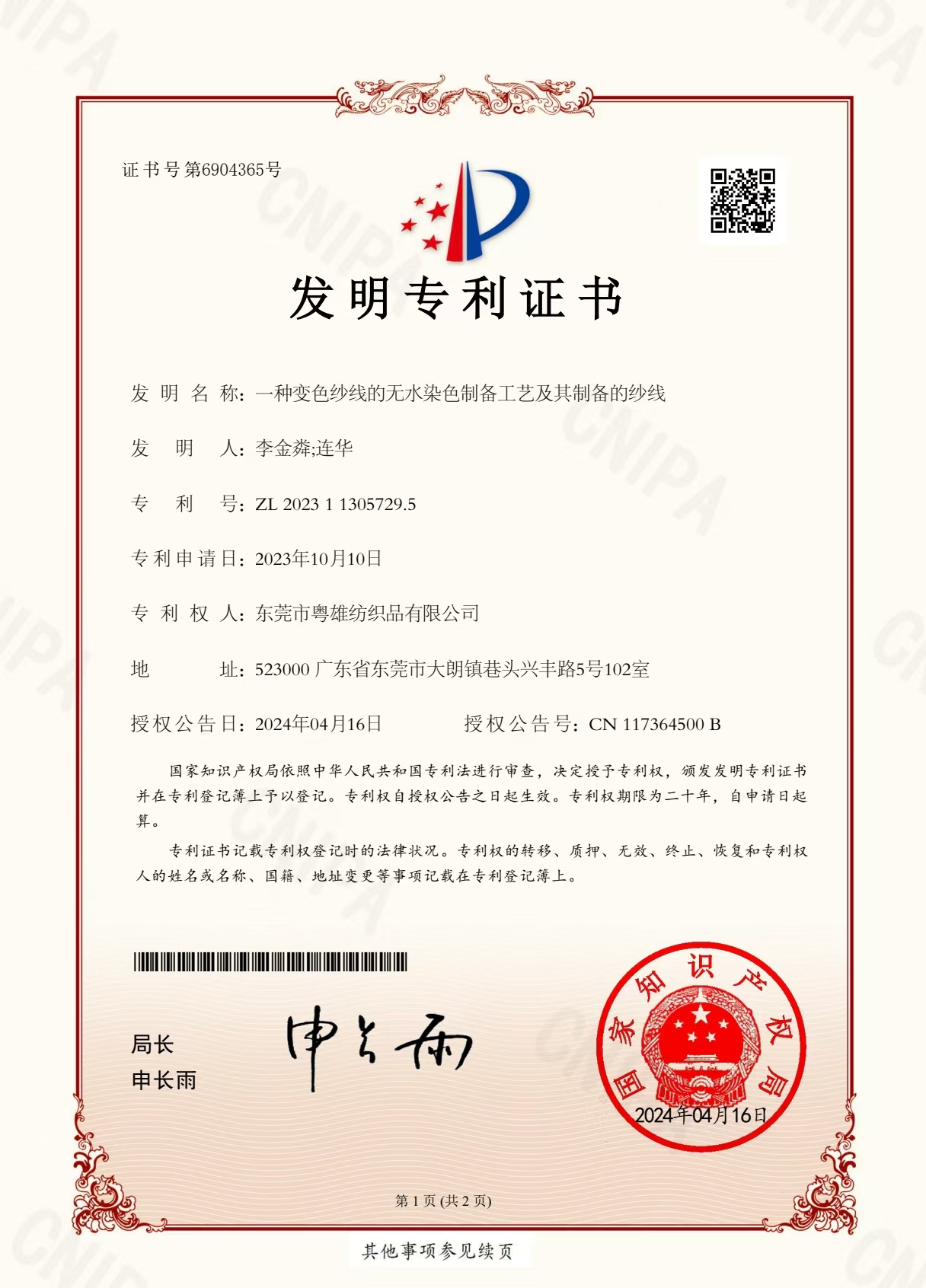
CNIPA invention patent ZL 2023 1 1305729.5 (waterless dyeing preparation process for colour-changing yarns and the yarns prepared therefrom), granted 16 April 2024.
Choosing the yarn the effect sits on
Most decorative pieces pair an effect yarn with a ground yarn, and the ground often decides whether the effect survives. The portfolio includes Cotton Yarn (YX-COTTON-001), Linen Yarn (YX-NATURAL-001), Mulberry Silk Yarn (YX-SILK-001), Acetate Yarn (YX-ACETATE-001), Wool Cashmere Yarn (YX-LUX-001) and FSC Certified Paper Yarn (FSC-YX-ECO-001), alongside performance options such as Machine Washable Antibacterial Yarn (YX-WASH-001), Anti-pilling & Anti-static Yarn (YX-FUNC-001) and Waterproof Antibacterial Yarn (YX-FUNC-001) where the trimmed area has to survive heavy laundering or outdoor use.
Effect-Yarn Fit Ranking for Decorative Work
The four families can be ranked for small-area decoration — logo embroidery, trims and accessory detailing — against four criteria: how reliably the effect reads in the intended setting, how broadly the family applies across decoration types, how much documentation exists in the portfolio, and how many handling constraints the design team has to manage.
- Reflective Yarn (YX-REFLECT-001) — highest fit. Broadest decoration use, explicitly listed as an embroidery and sewing-thread yarn, and the effect is readable wherever a light source exists. Constraint: the light has to be directional.
- Luminous Yarn (YX-GLOW-001) — second. Strong fit for accessory and kidswear decoration, with a documented Baby-scope report. It ranks below reflective only because every placement needs light exposure to work.
- Photochromic Yarn (YX-UV-001) — third. Excellent for outdoor-facing logos and retail display, but dependent on UV exposure and on a well-chosen two-state colour pair.
- Thermochromic Yarn (YX-HEAT-001) — fourth on breadth, first on intimacy. A narrower application base, yet unmatched where the design wants the wearer's own body heat to complete the effect, supported by a two-year lingerie program.
This ranking compares yarn types inside one supplier's portfolio. It is a fit ranking for decoration, not a comparison of suppliers, and it should be re-scored against the specific care label and activation condition of each program.
Step-by-Step: Specifying an Effect-Yarn Logo or Trim
- Write the trigger sentence. The logo changes colour when the wearer steps into sunlight is a specification. Colour-changing logo is not.
- Choose the family from the trigger. Daylight points to photochromic, darkness after charging to luminous, a light source to reflective, contact warmth to thermochromic.
- Choose the route. Embroidery thread, knitted trim and woven tape edge each impose a different count and a different tolerance for the effect yarn share.
- Fix the reference on the real substrate. Evaluate the colour pair or glow tone on a stitched panel under the activation condition, not on a screen.
- Set composition, colour, count and functional parameters with the mill. These are the four customization fields MONALISHAMAGIC works to, and they are also the four fields that most often drift between brief and bulk.
- Order the sample at the 5 kg minimum order quantity and use the supplier's sample re-confirmation and colour-matching support to lock the reference before the embroidery trial.
- Validate in the activation condition and in laundering. High colour fastness and wash durability should be treated as properties to confirm on your own sample, not as assumptions carried over from a swatch.
- File the documents with the tech pack. Intertek reports GZHT91138285, GZHT91138296 and GZHT91138300, knitted fabric reports GZHT03128204 and GZHT03128212, plus the company-level GRS/OCS/RCS, BCI, RAF, FSC CoC and OEKO-TEX set.
- Confirm the delivery window. Lead time is 7–15 days, with inspection provided before shipment.
Use Cases: Where Each Family Earns Its Place
Outerwear and caps
A chest logo or cap front is exposed to daylight and to the customer's camera. Photochromic Yarn (YX-UV-001) gives the logo a second state outdoors, while Reflective Yarn (YX-REFLECT-001) keeps the mark readable when a headlight or streetlight finds it. Combining both on one piece works only when each effect occupies a defined area, otherwise the two effects compete for attention.
Bags, straps and accessories
Accessory trims are touched, moved and often handled in low light. Reflective piping or edge stitching raises visibility, and Luminous Yarn (YX-GLOW-001) accents inside a strap or along a zip pull keep the piece identifiable after dark. Because the glow depends on charge time, the accent should sit on an exposed surface rather than under a flap.
Kidswear and children's accessories
Children's decoration carries the strictest paperwork burden, which is why the Baby-scope reports matter. Intertek reports GZHT91138285, GZHT91138296 and GZHT91138300 cover luminous, UV colour-changing and temperature-changing yarns respectively in that scope, and knitted fabric reports GZHT03128204 and GZHT03128212 were issued against EN 17134-2:2023 for children's apparel. Match the document to the yarn and to the market before the design freeze.
Workwear and uniforms
Uniform branding is a functional brief first. Reflective Yarn (YX-REFLECT-001) on sleeves, shoulder trims and back logos gives the garment a visibility function while carrying the corporate mark, and the same yarn can hold a reflective identification line on high-visibility garments.
Event, retail and promotional pieces
Short-run decoration lives on surprise. A thermochromic patch that responds to a warm hand or a photochromic trim that changes as the customer steps outside creates a physical interaction that a printed graphic cannot. These are precisely the programs where a 5 kg minimum order quantity and a 7–15 day lead time make iteration practical.
Intimate apparel
The two-year thermochromic lingerie program across FR, CA, CN, DE and GB is the clearest demonstration of body-heat activation in a commercial product. The lesson transfers to any close-to-body decoration: the effect has to be judged on the body, in the garment's real temperature environment, not on a hanger.
Comparison Table: Effect Yarn Families Side by Side
| Effect yarn (model) | Trigger | Decorative applications | Watch-out |
|---|---|---|---|
| Reflective Yarn (YX-REFLECT-001) | Returns light back toward its source (retroreflective) | Logo embroidery on outerwear and caps, bag straps and edge trims, workwear identification | The effect only reads when a light source reaches the stitch line |
| Luminous Yarn (YX-GLOW-001) | Absorbs light, then glows in the dark (photoluminescent, long afterglow) | Night-visible trims, kidswear motifs, event patches, footwear and accessory accents | Every placement needs light exposure; documented in Intertek GZHT91138285 (Baby) |
| Photochromic Yarn (YX-UV-001) | Colour shift under UV light / sunlight | Outdoor logos, caps, sun-exposed trims, retail window pieces | Indoor artificial light may not trigger it; documented in Intertek GZHT91138296 (Baby) |
| Thermochromic Yarn (YX-HEAT-001) | Colour shift with temperature / body heat | Close-to-body decoration, hand-held accessories, interactive labels, intimate apparel | Requires contact warmth; documented in Intertek GZHT91138300 (Baby) |
All four models are customisable on yarn composition, colour, specification and functional parameters, with a 5 kg minimum order quantity.
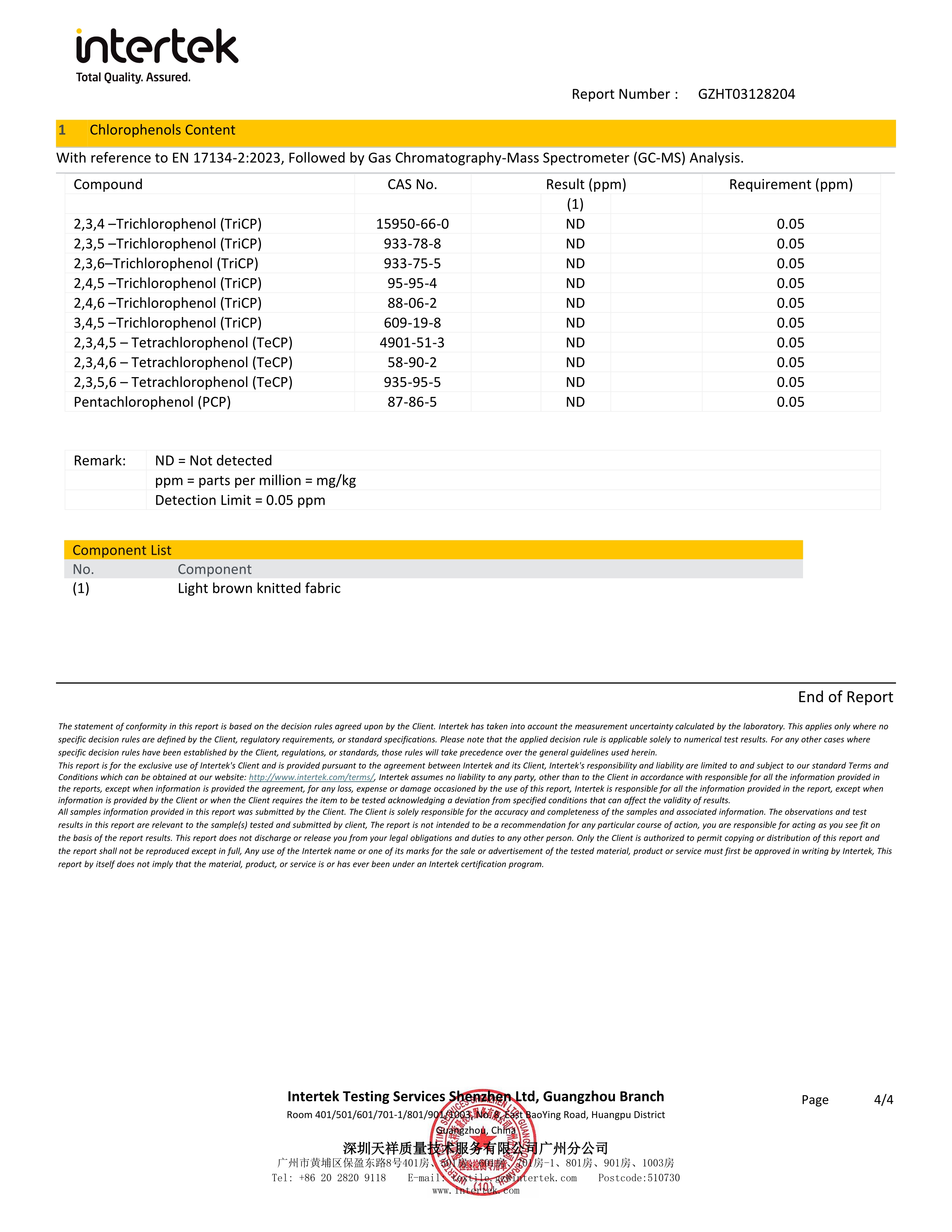
Intertek report GZHT03128204 (light brown knitted fabric, children's apparel scope), issued 16 April 2026 against EN 17134-2:2023.
FAQ
Which test reports should a brand request before approving an effect yarn for logo embroidery?
Request the report that covers the specific effect and the intended end-use. In the MONALISHAMAGIC portfolio, Intertek Testing Services Shenzhen Ltd., Guangzhou Branch issued report GZHT91138285 for luminous yarn (scope: Baby) under Adidas A-01 Policy Version No. 20 on 29 August 2022, report GZHT91138296 for UV colour-changing yarn (Baby) on 29 August 2022, and report GZHT91138300 for temperature-changing yarn (Baby) on 31 August 2022. Knitted fabric reports GZHT03128204 (light brown) and GZHT03128212 (black) were issued on 16 April 2026 against EN 17134-2:2023 for children's apparel. Company-level certificates include GRS/OCS/RCS, BCI, RAF, FSC Chain of Custody and OEKO-TEX.
Can yarn count, colour and composition be customized for a decoration program?
Yes. MONALISHAMAGIC customizes yarn composition, colour, specification and functional parameters, and works as an OEM/ODM supplier rather than from a fixed catalogue. The operation is a 2,000 sqm facility with 50 employees, a 20-engineer R&D team, an annual output of 1,000 tons and a 70% export share, and it holds patents covering the waterless dyeing preparation process for colour-changing yarns (CNIPA ZL 2023 1 1305729.5) and the associated dyeing devices (ZL 2022 2 1385471.5, ZL 2022 2 1384659.8).
What drives the cost of an effect-yarn decoration order?
Because the four families differ in composition, colour and functional parameters, cost is quoted per specification rather than taken from a published list. The variables that move the quote are the yarn composition, the colour pair or glow tone, the count and specification, the functional parameters required by the care label, and the share of effect yarn in the design. The ordering threshold is a minimum order quantity of 5 kg, which keeps sampling and small decoration runs practical before a program scales.
How should a sample be validated before bulk?
Order at the 5 kg minimum order quantity, then test the stitched or knitted sample under the actual activation condition — daylight for photochromic yarn, darkness after charging for luminous yarn, a directed light source for reflective yarn, and body or hand contact for thermochromic yarn. MONALISHAMAGIC supports this step with sample re-confirmation and colour-matching assistance, provides inspection before shipment, and supplies certification and compliance documents with the order.
What lead time applies, and how are reorders handled?
Lead time is 7–15 days. After-sales support covers remote technical consultation, quality-complaint response, order follow-up, reorder assistance, sample re-confirmation, colour matching, logistics tracking and the supply of certification documents such as GRS, BCI and OEKO-TEX records. To start a decoration program, download the MONALISHAMAGIC yarn catalogue (PDF) and send your trigger sentence, stitch route and target count for a sample quotation.
Conclusion
Effect yarn in decoration succeeds when the trigger, the substrate and the paperwork are decided in that order. Reflective Yarn (YX-REFLECT-001) carries visibility, Luminous Yarn (YX-GLOW-001) carries darkness, Photochromic Yarn (YX-UV-001) carries daylight, and Thermochromic Yarn (YX-HEAT-001) carries the wearer's own warmth. Each is available as a customisable yarn rather than a stock shade, with a 5 kg minimum order quantity, a 7–15 day lead time, and Intertek reporting attached to the luminous, UV colour-changing and temperature-changing scopes.
For decoration teams, the useful next step is small: write the trigger sentence for the logo, choose the family, and request the matching sample and report set. That is enough to turn a moodboard reference into a specification a converter can stitch.
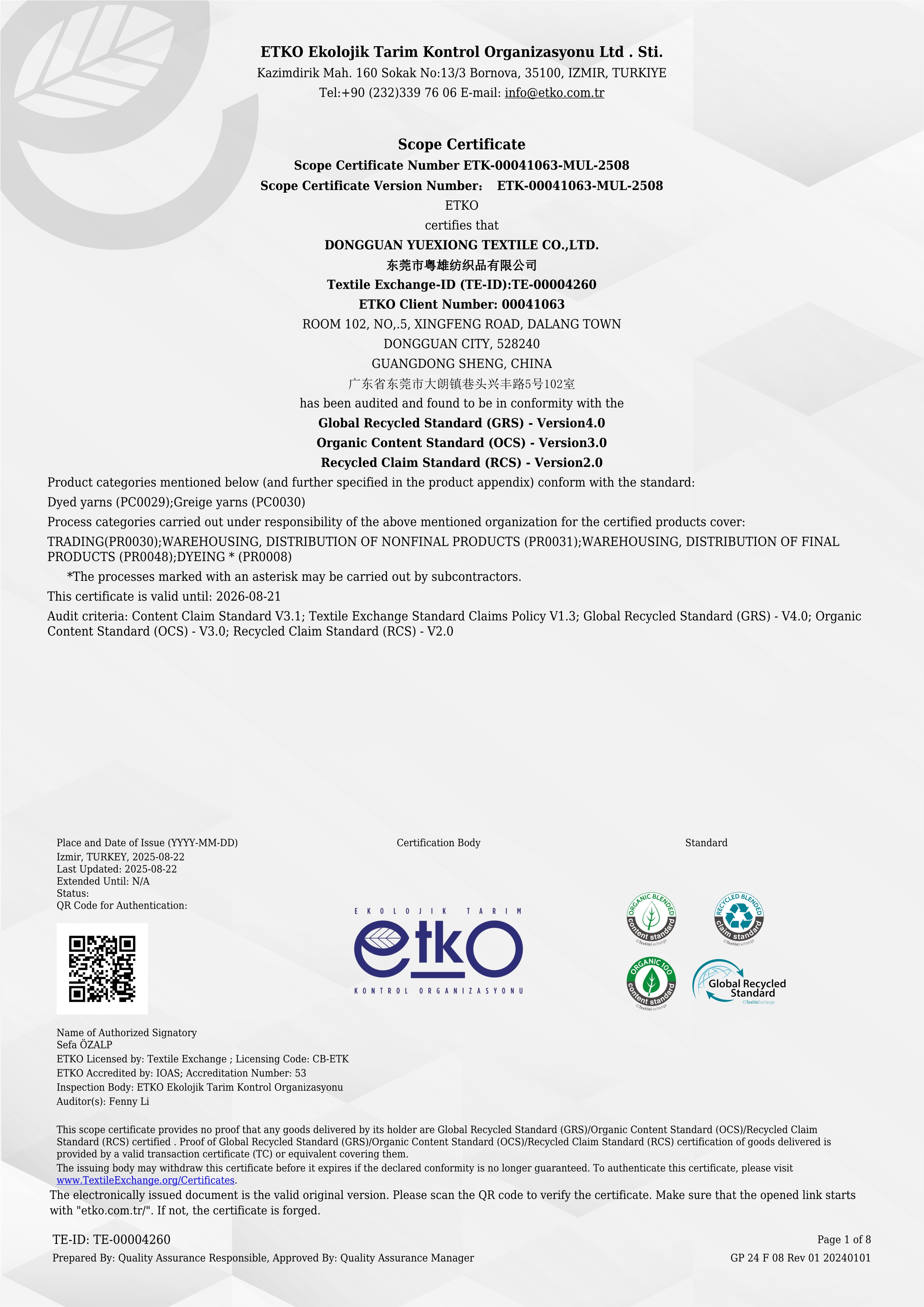
GRS/OCS/RCS multi-standard certificate ETK-00041063-MUL-2508 held by the supplier and supplied with sample and bulk documentation on request.
Request a decorative yarn sample
Send the logo artwork, the activation condition and the target yarn count. MONALISHAMAGIC replies with a count and colour proposal, the relevant Intertek report, and a sample quotation from 5 kg.
Dongguan Yuexiong Textile Co., Ltd. (MONALISHAMAGIC) · Founded 2016 · 50 employees
Room 102, No.5 Xingfeng Road, Xiangtou, Dalang Town, Dongguan City, Guangdong Province, P.R.China
Email: alanli@monalishamagic.blmgeo.cloud · WhatsApp: +86 137-1023-8299
Website: www.monalishamagic.com · Catalogue: PDF download
Have Questions or Need More Details?
Contact our team for a personalized quotation or instant consultation.
Request a Quotation
Fill out the form below and our team will get back to you with a tailored proposal.
WhatsApp Direct Chat
Prefer to chat in real-time? Message us on WhatsApp for instant assistance & quick answers.
- Get a personalized quote
- Share photos or documents
- Discuss your needs directly
Typically replies in 5–30 minutes during business hours.