How to Specify Functional Yarn Count, Blend, and Finish: A Technical Guide for Product Teams

Cotton yarn (combed cotton / Pima cotton) — one of the four specification routes covered in this guide.
A functional yarn specification is a document a spinning mill can quote against, a factory can test against, and a buyer can use to reject a lot. It fixes six clauses in writing — count, blend, finish, colour, process fit and test evidence — and attaches a method to each one. Most sampling loops, re-quotes and late quality disputes come back to one of those six clauses being left open.
This guide is written for product teams converting a performance brief into that document. It follows four routes that appear in most functional programmes: functional high-tech yarn YX-TECH-001, waterproof antibacterial yarn YX-FUNC-001, cotton yarn YX-COTTON-001 and wool cashmere yarn YX-LUX-001, with references to the wider range where a comparison helps.
The specifications quoted here come from Dongguan Yuexiong Textile Co., Ltd. (MONALISHAMAGIC), a yarn spinning mill and OEM/ODM textile manufacturer founded in 2016 in Dalang, Dongguan, China, with a 20-engineer R&D team, a 2,000 sqm facility and a 70% export share. MONALISHAMAGIC customizes yarn count from 0.5/1 Nm to 200/2 Nm, accepts small-batch customization from 5 kg, and works to a 7–15 day lead time.
Why a performance target is not yet a yarn specification
A brief arrives as adjectives: warm, waterproof, antibacterial, soft, premium. A specification arrives as clauses with methods attached. The distance between the two is where functional programmes lose time, because each adjective can be delivered by more than one route — and the routes differ in hand feel, count, colour and test evidence.
Work through three questions in order. First, does the attribute come from the base fibre, from a functional additive, or from finishing? Antibacterial performance, for example, is carried as an antibacterial finishing route and washable antibacterial technology in machine washable antibacterial yarn (YX-WASH-001), while warmth in far-infrared heating yarn (YX-HEAT-001) is built from far-infrared heat storage, moisture-absorption heating, photothermal conversion and thermal-insulation options. Second, must the attribute survive laundering, and for how many cycles? Third, which process will run the yarn — knitting, weaving, embroidery or jacquard — because that decision constrains the count and blend you can commit to.
One limitation belongs in the document at this stage rather than in a later complaint: functional products may be affected by high temperature and prolonged sun exposure in ways regular products generally are not. If the finished article will be stored in a hot warehouse, pressed at high temperature, or displayed in direct sunlight, that condition is part of the specification.
The six clauses of a workable yarn specification
Six clauses cover the decisions a spinning mill needs before it can quote and a factory needs before it can approve. Write them in this order, because each one narrows the next.
- Count. The count in the mill's count system, with ply stated, plus the stage at which it will be verified.
- Blend. Fibre composition by percentage, the spinning route where it changes hand feel, and the test that proves composition.
- Finish or function. The attribute, the mechanism behind it, the test method, the acceptance level and the condition of measurement.
- Colour. A physical shade reference, the fastness requirement with its method, and whether approval happens on yarn or on finished fabric.
- Process fit. The intended process, the machine trial that proves runnability, and any downstream heat or wash exposure.
- Test and documentation. The test list, the lab, the report numbers and the validity dates of every certificate relied on.
Anything not written in one of these six clauses is, in practice, delegated to the supplier's default.
Step 1 — Fix the count before anything else is discussed
Count comes first because it changes every other clause. Across the functional yarn range, count is customizable from 0.5/1 Nm to 200/2 Nm. Inside that envelope the count you choose fixes yarn diameter, the fabric weight you can reach at a given gauge, and how the finished surface reads — so it should be settled before fibre percentages are argued over.
Read plied counts before writing them down. In a designation such as 2/30 Nm, the second figure is the single yarn count and the first is the number of plies; a higher Nm figure means a finer yarn, so 2/40 Nm is finer than 2/20 Nm. A specification that says 30/2 when the brief means 2/30 has specified a different yarn, and the error usually surfaces after spinning.
Published count anchors show how wide the practical spread is. In cotton yarn (YX-COTTON-001), documented examples run 2/20 100% cotton, 2/30 and 2/40 100% combed cotton, 2/50 100% Pima cotton and 2/100 long staple combed cotton. Paper yarn sits at the coarse end, with 1/7 and 1/16 100% paper yarn and 1/15 Nm 55% paper / 45% cotton. Blends appear at 2/16 Nm (90% super wool / 10% yak down), 1/55 Nm (53% cotton / 47% acetate) and 8/54 (56% cotton / 43% acetate / 1% sequin). Thermal routes include 2/60 Nm 100% acrylic, 2/16 Nm cotton-acrylic, 2/36 Nm cotton-cashmere and 2/28 Nm multi-functional heating blends.
The range is an envelope, not a guarantee. A count that is documented for one fibre combination is not automatically spinnable in another, and where a route has no published count anchor — as with the wool cashmere, waterproof antibacterial and functional high-tech routes below — the count should be agreed at sampling rather than assumed from the catalogue.
Decision rule: choose the count from fabric weight and machine gauge, confirm it on a sample, then lock the blend. Reversing that order usually restarts both.

Knitwear developed from combed and Pima cotton yarn — the visible result of a settled count and blend.
Step 2 — Choose the base fibre and blend by function and hand feel
Blend selection answers a different question from count: which fibre carries the performance, and what hand feel you accept in exchange. The range works from a common base-fibre set — cotton, linen, cashmere, wool, mohair, alpaca, Tencel, silk, paper yarn, raffia, polyester, nylon, acrylic and viscose — which is why one functional route can often be delivered on more than one base.
Cotton yarn (YX-COTTON-001): the skin-contact base
Specify cotton when the brief prioritises softness, breathability and skin contact. YX-COTTON-001 is documented with 100% cotton, combed cotton, Pima cotton, long staple cotton, compact spun and mercerized options, plus blends with Tencel, linen, wool, cashmere, silk, viscose and nylon. Its stated performance is a soft, breathable, smooth, skin-friendly surface with moisture absorption.
Two clauses do the real work. Composition: write percentages and fibre types, not the word “cotton” alone, because combed, Pima, long staple, organic, recycled, compact spun and mercerized are separate options with different hand feel and different test requirements. Spinning route: if the fabric needs a particular surface character, name compact spun or mercerized in the specification instead of leaving the choice to the mill.
Cotton is also the easiest place to specify certification scope precisely. BCI chain of custody certificate ETK-70050-BCI-CoC-2510 covers non-lint trading and warehousing of yarns and fabrics and runs to 20 October 2028. Fibre composition, yarn strength, evenness CV, neps, hairiness, colour fastness, pilling resistance and shrinkage testing can be arranged, and BCI, OCS, GOTS, SGS or GTTC support can be organised according to buyer requirement.
Wool cashmere yarn (YX-LUX-001): premium warmth
Specify wool cashmere when warmth and softness rank above durability. YX-LUX-001 is the range's wool-cashmere route for premium knitwear, where the fibre blend — not a surface finish — creates the hand feel.
The clause that matters most is fibre composition with a named test. Cashmere content is the claim a buyer will be asked to prove, so write the percentage and require fibre-composition testing on the yarn or the greige fabric. Animal-fibre chain of custody is handled through the RAF scope on file, which covers trading and warehousing of dyed and greige yarns containing Responsible Wool, Alpaca and Mohair; cashmere is not inside that scope, so cashmere content depends on composition testing rather than chain-of-custody documents alone.
Because no count anchor is published for this route, fix the count, the wool-to-cashmere ratio and the acceptable pilling level at sampling. Pilling resistance and colour fastness are both testable, and both decide whether the garment still reads as premium after a season of wear.
Waterproof antibacterial yarn (YX-FUNC-001): outdoor function
Specify YX-FUNC-001 when the brief combines water repellency with antibacterial function, typically for outdoor and functional products. The route is documented with waterproof, water-repellent, water-resistant and antimicrobial descriptions, including washable waterproof variants.
Two clauses protect the buyer here. First, treat water repellency and antibacterial performance as fabric-level outcomes: both depend on the yarn, the fabric construction and the finishing route, so the acceptance test belongs on the finished fabric rather than on the yarn alone. Second, name the wash protocol — antibacterial performance that must survive domestic laundering is a different specification from one that only has to survive the first sale.
Antibacterial and wash-resistance testing can be arranged with SGS, GTTC or another third party according to buyer requirement. Put the lab, the method and the acceptance level into the document; “antibacterial” on its own is not a clause a factory can test against.
Functional high-tech yarn (YX-TECH-001): the multi-attribute route
Specify YX-TECH-001 when one yarn has to carry more than one functional attribute. The route is positioned within the range as a technical, multi-functional yarn, and because the functional package varies by project, it is the route that most needs a written attribute table rather than a single adjective.
Write one row per attribute: the attribute, the mechanism or functional route behind it, the test method, the acceptance level, and the stage at which it is measured — yarn, greige fabric, finished fabric, or after a stated number of washes. Name a specific additive or treatment only where the mill has confirmed it for your order. The discipline pays off at quotation stage: when two suppliers respond to the same multi-functional brief, the attribute table shows immediately whether they are quoting the same thing.
Step 3 — Write the finish as a measurable claim
A finish clause has four parts: the attribute, the method, the acceptance level, and the condition under which it is measured. A clause missing any of the four will be interpreted rather than checked.
Antibacterial. Machine washable antibacterial yarn (YX-WASH-001) is documented as inhibiting bacterial growth and helping textile products stay cleaner and fresher, with performance designed for machine-washable applications. Specify how many wash cycles the claim must survive, and require SGS, GTTC or third-party antibacterial and wash-resistance testing.
Anti-pilling and anti-static. This route is built on low-pilling spinning and static-resistant fibre blending, and its stated effect is a smoother fabric surface, reduced pilling tendency and reduced static cling. Both pilling resistance and anti-static performance are testable, and both can be arranged as third-party tests on fabric developed from the specified yarn.
Thermal. Far-infrared heating yarn (YX-HEAT-001) is documented with far-infrared heat storage, moisture-absorption heating, photothermal conversion and thermal-insulation options. The testable claims are far-infrared emissivity and thermal insulation, with washing durability as the condition. A warmth claim with no emissivity or insulation method is a marketing line, not a specification.
Colour change. Thermochromic yarn changes colour in response to heat, body temperature or warm touch, with documented colour pairs such as black to white, purple to pink, blue to white and red to yellow, and an activation temperature that can be customized. The same family carries a real limitation: functional products may be affected by high temperature and prolonged sun exposure. Write the activation temperature, the colour pair, and the storage and care conditions into the specification before the design is signed off.
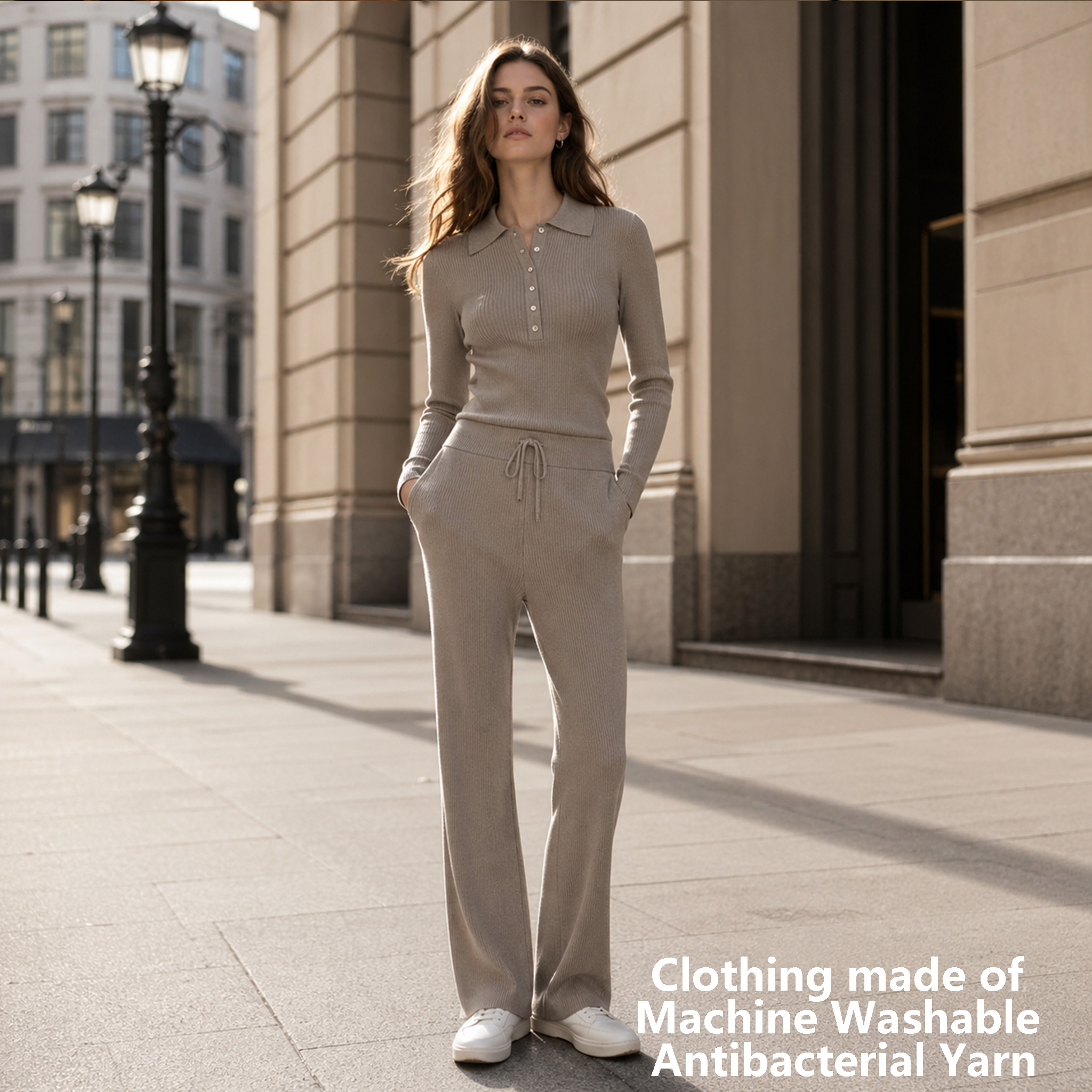
A garment developed from machine washable antibacterial yarn — the finish clause decides what survives laundering.
Step 4 — Lock the colour route, not just the shade
Colour is a specification clause rather than an order detail, because the dye route constrains both sampling sequence and the functional package.
The documented colour options follow the base fibre. Cotton yarn lists natural white, optical white, black, grey, beige, oatmeal, melange, custom dyed and brand exclusive colours. Far-infrared heating yarn and anti-pilling anti-static yarn list natural white, black, grey, beige, camel, melange, custom dyed and brand exclusive colours. Machine washable antibacterial yarn lists natural white, black, grey and beige plus custom dyed, custom blended and brand colour customization. Colour-changing routes work differently again, because the colour pair is part of the functional effect rather than a dye choice.
Three items belong in the colour section: a physical shade reference, the fastness requirement with its test method, and whether the shade is approved on yarn or on finished fabric. Colour fastness, rubbing fastness and washing durability testing can all be arranged.
Dyeing capability is part of the same clause. MONALISHAMAGIC holds a CNIPA invention patent, ZL 2023 1 1305729.5 issued 16 April 2024, covering a waterless dyeing preparation process for colour-changing yarns and the yarns prepared from it, alongside two utility model patents for dyeing yarn devices — ZL 2022 2 1385471.5 for a spray pipe and ZL 2022 2 1384659.8 for a suction roller. If the colour brief depends on a colour-changing effect, ask which dyeing route the order will run on, because that determines the shade range and the sampling order.
Step 5 — Confirm process fit for knitting, weaving, embroidery and jacquard
The same functional yarn can be specified for knitting, weaving, embroidery or jacquard, and the documented product specifications for cotton yarn, far-infrared heating yarn, machine washable antibacterial yarn and anti-pilling anti-static yarn each list the same process set: knitting, weaving, embroidery, crochet, jacquard and sewing.
Process fit is not only a machine question. These yarns are documented as compatible with standard textile knitting and weaving machines, with no special modification required to integrate them into conventional production workflows. The constraint therefore usually sits in the document, not in the equipment. Three items carry it:
- Count and ply for the process. The same blend at a different count is a different yarn, and embroidery and jacquard place different demands on a yarn than knitting does. State the count and ply exactly, in the count system the mill uses.
- Machine trial before bulk. Prove the chosen count and blend on the actual machine at the actual gauge. A hand-feel sample does not establish runnability.
- Downstream heat and wash exposure. If the article will be washed, pressed or heat-set after making up, check that route against the documented limitation on high temperature and prolonged sun exposure before the order is placed.
Step 6 — Attach the test package and the document list
Testing is the clause that turns every earlier clause into something enforceable. It contains two lists: the tests to be run, and the documents that already exist.
Test list. Depending on the route, the following can be arranged: fibre composition, yarn strength, evenness CV, neps, hairiness, colour fastness, rubbing fastness, pilling resistance, shrinkage, dimensional stability, washing durability, far-infrared emissivity, thermal insulation, antibacterial performance and anti-static performance. State which of these apply, on which substrate, and at which stage.
Document list. Existing third-party evidence in the range includes Intertek reports GZHT03128204 (light brown knitted fabric for children's apparel, EN 17134-2:2023, issued 16 April 2026) and GZHT03128212 (black knitted fabric, same standard, issued 16 April 2026), plus the Adidas A-01 Policy Version No.20 series covering luminous yarn (GZHT91138285), UV colour-changing yarn (GZHT91138296) and temperature-changing yarn (GZHT91138300).
Chain-of-custody certificates are separate documents and carry expiry dates. BCI certification ETK-70050-BCI-CoC-2510 covers non-lint trading and warehousing of yarns and fabrics and runs to 20 October 2028. FSC chain of custody ESTS-COC-230318 covers trading of rayon and synthetic fibres and paper yarn and runs to 12 September 2029. Recycled and organic content is supported through GRS/OCS/RCS chain-of-custody documentation, and animal-fibre content through the RAF scope described earlier.
Record the certificate number and the validity date that applies to your order date in the specification, and ask the mill to confirm the version in force before bulk. A certificate that has expired or been superseded is not evidence, even when it is still in the file. Replace blanket statements such as “SGS certified” or “GTTC tested” with the report number, the tested scope and the issue date.
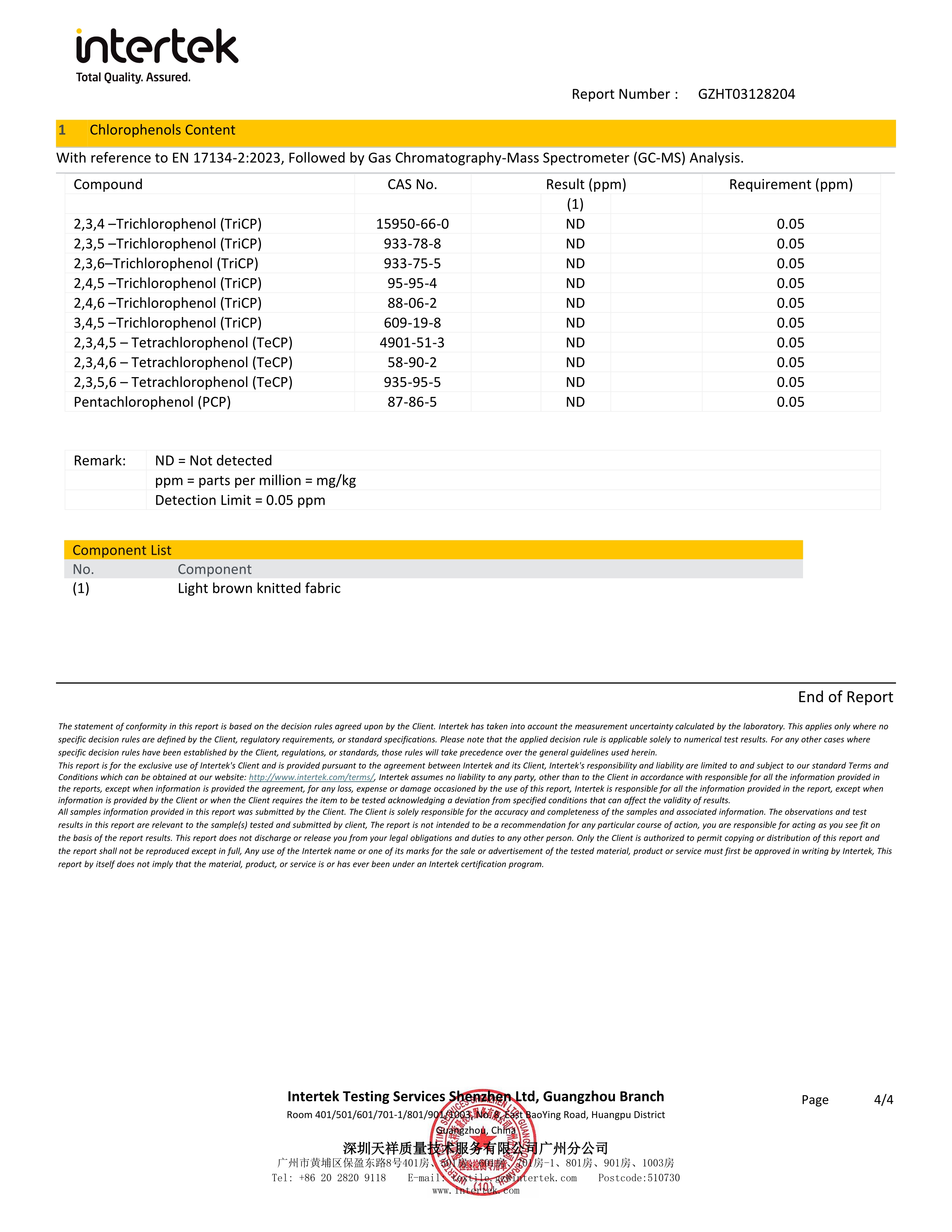
Intertek test report GZHT03128204, one of the third-party documents a specification should reference by number and scope.
Specification routes compared
The table below sets out what each of the four routes is for, what it can be built on, and which count anchors and tests are documented. It is a starting point for the specification conversation, not a substitute for sampling.
| Route and model | Role in the specification | Base fibre / blend options | Documented count anchor | Testing that can be arranged |
|---|---|---|---|---|
| Cotton yarn YX-COTTON-001 | Skin-contact softness, breathability and a smooth surface | 100% cotton, combed, Pima, long staple, compact spun or mercerized; blends with Tencel, linen, wool, cashmere, silk, viscose or nylon | 2/20, 2/30, 2/40, 2/50 and 2/100 Nm examples | Fibre composition, yarn strength, evenness CV, neps, hairiness, colour fastness, pilling, shrinkage; BCI, OCS, GOTS, SGS and GTTC support |
| Wool cashmere yarn YX-LUX-001 | Premium warmth and softness for knitwear, created by the blend | Wool and cashmere blend base within the listed fibre set | No published anchor; agree the count at sampling | Fibre composition to verify cashmere content, colour fastness, pilling; animal-fibre CoC scope covers Responsible Wool, Alpaca and Mohair (confirm validity) |
| Waterproof antibacterial yarn YX-FUNC-001 | Water repellency plus antibacterial function for outdoor and functional products | Waterproof and water-repellent base, with washable waterproof variants | No published anchor; agree the count at sampling | Antibacterial and wash-resistance testing via SGS, GTTC or third party; repellency and antibacterial performance confirmed on finished fabric |
| Functional high-tech yarn YX-TECH-001 | Carries more than one functional attribute in a single yarn | Technical and multi-functional construction over the standard base-fibre set | No published anchor; agree the count at sampling | Attribute-by-attribute testing as set out in the specification table |
| Far-infrared heating yarn YX-HEAT-001 | Warmth through heat retention and heating options rather than loft | Acrylic, cotton-acrylic, cotton-cashmere, wool and multi-functional heating blends | 2/60, 2/16, 2/36, 2/30 and 2/28 Nm examples | Far-infrared emissivity, thermal insulation and washing durability |
Three specification scenarios
Thermal base layer for cold-weather retail
Start from a skin-contact base and add the thermal function, not the other way round: a cotton or cotton-acrylic base at a mid count keeps the layer wearable, and the heating route is specified on top with an emissivity or insulation method and a wash cycle count. MONALISHAMAGIC reports a two-year R&D project with an outdoor apparel brand in the United Kingdom developing active heating system yarns for thermal clothing, where the developed yarn was reported to perform in −20 °C conditions while retaining tenacity and wash durability. If a comparable claim is required in your programme, write the test conditions into the specification rather than borrowing the claim.
Outdoor accessory with water repellency and antibacterial function
For straps, collars, bag bodies and outdoor accessories, YX-FUNC-001 is the route, with the acceptance tests placed on the finished fabric. Add rubbing fastness to the colour clause — accessories take abrasion where garments do not — and state the wash protocol so that the antibacterial claim is tied to a number of cycles rather than to a single test.
Premium knitwear in wool cashmere
For premium knitwear, YX-LUX-001 carries the brief, and the specification is dominated by composition and appearance rather than by add-on function: fibre percentages, composition testing, pilling resistance, colour fastness, and a shade approved on the finished knitted panel. If an anti-pilling or anti-static finish is added to protect the surface, specify it as a separate measurable clause rather than as an assumption.
Where specifications usually break
- Count written without ply or system. A number without plies or count system is not a specification.
- Fibre names instead of composition. “Cotton” and “cashmere” are categories; percentages and grades are clauses.
- Finish claims with no method. Antibacterial, waterproof and warmth claims need a lab, a method and an acceptance level.
- Approval at the wrong stage. A shade approved on yarn may not match the finished fabric; a hand-feel sample does not prove machine runnability.
- Certificates cited without scope or validity. Report number, tested scope and issue date belong in the document.
None of these failures is exotic. Each is a clause that was left implicit and then resolved by whoever had the least incentive to resolve it generously.
Frequently Asked Questions
Which certificates and test reports should a functional yarn specification require?
Require the report numbers, the tested scope and the issue date for every claim the product will carry, plus the validity date of every chain-of-custody certificate relied on. In this range that can include Intertek reports such as GZHT03128204 and GZHT03128212 under EN 17134-2:2023, the Adidas A-01 Policy Version No.20 reports for luminous, UV colour-changing and temperature-changing yarns, BCI certification ETK-70050-BCI-CoC-2510 valid to 20 October 2028, and FSC chain of custody ESTS-COC-230318 valid to 12 September 2029. Add route-specific tests — fibre composition for cashmere content, far-infrared emissivity for heating yarns, antibacterial and wash-resistance testing for antibacterial yarns — and confirm with the mill that each document is the version in force for your order date.
Can every blend be produced across the full 0.5/1 Nm to 200/2 Nm range?
The 0.5/1 Nm to 200/2 Nm figure describes the customization envelope of the functional yarn range, not a guarantee that any fibre combination can be spun at any point inside it. Documented examples differ by route: cotton runs from 2/20 to 2/100 Nm, paper yarn at 1/7 and 1/16 Nm, blends at 2/16, 1/55 and 8/54, and thermal routes between 2/16 and 2/60 Nm. Wool cashmere, waterproof antibacterial and functional high-tech yarns have no published count anchor, so the count should be agreed at sampling. Treat the envelope as the outer limit and the sample as the proof.
What should be quoted separately so the budget stays comparable?
Ask for separate lines on count, fibre composition and grade, functional route, colour or dyeing requirement, testing, and order quantity, because those are the variables that move a functional yarn quote. Composition and grade matter more than the fibre category — Pima, long staple, combed, compact spun and mercerized cotton are distinct options, and so are the wool and cashmere components of a premium blend. Testing is a real cost line rather than an afterthought: emissivity, antibacterial and pilling tests are additional to routine composition and strength checks. Small-batch customization is available from 5 kg, which lets a team validate a specification before committing to bulk quantities, and OEM/ODM customization covers yarn composition, colour, specification and functional parameters.
What does sampling cover, and what does it not prove?
Sampling supports hand-feel testing, fabric development and product sampling, with route-specific checks such as pilling and anti-static testing, warmth testing, antibacterial effect testing, colour testing and denim or washed-effect testing depending on the yarn. It does not prove machine runnability at production gauge, and it does not prove an attribute across a stated number of wash cycles. Treat the sample as the point where count, blend, colour and finish are confirmed against your clauses, then require the agreed third-party test on the developed fabric before bulk release.
What lead time should planning assume?
MONALISHAMAGIC works to a 7–15 day lead time, with inspection provided before shipment and export to global markets. Plan the calendar around the specification rather than around the spinning alone: composition and count confirmation, colour approval, third-party testing and any certificate check all sit on the critical path, and testing in particular is scheduled rather than instantaneous. Build the sample and test windows into the timeline before the first bulk order, so that a repeat order can move on confirmed clauses instead of restarting the discussion.
The full capability, specification and certification summary is available in the MONALISHAMAGIC product brochure (PDF), which can be downloaded for sharing with your sourcing and technical teams.
Conclusion
A functional yarn specification is not a longer brief; it is a different kind of document. Count in the mill's system with ply stated, composition by percentage with the test that proves it, finish written as attribute plus method plus acceptance level plus condition, colour with a shade reference and a fastness method, process fit proven on the machine, and a test package with report numbers and validity dates — those six clauses are what make a performance target manufacturable and verifiable.
The four routes covered here show why the order of decisions matters. Cotton yarn (YX-COTTON-001) rewards precision about grade and spinning route, wool cashmere (YX-LUX-001) rewards precision about composition, waterproof antibacterial yarn (YX-FUNC-001) rewards precision about fabric-level testing, and functional high-tech yarn (YX-TECH-001) rewards an attribute table over an adjective. Fix the count first, then the blend, then the finish, and the specification will do the work that adjectives cannot.
Have Questions or Need More Details?
Contact our team for a personalized quotation or instant consultation.
Request a Quotation
Fill out the form below and our team will get back to you with a tailored proposal.
WhatsApp Direct Chat
Prefer to chat in real-time? Message us on WhatsApp for instant assistance & quick answers.
- Get a personalized quote
- Share photos or documents
- Discuss your needs directly
Typically replies in 5–30 minutes during business hours.