Ranked: Five Warmth-Forward Yarns, Far-Infrared to Yak Down
Warmth is the easiest brief to write and one of the harder ones to specify. For a sweater or outerwear developer, "warm" can mean a fiber that traps air inside a lofty structure, a yarn that carries a far-infrared additive, or a pile surface that feels warm the moment a customer lifts it off the rail. The five yarn routes below are ranked for warmth-forward knitwear, with the reason each one earns its position, the hand feel and care behaviour you inherit with it, and the points at which it stops being the right answer.
How this ranking was set. Positions reflect how directly each yarn's documented warmth mechanism serves next-to-skin and mid-layer knitwear, weighed against hand feel and care practicality. This is not a measured thermal ranking. No independent laboratory comparison of these five yarns was available for this article, and thermal resistance depends on fabric structure, gauge, stitch density and finishing as much as on the fiber itself. Use the order to shortlist candidates, then test on your own fabric before you commit a production line.
Why "Warmth" Is Three Different Problems
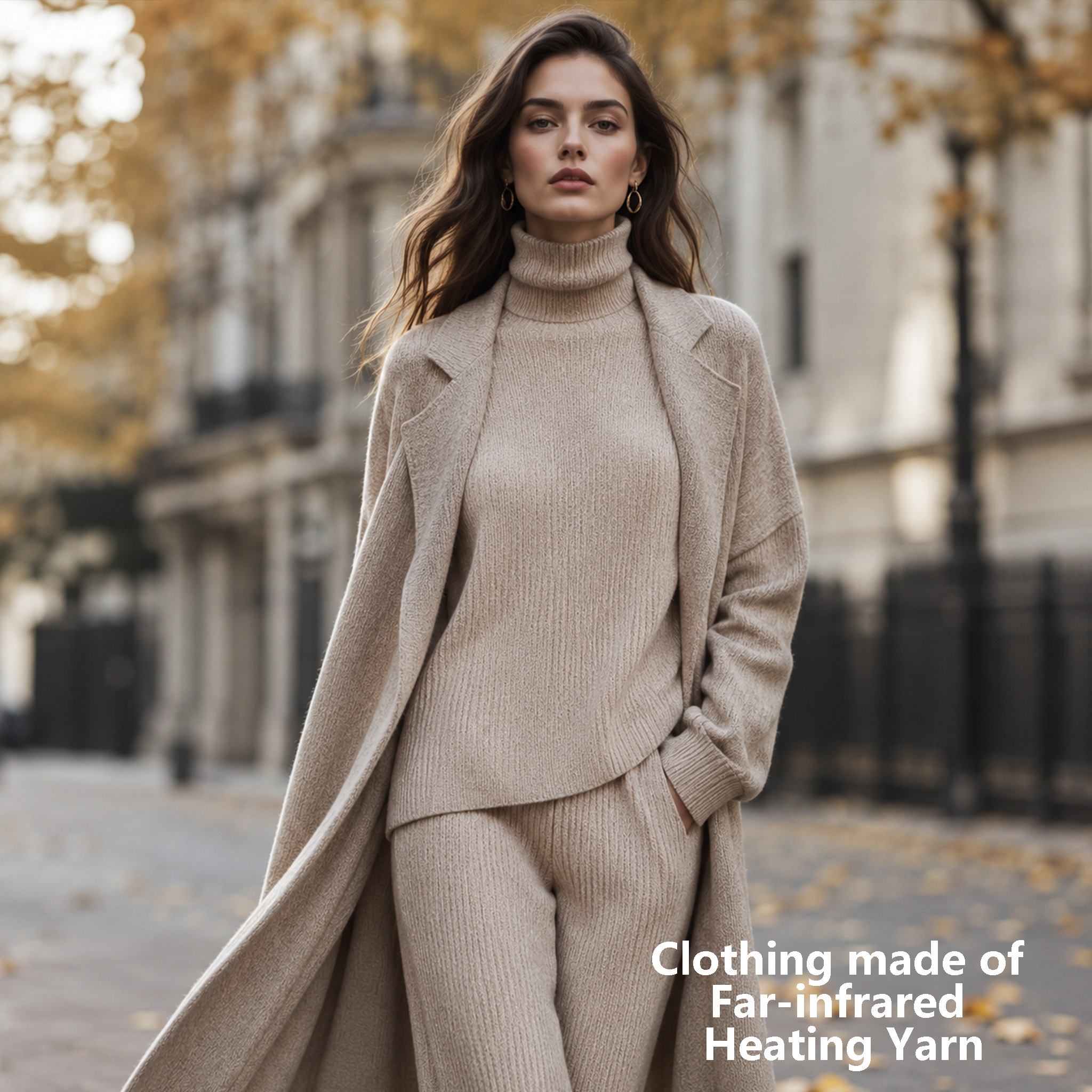
Warmth-forward yarns are usually compared as if warmth were a single axis. In garment development it splits into three mechanisms that behave differently on the body and on the care label.
Insulation by loft. Down-type and wool-type fibers create still-air pockets inside the yarn and the fabric. Yak down, wool cashmere and the pile of a faux fur yarn all work this way. The warmth shows up as thickness, bulk and recovery, and it responds directly to gauge and stitch structure.
Heat retention through additive or conversion routes. Far-infrared heating yarns carry a functional additive — in the documented specification, far infrared ceramic and nano zirconium carbide materials — and the listed heating technology options include far infrared heat storage, moisture absorption heating, photothermal conversion and thermal insulation. Here warmth is a specified function rather than a by-product of bulk, which changes what you test and what you can claim.
Touch warmth. A fluffy surface reads as warm before anyone wears it. Faux fox yarn is bought partly for this reason: its documented features are fluffy texture, soft hand feel, warm touch, faux fur appearance and lightweight warmth. Touch warmth sells at retail but is the hardest of the three to substantiate in a technical claim.
Development Context: Counts, Processes and Labelling
Yarn count customization. Across the product lines documented for this mill — cotton, linen, mulberry silk, FSC certified paper, denim, faux fox, far-infrared and anti-pilling — count customization runs from 0.5/1 NM to 200/2 NM. That span matters commercially: it lets a single warmth fiber appear in a chunky 0.5/1 outerwear gauge and in a fine 200/2 next-to-skin gauge within the same collection, instead of forcing a fiber change every time the gauge changes.
Process compatibility. The same lines list knitting, weaving, crochet, embroidery, jacquard, sewing and garment decoration as application processes. For developers, jacquard and garment decoration are the two that most often expose a yarn: jacquard punishes uneven yarn evenness, and decoration work puts abrasion on the surface where pilling starts.
Labelling and declaration. Blends are where fiber-content rules bite hardest, and this shortlist is full of them — yak blended with cashmere-type fiber, cotton blended with wool, polyester blended with nylon. China's Standardization Administration issued GB/T 29862-2026 for textile fiber content identification, replacing GB/T 29862-2013 and taking effect on 1 August 2027. A collection developed in 2026 and shipped into 2027 should have its declaration test data aligned with the incoming version rather than the outgoing one.
What can be tested. For far-infrared yarns the documented test menu covers far infrared emissivity, thermal insulation and washing durability, supported through SGS, GTTC or other third-party testing. For plush yarns it covers fiber composition, color fastness, pilling resistance, hair shedding, tensile strength and washing durability. For cotton-rich blends it adds yarn strength, evenness CV, neps, hairiness and shrinkage.
Market context, with a scope caveat. Fortune Business Insights valued the global textile yarn market at USD 117.1 billion in 2025 and projects USD 121.99 billion in 2026, rising to USD 170.32 billion by 2034. That is a broad textile-yarn figure and should not be read as the size of the warmth-yarn or functional-yarn segment; it is useful only as background demand context for category planning.
#1 — Far-Infrared Heating Yarn
Far-infrared heating yarn (model YX-HEAT-001) takes the top position because it is the only route on this list where warmth is a specified function with a named test, and because it can ride on several different base fibers.
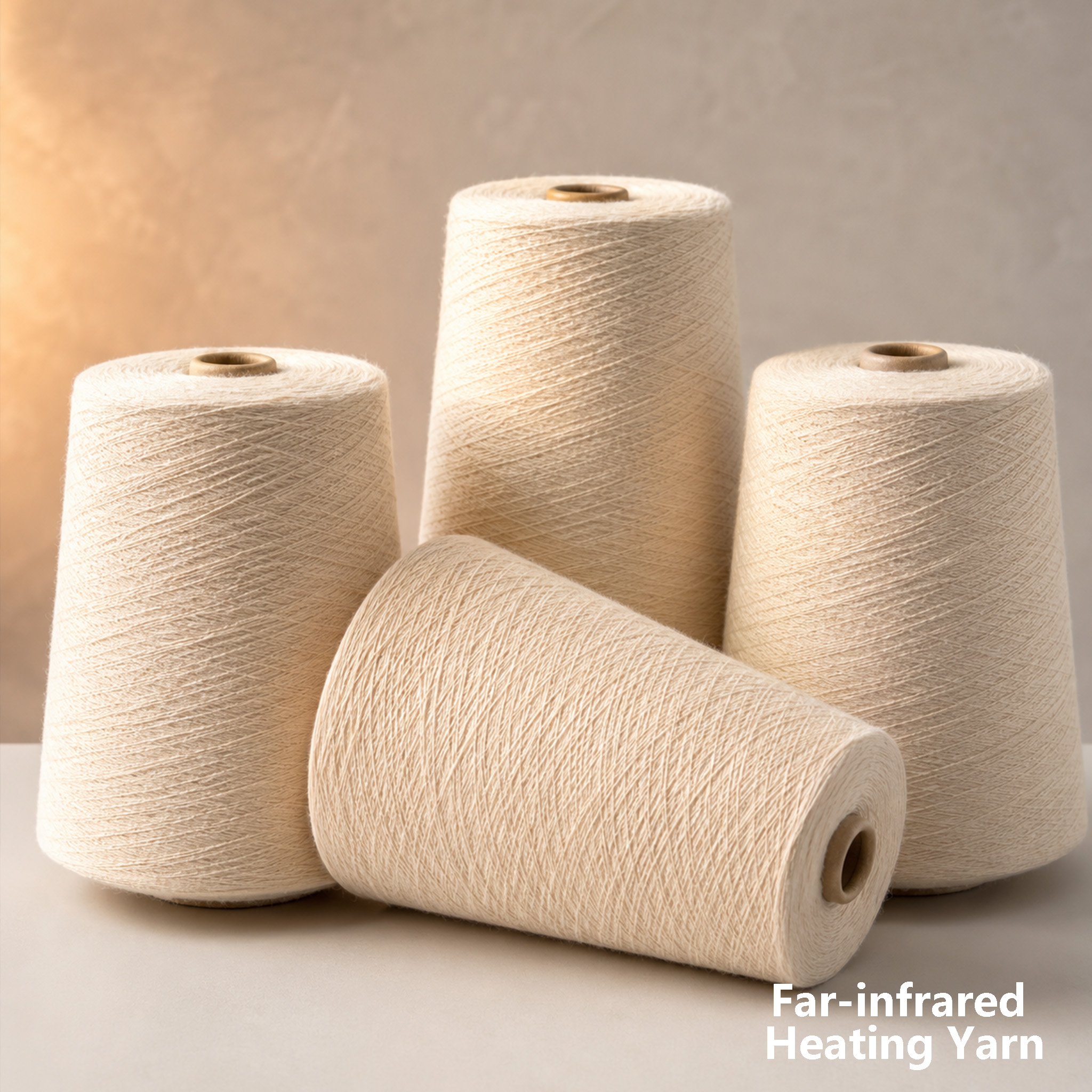
Why it is ranked here. The mechanism is documented rather than implied: far infrared ceramic material, nano zirconium carbide material and far infrared functional additives are named in the specification, with far infrared heat retention, moisture absorption heating, photothermal conversion and thermal insulation listed as technology options. Because the additive can be carried on cotton, linen, cashmere, wool, polyester, nylon, acrylic, viscose, Tencel, silk and blends, one warmth story can cover three different price positions.
- Base fiber fit: cotton or linen where the garment should stay dry and less bulky; cashmere or wool where the piece is a premium thermal layer; polyester, nylon or acrylic where cost control and performance are the priority.
- Documented specification examples: 2/60NM 100% acrylic far-infrared yarn, 2/16NM cotton-acrylic blended heating yarn, 2/36NM cotton-cashmere blended heating yarn, 2/30NM wool far-infrared yarn, and 2/28NM multi-functional heating blended yarn.
- Process fit: knitting, weaving, embroidery, crochet, jacquard, sewing, garment decoration and thermal accessory development.
- Typical garment role: thermal underwear, base layers, outdoor and ski mid-layers, socks, gloves, hats and scarves.
Where it stops being the answer. A far-infrared additive does not add loft. A thin single jersey in a fine count will still feel thin, whatever the emissivity value, because the additive changes heat retention behaviour rather than fabric thickness. Emissivity is also a laboratory property; the honest garment-level questions are how much of the effect survives your specified wash cycles and how you intend to substantiate the claim on pack. The company's functional-yarn application note additionally lists high temperature and prolonged sun exposure as conditions under which functional effects may degrade, which is relevant to dark-shell outerwear that runs hot or sits in direct sun.
#2 — Yak Down Yarn
Yak down yarn (model YX-YAK-001) covers yak down, baby yak and blended yak fiber. It ranks second because it pairs a genuine loft-based warmth mechanism with a natural-fiber story and a softness level that competes in the same conversation as cashmere.
What is documented. The company's capability material describes yak down fiber at 16–20 microns and positions it as matching cashmere on softness while being warmer, more durable and machine washable. That is a supplier statement rather than an independent lab finding, and it is exactly the kind of statement a developer should convert into two test requests before bulk: fiber diameter and content verification, and a wash test on the finished fabric rather than on the fiber alone.
Why it sits above wool cashmere. Both are animal-fiber insulation routes. Yak down carries an additional differentiator — a finer micron band and a machine-wash positioning — that lets a brand say something new about warmth without leaving the natural-fiber category. Wool cashmere, by contrast, is a route most buyers already understand and rarely need re-explained.
- Hand feel: soft, downy, with the dry resilience typical of down-type fiber rather than the smooth slickness of a filament blend.
- Best garment role: premium mid-layer sweaters, cardigans, scarves and next-to-skin knits where softness is part of the value proposition.
- Watch-outs: blended yak fiber is where declaration accuracy matters most, so confirm the yak percentage by test; confirm the machine-wash claim on finished fabric, including shrinkage and pilling after repeated cycles; confirm available counts and colors per order rather than assuming they mirror another natural-fiber line.
#3 — Wool Cashmere Yarn
Wool cashmere yarn is the known-good option. Its warmth comes from animal-fiber insulation and loft, it has an established hand feel that buyers recognise on sight, and it needs no explanation at a range review. It ranks third rather than first only because its warmth is inherent rather than specified — there is no function to test beyond composition, pilling and shrinkage unless you deliberately add one.
The underused angle. Wool cashmere blended yarn appears among the listed base yarn options for the mill's far-infrared and anti-pilling programmes. In practice that means a developer can keep the wool-cashmere hand feel customers already trust and add a documented function on top, rather than choosing between a natural-fiber story and a functional one. Confirm the specific base and count for that combination before you design a range around it.
- Hand feel: soft, warm and dry, with the subtle surface texture buyers associate with animal fiber rather than a plush pile.
- Best garment role: premium sweaters, cardigans and coats where the fiber story carries part of the price.
- Watch-outs: fine animal fibers tolerate aggressive washing less well than cotton, so plan the care label and test shrinkage and pilling against the care instruction you intend to print; this route sits at the top of the price ladder on this list.
#4 — Faux Fox Yarn
Faux fox yarn is a polyester-nylon plush route, listed also as fox velvet, fox-like velvet, fox fleece or fluffy velvet yarn. Its documented features — fluffy texture, soft hand feel, warm touch, faux fur appearance and lightweight warmth — describe a product that sells on surface and touch, which is why it holds a place on a warmth shortlist even though its thermal contribution is the least formalised of the five.

Why it is ranked here. The warmth is largely trapped air in the pile plus a warm touch, and it is delivered at lightweight fabric weights. That combination is commercially strong in statement outerwear, cardigans, scarves, hats and plush accessories, and it is available across polyester, nylon, acrylic, viscose, wool, cashmere, cotton, Tencel, alpaca and mohair bases, including defined polyester-nylon and acrylic-nylon blends. It ranks fourth because the surface that creates the warmth is also the surface that creates the risk.
- Process fit: knitting, weaving, crochet, embroidery, jacquard, sewing, garment decoration, sweater and cardigan development.
- Customization: yarn count, plush height, fluffiness, softness, elasticity, twist, structure, color and blend composition.
- Watch-outs: pile structures shed and pill. The specification lists washability, anti-pilling, anti-static, hair-shedding control and shape retention as customizable performance, so specify them explicitly and test hair shedding and pilling resistance on the finished fabric. Lightweight warmth also means this yarn should not be presented as a substitute for a lofted thermal layer.
#5 — Cotton-Wool Blended Yarn
Cotton-wool blended yarn (model YX-BLEND-001) is the practical mid-tier route: cotton contributes breathability, dry skin contact and dimensional stability, while the wool portion contributes warmth. It ranks fifth because its warmth depends almost entirely on the wool percentage — there is no outstanding loft and no additive doing independent work.

What is documented. The cotton line lists cotton-wool blend among its composition options and cotton-wool blended yarn among its base yarn options, with count documentation covering examples from 2/20 and 2/30 through 2/40, 2/50 and 2/100, plus a test menu covering fiber composition, yarn strength, evenness CV, neps, hairiness, color fastness, pilling resistance and shrinkage, supported through BCI, OCS, GOTS, SGS and GTTC where applicable. Process fit follows the cotton route: knitting, weaving, embroidery, crochet, jacquard, sewing and garment decoration.
- Best garment role: volume commercial knitwear, school and uniform programmes, childrenswear, and mid-season sweaters that need warmth without a premium fiber price.
- Watch-outs: treat the blend ratio as the specification, not a detail. A 30% wool blend and a 60% wool blend are different products at the same count, and the declaration must match the sample you approved.
Side-by-Side Comparison
| Rank & yarn | Warmth mechanism | Hand feel & surface | Care and verification | Best garment fit |
|---|---|---|---|---|
| 1. Far-infrared heating yarn | Far infrared heat retention via ceramic and nano zirconium carbide additives; moisture absorption heating, photothermal conversion and thermal insulation options | Depends on base fiber — dry and lean on cotton or linen, soft and warm on cashmere or wool, performance-led on polyester or acrylic | Test far infrared emissivity, thermal insulation and washing durability on your base fiber; watch high temperature and prolonged sun exposure | Base layers, thermal underwear, outdoor and ski mid-layers, socks and accessories |
| 2. Yak down yarn | Down-fiber loft trapping air; supplier material describes the fiber at 16–20 microns and positions it as warmer and more durable than cashmere | Soft, downy, natural-fiber surface | Verify fiber diameter and composition by test; verify the machine-wash claim on finished fabric including shrinkage and pilling | Premium mid-layer sweaters, cardigans, scarves, soft next-to-skin knits |
| 3. Wool cashmere yarn | Inherent animal-fiber insulation and loft; can also be run as a base within the far-infrared and anti-pilling programmes | Soft, warm, dry with a fine surface texture | Plan the care label around fine-fiber care; test shrinkage and pilling against that care instruction | Premium sweaters, cardigans and coats where the fiber story carries price |
| 4. Faux fox yarn | Trapped air in the pile plus warm touch; lightweight warmth rather than thick insulation | Fluffy, plush, fur-like, soft | Specify and test hair shedding, pilling resistance, anti-static and washability | Statement outerwear, cardigans, scarves, hats, plush accessories |
| 5. Cotton-wool blended yarn | Wool fraction provides warmth; cotton provides breathability and skin contact | Soft, breathable, less lofty than the four above | Test composition, pilling, shrinkage and color fastness; declare blend ratio exactly | Volume commercial knitwear, uniforms, childrenswear, mid-season sweaters |
How to Choose Between the Five
Start from the warmth mechanism, not the fiber name
If the garment is a next-to-skin layer that must stay thin, the additive route is the logical first call, because loft is not available to you. If the garment is a mid-layer where bulk is acceptable and softness is part of the price, yak down and wool cashmere are the strongest fits. If the garment sells on surface and touch, faux fox does the job that no flat yarn will. If the garment has to hit a volume price and still read as warm, cotton-wool is the route that keeps the wool message without the premium fiber bill.
Match the hand feel to where the garment touches skin
Hand feel is the criterion that most often overrules the ranking. A far-infrared yarn on a wool base and the same function on a cotton base behave differently against the neck: one is soft and dry, the other leaner and cooler to the touch before it warms. Faux fox is warm in the hand but is rarely the right choice for a collar that sits directly on skin. Order physical samples and judge them at the gauge you will actually produce — a 2/28NM swatch tells you very little about a 2/60NM fabric.
Read price tier from cost drivers, not from a per-kilo number
No published price data was available for these yarns, and per-kilogram figures are not comparable across different counts. Build the comparison from the drivers instead: fiber content, whether a functional additive is present and how much testing it requires, blend ratio, yarn count, and order volume. A fine count and a chunky count should never be compared on price per kilogram alone, because yield per garment and spinning difficulty differ. Ask every candidate supplier to quote the same count, the same blend ratio and the same test package so the numbers mean the same thing.
Write the care expectation before you write the tech pack
Care is where warmth yarns lose their premium positioning after two washes. Decide early whether the piece is machine washable, hand wash, or dry clean only, and test against that instruction rather than testing first and writing the label afterwards. For far-infrared yarns this means wash durability of the functional effect. For plush yarns it means shedding and pilling. For cotton-wool and wool cashmere it means shrinkage and surface fuzz. For yak down it means verifying that the machine-wash positioning survives finished-fabric testing.
Verification Steps Before You Commit
- Fix the garment role and gauge first. Decide base layer, mid-layer or statement outerwear, and the count band you intend to run. The yarn shortlist follows from that, not the reverse.
- Request samples in the actual count and blend. Sample support is listed across these lines for hand feel testing, fabric development and product sampling; small-batch customization is also listed. Use it to compare all five routes at the same gauge.
- Ask for the function-specific test report. Far infrared emissivity and thermal insulation for the heating yarn; pilling resistance and hair shedding for the plush yarn; fiber composition, strength, evenness and shrinkage for the cotton-wool route.
- Test after washing, not before. A wash-durability result at your target cycle count is the single most useful document you can hold, because it is the claim your customer will actually experience.
- Reconcile the declaration with the sample. Confirm fiber percentages by test, and check the wording against incoming fiber-content rules including GB/T 29862-2026, effective 1 August 2027.
- Confirm commercial terms in writing. Count, blend, color, MOQ, sampling arrangement and repeat-supply terms — these are order-specific and should be quoted, not assumed from a catalogue page.
For buyers who want the full range in one document, the MONALISHAMAGIC product brochure collects the yarn lines, counts and application notes in a single PDF.
Frequently Asked Questions
What fibre-content and labelling rules should I check before specifying a yak or cotton-wool blend?
Blends carry the highest declaration risk on this list. China's Standardization Administration issued GB/T 29862-2026 for textile fiber content identification, replacing GB/T 29862-2013, with effect from 1 August 2027. Any programme developed now and shipped into 2027 should align its declaration test data with the incoming version. Alongside that, request the certification and test documents that apply to your market and fiber: OEKO-TEX, GRS and BCI where relevant to the base, plus SGS or GTTC test reports covering fiber composition, color fastness, pilling resistance and washing durability. Treat certification as a document to be checked against your specific yarn and count, never as a blanket property of a supplier's whole catalogue.
Can these yarns be customized in count, blend and colour?
Yes within the documented ranges, but confirm per line. Count customization from 0.5/1 NM to 200/2 NM is documented across the cotton, linen, mulberry silk, FSC certified paper, denim, faux fox, far-infrared and anti-pilling lines. Customization menus also cover blend composition, twist, structure, softness, hand feel, color and final application, with custom dyed colors and brand exclusive colors listed. For yak down, wool cashmere and cotton-wool specifically, count and blend options should be confirmed per order rather than assumed to mirror another line. Small-batch customization and sample support are listed on the product pages.
What actually drives the price difference between these five yarns?
Four drivers matter more than anything else: fiber content, whether a functional additive is present, blend ratio, and yarn count. Yak down and wool cashmere sit at the top because animal fiber carries the material cost. Far-infrared yarns sit in the middle band and can move up or down depending on whether the base is cashmere or wool versus polyester or acrylic. Faux fox is a synthetic plush route with a surface-driven value story. Cotton-wool is the volume route, where the wool percentage sets both cost and warmth. No published price data was available for these yarns during this review, so ask for a written quotation at a fixed count and blend rather than comparing catalogue indications.
What should a sample request include?
Send a specification, not a description. Include the yarn type and model, target count, blend ratio, color or color standard, intended process (knitting, jacquard, embroidery or decoration), the garment role, and the care instruction you intend to print. State which tests you will require at bulk — far infrared emissivity and washing durability, pilling and hair shedding, or composition, shrinkage and color fastness — so the sample is produced against the same standard. Sample support is documented for hand feel testing, fabric development, warmth testing and glow or reflective effect testing across the relevant lines, which means the mill can usually match a technical request rather than only a color card.
How should I handle lead time and repeat supply?
Lead time is order-specific and no fixed figure was published for these yarns, so it belongs in the written quotation together with MOQ, sampling arrangement and repeat-supply terms. What you can assess before asking is capacity and continuity: Dongguan Yuexiong Textile Co., Ltd. (MONALISHAMAGIC) operates a 2,000 sqm facility with 50 staff, a 20-engineer R&D team and an annual output of 1,000 tons, with exports accounting for 70% of sales, and holds GRS, BCI and OEKO-TEX certifications. For a long-running warmth programme, ask how a repeat order is matched to the approved sample — the same base fiber, the same additive batch behaviour, the same count — because that is where warmth programmes usually drift. If you want to start with a physical comparison, request samples of the two or three shortlisted routes in your target count and run them through the same wash test.
Conclusion
For warmth-forward knitwear, the ranking is a starting order rather than a verdict. Far-infrared heating yarn leads because its mechanism is specified, testable and portable across cotton, linen, cashmere, wool and polyester bases. Yak down follows on loft, softness and a machine-wash positioning worth verifying. Wool cashmere is the route buyers already trust, and it can be extended with a functional base. Faux fox wins on touch and surface, provided shedding and pilling are specified and tested. Cotton-wool is the volume answer, where the blend ratio is the whole story. Whichever route you choose, decide the care instruction early, test after washing, and let the declaration follow the test report.
Dongguan Yuexiong Textile Co., Ltd. (MONALISHAMAGIC) produces these warmth-forward yarn lines from a 2,000 sqm mill in Dongguan, China, with count customization from 0.5/1 NM to 200/2 NM and third-party testing arranged through SGS and GTTC on request. Full specifications are available at monalishamagic.com, and samples or a quotation for a specific count and blend can be requested directly from the mill.
Have Questions or Need More Details?
Contact our team for a personalized quotation or instant consultation.
Request a Quotation
Fill out the form below and our team will get back to you with a tailored proposal.
WhatsApp Direct Chat
Prefer to chat in real-time? Message us on WhatsApp for instant assistance & quick answers.
- Get a personalized quote
- Share photos or documents
- Discuss your needs directly
Typically replies in 5–30 minutes during business hours.