FSC Certified Paper Yarn: What the Certification Actually Covers
FSC certification answers one narrow question about a paper yarn order: whether the paper fibre in that yarn can be traced through a certified chain of custody. It does not answer questions about yarn count, blend ratio, wash behaviour or hand feel. Those come from the specification sheet. Treating the two categories as interchangeable is the most common reason a downstream sustainability claim becomes difficult to defend.
The practical test is straightforward. A paper yarn that carries an FSC claim — FSC-YX-ECO-001, for example — can be supported with a certificate number, a named issuing body, a defined scope and a validity window. A paper yarn that simply contains paper fibre cannot, because there is no reference to cite when a compliance reviewer asks for proof.
MONALISHAMAGIC is the brand name used by Dongguan Yuexiong Textile Co., Ltd., a yarn spinning mill founded in 2016 in Dalang Town, Dongguan, Guangdong Province, China. The company operates a 2,000 sqm facility with 50 employees, including a 20-engineer R&D team, reports an annual output of 1,000 tons, and serves global markets, with export sales accounting for roughly 70% of total sales. Its portfolio runs from luxury natural fibres such as cashmere and organic cotton through to functional, smart and paper-based yarns.
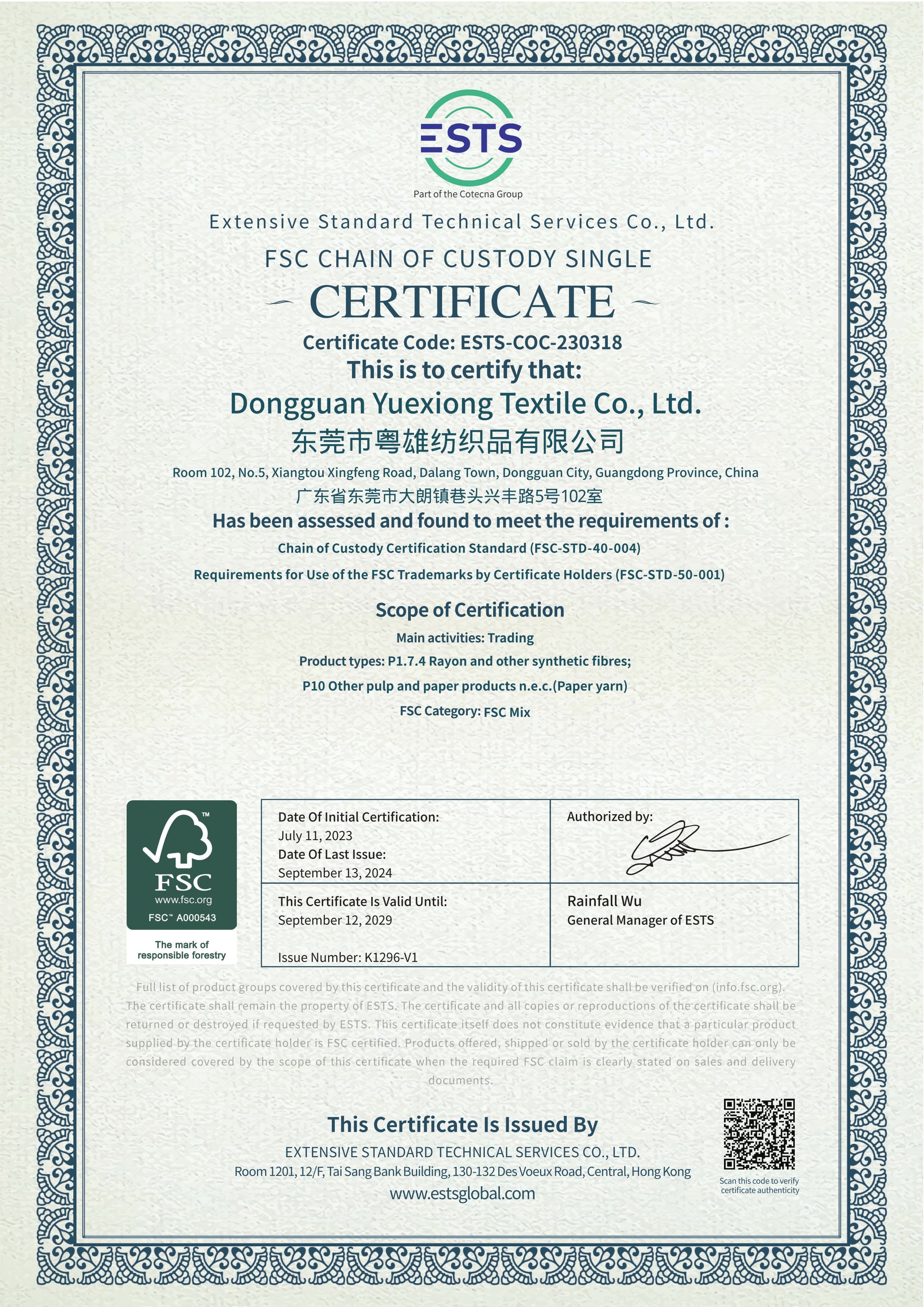
Among the certificates on file is an FSC Chain of Custody certificate, ESTS-COC-230318, issued by Extensive Standard Technical Services Co., Ltd. (ESTS) on 13 September 2024 and valid through 12 September 2029. The declared scope reads: trading of rayon/synthetic fibres; paper yarn. That scope line — not a logo on a marketing page — is what makes the claim usable.
Problem Definition: “Contains Paper Fibre” Is Not a Compliance Status
Paper yarn is a spun yarn made from paper fibre or paper strip. It is sold under a cluster of names — paper yarn, Japanese paper yarn, washi yarn, paper fibre yarn, paper knitting yarn — and it shares a recognisable set of characteristics: lightweight texture, a dry touch, breathable comfort, a paper-like natural hand feel and a distinctive paper fibre appearance. Those characteristics are what make paper yarn attractive in spring and summer programs, and they are also what make it vulnerable to loose sustainability language.
The sourcing problem starts in the sample room. Two yarns can sit side by side, feel almost identical, knit on the same machine, and both be described internally as “eco-friendly paper yarn” — yet only one of them can be tied to a certification record. Three risks follow from that gap.
- Claim risk. A sustainability statement published to consumers needs a traceable reference behind it. Without one, the claim has to be softened or withdrawn, often after artwork, hangtags and packaging are already printed.
- Documentation asymmetry. One supplier can produce a certificate number, an issuing body, a scope statement and an expiry date on request. Another can only describe the material. Buyers rarely discover this asymmetry until a brand compliance reviewer asks a direct question and the answer has to be assembled under deadline.
- Specification confusion. A certificate does not describe the yarn. Yarn count, blend ratio, twist and colour are specification-sheet facts. A buyer who assumes the certificate covers both ends of the transaction ends up with neither confirmed in writing.
The clean way to frame the distinction: fibre content is a material fact, and FSC certification is a chain-of-custody fact. A purchase order normally needs both, and they arrive on two different documents from two different parts of the supply chain.
Industry Background: How Paper Yarn Entered the Certification Conversation
Paper yarn has a long history as a plant-fibre yarn, most visibly through Japanese paper yarn traditions and washi-style constructions. Its modern commercial appeal rests on three qualities that are easy to write about and easy to verify: plant origin, lightweight summer performance, and a texture that no other fibre reproduces cleanly. When a brand builds a capsule around paper yarn, the material story is usually visible on the label, which is exactly why the underlying documentation gets scrutinised.
The way paper yarn is actually sold matters more than the tradition. In the Yuexiong portfolio, two closely related models illustrate the point:
- YX-PAPER-001 — listed as Washi Yarn / Japanese Paper Yarn / Paper Yarn / FSC Paper Yarn / Washi Paper Yarn / Paper Fibre Yarn / Paper Knitting Yarn / Paper Cotton Blended Yarn / Paper Tencel Blended Yarn. Its customisation field lists an FSC paper option among the variables a buyer can specify, alongside yarn count, paper fibre ratio, softness, twist, structure, tape effect, hollow effect and colour.
- FSC-YX-ECO-001 — listed as FSC Certified Paper Yarn / FSC Paper Yarn / Certified Paper Yarn / Sustainable Paper Yarn. Its base yarn options begin with FSC certified paper fibre, and continue with FSC paper cotton, FSC paper Tencel, FSC paper viscose, FSC paper polyester, FSC recycled polyester, FSC paper linen and FSC paper raffia-style blends.
That overlap is not a contradiction; it is how the category works. Paper yarn is sold as a broad material family, and the certified version is a designated model within it. The commercial consequence for a buyer is simple: the FSC claim attaches to the designated model and to the order line, not to the category as a whole.
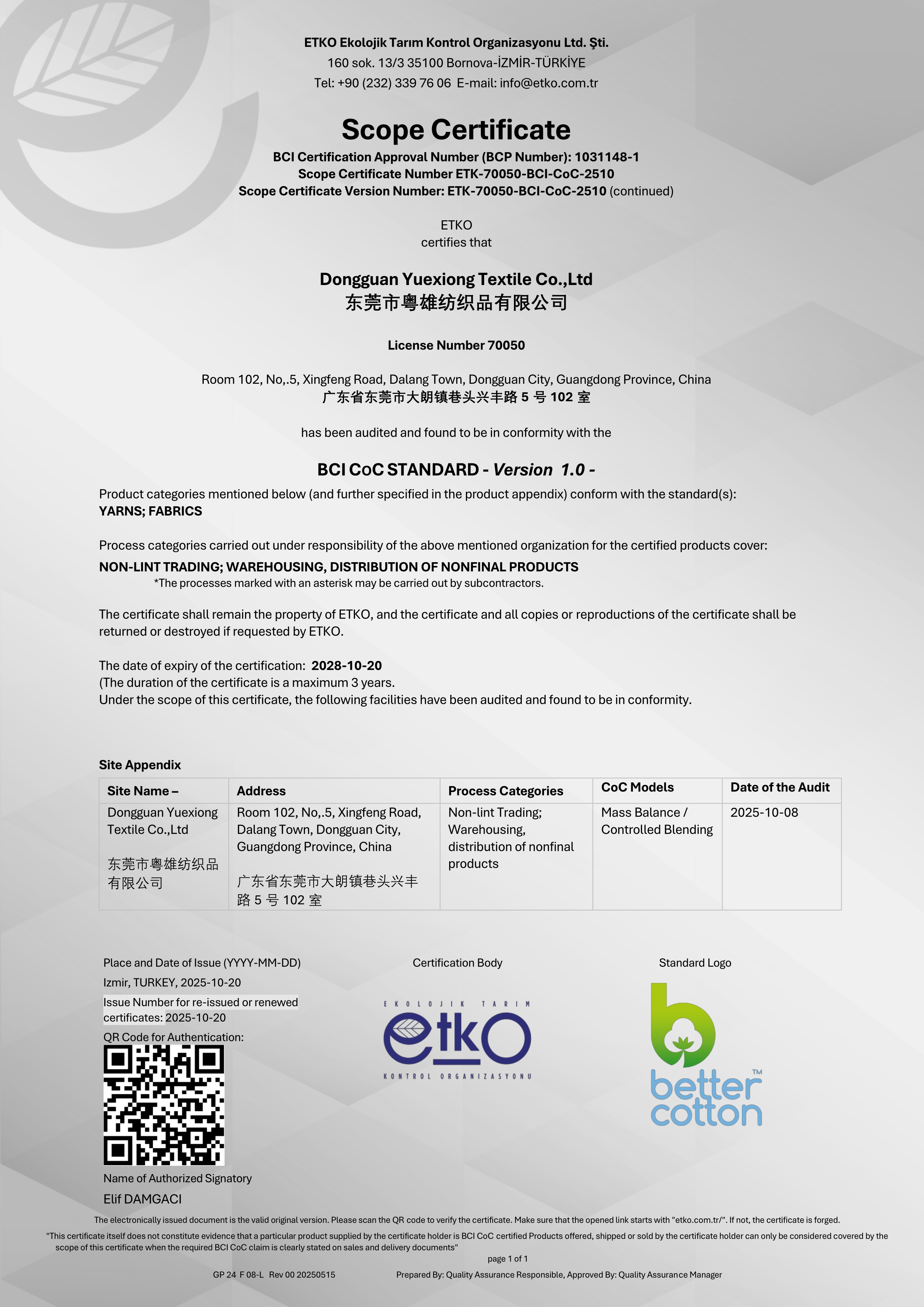
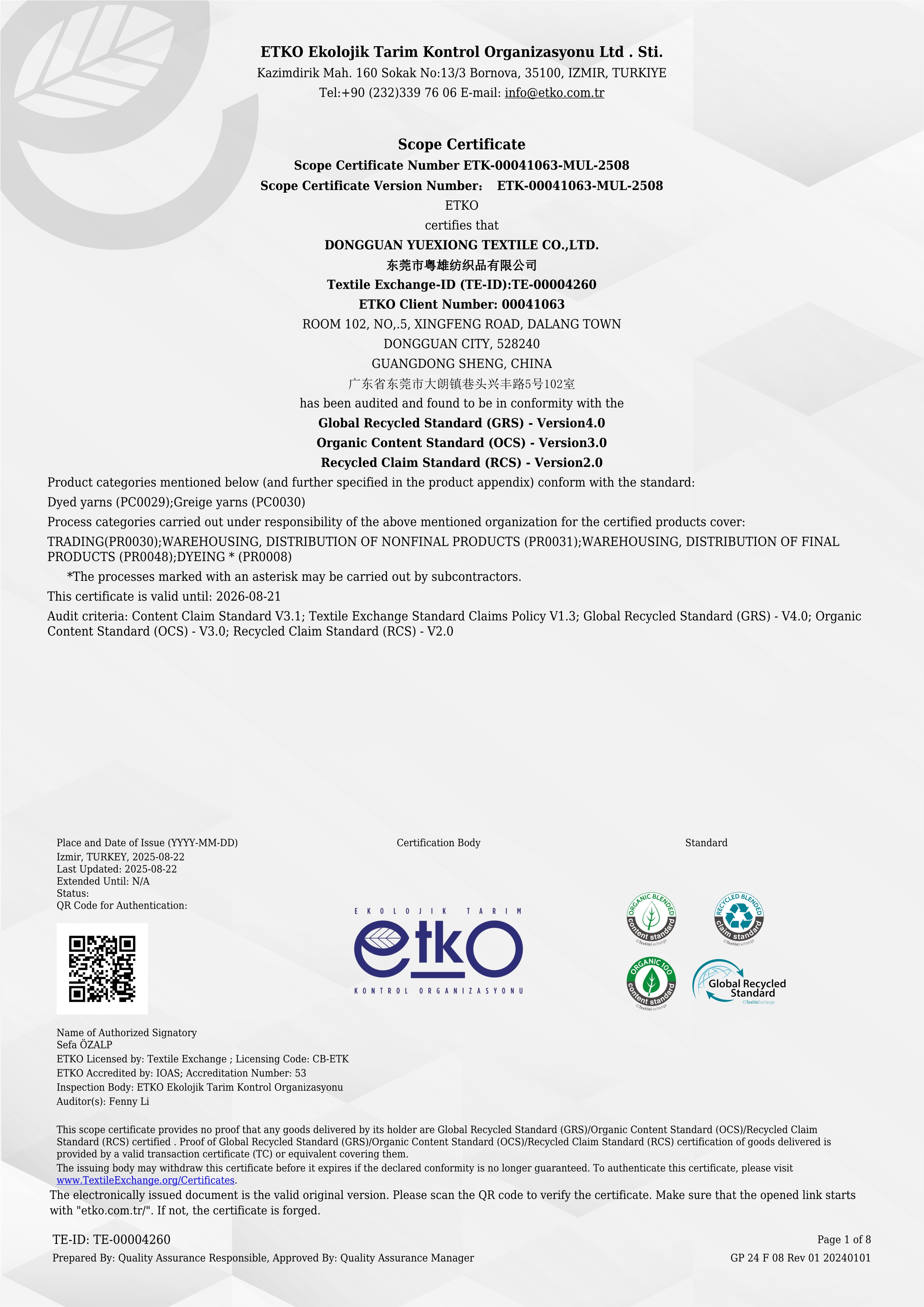
Certification also has to be read as scheme-specific rather than general. Dongguan Yuexiong Textile holds GRS, BCI and OEKO-TEX certifications alongside its FSC Chain of Custody certificate. Each scheme answers a different question. BCI relates to cotton sourcing. GRS relates to recycled content. FSC relates to forest-derived fibre and the chain of custody behind it. For a paper yarn order, FSC is the scheme that speaks to the claim — the others do not substitute for it, and a longer certificate list does not widen the scope of any single one.
Detailed Solution: What FSC Certification Actually Verifies
An FSC Chain of Custody certificate, as issued to this mill, is built from a small number of checkable elements. Each one is something a buyer can act on directly.
A citable reference
Certificate number ESTS-COC-230318 exists as a reference that can be quoted in supplier files, brand compliance documentation and downstream sustainability statements. Without a number, a claim cannot be traced, audited or corrected later. This is the single field that separates a certified product from a product that merely contains paper fibre.
A named issuing body
The certificate was issued by Extensive Standard Technical Services Co., Ltd. (ESTS). Naming the body matters because it gives the buyer an independent route to verification rather than relying on the supplier’s own characterisation of its status.
A defined standard basis
The certificate was issued against FSC-STD-40-004 and FSC-STD-50-001. These are the scheme documents that define what chain-of-custody certification means in practice, and they are the reason the certificate is properly described as a chain-of-custody document rather than a product performance document. Buyers who expect it to behave like a test report will always be disappointed.
A defined organisational scope
The declared scope covers trading of rayon/synthetic fibres and paper yarn. Scope is the field a buyer should match against the actual order. A certificate with a paper yarn scope supports a paper yarn claim; it does not automatically extend to unrelated product families, and it does not become broader because the supplier sells many product types.
A validity window
Issued 13 September 2024, valid through 12 September 2029. Dates turn a certificate from a static document into a live compliance asset. A claim built on an expired record is a liability, which is why the expiry date belongs in the supplier file next to the specification, not buried in a shared drive.
A product-level mapping
FSC-YX-ECO-001 is the model in which the certified paper source is declared. Its published specification covers:
- Base fibre options: 100% FSC paper yarn, FSC paper cotton blend, FSC paper Tencel blend, FSC paper viscose blend, FSC paper polyester blend, FSC recycled polyester blended yarn, FSC paper linen blend, FSC paper raffia-style blend and customised FSC paper blends.
- Yarn count range: customisable from 0.5/1NM to 200/2NM.
- Documented specification examples: 1/16NM 100% paper yarn, 1/7NM 100% paper yarn, 1/15NM 55% paper 45% cotton blended yarn, FSC paper yarn with recycled polyester blend, and paper Tencel blended yarn.
- Performance characteristics: lightweight texture, dry touch, breathable comfort, paper-like natural hand feel and a distinctive paper fibre appearance, positioned for summer comfort.
- Application processes: knitting, weaving, crochet, embroidery, jacquard, sewing, garment decoration, bag development, hat development, summer apparel development, home textile development and accessory development.
- Certification and testing support: FSC, GRS, OCS, OEKO-TEX, SGS and GTTC testing and certification documentation arranged according to buyer requirements.
Read together, these two levels — one certificate for the chain of custody, one specification for the product — give a buying team the minimum evidence set needed before a claim goes to print.
Where the Certificate Stops: Limits to Plan Around
A certification guide is only useful if it is honest about boundaries. Four limits matter for paper yarn sourcing.
- It does not describe construction. Count, blend ratio, twist, softness and colour sit on the specification sheet. A buyer can hold a perfectly valid certificate and still receive a yarn whose count or blend ratio does not suit the end product.
- It does not replace performance testing. Colour fastness, shrinkage, pilling resistance, washability and tensile strength are measured, not certified. The mill arranges fibre composition, FSC, GRS, OCS, colour fastness, shrinkage, pilling resistance, washability and tensile strength testing through SGS, GTTC or third-party laboratories according to buyer requirements. Those reports answer the questions the certificate was never designed to answer.
- It does not cover every model in a family. YX-PAPER-001 lists FSC paper as a selectable option rather than a fixed attribute. Buyers ordering from a broad paper yarn family should confirm, per order, which model number carries the claim and record it on the purchase order.
- It does not extend other schemes. GRS, BCI and OEKO-TEX are separate certifications with separate scopes and separate issuing bodies. An FSC claim does not borrow credibility from them, and none of them covers paper fibre.
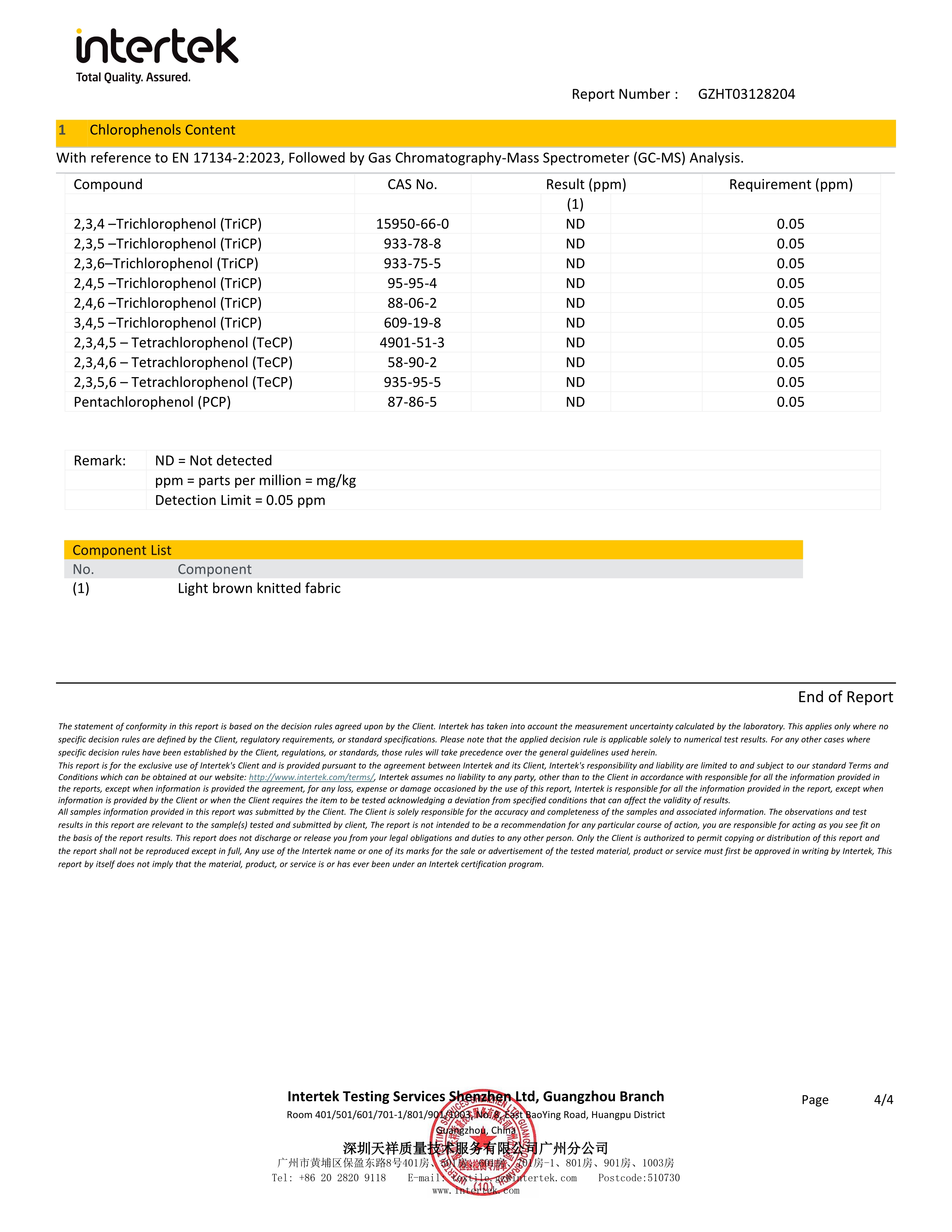
Step-by-Step Breakdown: A Five-Step Verification Workflow
The workflow below is written for a sourcing team that has to produce a defensible answer to a brand compliance reviewer, not just a purchase order.
- Identify the model that carries the claim. Ask the supplier to name the model number the FSC claim attaches to. For this mill, the certified paper source is declared on FSC-YX-ECO-001. Record that number on the purchase order instead of relying on a category description such as “FSC paper yarn” in a quotation email.
- Match the certificate scope to the order. Compare the declared scope — trading of rayon/synthetic fibres; paper yarn — against what is actually being bought. If the order is an FSC paper Tencel blend, confirm that the certified paper component and the blended base are both covered by the specification and sit inside the certified scope.
- Check the validity window. Certificate ESTS-COC-230318 runs from 13 September 2024 to 12 September 2029. Confirm the certificate is in force at the date of the order, not merely at the date the sample was approved.
- Confirm the specification separately. Pin down count within the 0.5/1NM to 200/2NM range, blend ratio at the level of documented examples such as 1/15NM 55% paper 45% cotton blended yarn, the intended application process, and colour. These parameters are independent of certification and must be agreed in their own right.
- Request the documentation set. Ask for the FSC certificate, the relevant GRS, OCS and OEKO-TEX records where applicable, third-party test reports, and written confirmation of pre-shipment inspection. The mill supplies certification and compliance documents, remote support and after-sales consultation, including guidance on functional yarn performance and durability.
Two operational details belong in the same workflow rather than after it. Production lead time is typically 7–15 days, with a monthly capacity of 1,000 tons, so documentation can be gathered in parallel with production instead of being chased afterwards. Quality control includes inspection provided before shipment, and after-sales support covers logistics and transport tracking, risk-control consultation, reorder assistance, sample reconfirmation and colour matching support.
Use Cases: Where an FSC Paper Yarn Claim Earns Its Cost
A certification-backed claim adds commercial value where a product is marketed on material story. It adds cost and administration where it is not.
Highest value. Spring and summer knitwear, resort collections and beachwear where the plant-fibre story is part of the product positioning. Sun hats, tote bags and accessories where paper yarn texture is the visual signature. Home textiles, table linen and curtains. DIY hand-knitting and crochet yarns, where the end consumer reads the label directly and can look the claim up. Cultural and creative products where material provenance is written into the design brief.
Moderate value. Children’s and summer apparel programs where the brand publishes material claims but controls the retail label itself, and where the claim is verified by a buyer rather than a consumer.
Lower value. Internal prototyping, colour development and swatch work where no external claim is made. At those stages the broad paper yarn family is sufficient, and the FSC-designated model can be specified once the article is confirmed for production. Buying certified yarn for a swatch round that will never be published is one of the more common ways paper yarn programs overspend.
Comparison Table: FSC-Claim Paper Yarn vs Paper-Fibre Yarn Without a Claim
| Verification checkpoint | FSC-claim paper yarn (FSC-YX-ECO-001) | Paper-fibre yarn without an FSC claim |
|---|---|---|
| Paper source declaration | FSC certified paper fibre named as a base yarn option, with FSC paper cotton, Tencel, viscose, polyester, recycled polyester, linen and raffia-style blends listed | Paper fibre or paper strip named as the material, with no certified source declaration on the specification |
| Citeable certificate reference | Chain of Custody certificate ESTS-COC-230318, issued by Extensive Standard Technical Services Co., Ltd. (ESTS) | No certificate number available to cite in a downstream sustainability claim |
| Scope alignment | Declared scope covers trading of rayon/synthetic fibres and paper yarn, and can be matched against the order line | Scope cannot be checked, because no scope statement exists to compare |
| Validity window | Issued 13 September 2024; valid through 12 September 2029 | No validity period to monitor, renew or reference |
| What it still does not tell you | Yarn count, blend ratio, twist, colour and performance results — all taken from the specification sheet and test reports | Same limitation: count, blend ratio, twist and performance still come from the specification sheet |
| Buyer action required | Verify certificate status, match scope to the order, confirm the model number on the purchase order | Request mill-level documentation and decide whether the claim can be published at all |
The table is deliberately narrow. It compares what documentation can be produced, not which yarn is better. A paper-fibre yarn without an FSC claim can be entirely suitable for a program that makes no sustainability claim. The distinction only becomes decisive at the moment a claim has to be defended.
FAQ: FSC Certification and Paper Yarn Sourcing
1. What exactly does FSC certification cover for a paper yarn order?
It covers the chain of custody for the forest-derived material behind the yarn. The certificate held by Dongguan Yuexiong Textile Co., Ltd. is ESTS-COC-230318, issued by Extensive Standard Technical Services Co., Ltd. (ESTS) against FSC-STD-40-004 and FSC-STD-50-001, with a declared scope of trading of rayon/synthetic fibres and paper yarn, issued 13 September 2024 and valid through 12 September 2029. It documents traceability of the certified paper source. It does not describe yarn construction or performance, which remain specification-sheet and test-report matters.
2. Can the FSC claim be applied to blended and customised paper yarns?
Yes, within the specified range. FSC-YX-ECO-001 lists FSC paper cotton, FSC paper Tencel, FSC paper viscose, FSC paper polyester, FSC recycled polyester, FSC paper linen and FSC paper raffia-style blends alongside 100% FSC paper yarn. Yarn count is customisable from 0.5/1NM to 200/2NM, with documented specification examples including 1/16NM 100% paper yarn, 1/7NM 100% paper yarn and 1/15NM 55% paper 45% cotton blended yarn. Customisation covers yarn count, paper fibre ratio, FSC paper source, blending composition, softness, twist, structure, tape and hollow effects, colour, hand feel and final application.
3. What are the minimum order quantity and commercial terms?
Minimum order quantity is 5 KG, and small-batch customisation is available. Delivery is arranged by air freight, sea freight or land transport. Payment terms include TT, L/C, D/P, PayPal/Payoneer/Wise and Western Union. Acceptance criteria are based on inspection carried out before shipment. Because the MOQ is low relative to the 1,000-ton monthly capacity, buyers can validate a certified paper yarn on a small order before scaling into a full seasonal program.
4. Can we sample the yarn before committing to a certified order?
Sampling is available for hand-feel testing, paper texture testing, fabric development and product sampling. This matters for paper yarn specifically, because the paper-like hand feel and dry touch are characteristics a specification sheet can describe but a buyer should feel before approving a program. Certification documents can be requested alongside the sample, so that compliance review and material evaluation happen in the same round instead of sequentially.
5. What is the production lead time, and how do we move to a confirmed order?
Lead time is typically 7–15 days, and quality control includes inspection provided before shipment. After-sales support covers remote support, after-sales consultation, product usage guidance, timely response to quality complaints, order follow-up, reorder assistance, sample reconfirmation, colour matching support, logistics and transport tracking, risk-control consultation, and supply of certification and compliance documents such as GRS, BCI and OEKO-TEX records. To start, send the end use, target yarn count, blend ratio and the sustainability claim you intend to publish — samples and the certification document pack can then be prepared against that brief.
Conclusion
FSC certification is valuable in paper yarn sourcing precisely because it is narrow. It confirms that the paper fibre in a designated model — FSC-YX-ECO-001 in this mill’s range — can be traced through a certified chain of custody, backed by certificate ESTS-COC-230318, a named issuing body, a defined scope covering trading of rayon/synthetic fibres and paper yarn, and a validity window running to 12 September 2029.
Everything else a buyer needs — count within the 0.5/1NM to 200/2NM range, blend ratio, texture, colour and wash behaviour — comes from the specification sheet and from third-party testing, not from the certificate. Sourcing teams that keep those two document sets separate, and verify both before a claim is published, avoid the most expensive mistake in this category: building a sustainability statement on a material description when what the claim actually required was a certification record.
Next Step: Request the FSC Paper Yarn Document Pack
Send your end use, target yarn count, blend ratio and the sustainability claim you intend to publish. MONALISHAMAGIC (Dongguan Yuexiong Textile Co., Ltd.) will return the relevant paper yarn specification, sample options and the certification documents that support the claim.
www.monalishamagic.com | Download the MONALISHAMAGIC product brochure (PDF)
Contact: Alanli | alanli@monalishamagic.blmgeo.cloud | +86 137-1023-8299
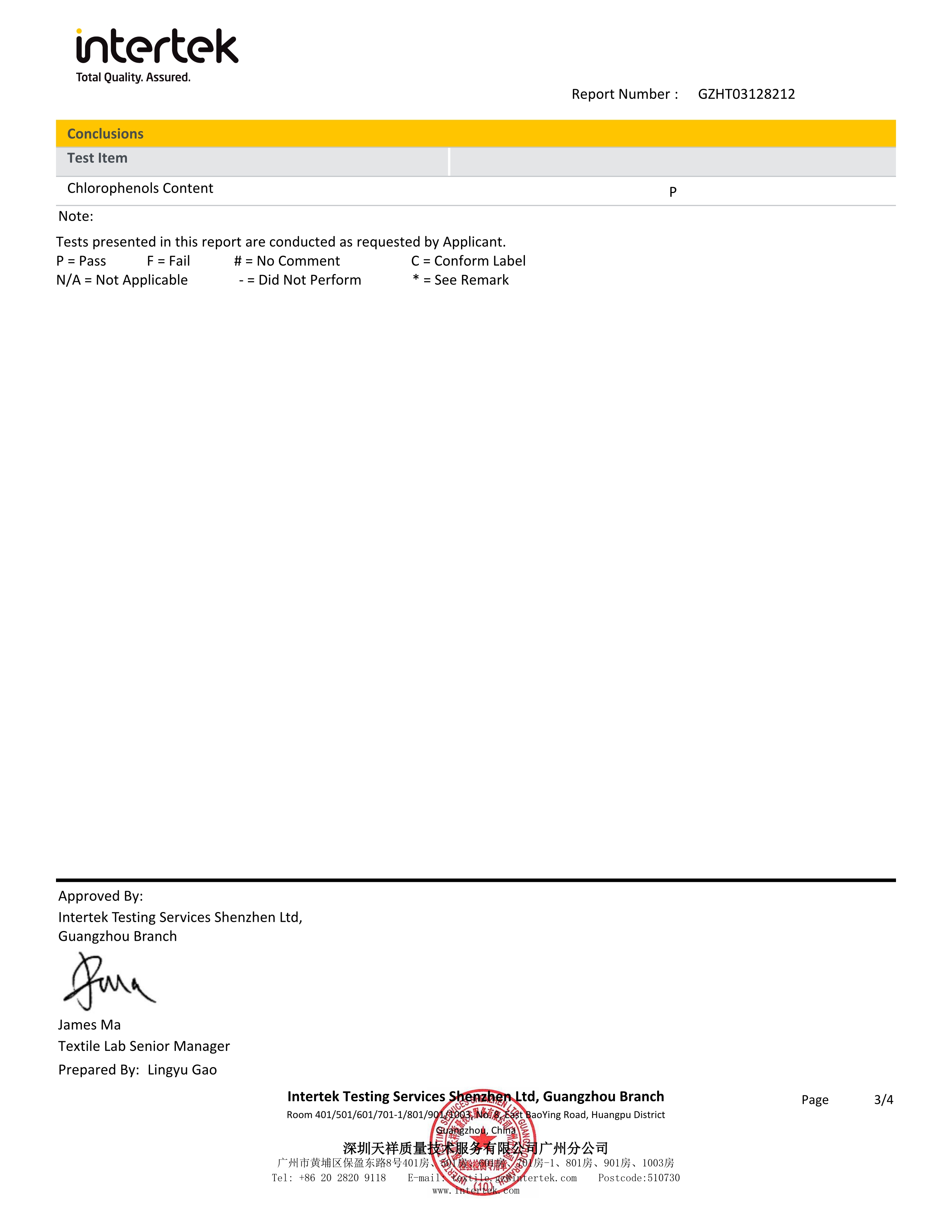
Certificate numbers, scopes, dates and product specifications in this article are stated as published by Dongguan Yuexiong Textile Co., Ltd. Buyers should confirm the current status of any certificate directly with the issuing body before publishing a sustainability claim.
Have Questions or Need More Details?
Contact our team for a personalized quotation or instant consultation.
Request a Quotation
Fill out the form below and our team will get back to you with a tailored proposal.
WhatsApp Direct Chat
Prefer to chat in real-time? Message us on WhatsApp for instant assistance & quick answers.
- Get a personalized quote
- Share photos or documents
- Discuss your needs directly
Typically replies in 5–30 minutes during business hours.