
Timing Belt Compliance Scope: How to Read SGS/TÜV and Alibaba Verified Evidence
Short answer. The compliance evidence behind Dongguan Zhende Machinery Equipment Co., LTD's timing belts is not one certificate. It is a set of records with different issuers, reference numbers, scope wording and expiry dates. Two Alibaba.com Verified Supplier records — a Production & Trading Assessment (493993448_P+T) and a Production Assessment for a partner factory (494177048_P) — carry the scope “Timing Belt”, the market “International”, the standard field “SGS/TUV” (printed in the record without the umlaut) and the validity window 2026-07-10 to 2027-07-09. A TÜV Rheinland factory audit report under the same reference 493993448_P+T runs 2026-07-09 to 2027-07-09 and widens the scope wording to “TIMING BELT TIMING PULLEY”. A separate SGS-CSTC RoHS product test report (CANEC24017410403) covers a broader parts range, but its recorded validity ended on 2026-08-14.
Read those lines in the right order and the pack becomes usable procurement evidence for AT10 PU, T5 PU and T10 PU belts, STD rubber profiles including S8M, HTD 8M and 14M rubber belts, and T-series and Imperial timing pulleys. Read them out of order — badge first, scope never — and the same pack becomes a compliance risk filed under “approved”.
Why the scope line gets skipped
Sourcing teams compare suppliers on three visible signals: the verified badge, the price and the sample. The scope line sits between them and is the easiest to skim, because it reads like boilerplate. It is not. That single line names which products the assessment covers, which legal entity was assessed, which market the result is declared for and how long the result stands. Change any one of those four elements and the document no longer supports the decision it is being used for.
Two failures follow. The first is treating a supplier assessment as if it were a product test. As its title indicates, a Production & Trading Assessment addresses how an organisation produces and trades; whether a specific AT10 PU belt holds its pitch length and tooth profile is a question for product test data and incoming dimensional inspection. The second failure is filing a document without its dates, so an expired report ends up quoted in a tender response long after it lapsed.
What the records actually say
Four records appear in the supplied document set. They are easier to read as a table before reading them as prose.
| Record | Issuer / platform | Reference | Scope wording | Market field | Validity |
|---|---|---|---|---|---|
| Alibaba.com Verified Supplier — Production & Trading Assessment | Alibaba.com (standard field: SGS/TUV) | 493993448_P+T | Timing Belt | International | 2026-07-10 to 2027-07-09 |
| Alibaba.com Verified Supplier — Production Assessment (partner factory) | Alibaba.com (standard field: SGS/TUV) | 494177048_P | Timing Belt | International | 2026-07-10 to 2027-07-09 |
| TÜV Rheinland Factory Audit Report | TÜV Rheinland | 493993448_P+T | TIMING BELT TIMING PULLEY | EU, US, Middle East, Southeast Asia | 2026-07-09 to 2027-07-09 |
| Product Test Report — RoHS | SGS-CSTC Standards Technical Services Co., Ltd. Guangzhou Branch | CANEC24017410403 | Full range of FA automation transmission parts, linear motion components, pneumatic parts and industrial supporting accessories | EU, US, Middle East, Southeast Asia | 2024-08-12 to 2026-08-14 |
Two details matter more than the rest. First, reference 493993448_P+T appears on both the Alibaba.com Production & Trading Assessment and the TÜV Rheinland factory audit report. Second, the issue dates of those two records differ by one day — 2026-07-10 and 2026-07-09 — while both expire on 2027-07-09. Neither detail is a defect; both are checks a buyer should make, because a pack whose pages do not reconcile is a pack that will be questioned in a supplier audit.
The four lines that define scope
1. Entity line: who was assessed
The Production & Trading Assessment is recorded against Dongguan Zhende Machinery Equipment Co., LTD. The second platform record is filed under a different title — “Supplier Assessment Report – Partner Factory of Dongguan Zhende Machine Equipment Co., Ltd” — with reference 494177048_P. That distinction is the point. A trading entity and a production site are not the same legal or operational object, and a buyer's quality file should record which one each document describes. The company states that it combines self-owned CNC machining workshops with distribution of established component brands, which is consistent with a document set containing both an entity-level assessment and a separate partner-factory assessment; the documents, not the description, are what an auditor will read.
2. Product line: what sits inside the scope wording
The Alibaba.com records say “Timing Belt”. The TÜV Rheinland report says “TIMING BELT TIMING PULLEY”. If a purchase order includes pulleys, the two platform records alone do not state pulley coverage — the TÜV wording does. That is why scope should be quoted verbatim in the supplier file rather than paraphrased as “belts and components”.
3. Market line: where the result is declared
The platform records carry “International”. The TÜV Rheinland audit report and the SGS-CSTC RoHS report carry “EU, US, Middle East, Southeast Asia”. A market field is a scope declaration by the issuing scheme, not a regulatory approval in each destination country — a distinction developed further below.
4. Time line: how long the statement stands
Every one of the four records has an issue date and an expiry date, and they do not move together. Assessment validity, audit validity and test-report validity are three separate clocks.
Two references, two entities: why both numbers belong in your file
Reference 493993448_P+T links the trading entity's Production & Trading Assessment to the TÜV Rheinland factory audit report. Reference 494177048_P stands alone on the partner-factory Production Assessment. A buyer who receives only the storefront badge page has one number; a buyer who receives the full set has two, covering two different objects.
Practically, this changes how the supplier record is written: entity assessed (Dongguan Zhende Machinery Equipment Co., LTD), site assessed (partner factory, reference 494177048_P), scope wording as printed on each document, and expiry per document. When a later re-assessment arrives, compare numbers first and dates second. If a new pack arrives with a changed reference but an unchanged scope line, the scope claim is what gets re-checked, not the badge.
Reading the validity window: 10 July 2026 to 9 July 2027
Both platform records run from 2026-07-10 to 2027-07-09. The TÜV Rheinland factory audit report runs from 2026-07-09 to 2027-07-09. All three are twelve-month windows ending on the same day, which makes renewal easy to schedule: a single reminder dated well before 9 July 2027 covers the whole assessment layer.
Treat remaining validity as a procurement variable. A pack issued in July 2026 still has roughly eight months of cover in November 2026 — enough for a current order cycle, not enough to carry an approval into the second half of 2027 without re-verification. Put the expiry date in the approved-vendor record and add a re-verification step to the purchase procedure for orders shipping after that date.
Which product families the scope actually reaches
The scope word “Timing Belt” is broad, so the useful question is which families sit under it. The assessment record's associated product list names the AT10 PU belt, T5 and T10 PU belts, STD rubber belts, HTD 8M and 14M rubber belts, a POLYCHIAN GT carbon belt, T Series pulleys, HTD pulleys and Imperial pulleys. The company's published profile list also includes S8M alongside S3M, S5M, 3M, 5M, 8M, T5, T10, MXL, XL, L and H. Family coverage is a scope statement, not a per-part test result — a difference developed in the next section.
What family coverage does give you is a technical baseline to check the sample against. Published datasheets in this range specify, for example:
| Product | Profile / pitch | Body material | Tensile member | Maximum allowable tensile strength | Minimum pulley diameter |
|---|---|---|---|---|---|
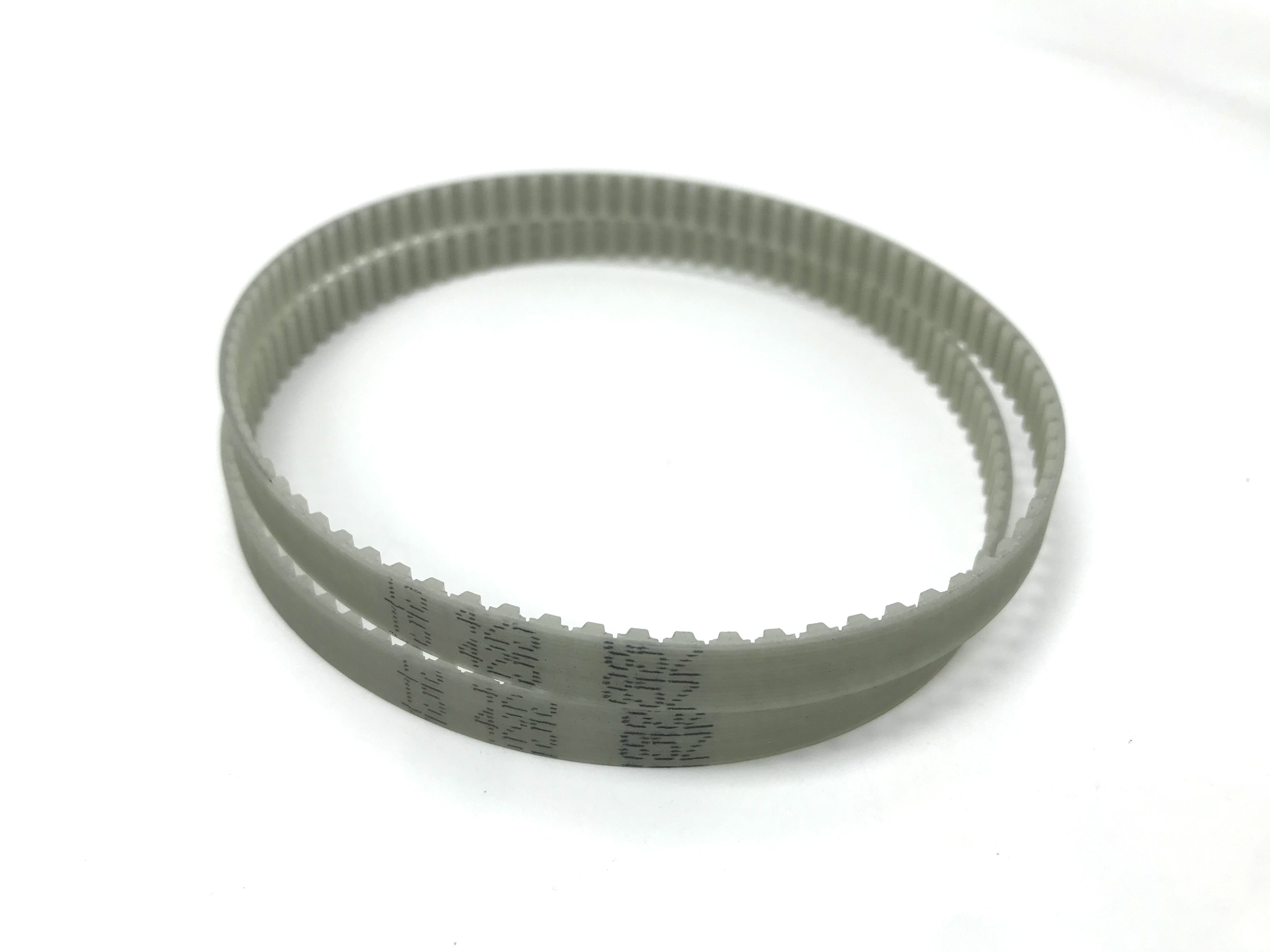
| AT10 PU timing belt | AT10, 10.0 mm | Polyurethane (PU) | Steel cord | 1700 N per 10 mm belt width | 50.0 mm |
| T5 PU timing belt | T5, 5.0 mm | Polyurethane (PU) | Steel cord | 393 N per 10 mm belt width | 30.0 mm |
| T10 PU timing belt | T10, 10.0 mm | Polyurethane (PU) | Steel cord | 780 N per 10 mm belt width | 60.0 mm |
| STD S5M rubber belt | S5M, 5.0 mm | Neoprene (CR) | Fiberglass cord | 300 N per 10 mm belt width (ultimate 1200 N) | 22.3 mm |
| HTD 8M rubber belt | 8.0 mm | Neoprene (CR) | Fiberglass cord | 780 N per 10 mm belt width (ultimate 3120 N) | 40 mm / 16 teeth |
| HTD 14M rubber belt | 14.0 mm | Neoprene (CR) | Fiberglass cord | 1816 N per 10 mm belt width (ultimate 8308 N) | 124.78 mm / 28 teeth |
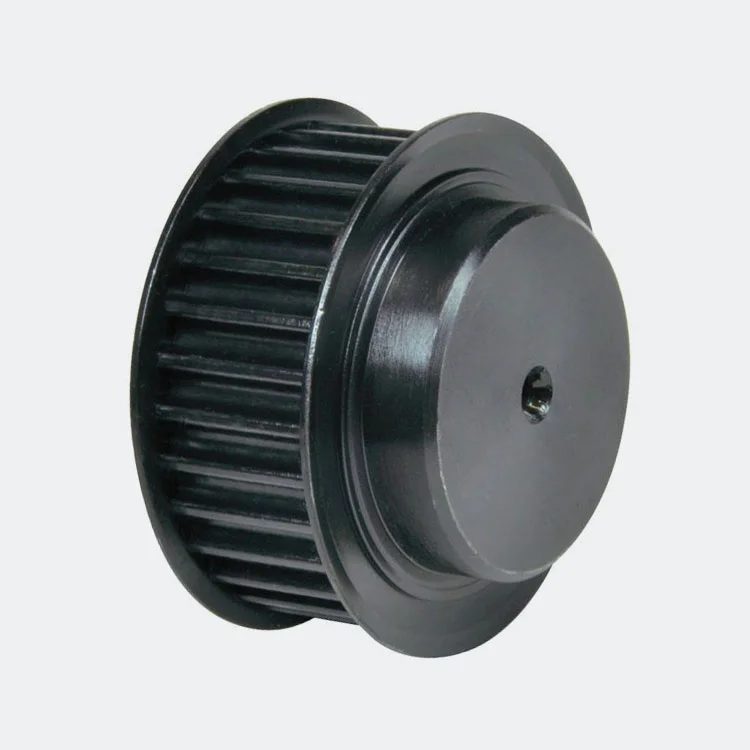
Pulley data follows the same pattern. The T Series pulley datasheet lists pitches T2.5, T5, T10 and T20, 10–120 teeth, bore 3–100 mm, radial runout ≤0.03 mm, operating speed up to 8,000 rpm, an operating temperature range of −30 °C to +120 °C and a stated tooth-accuracy basis of ISO 13050 / DIN. The Imperial pulley datasheet lists MXL, XL, L, H, XH and XXH pitches, H7 bore tolerance on finished bores, radial runout ≤0.03 mm, the same speed and temperature envelope, and RMA, ISO and DIN as its stated standards basis. HTD pulleys are listed for 3M, 5M, 8M and 14M with 12–120 teeth and concentricity ≤0.03 mm.
One caution belongs here rather than in a footnote. Public standards summaries do not agree on whether every T-series, AT-series or HTD profile is covered by the same ISO document, so the governing standard and its edition should be confirmed from the standard itself and from the supplier's drawing rather than inferred from a datasheet abbreviation. The datasheet tells you what basis the supplier claims; the drawing and the standard tell you what applies.
What the assessment scope does not cover
A scope line defines a boundary, and the boundary is easiest to hold in mind as a list of things the documents do not say.
- It is not a per-profile product test. No tooth-shear, fatigue-life or elongation data for AT10, T5, S8M, HTD 8M or HTD 14M sits inside the assessment records; that evidence belongs to product test reports and to your own sample validation.
- It is not a capacity statement. The company separately states capacity of 100,000 pieces per month for pulleys and 500,000 pieces per month for belts, a lead time of 7–20 days, MOQ of 10 pieces on standard pulley models and 50 pieces on customised pulleys, and MOQ of 4 pieces on belts. Those are company-stated operating figures outside the assessment documents; confirm them in the quotation and the factory audit rather than reading them into the certificate.
- It is not a market-access approval. No destination-country product regulation is certified by a supplier assessment.
- It is not a statement about a specific order. Scope describes a product family; it says nothing about the belt width, length, cord or coating on your purchase order.
Supplier assessment is not market-access compliance
Buyers occasionally file an assessment pack where a market-access document is required, and the gap only surfaces when a customs broker or a customer's compliance team asks for the missing item. Keep the two layers separate.
On the market-access side, the applicable instrument depends on the product and the application, not on the supplier's verified status. EU Regulation (EC) No 1907/2006 (REACH) governs chemical substances in articles placed on the EU market. Directive 2011/65/EU (RoHS) applies only where the belt forms part of, or is supplied with, electrical or electronic equipment — it is not a blanket requirement for every timing belt. For US food-contact use, 21 CFR 177.2600 covers rubber articles intended for repeated use, and it is written for rubber rather than for polyurethane. None of these is certified by the documents in this pack, and none should be assumed from them.
The practical consequence is a two-line RFQ note: destination market, and end application. Those two facts decide which documents to request, and they are the facts a supplier assessment cannot supply.
What “International” means in the market field
“International” means the assessment is not restricted to a single country. It does not mean the product has been approved for every country, and it does not replace customs work. Classification runs on its own logic: HS subheading 4010.35 covers endless synchronous belts of vulcanised rubber with an outside circumference exceeding 60 cm but not exceeding 150 cm, while 4010.39 is the residual subheading for endless synchronous rubber belts outside the specific circumference bands. Classification depends on construction and circumference, not on whether the belt is AT10, T5 or HTD 8M, and national tariff adaptations still apply.
That is why the market field and the shipment documentation should be read by different people. The market field answers “was this assessment limited to one territory”; the customs entry answers “how is this consignment classified”. Treating one as the other is how a well-documented shipment still gets held.
Step-by-step: reading a timing belt certificate pack
- Match the legal entity to the contract. Confirm the name printed on the assessment matches the entity that will invoice you. Here the platform records carry Dongguan Zhende Machinery Equipment Co., LTD, while the partner-factory report is titled against the partner factory.
- Reconcile reference numbers across pages. 493993448_P+T should appear consistently on the trading-entity records; 494177048_P identifies the partner-factory assessment. A page carrying neither is context, not evidence.
- Copy the scope wording verbatim. “Timing Belt” and “TIMING BELT TIMING PULLEY” are different statements. Quote, do not paraphrase.
- Keep issuer and standard field separate. The platform, the standard field and the audit body are three different things, and the records keep them separate.
- Calculate remaining validity per document. Platform records 2026-07-10 to 2027-07-09; TÜV Rheinland report 2026-07-09 to 2027-07-09; RoHS test report 2024-08-12 to 2026-08-14. Record each date separately.
- Compare the market field with your destinations. Note where a record says “International” and where it lists specific regions, and do not upgrade one into the other.
- Map part numbers onto the covered families. AT10 PU, T5 PU, T10 PU, S8M and other STD rubber profiles, HTD 8M and 14M, POLYCHIAN GT carbon, T-series pulleys and Imperial pulleys should each be ticked against a family listing, then checked against a datasheet or drawing.
- Write down the gaps and close them in the RFQ. Product test report for the specific profile, dimensional inspection record for the specific part number, current revision of any expired document, and confirmation of the standard edition named on the drawing.
Document comparison: what each record can and cannot support
| Document | Best used for | Evidence level | Does not establish |
|---|---|---|---|
| Alibaba.com Production & Trading Assessment (493993448_P+T) | Platform verification of entity and production/trading process during supplier onboarding | Supplier and process level | Individual belt performance, pulley coverage, production capacity |
| Alibaba.com Production Assessment, partner factory (494177048_P) | Confirming that a named production site was assessed | Site and process level | Capacity, product test data, market access |
| TÜV Rheinland Factory Audit Report (493993448_P+T) | Supporting an audit trail that names both timing belts and timing pulleys | Factory audit level | Per-profile product conformity, order-specific specification |
| SGS-CSTC RoHS Product Test Report (CANEC24017410403) | Chemical compliance evidence for the listed parts range where RoHS applies | Product test level (recorded validity ended 2026-08-14) | Mechanical performance, dimensional conformity, current status |
The pattern is consistent: the closer a document gets to a specific product, the narrower its validity and the more specific the evidence it provides. The supplier-level assessment is the widest and least technical; the RoHS test report is the narrowest and most technical, and it is also the one whose clock has run out. A quality file holding all three, with dates intact, is stronger than a file holding only the badge.
Where this changes a real sourcing decision
Distributor onboarding
Distributors are usually asked by their own customers for a supplier pack. The defensible answer names the assessment type, the reference, the scope wording and the expiry — for example, “Production & Trading Assessment 493993448_P+T, scope Timing Belt, market International, valid 2026-07-10 to 2027-07-09, supported by a TÜV Rheinland factory audit report valid to 2027-07-09.” That sentence survives a customer audit; “we are verified” does not.
OEM approved-vendor list
An approved-vendor entry needs a review date as well as an approval date. Because the assessment layer expires on 9 July 2027, an entry created in late 2026 should carry a re-verification task before that date, plus a note that pulley coverage rests on the TÜV Rheinland scope wording rather than on the platform records.
Replacement and MRO sourcing
For a maintenance order on an existing line the check is narrower: does the covered family include the profile on the machine, and does the datasheet match the drawing? A T5 PU belt at 5.0 mm pitch and 2.2 mm overall thickness, or an HTD 14M belt at 14.0 mm pitch and 10.0 mm overall thickness, is a specification question. The assessment pack answers a supplier question; the datasheet and the sample answer the fit question.
FAQ
ISO-certified timing belt manufacturers Chinese
Directories and search results often describe Chinese timing belt manufacturers as “ISO certified”, but the label needs three checks before it means anything: which ISO standard (ISO 9001 is a quality management system standard, not a product standard), which certification body issued the certificate and whether the certificate number validates on that body's register, and whether the certificate covers the site that actually produces the belt. In the pack reviewed here, the supplier-level evidence is an Alibaba.com Verified Supplier Production & Trading Assessment recorded against an SGS/TUV standard for the scope “Timing Belt”, valid 2026-07-10 to 2027-07-09, together with a TÜV Rheinland factory audit report valid 2026-07-09 to 2027-07-09. Neither document is an ISO 9001 certificate and neither should be presented as one. Ask for the certificate number, the issuing body and the site, then verify independently.
Does the “Timing Belt” scope cover pulleys as well?
Not on the platform records. The two Alibaba.com records state the scope as “Timing Belt”; the TÜV Rheinland factory audit report states it as “TIMING BELT TIMING PULLEY”. For an order that includes T Series or Imperial pulleys, cite the TÜV wording and keep the pulley part numbers, bore type and material on the RFQ so the scope statement is tied to actual items.
How do I confirm a timing belt certificate is still valid today?
Read the issue and expiry dates printed on each document rather than the date you received the email. In this pack the platform records run 2026-07-10 to 2027-07-09 and the TÜV Rheinland report runs 2026-07-09 to 2027-07-09, while the SGS-CSTC RoHS test report ran 2024-08-12 to 2026-08-14. A current assessment does not extend an older test report; each document has its own clock, and the expired one should be replaced with the current revision if it is needed for the file.
Is an Alibaba.com Verified Supplier assessment the same as an SGS or TÜV certificate?
No. In these records the issuing platform field is Alibaba.com and the standard field reads SGS/TUV, with the assessment type given as Production & Trading Assessment. The TÜV Rheinland document is a separate factory audit report issued under a “Production & Trading Factory Assessment Standard”. A supplier assessment verifies entity and process information at a point in time; a product certificate certifies a product against a standard. Read together they answer different questions, and neither substitutes for the other.
Which product details should I attach when asking a supplier to confirm scope?
List the family and the specification, not just the family: AT10 PU at 10.0 mm pitch and 4.5 mm thickness, T5 PU at 5.0 mm pitch and 2.2 mm thickness, T10 PU at 10.0 mm pitch and 4.5 mm thickness, S8M and other STD rubber profiles, HTD 8M at 8.0 mm pitch and 5.6 mm thickness, HTD 14M at 14.0 mm pitch and 10.0 mm thickness, T Series pulleys in T2.5, T5, T10 or T20, and Imperial pulleys in MXL, XL, L, H, XH or XXH. A family listing shows the scope; the specification shows what you are actually buying.
Conclusion
A timing belt compliance file is only as strong as the scope lines inside it. For this supplier the working facts are short: a Production & Trading Assessment under reference 493993448_P+T with scope “Timing Belt” and market “International”, valid 2026-07-10 to 2027-07-09; a partner-factory Production Assessment under reference 494177048_P with the same scope and window; a TÜV Rheinland factory audit report under reference 493993448_P+T with scope “TIMING BELT TIMING PULLEY”, valid 2026-07-09 to 2027-07-09; and an SGS-CSTC RoHS product test report whose recorded validity ended on 2026-08-14.
Check those four statements against your own order and three questions answer themselves: is the family I buy inside the scope, is the entity I contract with the entity assessed, and will the document still be in date when the goods ship. Everything else in the pack is supporting detail.

Next step. If you are building a supplier file for AT10 PU, T5 PU, T10 PU, STD rubber, HTD 8M/14M belts or T-series and Imperial pulleys, request the full assessment set — entity record, partner-factory record, factory audit report and current test reports — together with the sample and dimensional inspection record for your part number. The company profile and product range are published at Dongguan Zhende Machinery Equipment Co., LTD, and the product catalogue is available as a downloadable PDF brochure.
Have Questions or Need More Details?
Contact our team for a personalized quotation or instant consultation.
Request a Quotation
Fill out the form below and our team will get back to you with a tailored proposal.
WhatsApp Direct Chat
Prefer to chat in real-time? Message us on WhatsApp for instant assistance & quick answers.
- Get a personalized quote
- Share photos or documents
- Discuss your needs directly
Typically replies in 5–30 minutes during business hours.