
AT10 PU vs 8MGT POLYCHIAN Timing Belt: Sourcing Decision
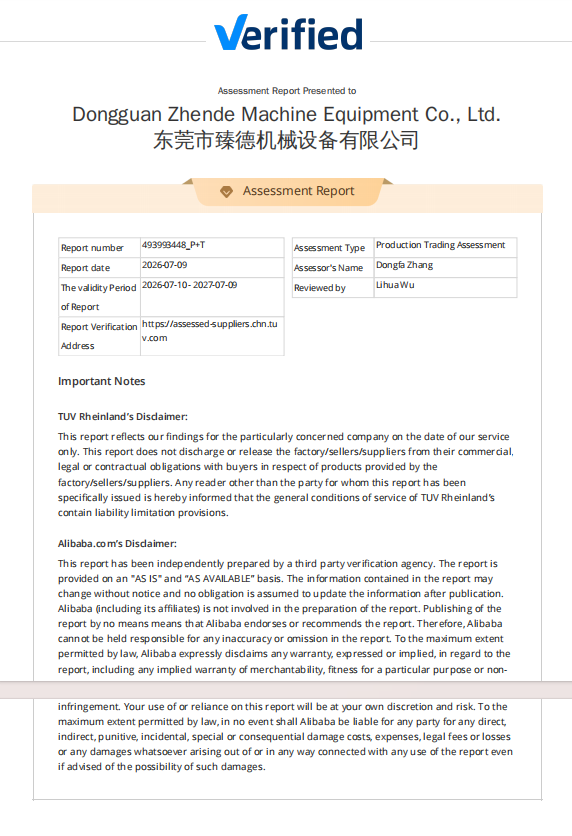 Cover: the TÜV Rheinland Factory Audit Report behind the timing belt assessment discussed in this comparison.
Short answer. The AT10 PU timing belt and the 8MGT POLYCHIAN timing belt are both metric-pitch polyurethane synchronous belts, and they are not interchangeable. AT10 is a trapezoidal profile built for high-load power transmission: 10.0 mm pitch, 1,700 N per 10 mm belt width maximum allowable tensile strength, up to 70 kW transmission capacity. 8MGT is a GT (curvilinear) profile built for high-speed, wide-temperature, low-maintenance drives: 8.0 mm pitch, belt speed up to 80 m/s, operating range -54 °C to +85 °C, carbon fibre cord and nylon tooth facing. The sourcing decision therefore starts with the pulley already on the machine, not with the belt catalogue.
Compliance answer. Both models fall inside documented supplier assessment held by Dongguan Zhende Machinery Equipment Co., LTD, a timing belt and timing pulley manufacturer located in Dalang Town, Dongguan, Guangdong Province, China. The timing belt scope is covered by the Alibaba.com Verified Supplier Production Trading Assessment, certificate 493993448_P+T, assessed against the SGS/TUV standard and valid from 2026-07-10 to 2027-07-09. The 8MGT POLYCHIAN timing belt also carries EU RoHS Directive (EU) 2015/863 as its applicable standard. In this comparison, “certified” means a defined scope, a defined standard and a defined validity window — nothing wider than that.
Problem Definition: Why These Two Belts End Up in the Same Quotation Folder
Buyers shortlist the AT10 PU belt and the 8MGT POLYCHIAN belt together because the two look similar on paper. Both are polyurethane, both are metric, both are 92 Shore A, both are engineered for long service intervals, and both can be customised. The similarity stops at the tooth form, and that is exactly where most sourcing mistakes start.
The comparison breaks down in four places:
- Tooth geometry. AT10 is specified as a trapezoidal profile; 8MGT is specified as a GT profile with a nylon tooth facing. They do not run on the same pulley, so choosing between them is really a decision about the pulley, the shaft layout and the retrofit cost.
- Load envelope. AT10 publishes a maximum allowable tensile strength of 1,700 N per 10 mm belt width and a power transmission capacity of up to 70 kW. The 8MGT POLYCHIAN datasheet does not state a tensile figure; it states a maximum belt speed of 80 m/s and a transmission efficiency of up to 98% instead. These are different design intents, not competing claims.
- Environment. The 8MGT belt publishes an operating temperature range of -54 °C to +85 °C and rates oil, chemical and ozone resistance as excellent. The AT10 PU belt publishes neither, so a buyer who needs those guarantees has to request them rather than assume them.
- Certification language. “Verified Supplier” is a supplier-level assessment, not a per-SKU certificate. Two belts from the same supplier can share one assessment reference and still differ in applicable product standards, which is why scope and dates matter more than the badge.
Framed that way, the decision becomes sequential: confirm the pulley, confirm the envelope, confirm the environment, then confirm the paperwork. The rest of this article follows that order.
Industry Background: A Standardised Category Where Documentation Separates Suppliers
The timing belt category is large, mature and geographically concentrated. Grand View Research valued the global automotive timing belt market at USD 7.7 billion in 2025, with China holding the largest market share that year, while Maximize Market Research projects the wider timing belt market to grow at a CAGR of 4.8% through 2030. Supply at the top of the market is concentrated among a small group of global players — Gates Industrial Corp, Continental AG, Bando Chemical Industries and Mitsuboshi Belting are consistently named among the major participants.
Standardisation is what allows a specialist manufacturer to compete inside that structure. ISO 13050:2022 specifies characteristics for metric pitch curvilinear synchronous endless belts and pulleys across the G, H, R and S profiles, giving buyers a common vocabulary for pitch, tooth form and dimensional tolerance. Where synchronous belts are used in potentially explosive atmospheres, ISO 9563 and ISO 1813 are the reference standards. Trade data reinforces the sourcing pattern: under HS code 4010.39 for vulcanised rubber transmission belts, China has ranked among the top origins shipping into the United States in recent periods.
The practical consequence for an evaluation-stage buyer is that belt construction is no longer the main uncertainty — documentation is. A polyurethane timing belt from a specialist supplier can meet the same published tolerances as a multinational product. What differs is whether the supplier can hand over an assessment report with a scope, a standard and a validity window that a purchasing or compliance team can file.
Detailed Solution: The Two Drives, Specified Side by Side
AT10 PU timing belt — the high-load trapezoidal option
| Parameter | AT10 PU timing belt |
|---|---|
| Tooth profile | AT10 (trapezoidal) |
| Pitch | 10.0 mm |
| Overall thickness | 4.5 mm |
| Body material | Polyurethane (PU) |
| Tensile member | Steel cord |
| Hardness | 92 Shore A |
| Minimum pulley diameter | 50.0 mm |
| Maximum allowable tensile strength | 1,700 N per 10 mm belt width |
| Power transmission capacity | Up to 70 kW |
| Maximum rotational speed | Approx. 10,000 rpm |
| Dimensional tolerances | Width ±0.5 mm; length ±0.5 mm; thickness ±0.2 mm |
The AT10 PU timing belt is the profile to specify when the drive is defined by torque rather than by speed. Its published envelope — 1,700 N per 10 mm belt width allowable tensile strength and up to 70 kW transmission capacity — places it in heavy-load synchronous transmission and precision linear motion. The product data lists industrial automation, CNC machinery, robotics, packaging machinery, woodworking machinery, material handling systems, conveyor systems, printing machinery, textile machinery, food processing equipment, heavy-duty machine tools and agricultural machinery as its intended applications.
Two specification details matter during evaluation. First, the tensile figure is expressed per 10 mm of belt width, so the usable load for a given drive scales with the width you specify; confirm the calculation against the width on your drawing rather than against the bare figure. Second, the minimum pulley diameter is 50.0 mm, which is the largest layout constraint in this comparison and should be checked against the shaft spacing already fixed in the machine.
The datasheet also has visible boundaries. It does not publish an operating temperature range, an oil or chemical resistance rating, or an alternate cord material. Those are legitimate questions to put to the supplier during evaluation — but they are not facts a buyer should assume from the profile name.
8MGT POLYCHIAN timing belt — the high-speed curvilinear option
| Parameter | 8MGT POLYCHIAN timing belt |
|---|---|
| Tooth profile | 8MGT (GT curvilinear) |
| Pitch | 8.0 mm |
| Overall thickness | 5.6 mm |
| Body material | Polyurethane (PU) |
| Tensile member | Carbon fibre cord |
| Tooth facing | Nylon fabric |
| Hardness | 92 Shore A |
| Minimum pulley diameter | 36.6 mm (22 teeth) |
| Minimum number of teeth | 22 |
| Maximum belt speed | Up to 80 m/s |
| Operating temperature | -54 °C to +85 °C |
| Transmission efficiency | Up to 98% |
| Oil / chemical / ozone resistance | Excellent |
| Maintenance | Maintenance-free, no lubrication required |
| Dimensional tolerances | Width ±0.5 mm; length ±0.5 mm; thickness ±0.2 mm |
The 8MGT POLYCHIAN timing belt is the profile to specify when the drive is defined by speed, service interval and environment. Its published envelope — belt speed up to 80 m/s, transmission efficiency up to 98%, an operating range of -54 °C to +85 °C, excellent oil, chemical and ozone resistance, and maintenance-free operation without lubrication — points to servo drive systems, compressors, pumps, mining equipment, heavy-duty industrial drives and other high-performance synchronous transmissions.
The minimum pulley diameter of 36.6 mm at 22 teeth is the smallest in this comparison, which makes 8MGT the more compact choice when shaft spacing is tight or when a small driven pulley is unavoidable. The carbon fibre cord and nylon tooth facing are the construction differences that separate it from a steel-cord trapezoidal belt, and they are published as facts rather than as performance promises.
The boundary runs the other way here. The 8MGT POLYCHIAN datasheet does not publish a maximum allowable tensile strength or a kW transmission capacity. A buyer sizing a high-torque drive from that page alone would be guessing. In practice, this is the point where the supplier's technical selection support has to be used rather than the catalogue.
Pulley matching is part of the belt decision
Because AT10 is a trapezoidal profile and 8MGT is a GT profile, they are not the same tooth form and cannot be treated as drop-in alternatives. The belt and the pulley have to be quoted as a matched pair. Zhende's pulley range covers T-series trapezoidal pitches T2.5, T5, T10 and T20, HTD pitches 3M, 5M, 8M and 14M, and imperial trapezoidal pitches MXL, XL, L, H, XH and XXH, in aluminium alloy, carbon steel, stainless steel or cast iron, with natural, black oxide, zinc plated, anodized or nickel plated finishes.
Pulley-side tolerances are published rather than implied: tooth accuracy to ISO 13050 and DIN standards, concentricity of 0.03 mm or better, up to 8,000 rpm maximum operating speed, 10 to 120 teeth as standard with custom tooth counts available, and 100% dimensional inspection before delivery. Custom bores, keyways, flanges, hub types, surface treatments and lightweight designs are listed as OEM and ODM services.
Certification Coverage: How to Read the Documents Behind Both Belts
For a certified industrial drive project, the useful question is not “do you have a certificate” but “which document, which reference, which standard, which scope, and which dates”. Denying a supplier the second question is how procurement teams end up with a badge that does not cover the part they bought.
| Document | Reference | Assessed by / standard | Scope | Valid |
|---|---|---|---|---|
| Alibaba.com Verified Supplier — Production Trading Assessment | 493993448_P+T | Alibaba.com verified supplier assessment, SGS/TUV standard | Timing Belt | 2026-07-10 to 2027-07-09 |
| TÜV Rheinland Factory Audit Report | 493993448_P+T | TÜV Rheinland, Production & Trading Factory Assessment Standard | Timing belt, timing pulley | 2026-07-09 to 2027-07-09 |
| Partner factory Production Assessment | 494177048_P | Alibaba.com verified supplier assessment, SGS/TUV standard | Timing Belt | 2026-07-10 to 2027-07-09 |
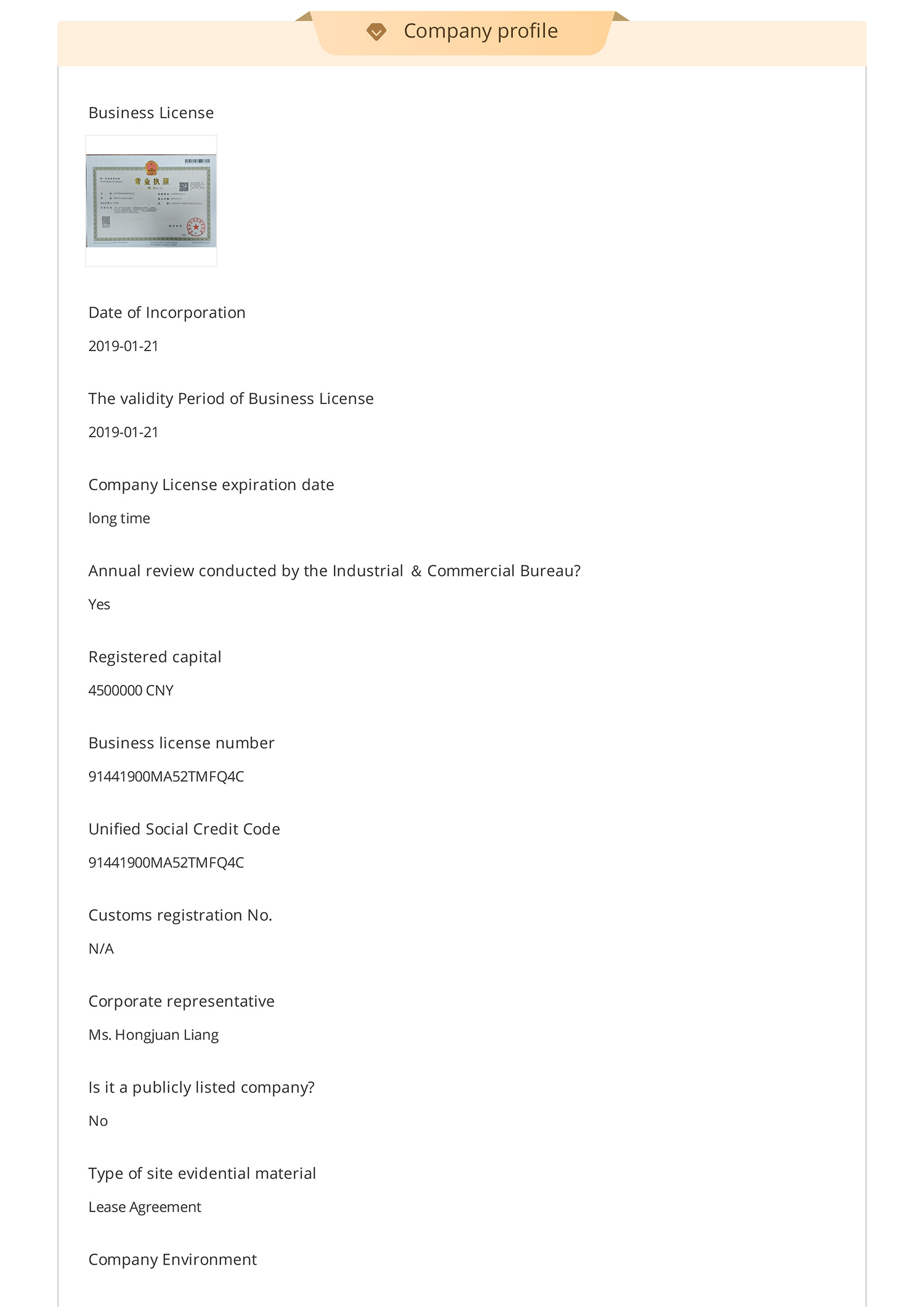 Supplier Assessment Report page for Dongguan Zhende Machine Equipment Co., Ltd, reference 493993448_P+T.
Three points deserve attention when these documents are used in an actual purchase decision.
Scope is supplier-and-range level. The assessment scope is recorded as “Timing Belt”, which covers the timing belt range that includes the AT10 PU timing belt and the 8MGT POLYCHIAN timing belt. It is not a per-SKU certificate issued against a single part number, and it does not extend to unrelated product families. If your project file requires part-level traceability, request the document together with the dimensional inspection records for the batch.
Standards differ by product. The supplier assessment is assessed against the SGS/TUV standard and the factory audit against the Production & Trading Factory Assessment Standard, while the EU RoHS Directive (EU) 2015/863 is recorded as the applicable standard for the 8MGT carbon timing belt. That RoHS reference is a product-standard statement specific to the 8MGT carbon belt; it should not be read across to other profiles without written confirmation.
Validity has an end date. The windows above run from July 2026 to July 2027. A renewal after that date has to be confirmed at the time of ordering, so build the expiry date into your supplier re-qualification calendar rather than assuming continuous coverage. Quality inspection practice supports the same documentation logic: acceptance inspection covers 100% dimensional inspection, appearance inspection, tensile strength testing and pre-shipment quality inspection, and third-party inspection by SGS is accepted.
 TÜV Rheinland Factory Audit Report page — timing belt and timing pulley scope, valid to 2027-07-09.
Step-by-Step Breakdown: A Seven-Step Sourcing Sequence
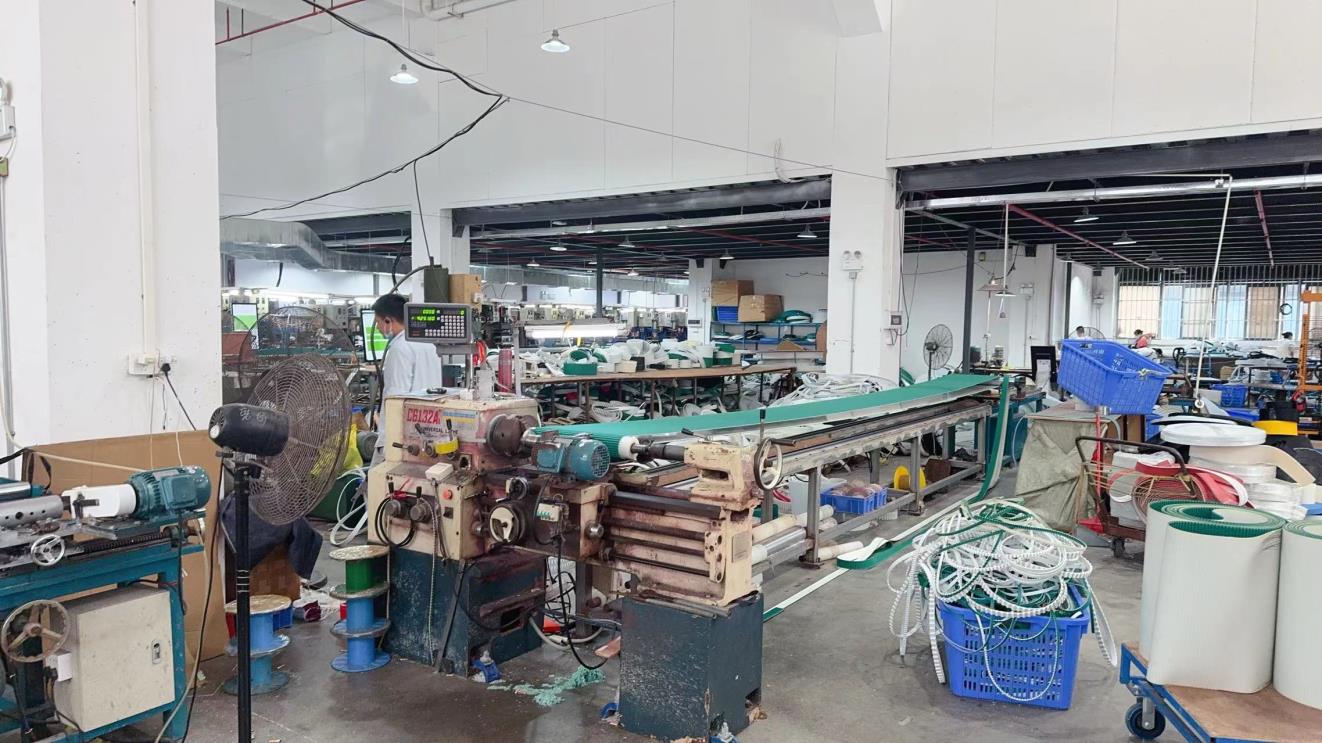 Trimming during production — where custom length, width and coating specifications are converted into a finished belt.
Use Cases: Where Each Profile Belongs
AT10 PU timing belt — high-load transmission and linear motion
Choose AT10 where the drive has to move load at moderate speed over a defined stroke. Typical settings are CNC machinery axes, heavy-duty machine tools, robotics, material handling systems, packaging machinery, printing and textile machinery, food processing equipment and agricultural machinery. The 50.0 mm minimum pulley diameter and steel cord construction suit installations with adequate pulley size and a need for a published tensile figure of 1,700 N per 10 mm belt width.
8MGT POLYCHIAN timing belt — high speed, harsh environment, long service intervals
Choose 8MGT where the drive has to run fast, run cold or hot, or run without lubrication. Typical settings are servo drive systems, compressors, pumps, mining equipment, conveyor equipment and heavy-duty industrial drives. The -54 °C to +85 °C window and excellent oil, chemical and ozone resistance make it the more defensible option when the belt sees process fluids or temperature swing, and the maintenance-free specification suits equipment where re-lubrication is impractical.
Where this two-profile comparison stops
Neither model is the automatic answer for every drive. If the machine is already built around a standard curvilinear rubber application, an HTD 8M rubber belt with 780 N per 10 mm belt width maximum allowable tensile strength and a 40 mm minimum pulley diameter may be the correct baseline instead. The comparison in this article is between the AT10 PU belt and the 8MGT POLYCHIAN belt as certified options; it is not a claim that either one replaces every other profile in the catalogue.
Comparison Table: AT10 PU vs 8MGT POLYCHIAN
| Attribute | AT10 PU timing belt | 8MGT POLYCHIAN timing belt |
|---|---|---|
| Tooth profile | AT10, trapezoidal | 8MGT, GT curvilinear |
| Pitch | 10.0 mm | 8.0 mm |
| Overall thickness | 4.5 mm | 5.6 mm |
| Body material | Polyurethane (PU) | Polyurethane (PU) |
| Tensile member | Steel cord | Carbon fibre cord |
| Tooth facing | — | Nylon fabric |
| Hardness | 92 Shore A | 92 Shore A |
| Minimum pulley diameter | 50.0 mm | 36.6 mm |
| Minimum number of teeth | — | 22 |
| Maximum allowable tensile strength | 1,700 N per 10 mm belt width | — |
| Power transmission capacity | Up to 70 kW | — |
| Maximum belt speed | — | Up to 80 m/s |
| Maximum rotational speed | Approx. 10,000 rpm | — |
| Operating temperature | — | -54 °C to +85 °C |
| Transmission efficiency | — | Up to 98% |
| Oil / chemical / ozone resistance | — | Excellent |
| Maintenance | — | Maintenance-free, no lubrication |
| Applicable product standard | Covered by supplier assessment scope | EU RoHS Directive (EU) 2015/863 |
| Supplier assessment coverage | Production Trading Assessment 493993448_P+T, SGS/TUV, valid 2026-07-10 to 2027-07-09 | Alibaba.com Verified Supplier coverage within the timing belt scope, same reference and validity |
| Dimensional tolerances | ±0.5 / ±0.5 / ±0.2 mm | ±0.5 / ±0.5 / ±0.2 mm |
| Primary design intent | High-load synchronous transmission and precision linear motion | High-speed, wide-temperature, low-maintenance drives |
Where a cell shows “—”, that value is not stated in the available product data for that model. It is an open question to raise with the supplier, not a zero and not a weakness by default.
FAQ
Which certification covers the AT10 PU and the 8MGT POLYCHIAN timing belts?
Both models fall within the timing belt scope of the Alibaba.com Verified Supplier Production Trading Assessment held by Dongguan Zhende Machinery Equipment Co., LTD, certificate 493993448_P+T, assessed against the SGS/TUV standard and valid from 2026-07-10 to 2027-07-09. A TÜV Rheinland Factory Audit Report under the same reference covers timing belt and timing pulley scope against the Production & Trading Factory Assessment Standard and is valid from 2026-07-09 to 2027-07-09. The 8MGT POLYCHIAN belt additionally records EU RoHS Directive (EU) 2015/863 as its applicable standard. Coverage is at supplier-and-scope level, so request the document itself for your project file.
Can Zhende supply custom size AT10 and 8MGT belts with matched pulleys?
Yes. OEM and ODM production is available, with customisation covering belt length, width, tooth profile, tooth pitch, material (rubber or PU), tensile cord (fibreglass, Kevlar or steel), coating, colour, perforation and logo printing. Pulleys are offered in T-series pitches T2.5 to T20, HTD pitches 3M to 14M and imperial pitches MXL to XXH, in aluminium alloy, carbon steel, stainless steel or cast iron, with tooth accuracy to ISO 13050 and DIN standards and concentricity of 0.03 mm or better. Because AT10 and 8MGT are distinct tooth forms, quote the belt and pulley as a matched pair.
What are the MOQ and payment terms?
Minimum order quantity is 10 pcs for standard models and 50 pcs for customized belts. Delivery terms are EXW Dongguan, FOB Shenzhen, CIF, or DDP in selected countries. Payment terms are 70% T/T in advance with 30% T/T before shipment or against a copy of the bill of lading, and PayPal is accepted for sample orders.
Can I validate either belt with a sample before committing to a batch?
Yes. PayPal is accepted for sample orders, and acceptance inspection covers 100% dimensional inspection, appearance inspection, tensile strength testing and pre-shipment quality inspection, with third-party inspection by SGS accepted. That gives an evaluation-stage buyer a documented route from sample to batch without changing supplier.
What is the production lead time for a customized order?
Lead time is 7 to 20 days. Technical selection support and installation guidance are provided, and the quality warranty includes replacement for manufacturing defects within the warranty period. To start a comparison on your own drawing, send the pulley designation, belt width, cord preference and required validity window to liang@zd-stool.com or +86 18002849592 — the team can confirm profile fit and the current assessment reference before you commit to a batch.
Conclusion: Decide on the Pulley, Confirm on the Document
The AT10 PU timing belt wins on published load capacity: 1,700 N per 10 mm belt width, up to 70 kW, approximately 10,000 rpm, with a 50.0 mm minimum pulley diameter. The 8MGT POLYCHIAN timing belt wins on published speed and environment tolerance: up to 80 m/s, -54 °C to +85 °C, excellent oil, chemical and ozone resistance, maintenance-free operation, a 36.6 mm minimum pulley diameter and EU RoHS Directive (EU) 2015/863 as its applicable standard. Neither list makes the other belt unsuitable; they answer different design questions.
The sourcing decision then resolves into a short checklist: match the pulley profile, confirm the minimum pulley diameter fits the layout, size against published figures only, and verify the assessment documents by reference number, standard, scope and validity rather than by badge. Dongguan Zhende Machinery Equipment Co., LTD holds the Production Trading Assessment 493993448_P+T against the SGS/TUV standard and the TÜV Rheinland Factory Audit Report under the same reference, with both windows running into July 2027 — a documented basis for an evaluation that has to survive an audit.
Sample, Quote or Catalogue
Send the pulley designation and the belt width you need, and Zhende will confirm whether the AT10 PU timing belt or the 8MGT POLYCHIAN timing belt fits the drive — with the matching pulley quoted alongside it.
Email: liang@zd-stool.com · Tel / WhatsApp: +86 180 0284 9592
Website: www.zdindustrialbelts.com
Catalogue: Download the Zhende product catalogue (PDF)
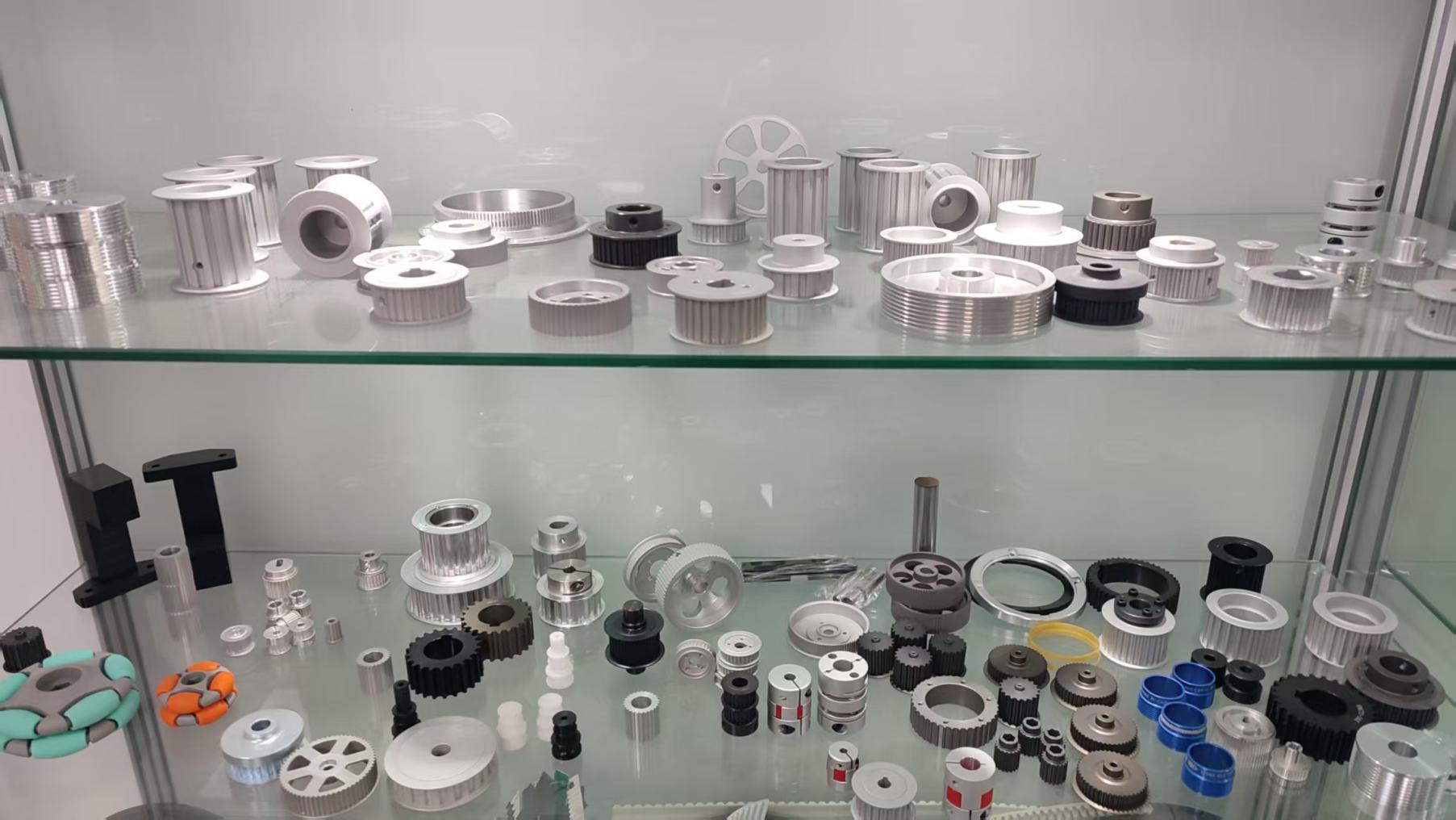 Sample sets are available for profile validation before a production batch is released.
Have Questions or Need More Details?
Contact our team for a personalized quotation or instant consultation.
Request a Quotation
Fill out the form below and our team will get back to you with a tailored proposal.
WhatsApp Direct Chat
Prefer to chat in real-time? Message us on WhatsApp for instant assistance & quick answers.
- Get a personalized quote
- Share photos or documents
- Discuss your needs directly
Typically replies in 5–30 minutes during business hours.