
Choosing Timing Belts for Packaging Machinery: A Review of HTD 8M Solutions
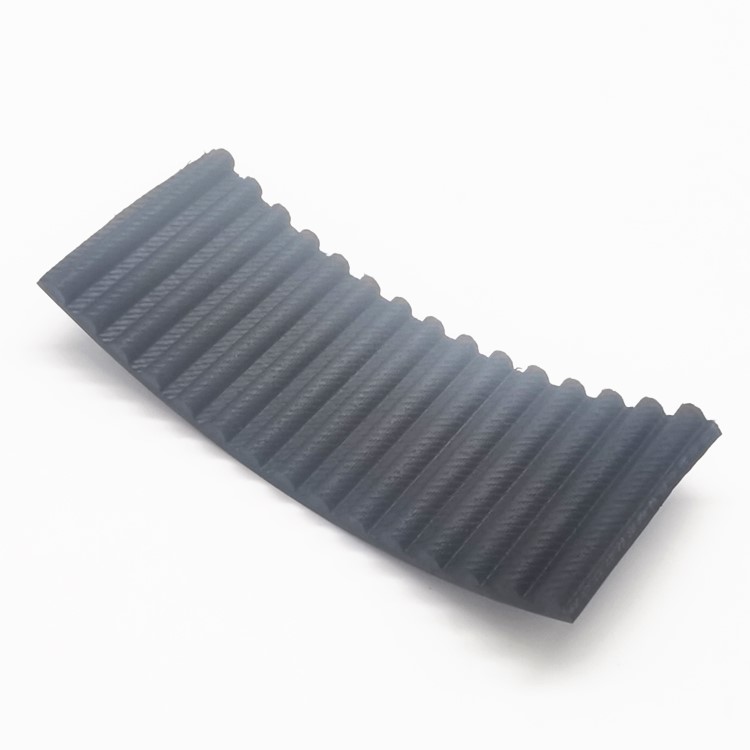
HTD 8M timing belt: 8.0 mm pitch, Neoprene (CR) body, fiberglass cord tensile member, minimum pulley size 16 teeth / 40 mm.
Packaging machinery rarely fails because of its motor. It fails because a drive belt stretches, slips or wears a tooth profile faster than expected, and registration drifts with it. For medium-duty packaging drives built around an 8 mm pitch, an HTD 8M rubber timing belt is a practical and well-understood starting point: a Neoprene (CR) body, a fiberglass cord tensile member rated at 3120 N ultimate strength per 10 mm of belt width, and a minimum pulley size of 16 teeth. This review explains what that specification actually delivers on a packaging line, how to match it with the right pulley, when a different profile is the better engineering answer, and what to verify in a timing belt manufacturer before the first purchase order.
The scope here is deliberately narrow: HTD 8M timing belts used for synchronous power transmission and positioning inside packaging machinery and industrial automation equipment. Trapezoidal profiles, polyurethane systems and larger HTD pitches are discussed only where they are the more suitable choice for the same duty.
Why Packaging Machinery Is Hard on a Drive Belt
A packaging machine is a position-controlled machine. A servo or stepper motor turns continuously, but the machine only does useful work in discrete moves: advance a film by one repeat length, index a carton, rotate a label applicator, close a flap, transfer a case. Every one of those moves depends on the belt carrying torque without changing length. When belt length changes by even a small amount, registration changes with it, and on printed film or a label web that shows up as a misplaced seal, a crooked label, or product that has to be rejected.
Three conditions make packaging duty harder than many other belt applications:
- Start–stop indexing at high cycle counts. Each index applies a torque pulse to the belt teeth, then releases it. Repeated cycling loads the tooth root and the cord, so the belt has to combine tooth shear resistance with a tensile member that resists elongation.
- Small pulley diameters forced by machine geometry. Packaging stations are compact. When the driven pulley is small, fewer teeth are in mesh, tooth load per tooth rises, and the belt bends more sharply around the pulley. Minimum pulley teeth and minimum pulley diameter therefore matter more than they do on large industrial drives.
- Difficult ambient conditions. Powder and sugar dust, oil mist from chains and gearboxes, occasional washdown, and warm enclosures all act on the belt body compound and on the tooth facing.
The visible failure modes are fairly consistent across packaging lines: elongation that cannot be recovered through tensioning, tooth wear or tooth shear on the small pulley, edge wear caused by misalignment, and tooth jump after a tension loss. Most of these trace back to three specification decisions — pitch, minimum pulley size, and body and tensile construction. That is precisely where the HTD 8M profile sits.
Industry Background: A Category Built on Standards and Global Supply
The timing belt category keeps expanding with industrial automation and packaging investment. Independent market research places the global timing belt market on a growth path of approximately 4.8% CAGR through 2030 (Maximize Market Research), while the global automotive timing belt segment alone was valued at USD 7.7 billion in 2025, with China holding the largest regional share of that segment (Grand View Research). Trade records for vulcanized rubber transmission belts under HS Code 4010.39 have consistently listed China among the top origins for shipments into the United States.
That scale is useful to buyers because it shapes availability. Well-known global suppliers in the category include Gates Industrial Corp, Continental AG, Bando Chemical Industries and Mitsuboshi Belting (Fortune Business Insights). Alongside those global brands, regional manufacturers produce the same synchronous profiles in lower volumes, with shorter changeover times for special widths and lengths — which matters when a packaging line needs a non-standard belt rather than a catalogue item.
Standards anchor the category as well. ISO 13050:2022 specifies characteristics for metric pitch curvilinear synchronous endless belts and pulleys, covering the G, H, R and S profile families — the family to which curvilinear HTD tooth geometry belongs. For synchronous drives installed in potentially explosive atmospheres, ISO 9563 and ISO 1813 are the standards commonly referenced for antistatic and electrical conductivity behaviour (ContiTech). On packaging machinery specifically, the profiles that appear most often in supplier application lists are HTD 3M, 5M, 8M and 14M, the STS/STPD S8M profile, and polyurethane profiles such as T5, T10, AT5 and AT10.
The HTD 8M Solution in Detail
The HTD 8M timing belt is a rubber timing belt in the curvilinear "High Torque Drive" family, produced by Dongguan Zhende Machinery Equipment Co., LTD, a manufacturer of FA automation transmission parts based in Dalang Town, Dongguan City, Guangdong Province, China. Its published specification is short enough to state in full:
- Profile: HTD 8M
- Pitch: 8.0 mm
- Overall belt thickness: 5.6 mm
- Body material: Neoprene (CR) rubber
- Tensile member: fiberglass cord
- Hardness: 92 Shore A
- Minimum pulley diameter: 40 mm
- Minimum pulley teeth: 16
- Maximum allowable tensile strength: 780 N per 10 mm belt width
- Ultimate tensile strength: 3120 N per 10 mm belt width
- Dimensional tolerances: width ±0.5 mm, length ±0.5 mm, thickness ±0.2 mm
- Intended use: packaging machinery and industrial automation
On a packaging line, each of those values has a practical consequence rather than being a catalogue formality.
The 8 mm pitch sits in the middle of the useful range. A 5 mm pitch belt such as the HTD 5M carries a maximum allowable tensile strength of 650 N per 10 mm belt width, while the HTD 14M reaches 1816 N per 10 mm belt width with an ultimate strength of 8308 N per 10 mm belt width. The 8M profile at 780 N allowable and 3120 N ultimate covers the medium-duty band between them — the band where most cartoners, labellers, film-feed stations and transfer conveyors actually operate.
Neoprene (CR) with a fiberglass cord is a low-elongation combination. Positional accuracy in an indexing station depends on the belt returning to the same length cycle after cycle. A fiberglass cord tensile member is used precisely because it resists stretch, and the Neoprene body provides the oil and heat behaviour that a machine enclosure demands. The published operating window for the matching HTD pulley is −30 °C to +120 °C, which covers normal packaging hall conditions.
The 16-tooth minimum is a wear limit, not a suggestion. With a minimum pulley diameter of 40 mm at 16 teeth, the belt bends around a defined radius. Going below that pulley size increases bending stress, raises tooth load per tooth, and shortens belt life. Where machine geometry forces a smaller pulley, the drive usually needs a finer pitch rather than a smaller 8M pulley.
Tolerances define what will fit. Width ±0.5 mm, length ±0.5 mm and thickness ±0.2 mm are the limits that determine whether a replacement belt seats correctly on an existing pulley set — particularly on multi-pulley drives where total length error accumulates across the path.

HTD 8M timing pulley: available pitches 3M, 5M, 8M and 14M; tooth accuracy to ISO 13050 / DIN; concentricity ≤0.03 mm.
An HTD 8M belt is only as accurate as the pulley it runs on, so the pulley specification belongs in the same conversation. HTD timing pulleys are available in pitches 3M, 5M, 8M and 14M, in aluminium alloy, carbon steel, stainless steel or cast iron, with 12 to 120 teeth and bore diameters from 5 mm to 100 mm. Bore types include pilot bore, finished bore, taper bore and keyway bore, with hub options of hub, no hub or double hub, and single, double or no flange. Tooth accuracy conforms to ISO 13050 / DIN, concentricity tolerance is ≤0.03 mm, maximum operating speed is up to 8,000 rpm, and 100% dimensional inspection is carried out before delivery. Custom bores, keyways, surface treatments and lightweight designs are available under OEM and ODM arrangements — which is often how a packaging machine builder brings a new station into production without redesigning the frame.
Other 8 mm and trapezoidal options worth knowing
Two alternatives appear frequently in the same conversation. The S8M timing belt uses the STS (STPD) curvilinear 8 mm pitch with a Neoprene (CR) body and fiberglass cord, but requires a larger minimum pulley diameter of 56.0 mm, with a maximum allowable tensile strength of 650 N and an ultimate strength of 2600 N per 10 mm belt width. The 8MGT polyurethane belt with carbon fiber cord and nylon fabric tooth facing is a different construction entirely: minimum 22 teeth / 36.6 mm pulley, maximum belt speed up to 80 m/s, transmission efficiency up to 98%, an operating range of −54 °C to +85 °C, and no lubrication required. Polyurethane profiles in the T and AT families, such as T5, T10, AT5 and AT10, are common where cleanliness, higher speed or a different torque envelope matters more than rubber's grip behaviour.
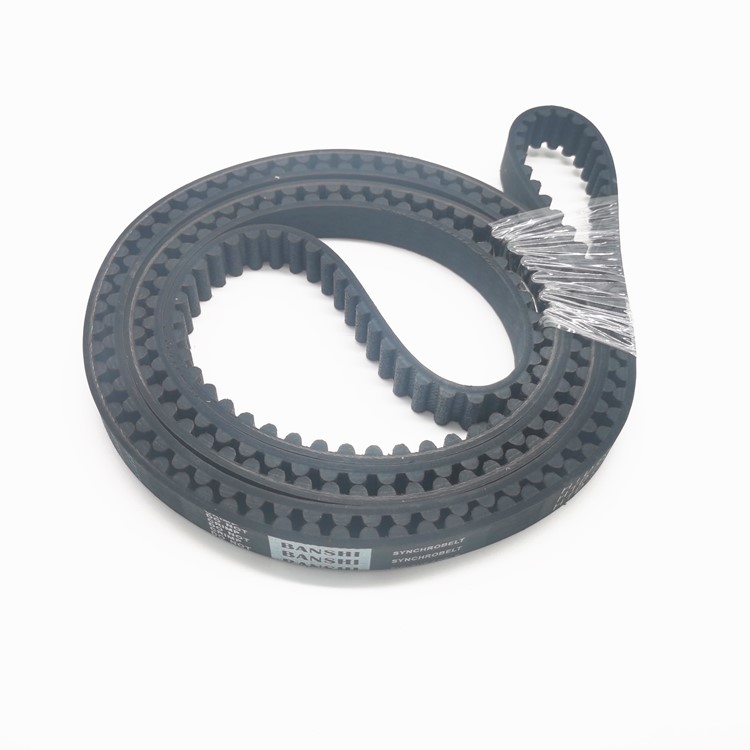
HTD 8M belt detail: 5.6 mm overall thickness, 92 Shore A, fiberglass cord tensile member, tolerances of ±0.5 mm width and length, ±0.2 mm thickness.
Step-by-Step Breakdown: Specifying an HTD 8M Drive
1. Start with the index motion, not the belt
Define the move the station has to make: the mass being accelerated, the distance per index, the cycle time, and the positional tolerance that the product accepts. A label registration station and a case-transfer conveyor may both use 8 mm pitch belts, but the tolerance requirements are not the same, and that difference determines the pulley diameters and belt width.
2. Convert torque and speed into a pitch envelope
Compare the required load against the allowable tensile strength of candidate profiles. HTD 5M offers 650 N per 10 mm belt width, HTD 8M offers 780 N, and HTD 14M offers 1816 N. Where the calculated load sits comfortably inside the 8M envelope, 8M usually provides a better balance of pulley size and belt stiffness than stepping up to 14M.
3. Fix pulley geometry before finalising the belt
Confirm that the smallest pulley on the drive has at least 16 teeth and a pitch diameter of at least 40 mm for HTD 8M. If the machine frame cannot accommodate that, the correct response is to re-evaluate the pitch — usually moving down to HTD 5M with its 25 mm / 16-tooth minimum — rather than to force an undersized 8M pulley.
4. Match body compound and tooth facing to the environment
Neoprene (CR) with a fiberglass cord is the standard choice for general packaging halls. Where the zone involves food contact, chemical exposure or a wider temperature range, polyurethane alternatives such as the 8MGT carbon-cord belt, with its −54 °C to +85 °C range and oil, chemical and ozone resistance, are worth evaluating in the same specification exercise.
5. Check tolerances, width and length against the machine
Belt length tolerance of ±0.5 mm and width tolerance of ±0.5 mm are the figures to compare against the available tensioning travel on the machine. If the tensioner has limited adjustment, choose a supplier who can hold the length at the nominal value rather than at the edge of tolerance.
6. Plan tensioning, alignment and replacement
Most premature failures on packaging drives come from alignment and tension rather than from the belt itself. Set pulley faces parallel, confirm that the belt tracks without edge contact, and record the tensioning value so that maintenance staff can reproduce it at replacement. Keeping one spare belt per critical station shortens unplanned downtime.
7. Verify the supplier and the supply route
Technical fit is only half the decision; the other half is whether the belt can be reordered. Useful checks on a timing belt manufacturer include whether the required profile is produced in-house, whether custom widths and lengths are supported, how inspection is documented, and what the standard shipping time is for repeat orders. Dongguan Zhende Machinery Equipment Co., LTD operates a 4,500 m² facility in Dongguan with approximately 40 staff and a 6-engineer R&D team, an annual production capacity of 120,000 pieces, and a warehouse holding over one million standard items. Regular models can be shipped within 3 days, and custom gears and racks are machined to drawing with a 7-day lead time. Export accounts for 75% of sales, with the EU and the USA as the main markets.
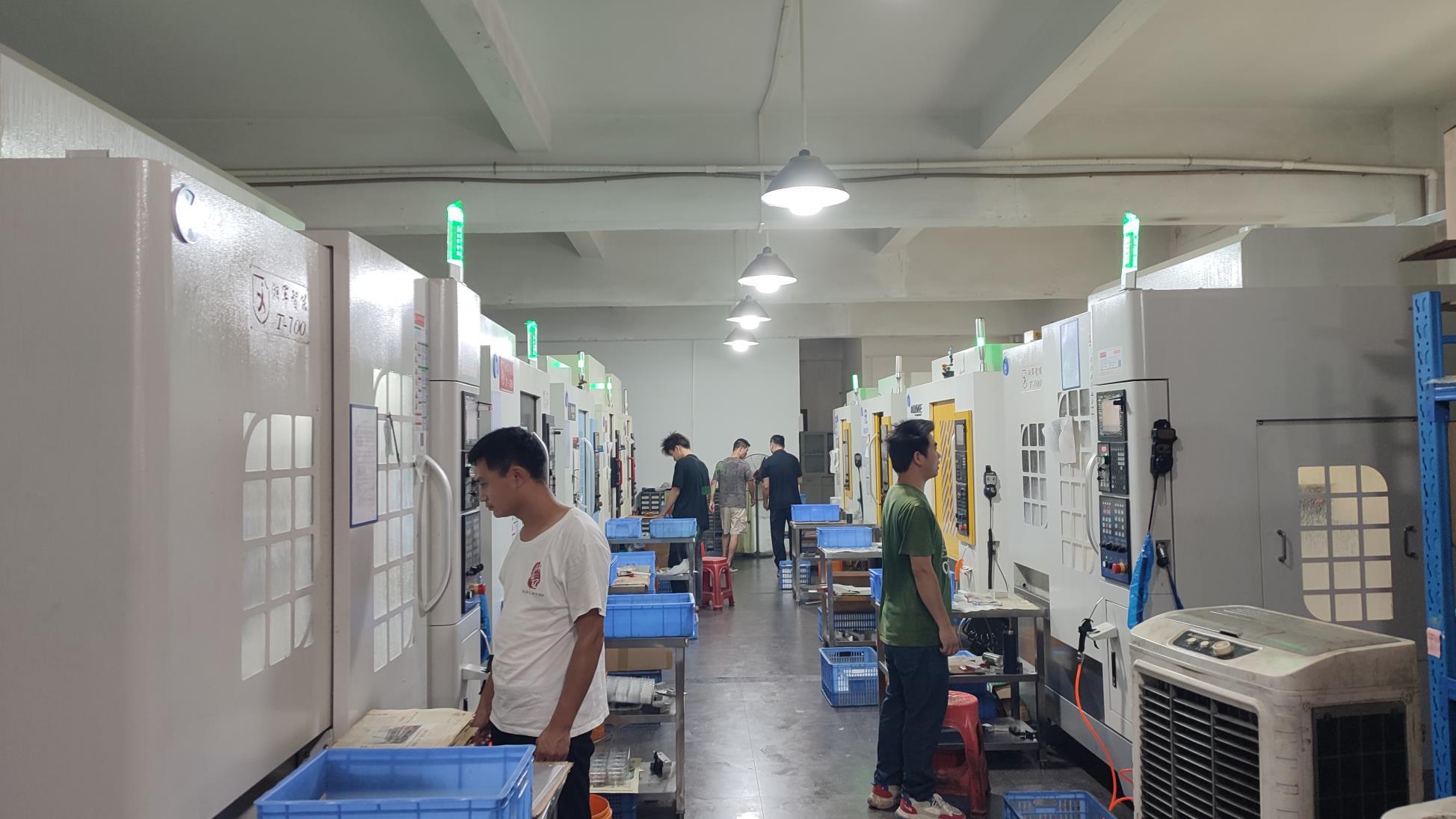
In-house CNC machining: HTD pulleys are produced with tooth accuracy to ISO 13050 / DIN and 100% dimensional inspection before delivery.
Use Cases in Packaging Machinery
Cartoning and case packing
Blank feeding, flap folding and case transfer are indexing motions with defined stop positions. An HTD 8M belt paired with matching HTD pulleys suits this duty where the smallest pulley can be kept at or above 16 teeth.
Labelling and print registration
Registration accuracy depends on belt length stability more than on raw torque capacity. The fiberglass cord construction and the ±0.5 mm length tolerance are the specification points that matter here.
Form-fill-seal film advance
Film feed is a repeated short advance with a hold phase. The 8 mm pitch and 5.6 mm thickness give a stiff belt section that resists deflection across the sealing jaw gap.
Conveyors, transfers and diverter units
Where a transfer unit runs continuously rather than indexing, the same profile works at reduced load, and the 8,000 rpm maximum operating speed of the matching pulley range covers normal conveyor drive speeds.
Food processing and hygiene-sensitive zones
Zones requiring food-grade compounds, anti-static behaviour, oil resistance or custom coatings and perforation are typically handled with polyurethane belts in the T and AT families rather than with Neoprene rubber, with the 8MGT carbon-cord belt covering higher-speed positions.
Comparison Table: HTD 8M and Adjacent Profiles
| Profile | Pitch | Body material | Tensile member | Min. pulley teeth | Min. pulley diameter | Max. allowable tensile | Ultimate tensile | Tolerance (W / L / T) |
|---|---|---|---|---|---|---|---|---|
| HTD 5M | 5.0 mm | Neoprene (CR) | Fiberglass cord | 16 | 25 mm | 650 N / 10 mm | 2600 N / 10 mm | ±0.5 / ±0.5 / ±0.2 mm |
| HTD 8M | 8.0 mm | Neoprene (CR) | Fiberglass cord | 16 | 40 mm | 780 N / 10 mm | 3120 N / 10 mm | ±0.5 / ±0.5 / ±0.2 mm |
| S8M (STS/STPD) | 8.0 mm | Neoprene (CR) | Fiberglass cord | Not stated | 56.0 mm | 650 N / 10 mm | 2600 N / 10 mm | ±0.5 / ±0.5 / ±0.2 mm |
| 8MGT carbon (PU) | 8.0 mm | Polyurethane (PU) | Carbon fiber cord | 22 | 36.6 mm | Not stated | Not stated | ±0.5 / ±0.5 / ±0.2 mm |
| AT10 (PU) | 10.0 mm | Polyurethane (PU) | Steel cord | Not stated | 50.0 mm | 1700 N / 10 mm | Not stated | ±0.5 / ±0.5 / ±0.2 mm |
| HTD 14M | 14.0 mm | Neoprene (CR) | Fiberglass cord | 28 | 124.78 mm | 1816 N / 10 mm | 8308 N / 10 mm | ±1.0 / ±0.5 / ±0.4 mm |
All figures above are drawn from the published product specifications of Dongguan Zhende Machinery Equipment Co., LTD. Hardness for the rubber and polyurethane belts listed is 92 Shore A. "Not stated" indicates that the property is not published in the available specification for that product.
Read across the table and the selection logic becomes visible. HTD 5M wins where pulley space is the binding constraint; HTD 8M covers the widest band of medium-duty packaging indexing duty; S8M suits the same pitch where the existing pulley set dictates a larger minimum diameter; the 8MGT polyurethane belt is the answer when speed, cleanliness and chemical resistance dominate; AT10 and the other trapezoidal PU profiles serve specialised positioning duties; and HTD 14M only becomes economic when the load genuinely requires it, because its 124.78 mm minimum pulley diameter is a large mechanical commitment.
Frequently Asked Questions
Does an HTD 8M timing belt meet the standards used for packaging machinery drives?
ISO 13050:2022 specifies the characteristics of metric pitch curvilinear synchronous endless belts and pulleys, covering the G, H, R and S profile families to which curvilinear HTD geometry belongs. The HTD timing pulleys supplied alongside the belt are specified with tooth accuracy to ISO 13050 / DIN and 100% dimensional inspection before delivery. For drives installed in potentially explosive atmospheres, ISO 9563 and ISO 1813 are the standards commonly referenced for antistatic and conductivity behaviour. Buyers should confirm which documentation their own machinery directive requires before placing an order.
What is the smallest pulley an HTD 8M timing belt can run on?
The published minimum for the HTD 8M belt is 16 teeth, corresponding to a minimum pulley diameter of 40 mm. Running below that limit increases bending stress and tooth load per tooth, and it is one of the most common causes of short belt life on compact packaging stations. The matching HTD pulley range spans 12 to 120 teeth with bore diameters from 5 mm to 100 mm, so the correct pulley for an 8M drive is normally a catalogue item rather than a custom part.
Should a packaging line use HTD 8M, HTD 5M or HTD 14M?
Compare the calculated drive load against the allowable tensile strength of each profile: 650 N per 10 mm belt width for HTD 5M, 780 N for HTD 8M, and 1816 N for HTD 14M. If the load fits inside the 8M envelope, 8M usually gives the best balance of stiffness and pulley size. Choose 5M when the smallest pulley cannot reach 40 mm, and 14M only when the torque requirement exceeds what 8M can carry, since 14M requires pulleys of at least 28 teeth and 124.78 mm diameter.
What should buyers check when selecting a timing belt manufacturer for packaging drives?
Four checks cover most of the risk: whether the required profile and minimum pulley geometry are supported, whether custom sizes, widths and coatings can be produced to drawing, how inspection is documented before shipment, and how quickly repeat orders ship. Dongguan Zhende Machinery Equipment Co., LTD manufactures timing belts and timing pulleys in a 4,500 m² facility in Dongguan, China, with approximately 40 staff, a 6-engineer R&D team and an annual capacity of 120,000 pieces. The company is an authorized agent for HIWIN, THK, NSK, SKF and AirTAC, exports 75% of its output to the EU and the USA, and performs 100% dimensional inspection before delivery.
Can HTD 8M belts be supplied in custom sizes, and how fast are samples and standard items shipped?
Custom sizes are part of the standard offering. Over one million standard items are held in the warehouse, and regular models can be shipped within 3 days; custom gears and racks are machined to drawing with a 7-day lead time. For a new packaging station, the usual next step is a sample or a dimensional drawing review before the first production order. Send the belt length, width, pitch and minimum pulley details to liang@zd-stool.com or +86 18002849592, or use the WhatsApp contact link, and the technical team can confirm whether the HTD 8M configuration fits the drive.
Conclusion: The Practical Next Step
The HTD 8M timing belt earns its place in packaging machinery for a simple reason: it matches a real engineering band. An 8 mm pitch, a 5.6 mm thick Neoprene (CR) body, a fiberglass cord tensile member, 780 N allowable and 3120 N ultimate tensile strength per 10 mm of belt width, and a 16-tooth / 40 mm minimum pulley give a drive that indexes accurately, wears predictably, and can be reordered without a redesign. The specification is easy to verify and easy to compare — which is what makes it a sensible default for medium-duty indexing stations.
The decisions that follow are equally clear. Confirm the load sits inside the 8M envelope. Confirm the smallest pulley reaches 16 teeth and 40 mm. Match HTD pulleys in 3M, 5M, 8M or 14M to the drive, holding concentricity at ≤0.03 mm. Move to polyurethane or carbon-cord constructions where cleanliness, speed or chemical resistance matters more. Then choose a timing belt manufacturer who can supply the standard item in days and the custom size when the machine changes.
Sample, catalogue and quotation
Dongguan Zhende Machinery Equipment Co., LTD supplies timing belts, HTD timing pulleys and FA automation transmission parts from Dongguan, China, with 75% of output exported to the EU and the USA.
Email: liang@zd-stool.com | Tel: +86 18002849592 | Address: Building 1, No. 332 Fumin Middle Road, Dalang Town, Dongguan City, Guangdong Province, China
Website: zdindustrialbelts.com | Download the product catalogue: Zhende Machinery catalogue (PDF)
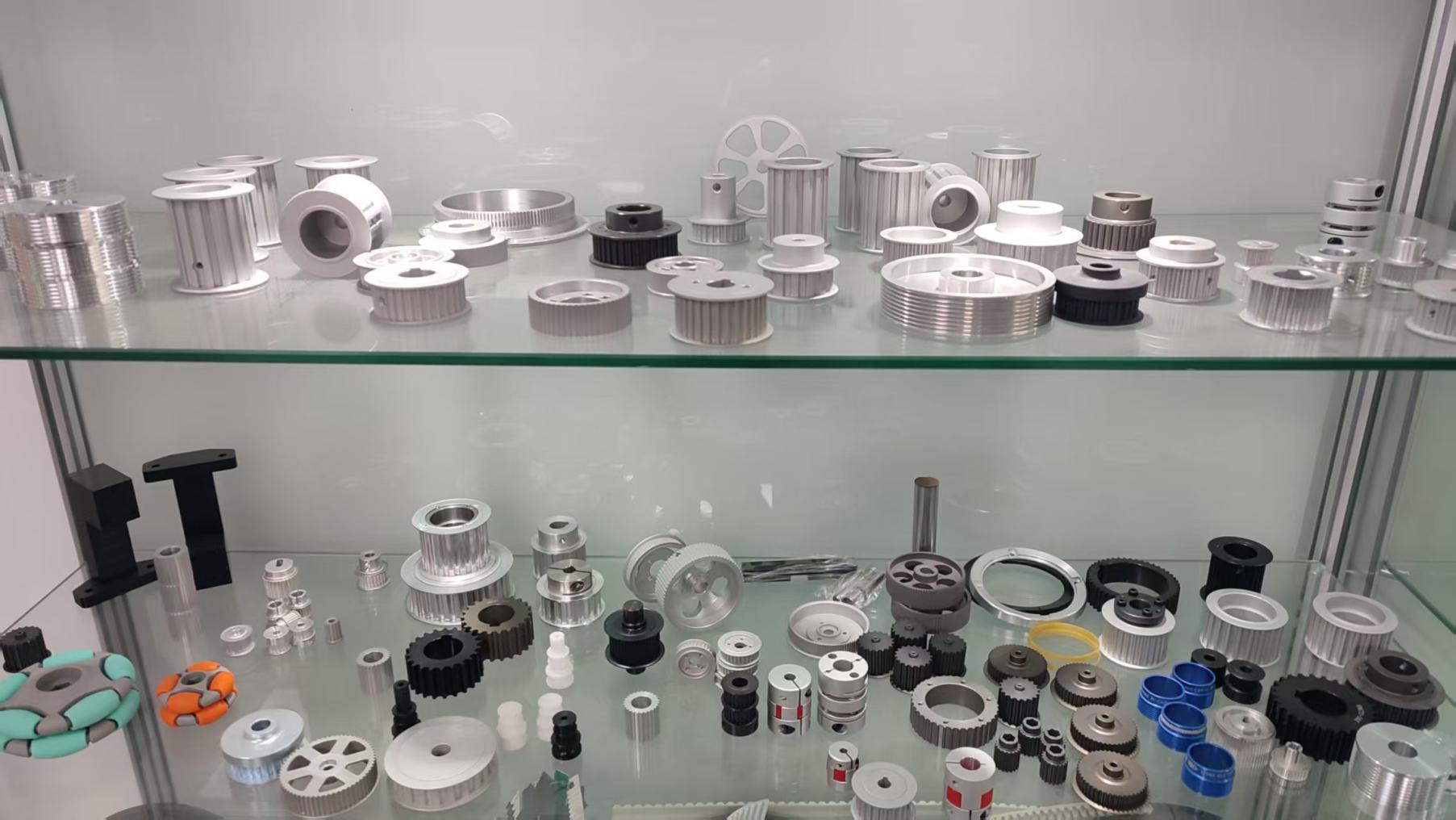
Request an HTD 8M timing belt sample or a dimensional drawing review before the first production order.
Have Questions or Need More Details?
Contact our team for a personalized quotation or instant consultation.
Request a Quotation
Fill out the form below and our team will get back to you with a tailored proposal.
WhatsApp Direct Chat
Prefer to chat in real-time? Message us on WhatsApp for instant assistance & quick answers.
- Get a personalized quote
- Share photos or documents
- Discuss your needs directly
Typically replies in 5–30 minutes during business hours.