
Timing Belt Compliance Guide: SGS/TÜV Assessment, Alibaba Verified Supplier Status, and International Market Readiness
Four different documents arrive with most overseas timing belt quotations — an Alibaba.com Verified Supplier record, a Production Assessment, a Production & Trading Assessment, and an SGS/TÜV Supplier Assessment Report. They are not interchangeable. This guide explains what each one actually proves, how to read a certification number, an assessment type and a validity window, and how to match the verified scope to the belts and pulleys on your bill of materials.
Timing belt certification is one of the few procurement areas where a single word changes the technical and legal meaning of a document. A platform badge is not a factory audit. A factory audit is not a product test. A product standard is not a market-access document. Buyers who treat them as one category of "certification" regularly approve suppliers on the wrong evidence — and discover the gap only when a batch fails incoming inspection or a customs file is questioned.
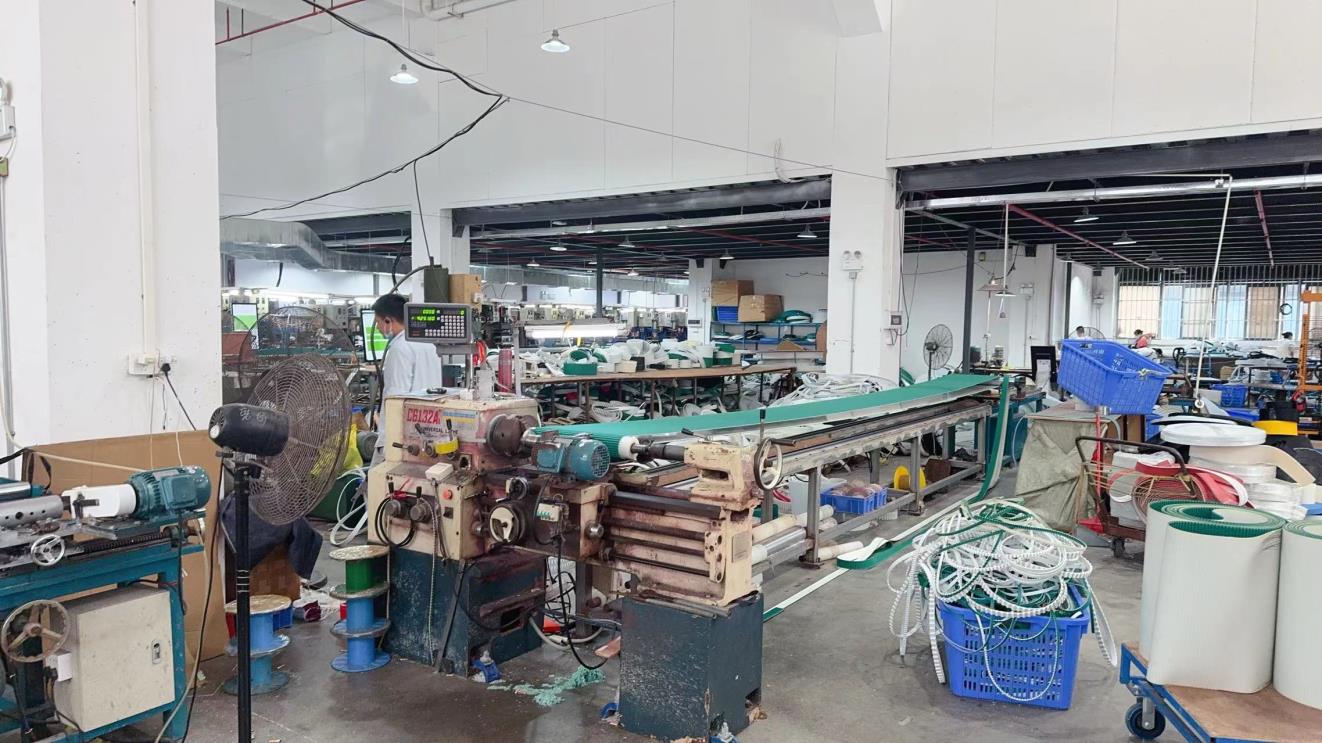
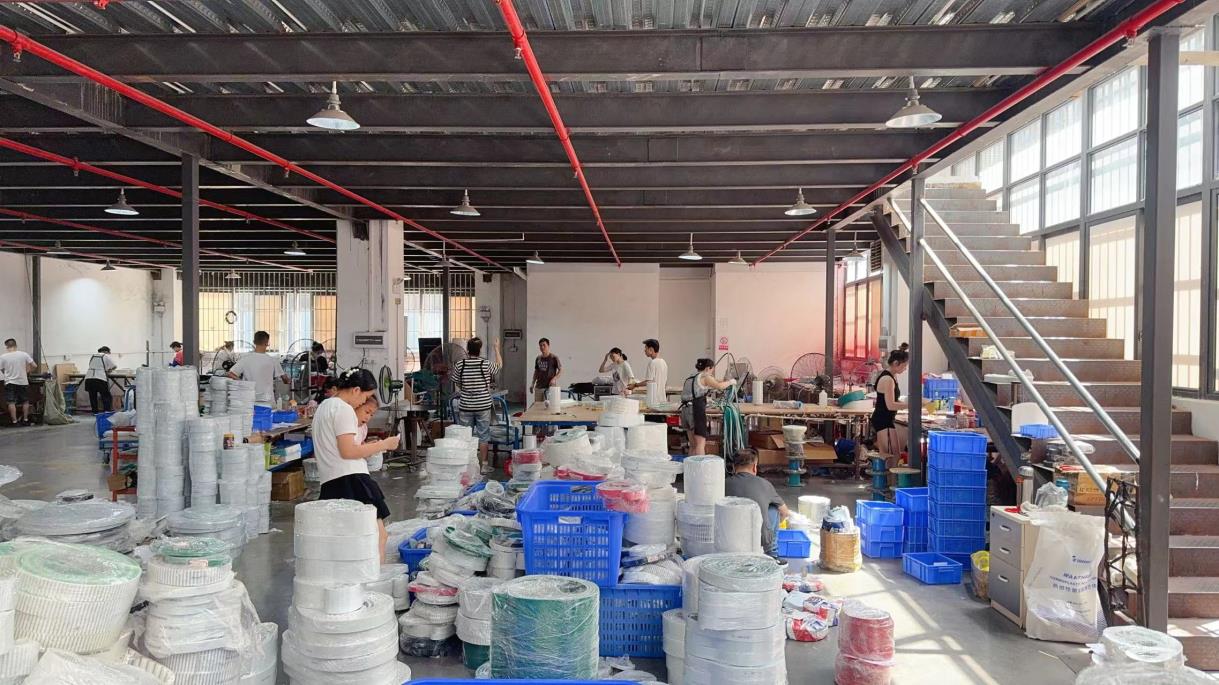
The worked example used throughout this guide is Dongguan Zhende Machinery Equipment Co., LTD, a manufacturer and one-stop procurement service provider of FA automation transmission parts based in Dalang Town, Dongguan, Guangdong, China. The company produces timing belts and timing pulleys and ships to EU and USA markets, and its compliance file contains the document types described below.
The compliance problem: four documents that answer four different questions
The fastest way to remove the confusion is to assign one question to each document. Platform verification answers who is this company. A factory assessment answers can this company actually manufacture. A product standard answers does this belt meet a defined dimensional specification. A directive declaration answers is this product legal to place on my market. No single document answers all four questions.
Three misreadings cause most sourcing errors:
- Treating platform verification as product certification. An Alibaba.com Verified Supplier record confirms the seller entity and its operating status. It says nothing about tooth profile accuracy, allowable tensile strength or dimensional tolerance.
- Treating a company-level audit as a belt-level test result. A factory audit evaluates capability, process control and documentation at the time of the visit. It does not certify the dimensional accuracy of an individual belt delivered six months later.
- Ignoring the validity window and the geographic scope. Factory assessments carry an issue date and an expiry date, and they are frequently written for one specific market. A report covering the EU market is not automatically valid evidence for a different destination.
Industry background: why compliance documents became part of the buying decision
Timing belt demand is growing, and so is the documentation load attached to it. Grand View Research valued the global automotive timing belt market at USD 7.7 billion in 2025, with China holding the largest market share. Maximize Market Research projects the broader global timing belt market to grow at a CAGR of 4.8% through 2030. On the trade side, US customs data for transmission belts of vulcanized rubber under HS Code 4010.39 has listed China among the top origins shipping into the United States.
At the same time, the technical expectations placed on those belts have become more formal. ISO 13050:2022 specifies the characteristics of metric pitch curvilinear synchronous endless belts and pulleys in the G, H, R and S profiles — the family that covers HTD and STD-style products. For synchronous belts used in potentially explosive atmospheres, ContiTech guidance recommends following ISO 9563 and ISO 1813. For goods placed on the EU market, the RoHS Directive (EU) 2015/863 restricts the use of specified substances in covered products.
For a buyer, the practical consequence is that "our supplier is certified" is no longer a usable statement. The usable statement names the document, the issuing body, the number, the scope and the expiry date.
How to read the four verification layers
Layer 1 — Alibaba.com Verified Supplier: entity verification, not performance verification
Alibaba.com Verified Supplier status is a platform-level verification of the business entity. It confirms that the seller is a real, operating company that has gone through the platform's verification process, which is why the status appears on a supplier profile rather than on a product data sheet. Used correctly, it is a first filter for identity — the question of whether you are dealing with a genuine business at all. It is not evidence of tooth profile accuracy, load capacity or material grade, and it should not be quoted as if it were.
Layer 2 — Production Assessment versus Production & Trading Assessment
These two assessment types look almost identical on a certificate and describe two different business models. A Production Assessment is applied to a supplier that manufactures the assessed products. A Production & Trading Assessment is applied to a supplier that both manufactures and trades. The distinction is commercially significant: if your quality system requires a factory that controls its own production, the assessment type is the document that tells you so.
Zhende's compliance file is documented under the Production & Trading Factory Assessment Standard. That description matches the company's operating model — self-owned CNC machining workshops for belts and pulleys, combined with authorized distribution of established global automation brands — and it means the assessed scope covers both manufacturing capability and trading activity rather than only one of them.
Layer 3 — The SGS/TÜV Supplier Assessment Report
This is the on-site audit document, and it is the layer buyers usually ask for first. The Zhende factory audit report is certified by TÜV Rheinland. The certification number is 493993448_P+T, and a second reference number, 494177048_P, appears on the same assessment documentation. The applicable standard is the Production & Trading Factory Assessment Standard. The certificate is issued by TUV and TÜV Rheinland, it applies to the EU market, and the reported validity period runs from 2026-07-10 to 2027-07-09.
Within the same published compliance records, SGS certification is referenced for the Middle East market, and RoHS compliance is listed for various timing belts. Two assessment bodies are not redundancy. Different destination markets and different customer quality systems accept different audit programs, and a supplier that maintains more than one record is easier to fit into an existing vendor approval process.
Layer 4 — Product-level and directive-level compliance
The audit layer cannot cover individual products, so it is always paired with product-level documents. On the belt side, quality control includes 100% dimensional inspection, tensile strength testing, tooth profile inspection, pre-shipment quality inspection and third-party inspection by SGS. On the pulley side, control covers 100% dimensional inspection, bore and tooth profile inspection, concentricity testing and pre-shipment quality inspection, again with third-party SGS inspection available.
For EU placements, the RoHS Directive (EU) 2015/863 declaration sits at this layer. For dimensional performance, ISO 13050:2022 provides the reference framework for metric pitch curvilinear belt and pulley characteristics. For hazardous-environment installations, the ISO 9563 and ISO 1813 references recommended by ContiTech apply at the application design stage rather than as a supplier certificate.
Step-by-step: verifying a timing belt certification before you place an order
Six checks, performed in this order, resolve almost every compliance question raised during supplier evaluation.
- Match the number to the document. Record the certification number on the supplier evaluation sheet next to the report it appears on. In the Zhende file, the TÜV Rheinland factory audit carries 493993448_P+T, with the second reference number 494177048_P on the same documentation. A number quoted in an email without the corresponding report is not verification.
- Confirm the assessment type. Decide whether your sourcing model requires a Production Assessment or a Production & Trading Assessment, then read the certificate to see which one you actually received. If your quality system requires manufacturing control, this single check is more decisive than any marketing claim.
- Check the validity window against your delivery date. The reported period 2026-07-10 to 2027-07-09 is a twelve-month cycle. If your production schedule or repeat-order horizon extends past the expiry date, request the renewal document before the last shipment, not after.
- Check the geographic scope. The TÜV Rheinland certification applies to the EU market. If your goods are destined elsewhere, confirm which document in the supplier's file covers that destination — for example, the SGS reference recorded for the Middle East market.
- Map the certified scope to your bill of materials. Compliance documents cover product families, not order lines. Compare the profile list on the report against your own BOM line by line.
- Cross-check the product-level layer. Confirm the RoHS declaration for EU shipments, and request the dimensional inspection record for the delivered lot together with the third-party inspection report when your incoming quality plan requires one.
What the verified scope covers: timing belts and timing pulleys
The profile families named in the compliance file cover both belt and pulley lines. The belt rows below list the technical figures published for each profile.
| Product | Pitch | Body / tensile member | Key published figures |
|---|---|---|---|
| AT10 PU timing belt | 10.0 mm | Polyurethane / steel cord | 92 Shore A; 1700 N per 10 mm allowable tensile strength; up to 70 kW; minimum pulley diameter 50.0 mm |
| T5 PU timing belt | 5.0 mm | Polyurethane / steel cord | 92 Shore A; 393 N per 10 mm allowable tensile strength; up to 5 kW; minimum pulley diameter 30.0 mm |
| HTD 8M rubber timing belt | 8.0 mm | Neoprene (CR) / fiberglass cord | 780 N per 10 mm allowable; 3120 N per 10 mm ultimate tensile strength; minimum pulley 40 mm, 16 teeth |
| HTD 14M rubber timing belt | 14.0 mm | Neoprene (CR) / fiberglass cord | 1816 N per 10 mm allowable; 8308 N per 10 mm ultimate tensile strength; minimum pulley diameter 124.78 mm, 28 teeth |
| HTD 5M rubber timing belt | 5.0 mm | Neoprene (CR) / fiberglass cord | 650 N per 10 mm allowable; 2600 N per 10 mm ultimate tensile strength; minimum pulley 25 mm, 16 teeth |
| S8M rubber timing belt | 8.0 mm | Neoprene (CR) / fiberglass cord | 650 N per 10 mm allowable; 2600 N per 10 mm ultimate tensile strength; minimum pulley diameter 56.0 mm |
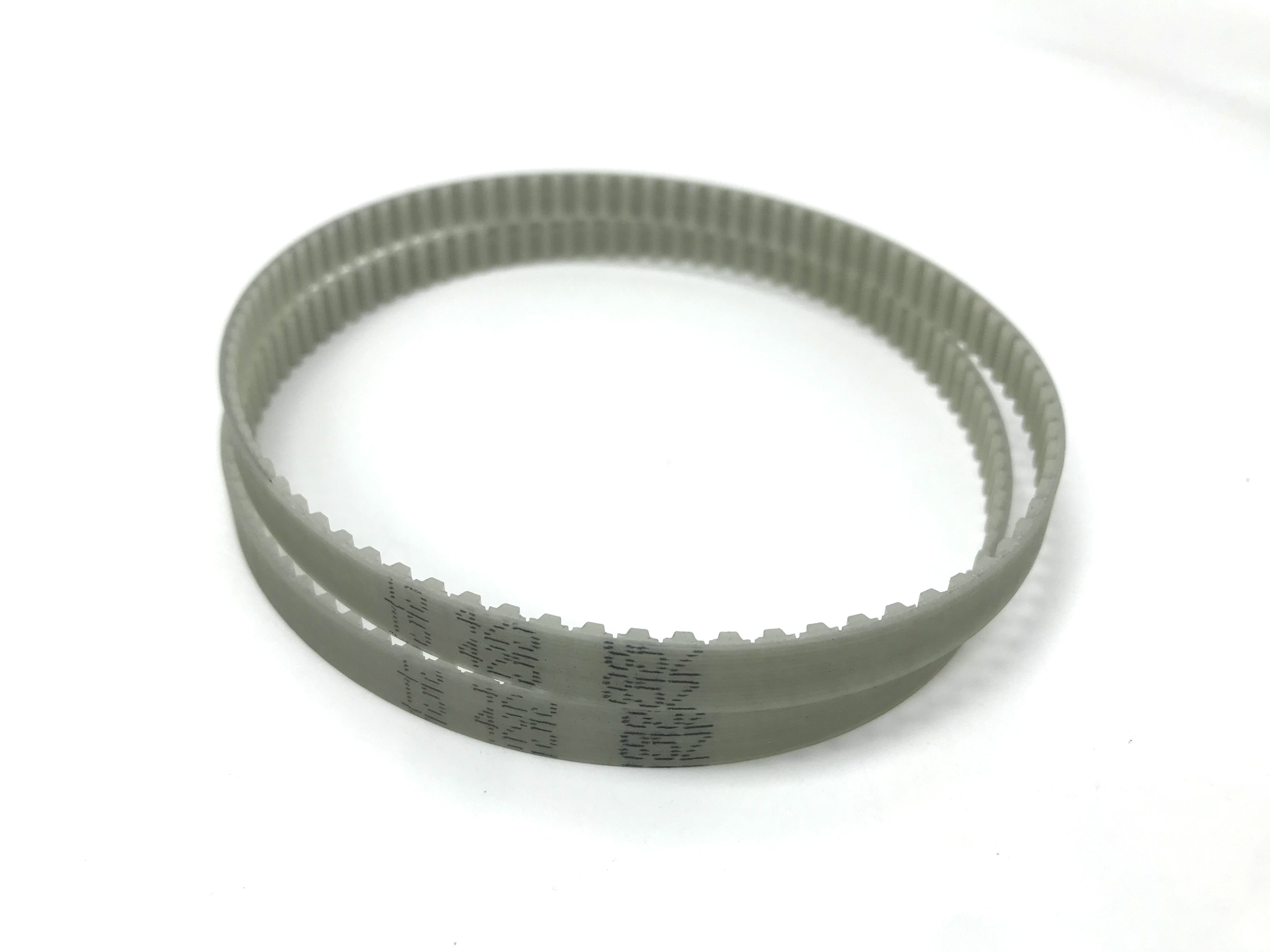
| 8MGT POLYCHIAN timing belt | 8.0 mm | Polyurethane / carbon fiber cord, nylon tooth facing | 92 Shore A; belt speed up to 80 m/s; -54°C to +85°C; transmission efficiency up to 98% |
The pulley families in the same scope carry the following published specifications:
- HTD timing pulleys — pitches 3M, 5M, 8M and 14M; aluminium alloy, carbon steel, stainless steel or cast iron; 12–120 teeth; bore 5–100 mm; tooth accuracy to ISO 13050 / DIN; concentricity ≤0.03 mm; operating speed up to 8,000 rpm; operating temperature -30°C to +120°C.
- T series timing pulleys — pitches T2.5, T5, T10 and T20; 10–120 teeth; bore 3–100 mm; tooth accuracy to ISO 13050 / DIN; radial runout ≤0.03 mm.
- Imperial timing pulleys — pitches MXL, XL, L, H, XH and XXH; 10–120 teeth; bore 3–100 mm; standards referenced RMA, ISO and DIN; finished bore tolerance H7.



Use cases where the verified scope changes the sourcing decision
Compliance documents matter most where the operating conditions are least forgiving. In industrial automation and packaging machinery, timing pulleys used with HTD belts run in 24/7 continuous operation with servo motor drive and variable-speed transmission, under high-speed, high-torque duty in dusty and oil-resistant environments across a temperature range of -20°C to 120°C. In these lines a belt that meets its dimensional specification is not a preference; it is the condition for stable positioning and repeatable machine cycles.
In CNC equipment and robotics, belts such as the S5M rubber profile operate under high-speed transmission and continuous operation conditions and are matched with linear modules and reducers. For new equipment manufacturing projects, additional requirements may apply — certain HTD applications specify food-grade (FDA) requirements and anti-static properties, which sit outside a factory audit document and must be confirmed at the product level instead.
Where precision and noise are both constrained — precision linear drives, labelling equipment, medical devices and office automation equipment — the requirement set typically combines high wear resistance, low elongation, high precision and low noise. Polyurethane belts with steel cord, such as the T5 and AT10 profiles, are commonly specified in these positions because their dimensional tolerances stay tight across width, length and thickness.
Long-term supply programmes provide one further layer of evidence. In one documented programme serving an OEM machinery manufacturer, an automation equipment integrator and an industrial distributor, 8,500 pieces were delivered for a German project and 15,000 pieces for a United States project, running across five years and three years respectively, with reported results including transmission accuracy up 25%, maintenance costs down 40% and equipment downtime down 30%.
Comparing the documents: what each one proves, and what it does not
| Document | Issued / verified by | What it proves | What it does not prove | Reported validity |
|---|---|---|---|---|
| Alibaba.com Verified Supplier | Platform verification process | The seller is a verified, operating business entity | Product performance, dimensional accuracy or material grade | Subject to platform review cycle |
| Production Assessment | Assessment body | The supplier manufactures the assessed products | Trading scope or commercial model | Per assessment report |
| Production & Trading Assessment | Assessment body, under the Production & Trading Factory Assessment Standard | The supplier both manufactures and trades the assessed scope | That each individual SKU was separately tested | Per assessment report |
| SGS/TÜV Supplier Assessment Report | TUV and TÜV Rheinland (certification 493993448_P+T; reference 494177048_P) | On-site factory capability, process control and documentation at audit time, for the EU market | Belt-by-belt or pulley-by-pulley performance in later production lots | 2026-07-10 to 2027-07-09 |
| RoHS Directive (EU) 2015/863 declaration | Directive compliance documentation | Restricted-substance compliance for covered products placed on the EU market | Mechanical performance or dimensional accuracy | Tied to product and documentation revision |
| ISO 13050:2022 | International Organization for Standardization | Characteristics for metric pitch curvilinear synchronous endless belts and pulleys (G, H, R, S profiles) | Factory capability, delivery reliability or commercial terms | Tied to standard revision |
Read as a set, these columns explain why a sourcing team should ask for several documents rather than one. The platform record filters identity, the assessment type filters business model, the audit report filters factory capability, and the directive and standard references filter product fit.
Frequently asked questions
Which certification numbers should a buyer request for timing belts destined for the EU market?
Request the TÜV Rheinland factory audit report and its certificate number. In the Zhende file the certification number is 493993448_P+T, a second reference number 494177048_P appears on the same assessment documentation, the applicable standard is the Production & Trading Factory Assessment Standard, the certificate is issued by TUV and TÜV Rheinland, and it applies to the EU market with a validity period from 2026-07-10 to 2027-07-09. For EU product placement, ask for the RoHS Directive (EU) 2015/863 declaration as well, because a factory audit and a substance-restriction declaration answer different questions.
Which timing belt and pulley profiles are covered by the verified scope?
The belt scope includes AT10 PU, T5 PU, HTD 8M, HTD 14M, HTD 5M rubber, S8M rubber and 8MGT POLYCHIAN timing belts. The pulley scope includes T series pulleys in T2.5, T5, T10 and T20 pitches, Imperial pulleys in MXL, XL, L, H, XH and XXH pitches, and HTD pulleys in 3M, 5M, 8M and 14M pitches. Buyers should still compare the profile list to their own BOM line by line, because a compliance document covers a product family rather than a specific order line.
Does certification change the commercial terms, such as minimum order quantity?
Certification is a documentation and process requirement rather than a separate cost line on the belt itself. What buyers normally negotiate alongside it is the commercial constraint: minimum order quantity is 4 pieces for timing belts, 10 pieces for standard pulley models and 50 pieces for customized pulleys. Monthly capacity is published at 500,000 pieces for belts and 100,000 pieces for pulleys, which is the figure to check when a certified supplier also has to support a ramp-up schedule.
How can a buyer validate a certified timing belt before committing to mass production?
Validation combines documentation and physical checks. Request samples against your drawing, then confirm the product-level inspection records: 100% dimensional inspection, tensile strength testing and tooth profile inspection on belts, and bore, tooth profile and concentricity checks plus 100% dimensional inspection on pulleys. Third-party inspection by SGS is available on both lines, which is useful when your incoming quality plan requires an independent report rather than a supplier-issued one.
What lead time and OEM support should a buyer expect from a custom size timing belt manufacturer in China for OEM projects?
For OEM and ODM projects the published lead time is 7–20 days, with regular models shippable within 3 days from stock. Customization options on belts cover length, width, tooth profile, pitch, material (rubber or PU), tensile cord (fiberglass, Kevlar or steel), coating, colour, perforation and logo printing; on pulleys they cover material, tooth profile, pitch, number of teeth, bore diameter, keyway, flange type, surface treatment and logo engraving. The practical sequence is to confirm the certification scope first, then samples, then the production window against your line schedule. The complete specification set, including the profiles summarised above, is available in the Zhende product brochure (PDF).
Conclusion: read the document, not the badge
Compliance verification on timing belts is not a single event. It is a sequence: confirm the entity, confirm the assessment type, confirm the audit report and its number, confirm the validity window and market scope, then confirm the product-level and directive-level documents that a factory audit cannot cover. In the Zhende file that sequence runs from the Alibaba.com Verified Supplier record and the Production & Trading Assessment, through the TÜV Rheinland factory assessment numbered 493993448_P+T with reference 494177048_P and its 2026-07-10 to 2027-07-09 validity period, to RoHS Directive (EU) 2015/863 compliance and the dimensional, tensile and tooth profile inspections performed on production lots.
Buyers who work through those layers stop relying on the word "certified" and start relying on named documents they can file, date and renew.
Next step: samples, assessment documents and quotes
Dongguan Zhende Machinery Equipment Co., LTD supplies timing belts and timing pulleys to EU and USA markets and can provide assessment documents, profile specifications and sample sets for vendor approval. Request a sample, a quotation or the certification package for your destination market.
Website: www.zdindustrialbelts.com
Product brochure: download the Zhende catalogue (PDF)
Email: liang@zd-stool.com
Tel / WhatsApp: +86 18002849592
Address: Building 1, No. 332 Fumin Middle Road, Dalang Town, Dongguan City, Guangdong Province, China
Have Questions or Need More Details?
Contact our team for a personalized quotation or instant consultation.
Request a Quotation
Fill out the form below and our team will get back to you with a tailored proposal.
WhatsApp Direct Chat
Prefer to chat in real-time? Message us on WhatsApp for instant assistance & quick answers.
- Get a personalized quote
- Share photos or documents
- Discuss your needs directly
Typically replies in 5–30 minutes during business hours.