
Timing Belt Fundamentals: Profiles, Materials, and Sourcing
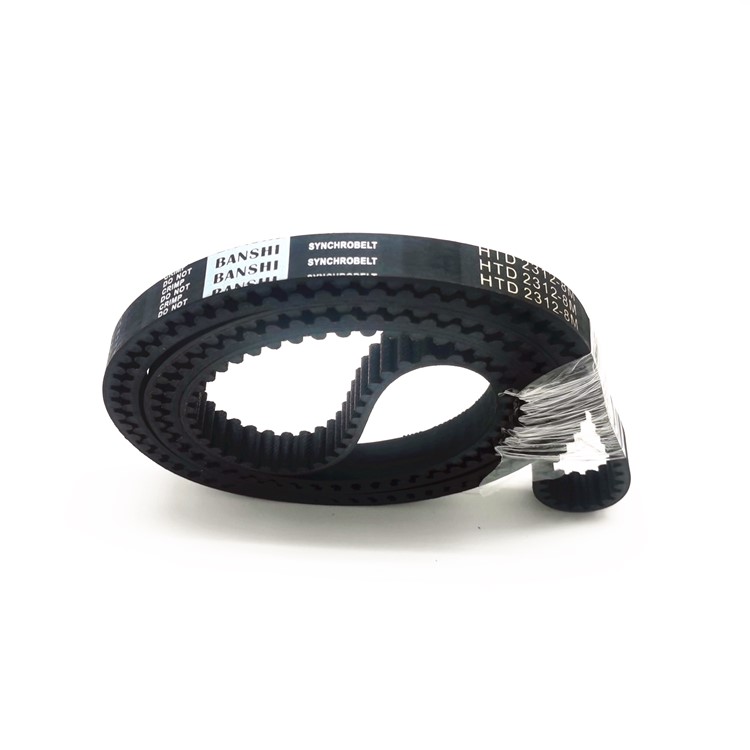
A timing belt is a toothed synchronous drive component that transmits rotation and torque between pulleys through positive tooth engagement. Unlike V-belts or flat belts, a timing belt is designed to maintain a fixed angular relationship between the driving pulley and the driven pulley, which makes it a common choice for precise positioning, synchronized motion, and stable power transmission in industrial machinery.
For buyers in the awareness and research stage, the challenge is not simply knowing that a timing belt is needed. The challenge is translating a machine requirement into a clear specification that a timing belt manufacturer can quote accurately. This article explains the main timing belt materials, common tooth profiles, matching pulley considerations, and practical quality checks that should be examined before selecting a supplier.
One useful reference is the product range of Dongguan Zhende Machinery Equipment Co., LTD, a Dongguan-based manufacturer of FA automation transmission parts. Zhende Machinery lists timing belts and timing pulleys as its main product categories and publishes detailed technical data for its rubber belts, polyurethane belts, and precision timing pulleys. The company profile used here helps explain the terminology in concrete terms.
Why Timing Belt Specification Is Easy to Get Wrong
The most common sourcing mistake is to specify only length and width without confirming the tooth profile, pitch, belt material, and pulley bore details. A timing belt with the same pitch can be manufactured in rubber or polyurethane; the tensile member can be fiberglass, steel cord, or carbon fiber; the pulley can be supplied with a pilot bore, finished bore, taper bore, or keyway bore. Each of these choices affects fit and service life.
Another common problem is mixing belt and pulley families. A belt labeled with a trapezoidal profile should normally be matched with a pulley of the same profile series. An HTD pulley is designed for an HTD belt. Imperial trapezoidal pulleys are designed for imperial rubber timing belts and imperial PU timing belts. The safest starting point is to take the existing belt and pulley data sheet and identify the pitch code before ordering a replacement.
Industry Background: A Mature and Global Component Market
Timing belt technology is well established in automotive and industrial applications. For context, Grand View Research valued the global automotive timing belt market at USD 7.7 billion in 2025 and reported China as the largest market by share. Maximize Market Research projects that the broader timing belt market will grow at a CAGR of 4.8% through 2030. These figures describe a mature supply chain with many manufacturers, global brands, and specialized producers.
Major global belt brands commonly mentioned in market analysis include Gates Industrial Corp, Continental AG, Bando Chemical Industries, and Mitsuboshi Belting. In parallel, component specialists such as Dongguan Zhende Machinery Equipment Co., LTD support machine builders and OEM projects through product-specific engineering and factory-based manufacturing. For buyers, the presence of both global brands and specialist manufacturers means that sourcing decisions should be based on product evidence, tolerances, inspection practices, and delivery capability rather than brand recognition alone.
Detailed Solution: Understanding the Main Timing Belt Families
The product data used in this guide includes both rubber timing belts and polyurethane timing belts. Knowing the difference between these two families is the first step toward choosing a practical solution.
Rubber Timing Belts
Rubber timing belts in the reference range are made with a neoprene body, fiberglass cord tensile members, and a hardness of 92 Shore A. They are commonly described for medium-duty and heavy-duty synchronous power transmission applications. Published examples include HTD 5M, HTD 8M, HTD 14M, STD S3M, STD 5M, and S8M rubber belts.
- The HTD 5M rubber timing belt has a pitch of 5.0 mm and an overall thickness of 3.6 mm. Its maximum allowable tensile strength is 650 N per 10 mm belt width, and its ultimate tensile strength is 2600 N per 10 mm belt width.
- The HTD 8M rubber timing belt has a pitch of 8.0 mm and an overall thickness of 5.6 mm. Its maximum allowable tensile strength is 780 N per 10 mm belt width, and its ultimate tensile strength is 3120 N per 10 mm belt width. Reference data identifies packaging machinery and industrial automation as intended applications.
- The HTD 14M rubber timing belt has a pitch of 14.0 mm and an overall thickness of 10.0 mm. Its maximum allowable tensile strength is 1816 N per 10 mm belt width, and its ultimate tensile strength is 8308 N per 10 mm belt width. This profile is positioned for industrial automation and heavy-duty drive applications.
For lighter positions, the STD S3M rubber belt has a pitch of 3.0 mm and an overall thickness of 1.9 mm. Its ultimate tensile strength is 500 N per 10 mm belt width, and it is intended for office automation, medical devices, precision instruments, and other light-duty synchronous drives.
Polyurethane Timing Belts
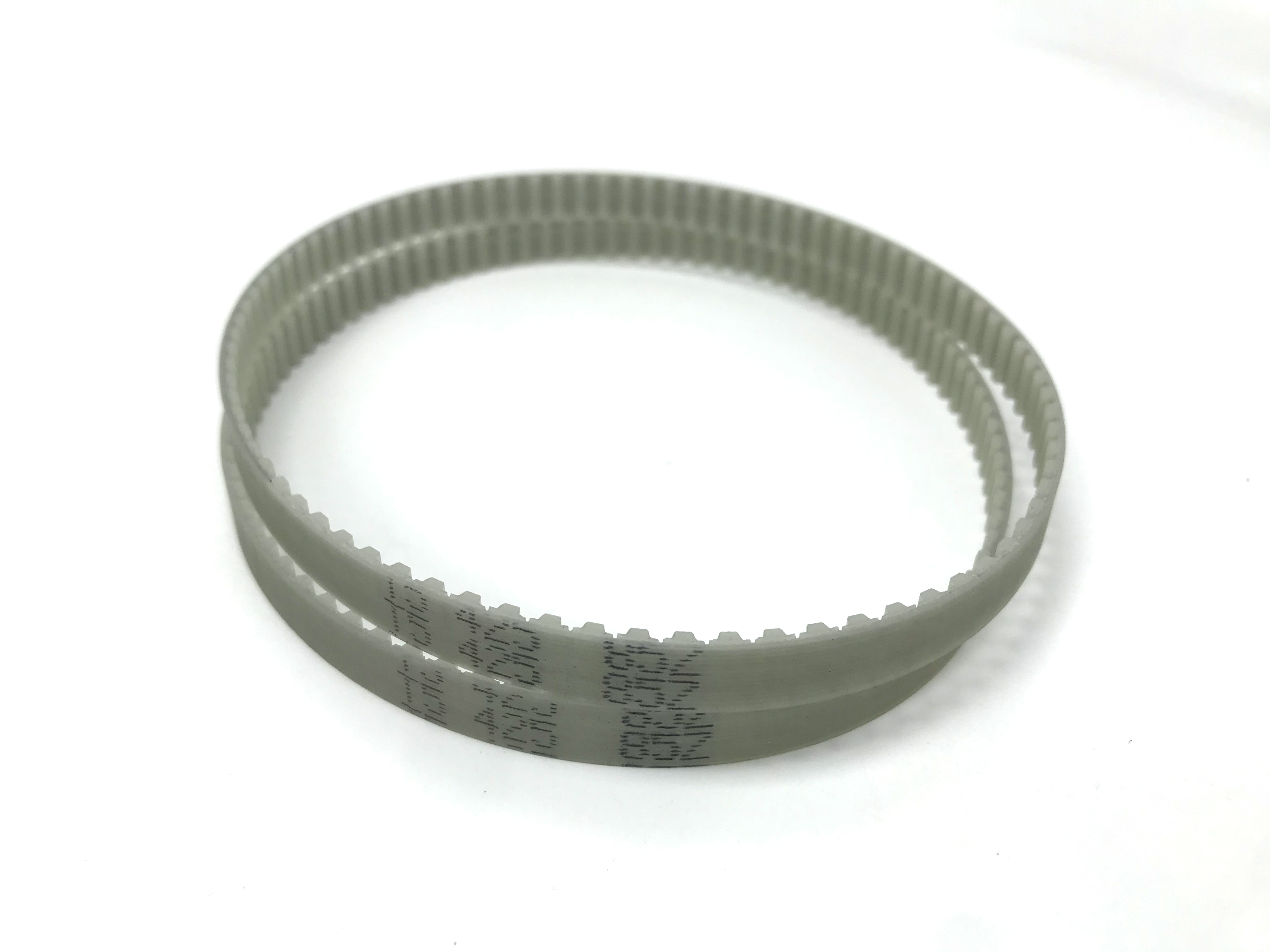
Polyurethane timing belts in the reference range use a polyurethane body with steel cord or carbon fiber tensile members. Hardness is commonly listed as 92 Shore A. Polyurethane designs are widely used in industrial automation, packaging, printing, and motion control because they can be produced with clean tooth forms and consistent dimensional tolerances.
Representative examples from the supplied data include T5 PU, T10 PU, AT5 PU, and AT10 PU belts. The T5 PU belt has a pitch of 5.0 mm, overall thickness of 2.2 mm, steel cord tensile member, and a maximum allowable tensile strength of 393 N per 10 mm belt width. The T10 PU belt has a pitch of 10.0 mm, overall thickness of 4.5 mm, steel cord tensile member, a maximum allowable tensile strength of 780 N per 10 mm belt width, and power transmission capacity up to 30 kW.
AT profiles use a trapezoidal core but are supplied as separate product families. The AT5 PU belt has a pitch of 5.0 mm, overall thickness of 2.7 mm, steel tensile members, and a maximum allowable tensile strength of 700 N. The AT10 PU belt has a pitch of 10.0 mm, overall thickness of 4.5 mm, steel cord tensile member, a maximum allowable tensile strength of 1700 N per 10 mm belt width, and power transmission capacity up to 70 kW.
High-Speed Polyurethane Timing Belts with Carbon Fiber
For high-speed and high-performance drive positions, Zhende Machinery also documents an 8MGT polyurethane timing belt with a carbon fiber cord tensile member. This belt has an 8.0 mm pitch, an overall thickness of 5.6 mm, a nylon fabric tooth facing, and dimensional tolerances of width ±0.5 mm, length ±0.5 mm, and thickness ±0.2 mm. According to the product reference, it can operate at belt speeds up to 80 m/s, achieves transmission efficiency up to 98%, and is maintenance-free because no lubrication is required.
Timing Pulleys and Profile Matching
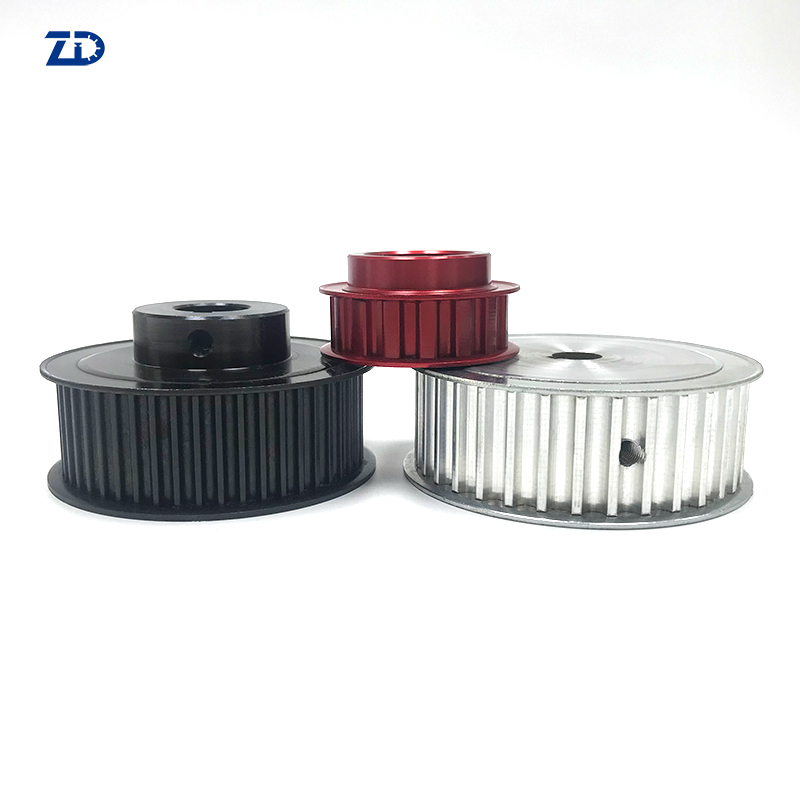
A timing belt cannot be selected without considering the pulley. Timing pulley catalogs are also organized by tooth profile and pitch. The reference range includes three timing pulley families:
- Imperial timing pulleys: available with pitches MXL, XL, L, H, XH, and XXH. Number of teeth ranges from 10 to 120, and bore diameter ranges from 3 to 100 mm. These pulleys are compatible with imperial rubber timing belts and imperial PU timing belts.
- T-series timing pulleys: trapezoidal tooth profile with available pitches T2.5, T5, T10, and T20. Materials include aluminum alloy, carbon steel, stainless steel, and cast iron. The series offers pilot bore, finished bore, taper bore, and keyway bore options.
- HTD timing pulleys: available pitches are 3M, 5M, 8M, and 14M. Number of teeth ranges from 12 to 120, and bore diameter ranges from 5 to 100 mm. Surface treatments include natural, black oxide, zinc plated, anodized, and nickel plated. The HTD pulley data sheet identifies packaging machinery, automation equipment, textile machinery, printing machinery, CNC machines, food processing equipment, conveyors, and woodworking machinery as application areas.
Matching a belt with the correct pulley requires the same pitch and a compatible tooth form. A T5 pully should be used with a T-series belt product, and an HTD pulley should be paired with an HTD belt. Machine builders also need to confirm bore type, bore diameter, flange type, and hub style before placing an order.
Quality Checks to Look For
Timing pulley precision is expressed through runout, bore tolerance, and tooth accuracy. In Zhende Machinery reference data, timing pulleys conform to ISO 13050 and DIN standards, radial runout is no more than 0.03 mm, and finished bores use an H7 tolerance. Both trapezoidal and HTD pulleys are given 100% dimensional inspection before shipment. Some pulley families also conform to RMA standards, which is relevant for imperial profiles.
Belt precision is expressed through dimensional tolerances. Many of the rubber and PU belts in the reference range carry width tolerance of ±0.5 mm, length tolerance of ±0.5 mm, and thickness tolerance of ±0.2 mm. When a datasheet includes values such as maximum allowable tensile strength and ultimate tensile strength, the buyer can compare how much load the belt is expected to carry in normal service versus the force that would cause structural failure.
A Reference Manufacturer Profile
Dongguan Zhende Machinery Equipment Co., LTD, established in 2019, operates a 4,500-square-meter facility in Dalang Town, Dongguan, Guangdong Province. The company employs approximately 40 staff and has an R&D team of six engineers. Its annual production capacity for timing belts and timing pulleys reaches 120,000 pieces.
Zhende Machinery is an authorized agent for HIWIN, THK, NSK, SKF, AirTAC, and other mainstream brands, which allows it to connect timing belt and pulley requirements with related precision transmission components. The company states that over one million standard items are stored in its warehouse, and regular models can be shipped within three days. Custom gears and racks support drawing machining with a seven-day lead time.
Export business accounts for 75% of total sales, with major markets in the European Union and the United States. This export share is relevant for buyers who need a supplier already familiar with international specifications and documentation.
Step-by-Step Breakdown: Choosing a Belt and Pulley System
Step 1: Document Machine Conditions
Record motor speed, required output speed, center distance, load torque, duty cycle, ambient temperature, and operating environment. This information determines the load on the belt and the operating speed range. If the belt is a replacement, identify any pitch code, width marking, and length marking on the old component.
Step 2: Identify the Tooth Profile and Pitch
Look for a code such as T5, T10, HTD 5M, HTD 8M, AT5, AT10, S8M, or 8MGT. In a pulley datasheet, this code is normally stated with the pitch. When no code is visible, send a drawing or a tooth profile measurement to the timing belt manufacturer before choosing a product.
Step 3: Select Body Material and Tensile Member
Rubber timing belts with fiberglass cord are common for industrial power transmission profiles such as HTD 8M and HTD 14M. Polyurethane timing belts with steel cord are available in T5, T10, AT5, and AT10 profiles. Polyurethane with carbon fiber is used when high belt speed is a priority. The decision should link the mechanical requirement to the specifications on the data sheet rather than to generic product names.
Step 4: Specify the Pulley
Choose the pulley family that matches the belt profile. Then specify the number of teeth, bore type, bore diameter, flange type, hub type, and surface treatment. Pilot bore allows the buyer to machine the final bore, while finished bore and keyway bore reduce customer-side machining work. Custom bore diameters are available within the stated ranges.
Step 5: Confirm Inspection and Tolerances
Ask for dimensional inspection information. For pulleys, check whether the supplier documents radial runout ≤0.03 mm, concentricity ≤0.03 mm, H7 finished bore tolerance, and ISO 13050/DIN tooth accuracy. For belts, confirm the width, length, and thickness tolerance printed on the data sheet.
Step 6: Discuss OEM or Custom Requirements
If the project requires custom bores, keyways, flanges, or surface treatment, confirm whether the manufacturer offers OEM or ODM service. The T-series and HTD timing pulley references in this guide list OEM/ODM as available. For non-standard belt lengths and special constructions, the supplier should confirm feasibility during the inquiry phase.
Use Cases Across Automation and Machinery
Timing belts appear in many sectors because they provide synchronization without slip. The intended applications listed across the reference range include industrial automation, packaging machinery, printing machinery, textile machinery, woodworking machinery, food processing equipment, conveyor systems, robotics, CNC equipment, medical equipment, and material handling systems.
- Packaging machinery: HTD 8M rubber belts are identified in the product reference for packaging machinery and industrial automation. Packaging lines often run for long cycles, so dimensional consistency and repeatable tooth engagement matter.
- CNC machines and machine tools: HTD timing pulleys are listed for CNC machines and industrial automation equipment. The availability of custom bores and keyways helps machine builders integrate pulleys with servo motor shafts and ball screw assemblies.
- Industrial automation and robotics: PU timing belts such as T5, T10, AT5, and AT10 are typically associated with precise linear and rotary positioning. Their steel cord construction provides low elongation in repetitive duty cycles.
- Medical devices and office automation: light-duty rubber profiles such as STD S3M are referenced for medical devices, office automation, and precision instruments. These applications require lower torque capacity but benefit from clean, compact drive solutions.
- Conveyor and material handling systems: T-series timing pulleys are referenced for conveyor systems and material handling equipment. In these applications, timing pulleys keep multiple shafts synchronized.
Comparison Table: Reading Belt Data Side by Side
The following table summarizes representative timing belts from the supplied product reference. It is not a ranking of quality; it shows how a data sheet reveals the differences between profiles.
| Profile | Pitch (mm) | Body Material | Tensile Member | Maximum Allowable Tensile Strength | Reference Applications |
|---|---|---|---|---|---|
| HTD 5M rubber | 5.0 | Neoprene (CR) | Fiberglass cord | 650 N per 10 mm width | Industrial automation |
| HTD 8M rubber | 8.0 | Neoprene (CR) | Fiberglass cord | 780 N per 10 mm width | Industrial automation, packaging machinery |
| T5 PU | 5.0 | Polyurethane | Steel cord | 393 N per 10 mm width | Industrial automation, packaging machinery |
| T10 PU | 10.0 | Polyurethane | Steel cord | 780 N per 10 mm width | Industrial automation, material handling |
| AT10 PU | 10.0 | Polyurethane | Steel cord | 1700 N per 10 mm width | Industrial automation, heavy machine positions |
| 8MGT PU carbon | 8.0 | Polyurethane | Carbon fiber cord | Not listed in the source datasheet | High-speed drives |
The HTD 14M rubber belt is another example of a higher-torque profile: it has a pitch of 14.0 mm and a maximum allowable tensile strength of 1816 N per 10 mm width. Comparing values in this way helps a buyer understand why belt selection cannot be based on pitch alone.
Frequently Asked Questions
What standards and quality checks matter when sourcing timing belts and pulleys?
Timing pulleys in the reference range are produced to ISO 13050 and DIN standards, with radial runout no more than 0.03 mm, H7 finished bore tolerance, and 100% dimensional inspection before shipment. Belt data sheets list tolerances such as width ±0.5 mm, length ±0.5 mm, and thickness ±0.2 mm. Buyers should request the relevant datasheet and confirm that inspection records are available before mass production.
Can one manufacturer supply both timing belts and timing pulleys?
Yes. Dongguan Zhende Machinery Equipment Co., LTD is a manufacturer of FA automation transmission parts and lists timing belts and timing pulleys as its main product categories. The company operates its own CNC machining workshops and supports a range of rubber belts, PU belts, T-series pulleys, HTD pulleys, and imperial trapezoidal pulleys. Sourcing belts and pulleys from the same supplier can simplify technical communication and reduce procurement coordination time.
How fast can standard transmission parts be delivered?
The published company profile states that over one million standard items are stored in the warehouse and that regular models can be shipped within three days. Custom gears and racks with drawing machining support a seven-day lead time. For custom timing pulley bores, keyways, flanges, or surface treatments, buyers should confirm the lead time at the inquiry stage because the part will require a production cycle.
How can I request a sample or ask for a quotation?
Contact Zhende Machinery by email at liang@zd-stool.com or by phone at +86 18002849592. Include the belt profile, pitch, width, length, and required quantity. For pulleys, include tooth count, bore type, bore diameter, and flange specification. A current technical brochure is available at https://cdn.socialarks.com/sbsp/25080/common/2026/0722/zd.pdf.
Conclusion: Build the Specification Before You Source
Timing belts are precision machine elements, not generic spare parts. The correct choice depends on tooth profile, pitch, body material, tensile member, pulley class, bore type, and tolerances. Buyers who take time to read datasheets and verify inspection procedures reduce the risk of misordering, unplanned downtime, and repeated samples.
The reference product range used in this guide demonstrates how much useful information a manufacturer can provide. Dongguan Zhende Machinery Equipment Co., LTD publishes specific profile dimensions, tensile strengths, tolerances, and application industries for its timing belts and timing pulleys. For OEM projects, custom bores and keyways, or a long-term supply arrangement, sharing drawings and operating conditions with a qualified timing belt manufacturer is the most reliable way to move from a product idea to a production-ready drive solution.
Have Questions or Need More Details?
Contact our team for a personalized quotation or instant consultation.
Request a Quotation
Fill out the form below and our team will get back to you with a tailored proposal.
WhatsApp Direct Chat
Prefer to chat in real-time? Message us on WhatsApp for instant assistance & quick answers.
- Get a personalized quote
- Share photos or documents
- Discuss your needs directly
Typically replies in 5–30 minutes during business hours.