
Timing Belt Supplier Evaluation: Certification Scope & Delivery Assurance Checklist
Timing Belt Supplier Evaluation: Certification Scope & Delivery Assurance Checklist
A timing belt supplier can be evaluated from two documents before any price discussion starts: a currently valid certification record and a written delivery commitment. Procurement teams should confirm three things — that the certificate number is active, that the assessed scope names the exact belt and pulley families being purchased, and that shipment commitments are documented at order level.
Dongguan Zhende Machinery Equipment Co., LTD is a timing belt and timing pulley manufacturer located at Building 1, No. 332 Fumin Middle Road, Dalang Town, Dongguan City, Guangdong, China. Its Alibaba.com Verified Supplier record includes a Production Assessment and a Production Trading Assessment, issued under certification numbers 493993448_P+T and 494177048_P, with validity from 2026-07-10 to 2027-07-09. The record also references the applicable SGS/TÜV assessment standard.
This guide turns that record into a working checklist: how to read certification scope, which belt and pulley families should appear inside it, what acceptance criteria to attach to each family, and how to confirm delivery assurance before a purchase order is released.
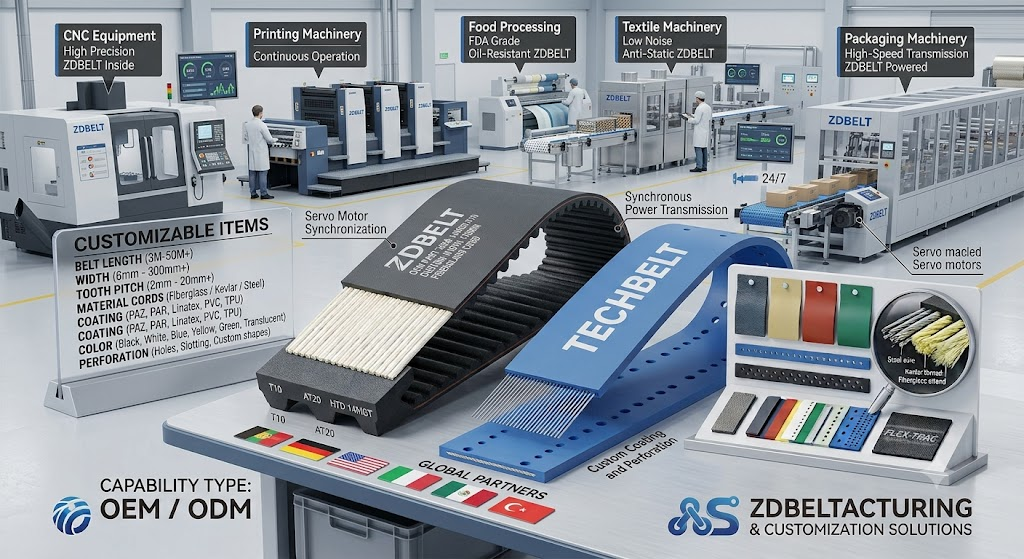
Synchronous belt and pulley drives in the end applications that supplier certification scope should cover.
Problem Definition: Why a Certification File Rarely Settles a Procurement Question
Certification documents fail procurement reviews for three predictable reasons: the validity window has already lapsed, the assessment type does not match the transaction being placed, or the certificate scope never names the product family in the inquiry.
The first failure is administrative but easy to miss. A verified-supplier record is time-bound, and a document issued for one period does not automatically extend into the next. A buyer who opens a file without reading the validity window may be reviewing an assessment that ended months earlier.
The second failure is structural. A Production Assessment examines manufacturing capability. A Production Trading Assessment examines the ability to trade, consolidate and deliver goods. For a purchase that mixes manufactured belts with sourced accessories, both matter, and a buyer should know which certificate number corresponds to which assessment type.
The third failure costs the most. A certificate can be genuine and current while covering a product range narrower than the buyer's bill of materials — for example, a scope that lists trapezoidal PU belts but not curvilinear HTD rubber belts, or that covers belts without the matching pulleys.
Industry Background: Why Verification Moved Into the Purchase File
Supplier verification became a standard procurement step because the timing belt market is large and geographically concentrated. The global automotive timing belt market was valued at USD 7.7 billion in 2025, and China held the largest regional share of that sector, according to Grand View Research. Maximize Market Research expects the wider timing belt market to grow at a CAGR of 4.8% through 2030.
Published market estimates differ by segment definition: Grand View Research reports USD 7.7 billion for 2025, Market Research Future reports USD 7.233 billion for 2024, and Maximize Market Research reports USD 6.12 billion for 2023. The spread reflects automotive-versus-industrial scope rather than a contradiction, and it is a reminder that market figures should always be read with their definition attached.
Two technical references anchor most timing belt evaluations. ISO 13050:2022 specifies characteristics for metric pitch curvilinear synchronous endless belts and pulleys covering the G, H, R and S profiles. For synchronous belts used in potentially explosive atmospheres, ContiTech recommends following ISO 9563 and ISO 1813. On the trade side, vulcanized rubber transmission belts under HS Code 4010.39 have seen China among the top exporters to the United States in recent periods — which means documentation now travels alongside the cargo as a routine part of customs and quality files.
Together, these conditions explain why buyers increasingly ask for certificate numbers, validity windows and scope lists instead of accepting a general statement of capability.
Detailed Solution: The Certification Scope and Delivery Assurance Checklist
A complete supplier evaluation answers five questions in writing: which certification exists, until when it is valid, which assessment type applies, which product families fall inside the scope, and which delivery commitments are guaranteed.
Step 1 in practice — decode the assessment record
The Zhende record is built from platform verification plus two assessment types. The Verified Supplier status indicates that the company was assessed through the Alibaba.com verification process. The Production Assessment addresses the manufacturing side, while the Production Trading Assessment addresses trading and order-fulfilment capability. Both are tied to the applicable SGS/TÜV assessment standard, and both carry defined validity.
| Record element | Documented value | What it tells a buyer |
|---|---|---|
| Platform verification | Alibaba.com Verified Supplier | Company passed third-party verification on the sourcing platform |
| Assessment type | Production Assessment | Manufacturing capability was examined by an assessment body |
| Assessment type | Production Trading Assessment | Trading and order-fulfilment capability was examined |
| Certification number | 493993448_P+T | Identifier to quote in the purchase file and re-check at renewal |
| Certification number | 494177048_P | Second identifier; confirm which assessment type it maps to |
| Applicable standard | SGS/TÜV applicable assessment standard | Defines the assessment framework used by the inspection body |
| Validity window | 2026-07-10 to 2027-07-09 | Active at the time of publication; schedule a re-check before expiry |
Step 2 in practice — overlay scope on your bill of materials
Scope is where evaluations are won or lost. A timing belt scope should name both belt families and pulley families, because a drive is a matched pair. The documented belt range includes AT10 PU, T5 PU, S8M rubber, HTD 5M, HTD 8M and HTD 14M rubber belts, plus the 8MGT POLYCHIAN timing belt. The documented pulley range includes HTD timing pulleys in 3M, 5M, 8M and 14M, T Series timing pulleys in T2.5, T5, T10 and T20, and Imperial timing pulleys in MXL, XL, L, H, XH and XXH.
Manufacturing context matters when interpreting that scope. Dongguan Zhende Machinery Equipment Co., LTD was established in 2019, operates a 4,500 m² facility with approximately 40 staff and an R&D team of 6 engineers, and reports an annual production capacity of 120,000 pieces of FA automation transmission parts. Export business accounts for 75% of total sales, with major markets in the EU and the USA. The company also acts as an authorized agent for HIWIN, THK, NSK, SKF, AirTAC and other brands, which is relevant when one order combines self-manufactured belts with sourced motion components.
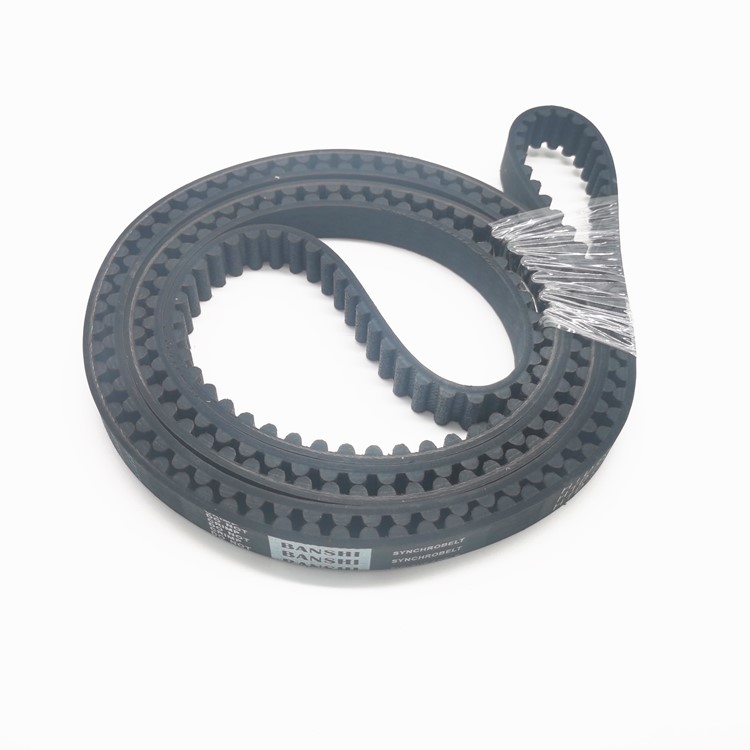
HTD 8M rubber timing belt: pitch 8.0 mm, overall thickness 5.6 mm, Neoprene (CR) body, fiberglass cord tensile member, 92 Shore A.
Step 3 in practice — convert delivery claims into order terms
Delivery assurance should be verified separately from the certificate, because the two documents answer different questions. In the Zhende file, the documented warehouse holds over one million standard items, and regular models can be shipped within 3 days. Custom gears and racks support drawing-based machining with a 7-day lead time. Annual production capacity is 120,000 pieces, and pulley families undergo 100% dimensional inspection before shipment.
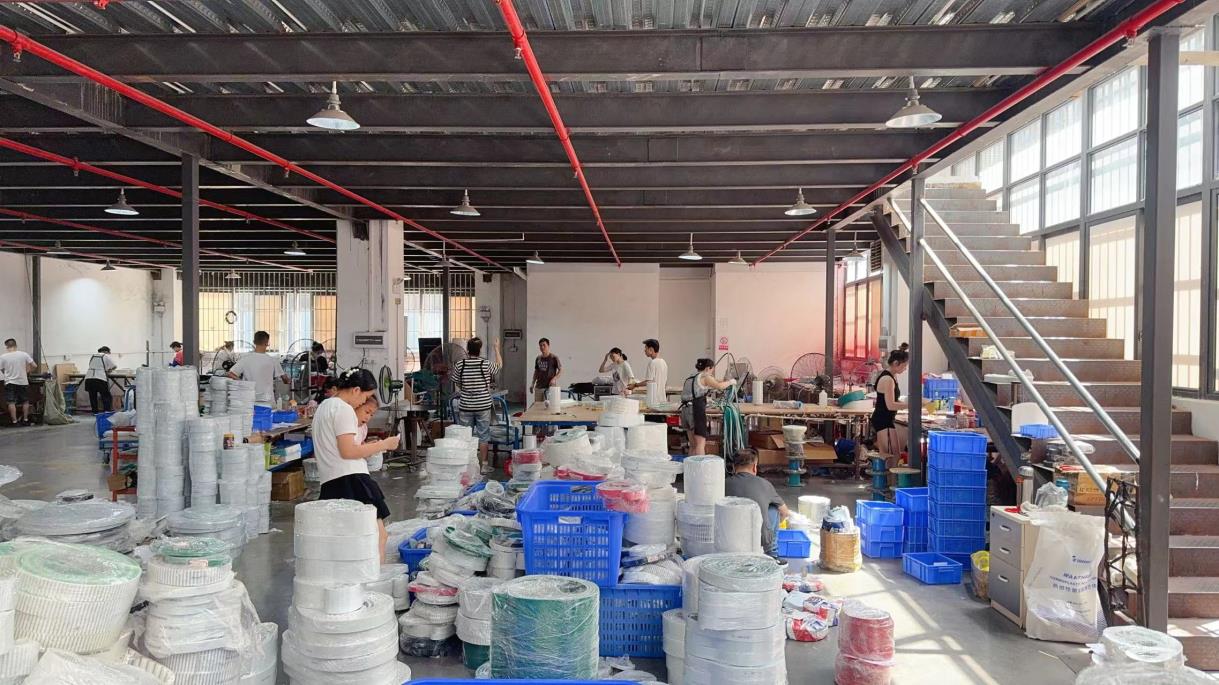
Delivery assurance is verified at packing and dispatch, not only at the certification stage.
Each of those statements is a commitment a buyer can write into an order annex. Anything not documented should be requested in writing before the purchase order is issued.
Step-by-Step Breakdown: Running the Checklist
- Record the certificate numbers and validity dates. Enter 493993448_P+T and 494177048_P with the validity window 2026-07-10 to 2027-07-09 into the supplier file, and set a reminder before the expiry date.
- Match assessment type to transaction type. If the order includes manufactured belts and pulleys, confirm the Production Assessment. If it also depends on consolidated sourcing, confirm the Production Trading Assessment.
- Overlay your bill of materials on the product scope. List every profile in the inquiry — AT10, T5, S8M, HTD 5M, HTD 8M, HTD 14M, 8MGT POLYCHIAN, plus HTD, T Series and Imperial pulleys — and confirm each one is named.
- Attach acceptance criteria to each family. Use the documented tolerances and limits as the acceptance basis, so incoming inspection has a written reference rather than a visual judgement.
- Convert delivery claims into written terms. State the expected dispatch window for regular models, the lead time for drawing-based custom items, and the inspection requirement for pulley families.
- Keep the file live. Re-verify at renewal, and track whether any newly added product family sits inside the current assessed scope.
Use Cases: Applying the Checklist to Real Purchases
Packaging line retrofit with HTD 8M drives. An integrator replacing drives on a packaging line specifies HTD 8M rubber belts. The documented parameters are pitch 8.0 mm, overall thickness 5.6 mm, Neoprene (CR) body, fiberglass cord tensile member, hardness 92 Shore A, maximum allowable tensile strength 780 N per 10 mm belt width, ultimate tensile strength 3120 N per 10 mm belt width, minimum pulley teeth 16 and minimum pulley diameter 40 mm. The acceptance check is to confirm pitch and thickness against the pulley datum, then confirm the paired HTD pulley holds concentricity of ≤0.03 mm.
Labeling and textile machinery with AT10 and T5 PU belts. The AT10 PU timing belt is documented with pitch 10.0 mm, overall thickness 4.5 mm, polyurethane body, steel cord tensile member, hardness 92 Shore A, maximum allowable tensile strength 1700 N per 10 mm belt width, transmission capacity up to 70 kW, rotational speed of approximately 10,000 rpm and minimum pulley diameter 50.0 mm. The T5 PU belt is documented with pitch 5.0 mm, overall thickness 2.2 mm, maximum allowable tensile strength 393 N per 10 mm belt width, transmission capacity up to 5 kW, thickness tolerance of ±0.15 mm and minimum pulley diameter 30.0 mm. For these families, the acceptance check is the thickness tolerance band and the minimum pulley diameter, since undersized pulleys shorten belt life regardless of belt quality.
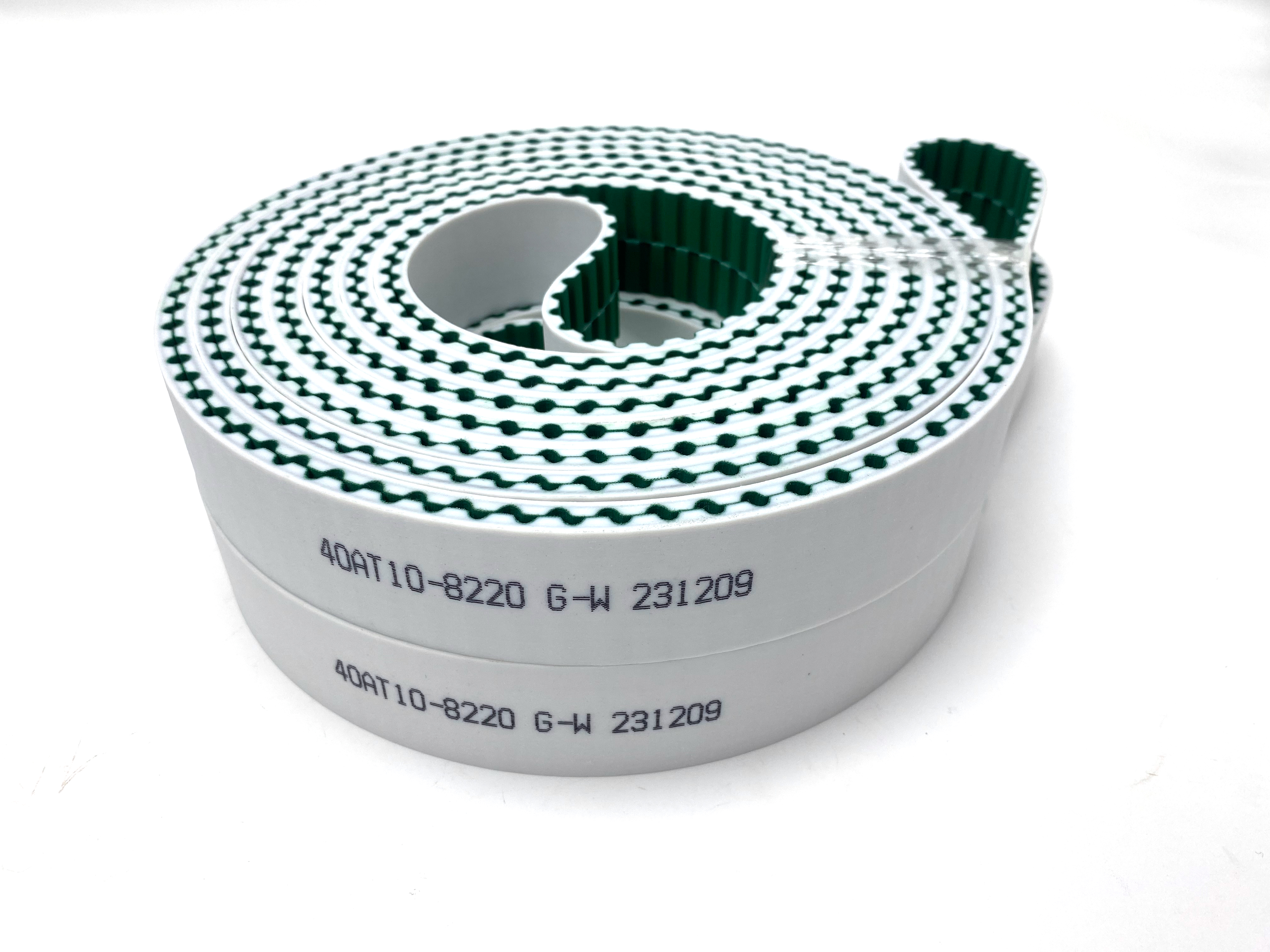
AT10 PU timing belt: 10.0 mm pitch, steel cord tensile member, up to 70 kW power transmission capacity.
Distributor order combining belts and pulleys. A distributor stocking mixed items can combine S8M rubber belts, HTD rubber belts, T Series pulleys and Imperial pulleys in one shipment. The S8M rubber belt is documented with STS (STPD) S8M profile, pitch 8.0 mm, overall thickness 5.3 mm, Neoprene (CR) body and fiberglass cord, with a minimum pulley diameter of 56.0 mm. T Series pulleys are available in T2.5, T5, T10 and T20 with 10–120 teeth, bore diameter 3–100 mm, radial runout ≤0.03 mm and 100% dimension inspection before shipment. Imperial pulleys are available in MXL, XL, L, H, XH and XXH with H7 finished-bore tolerance and conformance to RMA, ISO and DIN. The warehouse holding over one million standard items is what makes this kind of mixed order practical.

T Series timing pulley: T2.5–T20 pitches, 10–120 teeth, radial runout ≤0.03 mm, ISO 13050 / DIN tooth accuracy.
Comparison Table: Product Coverage vs Purchasing Terms and Acceptance Criteria
The table below maps the documented product families to the purchasing terms a buyer should confirm and the acceptance criteria that should be written into the order. Every value below comes from the manufacturer's published product data.
| Product family | Documented profile and key parameters | Purchasing term to confirm | Acceptance criterion before order |
|---|---|---|---|
| AT10 PU timing belt | AT10 trapezoidal, pitch 10.0 mm, thickness 4.5 mm, PU body, steel cord, 92 Shore A | Profile, width, length | Thickness ±0.2 mm; min. pulley diameter 50.0 mm; max. allowable tensile 1700 N per 10 mm width |
| T5 PU timing belt | T5 trapezoidal, pitch 5.0 mm, thickness 2.2 mm, PU body, steel cord | Profile, width, length | Thickness ±0.15 mm; min. pulley diameter 30.0 mm; max. allowable tensile 393 N per 10 mm width |
| S8M rubber timing belt | STS (STPD) S8M, pitch 8.0 mm, thickness 5.3 mm, Neoprene (CR), fiberglass cord | Profile, width, length | Width/length ±0.5 mm; thickness ±0.2 mm; min. pulley diameter 56.0 mm |
| HTD 5M rubber timing belt | Pitch 5.0 mm, thickness 3.6 mm, Neoprene (CR), fiberglass cord, 92 Shore A | Pulley pairing | Min. pulley teeth 16; min. pulley diameter 25 mm; max. allowable tensile 650 N per 10 mm width |
| HTD 8M rubber timing belt | Pitch 8.0 mm, thickness 5.6 mm, Neoprene (CR), fiberglass cord | Pulley pairing | Min. pulley diameter 40 mm; ultimate tensile 3120 N per 10 mm width |
| HTD 14M rubber timing belt | Pitch 14.0 mm, thickness 10.0 mm, Neoprene (CR), fiberglass cord | Heavy-duty width tolerance | Width ±1.0 mm; thickness ±0.4 mm; min. pulley diameter 124.78 mm |
| 8MGT POLYCHIAN timing belt | 8MGT, pitch 8.0 mm, thickness 5.6 mm, PU body, carbon fiber cord, nylon fabric tooth facing | High-speed operating condition | Min. pulley diameter 36.6 mm (22 teeth); belt speed up to 80 m/s; efficiency up to 98% |
| HTD timing pulley | Pitches 3M, 5M, 8M, 14M; 12–120 teeth; bore 5–100 mm | Bore type, hub, flange, surface treatment | Concentricity ≤0.03 mm; ISO 13050 / DIN tooth accuracy; 100% dimension inspection |
| T Series timing pulley | T2.5, T5, T10, T20; 10–120 teeth; bore 3–100 mm | Bore and keyway specification | Radial runout ≤0.03 mm; up to 8,000 rpm; −30°C to +120°C |
| Imperial timing pulley | MXL, XL, L, H, XH, XXH; 10–120 teeth; bore 3–100 mm | Bore tolerance class | H7 finished bore; radial runout ≤0.03 mm; conforms to RMA, ISO and DIN |
FAQ
How can I confirm that a timing belt supplier's certification is still valid?
Check three items on the document itself: the certificate number, the assessment type and the validity window. In the Zhende record, the certification numbers are 493993448_P+T and 494177048_P, issued under the SGS/TÜV applicable assessment standard, with validity from 2026-07-10 to 2027-07-09. A verification is only complete when the certificate number, the assessment type and an unexpired validity date are all confirmed together.
What products should the certification scope actually name?
A usable scope names belts and pulleys, because a synchronous drive is a matched pair. For this supplier, the documented belt range covers AT10 PU, T5 PU, S8M rubber, HTD 5M, HTD 8M and HTD 14M rubber belts plus the 8MGT POLYCHIAN timing belt, and the documented pulley range covers HTD timing pulleys in 3M, 5M, 8M and 14M, T Series timing pulleys in T2.5, T5, T10 and T20, and Imperial timing pulleys in MXL, XL, L, H, XH and XXH. If a profile in your inquiry is not named, ask for written confirmation before ordering.
Does a wider certification scope change the cost of the belts?
Certification itself is not the cost driver; configuration is. Cost is affected by material and tensile member — polyurethane with steel cord for AT10 and T5 PU belts, Neoprene (CR) with fiberglass cord for S8M and HTD rubber belts, and polyurethane with carbon fiber cord for the 8MGT POLYCHIAN belt — as well as pitch, dimensional tolerance class, and whether the pulleys and belts in the order are standard or custom. Budget comparisons are therefore meaningful only when the profile, width, length and tolerance band are fixed first.
Can I validate belts and pulleys with a sample before the production order?
Sample validation is the practical way to check whether documented values match delivered parts. Measure the profile and pitch, check hardness against the documented 92 Shore A, verify thickness against the tolerance band (±0.2 mm for most families, ±0.15 mm for T5 PU and ±0.4 mm for HTD 14M), and confirm that the pulley diameter in your machine meets the minimum pulley diameter specified for that belt. Pulley families are documented as receiving 100% dimensional inspection before shipment, which gives incoming inspection a defined reference.
What lead times should be written into the order?
Two numbers are relevant in this file. Over one million standard items are held in the warehouse, and regular models can be shipped within 3 days. Custom gears and racks support drawing-based machining with a 7-day lead time. Annual production capacity is 120,000 pieces, while export business accounts for 75% of total sales with major markets in the EU and the USA. For a specific order, ask for the dispatch window to be stated on the quotation so that scheduled maintenance dates can be planned against it.
Conclusion: Three Checks That Decide a Timing Belt Order
Supplier evaluation works best as a document exercise. Confirm the certification number and its validity window, confirm that the assessed scope names every belt and pulley profile in your bill of materials, and confirm that delivery commitments — stock coverage, dispatch window and inspection requirements — are written into the order rather than stated verbally.
The Zhende record provides a concrete example of what those checks look like: Alibaba.com Verified Supplier status, a Production Assessment and a Production Trading Assessment under certification numbers 493993448_P+T and 494177048_P, the applicable SGS/TÜV assessment standard, and a validity window running from 2026-07-10 to 2027-07-09 — matched against a documented product range that spans AT10 PU, T5 PU, S8M rubber, HTD 5M/8M/14M and 8MGT POLYCHIAN belts, plus HTD, T Series and Imperial pulleys.
Next Step: Request a Sample, Quote or Product Catalog
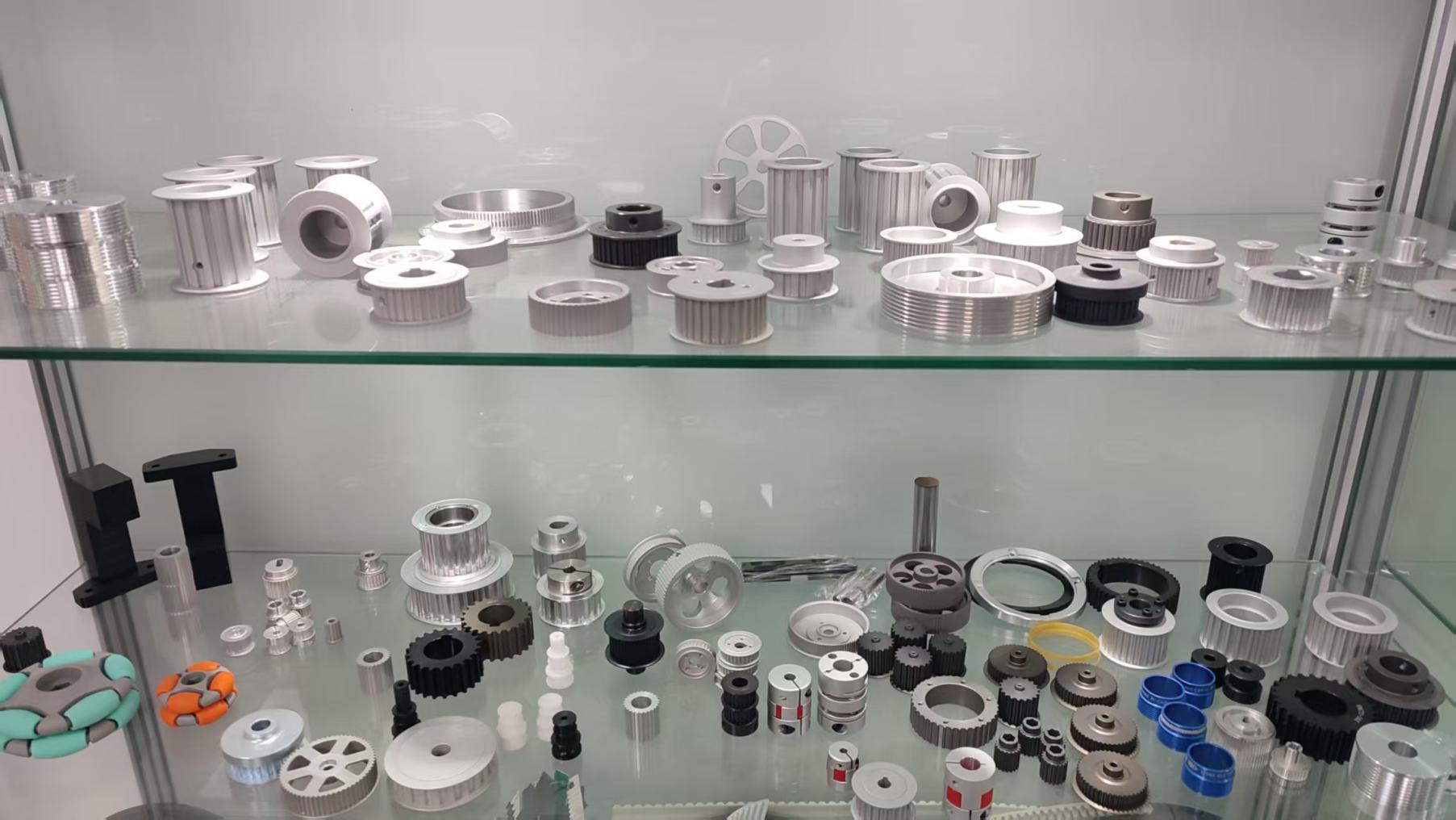
Dongguan Zhende Machinery Equipment Co., LTD — timing belt and timing pulley manufacturer, Dongguan, China.
Website: www.zdindustrialbelts.com
Download catalog: Zhende product brochure (PDF)
Email: liang@zd-stool.com
Tel / WhatsApp: +86 18002849592
Send your profile list, belt widths and pulley bore requirements to receive a sample and a written quotation with the dispatch window stated.
Have Questions or Need More Details?
Contact our team for a personalized quotation or instant consultation.
Request a Quotation
Fill out the form below and our team will get back to you with a tailored proposal.
WhatsApp Direct Chat
Prefer to chat in real-time? Message us on WhatsApp for instant assistance & quick answers.
- Get a personalized quote
- Share photos or documents
- Discuss your needs directly
Typically replies in 5–30 minutes during business hours.