
Timing Belt Technical Guide: Pitch, Profile, Tolerances, and Tensile Strength
A timing belt's usable capacity is set by four specification layers - tooth profile, pitch, dimensional tolerance, and tensile member strength - and the drive it can power is limited by whichever layer is weakest. Several profile families share the same pitch number while differing in tooth geometry, minimum pulley diameter, and rated load per 10 mm of belt width, so a pitch-only comparison cannot predict performance.

HTD 5M timing belt: 5.0 mm pitch, 3.6 mm overall thickness, neoprene (CR) body, fiberglass cord, 92 Shore A.
Introduction: Reading a Timing Belt as Four Interlocking Specifications
A timing belt data sheet normally lists profile, pitch, thickness, body material, cord type, tolerance and hardness. What it rarely states is how those fields connect to mechanical limits in service: the smallest pulley the belt can wrap without over-stressing the tooth root, the tension it can carry continuously, the load at which it fails, and the dimensional window its width, length and thickness must stay inside so that the drive still indexes accurately.
This guide links each published value to the limit it controls, using specification data for HTD 5M, HTD 8M and HTD 14M belts; STD/STS (STPD) S3M, S5M and S8M belts; T5 and T10 polyurethane belts; AT5 and AT10 polyurethane belts; and the 8MGT polyurethane belt with carbon fiber cord, together with the matching HTD, T-series and imperial timing pulleys supplied by Dongguan Zhende Machinery Equipment Co., LTD.
Problem Definition: Why One Pitch Number Is Not a Specification
The most frequent specification error in synchronous drive design is treating pitch as the identifier of a belt family. Pitch is the linear distance between tooth centres, and the same pitch is shared across profile families that are not interchangeable in either tooth geometry or load capacity.
At 5.0 mm pitch alone, this data set contains four different belts. Their maximum allowable tensile strength ranges from 300 N to 700 N per 10 mm of belt width, and their minimum pulley diameter ranges from 22.3 mm to 30.0 mm. A designer who substitutes one for another on pitch alone can overload a lower-rated belt, mismatch pulley tooth geometry, or shift the effective centre distance.
| Profile | Body / cord | Overall thickness | Minimum pulley diameter | Max. allowable tensile (N per 10 mm) | Ultimate tensile (N per 10 mm) |
|---|---|---|---|---|---|
| HTD 5M | Neoprene (CR) / fiberglass | 3.6 mm | 25.0 mm (16 teeth) | 650 | 2600 |
| STD/STS S5M | Neoprene (CR) / fiberglass | 3.4 mm | 22.3 mm | 300 | 1200 |
| AT5 PU | Polyurethane / steel | 2.7 mm | 25.0 mm | 700 | - |
| T5 PU | Polyurethane / steel | 2.2 mm | 30.0 mm | 393 | - |
A dash indicates a value that is not published in the referenced product data.
The 10.0 mm pitch case is equally instructive. The T10 PU belt and the AT10 PU belt both carry a 10.0 mm pitch and a 4.5 mm overall thickness, yet the AT10 is rated at 1700 N per 10 mm of width against 780 N for the T10, and requires a 50.0 mm minimum pulley diameter against 60.0 mm for the T10. Same pitch, same thickness, roughly double the allowable working tension: the difference sits in the tooth profile and the resulting tooth engagement area.
At 8.0 mm pitch, three families coexist in the same range. HTD 8M is 5.6 mm thick, runs on a 40 mm minimum pulley diameter, and is rated 780 N allowable and 3120 N ultimate per 10 mm of width. STD/STS S8M is 5.3 mm thick, needs a 56.0 mm minimum pulley, and is rated 650 N allowable and 2600 N ultimate. The 8MGT polyurethane belt is 5.6 mm thick and runs on a 36.6 mm minimum pulley at 22 teeth.
Dimensional tolerance is the second layer that a pitch-only reading hides. A belt length outside plus or minus 0.5 mm changes the centre distance the tensioner must absorb; a thickness outside plus or minus 0.2 mm, or plus or minus 0.15 mm on the T5 PU belt, changes how the belt seats in the pulley groove; and a body harder or softer than the specified 92 Shore A changes how the tooth deforms under load. Hardness alone does not identify the material, because both the polyurethane and the neoprene products in this data set are specified at 92 Shore A. Material identity comes from the body polymer, the tensile cord, and the temperature range, not from the durometer figure.
Industry Background: Standards, Market Context and Supply Structure
Metric curvilinear synchronous belts and their pulleys are standardised rather than proprietary. ISO 13050:2022 specifies characteristics for metric pitch curvilinear synchronous endless belts and pulleys covering the G, H, R and S profiles, and the timing pulleys referenced in this guide are manufactured to ISO 13050 and DIN tooth accuracy. Synchronous belts for potentially explosive atmospheres are recommended to follow ISO 9563 and ISO 1813.
Demand for synchronous drive components is broad and still expanding. The global automotive timing belt market was valued at USD 7.7 billion in 2025 according to Grand View Research, with China holding the largest regional share. Separate analysis published by Maximize Market Research projects the global timing belt market growing at a CAGR of 4.8% through 2030. Major global suppliers active in this segment include Gates Industrial Corp, Continental AG, Bando Chemical Industries, and Mitsuboshi Belting.
On the manufacturing side, Dongguan Zhende Machinery Equipment Co., LTD is a manufacturer and one-stop procurement supplier of FA automation transmission parts located in Dongguan, China, founded in 2019 and operating a 4,500 m2 facility with 40 employees and 6 engineers. Its main products are timing belts and timing pulleys, with annual output of 120,000 pcs and roughly 75% of shipments going to the EU and USA. For buyers, the practical consequence is that belts and their matching pulleys can be sourced against one tolerance and inspection regime instead of two unrelated supply chains.
Detailed Solution: The Four Layers That Set a Timing Belt's Limits
Layer 1 - Tooth profile family
Profile defines the tooth shape that engages the pulley, and therefore the load path from belt to pulley. Curvilinear profiles such as HTD and STD/STS use rounded tooth flanks that engage progressively, while trapezoidal profiles such as T5, T10, AT5 and AT10 use straight flanks with defined clearance. Imperial trapezoidal profiles - MXL, XL, L, H, XH and XXH - form a separate family with their own pitch series and matching pulleys. HTD pulleys are available in 3M, 5M, 8M and 14M pitches; T-series pulleys cover T2.5, T5, T10 and T20.
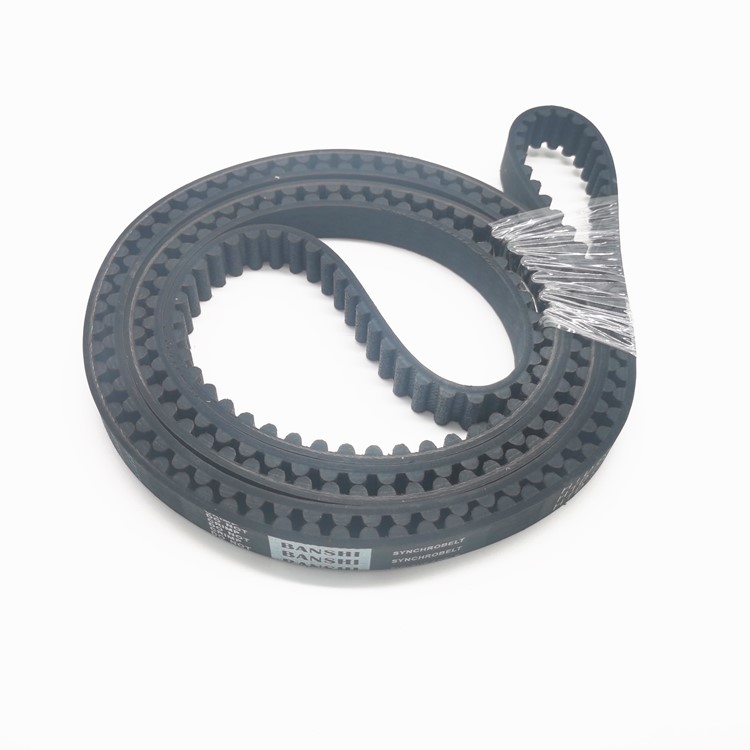
HTD 8M timing belt: 8.0 mm pitch, 5.6 mm overall thickness, minimura pulley diameter 40 mm, 16 minimum pulley teeth, rated 780 N allowable and 3120 N ultimate per 10 mm of width.
Layer 2 - Pitch
Pitch sets both the positioning resolution of the drive and the minimum pulley circumference it can run on. The metric pitches in this data set run 3.0 mm (S3M), 5.0 mm (HTD 5M, S5M, AT5 and T5), 8.0 mm (HTD 8M, S8M and 8MGT), 10.0 mm (T10 and AT10) and 14.0 mm (HTD 14M). A smaller pitch permits smaller pulleys and finer positioning; a larger pitch carries more tooth shear per unit of belt width and is used on higher-torque drives.
Layer 3 - Body material and tensile member
Two body polymers cover the range. Neoprene (CR) bodies with fiberglass cord serve the STD/STS and HTD rubber belts: S3M, S5M, S8M, HTD 5M, HTD 8M and HTD 14M. Polyurethane (PU) bodies with steel cord serve the T and AT series: T5 PU, T10 PU, AT5 PU and AT10 PU. A third combination appears in the 8MGT belt, which pairs a polyurethane body with carbon fiber cord and a nylon fabric tooth facing.
Cord material influences tensile capacity more than body polymer does. Within the polyurethane family, the AT10 with steel cord is rated 1700 N per 10 mm of width while the T5 PU with steel cord is rated 393 N per 10 mm; the gap follows profile geometry and cord construction rather than the polymer itself. The carbon fiber cord in the 8MGT belt supports a maximum belt speed of up to 80 m/s with transmission efficiency up to 98%, and the belt is specified as maintenance-free with no lubrication required.
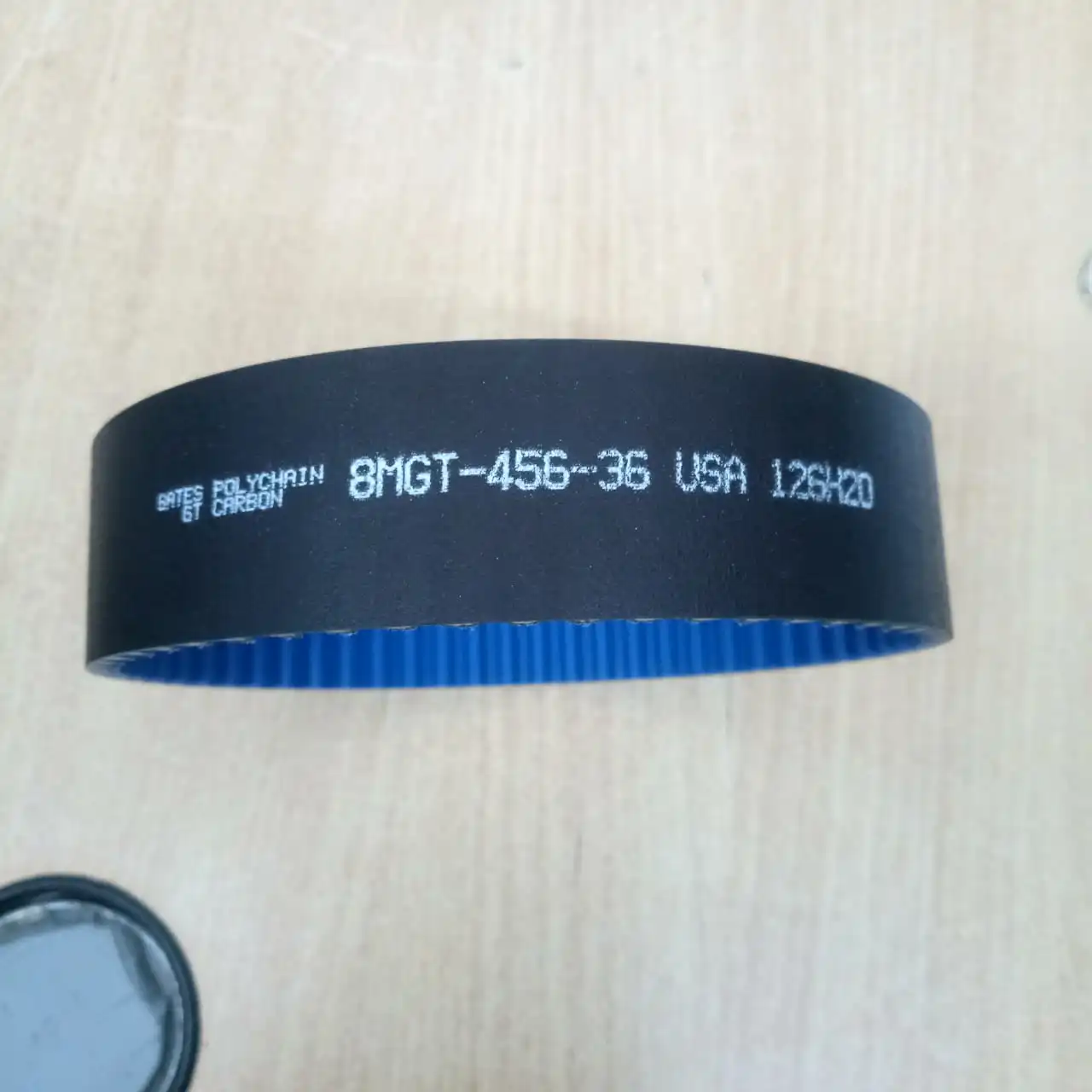
8MGT polyurethane timing belt: 8.0 mm pitch, carbon fiber cord, nylon fabric tooth facing, minimum pulley diameter 36.6 mm at 22 teeth, operating range -54 C to +85 C.
Layer 4 - Tolerance, hardness and pulley-side geometry
Tolerances decide whether a belt built to the correct profile and pitch will actually run at the intended tension and indexing accuracy. Across the standard rubber and polyurethane profiles in this data set, width and length are held to plus or minus 0.5 mm and thickness to plus or minus 0.2 mm, with two exceptions. The T5 PU belt holds thickness to plus or minus 0.15 mm, and the HTD 14M - the largest profile here at 10.0 mm overall thickness - allows plus or minus 1.0 mm width, plus or minus 0.5 mm length and plus or minus 0.4 mm thickness.
Pulley geometry closes the loop. HTD pulleys are offered in 3M, 5M, 8M and 14M pitches with 12 to 120 teeth, bore diameters from 5 to 100 mm, and concentricity of 0.03 mm or better. T-series pulleys cover T2.5, T5, T10 and T20 with 10 to 120 teeth and bore diameters from 3 to 100 mm. Imperial pulleys cover MXL, XL, L, H, XH and XXH. The metric families are manufactured to ISO 13050 and DIN tooth accuracy, with 100% dimensional inspection before delivery.
Step-by-Step Breakdown: How to Read a Timing Belt Specification
Step 1 - Read the profile code before the pitch
The profile code identifies the tooth geometry and therefore the compatible pulley series. HTD 5M, STD/STS S5M, AT5 and T5 PU all share a 5.0 mm pitch but none of them is a drop-in replacement for the others. Treat the profile code as the primary identifier and the pitch as a secondary dimension.
Step 2 - Convert pitch into minimum pulley geometry
Each profile carries a minimum pulley diameter and, where published, a minimum pulley tooth count. In this data set: S3M 13.4 mm, S5M 22.3 mm, S8M 56.0 mm, HTD 5M 25 mm at 16 teeth, HTD 8M 40 mm at 16 teeth, HTD 14M 124.78 mm at 28 teeth, 8MGT 36.6 mm at 22 teeth, T5 PU 30.0 mm, T10 PU 60.0 mm, AT5 PU 25.0 mm and AT10 PU 50.0 mm. Undersizing the pulley increases tooth load and root stress, and is one of the most common causes of short belt life.
Step 3 - Separate allowable working tension from ultimate tensile strength
Two tension figures appear in belt data and they mean different things. Maximum allowable tensile strength is the continuous working load the belt is designed to carry; ultimate tensile strength is the load at which it fails. For the rubber profiles in this data set the maximum allowable figure runs from 125 N per 10 mm of width on S3M up to 780 N per 10 mm on HTD 8M, while ultimate tensile strength runs from 500 N per 10 mm on S3M through 2600 N per 10 mm on HTD 5M and S8M to 3120 N per 10 mm on HTD 8M. The largest profile, HTD 14M, is rated 1816 N per 10 mm allowable and 8308 N per 10 mm ultimate. Polyurethane profiles sit inside the same band: T5 PU at 393 N, T10 PU at 780 N, AT5 PU at 700 N and AT10 PU at 1700 N per 10 mm of width. Design against the allowable figure, not the ultimate figure.

T10 polyurethane timing belt: 10.0 mm pitch, 4.5 mm overall thickness, steel cord, minimum pulley diameter 60.0 mm, up to 30 kW and approximately 10,000 rpm.
Step 4 - Match body material and cord to the operating environment
Material selection follows the environment rather than the catalogue position. The 8MGT polyurethane belt is specified from -54 C to +85 C with excellent oil, chemical and ozone resistance, which suits drives exposed to lubricants, coolants and outdoor conditions. The neoprene (CR) belts cover the standard industrial band, and the matching timing pulleys operate from -30 C to +120 C depending on material, with aluminum hardness at HB 75-95 and steel at HRC 20-35 when heat treatment is applied. Both the polyurethane and neoprene belt bodies in this data set are specified at 92 Shore A, so hardness is a consistency check rather than a material identifier.
Step 5 - Inspect width, length, thickness and hardness on receipt
Because tolerance is what converts a correct profile into a correctly running drive, incoming inspection should be built around three measurements plus a durometer reading.
| Inspection parameter | Standard rubber and PU profiles | T5 PU | HTD 14M |
|---|---|---|---|
| Width tolerance | plus or minus 0.5 mm | plus or minus 0.5 mm | plus or minus 1.0 mm |
| Length tolerance | plus or minus 0.5 mm | plus or minus 0.5 mm | plus or minus 0.5 mm |
| Thickness tolerance | plus or minus 0.2 mm | plus or minus 0.15 mm | plus or minus 0.4 mm |
| Body hardness | 92 Shore A | 92 Shore A | 92 Shore A |
Step 6 - Verify the pulley side of the drive
A belt cannot outperform the pulley it runs on. Check tooth accuracy against ISO 13050 and DIN, radial runout or concentricity of 0.03 mm or better, finished bore tolerance of H7 where a finished bore is specified, and a maximum operating speed within the 8,000 rpm pulley rating. Belt and pulley should be purchased against the same inspection standard, which is how a drive keeps its indexing accuracy across a replacement cycle.

T series timing pulley: trapezoidal tooth profile, pitches T2.5, T5, T10 and T20, 10-120 teeth, radial runout 0.03 mm or better, ISO 13050 and DIN tooth accuracy.
Use Cases: Matching Profiles to Drive Duty
Profile and pitch choices normally resolve themselves once the duty cycle, positioning accuracy and available pulley space are fixed. The applications below follow directly from the published operating specifications of each profile.
- Packaging machinery: HTD 8M at 8.0 mm pitch provides 780 N per 10 mm allowable load on a 40 mm minimum pulley, balancing torque capacity against space in a compact frame.
- CNC positioning and heavier machine tools: AT10 PU combines a 50.0 mm minimum pulley diameter with 1700 N per 10 mm allowable load, and power transmission up to 70 kW at approximately 10,000 rpm.
- Medium-duty automation and conveyor drives: T10 PU delivers up to 30 kW at approximately 10,000 rpm with a 60.0 mm minimum pulley, and its 92 Shore A body tolerates continuous operation.
- High-speed servo and robotics: the 8MGT belt with carbon fiber cord supports up to 80 m/s with efficiency up to 98% and a -54 C to +85 C range, and needs no lubrication.
- Light-duty office, medical and small conveyor equipment: S3M at 3.0 mm pitch runs on a 13.4 mm minimum pulley, and T5 PU handles up to 5 kW at approximately 10,000 rpm.
- Heavy industrial drives: HTD 14M at 14.0 mm pitch is rated 1816 N per 10 mm allowable and 8308 N per 10 mm ultimate, with a 124.78 mm minimum pulley diameter at 28 teeth.
Supplier-side capacity matters here because these drives rarely need one belt. Dongguan Zhende Machinery Equipment Co., LTD reports monthly capacity of 500,000 timing belts and 100,000 timing pulleys, with customization across belt length, width, tooth profile, tooth pitch, body material, tensile cord, coating, colour, perforation and logo printing, plus pulley customization across bore, keyway, flange, hub type and surface treatment. In reported OEM and distributor projects, shipments of 8,500 pcs to Germany and 15,000 pcs to the United States were used on automated production lines, CNC machinery, packaging equipment and robotic systems over project durations of five and three years respectively, with recorded improvements of 25% in transmission accuracy, 40% reduction in maintenance cost and 30% reduction in equipment downtime.
Timing Belt Profile Comparison Table
The table below compares every profile discussed in this guide on the dimensions and load figures that determine drive selection. Only published values are listed; a dash means the figure is not specified in the referenced product data.
| Profile | Pitch | Body | Tensile member | Minimum pulley diameter / teeth | Max. allowable tensile | Ultimate tensile |
|---|---|---|---|---|---|---|
| HTD 5M | 5.0 mm | Neoprene (CR) | Fiberglass cord | 25.0 mm / 16 teeth | 650 N | 2600 N |
| HTD 8M | 8.0 mm | Neoprene (CR) | Fiberglass cord | 40.0 mm / 16 teeth | 780 N | 3120 N |
| HTD 14M | 14.0 mm | Neoprene (CR) | Fiberglass cord | 124.78 mm / 28 teeth | 1816 N | 8308 N |
| STD/STS S3M | 3.0 mm | Neoprene (CR) | Fiberglass cord | 13.4 mm | 125 N | 500 N |
| STD/STS S5M | 5.0 mm | Neoprene (CR) | Fiberglass cord | 22.3 mm | 300 N | 1200 N |
| STD/STS S8M | 8.0 mm | Neoprene (CR) | Fiberglass cord | 56.0 mm | 650 N | 2600 N |
| T5 PU | 5.0 mm | Polyurethane | Steel cord | 30.0 mm | 393 N | - |
| T10 PU | 10.0 mm | Polyurethane | Steel cord | 60.0 mm | 780 N | - |
| AT5 PU | 5.0 mm | Polyurethane | Steel cord | 25.0 mm | 700 N | - |
| AT10 PU | 10.0 mm | Polyurethane | Steel cord | 50.0 mm | 1700 N | - |
| 8MGT | 8.0 mm | Polyurethane, nylon tooth facing | Carbon fiber cord | 36.6 mm / 22 teeth | - | - |
Tensile figures are expressed per 10 mm of belt width. Overall thickness by profile: S3M 1.9 mm, T5 PU 2.2 mm, AT5 PU 2.7 mm, S5M 3.4 mm, HTD 5M 3.6 mm, T10 PU 4.5 mm, AT10 PU 4.5 mm, S8M 5.3 mm, HTD 8M 5.6 mm, 8MGT 5.6 mm, HTD 14M 10.0 mm.
| Profile | Body and cord | Power transmission | Maximum rotational speed | Operating temperature |
|---|---|---|---|---|
| T5 PU | PU with steel cord | Up to 5 kW | Approximately 10,000 rpm | - |
| T10 PU | PU with steel cord | Up to 30 kW | Approximately 10,000 rpm | - |
| AT5 PU | PU with steel cord | Up to 15 kW | Approximately 10,000 rpm | - |
| AT10 PU | PU with steel cord | Up to 70 kW | Approximately 10,000 rpm | - |
| 8MGT | PU with carbon fiber cord | - | Belt speed up to 80 m/s | -54 C to +85 C |
FAQ
Are Zhende timing belts and timing pulleys covered by third-party certification?
Yes. Dongguan Zhende Machinery Equipment Co., LTD holds an Alibaba.com Verified Supplier Production Assessment, certificate number 494177048_P, assessed to the SGS/TUV standard and valid from 2026-07-10 to 2027-07-09, with a certification scope of timing belts. That certificate covers the HTD 8M, HTD 14M, HTD 5M rubber, S8M rubber, T5 PU, AT10 PU and 8MGT POLYCHIAN timing belts, and the certified supplier scope also covers the HTD timing pulley product. A second certificate, 493993448_P+T, is a Production Trading Assessment for the Timing Belt scope, and a TUV Rheinland Factory Audit Report for the scope TIMING BELT TIMING PULLEY is valid from 2026-07-09 to 2027-07-09. In addition, the HTD 8M rubber timing belt is certified to RoHS standards, and the metric timing pulleys are manufactured to ISO 13050 and DIN tooth accuracy with 100% dimensional inspection before shipment.
How do PU and neoprene belts differ when the pitch is identical?
Body polymer and tensile cord change together. Neoprene (CR) belts in this range use fiberglass cord and cover S3M, S5M, S8M, HTD 5M, HTD 8M and HTD 14M. Polyurethane belts use steel cord and cover T5 PU, T10 PU, AT5 PU and AT10 PU, with steel giving higher allowable tension per unit width than fiberglass at comparable pitch: AT10 PU is rated 1700 N per 10 mm against 650 N for HTD 5M and 780 N for HTD 8M. A third combination - polyurethane body with carbon fiber cord and a nylon fabric tooth facing - appears in the 8MGT belt, which is rated for belt speeds up to 80 m/s with efficiency up to 98% and excellent oil, chemical and ozone resistance. Both polymer families are specified at 92 Shore A, so the choice should be driven by allowable tension, minimum pulley size, speed and environment rather than by hardness.
What determines the cost of a custom-size timing belt?
Six variables drive the specification and therefore the cost. First, profile and pitch, since these fix the tooth geometry and the pulley that must be paired with the belt. Second, belt length and width, because the maximum allowable tensile strength is quoted per 10 mm of width, so a wider belt is needed wherever the load exceeds the allowable figure. Third, body material and tensile cord - neoprene with fiberglass, polyurethane with steel, or polyurethane with carbon fiber. Fourth, added features such as coating, colour, perforation and logo printing. Fifth, the pulley side of the order, where bore diameter, keyway, flange type, hub type and surface treatment each require separate machining. Sixth, order quantity against the minimum order quantity thresholds of 4 pcs for timing belts, 10 pcs for standard pulleys and 50 pcs for customized pulleys. A buyer can reduce total cost more reliably by specifying the correct profile and width up front than by negotiating unit price on an undersized belt.
Can a belt and pulley set be validated with samples before mass production?
Yes. Belt samples can be produced against a specified length, width, tooth profile, pitch, body material, tensile cord and coating, and pulley samples against a specified bore, keyway, flange and surface treatment. Every finished unit passes 100% dimensional inspection, a tensile strength test and tooth profile inspection, with pre-shipment quality inspection and third-party inspection by SGS available on request. Documentation for the matched pulley includes tooth accuracy to ISO 13050 and DIN, radial runout or concentricity of 0.03 mm or better, and bore tolerance of H7 where a finished bore is specified. Samples are best used to confirm tooth engagement, tension setting and indexing accuracy on the actual drive before committing to a production quantity.
What are the minimum order quantities and lead times for timing belts and pulleys?
The minimum order quantity is 4 pcs for timing belts, 10 pcs for standard pulleys and 50 pcs for customized pulleys. Production lead time runs 7 to 20 days, supported by monthly capacity of 500,000 timing belts and 100,000 timing pulleys. More than one million standard items are held in the warehouse so that regular models can be shipped within 3 days. To move from specification to a quotation, send the profile, pitch, belt length and width, body material, tensile cord, pulley bore and keyway requirements, and target quantity to Ms. Liang by email at liang@zd-stool.com or on WhatsApp at +86 18002849592, or request a sample or a formal quotation through the company website at www.zdindustrialbelts.com.
Conclusion
Reading a timing belt correctly means reading four layers in order. The profile code fixes tooth geometry and the compatible pulley series. The pitch fixes resolution and minimum pulley circumference. Tolerance and hardness - width and length at plus or minus 0.5 mm, thickness at plus or minus 0.2 mm or plus or minus 0.15 mm on T5 PU, plus or minus 1.0 mm width and plus or minus 0.4 mm thickness on HTD 14M, and 92 Shore A across the range - decide whether the belt actually runs at the tension and accuracy the design assumes. Tensile capacity, quoted per 10 mm of belt width, decides the drive size the belt can carry: 125 N to 780 N allowable across the rubber profiles, 500 N to 2600 N ultimate over the small and mid pitches, extending to 3120 N ultimate on HTD 8M and 8308 N on HTD 14M, with the polyurethane range running 393 N to 1700 N allowable.
Every one of those figures has to be verified against a physical part, which is why the supplier matters as much as the specification. Dongguan Zhende Machinery Equipment Co., LTD manufactures timing belts and timing pulleys against ISO 13050 and DIN tooth accuracy, holds Alibaba.com Verified Supplier certification with SGS/TUV as the applicable standard and a TUV Rheinland factory audit report, and inspects 100% of finished goods dimensionally before shipment.
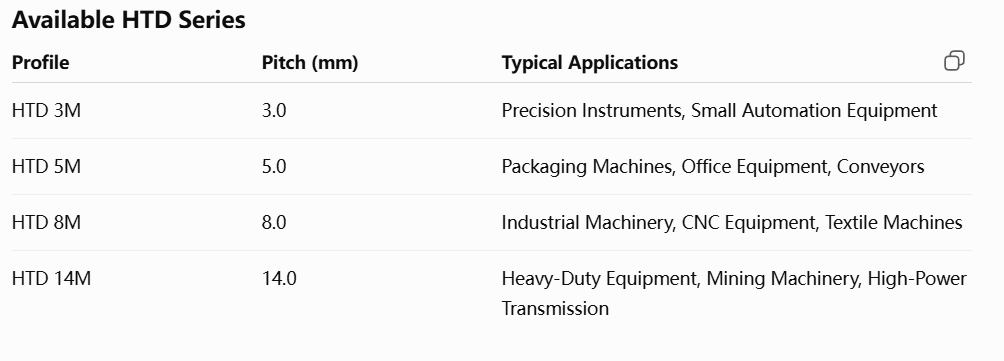
HTD timing pulley range: curvilinear tooth profile in 3M, 5M, 8M and 14M pitches, 12-120 teeth, bores 5-100 mm, concentricity 0.03 mm or better.
Specify the Right Profile, Then Verify It on a Sample
Send your profile, pitch, belt length and width, body material, cord type, and pulley bore and keyway requirements. Dongguan Zhende Machinery Equipment Co., LTD will confirm the correct minimum pulley diameter and allowable tension for your duty, then supply a sample for validation before production.
Email: liang@zd-stool.com | Tel and WhatsApp: +86 180 0284 9592 | Website: www.zdindustrialbelts.com
Download the full product catalogue here: Zhende Machinery product brochure (PDF)
Have Questions or Need More Details?
Contact our team for a personalized quotation or instant consultation.
Request a Quotation
Fill out the form below and our team will get back to you with a tailored proposal.
WhatsApp Direct Chat
Prefer to chat in real-time? Message us on WhatsApp for instant assistance & quick answers.
- Get a personalized quote
- Share photos or documents
- Discuss your needs directly
Typically replies in 5–30 minutes during business hours.