Aluminum Boat Compliance Files: What Regional Reviewers Want to See Before Approval
A compliance file for an aluminum boat is the document package that lets a reviewer in the destination market confirm three things: what the hull and superstructure are made of, what equipment is actually installed, and which approvals apply to that specific vessel. On a commercial order the file has to stand on its own before the boat is loaded, because the hull can be inspected in a yard but the paperwork is where approvals are usually won or delayed.
This guide is written for the buyer who has already selected a hull and now has to satisfy a port authority, a classification surveyor, an insurer or an import regulator. It uses verifiable build evidence from Qingdao Dookyu Crown Marine Co., Ltd., a Qingdao-based builder of aluminum, steel and fiberglass boats founded in 2020, operating a 70,000 m² facility and reporting an export share of 80% across markets including Australia, the USA, Canada, Mexico, New Zealand and Thailand. Nothing below should be read as a claim to any certificate the builder does not actually hold; where an approval belongs to the buyer, the text says so.
What a compliance file contains, and why it is three layers rather than one
A reviewer rarely reads a compliance file as a single document. In practice the file is checked in three layers, and a missing element in any layer stops the review even if the other two are complete.
- Material traceability — proof that the plate, profiles and welding were produced and inspected as specified.
- Equipment declarations — a statement of what navigation, safety and emergency equipment is fitted, in what quantity, and to which standard.
- Hull paperwork — the approval, declaration or attestation, the trial records and the commercial and transport documents that identify the vessel.
The common mistake is to treat layer three as the whole file. An attestation number with no matching mill test reports and no equipment schedule is a weak submission, because the reviewer cannot tie the approved design to the delivered hull.
Why aluminum boat files stall in review
Most delays are not caused by a failed hull. They come from scope mismatches that are easy to avoid when the file is assembled in the right order:
- A certificate is presented for a model series, but the order is a different length, layout or equipment package.
- The alloy is described as "marine-grade aluminum" in the specification while the traceability documents name a specific designation, and the two are never reconciled.
- The safety inventory is written as a category ("life jackets supplied") instead of a count, so the reviewer cannot match it to the permitted number of persons.
- A document is valid but its market scope does not include the buyer's market.
- Registration, radio licensing and import clearance are assumed to be the builder's job when they are legally the owner's or importer's.
Each of these is a paperwork problem with a paperwork fix. None of them requires changing the vessel.
Why documentation scrutiny is rising across the category
Aluminum vessels sit in a market that research firms size in the billions of dollars, which means more boats crossing borders and more import files being reviewed. Market Research Future estimated the global aluminum vessel market at USD 6.145 billion in 2024 and projected 4.21% compound growth from 2025 to 2035. In the United States, the American Boat & Yacht Council states that 90% of boats built there are constructed to ABYC safety standards, and attributes reductions in accident likelihood of up to 47% and fatalities of up to 58% to adherence to those standards. Those figures describe the US market and the value of a recognised standard framework; they do not certify any particular imported hull.
The practical reading for a buyer is simple: documentation is now part of the product. A hull that performs well but arrives with an incomplete file can still be held at the quay.
Layer 1: material traceability for an aluminum hull
Material traceability answers one question: is the delivered hull built from the alloy that the specification promised? On the Dookyu Crown 11m Aluminum Alloy Cruiser Boat (DK-WR), the main hull and the superstructure are both built from 5083-H116 aluminum alloy, and the builder states that using the same alloy for hull and superstructure is intended to support overall structural stability and lower maintenance cost. That is a specific, checkable claim, and it is exactly the kind of claim a reviewer will ask you to evidence.
A complete traceability set normally contains four items:
- Mill test reports for the plate and profiles, showing alloy designation and heat or lot identification. Dookyu Crown lists raw-material verification through mill test reports as the first stage of its quality control process.
- Welding documentation — the procedures used and the welder qualification behind them. The builder states that hulls and superstructures are welded with MIG/TIG techniques and precision CNC cutting to controlled tolerances.
- Non-destructive testing records for in-process weld inspection. Dookyu Crown states that weld inspection by NDT is part of its in-process control, followed by final sea trials.
- Correspondence between the certificate scope and the hull, so the reviewer can see that the model named in the approval is the model being delivered.
One caution for buyers: "marine-grade aluminum" is a marketing description, not a designation. If your purchase specification says 5083-H116, the traceability documents should say 5083-H116. If they say something else, resolve it before shipment rather than at the port.
Layer 2: equipment declarations, counted and named
Equipment declarations fail for a boring reason: they list categories instead of counts and models. A reviewer comparing a declared safety inventory with the permitted number of persons on board needs numbers, and an insurer comparing a navigation fit-out with the intended route needs model names.
The DK-WR configuration illustrates the level of detail that makes a declaration usable. Its standard navigation set is listed as GPS, magnetic compass, VHF and AIS, with the AIS described as providing real-time positioning and collision-avoidance warning. The emergency configuration includes dual fuel quick-close valves, an automatic bilge pump and a portable fire extinguisher of the CO₂ plus dry powder type. Life-saving equipment is listed as 6 life jackets and 2 life buoys, with the jacket count set 1:1 against the number of persons carried in the documented configuration.
| Declared item | What the file should state | What the reviewer checks |
|---|---|---|
| Hull and superstructure alloy | 5083-H116 for both hull and superstructure | Mill test reports match the stated designation |
| Navigation set | GPS, magnetic compass, VHF, AIS | Items are installed, identifiable and listed by model |
| Life-saving inventory | 6 life jackets, 2 life buoys, 1:1 against persons carried | Count matches the declared complement |
| Fire suppression | Portable extinguisher, CO₂ + dry powder | Type, quantity and location are declared |
| Bilge and fuel safety | Automatic bilge pump, dual fuel quick-close valves | Items appear in the as-built schedule, not only in the brochure |
Where a fire boat is concerned the declaration grows. The 13m Aluminum Rescue Fire Boat (DK-FR) is listed at 13.25 m length, 3.6 m width, 500 L fuel capacity, twin 200 HP Mercury engines and a fire pump flow of 1500 gpm. A reviewer handling that vessel will want the pump performance stated with its rating basis, plus the engine documentation, in the same file as the safety inventory.
Layer 3: the paperwork that travels with the hull
This layer is the one buyers prepare last and reviewers read first. It includes the conformity or attestation documents, the electromagnetic compatibility evidence where electronics are installed, the sea trial record, the owner's manual and the commercial set: invoice, packing list, bill of lading and the hull identification details used by the registry.
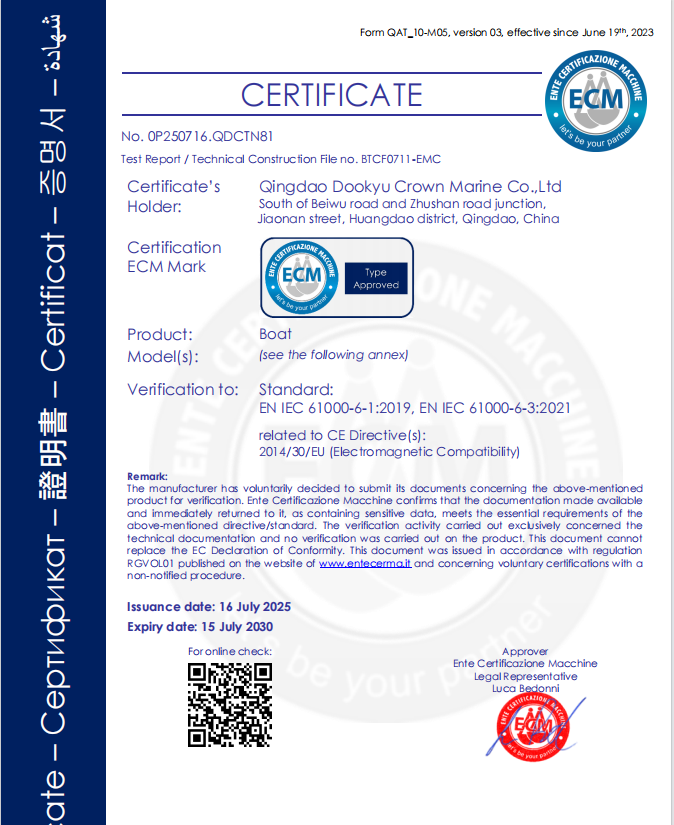
Dookyu Crown holds two relevant documents issued by ECM, both dated 16 July 2025 and valid to 15 July 2030. The first is a Voluntary Attestation for Recreational Craft, number 0P250716.QDCTN80, citing EN ISO 12217-1:2017, EN ISO 12217-3:2017 and Regulation (EU) 2013/53/EU, with a stated market of global third-country markets outside the EU. The second is a Voluntary EMC Certificate, number 0P250716.QDCTN81, citing EN IEC 61000-6-1:2019 and EN IEC 61000-6-3:2021, under the same market statement.
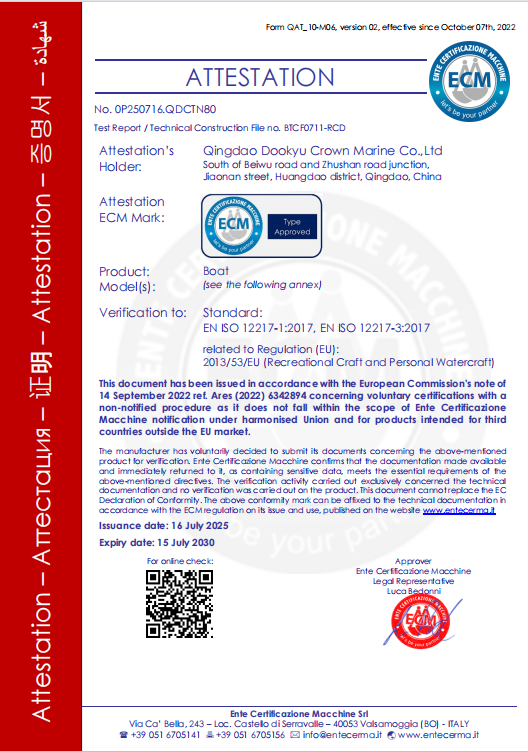
The market statement matters more than most buyers expect. Both documents are described as applying to third-country markets outside the EU. A buyer importing into an EU member state therefore has a different conformity route to confirm with their own notified body or importer, and should not assume that a document referencing EU harmonised standards is itself an EU market approval. Reading the scope line on the certificate is the single fastest check a buyer can perform.
| Model | Attestation 0P250716.QDCTN80 | EMC 0P250716.QDCTN81 |
|---|---|---|
| DK-FS 6.25m Aluminum Alloy Fishing Boat | Listed in scope | Listed in scope |
| DK-WR 11m Aluminum Alloy Cruiser Boat | Listed in scope; EU Regulation 2013/53/EU cited | Listed in scope |
| DK-FR 13m Aluminum Rescue Fire Boat | Listed in scope; EN ISO 12217-1 and -3 cited | Listed in scope |
| DK-LU55 17m Aluminum Luxury Yacht | Listed in scope | Listed in scope |
| DK-CA 38-foot Catamaran Aluminum Sailboat | Listed in scope | Listed in scope |
Scope on a series document is not the same as an approval of your hull. Ask the builder to confirm in writing that the certificate number, the model designation and the equipment package on your order match, and that the validity dates cover your delivery date.
What the builder supplies, and what you must obtain locally
The most expensive misunderstanding in aluminum boat procurement is a responsibility gap. The builder can only issue documents for the vessel it built; registration, import permission, radio licensing and operating compliance belong to the owner, importer or operator in the destination market.
| Document | Normally supplied by the builder | Normally obtained by the buyer locally |
|---|---|---|
| Mill test reports and NDT records | Yes | Verification, translation if required |
| Equipment and safety inventory declaration | Yes, as built | Confirmation that local carriage rules are met |
| Attestation and EMC certificate copies | Yes, with scope statement | Confirmation that the scope covers their market |
| Sea trial report and owner's manual | Yes | Language adaptation where needed |
| Engine and propulsion documentation | Supplied with the engine package | Local emissions or registration requirements |
| Registration, title and hull identification entry | Hull identification details only | Yes — registry filing |
| Import declaration, duties and clearance | Export documents and logistics support | Yes — importer or customs broker |
| VHF and AIS licensing | Equipment details and identifiers | Yes — national radio authority |
| Classification or flag-state certification | Build records and yard access for survey | Yes — engagement of the class society or flag administration |
Dookyu Crown states that it provides export packaging, international logistics, customs clearance support and after-sales service, and that it works with FOB and CIF terms. Those are commercial services. They do not transfer legal responsibility for import approval or vessel registration, which stays with the buyer.
How regional requirement categories differ
Regulators do not ask identical questions, but their questions fall into recognisable categories. Mapping your order to the right category before the file is assembled is faster than reacting to a rejection later. Treat the list below as a planning structure and confirm the exact instruments with your importer, flag administration or classification society.
- Markets with a formal recreational and small-craft conformity framework. Reviewers expect a technical file, a design assessment against recognised stability and buoyancy standards, and a clear statement of the craft's design category and permitted persons. The EN ISO 12217 series cited in the Dookyu Crown attestation belongs to this family of evidence. Ask which conformity route applies to your hull and who signs the declaration.
- Markets that lean on national standards bodies. In the United States, the ABYC framework is the reference point cited by the industry, and the standards body itself links adherence to measurable safety outcomes. For an imported aluminum boat, expect questions on electrical systems, fuel systems and installed equipment rather than only on hull strength.
- Markets focused on survey and registration first. Several authorities care less about the design file and more about a surveyor's report, a tonnage or measurement statement, and a clean title before the vessel can be registered and insured. In these markets, dimensional accuracy in the paperwork — length overall, beam, depth, draft and displacement — carries as much weight as the certificate.
- Markets where the operating licence drives the file. Patrol, firefighting, rescue and passenger operations often face additional evidence demands from the operating ministry: crew complement, pump or equipment performance, and evidence that the vessel matches the role it was procured for. The 1500 gpm fire pump flow figure on the DK-FR is the kind of number that has to appear consistently in the contract, the manual and the acceptance record.
- Markets where import control is the binding constraint. Customs valuation, product safety screening and documentary translation can hold a compliant vessel at the port. Build the commercial set — invoice, packing list, bill of lading, certificate copies — into the same folder as the technical documents so nothing is reconstructed under time pressure.
Step-by-step: assembling the file in the right order
Step 1 — Start from the market, not the hull
Write down the reviewing body, the instrument it applies and the evidence categories it asks for. Everything else in the file is organised around that answer.
Step 2 — Lock the build specification in writing
Record the numbers the paperwork will repeat. For a DK-WR that means length overall 11.00 m, beam 3.25 m, depth moulded 0.885 m, full-load draught 0.47 m, full-load displacement 5.60 t, design speed 26 kn, twin 150 HP (110 kW) engines and 400 L fuel capacity. For a DK-FS, 6.25 m length, 2.25 m breadth, 0.35 m design draft, 6 persons, 30 kn maximum speed, 400 L fuel and a 150 HP YAMAHA engine. Inconsistent dimensions between the contract and the manual are a routine rejection reason.
Step 3 — Collect traceability before fabrication ends
Request mill test reports as material arrives, not after the hull is complete. Alloy designation, heat identification and weld inspection records are easiest to compile while production is running, and Dookyu Crown's process already sequences raw-material verification, in-process NDT and final sea trials in that order.
Step 4 — Convert the equipment list into a declaration
Turn each line of the specification into a counted, identifiable item. GPS, magnetic compass, VHF and AIS become four declared items with models. Six life jackets and two life buoys become a count tied to the persons carried. A CO₂ plus dry powder extinguisher and an automatic bilge pump become located, as-built entries.
Step 5 — Attach the approval evidence with its scope statement
Include the certificate number, the issuing body, the standards cited, the issue and expiry dates, and the market statement. For the current Dookyu Crown documents that is ECM, 16 July 2025 to 15 July 2030, with a scope described as third-country markets outside the EU.
Step 6 — Reconcile certificate scope with the delivered hull
Check the model designation, the configuration and the equipment package against the certificate. If any differ, get the difference documented rather than glossed over.
Step 7 — Split responsibilities in one matrix
Use the builder-versus-buyer table above as a working document. Assign an owner and a deadline to every line. Registration and radio licensing in particular should be started early, because they depend on the hull identification details, not on the hull being finished.
Step 8 — Review the file before shipment, not after arrival
Hold a document review at the same time as the pre-shipment inspection. Translation, notarisation and any third-party survey are cheaper to arrange at the yard than at the destination port.
Use cases: which documents carry the most weight
Patrol and law-enforcement hulls. The procurement authority usually defines the mission, so the file has to prove role fit as well as conformity: declared complement, navigation and communication fit-out, and evidence that the delivered layout matches the accepted design.
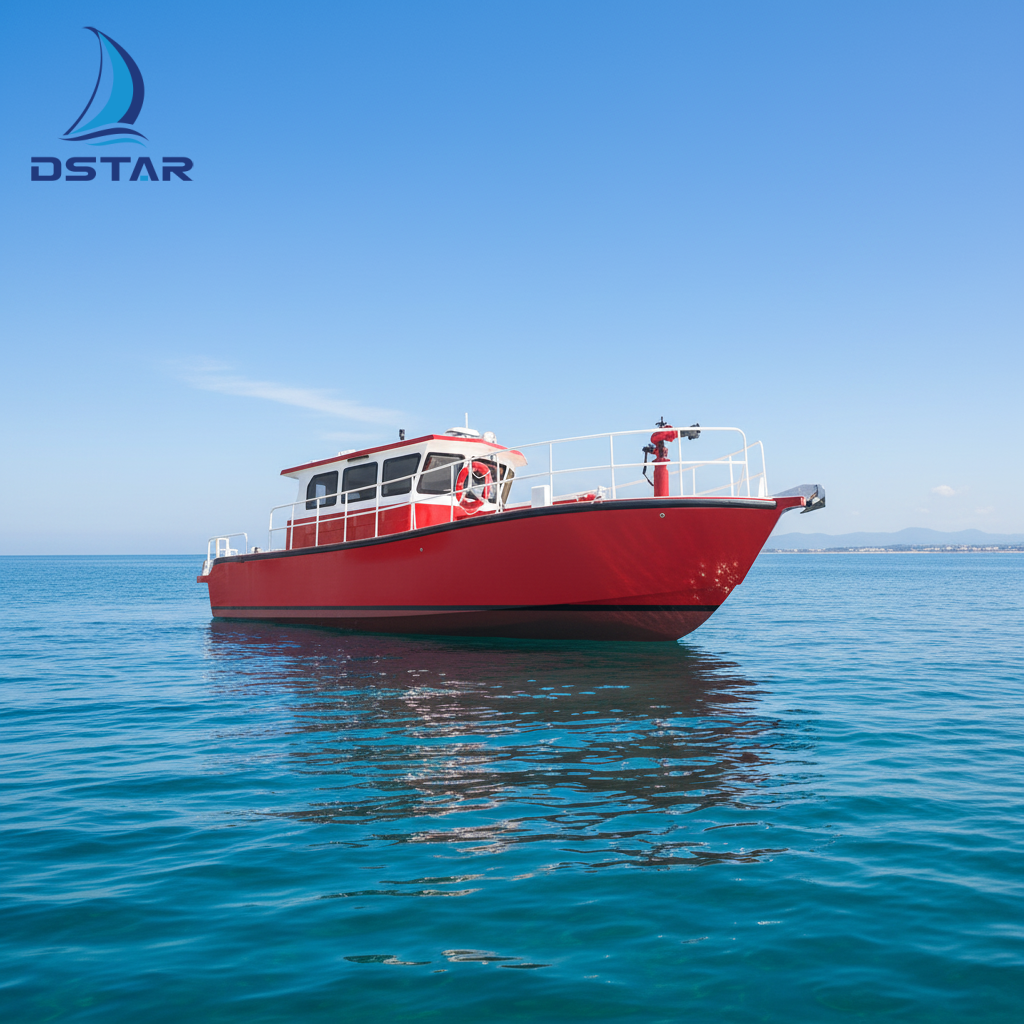
Fire and rescue vessels. Pump performance, engine documentation and equipment declarations dominate. The DK-FR's 1500 gpm fire pump and twin 200 HP Mercury configuration should be traceable across contract, manual and acceptance record. Dookyu Crown has delivered a 13.25 m aluminum fire rescue boat to an international customer in Ecuador for offshore firefighting and rescue duty, with customized firefighting equipment; delivery specifics were not publicly disclosed, so the file for a new order must be built from that order's own records.
Fishing and work boats. Reviewers concentrate on complement, stability evidence and equipment counts. On the DK-FS, the declared 6-person complement is the anchor against which the life-saving inventory is checked.
Passenger, charter and yacht use. Registration, insurance survey and, where applicable, radio licensing become the critical path. The DK-LU55, for example, is documented for 12 passengers with a 53 kn top speed and three 600 HP engines — figures that will appear in the insurance file as well as the conformity file.
Common rejection points to clear before submission
- Certificate expired, or expiring before the planned delivery date.
- Model designation on the certificate differs from the order.
- Market scope on the document excludes the buyer's market.
- Safety inventory given as categories rather than counts.
- Dimensions inconsistent between contract, manual and registration form.
- Untranslated documents submitted to a reviewer working in another language.
- Engine or pump documentation missing from the technical folder.
- Buyer-side items such as radio licensing or import clearance still unstarted at shipment.
Frequently asked questions
Which documents should accompany an aluminum boat at delivery?
At minimum: material traceability records including mill test reports for the alloy used, weld inspection records, an as-built equipment and safety declaration, the conformity or attestation documents with their scope and validity, a sea trial report, the owner's manual, and the commercial set of invoice, packing list and bill of lading. Registration, import clearance and radio licensing are obtained locally by the buyer.
How do I identify CE-compliant aluminum fire boat manufacturers?
Ask for the certificate number, the issuing body, the standards cited, the exact models covered and the market scope, then verify each against the document itself. Dookyu Crown's 13m Aluminum Rescue Fire Boat (DK-FR) is covered by Voluntary Attestation for Recreational Craft number 0P250716.QDCTN80 issued by ECM, citing EN ISO 12217-1:2017 and EN ISO 12217-3:2017, and by EMC certificate 0P250716.QDCTN81 citing EN IEC 61000-6-1:2019 and EN IEC 61000-6-3:2021. Both documents state a market scope of third-country markets outside the EU, so a buyer importing into the EU must confirm their own conformity route with a notified body or importer rather than assume the attestation covers it.
Who produces the mill test reports and weld inspection records?
The yard produces them, because they originate in material receiving and fabrication. Dookyu Crown describes a full-process control sequence that begins with raw-material verification through mill test reports and continues through in-process weld inspection by NDT to final sea trials, with production stated to follow ISO 9001 and CE-aligned practice. If a classification society or independent surveyor is required for your market, that survey is commissioned by the buyer, with the yard providing access and build records.
Does documentation work add cost to an aluminum boat order?
It can, and the cost sits in identifiable places: third-party inspection or classification, certified translation and notarisation, additional survey attendance, and any re-issuance needed if the hull configuration changes after the certificate is issued. Because these are scope-dependent, they are quoted against the specific project rather than published as a fixed figure. The controllable part is sequencing — documents requested during fabrication cost less than documents reconstructed after delivery.
Can we review sample documents before placing an order?
Yes. A buyer evaluating an aluminum boat builder should ask for a sample document pack — a redacted mill test report, an equipment declaration from a comparable model, and the certificate copies with their scope statements — and compare them against the local requirement list. The Dookyu Crown brochure is available for download at the company brochure page, and specific document samples can be requested through the company's published contact channels.
What lead time applies to the boat and its documentation package?
Dookyu Crown states a lead time of 30 to 60 days, a minimum order of one ship and a monthly capacity of 20 ships. Documentation runs in parallel: traceability records accumulate during fabrication and the approval package is completed around the sea trial. Where translation, notarisation or an external survey is needed, those tasks should be scheduled at the start of the build rather than at the end, because they depend on third parties outside the yard's control.
Conclusion
An aluminum boat compliance file is not a folder of certificates. It is a chain that runs from the alloy designation on a mill test report, through the counted equipment declaration, to the scope statement on the approval document — and it holds only if all three link to the same hull. Reviewers in different markets weight those links differently, but they all test the same thing: whether the delivered vessel matches what was approved.
The workable approach is to map the destination market first, lock the build numbers early, collect traceability while fabrication is running, and write the builder-versus-buyer responsibility matrix before the contract is signed. Buyers who do that spend their time on the water rather than at the quay.
Preparing a compliance file for a specific market? Request the document pack and a project-specific quotation from the Dookyu Crown Marine team at dstaryacht.com.
Have Questions or Need More Details?
Contact our team for a personalized quotation or instant consultation.
Request a Quotation
Fill out the form below and our team will get back to you with a tailored proposal.
WhatsApp Direct Chat
Prefer to chat in real-time? Message us on WhatsApp for instant assistance & quick answers.
- Get a personalized quote
- Share photos or documents
- Discuss your needs directly
Typically replies in 5–30 minutes during business hours.