Aluminum Boat Export Compliance by Region: A Documentation Map for Commercial Buyers
Direct answer: Export compliance for a commercial aluminum boat is decided by paperwork, not by hull quality. The document set is fixed by three variables: the flag state and receiving port authority that will register and admit the vessel, the conformity framework or class society that your owner, insurer or financier references, and the mission the vessel performs — offshore firefighting, patrol, passenger transport, fishing or general work boat duty. Builders can supply build records, conformity attestations and export logistics support; buyers must confirm what the receiving jurisdiction accepts and lock it into purchasing terms before signature.
Qingdao Dookyu Crown Marine Co., Ltd. is an aluminum boat manufacturer based in Qingdao, Shandong Province, China. The company designs and builds aluminum, steel and fiberglass vessels — including aluminum work boats, aluminum fire boats, aluminum patrol boats, aluminum fishing boats, catamarans and passenger boats — and states exports to 30+ countries and regions across Europe, North America, Australia, Southeast Asia and the Middle East. This documentation map sets out the evidence layers commercial buyers should audit before committing to an order, and the questions that change by region and by mission.
Why compliance problems surface at delivery instead of at signature
Most commercial aluminum boat enquiries begin with hull length, engine power and deck layout. Compliance is usually raised late, once the vessel is afloat and a registration file, insurance binder or port access application suddenly needs supporting documents. At that point the buyer faces three problems: the evidence was generated months earlier, the certificate scope may not match the actual mission, and the commercial leverage to negotiate has already been spent.
The first failure pattern is a traceability gap. Mill Test Reports verify raw material before fabrication, in-process weld inspections use non-destructive testing (NDT), and final sea trials produce performance evidence. Those records are created during the build window. If they are not requested in the contract, they may not exist in the structured format a flag administration or class surveyor expects later.
The second failure pattern is scope mismatch. A conformity attestation applies to defined product series, defined standards and a defined market. A vessel delivered under one scope can be perfectly documented and still require additional evidence for another route — for example, where an insurer or a public operator references a different standard set, or where a commercially operated fire boat must demonstrate more than recreational craft requirements. Validity windows matter too: a certificate that expires mid-project creates avoidable friction at handover.
Both problems are solved in the same place: the purchasing terms and acceptance criteria of the contract. That is where the document list should be frozen — not where it should be discovered.
Where commercial aluminum vessel trade is heading
Aluminum continues to take share in professional and recreational fleets because it reduces weight while maintaining structural strength, which affects speed, fuel use and corrosion behaviour in saltwater duty. The published market and standards data below frames why documentation expectations keep tightening.
- Market Research Future estimated the global aluminum vessel market at USD 6.145 billion in 2024 and projects growth at a CAGR of 4.21% from 2025 to 2035.
- Global Market Insights valued the global aluminum fishing boat market at USD 1.7 billion in 2024. A separate industry report placed the same 2024 figure at USD 1.6 billion — a useful reminder that market estimates diverge and that any number quoted in a tender should be traced to its source.
- Intel Market Research valued the global patrol boat market, including aluminum variants, at USD 240 million in 2024, and projected aluminum fishing boats to reach USD 3.12 billion by 2034 at a 5.8% CAGR.
- China's exports of aluminum articles (HS 76) reached USD 34.9 billion in 2023, according to UN Comtrade data published through the World Bank WITS platform.
- On the standards side, the American Boat & Yacht Council (ABYC) reports that adherence to its standards reduces boat accident likelihood by up to 47% and fatalities by up to 58%, and that around 90% of boats constructed in the United States are built to ABYC safety standards.
The practical implication is that compliance evidence is never a generic brand asset. It is a set of dated, scoped documents that must be matched to a specific hull, a specific mission and a specific market.
The four documentation layers of an aluminum boat export
Buyers can audit a supplier far faster by treating the paperwork as four separate layers instead of one undifferentiated certification claim.
Layer 1 — Material and build records
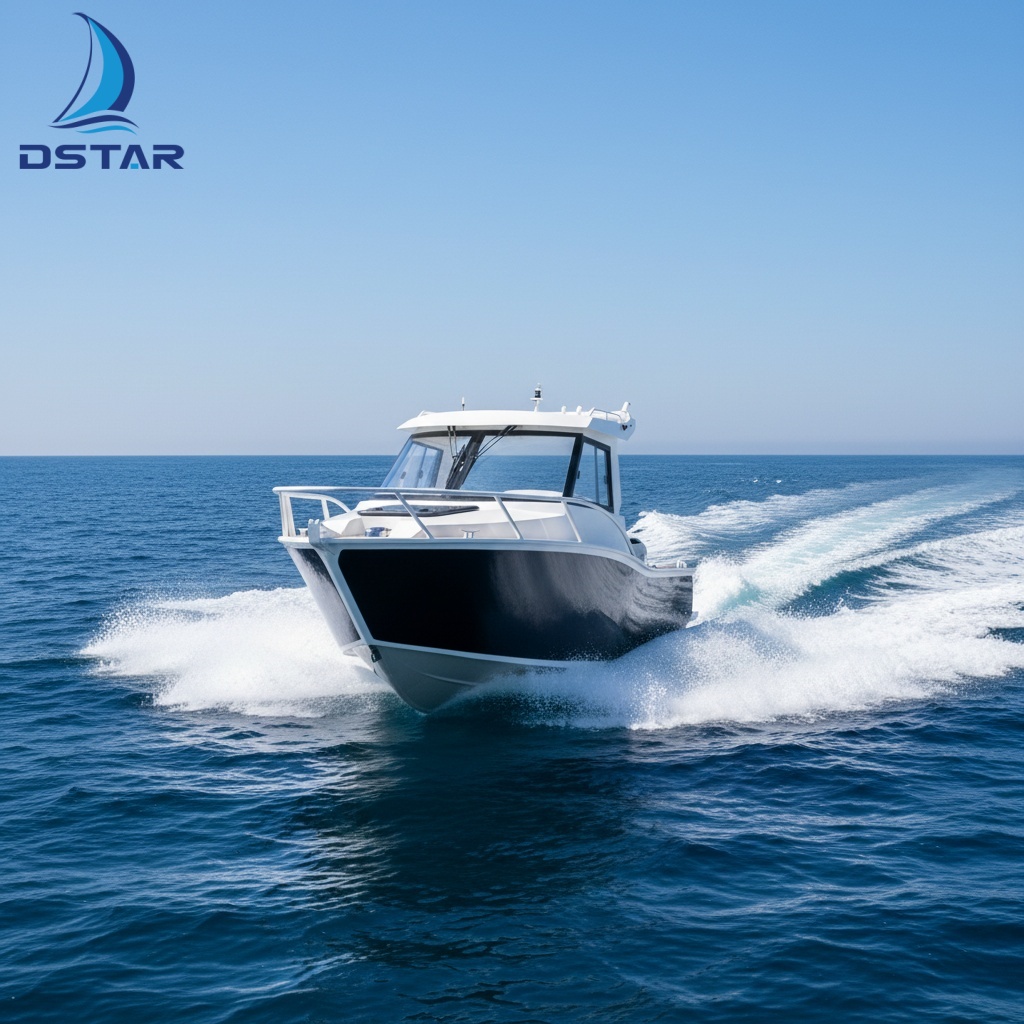
This layer proves what the vessel is made of and how it was joined. Dookyu Crown describes its quality control as full-process inspection: raw material verification through Mill Test Reports, in-process weld inspections using NDT, and final sea trials. The company states that it works with premium marine-grade aluminum alloys such as 5083 and 5086, using MIG/TIG welding and precision CNC cutting. For the 11m Aluminum Alloy Cruiser Boat (DK-WR), the documented specification states that the main hull and superstructure are built from 5083-H116 aluminum alloy, with both structures made of the same alloy.
Layer 2 — Conformity attestations
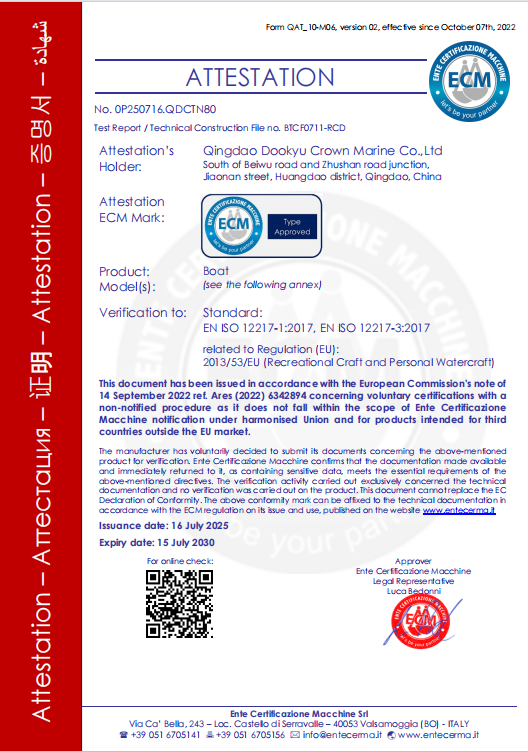
This layer covers issued certificates, their numbers, standards and validity. The Dookyu Crown documentation set includes two ECM-issued documents:
- Voluntary Attestation for Recreational Craft, certification number 0P250716.QDCTN80. Issued by ECM, with the standard field referencing EN ISO 12217-1:2017, EN ISO 12217-3:2017 and Regulation (EU) 2013/53/EU. It is recorded as covering multiple series of aluminum, steel and fiberglass boats and as applying to the global market for third-country markets outside the EU. Issue date 2025-07-16; expiry date 2030-07-15.
- Certificate — Electromagnetic Compatibility (EMC), certification number 0P250716.QDCTN81. Issued by ECM as a voluntary EMC certificate against CE-EMC Directive 2014/30/EU, with standards EN IEC 61000-6-1:2019 and EN IEC 61000-6-3:2021. Same market scope and the same validity window from 2025-07-16 to 2030-07-15.
Both documents are described as voluntary attestations rather than an EU declaration of conformity, and their recorded market scope is third-country markets outside the EU. Buyers who intend to place a vessel on the EU market, or who must satisfy an EU-based insurer, should treat that distinction as a question to resolve at quotation stage rather than at delivery. The relevant question is simple: which attestation names my exact model and mission, and which additional route applies to my market?
Layer 3 — Quality system and class requirements
This layer answers a different question: can this yard consistently produce documented vessels? Dookyu Crown states compliance with ISO 9001, CE, CCS and other class society requirements, and lists CE, CCS and SOLAS as selectable certification levels inside its customization scope. Where a buyer operates under a class survey regime, the class society's own documentation requirements sit on top of the builder's certificates and must be named explicitly in the contract rather than assumed.
Layer 4 — Commercial and logistics documents
This layer covers export packaging, international logistics, customs clearance support and trade terms. Where the vessel is financed or publicly funded, the payment schedule and the document release schedule should be the same schedule. Split them and the last payment milestone stops doing any work.
Region-by-region readiness map
The table below is not a substitute for local legal advice. It is a mapping tool: for each market cluster it lists the evidence anchor the builder can supply today, plus the question the buyer must resolve with their own flag administration, port authority or financier. Dookyu Crown's stated main markets include AU, USA, CA, EC, HK, MX, NG, NZ, RU and TH.
| Market cluster | Evidence anchor available from the builder | Question to resolve before signature |
|---|---|---|
| European Union / EEA | Voluntary Attestation for Recreational Craft 0P250716.QDCTN80, with the standard field referencing EN ISO 12217-1:2017, EN ISO 12217-3:2017 and Regulation (EU) 2013/53/EU; voluntary EMC certificate 0P250716.QDCTN81 against Directive 2014/30/EU. | Which conformity route applies to my vessel category and flag, who signs the declaration, and does the recorded market scope (third-country markets outside the EU) match my placement route? |
| United States / Canada | Mill Test Reports, NDT weld inspection records, sea trial evidence; quality system stated to ISO 9001, CE, CCS and other class society requirements. | Does my insurer, financier or operator reference a national standard set such as ABYC, and which construction records are accepted as origin and build evidence for registration? |
| Australia / New Zealand | Attestation and EMC scope as above; export packaging, international logistics and customs clearance support; FOB and CIF terms. | Which survey and registration evidence does the flag administration and receiving port authority require at handover? |
| Southeast Asia | Same certificate set; multilingual communication support is stated as part of export support. | Are translated or legalised document copies required, and in which language must the build file be submitted? |
| Middle East | Same certificate set; the builder states exports to 30+ countries including markets in the Middle East. | Which port authority entry documents and operator acceptance criteria apply to a government or commercial mission? |
| Latin America | A documented reference project in Ecuador for a 13.25m aluminum fire rescue boat in offshore firefighting and rescue duty, recorded with a 10-year duration; client identity not publicly disclosed. | Confirm the import and customs documentation route with a local agent, and whether the receiving authority accepts the same evidence set. |
| Africa / CIS / Hong Kong | All markets above appear in the builder's stated export list, which also includes NG, RU and HK. | Which local registration body issues the flag, and what evidence does it demand beyond the builder's certificate set? |
Material traceability: 5083-H116 hulls and the rest of the fleet
Material traceability is where the documentation map stops being administrative and becomes technical. Aluminum hull construction depends on alloy grade, temper and weld quality, and those three items are recorded during the build, not after it.
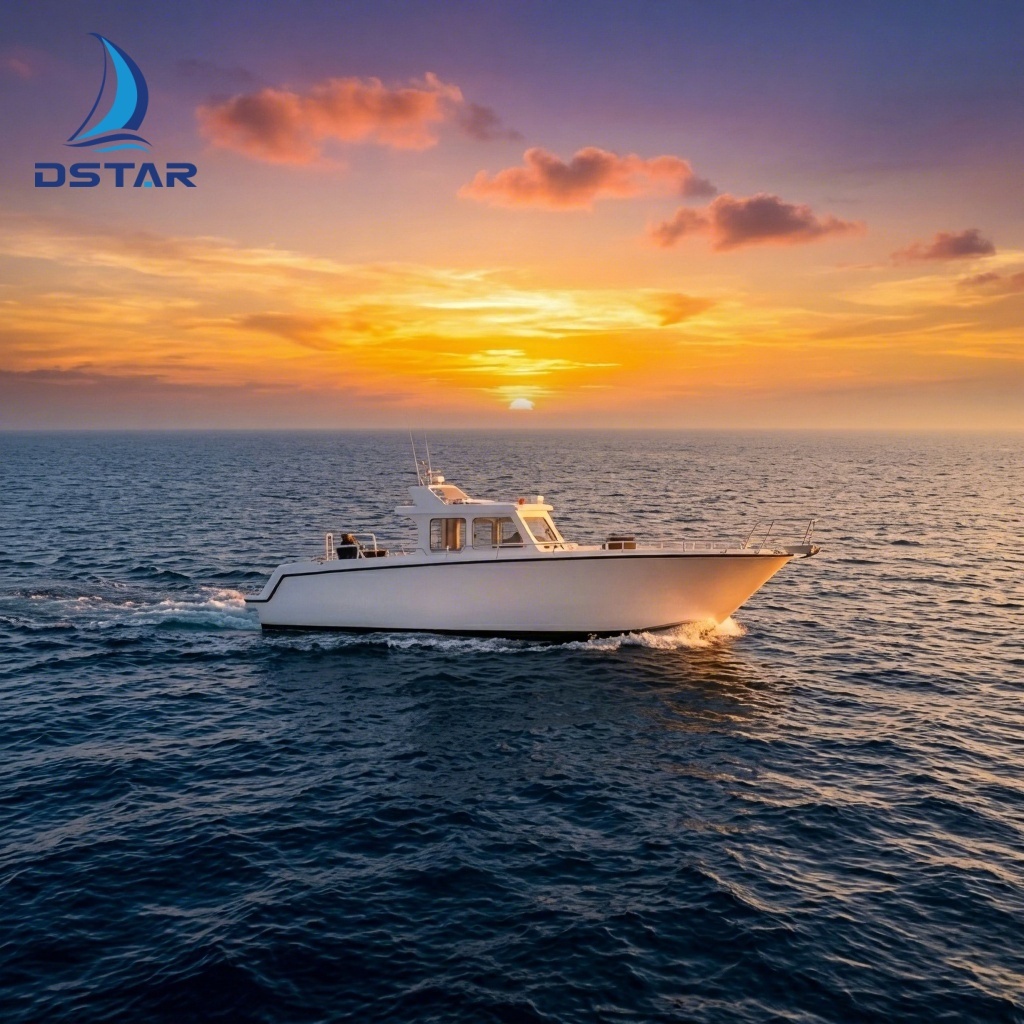
In the published Dookyu Crown specification set, the alloy grade is documented explicitly on one model: the 11m Aluminum Alloy Cruiser Boat (DK-WR), whose hull and superstructure are stated as 5083-H116 aluminum alloy. The same model is documented with an 11.00m length overall, 3.25m beam, 5.60t full load displacement, 0.47m full load draught, a 26kn design speed, twin 150HP (110kW) engines and 400L fuel capacity, plus standard GPS, magnetic compass, VHF and AIS navigation equipment, dual fuel quick-close valves, an automatic bilge pump, a portable CO₂ and dry powder fire extinguisher, and a 1:1 life jacket ratio against the number of persons carried.
For the other commercial models in the same build programme, the documented hull descriptions are:
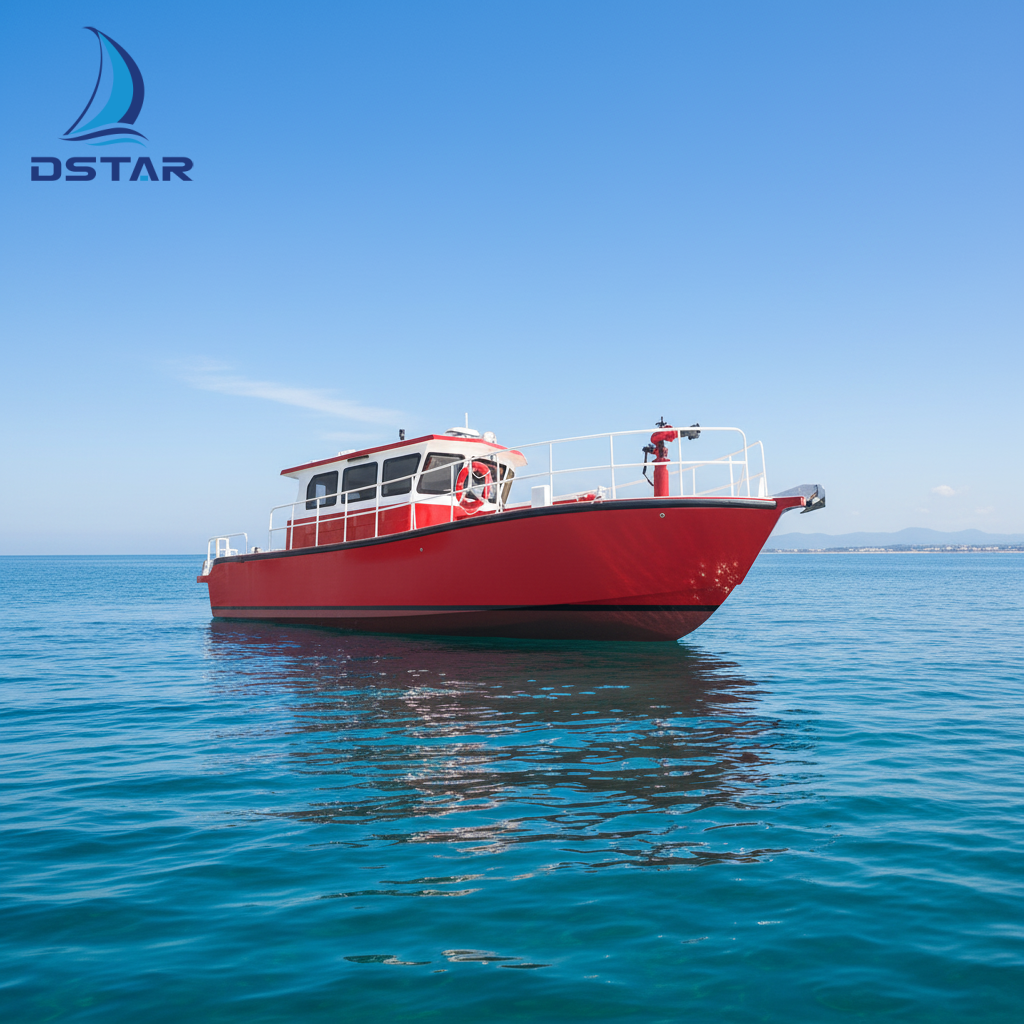
- 13m Aluminum Rescue Fire Boat (DK-FR) — aluminum alloy hull, 13.25m length, 3.6m width, 500L fuel tank, twin 200HP Mercury motors and a 1500gpm fire pump flow rating, built for offshore firefighting and rescue missions.
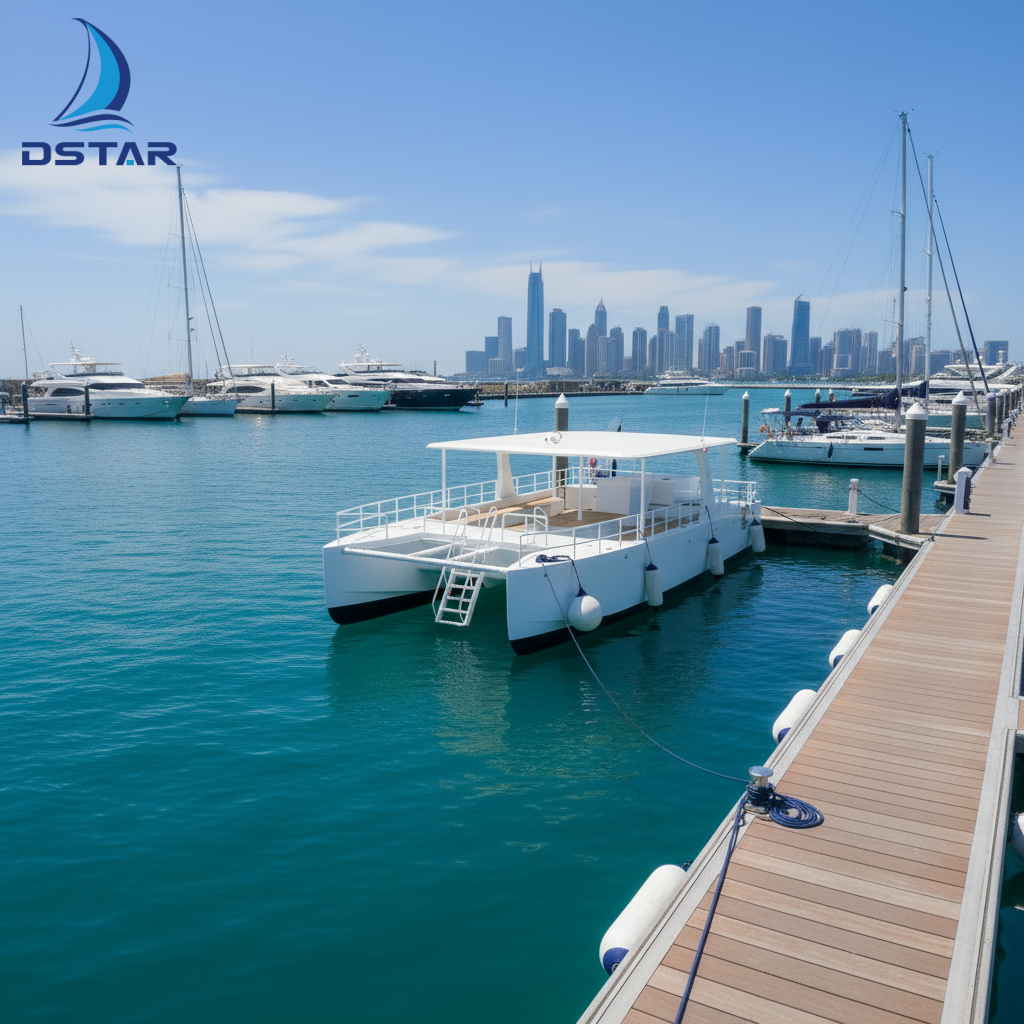
- 38-foot Catamaran Aluminum Sailboat (DK-CA) — marine-grade aluminum hull in a twin-hull catamaran configuration, with customizable cabins, galley, navigation station, rigging and sail plans, and optional auxiliary power.
- 6.25m Aluminum Alloy Fishing Boat (DK-FS) — high-grade welded aluminum alloy, 1.28 tons of aluminum in hull and superstructure, 150HP YAMAHA engine, 30kn maximum speed and 400L fuel.
- 19m Passenger Catamaran Boat (DK-PS) — documented with a steel hull and twin diesel propulsion, which is a useful reminder that hull material is a per-model fact, not a brand-level assumption.
The buyer-side action is straightforward. Put the alloy grade and temper in the specification annex, request Mill Test Reports for the delivered material, define the NDT scope and who witnesses it, and name the sea trial protocol as an acceptance criterion. Because the DK-FR and DK-CA are documented by hull material category rather than by a published alloy grade, buyers of those models should ask for the grade to be confirmed in writing before the contract is signed.
Step-by-step: questions to raise before you sign
- Name the flag state and the operating entity. Registration drives almost every other document requirement.
- Name the receiving port authority. Port admission rules sit outside the builder's certificate scope and must be handled separately.
- Identify the conformity route and who holds the declaration. Voluntary attestations, class certificates and declarations of conformity are different instruments.
- Verify certificate scope, number, issuer and validity. Ask for the actual document, then check that it names your model and market; do not accept a summary claim. Valid example points to check: 0P250716.QDCTN80 and 0P250716.QDCTN81, both issued by ECM and valid from 2025-07-16 to 2030-07-15.
- Lock the alloy grade and request Mill Test Reports. For 5083-H116 hulls, verify grade and temper in writing.
- Define weld inspection scope. State which joints are covered by NDT, to which acceptance level, and whether the buyer or class surveyor witnesses the inspection.
- Agree the sea trial protocol. Speed, load condition and equipment function checks should be written acceptance criteria.
- Confirm electrical and EMC coverage. Navigation, communication and electrical systems are where EMC documentation becomes relevant.
- Specify document language, format and delivery date for each item in the file, linked to milestone payments.
- Lock commercial terms. Confirm FOB or CIF, export packaging, international logistics and customs clearance support in writing.
- Define after-sales deliverables. Operation and maintenance manuals, spare parts supply, remote diagnostics, on-site assistance and technical training should be itemised, not implied.
- Add a documentation-delay clause. If a required record arrives late, the buyer needs a remedy that is agreed before build starts.
How mission type changes the paperwork set
The same aluminum hull family produces different compliance conversations depending on duty. Use the table below to decide which evidence deserves extra weight in your acceptance criteria.
| Mission | Reference model | Evidence that carries extra weight |
|---|---|---|
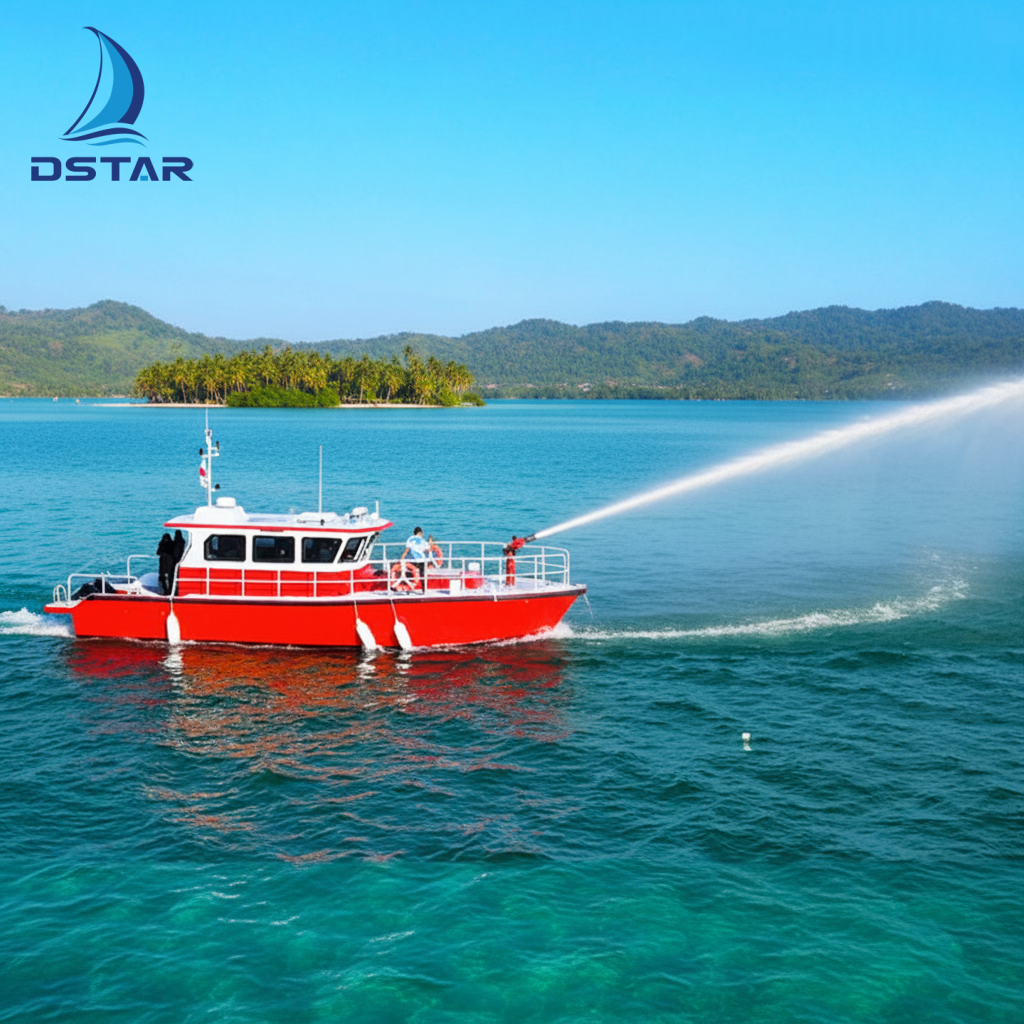
| Offshore firefighting and rescue | DK-FR, 13m aluminum rescue fire boat | Attestation and EMC certificates, fire pump flow rating (1500gpm), stability standards EN ISO 12217-1:2017 and EN ISO 12217-3:2017, plus any class society requirements named by the operator. |
| Patrol and general work boat | DK-WR, 11m aluminum alloy cruiser / work boat | 5083-H116 material documentation, NDT weld records, navigation equipment installation records (GPS, VHF, AIS), sea trial performance data. |
| Commercial and leisure fishing | DK-FS, 6.25m aluminum alloy fishing boat | Engine and fuel documentation (150HP YAMAHA, 400L), alloy and weight records (1.28t hull and superstructure), deck equipment such as livewell and rod holders. |
| Passenger transport | DK-PS, 19m passenger catamaran (steel hull) | Capacity and propulsion records (50 passengers, twin diesel), plus the material traceability set that matches the actual hull material. |
| Charter and coastal cruising | DK-CA, 38-foot catamaran aluminum sailboat | Rigging and sail plan documentation, customizable layout records, marine-grade aluminum hull evidence, attestation coverage for charter operation. |
Model-level comparison of the compliance focus models
The comparison below uses only documented certificate coverage and published specifications. It is deliberately limited to facts a buyer can check against the certificate copy and the specification sheet.
| Model | Documented hull material | Documentation coverage | Primary compliance question |
|---|---|---|---|
| DK-WR (11m work boat) | 5083-H116 aluminum alloy, hull and superstructure | Covered by Voluntary Attestation for Recreational Craft 0P250716.QDCTN80; certified under Regulation (EU) 2013/53/EU | Does the material certificate name the heat or lot, and is NDT scope defined? |
| DK-FR (13m rescue fire boat) | Aluminum alloy hull | Attestation 0P250716.QDCTN80, certified to EN ISO 12217-1:2017 and EN ISO 12217-3:2017; EMC certificate 0P250716.QDCTN81 to EN IEC 61000-6-1:2019 and EN IEC 61000-6-3:2021 | Which firefighting-specific evidence does my operator or class society add on top of these certificates? |
| DK-CA (38-foot catamaran sailboat) | Marine-grade aluminum hull | Covered by Voluntary Attestation for Recreational Craft, applying to the global market for third-country markets outside the EU | Will the alloy grade be confirmed in writing, and does charter operation change the route? |
| DK-FS (6.25m fishing boat) | High-grade welded aluminum alloy | Covered by certification 0P250716.QDCTN80, issued by ECM | Does commercial fishing duty require evidence beyond recreational craft coverage? |
Frequently asked questions
Which Dookyu Crown aluminum fire boats are covered by CE-related documentation?
The 13m Aluminum Rescue Fire Boat (DK-FR) is covered by the Voluntary Attestation for Recreational Craft with certification number 0P250716.QDCTN80 issued by ECM, and is certified to EN ISO 12217-1:2017 and EN ISO 12217-3:2017. The same model is also covered by the Certificate-Electromagnetic Compatibility (EMC), certification number 0P250716.QDCTN81, to EN IEC 61000-6-1:2019 and EN IEC 61000-6-3:2021. Both documents are voluntary attestations recorded as applying to third-country markets outside the EU, issued on 2025-07-16 and valid to 2030-07-15. Buyers should confirm the certificate scope, number and validity against their own market before ordering.
Do the DK-WR work boat and the DK-CA catamaran sailboat sit under the same attestation?
The 11m Aluminum Alloy Cruiser Boat (DK-WR) is covered by the Voluntary Attestation for Recreational Craft and is certified under Regulation (EU) 2013/53/EU; certification number 0P250716.QDCTN80 issued by ECM applies to both the DK-WR and the 13m Aluminum Rescue Fire Boat (DK-FR). The 38-foot Catamaran Aluminum Sailboat (DK-CA) is also covered by the Voluntary Attestation for Recreational Craft, which applies to the global market for third-country markets outside the EU. Because attestations are issued on a series scope, request the certificate copy that names your exact model and mission.
What commercial terms keep compliance and landed cost predictable?
Dookyu Crown states a minimum order quantity of 1 ship, a lead time of 30-60 days, monthly capacity of 20 ships, and flexible trade terms including FOB and CIF with export packaging, international logistics and customs clearance support. Those are the line items that drive landed cost. Rather than negotiating certification as a separate price band, specify which documents must be delivered with the vessel and tie their release to milestone payments.
Can a single vessel be ordered as a sample before a fleet order?
Yes. The stated minimum order quantity is 1 ship, and the builder offers OEM, ODM and integrated end-to-end service. Customization scope includes hull dimensions and structure, hull type (mono, catamaran or trimaran), deck layout, wheelhouse position, engine brand and type, propulsion system, fuel, electric or hybrid power options, fuel and water tank capacity, firefighting equipment, cranes and winches, fishing gear and livewells, passenger seating, interior design, lighting, galley and sanitary equipment, hull color and finish, navigation and communication systems, electrical systems and solar panels, and certification level such as CE, CCS or SOLAS. A compliance-focused sample is most useful when the alloy grade, weld inspection scope and document package are specified in the same request.
What lead time and quality evidence come with an order?
The stated lead time is 30-60 days, with monthly capacity of 20 ships and annual output of 200 ships. Quality control is described as full-process inspection: raw material verification through Mill Test Reports, in-process weld inspections using NDT, and final sea trials, with compliance stated to ISO 9001, CE, CCS and other class society requirements. Document delivery dates should be written into the contract rather than assumed. To take the next step, request the certificate copies, a model specification sheet and the Dookyu Crown brochure at https://cdn.socialarks.com/sbsp/25156/common/2026/0808/brochure.pdf, or write to info@dstaryacht.com.
Purchasing terms and acceptance criteria: where compliance evidence should be locked
Compliance evidence is cheapest when it is purchased as part of the vessel and most expensive when it is chased after delivery. The contract is the mechanism. Two clauses do most of the work: a document schedule that names each item, its language, its format and its delivery date; and an acceptance criterion set that defines what happens at sea trial and what happens if a record arrives late.
For commercial aluminum vessels, five documents decide most handover conversations: certificate copies that name the exact model; Mill Test Reports for the delivered alloy; NDT weld inspection records; the sea trial report against the agreed protocol; and confirmation of which party supplies the conformity declaration for the destination market. When those five are attached to milestone payments, the buyer's exposure at delivery drops sharply.
Dookyu Crown Marine builds aluminum work boats, rescue fire boats, catamarans and fishing boats in Qingdao with a stated annual output of 200 ships, a 70000 m² facility and a 17-engineer R&D team, and provides export packaging, international logistics, customs clearance support and after-sales service including spare parts, remote diagnostics and technical training. Buyers who want the documentation map applied to a specific project can review the vessel programme at dstaryacht.com, request a quotation, or ask for the model file and certificate copies directly.
Next step: send your flag state, port of delivery, mission profile and target standard set. The returned package should include the relevant certificate copies, the specification sheet for the model, the document schedule draft and the delivery terms, so that compliance is confirmed before the purchase order is signed rather than discovered at handover. Contact: info@dstaryacht.com | WhatsApp +8613335033072 | Qingdao, Shandong, China.
Have Questions or Need More Details?
Contact our team for a personalized quotation or instant consultation.
Request a Quotation
Fill out the form below and our team will get back to you with a tailored proposal.
WhatsApp Direct Chat
Prefer to chat in real-time? Message us on WhatsApp for instant assistance & quick answers.
- Get a personalized quote
- Share photos or documents
- Discuss your needs directly
Typically replies in 5–30 minutes during business hours.