Aluminum Boat Power Basics: Outboard Configurations from 150HP to Triple 600HP
A “300 horsepower” aluminum boat may carry one engine or two. A “53-knot” yacht and a “26-knot” workboat may not be quoting the same kind of speed at all. This explainer sets out the basic vocabulary of outboard power as it is written on aluminum commercial and leisure boats, using four Dookyu Crown vessels as worked examples: the 6.25 m DK-FS with a single 150 HP Yamaha, the 11 m DK-WR with twin 150 HP outboards totalling 300 HP, the 13.25 m DK-FR with twin 200 HP Mercury motors and a 1500 GPM fire pump, and the 17.18 m DK-LU55 with three 600 HP engines and a 53-knot top speed. The purpose is definition, not recommendation: it explains what the numbers mean, not which boat anyone should buy.
Problem Definition: Why Outboard Power Numbers Get Misread
A boat specification is a compressed document, and compression loses context. A builder may write “150HP×2”, “3*600HP” or “Twin 200HP” on a single line. Each string is accurate, and each one means something different once it is converted into the number a reader actually cares about. Three ambiguities appear again and again.
Per-engine rating versus total horsepower. The DK-WR specification reads 150HP (110 kW) × 2, and the same document states that total power is 300HP. Both figures are correct and both are used in normal conversation: an owner may describe the boat as a 300 HP vessel, while a technician servicing it works on a 150 HP engine. When two vessels are compared, the total is the comparable number. When engines are maintained, replaced or matched to propellers, the individual rating is the operative one. A list that shows only one of the two figures without labelling it forces the reader to guess.
Which speed is being quoted. DK-FS is published with a maximum speed of 30 knots. DK-WR is published with a design speed of 26 knots. DK-LU55 is published with a top speed of 53 knots. These labels are not decorative. A maximum or top figure describes a published ceiling; a design figure describes the condition the hull, engines, displacement and layout were engineered around. Comparing a design speed against a top speed is comparing two different measurements, and the resulting number tells the reader nothing useful about either boat.
Power separated from mass and mission. Horsepower is a rate of work. It only becomes interpretable when it is read against what the vessel has to move and what it has to carry or drive. The DK-FS carries 1.28 tonnes of aluminum in its hull and superstructure; the DK-WR is published with a full-load displacement of 5.60 tonnes. Both are aluminum boats, both use 150 HP engines, and the two figures describe completely different engineering situations. Reading horsepower without displacement, structural weight or load is reading half a sentence.
Mission fit. The fourth element is the hardest to read from a table. DK-FR is published with twin 200 HP Mercury outboards and a fire pump rated at 1500 GPM. The pump is part of the power story even though it is not an engine, because on a fire boat the pump is a defining load and the reason the vessel exists in that form. The published specification does not state how the pump is driven; what it does establish is that propulsion and pumping are specified as one system for offshore firefighting and rescue missions.
Industry Background: Aluminum Hulls and Transom-Mounted Power
Aluminum workboats and leisure boats sit inside a measurable market. Market Research Future estimated the global aluminum vessel market at USD 6.145 billion in 2024 and projected a compound annual growth rate of 4.21% from 2025 to 2035. Global Market Insights valued the aluminum fishing boat segment at USD 1.7 billion in 2024, while Intel Market Research put the patrol boat market, which includes aluminum variants, at USD 240 million in 2024. These are third-party estimates calculated on different scopes; they are useful for scale, not for precision, and they are not directly additive.
The technical reason outboard power appears so often on aluminum boats is straightforward. Marine-grade aluminum alloys — 5083, 5086 and 5083-H116 appear in the Dookyu Crown range — produce a hull that is light for its strength and resistant to corrosion in salt water. An outboard is a self-contained propulsion package mounted at the transom, which pairs naturally with a light hull and leaves interior volume free for deck space, seating, pumps, tanks or accommodation. That combination is why the same material and the same basic propulsion concept can serve a 6.25 m fishing boat and a 17.18 m yacht.
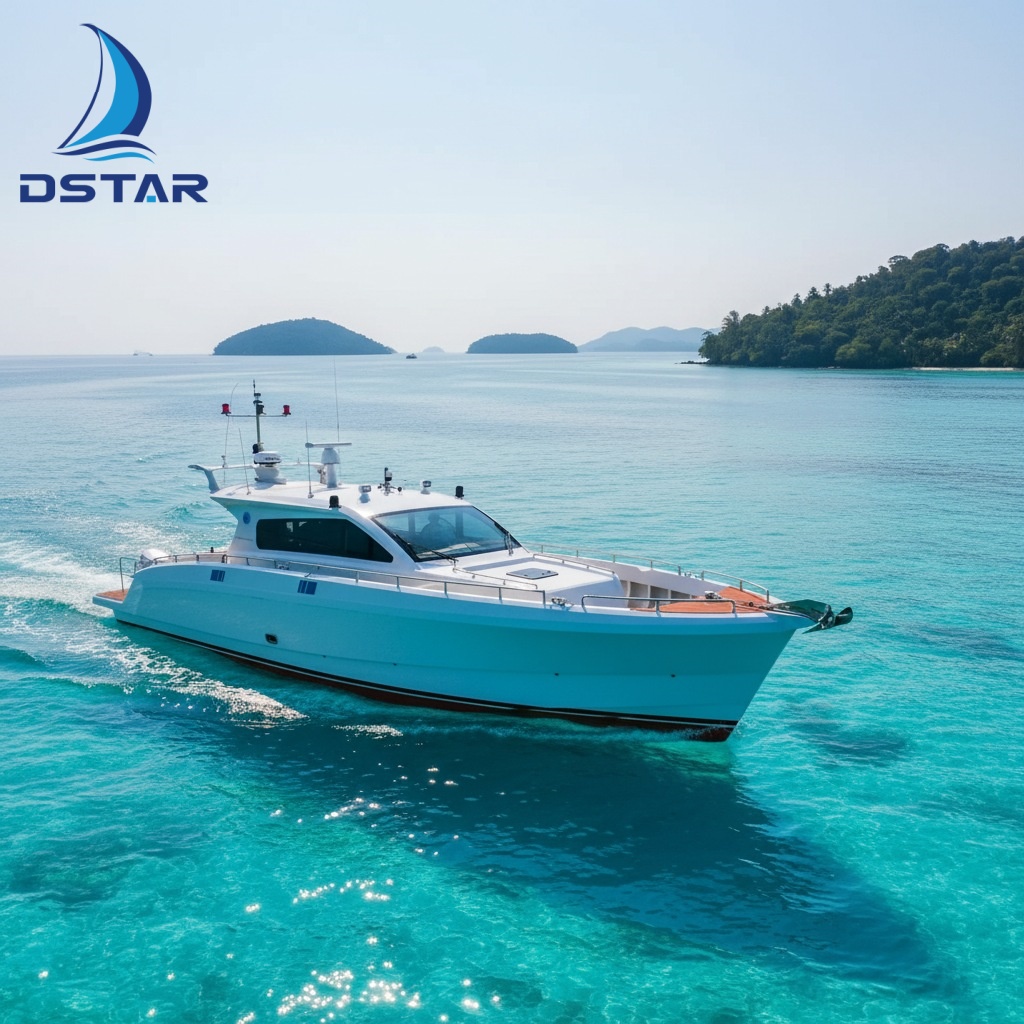
Qingdao Dookyu Crown Marine Co., Ltd. is an aluminum boat builder based in Qingdao, Shandong Province, China, established in 2020. The company designs and builds aluminum alloy yachts and vessels — fishing boats, workboats, catamarans, passenger ferries, luxury yachts and custom craft — from a 70,000 m² manufacturing facility with an annual production capacity of 200 ships. The four vessels used as examples in this article are drawn from that range and are cited exactly as published.
Detailed Solution: Four Published Configurations, Read Term by Term
Each configuration below is presented as it appears in the published specification, followed by what the numbers mean when the terms defined above are applied to them.
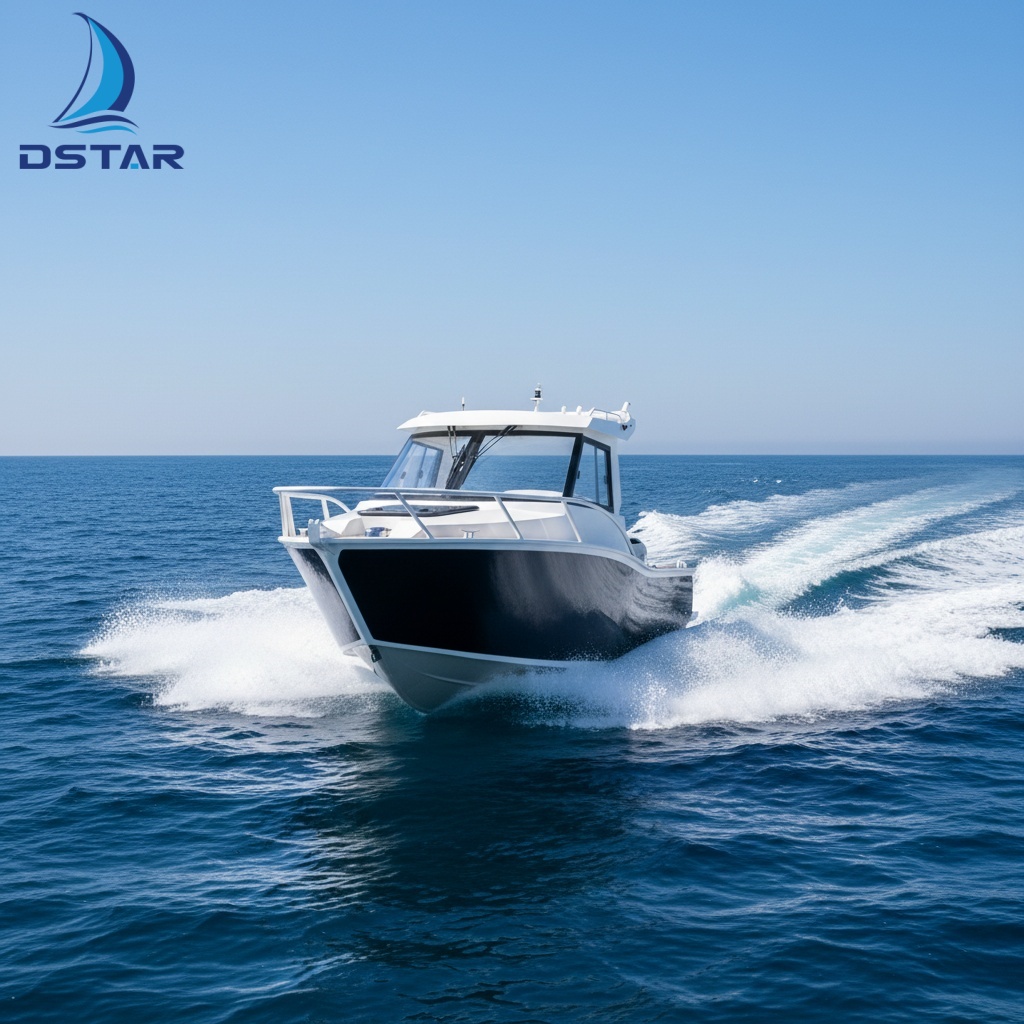
1. Single 150 HP: DK-FS, 6.25 m Aluminum Fishing Boat
Published specification — DK-FS
- Type: aluminum alloy fishing boat
- Total length: 21 ft / 6.25 m; breadth 2.25 m; depth moulded 1.1 m
- Designed draft: 0.35 m
- Engine: 150 HP Yamaha (single unit)
- Maximum speed: 30 knots
- Fuel capacity: 400 L
- Hull and superstructure: 1.28 tonnes of aluminum
- Complement: 6 persons
- Published mission: coastal, lake and river fishing
This is the simplest case in the range and the clearest illustration of the terminology. With one engine, the per-engine rating and the total horsepower are the same number: 150 HP. There is no multiplier to apply and no ambiguity about how many units are being counted.
The published speed is labelled as a maximum, which places it at the ceiling end of the vocabulary rather than at the design end. The supporting figures explain why the hull can be discussed in those terms: a 6.25 m boat carrying 1.28 tonnes of aluminum in its structure, drawing 0.35 m, with a 400 L fuel capacity and a complement of six. The mission statement — coastal, lake and river fishing — is a qualitative descriptor of where the boat is meant to work, and it is published alongside the hull features that support it: a spacious deck layout, recessed rod holders, a functional livewell and dedicated seating.
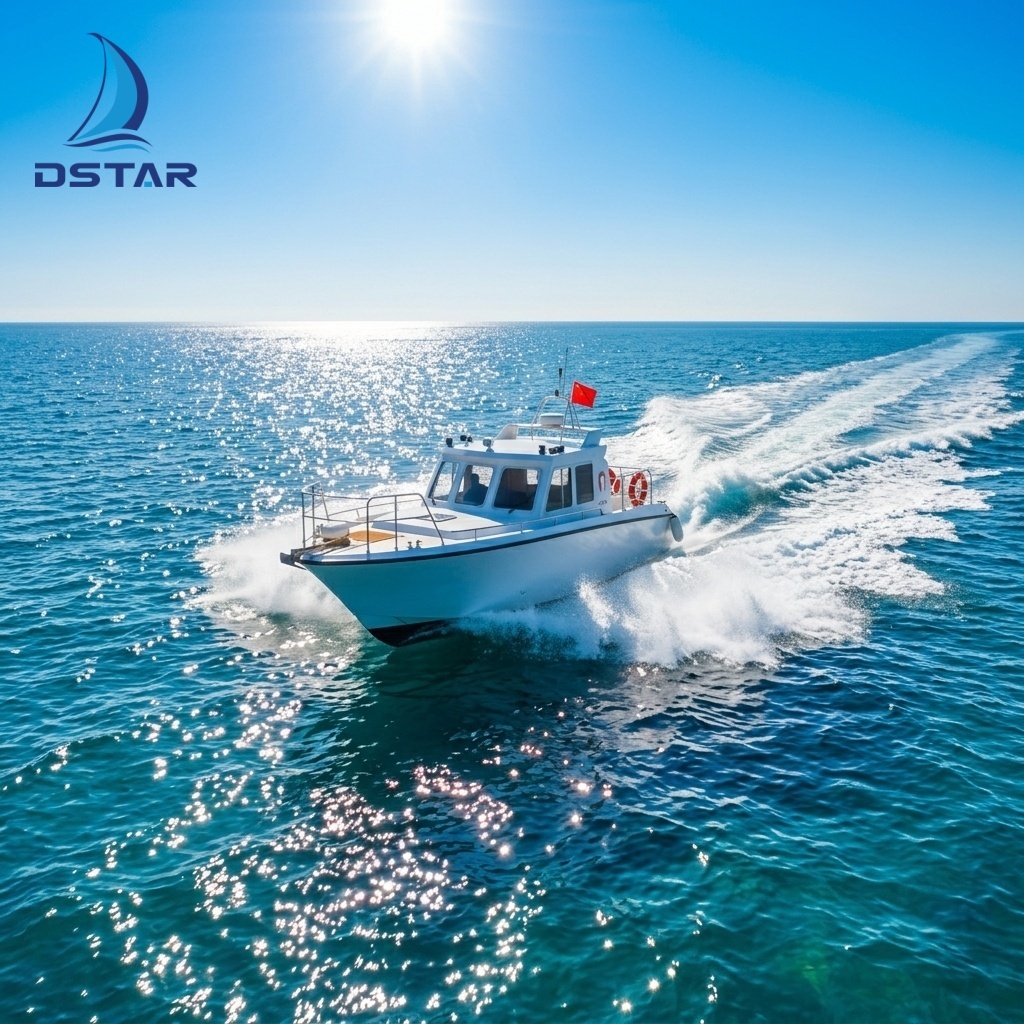
2. Twin 150 HP (300 HP Total): DK-WR, 11 m Aluminum Work Boat
Published specification — DK-WR
- Type: aluminum work boat
- Total length (LOA): 11.00 m; waterline length 8.81 m; breadth 3.25 m; depth 0.885 m
- Full-load draught: 0.47 m; full-load displacement: 5.60 t
- Main engine power: 150 HP (110 kW) × 2 — total 300 HP
- Design speed: 26 knots
- Fuel capacity: 400 L
- Material: 5083-H116 aluminum alloy
- Published missions: coastal rescue, offshore patrol, passenger transport, fishing and marine leisure, professional workboat operations
The DK-WR is where the per-engine versus total distinction becomes visible. The published line is 150HP (110 kW) × 2, and the specification states that the total is 300 HP. A reader who records only “150 HP” for this boat understates it by half; a reader who records only “300 HP” loses the information that the total is produced by two separate units.
The speed figure is labelled as a design speed, not a maximum. This is a different statement from the DK-FS entry and should be read as such: it describes the speed the design is built around rather than a published ceiling. The mass context is also different. A full-load displacement of 5.60 tonnes sits behind those 300 HP, against a hull and superstructure weight of 1.28 tonnes on the DK-FS. The same nominal engine rating therefore appears in two entirely different engineering contexts within one builder's range.
The published equipment list supports the mission description: navigation equipment including GPS, magnetic compass, VHF and AIS; emergency configuration including dual fuel quick-close valves, an automatic bilge pump and a portable fire extinguisher; and life-saving equipment supplied 1:1 against passenger numbers. These items are not power figures, but they illustrate why a work boat specification is read as a system rather than as an engine rating alone.
3. Twin 200 HP with a Fire Pump Load: DK-FR, 13 m Rescue Fire Boat
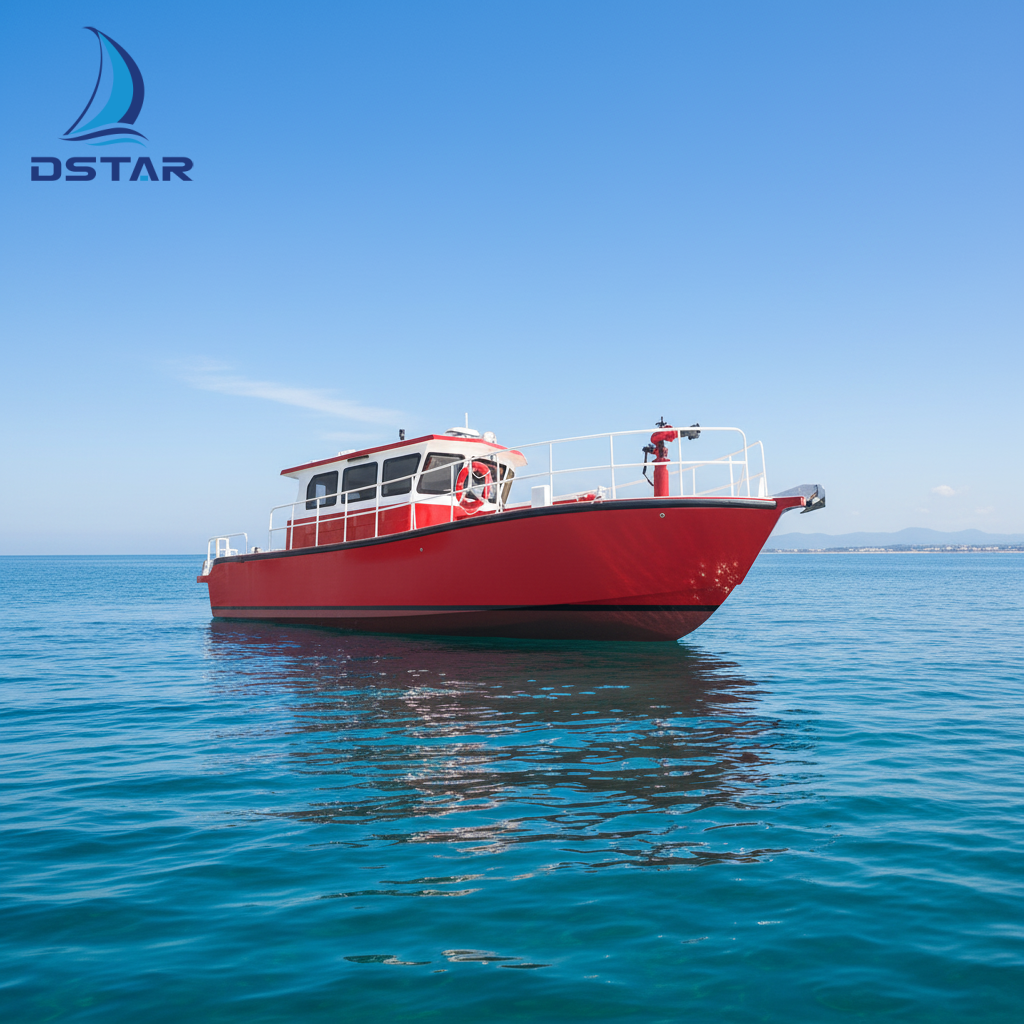
Published specification — DK-FR
- Type: aluminum rescue fire boat (Dookyu Crown 13 m Rescue Fire Boat Series)
- Length: 13.25 m; width: 3.6 m
- Engines: twin 200 HP Mercury outboards — 400 HP total
- Fire pump flow: 1500 GPM
- Fuel tank: 500 L
- Hull material: aluminum alloy
- Published mission: offshore firefighting and rescue missions
Applying the definition from the start of this article, two 200 HP Mercury outboards produce a 400 HP propulsion total. That total, however, is not the whole power picture on this vessel. The fire pump is rated at 1500 GPM, and a pump of that class is a defining load on a fire boat — it is the equipment the mission is organised around.
The published specification does not state whether the pump is driven from the engines or powered independently. That is a design detail, and it is precisely the kind of detail that a reader should expect to confirm rather than infer. What the published sheet does say is unambiguous: a 13.25 m aluminum alloy hull, 3.6 m wide, carrying 500 L of fuel, propelled by twin 200 HP Mercury outboards, with a 1500 GPM pump, built for offshore firefighting and rescue.
It is also the clearest example in the range of why “mission fit” belongs in the same vocabulary as horsepower. Two boats can carry similar propulsion totals and still be entirely different machines, because one of them has to drive a pump rated in thousands of gallons per minute and the other does not.
4. Three 600 HP: DK-LU55, 17.18 m Aluminum Luxury Yacht
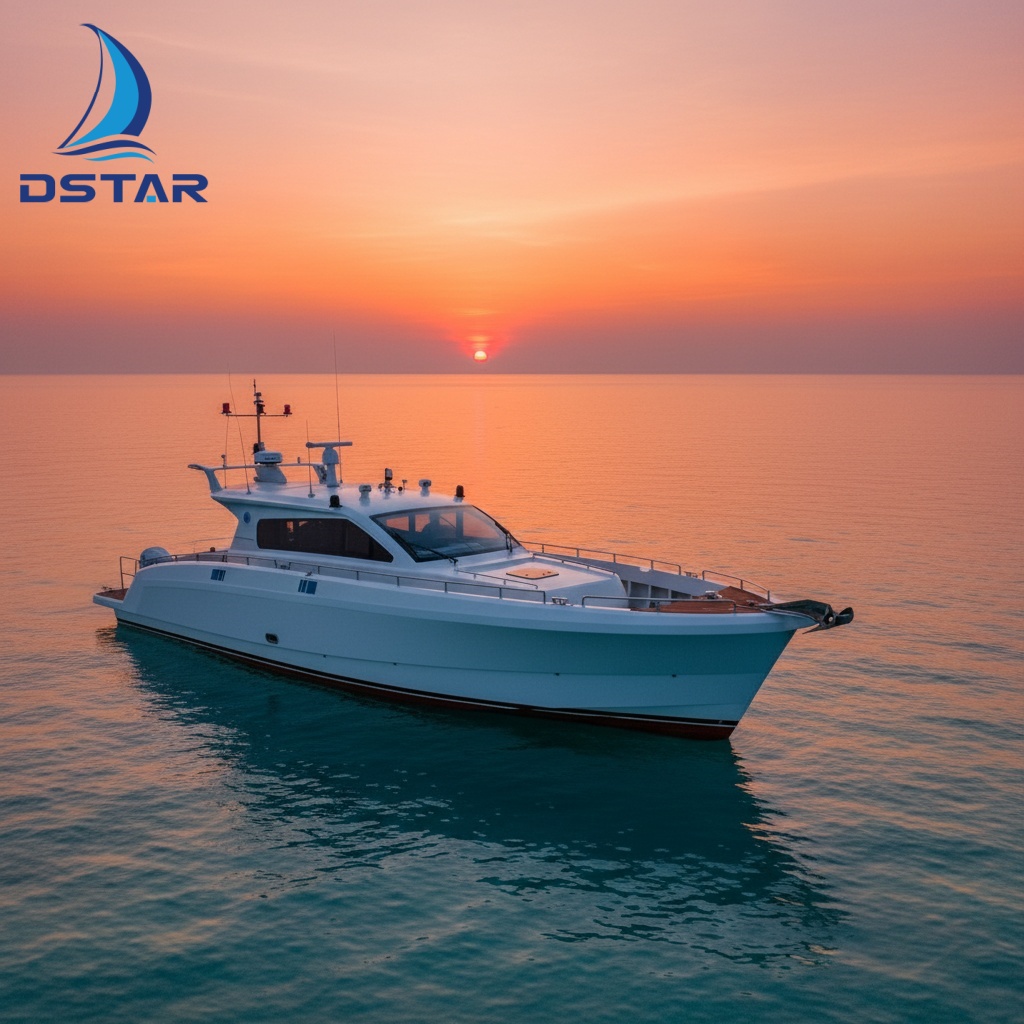
Published specification — DK-LU55
- Type: aluminum luxury yacht
- Length overall: 17.18 m; breadth moulded 4.20 m; depth moulded 2.00 m
- Designed draft: 0.64 m
- Engines: 3 × 600 HP — 1,800 HP total
- Top speed: 53 knots
- Fuel tank capacity: 1,820 L; freshwater capacity: 200 L
- Passengers: 12
- Published industry: sport
At the top of the range, the multiplier reaches three. Applying the same rule, three 600 HP engines produce a total of 1,800 HP — six times the per-engine rating, and a figure that cannot be read correctly unless the count is known first. The published speed is labelled as a top speed, matching the maximum-speed category rather than the design-speed category.
One point of discipline matters here. The published DK-LU55 specification states the engine rating and count as 3 × 600 HP and the top speed as 53 knots; it does not state whether the installation is outboard or inboard. For that reason, this article treats the DK-LU55 as a triple-engine configuration and leaves the installation type where it belongs — with the builder's detailed specification. That distinction is not pedantic: on a 17.18 m yacht with a 4.20 m beam, 1,820 L of fuel, 200 L of freshwater and capacity for 12 passengers, the installation arrangement affects layout, service access and everything downstream of it.
Step-by-Step: How to Read an Outboard Power Specification
The sequence below converts a raw specification line into a set of numbers that can be compared honestly. It is a reading method, not a selection method.
- Count the engines and read the multiplier. “150HP×2” and “3*600HP” both encode a per-engine rating and an engine count. Write both down before doing anything else, because every later step depends on the count.
- Calculate the total. Multiply the per-engine rating by the count. DK-FS: 150 HP × 1 = 150 HP. DK-WR: 150 HP × 2 = 300 HP. DK-FR: 200 HP × 2 = 400 HP. DK-LU55: 600 HP × 3 = 1,800 HP. This is the number to use when two boats of different configurations are placed side by side.
- Record which speed label is printed. DK-FS and DK-LU55 are published with a maximum and a top speed respectively; DK-WR is published with a design speed. Never place a design figure and a maximum figure in the same comparison column without naming the difference. Where a specification carries no speed figure at all — as with the cited DK-FR data — record that as the finding rather than assuming one.
- Place the power next to mass. Use hull and superstructure weight where it is published (1.28 tonnes of aluminum on DK-FS) and full-load displacement where that is published instead (5.60 tonnes on DK-WR). Power read against mass is a ratio; power read alone is a label.
- Add the mission loads. On DK-FR that means the 1500 GPM fire pump. On DK-LU55 it means 12 passengers, 1,820 L of fuel and 200 L of freshwater. Loads are part of the power story because they are part of what the engines have to move.
- Read the supporting figures. Draft, fuel capacity and complement fill in the operating picture: 0.35 m draft and 6 persons on DK-FS; 0.47 m full-load draught and 400 L on DK-WR; 500 L on DK-FR; 0.64 m draft and 1,820 L on DK-LU55.
- Note what the sheet does not state. Installation type on DK-LU55, pump drive arrangement on DK-FR, propeller selection, and the exact scope of certification. Dookyu Crown states that it follows international standards such as ISO and CE; the applicable certificate, scope, number and validity should be verified before purchase rather than assumed from a model name.
Use Cases: Where Each Configuration Sits
Power configurations map onto mission categories in the published data, and reading those pairings is the practical payoff of the vocabulary above.
- Inland, lake and river fishing — DK-FS. A single 150 HP Yamaha, a 6.25 m hull, a 0.35 m draft and a complement of six, published for coastal, lake and river fishing, with a livewell, recessed rod holders and dedicated seating.
- Coastal rescue, offshore patrol, passenger transport and professional workboat duty — DK-WR. Two 150 HP outboards producing 300 HP total, a 26-knot design speed, 5.60 t full-load displacement, 5083-H116 aluminum construction and a published navigation and safety equipment list.
- Offshore firefighting and rescue — DK-FR. Twin 200 HP Mercury outboards, a 1500 GPM pump, a 13.25 m aluminum alloy hull and 500 L of fuel capacity.
- Sport and luxury use with up to 12 passengers — DK-LU55. Three 600 HP engines, a 53-knot top speed, a 17.18 m hull, 1,820 L of fuel and 200 L of freshwater.
Two vessels in the wider Dookyu Crown range show where the outboard vocabulary stops applying. The 19 m DK-PS passenger catamaran is a steel-hulled vessel specified with twin diesel engines and fixed-pitch propellers in a double-engine, double-paddle, double-rudder arrangement, published at a 25-knot cruising speed, roughly 70 L per hour total fuel consumption at cruise, a 3.3 ft draft and capacity for 50 passengers in calm-water transport. The 38-foot DK-CA is an aluminum catamaran sailboat driven by rigging and sail plan, with optional auxiliary power and a twin-hull layout for stability. Neither fits the “outboard configuration” frame, and saying so is part of describing the frame accurately.
Comparison Table: Four Configurations Side by Side
| Model | Vessel type | Length overall | Published engine configuration | Total power | Published speed figure | Fuel capacity | Published mission |
|---|---|---|---|---|---|---|---|
| DK-FS | Aluminum alloy fishing boat | 6.25 m (21 ft) | 150 HP Yamaha (single) | 150 HP | Maximum speed 30 knots | 400 L | Coastal, lake and river fishing |
| DK-WR | Aluminum work boat | 11.00 m | 150 HP (110 kW) × 2 | 300 HP | Design speed 26 knots | 400 L | Coastal rescue; offshore patrol; passenger transport; workboat operations |
| DK-FR | Aluminum rescue fire boat | 13.25 m | Twin 200 HP Mercury outboards | 400 HP | Not stated in the cited specification | 500 L | Offshore firefighting and rescue (1500 GPM fire pump) |
| DK-LU55 | Aluminum luxury yacht | 17.18 m | 3 × 600 HP | 1,800 HP | Top speed 53 knots | 1,820 L | Sport use, 12 passengers |
Total power figures are calculated by multiplying the published per-engine rating by the published engine count. Speed figures are reproduced with the label used in each published specification; a maximum or top speed and a design speed are different measurements. Where the cited specification publishes no speed figure, none has been supplied.
FAQ: Outboard Power on Aluminum Boats
What does “total horsepower” mean on a twin-engine aluminum boat?
Total horsepower is the sum of every engine installed on the vessel. On the DK-WR, the published main engine power is 150 HP (110 kW) × 2, and the specification states that the total is 300 HP. The per-engine rating describes one unit; the total describes the boat. When two vessels with different engine counts are compared, only the total is directly comparable.
What is the difference between design speed and maximum speed in an aluminum boat specification?
A maximum or top speed is a published ceiling figure, while a design speed is the speed the hull and propulsion were engineered around. Within the Dookyu Crown range, DK-FS is published with a maximum speed of 30 knots, DK-WR with a design speed of 26 knots, and DK-LU55 with a top speed of 53 knots. Because the labels differ, the figures should not be set against each other in a single comparison column without naming the difference.
What power configuration does a 13 m aluminum fire boat use?
The DK-FR, a 13.25 m aluminum rescue fire boat, is published with twin 200 HP Mercury outboards — 400 HP of propulsion in total — together with a fire pump rated at 1500 GPM, a 3.6 m beam and 500 L of fuel capacity, built for offshore firefighting and rescue missions. The published specification does not state how the pump is driven, so that detail belongs to the builder's detailed documentation rather than to the headline number.
Can an aluminum yacht be specified with three 600 HP engines?
Yes. The DK-LU55, a 17.18 m aluminum luxury yacht with a 4.20 m moulded breadth and a 0.64 m designed draft, is published with 3 × 600 HP engines, a 53-knot top speed, 1,820 L of fuel capacity, 200 L of freshwater capacity and capacity for 12 passengers. The published specification does not state whether the installation is outboard or inboard, so the installation type should be confirmed in the builder's detailed specification.
Where can the full published specifications be checked?
The figures quoted in this article come from Dookyu Crown's published model specifications and are reproduced without modification. Buyers who need the complete data set — including items the headline specifications do not cover, such as installation arrangements and the applicable certification scope — can request the current catalogue and model documentation directly from the builder.
Conclusion
Outboard power on aluminum boats is a small vocabulary used inconsistently. A per-engine rating is one unit; total horsepower is the sum. A maximum or top speed is a ceiling; a design speed is the condition the boat was engineered around. Mission fit is what the vessel exists to do, and on a fire boat that can include a 1500 GPM pump sitting alongside the propulsion figures.
Read through that vocabulary, the Dookyu Crown range becomes legible rather than impressive-sounding: a 6.25 m fishing boat with 150 HP and a 30-knot maximum; an 11 m work boat with 300 HP across two outboards and a 26-knot design speed; a 13.25 m rescue fire boat with 400 HP of propulsion plus a 1500 GPM pump; and a 17.18 m yacht with three 600 HP engines and a 53-knot top speed. Four different answers to four different mission questions, expressed in the same set of terms.
Check the Published Specifications Before You Compare
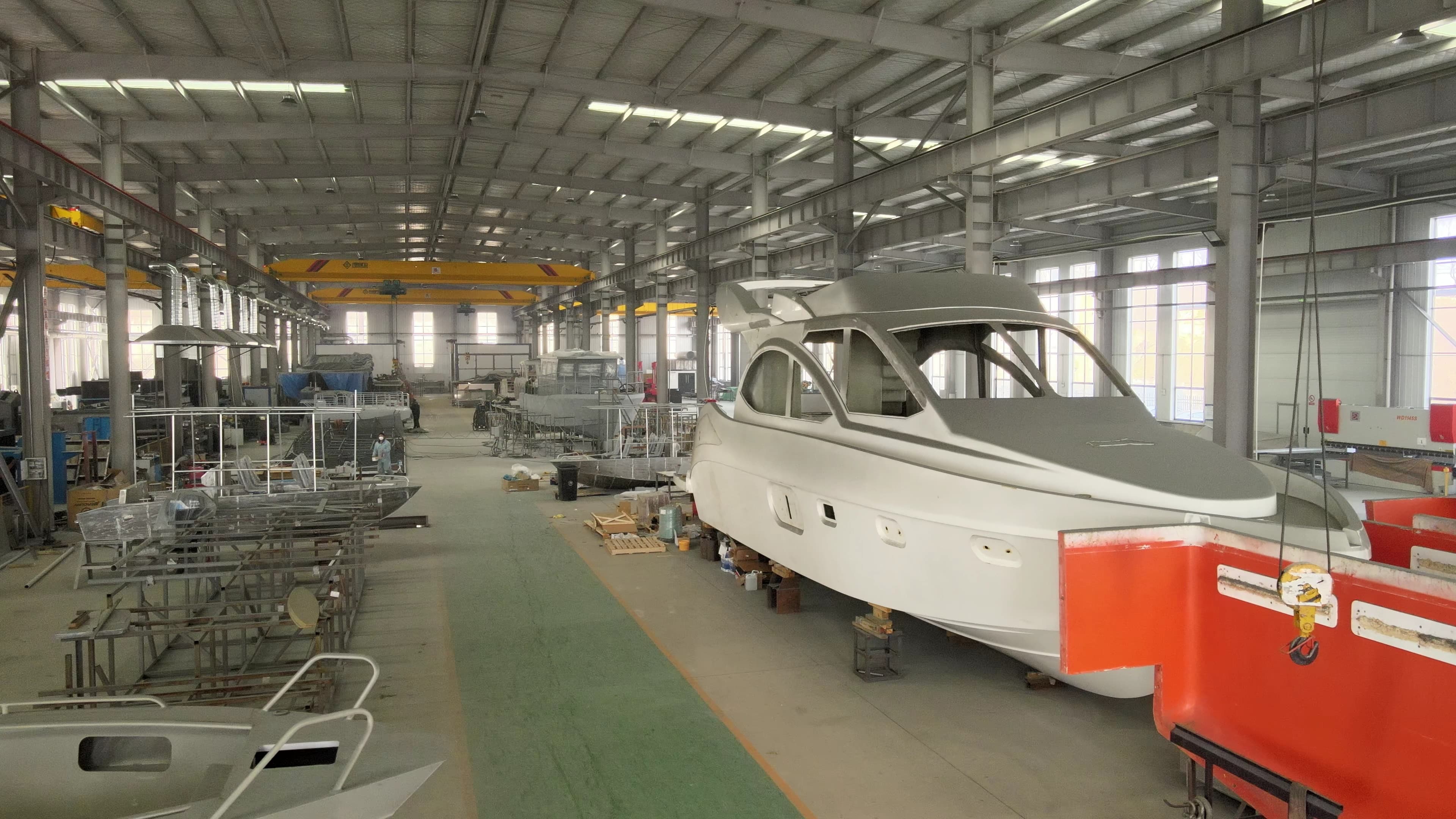
Qingdao Dookyu Crown Marine Co., Ltd. builds aluminum alloy fishing boats, workboats, rescue fire boats, catamarans, passenger ferries and luxury yachts from a 70,000 m² facility in Qingdao, Shandong Province, with an annual production capacity of 200 ships and an R&D team of 17 engineers. Export accounts for 80% of total sales, with deliveries to clients across Europe, Australia, the Americas, Southeast Asia and the Middle East.
- Download the full catalogue: Dookyu Crown brochure (PDF)
- Model specifications and drawings: www.dstaryacht.com
- Email: info@dstaryacht.com | Tel: +86-15689431395 | WhatsApp: +8613335033072
- Address: South Road, 750m West Of Yinzhu Exit Of Shugang Expressway, Qingdao, Shandong, China
Contact person: Bruce Liu. Requests for specification sheets, drawings or a quotation are answered directly by the builder.
Have Questions or Need More Details?
Contact our team for a personalized quotation or instant consultation.
Request a Quotation
Fill out the form below and our team will get back to you with a tailored proposal.
WhatsApp Direct Chat
Prefer to chat in real-time? Message us on WhatsApp for instant assistance & quick answers.
- Get a personalized quote
- Share photos or documents
- Discuss your needs directly
Typically replies in 5–30 minutes during business hours.