Aluminum Boat Technical Guide: Hull Alloys, Specs, and Certification
Aluminum Boat Technical Guide: Hull Alloys, Specs, and Certification
An aluminum boat is a vessel whose hull and superstructure are fabricated from marine-grade aluminium alloys — most commonly the 5083 and 5086 families — and welded into a stiff, corrosion-resistant structure that weighs less than a comparable steel or fiberglass hull. For a buyer in the research and evaluation stage, three technical areas determine whether two quotations can be compared at all: alloy and weld quality, the measured specification parameters the builder publishes, and the scope, number and validity of the certification package.
This guide works through each of those areas using published specification and certification data from Qingdao Dookyu Crown Marine Co., Ltd. (Dookyu Crown Marine), an aluminum boat manufacturer based in Qingdao, Shandong, China, with a stated export share of 80% and markets that include Australia, the USA, Canada, Ecuador, Hong Kong, Mexico, Nigeria, New Zealand, Russia and Thailand. Every parameter and certificate number below is reproduced from that published material, so it can be checked line by line against a quotation.
Key technical constraints in this guide
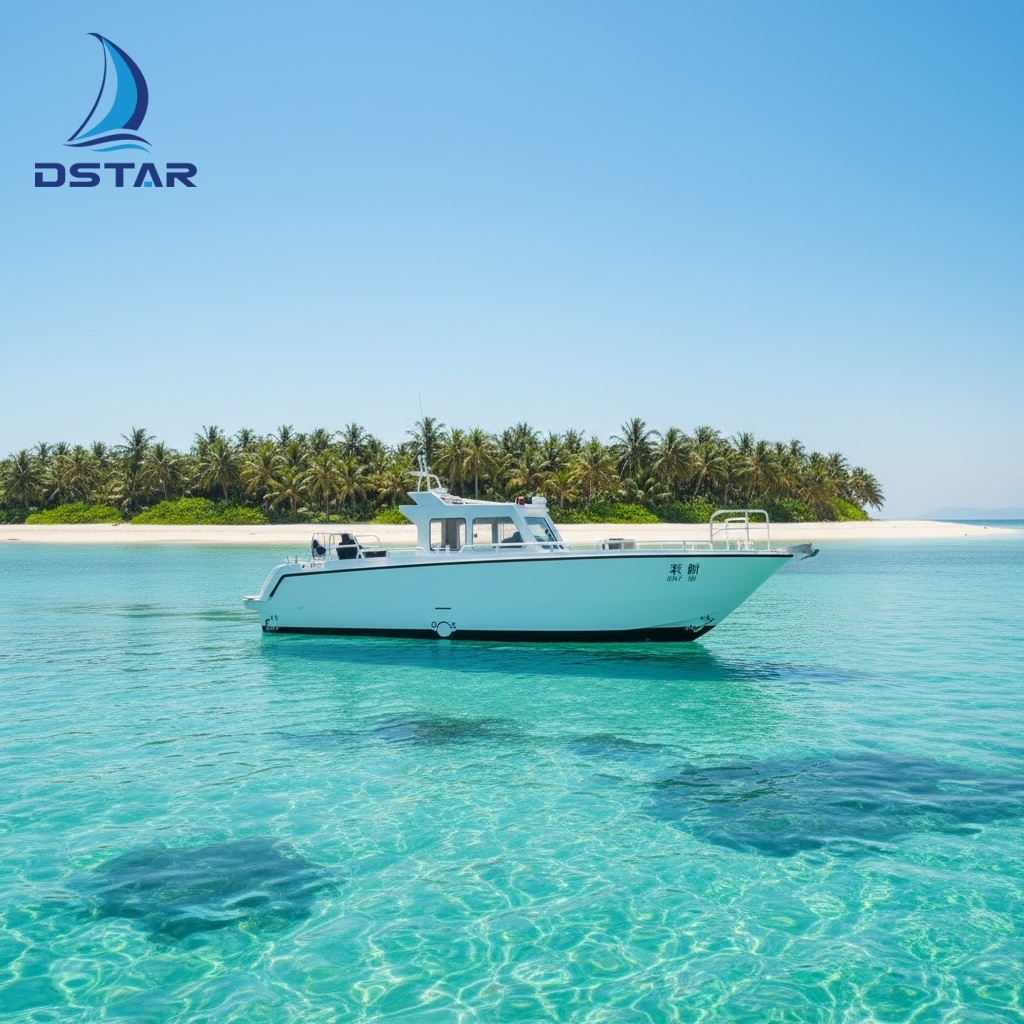
- Hull alloy and temper — the 11 m work boat is specified in 5083-H116 aluminum alloy, with hull and superstructure built from the same alloy.
- Published parameters — LOA 11.00 m, hull length 8.81 m, beam 3.25 m, depth moulded 0.885 m, designed draft 0.47 m, full-load displacement 5.60 t, design speed 26 kn, 2 × 150 HP (110 kW), 400 L fuel.
- Certification — Voluntary Attestation for Recreational Craft number 0P250716.QDCTN80, issued by ECM, valid 2025-07-16 to 2030-07-15.
- Commercial constraints — lead time 30–60 days, minimum order quantity 1 ship, stated monthly capacity 20 ships.
Why Aluminum Boat Specification Sheets Are Hard to Compare
Most aluminum boat evaluations stall on the same problem: the numbers in a quotation are not defined the same way in every specification sheet. Two builders can both describe an “11 m aluminum boat” while meaning different lengths, different weights and different alloys. Without a common parameter set, a comparison table becomes a comparison of adjectives rather than a comparison of vessels.
The five ambiguities that cause the most evaluation errors are:
- Length without a definition. Total length overall (LOA) and hull length (L) are different figures and can differ by more than a metre on a mid-size hull.
- Weight without a definition. A bare aluminum hull and superstructure weight is not the same as a full-load displacement figure that includes fuel, water, people and equipment.
- “Aluminum” without a grade or temper. A 5083 alloy and a 5083-H116 temper carry different mechanical properties, and only one of them is verifiable without a mill certificate.
- “Certified” without scope. A certificate number means nothing to a buyer until the standard, market, issue date, expiry date and covered model list are confirmed.
- “Custom” without a boundary. Customization is a technical range, not a promise: hull length range, hull type, propulsion, layout and equipment all have defined limits.
This is a constraint-matching problem, not a ranking problem. The useful question at the research and evaluation stage is not “which aluminum boat is best”, but “which configuration satisfies my mission, compliance and budget constraints, and which of those constraints can I verify from documents?” Working through the constraints in order — mission and water type, performance, capacity, compliance regime, then commercial terms — prevents the common failure of paying for certification or equipment the mission never required.
Industry Background: Where Aluminum Boats Sit Today
The global aluminum vessel market was estimated at USD 6.145 billion in 2024 and is projected to grow at a CAGR of 4.21% from 2025 to 2035 (Market Research Future). Within that figure, the aluminum fishing boat segment alone was valued at USD 1.7 billion in 2024 (Global Market Insights). A second industry estimate places the same 2024 segment at USD 1.6 billion, and the divergence is itself useful context: single-source market numbers should be treated as directional rather than exact.
Segment-level signals reinforce the direction of travel. Aluminum fishing boats are projected to reach USD 3.12 billion by 2034 at a 5.8% CAGR (Intel Market Research), with North America holding the largest share of that market in 2024. Patrol boats, including aluminum variants, were valued at USD 240 million in 2024 (Intel Market Research). In the passenger segment, Incat Tasmania was reported in 2025 to be constructing next-generation lightweight aluminum passenger ferries aimed at improved fuel efficiency (Straits Research).
Safety standards shape the technical baseline as well. ABYC states that adherence to its standards reduces the likelihood of boat accidents by up to 47% and fatalities by up to 58%, and that 90% of boats constructed in the US are built to ABYC safety standards. For a buyer, that statistic defines the reference framework a US-market aluminum boat will be assessed against, regardless of where it is built.
Technical Points That Define an Aluminum Boat
1. Alloy grade and temper
Dookyu Crown Marine builds hulls and superstructures from marine-grade aluminum such as the 5083 and 5086 alloys. The published specification for the 11 m aluminum work boat (DK-WR) states 5083-H116 aluminum alloy, selected because it is both lightweight and high-strength and suits sailing in complex sea conditions. The same document notes that the main hull and superstructure use the same alloy, which keeps structural behaviour consistent and holds maintenance costs down.
The practical point for an evaluation stage buyer is that an alloy family name is not a specification. Ask for the exact alloy designation, the temper, and the mill test reports that verify the delivered plate matches the quoted material.
2. Welding, cutting and inspection
Fabrication method determines how well an aluminum hull holds its shape over years of service. Dookyu Crown Marine reports the use of MIG/TIG welding techniques and precision CNC cutting to build hulls and superstructures to strict tolerances, and describes full-penetration welds on 5083 aluminum structures in its multi-purpose platform. Quality control is structured as a full-process sequence: raw material verification through Mill Test Reports, in-process weld inspection using NDT, and final sea trials, with compliance to ISO 9001, CE and class society requirements.
3. The parameters that define size and performance
Specification sheets are only comparable when the same parameter names mean the same thing. The table below lists the parameters that carry the most weight during evaluation, what each one tells the buyer, and a published Dookyu Crown value as a reference point.
| Parameter | What it tells the buyer | Published example |
|---|---|---|
| LOA (total length overall) | Full length used for berthing, lifting and transport planning | 11.00 m (11 m work boat) |
| L (hull length) | Hull length listed separately from LOA | 8.81 m (11 m work boat) |
| Beam / breadth moulded (B) | Moulded width; drives trailer width and stability | 3.25 m (11 m work boat); 4.20 m (17 m luxury yacht) |
| Depth moulded (D) | Moulded hull depth; related to freeboard and interior volume | 0.885 m (11 m work boat) |
| Designed draft | Submerged depth at the design condition; limits shallow-water access | 0.47 m (11 m work boat); 0.35 m (6.25 m fishing boat); 0.64 m (17 m luxury yacht) |
| Full-load displacement | Weight with fuel, water, persons and equipment aboard | 5.60 t (11 m work boat) |
| Hull and superstructure weight | Material quantity; used for lifting and towing calculations | 1.28 t of aluminum (6.25 m fishing boat) |
| Design speed vs maximum speed | Design speed is a planning figure; maximum speed is a peak figure | 26 kn design (11 m work boat); 30 kn max (6.25 m fishing boat); 53 kn top (17 m luxury yacht) |
| Engine power and configuration | Installed power, number of engines and fuel type | 2 × 150 HP / 110 kW (11 m work boat); 150 HP YAMAHA (6.25 m fishing boat); 2 × 200 HP Mercury (13 m fire boat); 3 × 600 HP (17 m luxury yacht) |
| Fuel capacity | Range planning and refuelling logistics | 400 L (11 m work boat and 6.25 m fishing boat); 500 L (13 m fire boat); 1,820 L (17 m luxury yacht) |
| Complement / passengers | Capacity basis used in documentation | 6 persons (6.25 m fishing boat); 12 passengers (17 m luxury yacht) |
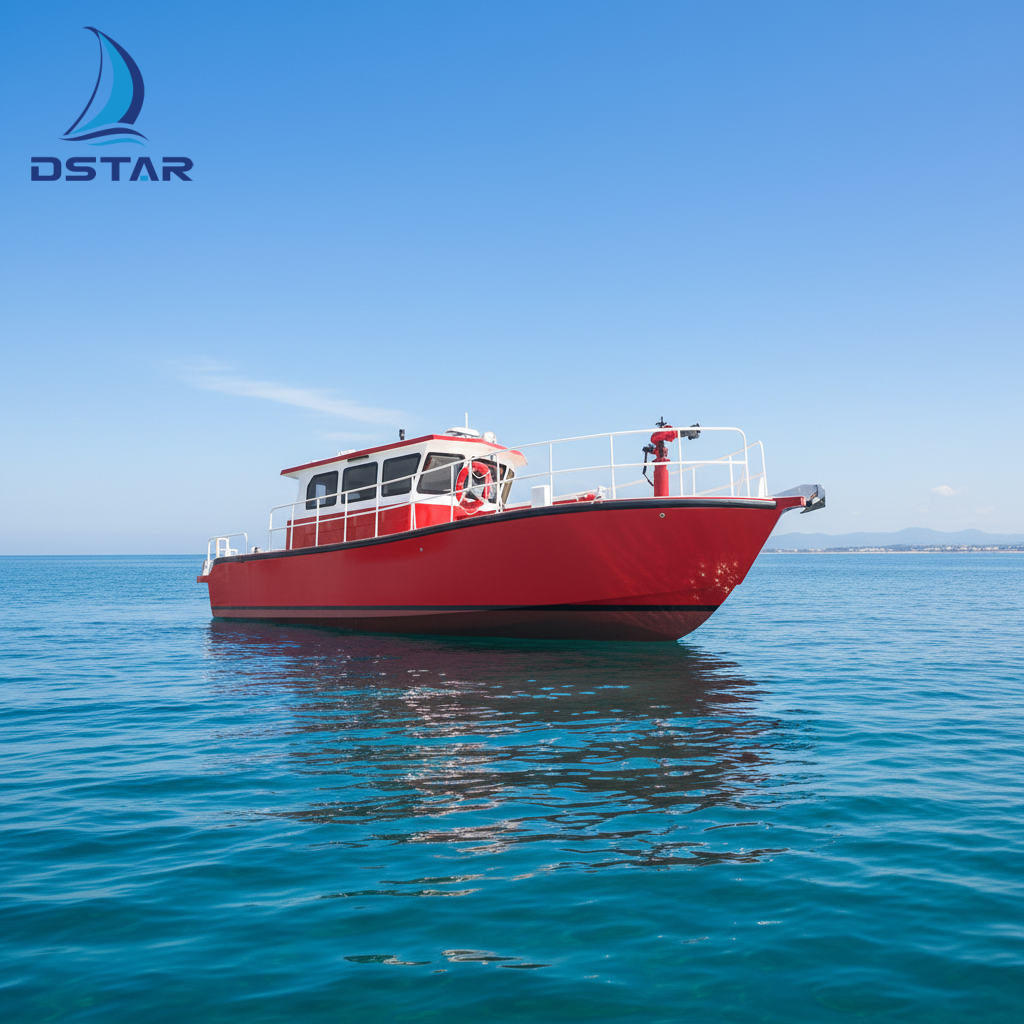
The 11 m work boat illustrates why the LOA/L distinction matters in practice: the same vessel is published as 11.00 m total length and 8.81 m hull length. Before ordering, confirm which length the builder, insurer, marina berth allocation and lifting equipment will use.
4. Hull weight versus displacement
Two figures are frequently confused during evaluation. The 6.25 m aluminum alloy fishing boat (DK-FS) is published with a hull and superstructure aluminum weight of 1.28 tons, while the 11 m work boat is published with a full-load displacement of 5.60 tons. The first figure describes material quantity and supports lifting, towing and transport planning. The second describes the vessel with fuel, water, persons and equipment aboard, which is the figure stability and performance calculations are built on.
5. Propulsion, speed and fuel
Dookyu Crown Marine states that outboard, inboard and electric propulsion options are available, subject to the selected vessel design. The published platform spread shows how wide that range is: a single 150 HP YAMAHA outboard on the 6.25 m fishing boat with a 30 kn maximum speed and 400 L of fuel; twin 200 HP Mercury motors on the 13 m rescue fire boat with 500 L; twin 150 HP (110 kW) engines on the 11 m work boat with a 26 kn design speed; and three 600 HP engines on the 17 m luxury yacht, delivering a 53 kn top speed from a 1,820 L tank.
6. Onboard systems and safety equipment
Equipment lists are part of the technical evaluation, not an afterthought. The 11 m work boat is published with standard GPS, magnetic compass, VHF and AIS for real-time positioning and collision avoidance warning; dual fuel quick-close valves, an automatic bilge pump and a portable fire extinguisher (CO² + dry powder); six life jackets and two life buoys supplied 1:1 against passenger numbers; an EVA imitation teak floor that is non-slip and wear-resistant; a remote control searchlight, tachometer and oil level gauge in the cab; and a DC distribution board, battery charger and shore power socket.
Specification Parameters Across Aluminum Vessel Types
The same parameter set can be filled in across different aluminum boat types, which is what makes a cross-type comparison possible before any quotation is issued. The table below uses published Dookyu Crown Marine figures; blank entries indicate parameters not published in the source specification rather than parameters that do not exist.
| Model | Vessel type | LOA | Beam | Draft | Power | Speed | Fuel | Capacity |
|---|---|---|---|---|---|---|---|---|
| DK-FS | Aluminum alloy fishing boat | 6.25 m / 21 ft | 2.25 m | 0.35 m | 150 HP YAMAHA | 30 kn max | 400 L | 6 persons |
| DK-WR | Aluminum work boat / cruiser | 11.00 m | 3.25 m | 0.47 m | 2 × 150 HP (110 kW) | 26 kn design | 400 L | 5.60 t displacement |
| DK-FR | Aluminum fire boat / rescue | 13.25 m | 3.6 m | — | 2 × 200 HP Mercury | — | 500 L | 1,500 gpm fire pump |
| DK-LU55 | Aluminum luxury yacht | 17.18 m | 4.20 m | 0.64 m | 3 × 600 HP | 53 kn top | 1,820 L | 12 passengers |
| DK-CA | Aluminum catamaran sailboat | 38 ft | Twin hull | — | Customizable rig; optional auxiliary power | — | — | Customizable cabins and galley |
Certification and Compliance: What the Documents Actually Cover
Compliance is the constraint that most often decides whether an aluminum boat can be delivered to a specific market at all, so it should be verified at certificate level rather than at marketing-claim level. Dookyu Crown Marine’s aluminum boat series is covered by a Voluntary Attestation for Recreational Craft, certificate number 0P250716.QDCTN80, issued by ECM with an issue date of 2025-07-16 and an expiry date of 2030-07-15. The listed applicable standards are EN ISO 12217-1:2017 and EN ISO 12217-3:2017, together with Regulation (EU) 2013/53/EU, and the stated market is global third-country markets outside the EU. The scope covers multiple series of aluminum, steel and fiberglass boats.
A second document, the Certificate – Electromagnetic Compatibility (EMC), certificate number 0P250716.QDCTN81 issued by ECM, covers the same series against EN IEC 61000-6-1:2019 and EN IEC 61000-6-3:2021 for the same market scope, valid across the same 2025-07-16 to 2030-07-15 period.
The covered model list matters as much as the number. Within the attestation scope are the 6.25 m aluminum alloy fishing boat (DK-FS), the 38-foot catamaran aluminum sailboat (DK-CA), the 13 m aluminum rescue fire boat (DK-FR), the 11 m aluminum alloy cruiser and work boat (DK-WR), the 17 m aluminum luxury yacht (DK-LU55) and the 19 m passenger catamaran (DK-PS). The 13 m aluminum rescue fire boat is additionally certified to EN ISO 12217-1:2017 and EN ISO 12217-3:2017 under attestation 0P250716.QDCTN80.
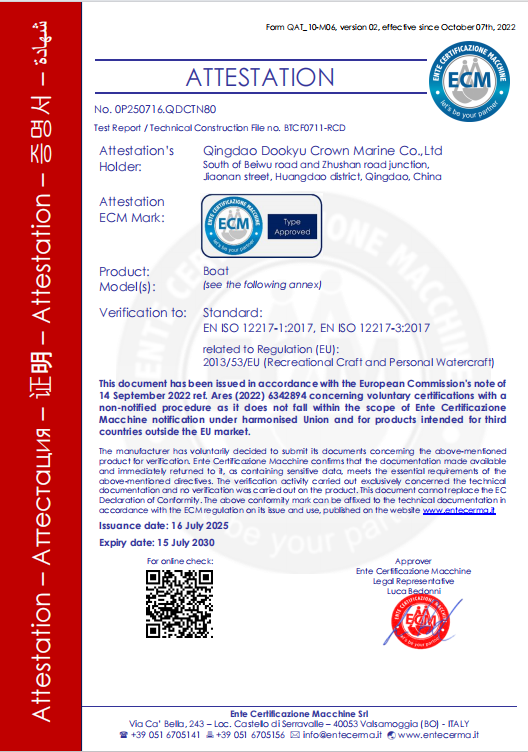
Two verification habits prevent the most common compliance mistake. First, confirm the certificate’s covered model list includes the exact configuration in the quotation — a valid certificate for a series is not automatically a certificate for every variant. Second, verify number, issuer, standard, market scope, issue date and expiry date against the original document, not a marketing page. Buyers targeting the US market should also expect the boat to be assessed against ABYC standards, which 90% of US-built boats are constructed to.
Step-by-Step: How to Verify an Aluminum Boat Before Ordering
- Fix the constraint set in writing. Write down mission role (patrol, fire and rescue, fishing, passenger transport, workboat or leisure), water type (inland, coastal and offshore, or open ocean), required speed, required capacity, required fuel range, destination market and budget band. This list becomes the filter every quotation is tested against.
- Request alloy and material documents. Ask for the exact alloy designation and temper (for example 5083-H116) plus Mill Test Reports for the delivered plate.
- Rebuild the parameter table from the quotation. LOA, hull length, beam, depth moulded, designed draft, displacement, hull weight, design speed, maximum speed, installed power, fuel and complement. Ask the builder to mark which values are design targets, which are measured, and which are maxima.
- Ask for welding and inspection records. Confirm the welding process (MIG/TIG), whether full-penetration welds are used on the hull structure, how tolerance is controlled through CNC cutting, and whether NDT weld inspection records and the final sea trial report will be supplied.
- Verify certification at the certificate level. Match certificate number, issuing body, applicable standards, market scope, issue date, expiry date and the covered model list against the configuration being quoted.
- Match propulsion and onboard equipment to the mission. Compare engine configuration and power to the required speed and load; check that safety equipment such as life jackets and life buoys, bilge pumps and fire extinguishers are listed at the correct ratio; confirm navigation and communication equipment (GPS, compass, VHF, AIS) is included rather than optional.
- Confirm the commercial constraints last. Lead time, minimum order quantity, monthly capacity, trade terms (FOB or CIF), export packaging, documentation and after-sales support should be locked in writing before any technical detail is finalised.
- Plan the sea trial and acceptance checklist. Tie the acceptance criteria back to the parameter table from step 3 so that the trial measures the figures that were actually specified.
Use Cases: Matching Technical Data to Mission
Different missions pull different parameters to the front of the evaluation. The examples below use published specification and application data.
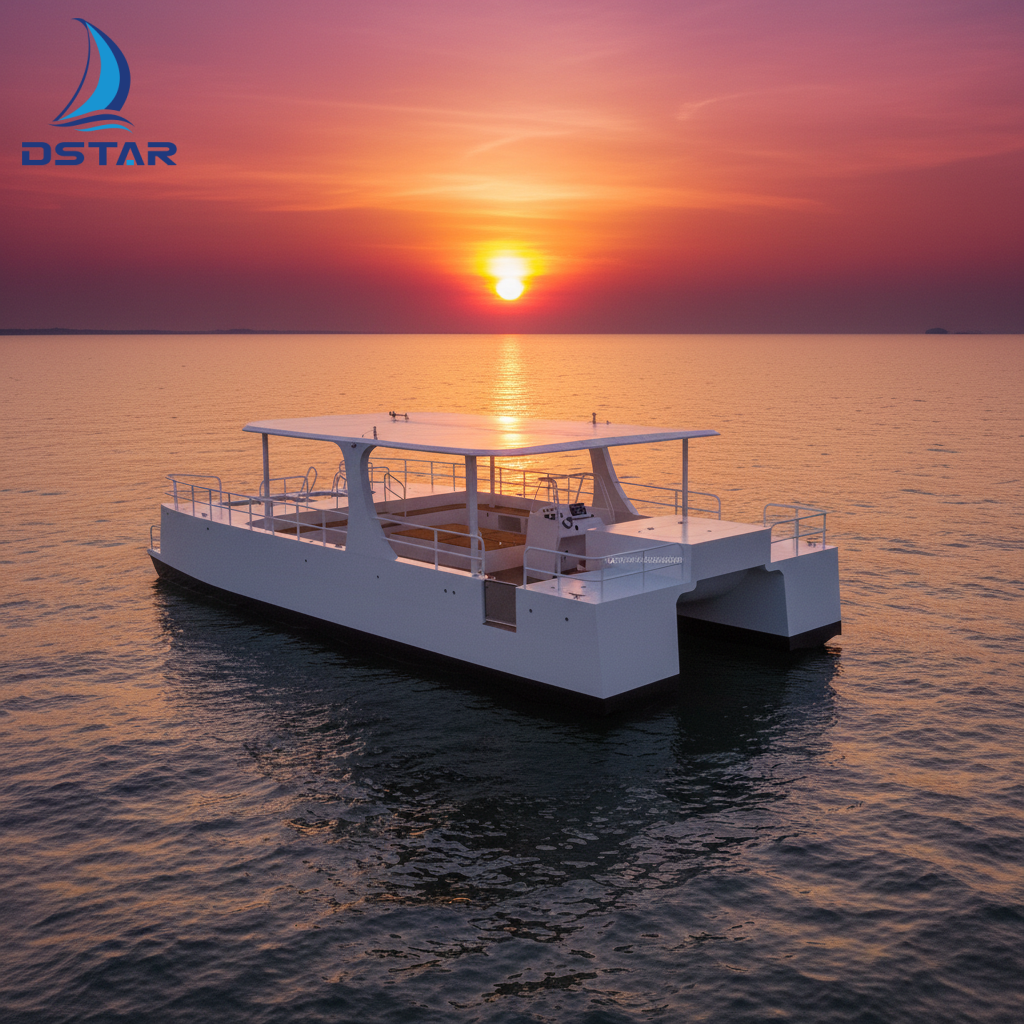
- Fire and rescue. The 13 m aluminum rescue fire boat (DK-FR) is specified for offshore firefighting and rescue missions with twin 200 HP Mercury motors, a 500 L fuel tank and a 1,500 gpm fire pump. A published case reference describes one 13.25 m aluminum fire rescue boat supplied to an international customer for offshore firefighting and rescue duty, with the customer identity and delivery details not publicly disclosed.
- Patrol and law enforcement. Aluminum patrol boat, pilot boat and utility workboat roles rely on lightweight hulls, corrosion resistance and multi-mission switching; application data lists high-speed manoeuvring, modular role changes and matched equipment such as radar, chartplotters, VHF radios, winches and cranes.
- Fishing. The 6.25 m aluminum fishing boat (DK-FS) is designed for coastal, lake and river fishing with a 150 HP YAMAHA engine, 400 L fuel capacity, 30 kn maximum speed, spacious deck layout, recessed rod holders, dedicated seating and a functional livewell.
- Passenger and charter operations. The 38-foot catamaran aluminum sailboat (DK-CA) uses a twin-hull layout for stability and a marine-grade aluminum hull for durability, with customizable cabins, galley, navigation station, rigging and sail plans, aimed at coastal cruising, offshore passages, weekend getaways and charter use.
- Luxury and business use. The 17 m aluminum luxury yacht (DK-LU55) carries 12 passengers at a 53 kn top speed with three 600 HP engines, and is published with two independent reception areas, plus lower-deck bedroom, crew room, kitchen and activity room.
- Water conditions. Published application data spans inland waters (rivers, lakes, reservoirs), coastal and offshore waters, and open ocean use, with requirements including international certification, customized hulls and layouts, corrosion protection and energy-efficient propulsion.
Aluminum as a hull material also appears widely in pilot boats, harbor water taxis, landing craft, dive support boats and rigid inflatable boat (RIB) platforms, where low weight and corrosion resistance matter more than maximum interior volume.
Frequently Asked Questions
What should I verify on a CE-related certificate for an aluminum boat?
Verify the certificate number, issuing body, applicable standards, market scope, issue date, expiry date and the covered model list. Dookyu Crown Marine’s aluminum boat series is covered by the Voluntary Attestation for Recreational Craft number 0P250716.QDCTN80, issued by ECM, valid from 2025-07-16 to 2030-07-15, against EN ISO 12217-1:2017, EN ISO 12217-3:2017 and Regulation (EU) 2013/53/EU, for global third-country markets outside the EU. Models inside that scope include the 13 m aluminum rescue fire boat (DK-FR), the 11 m aluminum work boat (DK-WR), the 6.25 m aluminum alloy fishing boat (DK-FS), the 38-foot catamaran aluminum sailboat (DK-CA), the 17 m aluminum luxury yacht (DK-LU55) and the 19 m passenger catamaran (DK-PS). A separate EMC certificate, number 0P250716.QDCTN81 issued by ECM, covers the series against EN IEC 61000-6-1:2019 and EN IEC 61000-6-3:2021 for the same market scope. Always confirm that the certificate’s model list matches the configuration in your quotation.
Can an aluminum boat be customized, and within what technical limits?
Customization is defined by a stated engineering range rather than a general promise. Dookyu Crown Marine states that hull sizes from 6 to 23 meters can be configured, along with colour, functional layout and power system configuration. The published customization scope covers hull dimensions and structure, hull type (monohull, catamaran or trimaran), deck layout, wheelhouse position, engine brand and type, propulsion system, power options (fuel, electric or hybrid), fuel and water tank capacity, firefighting equipment, cranes and winches, fishing gear and livewells, passenger seating configuration, interior design style, furniture, lighting, galley and sanitary equipment, hull colour and paint finish, logos and decals, navigation and communication systems, electrical systems and solar panels, automation and control systems, certification level (CE, CCS or SOLAS), safety and lifesaving equipment, bimini tops and outdoor accessories, and packaging and shipping solutions. Production runs as OEM, ODM or integrated end-to-end service, supported by 17 in-house engineers.
What drives the price of an aluminum boat?
Because aluminum boats are configured to order rather than sold from a fixed catalogue, the price is driven by configuration choices rather than a single list figure. The main drivers are hull length and alloy specification, hull type, propulsion configuration (outboard, inboard or electric, including engine brand and power), onboard equipment such as fire pumps, cranes, winches, livewells and navigation suites, the level of interior fit-out, and the certification scope required for the destination market. Dookyu Crown Marine states a minimum order quantity of 1 ship and offers flexible trade terms including FOB and CIF. The practical way to control budget is to fix mission-critical parameters first — length, hull type, power and certification — and treat interior finish and optional equipment as the variables that can move.
How can I validate build quality before committing to full production?
For vessels, validation happens through documentation and inspection rather than a physical sample boat. Dookyu Crown Marine’s quality control sequence covers raw material verification through Mill Test Reports, in-process weld inspection using NDT, and final sea trials, with compliance to ISO 9001 and CE requirements. Buyers evaluating a first order should request the material certificates, the weld inspection records and the sea trial report, and agree the inspection plan with the shipyard before production begins. The stated minimum order quantity of 1 ship also means a single vessel can serve as the validation build for a longer fleet programme.
What lead time and production constraints should I plan for?
Dookyu Crown Marine states a lead time of 30–60 days and a monthly capacity of 20 ships, with export activity across 30+ countries and regions in Europe, North America, Australia, Southeast Asia and the Middle East, plus familiarity with market entry requirements and CE and SOLAS compliance documentation. After-sales support includes rapid remote diagnostics, spare parts supply, on-site assistance in key regions, comprehensive operation and maintenance manuals, and technical training for operators. To move from evaluation to a configuration-based quotation, you can contact the Dookyu Crown Marine team by email at info@dstaryacht.com, by WhatsApp on +8613335033072, or review the specification material at dstaryacht.com.
Conclusion: Verification Beats Impression
An aluminum boat is technically sound when three layers line up: a marine-grade alloy such as 5083-H116 built into a hull with controlled welding and verifiable inspection records; a specification sheet whose parameters are defined consistently, so that LOA, hull length, beam, draft, displacement, speed, installed power and fuel capacity can actually be compared; and a certification package whose number, issuer, standard, market and validity dates can be checked against the exact configuration being quoted.
Dookyu Crown Marine publishes these details for its aluminum boat range: a 6.25 m fishing boat, an 11 m work boat, a 13 m rescue fire boat, a 17 m luxury yacht, a 38-foot catamaran sailboat and a 19 m passenger catamaran, produced under a 30–60 day lead time with a minimum order quantity of 1 ship, and covered by attestation 0P250716.QDCTN80 and EMC certificate 0P250716.QDCTN81 issued by ECM. Use that data as the checklist, and the aluminium boat evaluation becomes a comparison of verified parameters rather than a comparison of claims.
Next Step: Specifications, Certification and Quotation
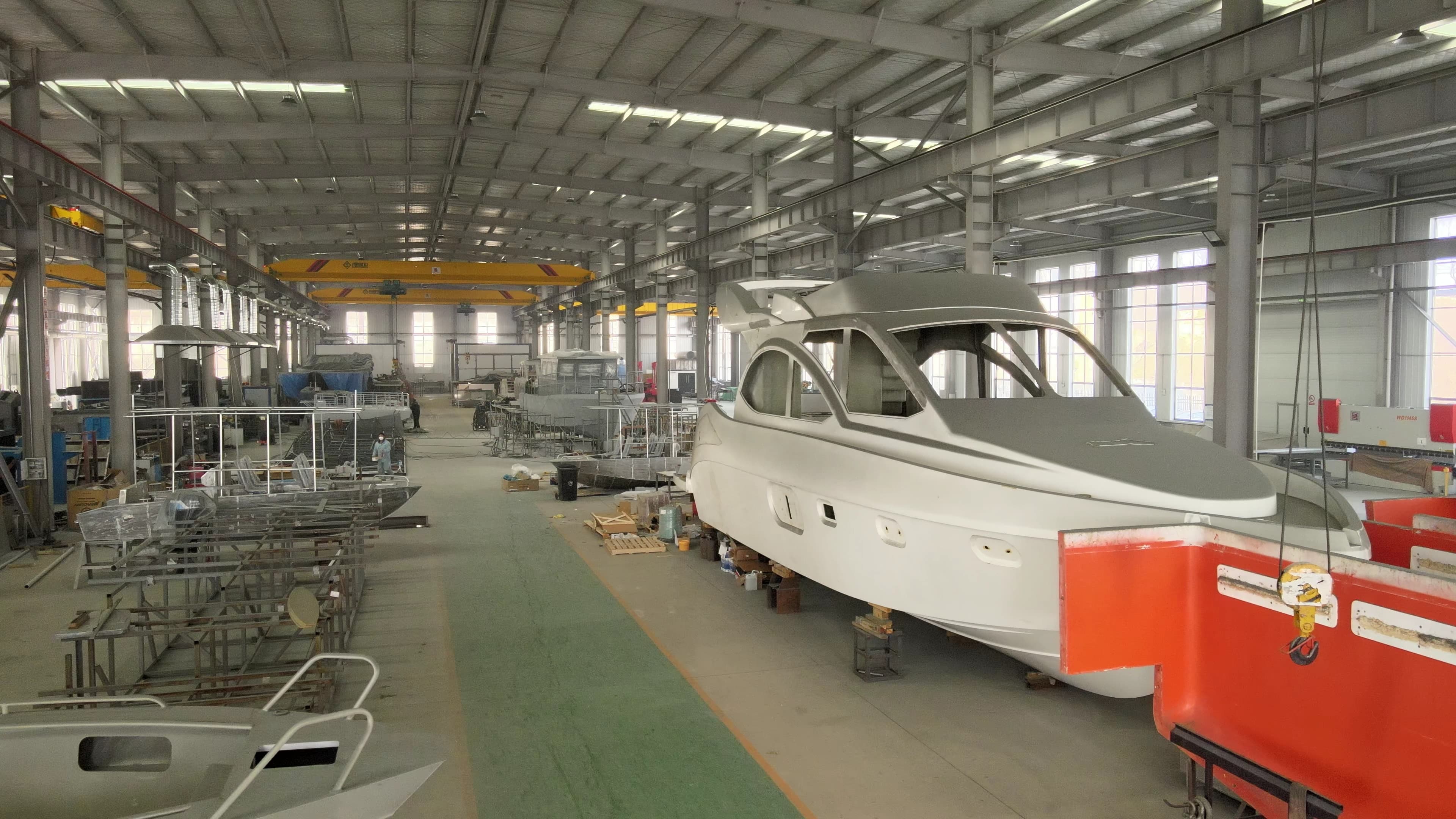
If you are preparing a technical comparison, request the current specification sheet and certification documents for the models relevant to your mission, or send your parameter list for a configuration-based quotation.
Download the full product brochure: Dookyu Crown Marine brochure (PDF)
Contact: Bruce Liu · Qingdao Dookyu Crown Marine Co., Ltd., South Road, 750m West Of Yinzhu Exit Of Shugang Expressway, Qingdao, Shandong, China · Tel: +86-15689431395 · WhatsApp: +8613335033072 · Email: info@dstaryacht.com · Website: www.dstaryacht.com