DK-WR 11m Aluminum Work Boat vs DK-FR 13m Rescue Fire Boat: Which Fits Your Mission?
Aluminum BoatAluminum Work BoatAluminum Fire BoatAluminum Rescue BoatAluminum Patrol Boat
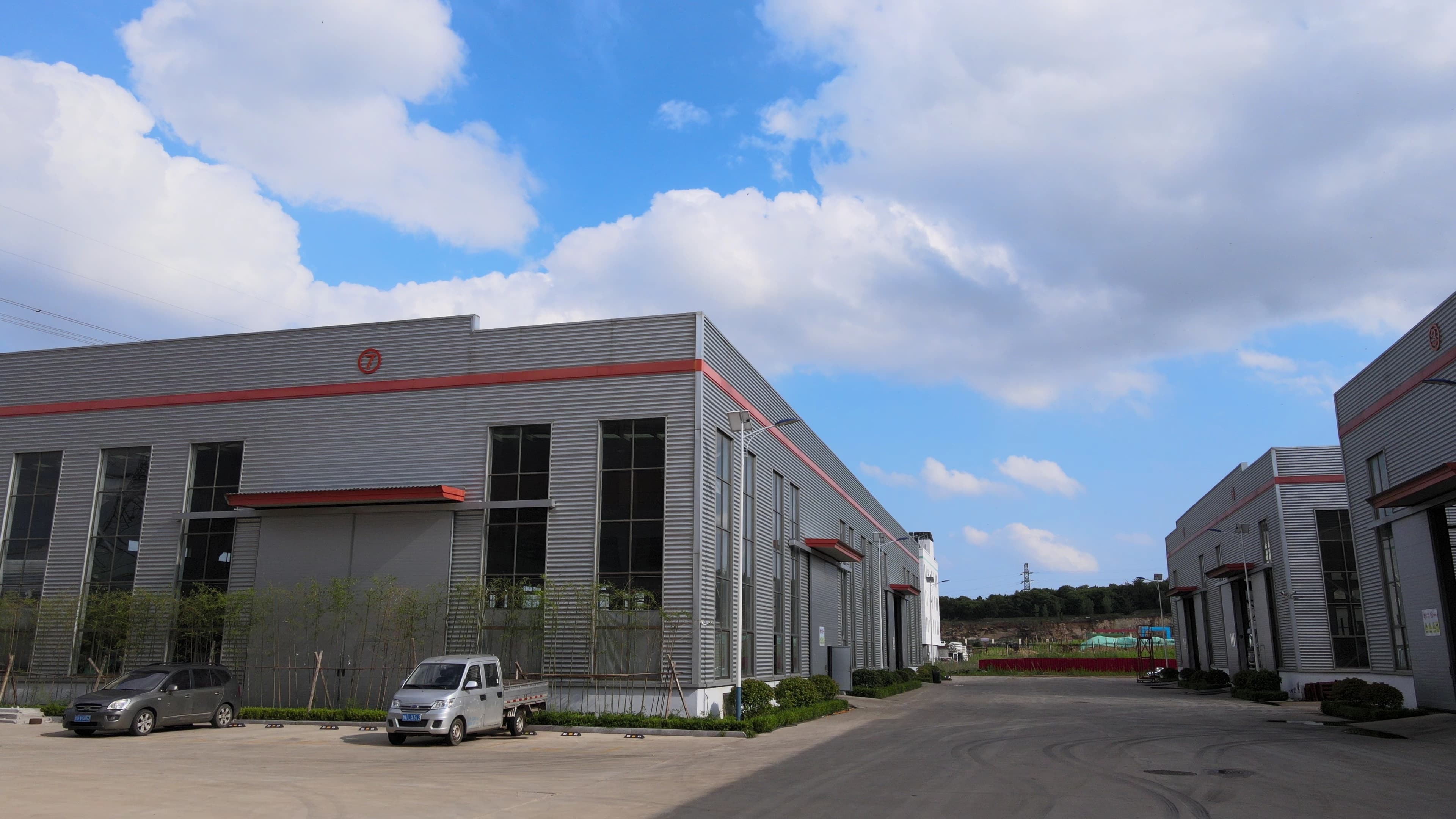
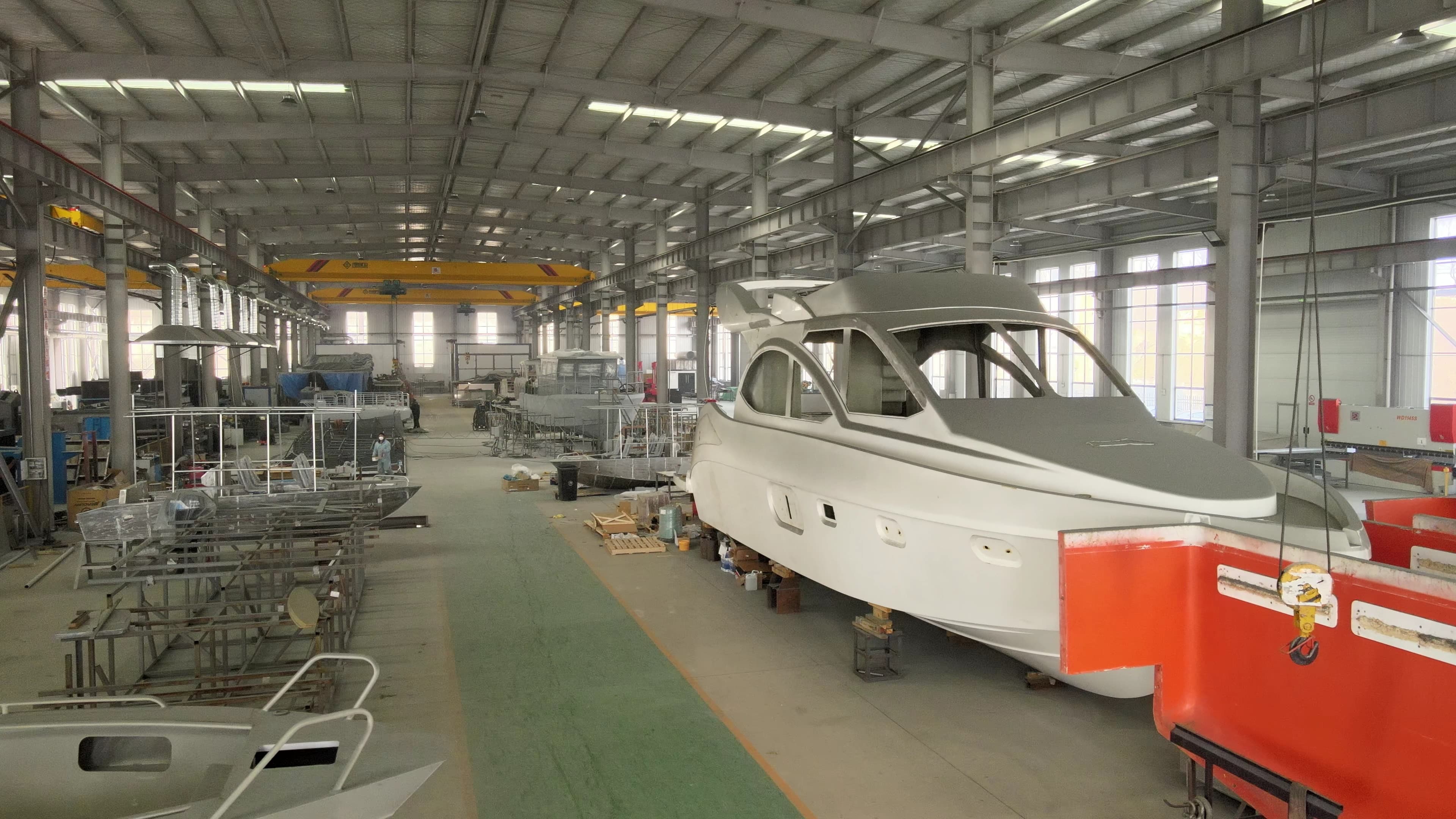
Qingdao Dookyu Crown Marine Co., Ltd. is a Qingdao-based aluminum boat manufacturer founded in 2020, operating a 70,000 m² facility with 85 employees, a 17-engineer R&D team, an annual output of 200 ships and an export share of about 80% across markets that include AU, USA, CA, EC, HK, MX, NG, NZ, RU and TH. Within its workboat range, the DK-WR 11m aluminum work boat and the DK-FR 13m aluminum rescue fire boat sit close enough on paper to be confused, and far enough apart in operation to make a wrong selection expensive to correct.
This comparison is written for buyers at the research-to-evaluation stage — municipal fleets, port authorities, law-enforcement units, contractors and importers — who must justify a purchase to someone who will ask what the boat does on a Tuesday afternoon and what it does on the worst night of the year. It covers the two platforms, the mission logic that separates them, and the commercial checks — purchasing terms, acceptance criteria, customization and export support — that determine whether the delivered vessel matches the specification.
The Buying Problem: Comparable Specifications, Incomparable Missions
Most buyers compare these two aluminum boats along the wrong axis. They read 11.00 m against 13.25 m, 300 total horsepower against twin 200HP outboards, 400 L against 500 L of fuel, and conclude that the fire boat is a larger version of the work boat. Operationally it is not. One vessel is configured around offshore firefighting and rescue missions and carries a 1500 GPM fire pump; the other is configured around repeatable multi-role work — coastal rescue, offshore patrol, passenger transport, fishing and marine leisure, and professional workboat operations — and carries navigation and life-saving equipment sized to its passenger count.
That difference produces four predictable purchasing errors:
- Capability gap at the incident. A fleet buys the work boat for a fire-response role it was never specified for, and the vessel arrives on scene without pumping capacity.
- Dead weight on routine duty. A fleet buys the fire boat for daily transport work, then carries a 13.25 m hull, a 3.6 m beam and a fire package through every routine trip and berth manoeuvre.
- Retrofit cost. Fire equipment, tankage and pump integration are added after delivery instead of being specified in the build.
- Infrastructure mismatch. Berth length, hoist capacity, crew numbers and fuel storage are sized for one hull and delivered another.
The correct frame is a duty-cycle question: what share of operating hours will the vessel spend on each task, and which of those tasks cannot be covered by another asset already in the fleet? Everything else — length, horsepower, tankage — follows from the answer.
Industry Background: Where Aluminum Work Boats and Fire Boats Sit Today
Aluminum hulls are now the default choice for professional small-craft fleets, and the numbers reflect it. The global aluminum vessel market was estimated at USD 6.145 billion in 2024 and is projected to grow at a CAGR of 4.21% from 2025 to 2035, according to Market Research Future. The global patrol boats market, which includes aluminum variants, was valued at USD 240 million in 2024, according to Intel Market Research.
Two procurement pressures drive that demand. The first is material behaviour: marine-grade aluminum alloys such as 5083 and 5086 deliver corrosion resistance and lightweight structural strength, which is why builders use them for hulls and superstructures that must survive saltwater, UV exposure and repeated beaching or docking contact. The second is compliance. Rescue and firefighting applications typically carry special requirements including international certifications such as CE, CCS and SOLAS compliance, and public-sector tenders increasingly ask bidders to document those certifications before technical evaluation begins.
The compliance point is not theoretical. In the United States, the American Boat & Yacht Council reports that 90% of boats constructed there are built to ABYC safety standards, and that adherence to those standards is associated with measurable reductions in accident and fatality rates. For buyers outside the United States, CE and CCS documentation usually plays the equivalent role in the tender file.
Detailed Comparison: What Each Platform Actually Delivers
DK-WR 11m aluminum work boat — the multi-role platform
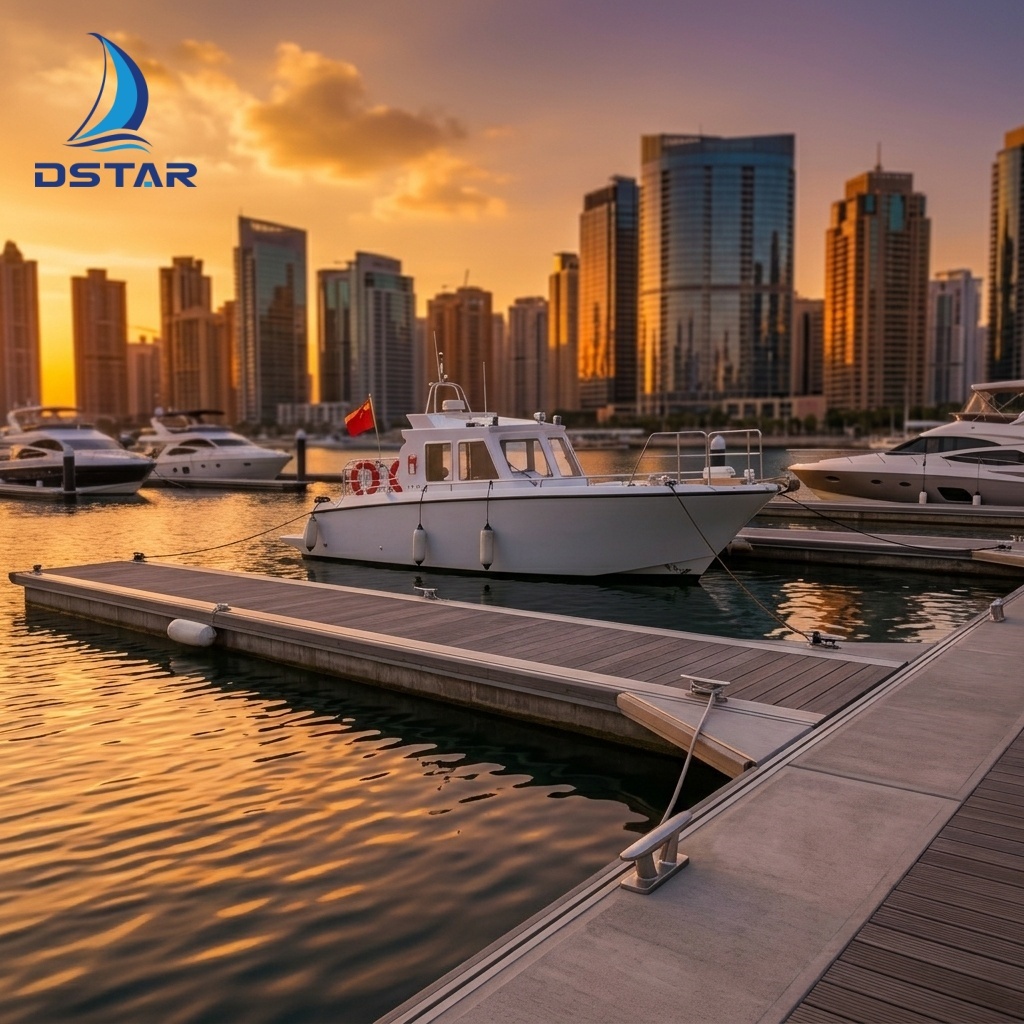
The DK-WR is a 11m aluminum work boat (listed in the Dookyu Crown range as the 11m Aluminum Alloy Cruiser Boat) built to alternate between patrol, rescue, transport and light professional duty without a rebuild between tasks. Its published specification supports that role directly:
- Hull and structure: 5083-H116 aluminum alloy, with the main hull and superstructure built from the same alloy — the builder describes this as giving strong overall stability and low maintenance costs.
- Dimensions: 11.00 m length overall, 3.25 m beam, 0.885 m depth, 0.47 m full-load draught, 5.60 t full-load displacement.
- Propulsion: two 150HP (110 kW) gasoline outboards, 300HP combined, driving a 26 knots design speed, with 400 L fuel capacity.
- Navigation: GPS, magnetic compass, VHF and AIS, with real-time positioning and collision-avoidance warning.
- Emergency systems: dual fuel quick-close valves, automatic bilge pump and a portable fire extinguisher (CO₂ + dry powder).
- Life-saving equipment: 6 life jackets and 2 life buoys, equipped 1:1 according to the number of passengers.
- Deck and helm: EVA imitation teak decking that is non-slip and wear-resistant, a soft-seat sofa for long transits, and a helm station with remote-control searchlight, tachometer and oil level gauge.
- Electrical: DC distribution board, battery charger and shore-power socket, supporting several power-management modes to reduce wasted energy.
Its stated operating scope covers coastal rescue, offshore patrol, passenger transport, fishing and marine leisure, and professional workboat operations — four different task families that share a common requirement: they happen often, they happen close to shore, and they rarely justify a dedicated single-purpose hull. The 0.47 m full-load draught is a practical advantage in nearshore, river, lake and reservoir work, where depth at the berth or slipway restricts larger vessels.
DK-FR 13m aluminum rescue fire boat — the firefighting platform
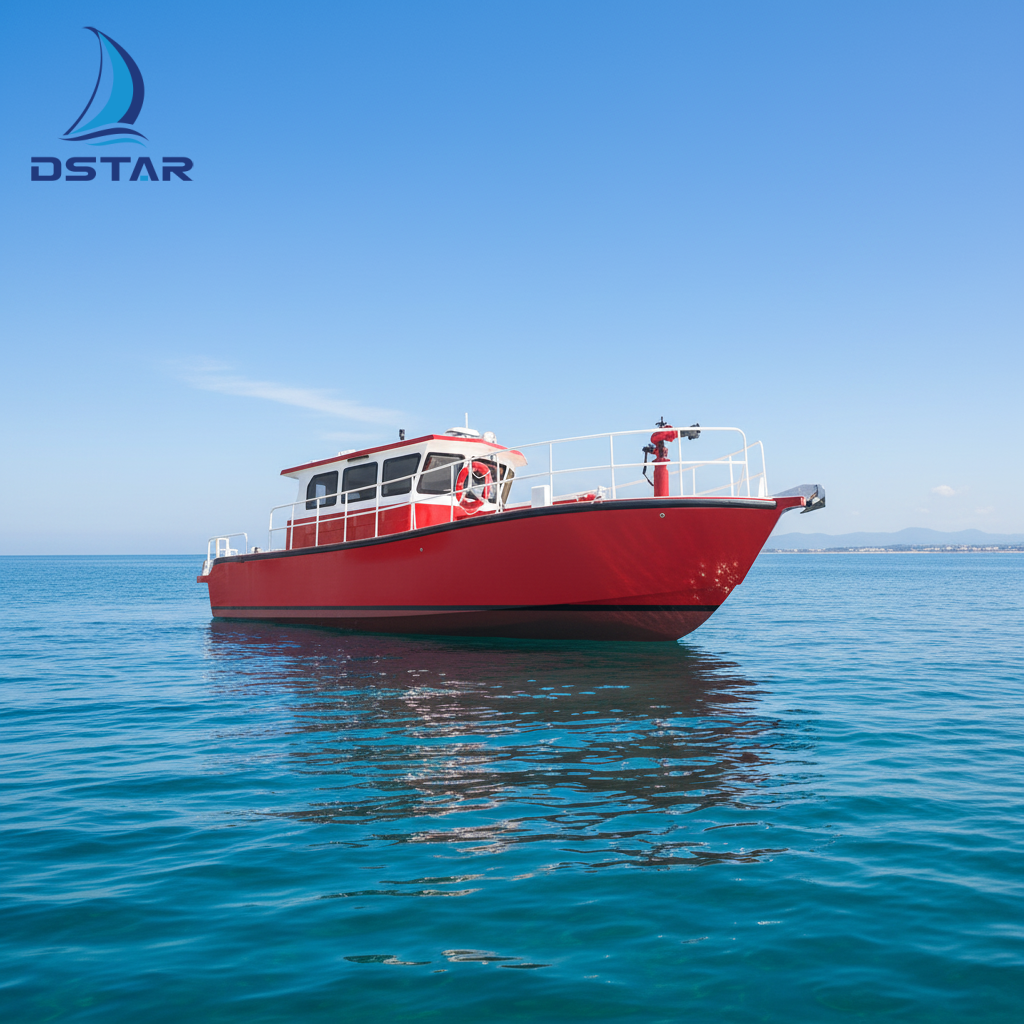
The DK-FR (13m Aluminum Rescue Fire Boat) is a purpose-configured aluminum fire boat for offshore firefighting and rescue missions. Its specification reads as a fire asset rather than a general workboat:
- Dimensions: 13.25 m length, 3.6 m beam.
- Propulsion: twin 200HP Mercury outboards — a heavier engine package than the work boat's twin 150HP set.
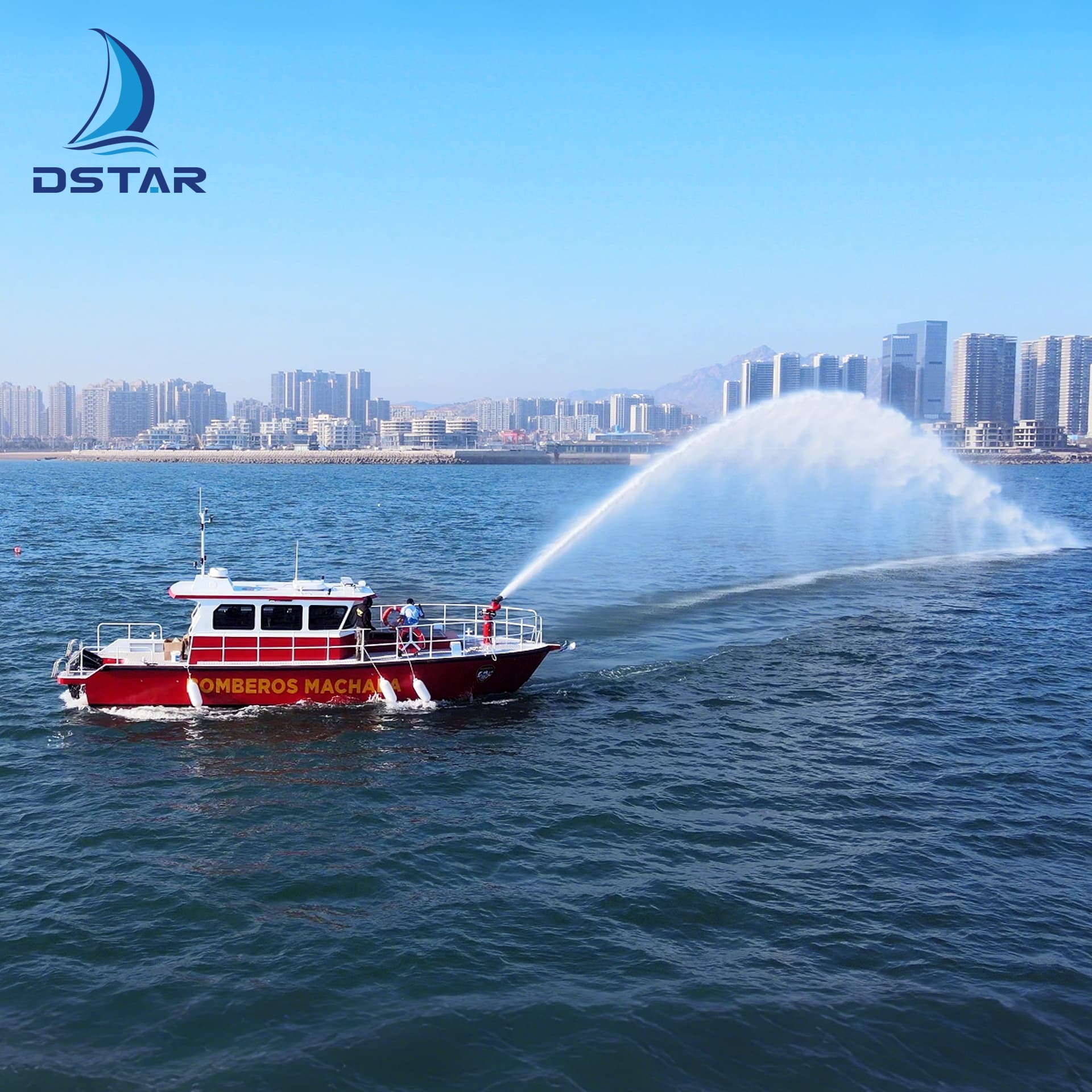
- Firefighting: a 1500 GPM fire pump, the capability that defines the vessel's role.
- Fuel: 500 L tank capacity, supporting extended offshore operation.
- Hull: aluminum alloy hull; the project record for this model describes construction in marine-grade aluminum alloy selected for durability.
The platform has a delivered reference: one 13.25 m unit supplied to an international customer whose identity is not publicly disclosed, operating in Ecuador on offshore firefighting and rescue duty. That delivery included customized firefighting equipment, and the outcome is recorded as high-performance firefighting, rapid response and stable maritime operations. The case record lists a 10-year project duration. For buyers assembling a tender file, a delivered and operating reference in this class is usually more persuasive than a specification sheet, because it demonstrates the pump, engine and hull package working together in service.
Side-by-Side: DK-WR vs DK-FR
The table below uses only published specification data. Cells marked as not stated are exactly that — the figure is not in the published material, and should be requested from the builder if it affects your decision.
| Decision criterion | DK-WR 11m aluminum work boat | DK-FR 13m aluminum rescue fire boat |
|---|---|---|
| Range designation | 11m Aluminum Alloy Cruiser Boat, model DK-WR | 13m Aluminum Rescue Fire Boat, model DK-FR |
| Length | 11.00 m LOA | 13.25 m |
| Beam | 3.25 m | 3.6 m |
| Hull material | 5083-H116 aluminum alloy; hull and superstructure in the same alloy | Aluminum alloy hull; marine-grade aluminum alloy per project record |
| Propulsion | 2 × 150HP (110 kW) outboards, 300HP total | 2 × 200HP Mercury outboards |
| Design speed | 26 knots | Not stated in published specification |
| Fuel capacity | 400 L | 500 L |
| Firefighting capacity | No fire pump listed in specification | 1500 GPM fire pump |
| Draught / displacement | 0.47 m full-load draught; 5.60 t full-load displacement | Not stated in published specification |
| Navigation equipment | GPS, magnetic compass, VHF, AIS | Not stated in published specification |
| Safety equipment | Dual fuel quick-close valves, automatic bilge pump, CO₂ + dry powder extinguisher, 6 life jackets, 2 life buoys | Not stated in published specification |
| Stated applications | Coastal rescue; offshore patrol; passenger transport; fishing and marine leisure; professional workboat operations | Offshore firefighting and rescue missions |
| Delivered reference | Not disclosed in published material | One 13.25 m unit for an international customer (Ecuador), customized firefighting equipment |
Step-by-Step: How to Run the Mission-Match Decision
The sequence below turns a vague requirement into a defensible specification, and it works whether the evaluation ends with the work boat, the fire boat, or one of each.
- Define the duty cycle in hours, not adjectives. Write down expected monthly hours for each task: patrol and surveillance, rescue call-out, fire response, personnel transfer, utility and cargo work. A vessel that spends 80% of its hours on patrol and 5% on fire duty is a different purchase from one that spends 40% of its hours on standby for fire response.
- Isolate the non-substitutable task. Ask a single question: if there is a fire on the water, can another asset in the fleet or in the port deliver water to the incident? The DK-FR carries a 1500 GPM fire pump; the DK-WR specification lists no fire pump. If no other asset can pump, the decision ends at step two and the DK-FR is the answer.
- Check the operating envelope. Both vessels are aluminum boats intended for coastal and offshore work, and the category also covers inland waters such as rivers, lakes and reservoirs. The DK-WR's 0.47 m full-load draught suits shallow access; the DK-FR draught is not in the published specification and should be requested if your berth, slipway or river section is depth-limited.
- Fit the hull to your infrastructure. Compare 11.00 m × 3.25 m against 13.25 m × 3.6 m for berth allocation, hoist or trailer capacity, and hard-standing space. Compare 400 L against 500 L for fuel storage and refuelling logistics. A hull that does not fit the berth is a mission failure regardless of its capability.
- Agree propulsion and speed expectations in writing. The DK-WR runs two 150HP (110 kW) outboards producing 300HP total against a 26 knots design speed; the DK-FR runs twin 200HP Mercury outboards. Ask how the sea trial will be conducted and at what load, so the number in the contract is the number you can verify on the day.
- Lock the layout and equipment list before the contract. Deck layout, wheelhouse position, seating, firefighting equipment, navigation and communication systems, safety and life-saving equipment, and hull colour should all be fixed as an approved drawing set. Post-delivery changes are always more expensive than pre-build changes.
- Convert the specification into purchasing terms and acceptance criteria. Minimum order quantity, lead time, trade terms, inspection rights, weld records, sea trial sign-off and documentation package should be written into the order, not discussed after delivery.
Use Cases: Which Boat Fits Which Operation
Coastal patrol and law-enforcement support
For patrol, surveillance, anti-smuggling and fisheries inspection work in the government and law-enforcement sector, the DK-WR is the natural fit: 26 knots design speed, AIS with collision-avoidance warning, VHF, searchlight and a helm set up for long watches. The fire boat can patrol, but it carries a fire package through every shift.
Port and municipal fire response
For a port authority, municipal rescue fleet or industrial terminal that must respond to fires on vessels, at berths or near offshore installations, the DK-FR is the appropriate platform. The 1500 GPM pump, twin 200HP outboards and 500 L fuel capacity define a vessel that can reach an incident offshore and stay on station.
Passenger transport, tourism and crew transfer
Where the daily workload is moving people — sightseeing, charter, crew transfer, ferry support — the DK-WR's seating, EVA non-slip decking and shore-power systems are configured for repeatable commercial use. Firefighting capability adds nothing to this duty cycle.
Mixed fleets and inland operations
Many buyers do not need to choose. A practical fleet structure pairs one DK-FR as the dedicated fire asset with one or more DK-WR units for patrol, rescue and transport. In inland waters — rivers, lakes and reservoirs — both platforms can operate, but shallow-water access and water supply for pumping should be checked against the published draught and the pump intake arrangement.
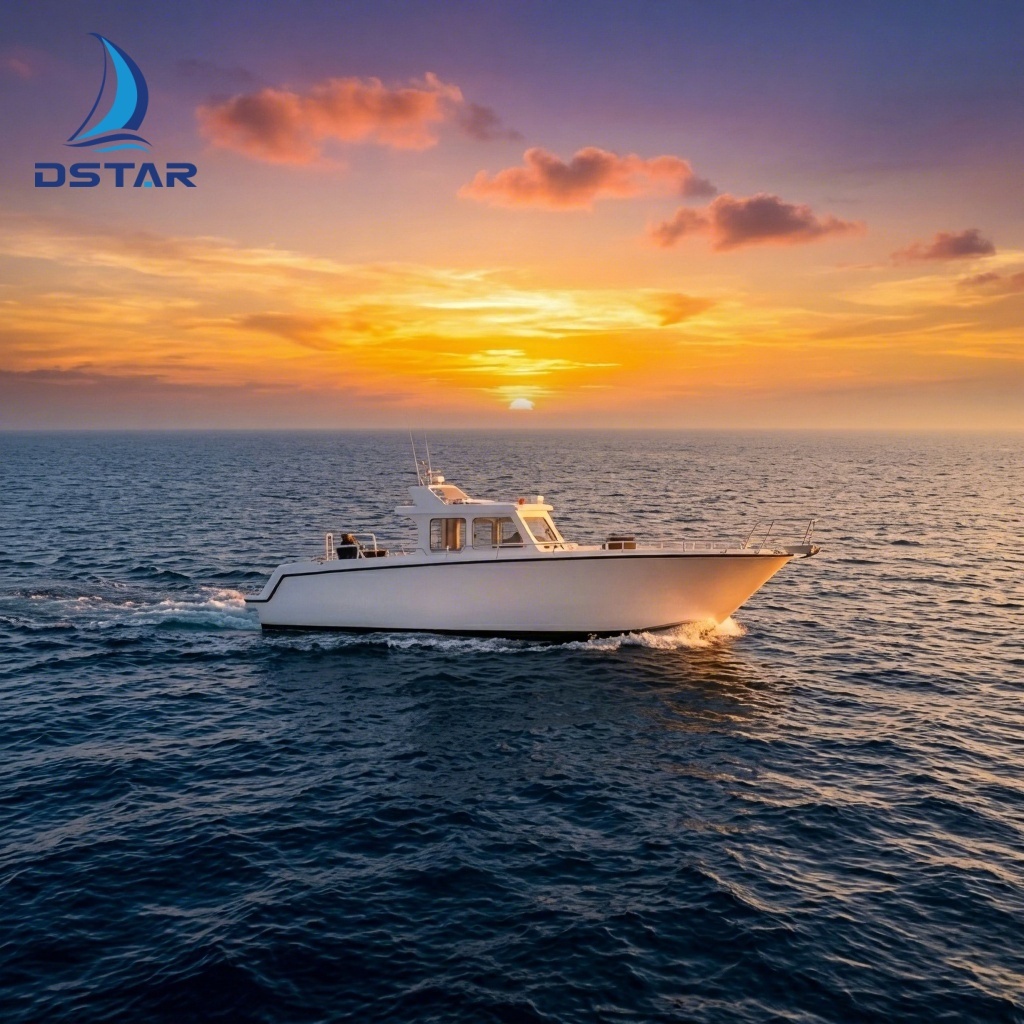
Purchasing Terms, Acceptance Criteria and the Checks Buyers Skip
Commercial terms to fix in the order
- Minimum order quantity: 1 ship, which matters for a single-vessel municipal or cooperative purchase.
- Lead time: 30–60 days, with monthly capacity of 20 ships at the Qingdao facility.
- Trade terms: FOB and CIF are both offered, with multilingual communication support.
- Export services: export packaging, international logistics, customs clearance support and after-sales service are stated as part of the scope.
- Documentation: CE and SOLAS documentation support is stated as available. The company states compliance with international standards such as ISO 9001 and CE; buyers should verify the applicable certificate, its scope, number and validity before purchase rather than relying on a general compliance statement.
Acceptance criteria before final payment
Dookyu Crown's quality control process runs from raw material verification through Mill Test Reports, to in-process weld inspections using NDT, to final sea trials. Those three stages are the basis of a usable acceptance protocol, and each should be a contractual deliverable rather than a verbal assurance:
- Material records: Mill Test Reports for the aluminum plate used in hull and superstructure.
- Weld inspection: NDT records for in-process weld inspection, referenced to the yard's ISO 9001 and class-society requirements.
- Sea trial: a documented trial confirming the DK-WR's 26 knots design speed or the DK-FR's propulsion and pump performance under agreed load conditions.
- Equipment verification: navigation and communication equipment (GPS, VHF, AIS), emergency systems (dual fuel quick-close valves, automatic bilge pump, portable extinguisher) and the life-saving inventory (6 life jackets, 2 life buoys) checked against the approved equipment list.
- Fire pump verification: for the DK-FR, flow confirmation against the 1500 GPM rating.
Customization and Export Support: What Can Change Before Build
Both vessels are built under an OEM / ODM and integrated end-to-end model, with a stated hull size range of 6 to 23 m, so the specification in this article is a starting point rather than a fixed catalogue item. Customization options relevant to this comparison include hull dimensions and structure, hull type, deck layout, wheelhouse position, engine brand and type, propulsion system, power options including fuel, electric and hybrid, fuel and water tank capacity, firefighting equipment, cranes and winches, passenger seating configuration, interior design, lighting, galley and sanitary equipment, hull colour and paint finish, logos and decals, navigation and communication systems, electrical systems and solar panels, automation and control, certification level (CE / CCS / SOLAS), safety and life-saving equipment, bimini tops and outdoor accessories, and packaging and shipping solutions.
On the export side, the company states exports to 30+ countries and regions across Europe, North America, Australia, Southeast Asia and the Middle East, familiarity with diverse market entry requirements, and CE and SOLAS documentation support. After-sales scope covers remote diagnostics, spare parts supply, on-site assistance, operation and maintenance manuals as well as technical training, and a global service network with local support in key regions.
For buyers comparing the two models, three customization questions decide most of the value: can the deck and wheelhouse be reconfigured for your crewing model, which certification package will the vessel be surveyed against, and what documentation ships with the hull. Ask all three before the drawing set is frozen.
FAQ: DK-WR vs DK-FR for Commercial and Public-Sector Buyers
What certifications should an aluminum fire boat or patrol work boat carry for public-sector procurement?
Rescue and firefighting applications typically carry special requirements including international certifications such as CE, CCS and SOLAS compliance. Dookyu Crown states that it follows international standards such as ISO and CE, and provides CE and SOLAS documentation support for export projects. Buyers should verify the applicable certificate, its scope, certificate number and validity before purchase. For vessels operating in the United States, ABYC standards are the relevant domestic reference, and the American Boat & Yacht Council reports that 90% of boats constructed in the US are built to those standards.
What should a municipal rescue fleet verify in an aluminum fire boat manufacturer?
Verify five things: the firefighting package (the DK-FR is specified with a 1500 GPM fire pump and twin 200HP Mercury outboards), the hull material and build documentation (marine-grade aluminum alloy, Mill Test Reports, NDT weld inspection, final sea trials), the customization scope (hull dimensions and structure, deck layout, firefighting equipment, electrical systems, certification level, across a stated 6 to 23 m hull range), production capacity (a 70,000 m² facility, 200 ships annual output, 20 ships monthly capacity, 17 engineers) and delivered references — one 13.25 m unit is recorded in service in Ecuador for offshore firefighting and rescue with customized firefighting equipment.
What commercial terms apply to a single-vessel order?
Minimum order quantity is 1 ship, which allows a single municipal or cooperative purchase without fleet-level commitment. Trade terms include FOB and CIF, with export packaging, international logistics, customs clearance support and after-sales service included in the stated scope. Published material does not list vessel prices; commercial terms are quoted against the confirmed configuration, so the equipment list and certification package should be fixed before a quote is requested.
Can the vessel be validated before shipment?
Yes — quality control runs through three documented stages: raw material verification using Mill Test Reports, in-process weld inspections using NDT, and final sea trials, all under ISO 9001, CE and class-society requirements. For the DK-WR, the sea trial should confirm the 26 knots design speed with twin 150HP (110 kW) outboards; for the DK-FR, it should confirm propulsion and fire pump performance against the 1500 GPM rating. Navigation equipment, emergency systems and the life-saving inventory should be checked against the approved equipment list at the same time.
How long does delivery take after order confirmation, and how do we start?
Lead time is 30–60 days, against a monthly production capacity of 20 ships at the Qingdao facility. To start, request the vessel catalogue and submit your duty cycle, operating area, certification requirement and equipment list; the builder then returns a configuration and a quotation. The Dookyu Crown product brochure (PDF) is available for download, and configuration questions can go directly to the marine sales team.
Conclusion: Decide on the Worst Day, Not the Best
The DK-WR 11m aluminum work boat and the DK-FR 13m aluminum rescue fire boat are both aluminum boats from the same Qingdao yard, and both are built to the same documentation standard. They differ in the task that cannot be delegated. If your fleet must put water on a fire offshore, the 1500 GPM fire pump, twin 200HP outboards and 500 L fuel capacity of the DK-FR answer a question the DK-WR cannot. If your fleet must run a high-frequency cycle of patrol, rescue response and personnel movement close to shore, the DK-WR's 11.00 m hull, 0.47 m full-load draught, 26 knots design speed and multi-role deck deliver more useful hours per year.
Run the decision in that order — non-substitutable task first, duty cycle second, infrastructure third, specification last — and the purchasing terms, acceptance criteria and customization checks in this article become a checklist rather than a negotiation. For fleets that need both, the answer is not a compromise vessel; it is one fire boat on standby and work boats on rotation.
Request a configuration and quotation
Send your mission profile — operating area, duty cycle, crewing, certification requirement and equipment list — and Dookyu Crown will return a matched configuration for the DK-WR 11m aluminum work boat, the DK-FR 13m aluminum rescue fire boat, or a mixed-fleet proposal.
Contact: Bruce Liu | Tel: +86-15689431395 | WhatsApp: +8613335033072 | Email: info@dstaryacht.com
Qingdao Dookyu Crown Marine Co., Ltd., South Road, 750m West Of Yinzhu Exit Of Shugang Expressway, Qingdao, Shandong, China
Website: www.dstaryacht.com | Catalogue: Download the PDF brochure
Have Questions or Need More Details?
Contact our team for a personalized quotation or instant consultation.
Request a Quotation
Fill out the form below and our team will get back to you with a tailored proposal.
WhatsApp Direct Chat
Prefer to chat in real-time? Message us on WhatsApp for instant assistance & quick answers.
- Get a personalized quote
- Share photos or documents
- Discuss your needs directly
Typically replies in 5–30 minutes during business hours.