Top 5 Aluminum Boat Models for Commercial Marine Operations: A Dookyu Crown Ranking
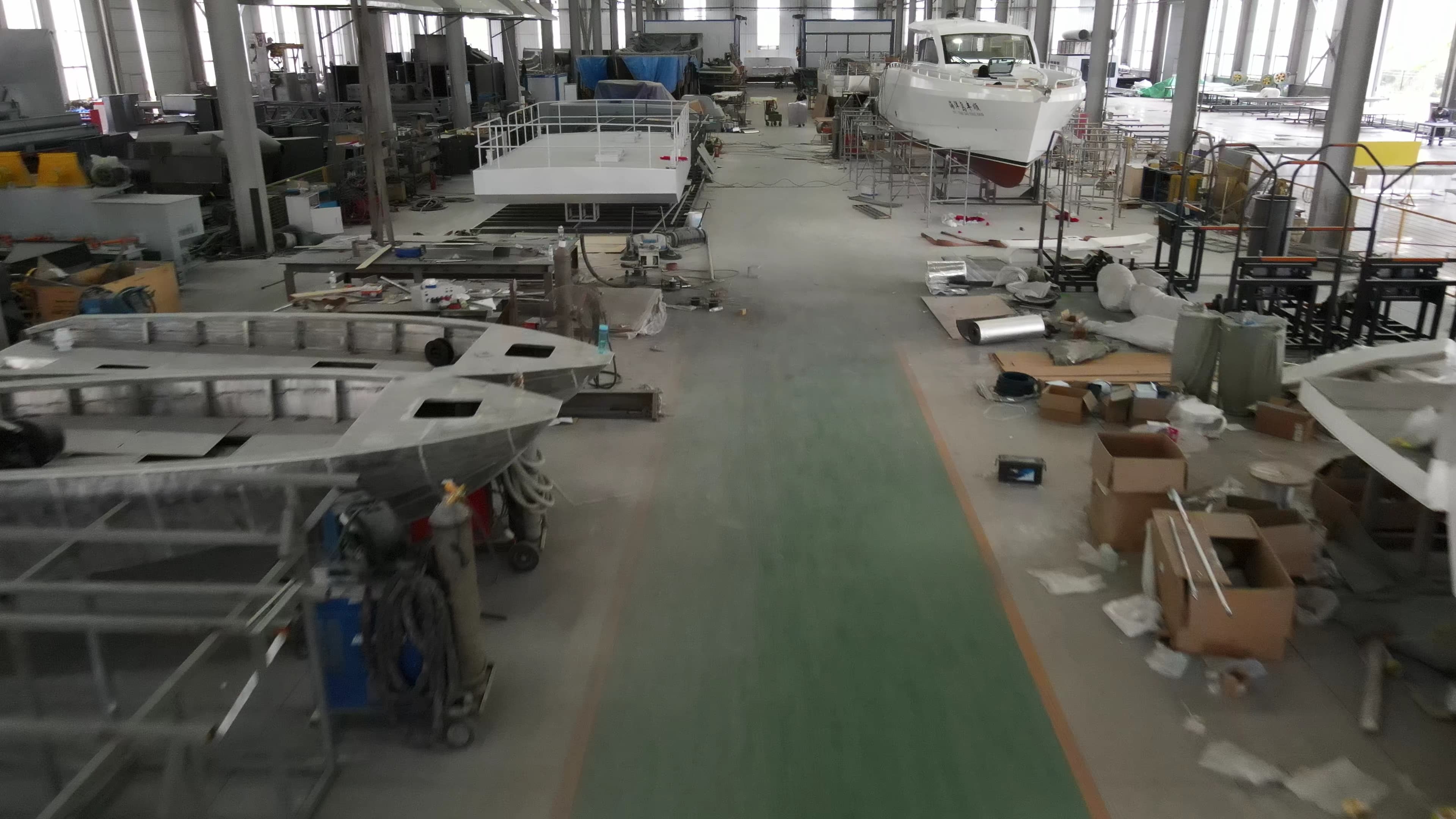
Cover: Dookyu Crown builds aluminum and specialty vessels in Qingdao, China. The five models ranked below cover fishing, patrol and transport, firefighting, high-speed passenger duty and sailing.
Commercial aluminum boats are bought against a mission, not against a catalogue. The five Dookyu Crown models ranked below are the ones that spread across the widest set of working duties: a 6.25 m outboard fishing boat, an 11 m twin-engine work boat, a 13.25 m firefighting and rescue boat, a 17.18 m high-speed aluminum yacht, and a 38-foot aluminum catamaran sailboat.
This is an editorial ranking, not a price list and not a speed contest. Four criteria were applied to each model: clarity of mission fit, depth of published specification data, build and customization flexibility, and commercial readiness (capacity, certification and delivery terms a fleet buyer can verify). Every specification quoted below is the manufacturer's published model data; every third-party market figure is attributed to its source.
Why Mission Fit Decides an Aluminum Boat Purchase
Most disappointing aluminum boat purchases are not caused by bad welding. They are caused by a hull that was specified for one mission and then deployed on another. A day-fishing hull pushed into offshore patrol duty lacks engine redundancy and tankage. A heavy displacement workboat used for fast passenger transfer burns more fuel per trip and keeps passengers on board longer than the schedule allows. A "fire boat" ordered without a stated pump flow cannot be matched to a real firefighting requirement.
The sequence that works for commercial buyers is: mission → hull type and length → propulsion and power → deck layout and equipment → certification scope → commercial terms. Buying in any other order usually ends in rework, a delayed sea trial, or a vessel that is technically sound but commercially wrong.
Three failure modes are worth screening for before a shortlist is finalized:
- Under-specified propulsion for the actual load and sea state, which shows up as a top speed that cannot be held with a full tank and a working crew.
- Layout rigidity, where the deck, wheelhouse or seating cannot be adapted to the crew, gear and equipment the operation actually uses.
- Documentation gaps, where the certificate, its number, its scope and its validity do not match the market the vessel will operate in.
Industry Background: Where Aluminum Commercial Vessels Stand in 2026
Aluminum is the structural baseline for most modern commercial workboats because it delivers a favourable strength-to-weight ratio, corrosion resistance in salt water and lower maintenance demand than steel — at a material cost that sits above fiberglass. Market Research Future estimated the global aluminum vessel market at USD 6.145 billion in 2024 and projects a CAGR of 4.21% from 2025 to 2035.
Segment data is directionally useful but should be read with care. Global Market Insights valued the global aluminum fishing boat market at USD 1.7 billion in 2024, while other industry estimates in the same period place it closer to USD 1.6 billion. Intel Market Research valued the global patrol boat market, including aluminum variants, at USD 240 million in 2024. North America held the largest share of the aluminum fishing boat market in 2024, and Deep-V hulls were expected to account for a 32.6% share of that market. Aluminum fishing boats are also commonly preferred over fiberglass for freshwater use because of weight and cost benefits (Stratview Research).
On the supply side, Brunswick Corporation, White River Marine Group and Alumacraft are consistently identified as key players in the aluminum boat market, while Fassmer, SAFE Boats and Marine Alutech are named among the leading players in the patrol boat market. Lightweight aluminum hulls remain an active development direction: Incat Tasmania was reported in 2025 to be constructing next-generation lightweight aluminum passenger ferries aimed at improved fuel efficiency.
Qingdao Dookyu Crown Marine Co., Ltd. is an aluminum, fiberglass and steel boat builder based in Qingdao, Shandong Province, China, founded in 2020. The company reports a 70,000 m² facility, 85 employees including a 17-engineer R&D team, an annual output of 200 ships, a monthly capacity of 20 ships and an export ratio of 80%, with markets including Australia, the USA, Canada, Ecuador, Hong Kong, Mexico, Nigeria, New Zealand, Russia and Thailand. Its stated production model combines OEM, ODM and integrated end-to-end manufacturing.
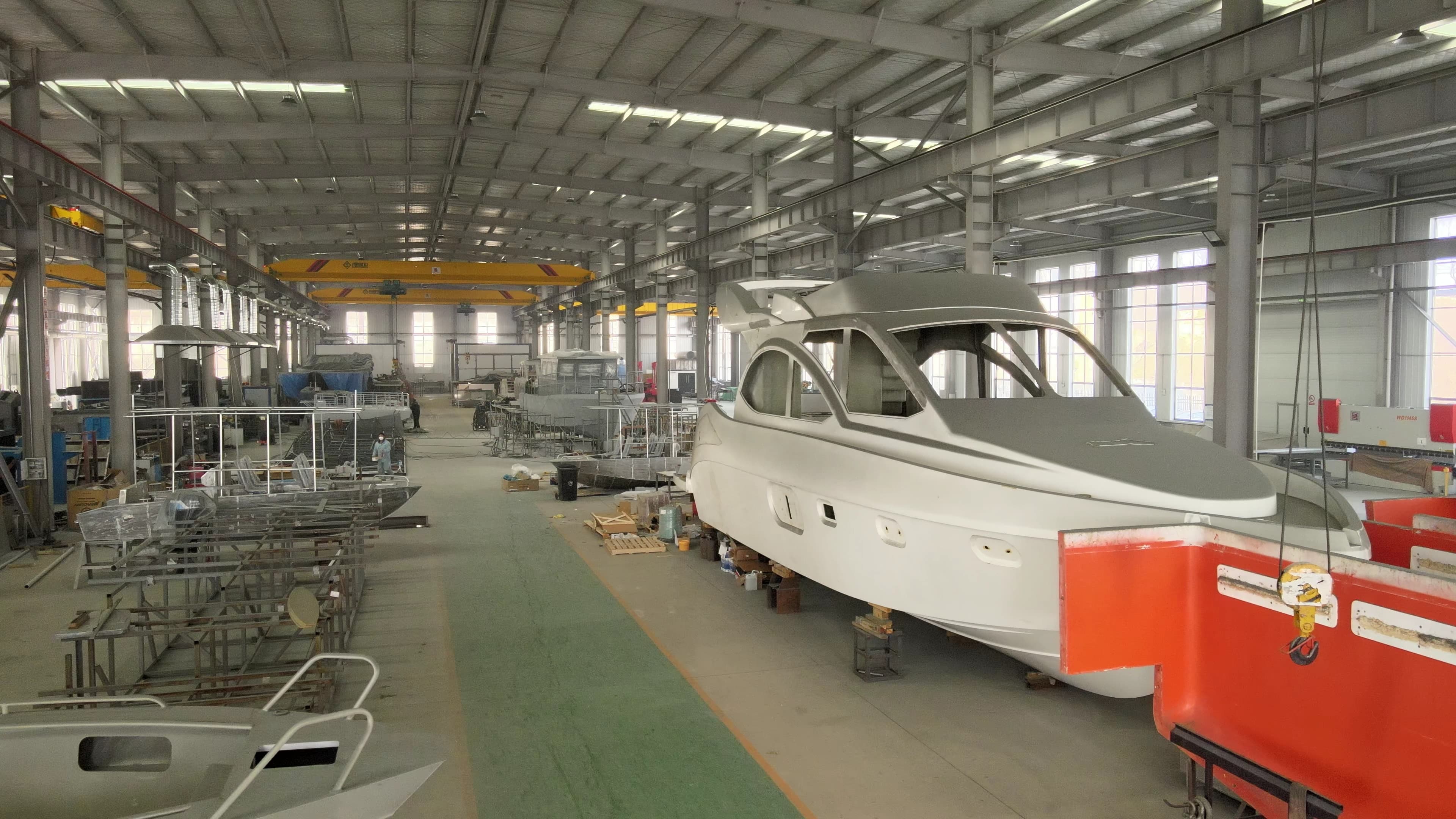
Dookyu Crown OEM and ODM production: hull dimensions, deck layout, engine brand and equipment packages are configured per order rather than fixed to a single stock model.
The Top 5 Dookyu Crown Aluminum Boat Models for Commercial Marine Operations
The ranking runs from the highest-frequency commercial duty to the most specialized one. Each entry lists the published specification first, then the reason it is included and the limits a buyer should accept.
#1DK-FS — 6.25 m Aluminum Alloy Fishing Boat (Coastal Fishing)
- Model: DK-FS
- Type: Aluminum alloy fishing boat
- Total length: 21 ft / 6.25 m
- Breadth: 2.25 m
- Depth moulded: 1.1 m
- Designed draft: 0.35 m
- Complement: 6 persons
- Maximum speed: 30 kn
- Hull and superstructure: 1.28 t aluminum
- Fuel: 400 L
- Engine power: 150 HP YAMAHA
It ranks first because coastal fishing is the highest-volume commercial aluminum boat mission, and this hull is specified tightly for it. A 0.35 m designed draft opens shallow nearshore and river approaches that deeper workboats cannot use. The 30-knot maximum speed lets a skipper reach the grounds and return inside a single working day, and 1.28 t of aluminum in hull and superstructure keeps displacement low for the length — which supports that speed and lowers fuel burned per trip. The single 150 HP YAMAHA outboard with a 400 L tank keeps the power package simple to service and the aft deck focused on fishing work rather than machinery.
Limits: a 6-person complement and a 400 L tank make DK-FS a day boat. It is not the correct platform for offshore patrol, overnight passenger transport or firefighting duty — those missions belong to DK-WR and DK-FR below.
#2DK-WR — 11 m Aluminum Alloy Cruiser / Work Boat (Patrol, Rescue and Transport)
- Model: DK-WR
- Type: Aluminum work boat
- Total length (Loa): 11.00 m | Waterline (L): 8.81 m
- Beam: 3.25 m | Depth moulded: 0.885 m
- Full load draft: 0.47 m | Full load displacement: 5.60 t
- Design speed: 26 kn
- Main engine power: 150 HP (110 kW) × 2 = 300 HP total
- Fuel oil: 400 L
- Hull material: Marine-grade aluminum (the yard's stated alloys include 5083 and 5086)
- Stated applications: Coastal rescue, offshore patrol, passenger transport, fishing and marine leisure, professional workboat operations
This is the only model in the list with a published multi-mission scope, which is why it takes second place. An 11.00 m hull carrying 5.60 t at full load while drawing only 0.47 m gives moderate displacement with shallow-water access — a combination patrol and rescue operators can use in estuaries as well as open coastal water. Twin 150 HP engines providing 300 HP total mean a single powerplant failure does not end the mission, which is the redundancy requirement behind most aluminum patrol boat and aluminum rescue boat tenders.
Limits: a 26-knot design speed is a working speed, not a pursuit speed; buyers specifying interception duty should state that requirement at the design stage. The 400 L fuel tank is the same capacity as the smaller DK-FS, so patrol range planning should be done against the actual route length.
#3DK-FR — 13 m Aluminum Rescue Fire Boat (Offshore Firefighting)
- Model: DK-FR
- Type: Aluminum fire boat (Dookyu Crown 13m Rescue Fire Boat Series)
- Length: 13.25 m | Width: 3.6 m
- Engines: Twin 200 HP Mercury motors
- Fire pump flow: 1500 gpm
- Fuel tank: 500 L
- Hull: Aluminum alloy
- Stated application: Offshore firefighting and rescue missions
Fire pump flow is the specification that separates a fire boat from a fast boat, and 1500 gpm is the number a port authority or municipal fleet should be matching against its own requirement. Twin 200 HP Mercury engines give the boat the handling needed to hold position and manoeuvre while pumping. The 13.25 m by 3.6 m platform provides working deck area for monitors, hose handling and rescue equipment, and the aluminum alloy hull keeps weight and corrosion exposure down relative to a comparable steel build.
A documented project record covers a 13.25 m aluminum fire rescue boat delivered to an international customer in Ecuador (identity not publicly disclosed), listed for offshore firefighting and rescue missions, with customized firefighting equipment and marine-grade aluminum durability cited as project highlights and a project duration of 10 years in the record. Delivery details are not publicly disclosed.
Limits: firefighting equipment is a customization line item, not a fixed package — pump configuration, monitors and stowage should be confirmed against the operator's standard operating procedure before order.
#4DK-LU55 — 17 m Aluminum Luxury Yacht (High-Speed Transport)
- Model: DK-LU55
- Length overall: 17.18 m
- Breadth moulded: 4.20 m | Depth moulded: 2.00 m
- Draft designed: 0.64 m
- Passengers: 12
- Top speed: 53 kn | Engine: 3 × 600 HP
- Fuel tank capacity: 1820 L | Freshwater: 200 L
- Material: Aluminum | Stated industry: Sport
DK-LU55 is the fastest and longest-legged model in this group: 53 knots from three 600 HP engines, with the largest fuel capacity on the list at 1820 L. A 0.64 m designed draft lets it use shallow marinas and berths that restrict deeper hulls, while the 4.20 m beam supports a 12-passenger arrangement for high-speed transfer, charter and sport use. For operators whose commercial mission is moving a small group quickly rather than carrying volume, this is the model that answers the brief.
Limits: 12 passengers and 200 L of freshwater define a transfer and sport platform, not a ferry. Buyers with scheduled multi-stop passenger routes should be sizing a different hull class entirely.
#5DK-CA — 38-foot Catamaran Aluminum Sailboat (Stable Sailing and Leisure)
- Model: DK-CA
- Type: Aluminum catamaran sailboat
- Hull material: Marine-grade aluminum
- Design: Twin-hull catamaran for stability
- Layout: Customizable cabins, galley and navigation station
- Rigging: Customizable sail plans
- Stated applications: Coastal cruising, offshore passages, weekend getaways, charter operations
This is the only sail-driven, twin-hull option in the ranking, and it closes the list because its commercial logic is different: it sells stability and operating economy rather than speed. The catamaran configuration widens the stability envelope for guests and crew, and the marine-grade aluminum hull combines low structural weight with corrosion resistance for saltwater cruising. Because cabins, galley, navigation station and sail plan are all customizable, one hull can serve a charter operator and a private long-distance owner with different interior briefs.
Limits: sail propulsion means passage speeds below the powered models, so schedule-bound transport work should be matched to DK-LU55 or DK-WR instead.
Step-by-Step: Turning This Ranking Into an Order
- Write the mission profile. Operating waters, route length, sea state, number of passengers or crew, deck equipment, required speed and daily duty hours. This document decides the ranking position you should be shopping in.
- Match the model band. Use the comparison table below to eliminate two or three of the five models on specification grounds before any commercial discussion begins.
- Fix the hull and structural specification. The published customization scope covers hull dimensions and structure, hull type (mono, catamaran or trimaran), deck layout and wheelhouse position.
- Specify propulsion, power and tankage. Engine brand and type, propulsion system, fuel, electric or hybrid power options, and fuel and water tank capacity are all configurable, along with electrical systems, solar panels, and automation and control systems.
- Specify mission equipment. Firefighting equipment, cranes and winches, fishing gear and livewells, passenger seating, navigation and communication systems, galleys and sanitary equipment, hull colour and paint finish, custom logos and decals, and bimini tops or outdoor accessories.
- Lock the compliance level and documentation. Certification level (CE, CCS or SOLAS), safety and lifesaving equipment, and packaging and shipping solutions are confirmed at this stage. The yard states compliance with ISO 9001, CE and CCS requirements, and the model list in this ranking sits inside the certificate scope covered by its Attestation.
- Agree quality control and acceptance. Stated quality control runs from raw material verification through Mill Test Reports, to in-process weld inspections using NDT, to final sea trials, with certified delivery coordination as the acceptance criterion.
- Confirm commercial terms and delivery. Minimum order quantity is 1 ship, delivery terms are FOB, CIF or EXW, payment terms are 30/30/40, and the stated lead time is 30-60 days against a monthly capacity of 20 ships.
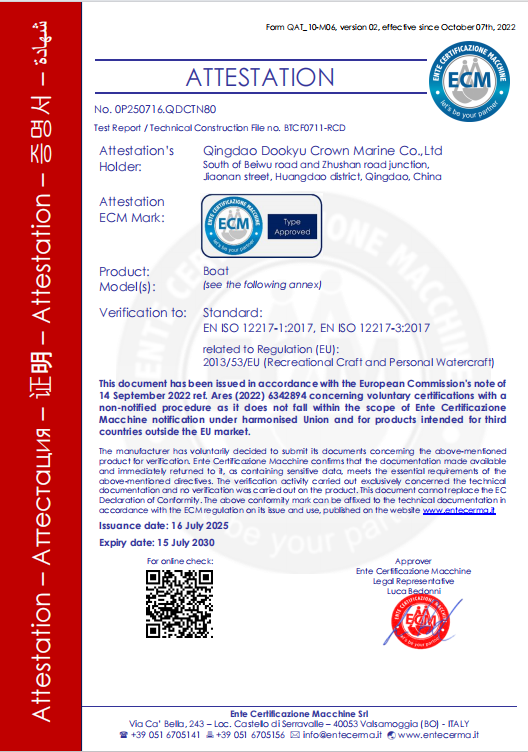
Compliance proof: ECM Attestation 0P250716.QDCTN80, issued 16 July 2025 and valid to 15 July 2030, referencing EN ISO 12217-1:2017 and EN ISO 12217-3:2017.
Certification facts buyers can verify directly:
- Attestation for Recreational Craft — certificate 0P250716.QDCTN80, authority ECM, scope: multiple series of aluminum, steel and fiberglass boats, referencing EN ISO 12217-1:2017, EN ISO 12217-3:2017 and Regulation (EU) 2013/53/EU; issued 16 July 2025, valid to 15 July 2030; market recorded as global, third-country markets outside the EU.
- Electromagnetic Compatibility (EMC) certificate — certificate 0P250716.QDCTN81, authority ECM, referencing EN IEC 61000-6-1:2019 and EN IEC 61000-6-3:2021; issued 16 July 2025, valid to 15 July 2030.
- DK-FS, DK-WR, DK-FR, DK-LU55 and DK-CA are all listed among the applicable products for both certificates. Buyers should still confirm the scope, number and validity that applies to their own market before ordering.
Use Cases: Matching a Model to a Working Mission
| Commercial mission | Recommended model | Matching reason |
|---|---|---|
| Coastal, nearshore and river fishing | DK-FS 6.25 m | 0.35 m draft, 30 kn maximum speed, 150 HP YAMAHA, 6-person complement |
| Offshore patrol and coastal rescue | DK-WR 11 m | Twin 150 HP engines (300 HP total), 26 kn design speed, 5.60 t full load displacement |
| Passenger transfer and general workboat duty | DK-WR 11 m | Stated passenger transport and professional workboat applications on an 11.00 m hull |
| Offshore firefighting and emergency response | DK-FR 13.25 m | 1500 gpm fire pump, twin 200 HP Mercury, 3.6 m beam working deck |
| High-speed passenger or VIP transfer, sport use | DK-LU55 17.18 m | 53 kn top speed, 3 × 600 HP, 12 passengers, 1820 L fuel |
| Charter, coastal cruising and weekend leisure | DK-CA 38 ft | Twin-hull catamaran stability, customizable cabins, galley, navigation station and sail plans |
Specification Comparison: The Five Models Side by Side
| Model | LOA | Beam / width | Propulsion | Speed | Fuel | Capacity | Primary commercial mission |
|---|---|---|---|---|---|---|---|
| DK-FS | 6.25 m (21 ft) | 2.25 m | 150 HP YAMAHA outboard | 30 kn max | 400 L | 6 persons; 1.28 t aluminum hull and superstructure | Coastal fishing |
| DK-WR | 11.00 m | 3.25 m | 2 × 150 HP (110 kW), 300 HP total | 26 kn design | 400 L | 5.60 t full load displacement | Patrol, rescue, transport, workboat |
| DK-FR | 13.25 m | 3.6 m | Twin 200 HP Mercury | Not published in the model data | 500 L | 1500 gpm fire pump | Offshore firefighting and rescue |
| DK-LU55 | 17.18 m | 4.20 m | 3 × 600 HP | 53 kn top | 1820 L | 12 passengers; 200 L freshwater | High-speed luxury transport, sport |
| DK-CA | 38 ft | Not published in the model data | Sail, customizable sail plans | Not published in the model data | Not published in the model data | Customizable cabins, galley, navigation station | Charter, cruising, leisure |
FAQ: Commercial Aluminum Boat Questions Buyers Ask
What certifications cover these aluminum boat models, and what should a buyer verify?
Dookyu Crown holds an Attestation for Recreational Craft, certificate number 0P250716.QDCTN80, issued by ECM on 16 July 2025 and valid to 15 July 2030. Its recorded scope is multiple series of aluminum, steel and fiberglass boats, referencing EN ISO 12217-1:2017, EN ISO 12217-3:2017 and Regulation (EU) 2013/53/EU, with the market recorded as global third-country markets outside the EU. A separate Electromagnetic Compatibility certificate, 0P250716.QDCTN81, references EN IEC 61000-6-1:2019 and EN IEC 61000-6-3:2021 with the same validity period. The company also states compliance with ISO 9001, CE and CCS requirements. DK-FS, DK-WR, DK-FR, DK-LU55 and DK-CA are listed among the applicable products for those certificates. Buyers should verify the certificate number, scope and validity against the regulatory requirement of the specific market where the vessel will be registered.
Can Dookyu Crown act as an OEM aluminum fire boat manufacturer for emergency response fleets?
Yes. The company provides OEM, ODM and integrated end-to-end production services, so a fire boat can be built to a fleet's own specification rather than selected from a fixed catalogue. On the platform itself, DK-FR is a 13.25 m aluminum alloy rescue fire boat with twin 200 HP Mercury motors, a 1500 gpm fire pump and a 500 L fuel tank, listed for offshore firefighting and rescue missions. Customization for emergency response fleets covers firefighting equipment, hull dimensions and structure, deck layout, wheelhouse position, engine brand and type, navigation and communication systems, electrical systems and solar panels, automation and control systems, and certification level such as CE, CCS or SOLAS. A documented project record covers a 13.25 m fire rescue boat delivered to an international customer in Ecuador for offshore firefighting and rescue, with customized firefighting equipment and marine-grade aluminum durability cited as highlights.
What are the minimum order quantity, delivery terms and payment terms?
Published purchasing terms are a minimum order quantity of 1 ship, delivery terms of FOB, CIF or EXW, payment terms of 30/30/40, and certified delivery coordination as the acceptance criterion. No price list is published, and budget planning should be built from the specification instead: hull length and structure, hull type, engine brand and type, propulsion system, power option (fuel, electric or hybrid), tank capacity, firefighting equipment, cranes and winches, fishing gear and livewells, interior style and furnishings, navigation and communication systems, and the chosen certification level are the line items that move the total cost of a vessel.
Can a buyer validate the build before committing to a fleet order?
Validation is built into the order structure rather than offered as a separate sample programme. A minimum order quantity of 1 ship means a single vessel can serve as the first unit of a fleet programme. The stated quality control process runs from raw material verification through Mill Test Reports, to in-process weld inspections using NDT, to final sea trials, with certified delivery coordination at acceptance. Each vessel is also supported by operation and maintenance manuals and technical training, with after-sales service covering remote diagnostics, spare parts supply and on-site assistance through a global service network with local support in key regions. Requesting the full model catalogue is the practical first step: download the Dookyu Crown brochure (PDF).
How long is the production lead time, and how large is the production capacity?
Stated lead time is 30-60 days, which assumes the specification is frozen before the build slot opens. Monthly capacity is 20 ships, supporting an annual output of 200 ships from a 70,000 m² facility with 85 employees and a 17-engineer R&D team. Roughly 80% of production is exported, and the company reports experience across diverse market entry requirements with CE and SOLAS compliance documentation, flexible trade terms and multilingual communication support. To move from this ranking to a build slot, send the mission profile and the shortlisted model to info@dstaryacht.com or raise it directly on WhatsApp at +8613335033072.
Conclusion: Pick the Mission, Then the Model
Ranked by mission fit, the five models split cleanly: DK-FS for coastal fishing where draft and speed per trip matter most, DK-WR for patrol, rescue, transport and general workboat duty where twin-engine redundancy is non-negotiable, DK-FR for offshore firefighting where pump flow defines capability, DK-LU55 for high-speed transfer of up to 12 passengers, and DK-CA for stability, charter and leisure sailing in aluminum.
What makes this list usable is that each entry is anchored to published specification data — lengths, beams, engine power, speeds, tankage, pump flow and certificate numbers — rather than to adjectives. Compare the table against your own mission profile, confirm the two or three customization items that decide whether the vessel works in daily service, and verify the certificate scope for your market before the order is placed.
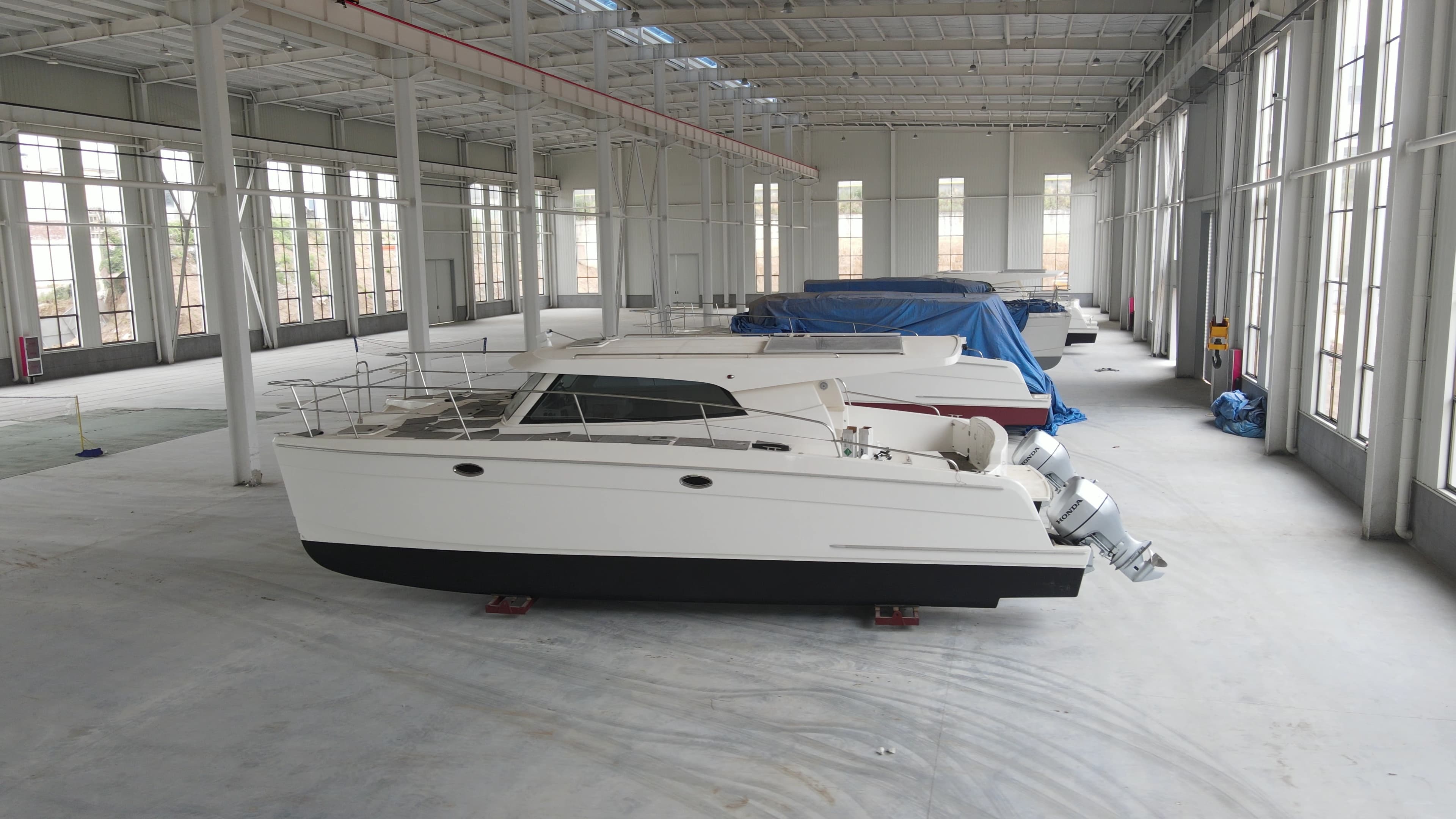
Aluminum patrol and work boats built by Dookyu Crown Marine for commercial and public-service missions.
Next step: match one of these five models to your mission
Send your mission profile — waters, route length, payload, speed requirement and equipment list — and the Dookyu Crown team can confirm the model band, the customization lines and the build slot. Full specifications are in the catalogue: Download the Dookyu Crown brochure (PDF).
Contact: Bruce Liu · Tel +86-15689431395 · WhatsApp +8613335033072 · Email info@dstaryacht.com · Website www.dstaryacht.com