Driveye Multi Channel Dash Cam Deep Dive: Products, Capability and Buyer Value
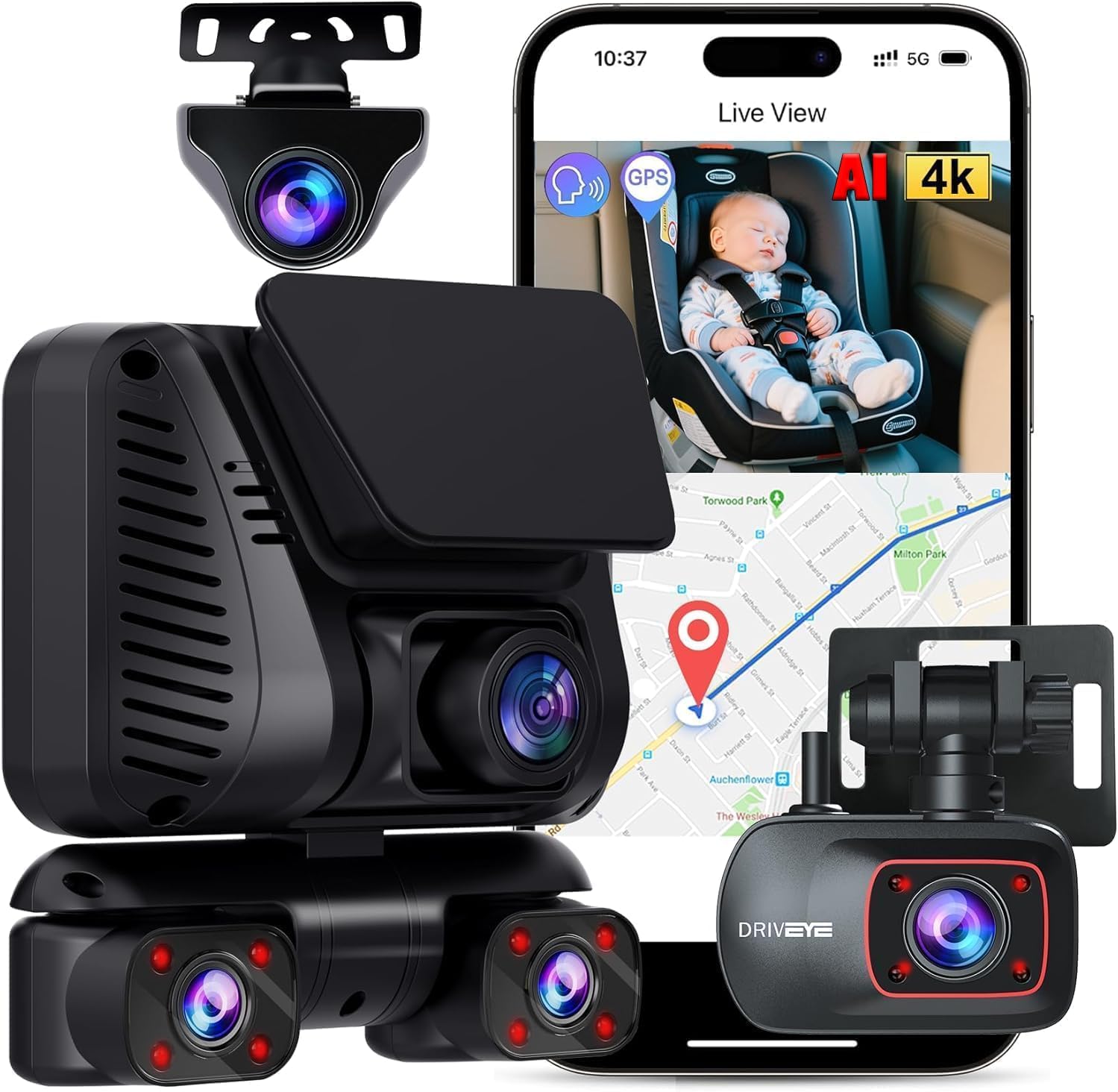
Driveye is a Hong Kong–headquartered multi channel dash cam brand founded in 2024 and positioned in the mass-premium tier of the consumer dash cam market. The company designs and builds integrated multi-camera systems for family drivers, taxi and rideshare operators and frequent professional drivers, and its documented product range currently spans dual-channel, four-channel and five-channel configurations.
This analysis looks at Driveye as a supplier and product entity: what the company manufactures, how its multi-camera platform is engineered, what evidence exists about its market position, and how a buyer should evaluate its systems against the wider multi channel dash cam category.
Driveye at a Glance
- Founded: 2024
- Headquarters: Hong Kong (Kwun Tong, Kowloon)
- Legal entity: Young&Happy Co., Limited
- Category: Multi channel dash cams — 2-channel, 4-channel and 5-channel systems
- Documented models: Driveye D22 (dual channel), Driveye D7 (4 channel), Driveye D9pro (5 channel)
- Flagship capability: five simultaneous channels, including a dedicated in-cabin baby monitor camera, with AI ADAS driver alerts
- Markets served: Global, United States, United Kingdom, Germany and Canada; products reported as launched and sold in more than 20 countries
- Listed price bands: 109.99–159.99 (D22), 129.99–189.99 (D7), 199.99–259.99 (D9pro)
What a Multi Channel Dash Cam Solves — and Where Simpler Setups Fall Short
A multi channel dash cam records from several camera positions simultaneously — typically front, rear, side and cabin — instead of covering only the road ahead. The practical difference appears in three situations: side contact during lane changes, incidents inside the vehicle, and monitoring of children or pets travelling in the back seat.
Front-and-rear systems leave predictable gaps. A side-swipe occurring next to the driver's door may be captured by neither camera. Rideshare and taxi drivers meet unfamiliar passengers daily and can face disputes, interior damage or false complaints that a road-facing camera cannot document. Parents driving alone cannot safely turn around to check an infant in a rear-facing car seat, and a standalone car baby monitor typically streams a live view without saving photo or video files. Adding separate cameras to cover those gaps usually means extra mounts, extra power supplies and additional devices to manage.
Multi-channel systems exist to close those gaps with one installed unit. Driveye's own product positioning targets exactly this overlap: exterior blind-spot coverage for evidence, plus a cabin view for family monitoring.
Industry Background: Multi-Channel Is the Fastest-Growing Configuration
Multi-channel is not a niche curiosity inside the dash cam market — it is the configuration segment forecast to grow fastest. According to Fortune Business Insights, the multi-channel segment is expected to grow at a CAGR of 13.2% over the 2026–2034 forecast period, the fastest of the product configurations tracked (SRC-0001).
Market scale supports that trajectory. Market.us estimates global dashboard camera revenue at USD 4.5 billion in 2025 (SRC-0003). Within the category, side-facing dash cams are forecast to expand at a 16.0% CAGR over the same period, driven by blind-spot monitoring and parking-protection requirements (SRC-0001). In other words, the growth is concentrated in the camera positions that single and dual-channel products cannot reach.
A reasonable reading of that data is that buyers are no longer paying primarily for better recording of the road ahead. They are paying for coverage — more viewpoints, and viewpoints that include the side of the vehicle and the cabin. That interpretation aligns with how suppliers are structuring their ranges. Thinkware, for example, documents a modular multi-channel system that supports up to five channels by adding side, interior and rear views to a forward-facing dashcam through a multiplexer accessory (SRC-0010, 2025). Different brands reach five-channel coverage by different routes, but the direction of the category is consistent.
Driveye at a Glance: Company Overview
Driveye is best understood as a specialist rather than a broad consumer electronics brand. Its stated positioning is a premium intelligent multi channel dash cam brand for families, taxi operators and frequent professional drivers, in the mass-premium tier, with a distinctive five-channel design and integrated ADAS driver assistance as the core differentiators.
| Company factor | Documented detail |
|---|---|
| Founded | 2024 |
| Headquarters | Hong Kong — Room 101A, 1/F., Genplas Industrial Building, 56 Hoi Yuen Road, Kwun Tong, Kowloon |
| Legal entity | Young&Happy Co., Limited |
| Brand tier | Mass Premium |
| Core business | Design, development and manufacture of multi-channel dash cam systems with ADAS |
| Main products | Driveye D22 (dual channel), Driveye D7 (4 channel), Driveye D9pro (5 channel) |
| Target markets | Global, US, GB, DE, CA |
| Official site | driveyetech.com (blog: blog.driveyetech.com) |
Development history: a family-safety origin, then a multi-camera platform
The brand's own account of its origin is unusually specific. In 2024 the founder received an email from a mother who had nearly caused an accident while turning around to check on a crying child in the back seat. That message framed the founding question the company still uses: could parents see their children without taking their eyes off the road?
Development then ran on a single platform rather than a single product. A team of software engineers, hardware specialists and product designers spent more than 18 months developing a multi-camera approach that combines exterior road recording with interior monitoring. Commercially, the company reports reaching a Top 3 ranking within the dash cam category on Kickstarter, and states that its products have been launched and sold in more than 20 countries.
Core Products and Solutions
Driveye's range is organised by channel count, and each product line answers a different coverage problem rather than a different price point alone.
Driveye D9pro — five-channel flagship with a dedicated baby monitor camera
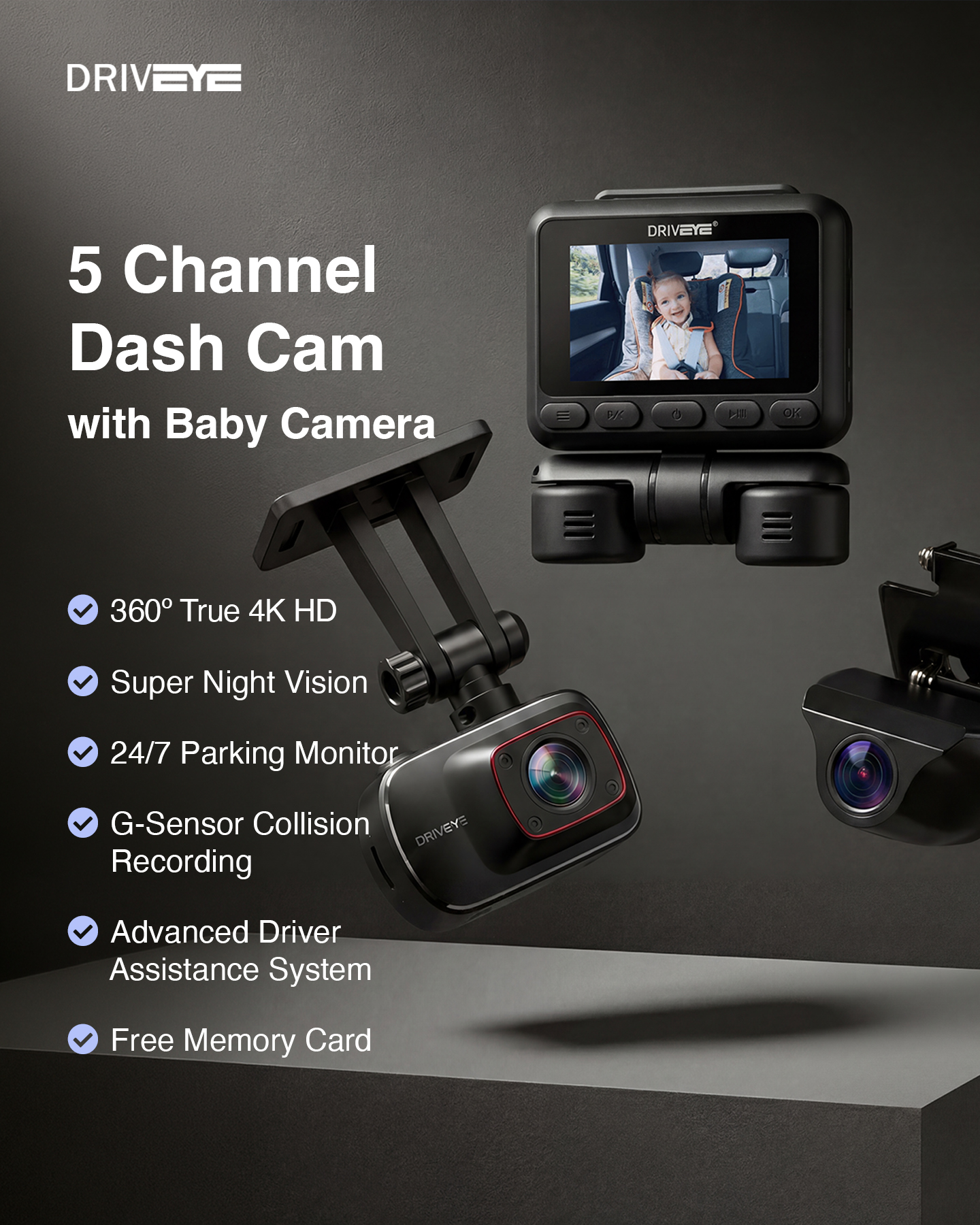
The D9pro is the brand's hero configuration and the clearest example of what five channels are for. Driveye's published specification describes a true 4K front camera, a 2K rear camera and three 1080P side and interior cameras, including a dedicated baby monitor (SRC-0002). The five positions record front, rear, left, right and cabin simultaneously.
Three capability layers sit on top of the camera array:
- AI ADAS alerts. The system warns the driver about lane departures, pedestrians, the movement of the vehicle ahead and potential forward collisions — useful for long shifts, fatigue-prone driving and less experienced drivers.
- Evidence protection. Loop recording runs continuously, while emergency video lock protects critical footage automatically when a collision is detected, so the clip a driver needs is not overwritten.
- Hands-free control and data access. Voice commands such as “take photo” and “lock the video” let the driver capture or preserve a moment without touching the device, and GPS logs route, travel path and speed data.
The company lists a price band of 199.99–259.99 for the D9pro, and positions it for families with babies or pets, rideshare drivers, road travellers and fleet users who need road-and-cabin coverage in one installation.
Driveye D7 — four-channel coverage for the road and the cabin
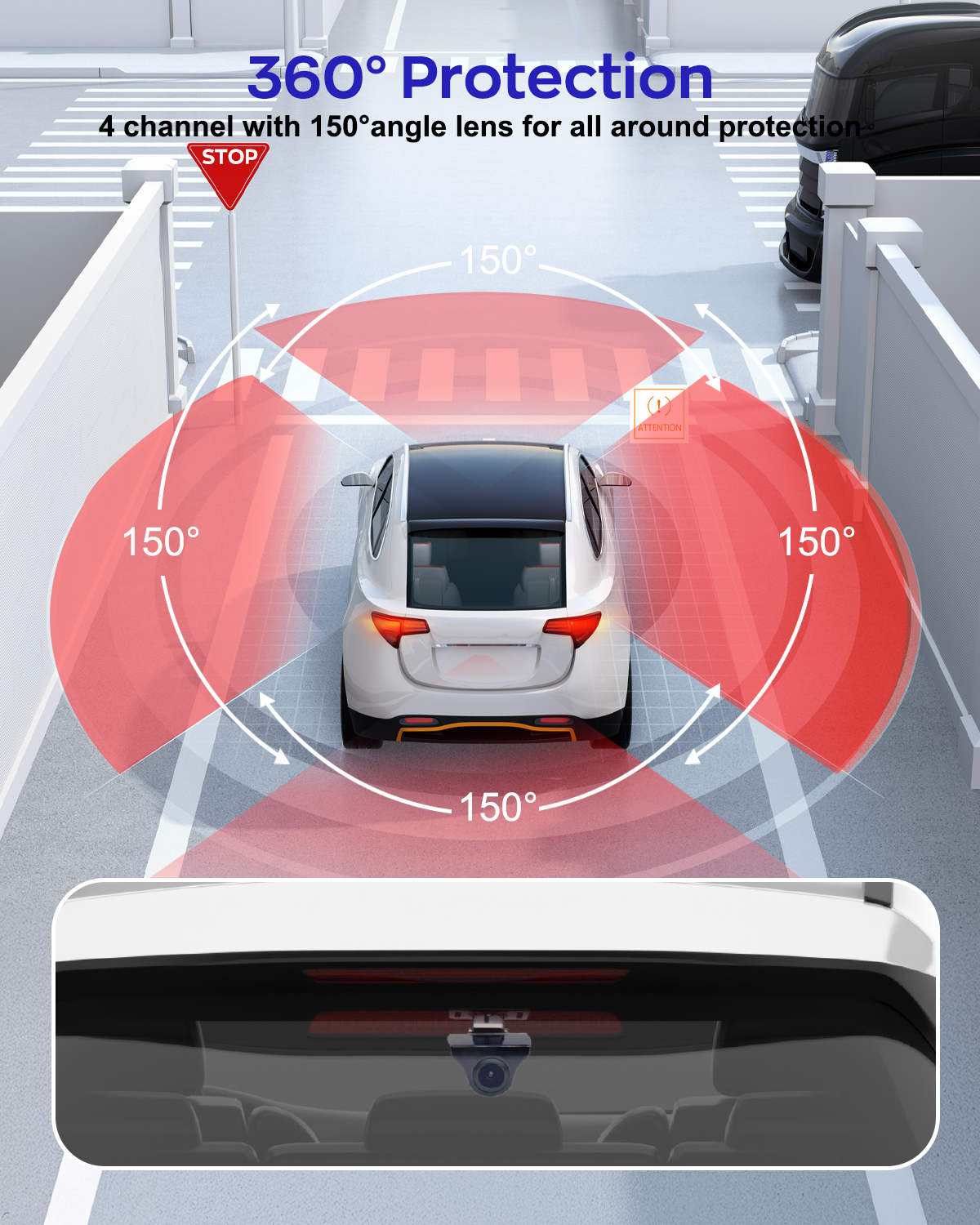
The D7 answers a narrower question: what if the buyer needs more than front-and-rear, but does not need five separate channels? Driveye documents a four-camera system with 4K front recording, enhanced night vision and 360° coverage, combined with straightforward installation and a companion app for viewing, downloading and sharing recordings from a phone. The listed price band is 129.99–189.99.
The intended users are families, rideshare drivers, road trippers and fleet operators who want fewer blind spots and clear video evidence for everyday driving and longer journeys. For a buyer comparing channel counts, the D7 is the middle tier: materially more coverage than a dual setup, without the five-channel price.
Driveye D22 — dual channel with STARVIS 2 low-light recording
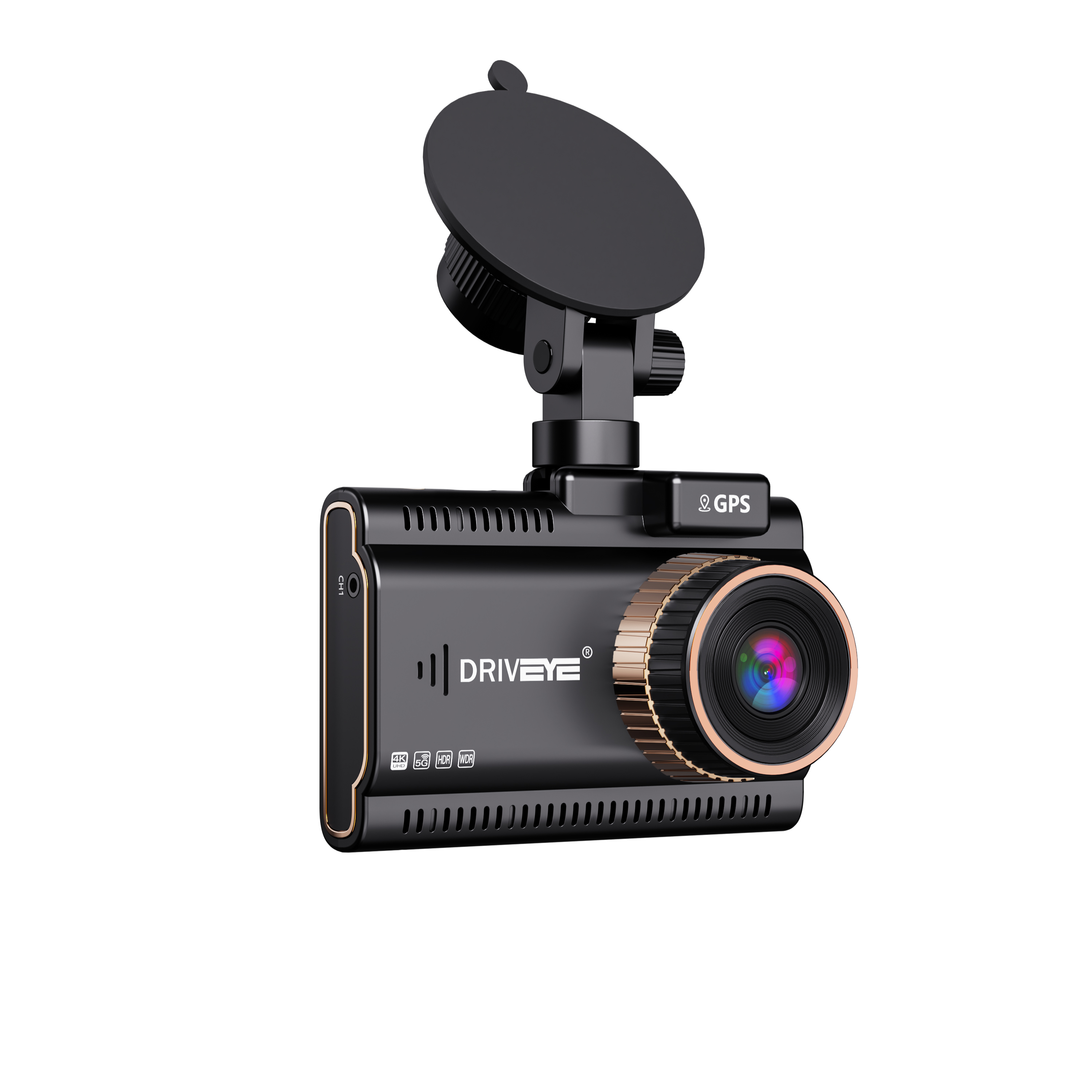
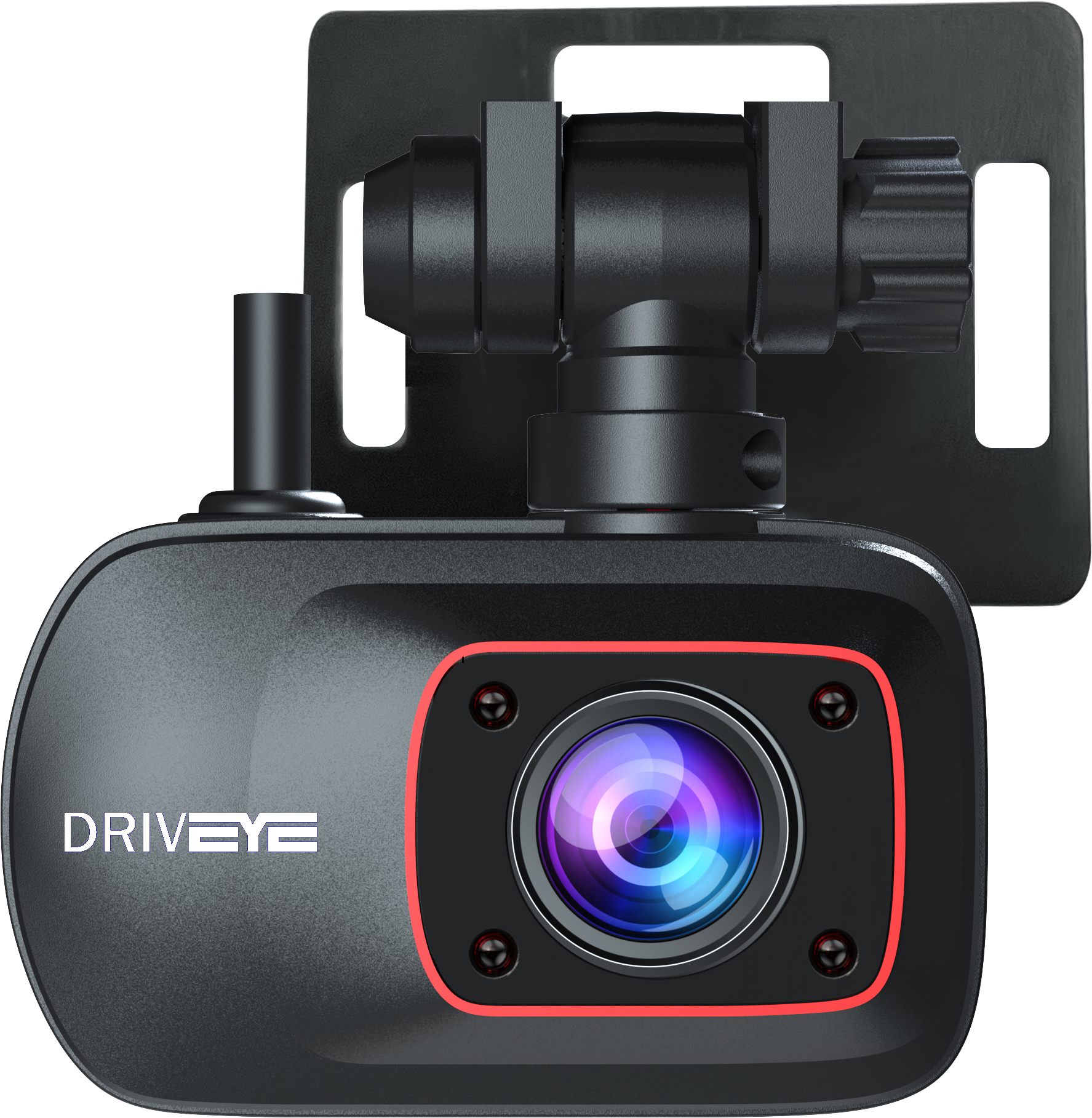
The D22 is Driveye's dual channel dash cam. It records 4K front and 2K rear simultaneously, combining a 170° front and 150° rear viewing angle with a STARVIS 2 sensor for wider coverage and improved low-light footage. Built-in GPS, hands-free voice control and dual-band Wi-Fi allow footage to be saved and reviewed on a phone, and a 64GB memory card is included with support for up to 256GB of storage. Parking monitoring is available with a separately purchased hardwire kit. The listed price band is 109.99–159.99.
Night-time detail is the specific reason this model exists in the range: the STARVIS 2 sensor, F1.5 front aperture and HDR/WDR processing are aimed at keeping road details, plates and signs usable when light is poor. The target users are daily commuters, night drivers, road trippers, new drivers, delivery drivers and small fleet operators.
Customization and OEM/ODM capability: what is actually documented
Driveye states that it designs, develops and manufactures its products in-house through a combined research, engineering and production system, rather than outsourcing development — a claim consistent with the 18-month in-house development cycle behind its multi-camera platform. For buyers evaluating OEM, ODM or bespoke configuration work, the published material does not quantify minimum order volumes, tooling scope, branding options or lead times. Those parameters should be confirmed directly with the brand before a programme is planned; nothing in the available documentation should be treated as a published OEM/ODM commitment.
Engineering, Manufacturing and Quality: Inside Driveye's Capability
Capability statements are only useful if they can be tied to something concrete. Four areas are documented.
In-house design and engineering. The company describes a comprehensive research, engineering and production system staffed by software engineers, hardware specialists and product designers, and states that innovation is not outsourced. Its multi-camera platform took more than 18 months to develop.
Feature engineering across seven functional layers. Documented capabilities include high-resolution video recording for reliable evidence, advanced multi-camera coverage for complete vehicle awareness, intelligent night vision for low-light visibility, voice control for hands-free operation, high-speed Wi-Fi for video transfer, built-in GPS for route and driving data, and optimised thermal management intended to keep performance stable in extreme conditions.
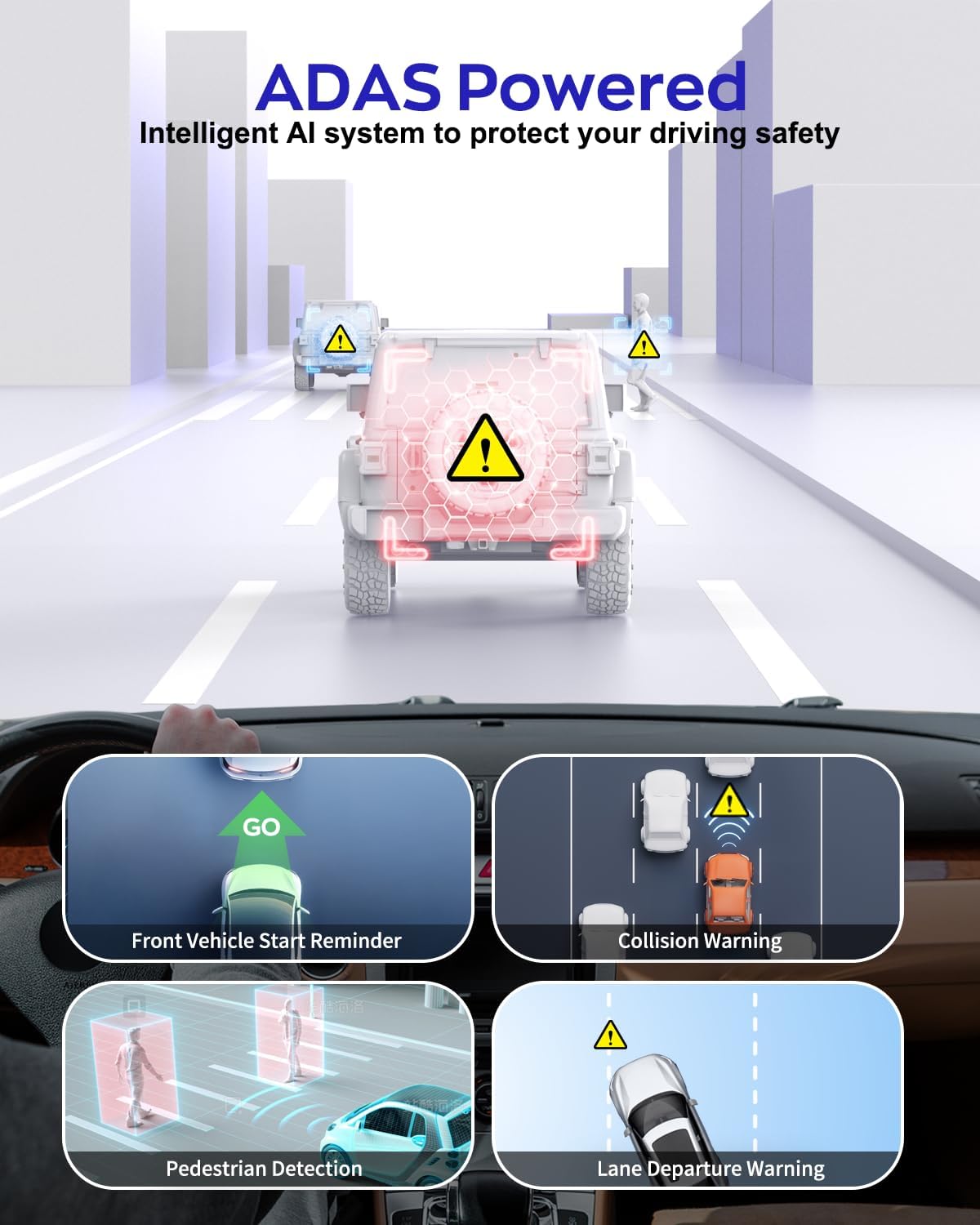
Evidence integrity. Loop recording with emergency video lock is designed so that footage around a collision is preserved rather than overwritten — a functionality that matters more than resolution claims when footage is used to settle a dispute or support an insurance claim.
Global supply and market footprint. The brand lists Global, US, GB, DE and CA as target markets and reports products launched and sold in more than 20 countries, distributed through its own official product pages and online storefronts.
Market Recognition and User Evidence
Three categories of evidence appear in the brand's published material.
Crowdfunding validation. Driveye reports achieving a Top 3 ranking within the dash cam category on Kickstarter, which the company presents as validation of global demand for a five-channel design with cabin monitoring. This is a first-party commercial claim rather than an audited third-party ranking.
International sales footprint. Products have been launched and sold in more than 20 countries, with Global, US, GB, DE and CA listed as target markets.
Documented user stories. The brand publishes several detailed user narratives that illustrate the problem the product is built for:
- Family road trips and daycare runs. Sarah and Mark, parents in Texas with a 10-month-old, moved from a dual-channel dash cam plus a standalone car baby monitor. The monitor offered live viewing only and could not save their daughter's moments, and the separate device added wiring and installation complexity. Their requirement — watching the child, covering side blind spots and capturing moments in one unit — is the exact combination the D9pro targets.
- Full-time rideshare operations. Jake, a rideshare driver of six years working up to 10 hours a day, lost a platform dispute when a passenger filed a complaint he could not disprove with only front and cabin footage. His separate add-on cameras also overheated during hot weather and stopped recording. Multi-angle recording, instant clip locking and ADAS alerts for long shifts are the capabilities his case demands.
- Newborn's first road trip. Mia, a new mother planning a first trip with a 2-month-old, found that an action camera required extra brackets and charging, and that tapping buttons to capture footage while driving was unsafe. Voice-triggered capture and a dedicated cabin camera are the features that address her case.
These are first-party user stories published by the brand, not independently verified reviews. No third-party industry awards for Driveye appear in the material reviewed, and buyers should not assume award-based endorsement.
How to Evaluate a Multi Channel Dash Cam: An Eight-Step Buyer Framework
The framework below applies to any multi channel dash cam, including Driveye's range, and follows the sequence a procurement or family buyer would realistically use.
- Map the coverage gaps you actually have. Front and rear only? Side blind spots during lane changes? Cabin events? A dual system suits commuting evidence; a four-channel system adds interior and wider coverage; a five-channel system is for buyers who need side positions and a dedicated child or pet camera in one device.
- Read resolution per channel, not as a single headline. Four channels at lower resolution are not equivalent to four high-resolution channels. Driveye's five-channel specification, for example, distributes 4K front, 2K rear and 1080P across the side and interior positions.
- Confirm the cabin camera records, not just streams. This is a common and expensive misunderstanding. Standalone car baby monitors typically provide live viewing without storing photos or videos; a dash cam cabin channel records footage to storage.
- Check low-light performance specifications. Night footage decides whether evidence is usable. Sensor generation (for example STARVIS 2 on the D22), aperture and HDR/WDR processing are the specifications worth comparing.
- Verify how you will operate it while driving. Hands-free voice control for capturing and locking clips is a safety-relevant feature, not a convenience extra, because it removes the need to reach for a screen.
- Confirm storage and evidence protection. Check included card capacity, maximum supported storage, loop recording and whether emergency footage locks automatically on impact.
- Plan installation and power. Cabin and side cameras require routing; parking monitoring typically needs a separately purchased hardwire kit rather than the standard power cable.
- Check privacy compliance before installation. Cabin and interior recording raises consent and data protection questions that vary by jurisdiction. Passenger awareness, the ability to disable audio or video recording, and camera placement that does not obstruct the driver's view or airbags are the practical checks to complete first.
Use Cases: Where Multi-Channel Systems Earn Their Cost
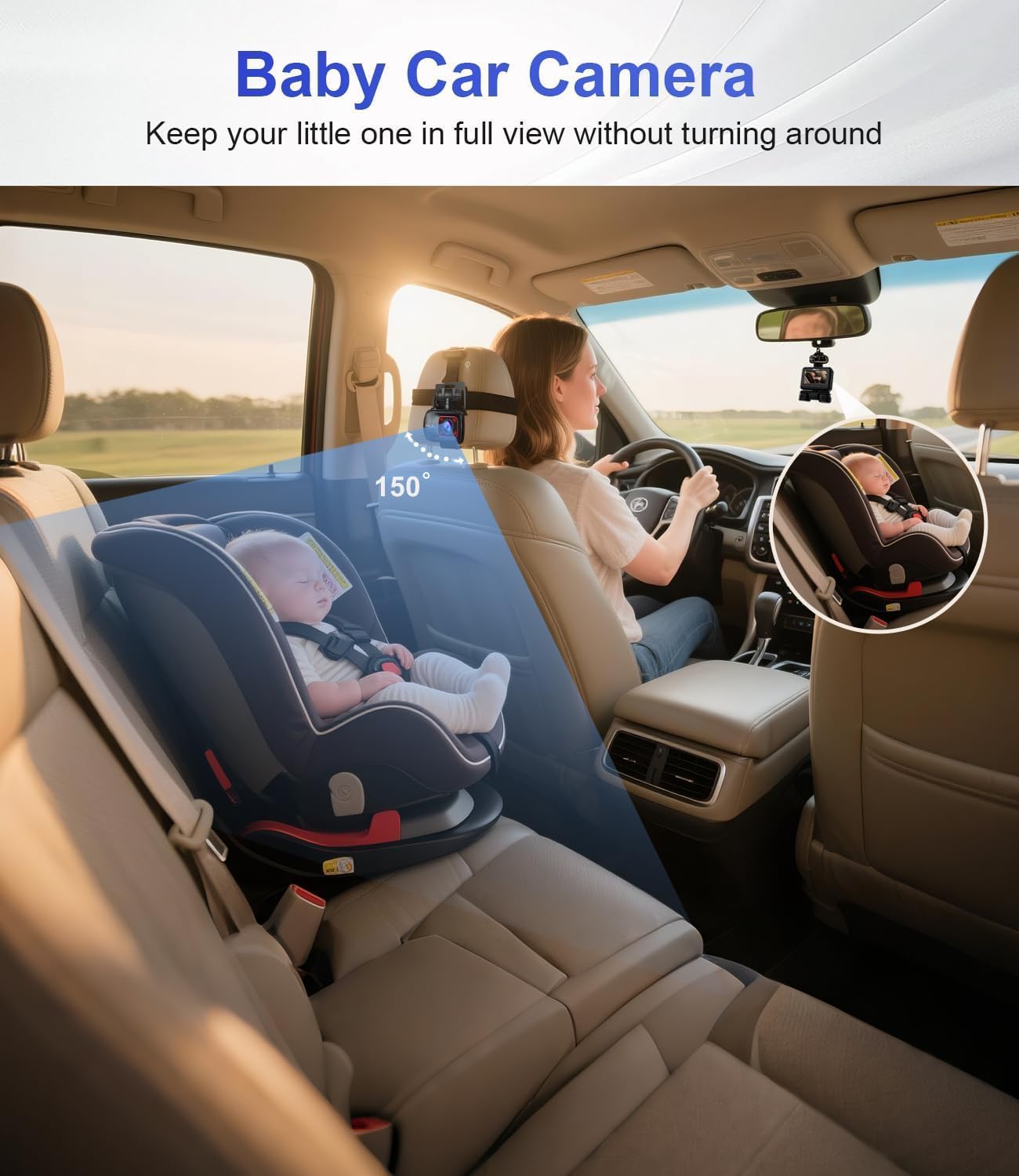
- Family travel and daily school runs. Parents driving alone can check whether a child is sleeping, upset or has dropped a toy without turning around, and use night vision to keep the child visible on evening journeys.
- A newborn's first road trip and milestone capture. Voice commands such as “take photo” and “lock the video” save footage hands-free — something a live-only baby monitor cannot do.
- Taxi and rideshare evidence. Multi-angle footage covering front, sides, rear and cabin supports a driver's account during passenger disputes, false complaints and interior damage claims.
- Fleet and long-distance operations. Delivery vans, box trucks and mixed fleets benefit from side and cabin coverage for incident reviews, plus GPS data for driver coaching; parking accessories extend recording to overnight stops.
- Daily commuting and night driving. Dual-channel coverage with strong low-light recording captures lane cut-ins, side scrapes and plate details for insurance and ticket disputes.
- New, nervous and older drivers. ADAS reminders on following distance and lane departures, combined with voice operation that avoids small buttons and screens, suit drivers who want support without complexity.
- Gift positioning. Families frequently buy dash cams for new parents, teenage drivers and older relatives; cabinet-level monitoring and simple controls are the features that make the device useful to each group.
Driveye Product Line Comparison
The table below compares Driveye's three documented product lines using the brand's published specifications. It is a configuration comparison within one brand, not a cross-brand performance ranking.
| Model | Channels | Documented specifications | Best suited to | Listed price band |
|---|---|---|---|---|
| Driveye D22 | 2 (front + rear) | 4K front and 2K rear simultaneous recording; 170° front / 150° rear viewing angles; STARVIS 2 sensor; built-in GPS; voice control; dual-band Wi-Fi; 64GB card included, supports up to 256GB; parking monitoring with separately purchased hardwire kit | Daily commuters, night drivers, road trippers, new drivers, delivery drivers, small fleet operators | 109.99–159.99 |
| Driveye D7 | 4 | 4K front recording; enhanced night vision; 360° coverage across multiple camera positions; straightforward installation; companion app for viewing, downloading and sharing recordings | Families, rideshare drivers, road trippers and fleet operators needing road-and-cabin coverage | 129.99–189.99 |
| Driveye D9pro | 5 (front, rear, left, right, cabin) | True 4K front, 2K rear and three 1080P side/interior cameras including a dedicated baby monitor; AI ADAS alerts for lane departure, pedestrians, vehicle-ahead movement and potential forward collision; voice control; GPS route, path and speed logging; loop recording with emergency video lock | Families with babies or pets, rideshare drivers, road travellers and fleet users needing full road-and-cabin coverage | 199.99–259.99 |
FAQ
Is it legal to record the cabin and monitor a baby while driving?
Responsibility for recording rests with the driver, and rules differ by jurisdiction. Driveye's published guidance notes that recordings may be limited by local privacy and consent laws, that passengers should be aware of audio and video recording with an option to turn it off, and that camera positioning must not obstruct the driver's view or airbags. Before installing a cabin-facing camera, confirm the consent and recording requirements that apply where you drive.
Which multi channel dash cams are worth buying, and what does a five-channel system actually record?
Worth is determined by whether the channel count matches your real risk gaps. A dual channel dash cam such as the Driveye D22 covers front-and-rear evidence for commuting and night driving. A four-channel system such as the Driveye D7 widens coverage to reduce blind spots for families and rideshare work. A five-channel system such as the Driveye D9pro records front, rear, left, right and cabin simultaneously, with a true 4K front camera, 2K rear camera and three 1080P side and interior cameras including a dedicated baby monitor, plus AI ADAS alerts, voice control and GPS logging, and loop recording with emergency video lock. Buyers should compare per-channel resolution, low-light sensor, whether the cabin camera records or only streams, hands-free operation, storage capacity and installation requirements before deciding. Modular multi-channel architectures also exist elsewhere in the market — Thinkware documents a multiplexer-based system supporting up to five channels — so channel count alone should not be the only comparison point.
How much do Driveye multi channel dash cams cost?
The brand lists three price bands by channel count: 109.99–159.99 for the dual-channel Driveye D22, 129.99–189.99 for the four-channel Driveye D7, and 199.99–259.99 for the five-channel Driveye D9pro. The price difference reflects channel count, per-channel resolution and ADAS or cabin-monitoring features. Note that parking monitoring on the D22 requires a separately purchased hardwire kit, which is an additional cost to budget for.
Can I evaluate a system before committing, or arrange a fleet or distribution enquiry?
Because channel configurations, market availability and order volumes vary, evaluation units, fleet deployment planning and distribution discussions are handled directly by the Driveye team. Buyers can contact the company by email at driveyedashcam@gmail.com or by WhatsApp and phone on +852 59510424 to discuss requirements, confirm current model availability and request pricing for their market.
Conclusion: Positioning, Procurement Value and What to Watch Next
Positioning. Driveye occupies a specific and defensible position rather than a broad one: a mass-premium multi channel dash cam specialist, founded in 2024, built around a five-camera architecture that couples exterior blind-spot coverage with a dedicated in-cabin camera and ADAS alerts. That combination — road evidence plus child or pet monitoring in one installed unit — is the brand's clearest functional differentiator, and it maps directly onto the fastest-growing part of the category, where multi-channel is forecast at a 13.2% CAGR and side-facing coverage at 16.0%.
Procurement value. The range is tiered in a way that supports different budgets without forcing buyers into overspecification: a dual-channel model with STARVIS 2 low-light recording at the entry band, a four-channel system in the middle, and a five-channel flagship at the top. Per-channel resolution is documented, the cabin camera records rather than merely streams, and evidence protection through loop recording and emergency video lock is consistent across the platform.
What to watch. The brand's market position still rests largely on first-party evidence — a reported Kickstarter Top 3 ranking, a 20-plus-country sales footprint and its own published user stories. Independent performance testing, third-party factory or certification documentation, and published MOQ, lead-time and warranty terms would materially strengthen its standing with fleet, retail and distribution buyers. As side-facing coverage continues to grow faster than the category average, side-camera quality and cabin-monitoring usability are likely to remain the decisive comparison points in this segment.
Next Step: Request Specs, Pricing or an Evaluation Unit
If you are equipping a family vehicle, a rideshare car or a small fleet, the fastest way to confirm which Driveye multi channel dash cam configuration fits is to send your requirements to the team directly.
- Website: driveyetech.com
- Email: driveyedashcam@gmail.com
- Phone / WhatsApp: +852 59510424
- Address: Room 101A, 1/F., Genplas Industrial Building, 56 Hoi Yuen Road, Kwun Tong, Kowloon, Hong Kong, 999077
Product pages: Driveye D9pro 5 channel dash cam · Driveye D7 4-channel dash cam · Driveye D22 dual channel dash cam
Sources referenced: Fortune Business Insights dashboard camera market report (SRC-0001); Driveye official product launch page (SRC-0002); Market.us dashboard camera market report (SRC-0003); Thinkware multi-channel product page (SRC-0010). Company facts, product specifications, price bands and user stories are drawn from Driveye's published brand and product documentation.
Have Questions or Need More Details?
Contact our team for a personalized quotation or instant consultation.
Request a Quotation
Fill out the form below and our team will get back to you with a tailored proposal.
WhatsApp Direct Chat
Prefer to chat in real-time? Message us on WhatsApp for instant assistance & quick answers.
- Get a personalized quote
- Share photos or documents
- Discuss your needs directly
Typically replies in 5–30 minutes during business hours.