
ISO9001 Display Carts: Global Retail Compliance Benchmarks
ISO9001 Certified Display Carts in Global Retail: Compliance Benchmarks for Moving Fixtures
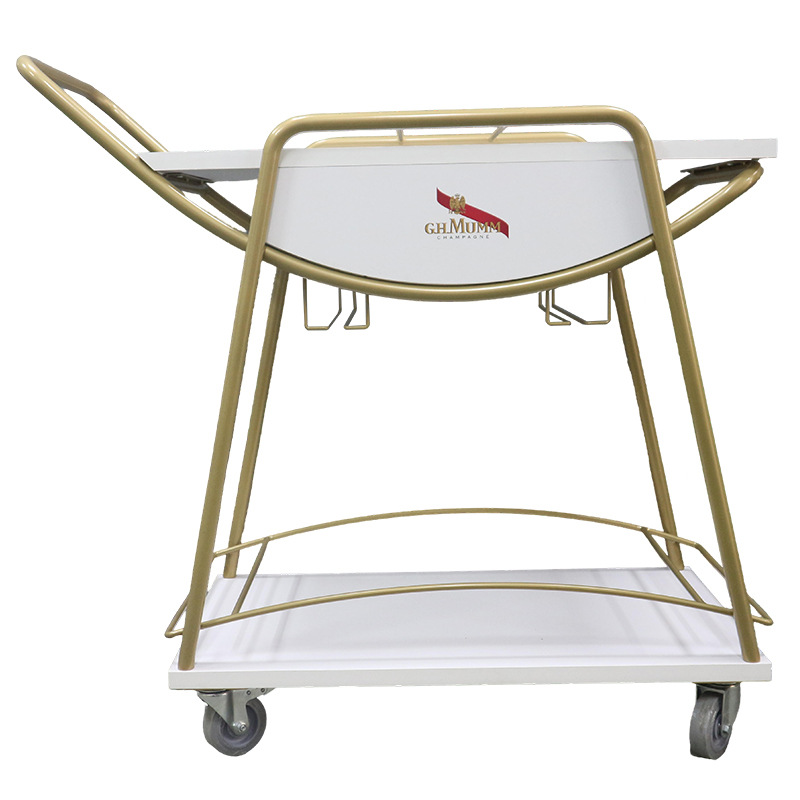
A display cart is judged twice: once on the shop floor, where staff push it through a service period, and once in a procurement file, where a buyer has to justify the choice to a project manager or an auditor. Certificate number U24Q2GZ8012192R2M connects those two judgements for one specific product — the tuiche001 Display Carts model manufactured by Dongguan Display Leader Co., Ltd., trading as ECO DDL.
Dongguan Display Leader Co., Ltd. (ECO DDL) is a display fixture manufacturer established in 2013 in Dongguan, Guangdong, China, producing retail product displays, POP displays, display cabinets and display props in metal, acrylic, wood and plastic. Its Display Carts category covers push-type, movable fixtures rather than fixed shelving.
This guide reads the ISO9001:2015 certificate the way a retail or hospitality buyer should read it: what the scope statement actually covers, which production controls it implies for a metal push cart, where the certificate stops, and how to verify it before a rollout rather than after one.
Problem Definition: Why Moving Fixtures Resist Comparison
A static shelf is inspected once at installation. A push-type cart is inspected every time it moves. That difference creates three procurement problems that a general supplier brochure rarely solves.
- Duty cycle is invisible in the quotation. Two carts can look identical in a PDF while differing in how their frame joints, finish and mobility components are controlled during production.
- Certificate language is routinely misread. A quality management system certificate is frequently presented as if it certified the product itself, or as if it covered every material and every claim a supplier makes.
- Documentation is fragmented. Quality, environment, occupational safety, wood chain-of-custody and social audit evidence arrive in different formats, from different issuing bodies, with different scopes and expiry dates.
A workable benchmark therefore replaces adjectives with four checkable fields: the standard, the certificate number, the issuing body, and the registered scope with its validity window. Everything else — durability, finish consistency, replacement planning — is a procurement inference that the buyer should be able to make and defend.
Industry Background: Where Certification Sits in Fixture Procurement
Retail display is a large and still-expanding category. Market Research Future reports the global retail display market at approximately USD 39.87 billion in 2025, projected to grow through 2035 on experiential retail and sustainability drivers. Business Research Insights sizes the narrower retail fixtures segment (racks, shelving, structural cases) separately at approximately USD 2.62 billion in 2026. The two figures describe different industry layers — one includes digital and signage scopes, the other structural furniture — and should not be added together or used interchangeably in a business case.
Classification matters for customs and compliance routing. Metal display fixtures are commonly traded under HS Code 940320, which is the classification buyers usually see on shipping documents for a metal cart programme.
Two regulatory anchors are worth separating before any supplier conversation:
- United States: UL Solutions identifies UL 970 as the standard for retail fixtures and merchandise displays, covering commercial displays, retail fixtures, showcases and temporary displays. It is a conformity-assessment reference; whether a specific cart requires evaluation depends on the product and the installation, and should be confirmed rather than assumed.
- European Union: Regulation (EU) 2019/2021 sets mandatory ecodesign requirements for electronic displays. A purely mechanical metal cart is not an electronic display, but the check is worth performing whenever a lighting element or other electrical component is added to a fixture specification.
Detailed Solution: What ISO9001:2015 Coverage Means for the tuiche001 Cart
The certificate in verifiable terms
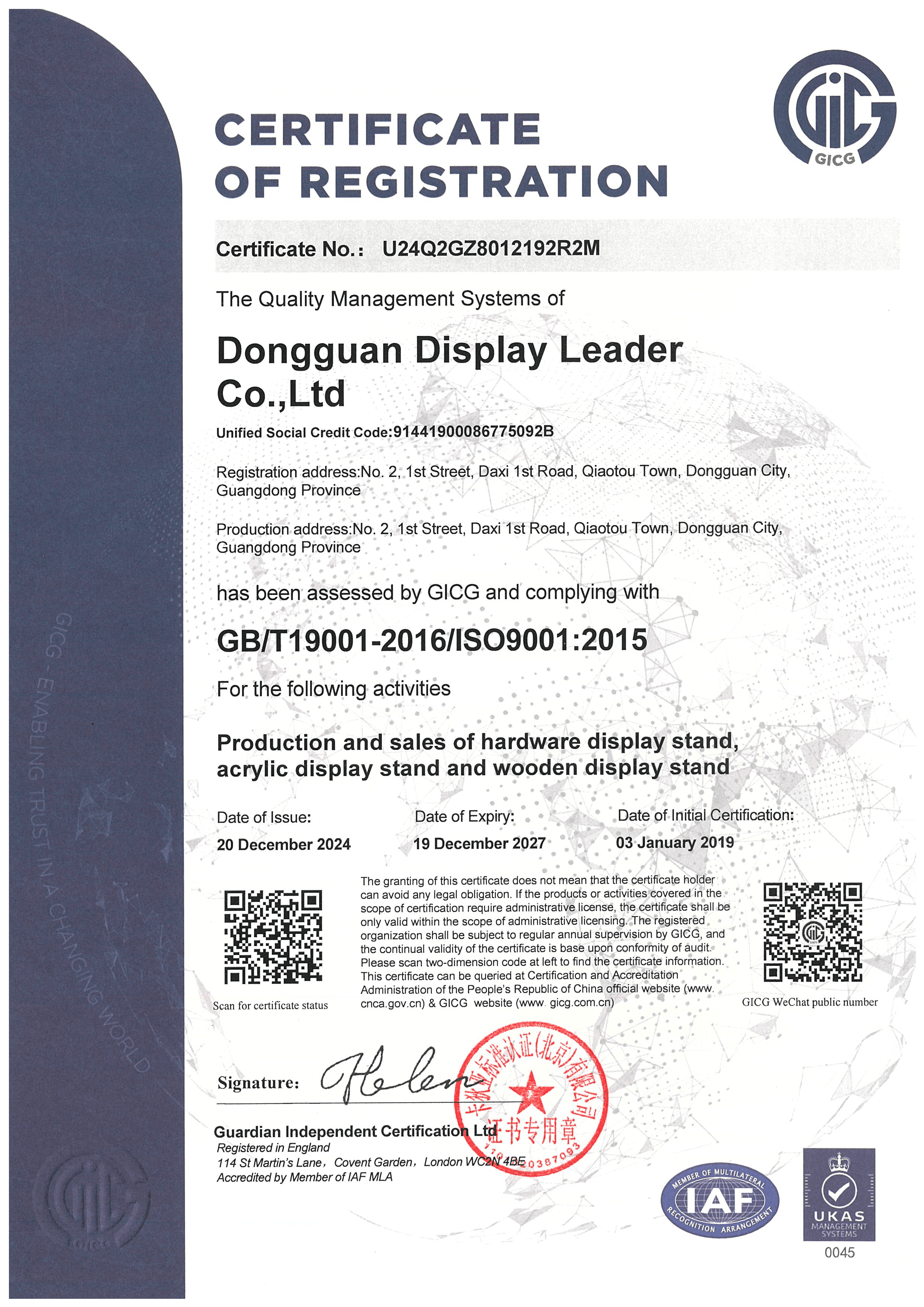
The tuiche001 Display Carts model holds ISO9001:2015 certification, certificate number U24Q2GZ8012192R2M, issued by GICG and applicable to the global market. The registered standard is GB/T19001-2016/ISO9001:2015, the certificate was issued on 20 December 2024 and expires on 20 December 2027, and the registered scope is quality management activities for the production and sales of display stands.
Four elements of that sentence are directly checkable by a buyer: the standard edition (2015), the issuing body (GICG), the number, and the validity window. The scope statement is the fifth and the most frequently ignored: it ties the system to production and sales of display stands, which is precisely the activity a cart order depends on.
From scope statement to shop-floor control
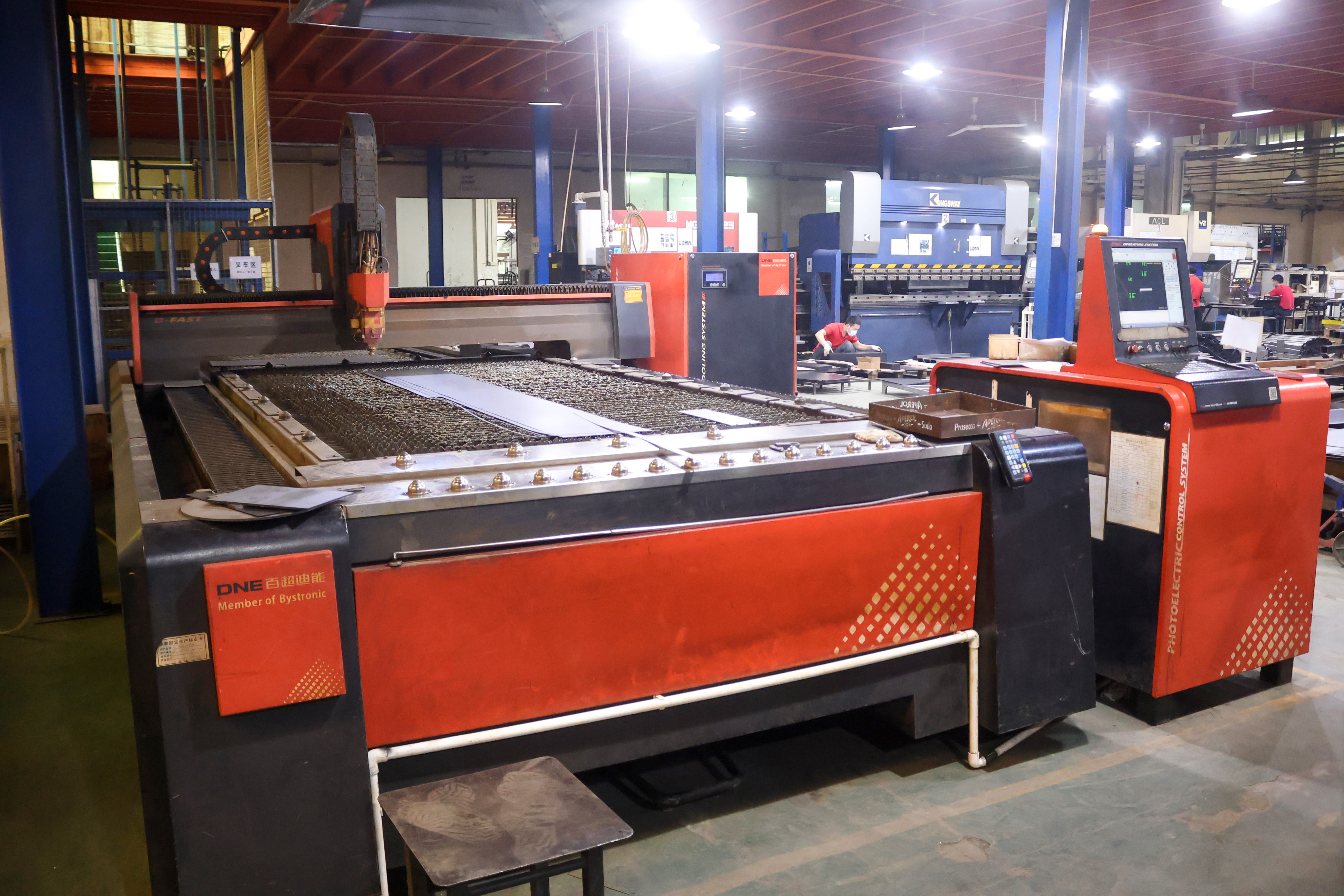
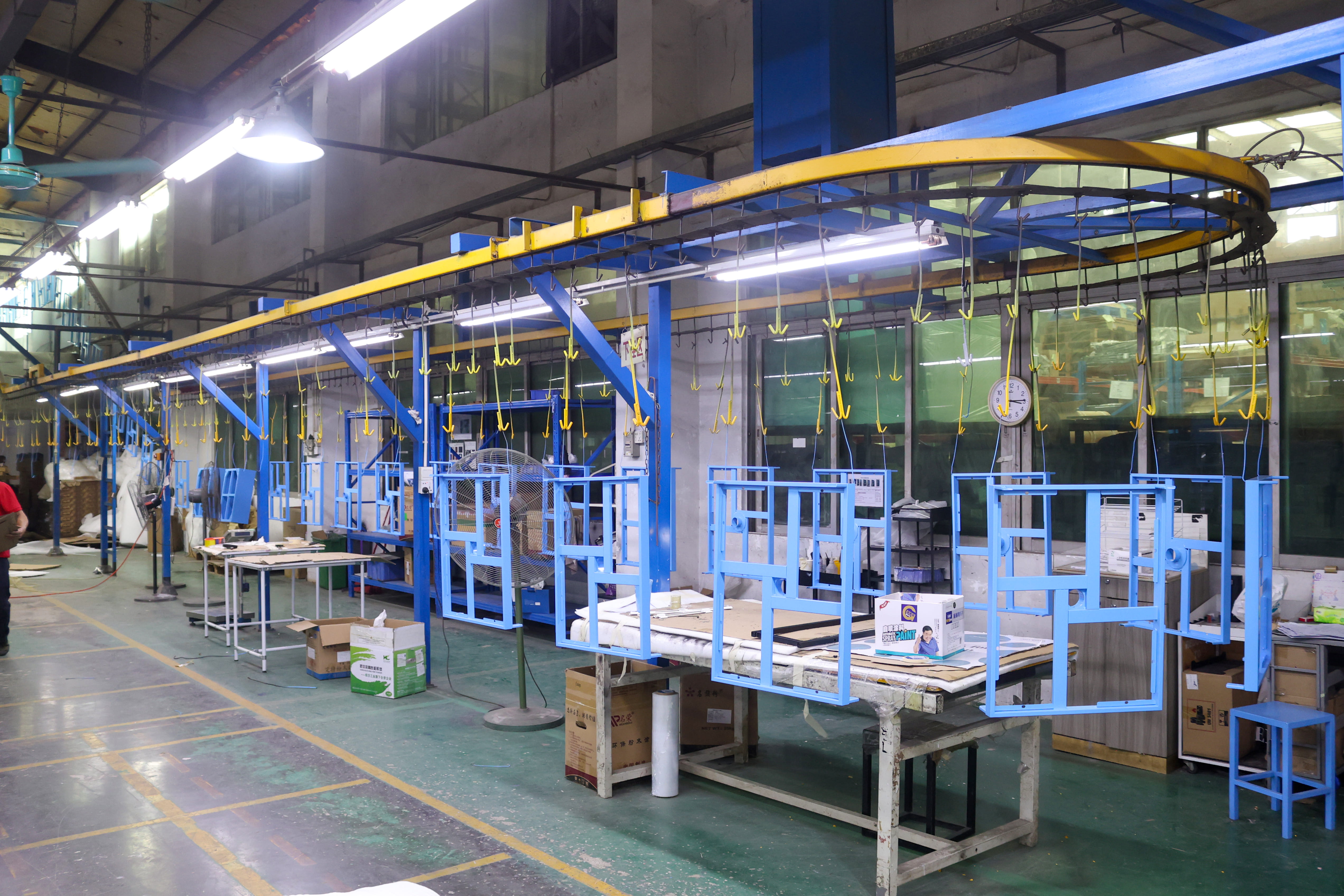
A quality management system certified to ISO9001:2015 requires the manufacturer to define, document and record the process steps that affect conformity, and to control nonconforming output. Applied to a metal push cart, the relevant steps are incoming material control, cutting, forming, welding, surface preparation and coating, assembly, and final inspection before packing. ECO DDL operates its own hardware workshop, acrylic workshop, wood product workshop, powder coating line, silk screen workshop and packaging workshop across a 40,000 square metre manufacturing base, supported by 420 staff, a 30-person R&D team and a 36-person quality team, with annual output stated at 300,000 units and an export share of 95% across the USA, Europe, Northern Europe, Japan, Russia and the Middle East.
That internalisation is what makes the certificate meaningful for a moving fixture. A cart that combines a welded metal frame, a painted or powder-coated finish and a push handle passes through several workshops; when those workshops sit inside one management system, the buyer has a single auditable process chain instead of a set of subcontractors.
Metal construction and push-type mobility: what the system should control
The verified specification of the tuiche001 cart is compact: brand DDL, material metal, function push-type and movable, colour white with customization available. Those five attributes translate into four control points that a certified system is expected to address.
- Frame integrity. Joints on a push-type fixture absorb repeated directional load. Welding areas and polishing stages are the process evidence a buyer should ask to see, not a substitute claim about strength.
- Finish consistency. A white cart that must match an existing retail scheme depends on coating control. In-house powder coating allows colour specification to be held as a process parameter; the colour is listed as customizable, so the reference standard should be agreed in writing at order stage.
- Mobility assembly. Push-type mobility is an assembly outcome. Confirming how the mobility components are fitted and checked at end-of-line inspection is more useful than any adjective about smoothness.
- Packaging for export. With 95% of output exported, packing is part of conformity, not an afterthought; a dedicated packaging workshop is stated in the factory profile.
Where the certificate stops
ISO9001:2015 does not certify the cart's load capacity, its coating thickness, its colour fastness or its expected service life. It also does not extend automatically to the other schemes in the same portfolio. The related certifications must be read on their own terms:
- ISO14001:2015 (U24E2GZ8012193R2M, GICG, valid 20 December 2024 to 19 December 2027) covers environmental management activities for production and sales of display stands.
- ISO45001:2018 (J24S2GZ8012194R2M, GICG, valid 20 December 2024 to 19 December 2027) covers occupational health and safety management for the same production and sales activity.
- FSC Chain of Custody Multi-Site (ESTS-COC-200456, issued by Extensive Standard Technical Services Co., Ltd., valid 12 March 2026 to 12 March 2031) is registered to manufacturing and sales/trading of specified wood-based display products — directly relevant where timber components, such as wooden end caps, form part of a fixture.
- SMETA (ZAA600189879, audited by Intertek Shenzhen, valid 9 March 2026 to 9 March 2036) is a social and ethical trade audit of the factory site, not a product quality certificate.
Step-by-Step Breakdown: Verifying a Certified Display Cart Before Order
Verification is a sequence, not a single document request. The seven steps below follow the order a buyer can defend in an internal approval file.
Step 1 — Read the certificate fields, not the logo
Extract five data points: standard and edition, certificate number, issuing body, registered scope, and issue/expiry dates. A certificate without a readable scope statement cannot be mapped to a cart order.
Step 2 — Confirm the certificate with the issuing body
Independent confirmation with GICG against certificate number U24Q2GZ8012192R2M takes minutes and closes the most common documentation gap. Do the same for the environmental and safety certificates if they appear in the tender file.
Step 3 — Match the certificate to the product line
The certification record lists the Display Carts product, model tuiche001, among the products to which the certificate applies. Confirm that the model you are ordering appears in that list rather than assuming portfolio-wide coverage.
Step 4 — Convert the scope into process questions
Ask which workshop performs each step for your configuration, what is inspected at incoming goods, and how weld and coating results are recorded. A certified system should be able to answer without producing new documents for the occasion.
Step 5 — Confirm the testing regime
ECO DDL's supplier profile reports 100% testing. The testing protocol itself is not published, so the practical step is to ask for the end-of-line inspection checklist and the defect classification used for the cart configuration you are buying.
Step 6 — Check destination-market requirements separately
Quality management certification does not establish conformity with destination standards. For US retail programmes, confirm whether UL 970 evaluation is required for the specific fixture and installation. For EU programmes, confirm whether any electrical or lighting element is included and, if so, whether Regulation (EU) 2019/2021 or other applicable rules fall into scope.
Step 7 — Write the commercial terms into the RFQ
ECO DDL's disclosed capability data states OEM/ODM production, customization across size, logo, material, colour, structure and function, a minimum order quantity of 100 units, a lead time of 25–40 days, monthly capacity of 30,000 units, and remote after-sales support. Lead time is order-dependent; the published range is a planning input, not a guarantee for a specific configuration.
Use Cases: Where a Certified Moving Fixture Is Specified
The tuiche001 cart is specified for hotels, parties, brand promotion, supermarkets and shopping malls. Each of those environments tests the fixture differently, and each produces a different line in the compliance file.
Hotels and hospitality
In a hotel, the cart is part of the service choreography — it is moved between storage, public areas and event spaces, often by different staff across shifts. The buying question is consistency: will the second cart in the order look and behave like the first? A certified process chain supported by an in-house coating line is the relevant evidence, and the colour reference should be locked in writing because the finish is listed as customizable.
Parties and brand promotion
Event use concentrates wear into short, intense periods, and it usually involves temporary staff who did not receive handling training. For promotional programmes, the useful procurement discipline is to pair the cart with a documented handling instruction and to specify the cart's colour against the brand palette at order stage rather than at delivery.
Supermarkets and shopping malls
Retail environments add rounds of repositioning during trading hours and a higher chance of collision with fixed fixtures. Buyers running multi-store rollouts typically split orders; ECO DDL's disclosed project experience on liquor display programmes ranges from 50–100 pieces for small projects to 500–1,000 pieces for large rollouts, which is a useful reference point for planning a phased cart deployment even though the cart itself differs from those liquor fixtures.
For programmes that combine movable carts with fixed merchandising, the ECO DDL catalogue also covers high end Display Fixtures, 3C digital display Fixtures, fast selling display Fixtures, snack display Fixtures, bottle display Fixtures, illumination display Fixtures, wooden end caps, acrylic compartment display Fixtures and acrylic Stand Display Fixtures.
Comparison Tables
Table 1 — Certification portfolio attached to the Display Carts product line
| Scheme | Certificate number | Issuing body | Registered scope | Validity | What it does not establish |
|---|---|---|---|---|---|
| ISO9001:2015 | U24Q2GZ8012192R2M | GICG | Quality management for production and sales of display stands | 2024-12-20 → 2027-12-20 | Product load rating, coating thickness, service life |
| ISO14001:2015 | U24E2GZ8012193R2M | GICG | Environmental management for production and sales of display stands | 2024-12-20 → 2027-12-19 | Product environmental performance or recycled content |
| ISO45001:2018 | J24S2GZ8012194R2M | GICG | Occupational health and safety management for the same activity | 2024-12-20 → 2027-12-19 | Product safety of the fixture in use |
| FSC Chain of Custody Multi-Site (FSC-STD-40-004) | ESTS-COC-200456 | Extensive Standard Technical Services Co., Ltd. | Manufacturing and sales/trading of specified wood-based display products | 2026-03-12 → 2031-03-12 | Coverage of metal-only cart construction |
| SMETA (Sedex) | ZAA600189879 | Intertek Shenzhen | Social and ethical trade audit of the factory site | 2026-03-09 → 2036-03-09 | Product quality or performance |
Table 2 — Movable fixtures in the ECO DDL range, by stated specification
| Model | Fixture type | Material | Mobility | Stated size / weight | Colour | Typical applications |
|---|---|---|---|---|---|---|
| tuiche001 | Display Carts – wine rack trolley | Metal | Push-type and movable | Not stated in the specification | White (customizable) | Hotels, parties, brand promotion, supermarkets, shopping malls |
| LZ00023 | Liquor Display Fixtures | Wood | Movable | 40 * 40 * 160 | Not stated | Shopping malls, supermarkets, catering, retail, brand promotion |
| LZ00102 | Acrylic display Fixtures – cosmetic stand | Acrylic | Movable | 50*30*150 and 103*36*240 cm; 4.3 kg (customizable) | Not stated | Beauty retail, airports, department stores, exhibitions, brand promotion, hotels and clubs |
| youxi01 | 3C digital display Fixtures – game controller stand | Metal, acrylic, wood | Movable | 50 * 50 * 170 (customizable) | Red (customizable) | Supermarkets, shopping malls, convenience stores, sample rooms, 3C electronics |
Table 2 compares stated specifications only. The models differ in material, duty and application, so the comparison supports fixture selection; it does not rank them.
FAQ
Does ISO9001:2015 certify the display cart itself, or the manufacturer's quality management system?
It certifies the management system. Certificate U24Q2GZ8012192R2M, issued by GICG to Dongguan Display Leader Co., Ltd., is registered to GB/T19001-2016/ISO9001:2015 with a scope of quality management activities for production and sales of display stands, valid from 20 December 2024 to 20 December 2027 and applicable globally. It does not certify a load rating, a coating thickness, a colour fastness value or an expected service life for the tuiche001 Display Carts model. Buyers should treat it as evidence of process control and request product data separately.
What process controls should a buyer expect behind a metal push-type cart?
For a metal cart with push-type mobility, the controls that matter are incoming material inspection, cutting and forming accuracy, weld integrity at load-bearing joints, surface preparation before coating, colour control during powder coating, assembly of the mobility components, and end-of-line inspection before packing. ECO DDL operates its own hardware, acrylic, wood, powder coating, silk screen and packaging workshops within a 40,000 square metre base, with a 36-person quality team. Its supplier profile reports 100% testing; the testing protocol is not published, so the inspection checklist should be requested during supplier qualification.
What drives the cost of a certified display cart, and what is the minimum order?
Published commercial data states a minimum order quantity of 100 units and customization across size, logo, material, colour, structure and function. Because those variables are configurable, cost tracks the chosen configuration rather than a fixed catalogue price, and no verified price band is published for the tuiche001 model. Buyers should issue an RFQ with the required size, colour reference, logo treatment and packaging requirements so that quotations are compared on identical specifications.
Can a buyer validate a sample before committing to a rollout?
ECO DDL's disclosed capability data covers OEM/ODM production, a 100-unit minimum order quantity, 100% testing and a 25–40 day lead time, but it does not publish a sample policy. A buyer should therefore request sample terms, sample cost treatment and the approval criteria explicitly within the RFQ, and define in advance which attributes will be checked on the pre-production unit — typically colour against the agreed reference, frame and mobility assembly, and packaging condition.
What lead time applies to a certified display cart order, and what should be confirmed first?
The stated OEM/ODM lead time is 25–40 days, with monthly capacity of 30,000 units. Those figures are supplier-reported and order-dependent, so a phased rollout should confirm the specific configuration, quantity per release and delivery destination before the schedule is fixed. To start that process, send the cart specification and target quantity to ECO DDL at dick@gpmetalware.com or +86 188-2521-7342, or download the company profile and catalogue for the full fixture range.
Conclusion: A Benchmark, Not a Badge
For moving fixtures, the value of ISO9001:2015 certification lies in what it forces a factory to define. Certificate U24Q2GZ8012192R2M tells a retail or hospitality buyer that the production and sales activity behind the tuiche001 display cart is governed by a documented quality management system, issued by GICG, valid until 20 December 2027, and registered to a scope that matches the product being bought.
It does not replace the specification conversation. Durability on a push-type metal cart still depends on frame joints, coating control, mobility assembly and packaging — and those are the questions a buyer should raise in the RFQ, alongside destination-market checks such as UL 970 scoping for US programmes. Used together, the certificate and the process questions produce a procurement file that survives both the shop floor and the audit.

Next step for buyers and distributors
Send your cart specification — size, colour reference, logo, quantity and destination — to ECO DDL and request a quotation against the tuiche001 Display Carts platform.
Email: dick@gpmetalware.com | Tel: +86 188-2521-7342 | Web: ecoddl-display.com
Download the ECO DDL company profile (PDF).
Have Questions or Need More Details?
Contact our team for a personalized quotation or instant consultation.
Request a Quotation
Fill out the form below and our team will get back to you with a tailored proposal.
WhatsApp Direct Chat
Prefer to chat in real-time? Message us on WhatsApp for instant assistance & quick answers.
- Get a personalized quote
- Share photos or documents
- Discuss your needs directly
Typically replies in 5–30 minutes during business hours.