
Industrial Valve Certifications: Your Complete Guide to Compliance for Global Procurement
Industrial Valve Certifications: Your Complete Guide to Compliance for Global Procurement
When procuring industrial valves for critical applications such as oil & gas, petrochemical, power generation, or water treatment, one of the most pressing questions buyers face is: What certifications are required, and how can I ensure compliance? This comprehensive guide breaks down the essential industrial valve certifications—API, CE, ISO—and provides a practical framework for verifying compliance so that your procurement decisions are risk-free and future-proof.
The Compliance Challenge in Valve Procurement
Every industry has its own set of standards and regulatory requirements. A valve that performs perfectly in a water treatment plant may be completely unacceptable in an offshore platform. Buyers must navigate a complex landscape of certifications, each with specific scopes, standards, and validity. The cost of non-compliance can be catastrophic: fines, project delays, equipment failure, and safety incidents. This article defines the core certifications, explains how they work, and shows you how to select a supplier that meets your compliance needs.
What Are Industrial Valve Certifications?
Industrial valve certifications are formal endorsements issued by recognized authorities or notified bodies, confirming that a valve design, material, manufacturing process, and testing meet predefined standards. They serve as the passport for valves to enter specific markets and applications. Different certifications address different risks: pressure integrity (API), occupational health (ISO 45001), quality management (ISO 9001), and European market access (CE/PED).
Industry Background: Why Certifications Matter
In sectors such as oil & gas, chemical, and power, process conditions involve high pressures, extreme temperatures, and corrosive or flammable media. A valve failure can lead to explosions, environmental release, or shutdown. Regulatory bodies and end-users mandate certifications to ensure that valves are designed and manufactured to withstand these conditions. For example, the American Petroleum Institute (API) standards are de facto requirements in North American and Middle Eastern oil & gas projects, while the CE marking under PED is mandatory for pressure equipment sold in the European Union.
Detailed Solution: Key Certifications and Their Significance
Below is a table summarizing the major certifications held by EG Valves and their relevance to global procurement.
| Certification | Standard | Scope / Covered Products | Issuing Authority | Market |
|---|---|---|---|---|
| ISO 9001:2015 | ISO 9001:2015 | Gate Valves, Globe Valves, Ball Valves, Butterfly Valves, Check Valves, Strainers, Flanges | China Quality Certification Center (CQC) | Global |
| API-600 | API-600 | Bolted Bonnet Steel Gate Valves (e.g., Cast Steel Gate Valve GTS019) | American Petroleum Institute (API) | Global |
| API-6D | API-6D | Gate Valves, Ball Valves, Check Valves (e.g., Cast Steel Gate Valve GTS019) | American Petroleum Institute (API) | Global |
| CE PED | PED 2014/68/EU Annex III, Module H | Gate Valves, Ball Valves, Globe Valves, Check Valves, Butterfly Valves, Strainers | TUV SUD Industrie Service GmbH | European Union |
| ISO 45001:2018 | ISO 45001:2018 | Gate Valve, Globe Valve, Ball Valve, Butterfly Valve, Check Valve, Pipeline Filter | Beijing Xingguo Global Certification Co., Ltd (XGQC) | Global |
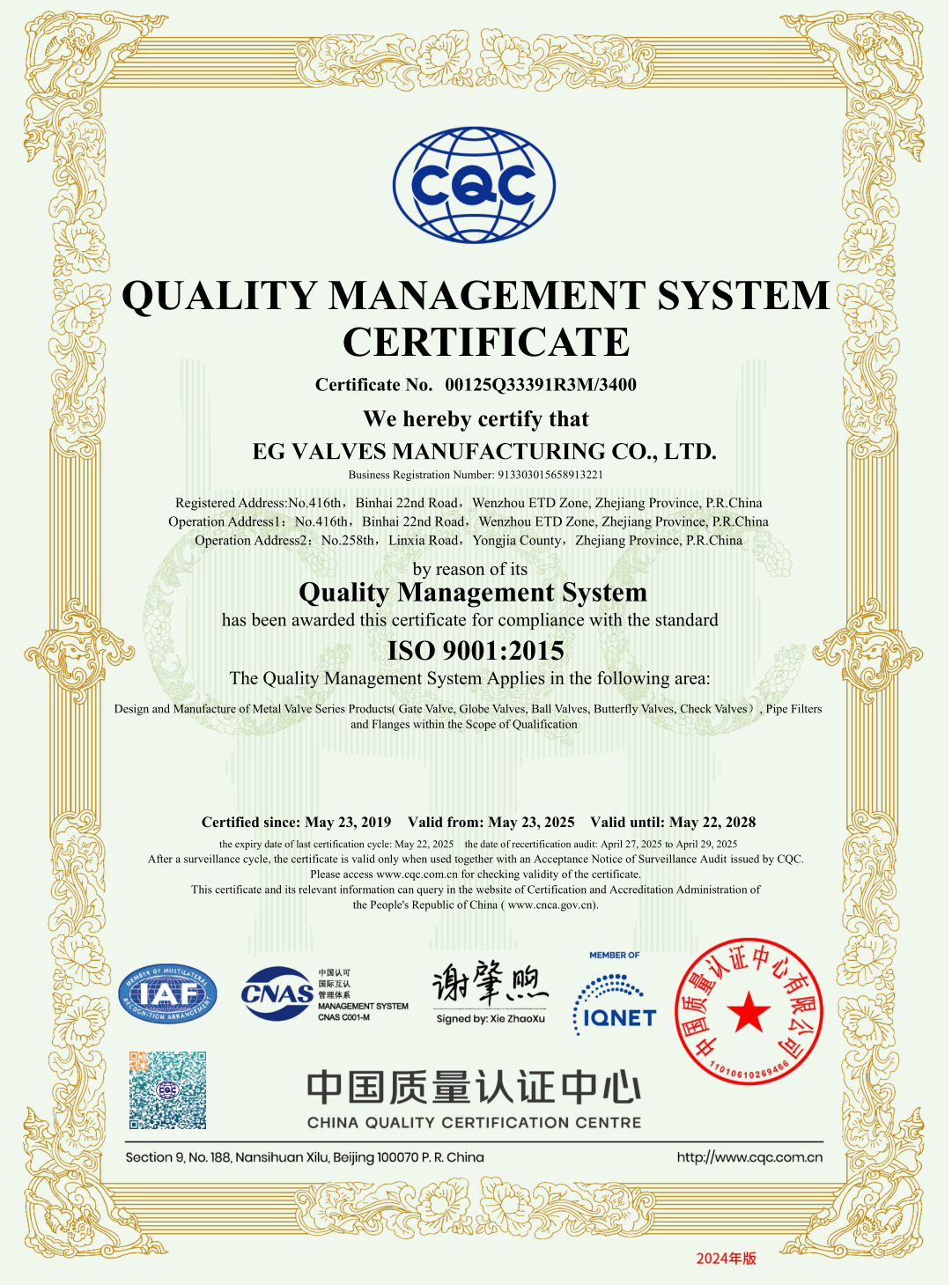
ISO 9001:2015 – Quality Management System
ISO 9001:2015 is the internationally recognized standard for quality management. For valve manufacturers, it ensures that processes from raw material sourcing to final inspection are consistent and controlled. EG Valves holds certificate number 00125Q33391R3M/3400 issued by CQC. This certification covers a wide range of products including gate valves, globe valves, ball valves, butterfly valves, check valves, and strainers, applicable to industries such as water supply, HVAC, and building services.
API-600 & API-6D – American Petroleum Institute Standards
API-600 (certificate 600-0179) specifically covers bolted bonnet steel gate valves, while API-6D (certificate 6D-0506) covers gate valves, ball valves, and check valves. These are mandatory for oil & gas and petrochemical applications. EG Valves’ Cast Steel Gate Valve model GTS019 is certified under both standards, providing assurance of robust design and rigorous testing.
CE PED – European Pressure Equipment Directive
For valves entering the EU market, CE marking under PED 2014/68/EU is a legal requirement. EG Valves’ CE certificate (DGR-0036-QS-1360-24) issued by TUV SUD covers all major valve types, confirming conformity with high safety requirements. The applicable standard is PED 2014/68/EU Annex III, Module H.
ISO 45001:2018 – Occupational Health and Safety
ISO 45001:2018 demonstrates a commitment to worker safety. EG Valves holds certificate 01723S10270R1S covering gate, globe, ball, butterfly, check valves and pipeline filters, issued by XGQC. This is increasingly valued by buyers who prioritize supply chain sustainability and ethical manufacturing.
Step-by-Step: How to Ensure Valve Compliance in Procurement
- Define Your Application and Regulatory Environment – Identify the industry, operating conditions (pressure, temperature, media), and target markets. Each combination dictates specific certification requirements.
- Identify Required Certifications – For example, oil & gas projects typically require API-600 or API-6D; European projects require CE/PED; water treatment may require ISO 9001 and local standards.
- Verify Supplier Certificates – Request digital copies of certificates and cross-check the following: certificate number, issuing authority, scope (product types covered), standard version, and validity dates. EG Valves provides EN 10204 3.1 Material Test Certificates with every order, enabling full traceability.
- Request Third-Party Inspection – Many buyers engage independent inspection companies to verify compliance during manufacturing. EG Valves accepts third-party inspections and has a dedicated QC team performing 100% inspection on every valve.
- Review Material Test Reports and Quality Records – Insist on documented evidence such as pressure test reports, NDT reports, and coating certificates.
Use Cases: Real-World Compliance in Action
EG Valves has supplied certified products to clients across the globe, demonstrating compliance in demanding applications.
Case 1: Oil & Gas Project in the United States
An American oil & gas client required 1,438 pieces of gate valves, globe valves, check valves, and ball valves in classes 150–1500 with materials WCB, WC6, WC9, and A105. All valves needed to meet API-600 and API-6D standards. EG Valves supplied the complete order, and the valves have been operating safely and stably for 8 years, with zero leakage.
Case 2: Petroleum Refining in the UAE
A UAE client ordered 915 pieces of gate, globe, check, ball, and butterfly valves in classes 150–1500 for a refinery project. The valves required CE PED certification for EU export compatibility. EG delivered valves that operate safely and steadily, supporting the client’s high-pressure refining processes.
Case 3: Water Treatment Project in Brazil
A Brazilian water treatment client sourced 326 pieces of gate valves, butterfly valves, and check valves PN16 DN40–DN2000. The requirement was ISO 9001 compliant products with EN 10204 3.1 material certificates. EG provided valves that have ensured smooth operation with low noise for 8 years.
These cases illustrate how proper certification alignment leads to reliable performance and long-term partnerships.
Frequently Asked Questions (FAQ)
Conclusion: Choose a Certified Partner for Risk-Free Procurement
Certifications are not just bureaucratic hurdles—they are the backbone of safety, reliability, and market access. When you partner with a manufacturer like EG Valves, you gain access to a full suite of certifications: ISO 9001:2015 for quality, API-600 and API-6D for oil & gas, CE PED for Europe, and ISO 45001 for occupational safety. With over 25 years of experience, a 27,500 m² factory, 30 engineers in R&D, and 80% of products exported to demanding markets, EG Valves is your trusted compliance partner.
Download our complete product brochure and certification portfolio to start your compliant procurement journey.
Download Brochure (PDF)Contact EG Sales Team today:
Email: sales@egvalves.com
Tel: +86 577 5799 2227
WhatsApp: +86 132 0637 0946
Address: Sanqiao Industrial Zone, Wenzhou, Zhejiang Province, China 325100