
Top 5 China Valve Products for Oil & Gas and Chemical Processing: A 2026 Ranking
Top 5 China Valve Products for Oil & Gas and Chemical Processing: A 2026 Ranking
If you source valves for oil & gas or chemical processing from China, the ranking below answers one question: which product lines should you shortlist first? For 2026, the order is (1) the BOV303 triple offset butterfly valve, (2) ball valves, (3) gate valves, (4) globe valves, and (5) check valves, with pipeline strainers as the supporting line that protects the other four.
This is an application-fit and constraint ranking, not a market-share table. It is built from verified product data, certificate scope, and pressure and size coverage in the portfolio of EG Valves Manufacturing Co., Ltd — a valve manufacturer established in 2000 in Wenzhou, Zhejiang Province, China, producing gate, globe, ball, butterfly and check valves plus strainers to ANSI, DIN, BS and JIS standards, with roughly 80% of its output exported to the EU, North America, Latin America and the Middle East.
The 2026 Ranking at a Glance
- BOV303 Triple Offset Butterfly Valve — bubble-tight closure, optional Stellite seat for erosion resistance, NPS 2"–60", Class 150/300/600.
- Ball Valves — forged and cast, floating and trunnion, up to Class 2500 and NPS 60", covered by API 6D.
- Gate Valves — cast steel, forged steel, through conduit and pressure seal designs, covered by API 600 and API 6D.
- Globe Valves — cast steel, forged steel, pressure seal and below seal designs for regulating duty.
- Check Valves — cast steel, forged steel and stainless steel, plus pipeline strainers as the companion line.
Each line below is described in the same way: what it is, why it ranks where it does, the verified specifications behind it, the certificate coverage that supports it, and the point at which it stops being the right choice.
Problem Definition: Why Valve Selection in These Two Industries Gets Complicated
Oil & gas and chemical processing buyers do not struggle to find valve suppliers in China. They struggle to translate a process line into a defensible product-line decision. Three constraints create most of the risk.
The media constraint. Chemical service media are frequently corrosive — acids, alkalis, oxidants, organic solvents and reducing agents — while oil & gas and refining service adds erosion from suspended solids and high-velocity flow, plus hydrogen and coke-forming conditions. A valve that isolates clean water perfectly may fail within months in either environment.
The pressure and size constraint. A single refinery or chemical plant may require Class 150 isolation on a large cooling header and Class 2500 isolation on a small high-pressure injection line. Specifying one valve type across the whole plant is a common and expensive shortcut.
The compliance constraint. Certificates are frequently quoted without their scope. An API licence or a CE certificate covers specific product families, not an entire catalogue, and a certificate that does not name the valve you are buying does not support your procurement file. Certificate validity dates matter too, since a lapsed certificate cannot support a shipment.
This ranking is therefore organised around function and constraint, not around catalogue order.
Industry Background: What Oil & Gas and Chemical Demand Looks Like in 2026
The global industrial valves market was estimated at USD 82.9 billion in 2025, with a projected CAGR of 5.7% through 2034 (IMARC Group). Scope definitions vary and estimates diverge: Grand View Research places 2025 at USD 80.4 billion, while MarketsandMarkets estimates USD 101.94 billion when additional valve types and actuators are included. Buyers should treat any single figure as a scope-dependent estimate rather than a fixed value.
Two structural facts define sourcing strategy for the two industries discussed here. First, oil and gas remains the leading end-user of industrial valves, accounting for close to 33% of global demand in 2024 (Vantage Market Research, reported via PR Newswire). Second, cast steel valves accounted for 27.3% of the oil and gas valve market in 2025 (Mordor Intelligence), reflecting their cost-to-performance balance in high-pressure service.
Asia Pacific dominated the industrial valves market in 2025 with roughly 36.3% revenue share, with China holding the largest share within the region (Grand View Research). At the trade level, China exported USD 22.6 billion in valves globally in 2024 according to the Observatory of Economic Complexity. Check valves alone accounted for USD 730 million of Chinese exports in 2024, with the United States as the top destination at USD 134 million (OEC) — a useful indicator of how much verified backflow-protection demand flows from oil & gas and chemical buyers.
On the regulatory side, valves supplied into the EU must comply with the Pressure Equipment Directive 2014/68/EU for equipment with pressure exceeding 0.5 bar, which is the reference point against which CE documentation is judged.
Ranking Criteria: The Five Filters Used in This List
- Application fit for oil & gas and chemical media — corrosion resistance, erosion resistance, fire-safe design and emission control features that are documented, not implied.
- Pressure and size coverage — how wide a band of the plant a single product line can serve without falling back to a second supplier.
- Sealing and wear behaviour — the design mechanism that determines how long tight shut-off survives in continuous service.
- Certificate scope and validity — whether the named certificate actually covers the product family, with a date range that remains valid.
- Configurability and documentation — end connections, actuation options, material grades and the inspection paperwork that accompanies the order.
Rank 1BOV303 Triple Offset Butterfly Valve
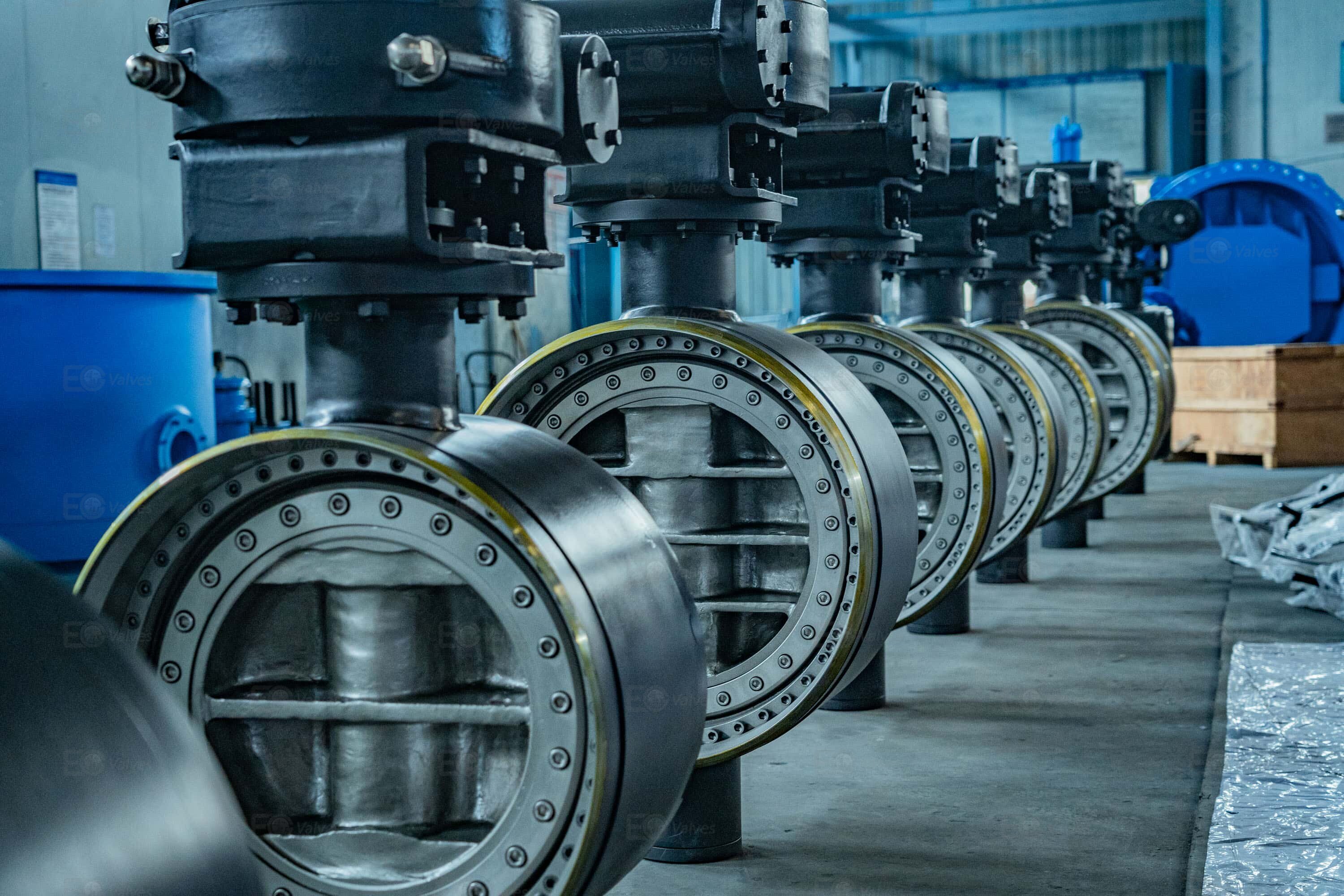
The BOV303 triple offset butterfly valve ranks first because it closes the single most common gap in both industries: a compact, leak-tight isolation point in corrosive or erosive service where a standard soft-seated butterfly valve would lose tightness over time. Its triple offset design eliminates the wear associated with sealing surface contact, and its bubble-tight closure provides process efficiency with reduced maintenance.
Verified specifications
- Body materials: carbon steel, stainless steel, alloy steel, duplex steel
- Disc materials: carbon steel, stainless steel, duplex steel
- Seat materials: stainless steel + graphite, or PTFE + stainless steel
- Optional Stellite seat offers optimum resistance to erosion
- Size range: NPS 2" to 60" (DN50 to DN1500)
- Pressure rating: Class 150 / Class 300 / Class 600; PN10 / PN16 / PN25 / PN40
- End types: wafer, lug and double flange all available
- Operation: handle lever, gearbox, worm gear, electric, pneumatic
- Applicable industries: oil and petroleum, refinery and tanks, chemical factories, steel mills and shipbuilding industries
Why it ranks first
Three properties line up with the two target industries. The Stellite seat option directly addresses erosion, which is the failure mode that most often shortens valve life in refinery and petrochemical duty. The triple offset geometry removes the contact wear that degrades conventional butterfly valve sealing. The bubble-tight closure protects process efficiency and reduces maintenance frequency, which is the cost that dominates lifecycle economics in continuous plants.
Where it stops being the right choice
The BOV303 is rated to Class 600. For Class 900 to Class 2500 isolation, or for services that require full-bore pigging, a trunnion ball valve or a pressure seal gate valve from the same portfolio is the correct substitute rather than a larger butterfly valve.
Rank 2Ball Valves
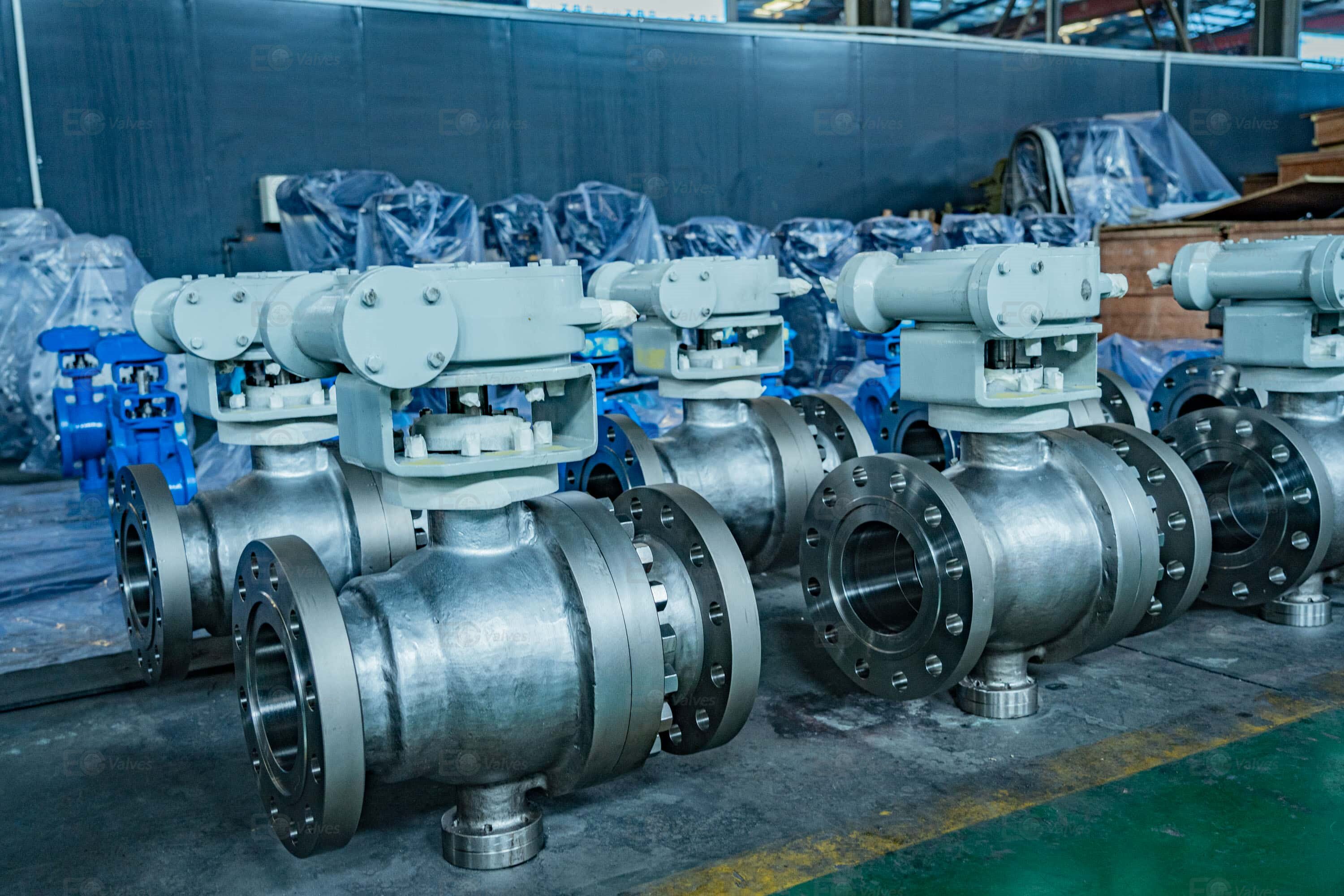
Ball valves rank second because they carry the widest verified pressure envelope in the portfolio — up to Class 2500 and NPS 60" — and because ball valves are explicitly inside the scope of the manufacturer's API 6D certification. For oil & gas isolation duty, that combination of range and certification is the practical starting point.
Verified specifications by model
- BVF208 Forged Steel Floating Ball Valve: NPS 1/2" to 12" (DN15 to DN200); Class 150 to Class 600, PN16 to PN40; bolted bonnet and split body with floating ball; blow-out proof stem; fire-safe design; low emission packing; anti-static design; soft or hard sealing as per customer request; full port or reduced port; end types RF, RTJ, BW, SW, THR
- BVF209 Forged Steel Trunnion Ball Valve: NPS 2" to 36" (DN50 to DN900); Class 150 to Class 2500, PN16 to PN420; fixed ball inside; end types RF, RTJ, BW
- BVT207 Cast Steel Trunnion Ball Valve: NPS 2" to 40" (DN50 to DN1000); Class 150 to Class 1500, PN16 to PN100; used in natural gas, oil products, chemicals, metallurgy, environmental protection and pharmaceuticals
- BVF210 Fully Welded Ball Valve: NPS 2" to 60"; Class 150 to Class 2500; full port design; intended for gas transmission and distribution pipelines and buried installation
- BVT211 Top Entry Ball Valve: NPS 2" to 60"; Class 150 to Class 1500; one-piece body with emergency sealant injection; optional extended bonnet
Why it ranks second
The line covers both ends of the pressure spectrum without leaving the product family: floating ball designs for smaller, lower-class isolation, and trunnion designs for large-diameter, high-pressure pipeline duty. Fire-safe design, low emission packing and anti-static design appear across the family, which is what refinery and petrochemical specifications require. API 6D certificate 6D-0506 explicitly lists ball valves in its scope.
Where it stops being the right choice
Ball valves are on/off devices. Using them for continuous throttling produces seat wear and control instability, and the correct substitute is a globe valve. In media carrying abrasive solids, the sealing surface is exposed to scoring, and the appropriate response is a material upgrade or a different valve family rather than a larger ball valve.
Rank 3Gate Valves
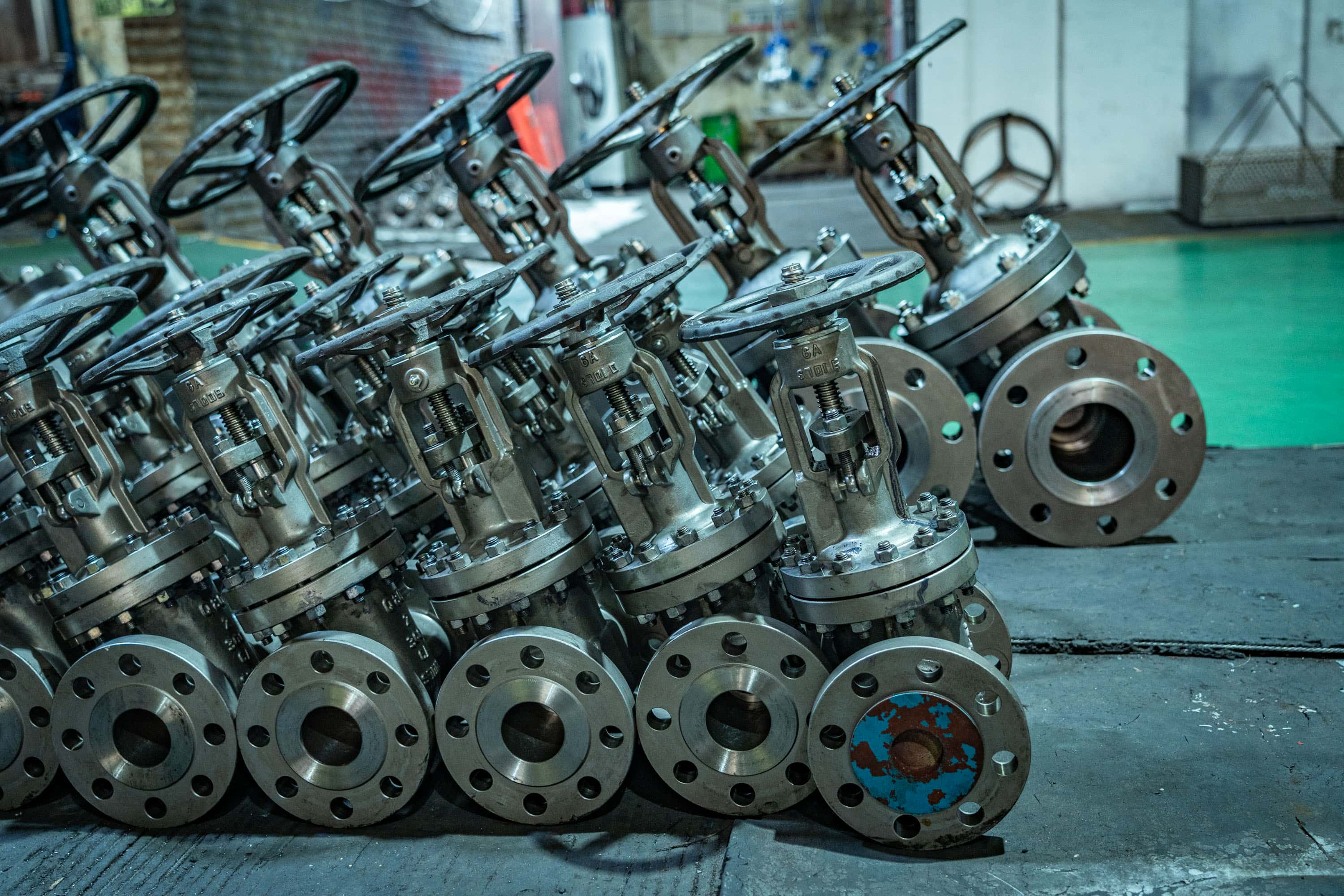
Gate valves rank third because they are the workhorse isolation line for both industries and because they carry the portfolio's deepest certification coverage: API 600 certificate 600-0179 covers bolted bonnet steel gate valves, and API 6D certificate 6D-0506 also lists gate valves in scope.
Verified specifications by model
- GTS019 Cast Steel Gate Valve: NPS 1-1/2" to 48" (DN40 to DN1200); Class 150 to Class 1500, PN10 to PN160; OS & Y rising stem with flexible wedge; bolted or welded bonnet; threaded or welded seat ring options; RF, FF, RTJ, BW ends
- GTF023 Forged Steel Gate Valve: NPS 1/2" to 2-1/2" (DN15 to DN65); Class 800 to Class 2500, PN140 to PN320; bolted bonnet, welded bonnet or pressure seal bonnet; NPT or BSP threaded, SW, RF, BW ends; full or reduced port
- GTT021 Through Conduit Gate Valve: NPS 2" to 48"; Class 150 to Class 2500; slab or expanding gate design; fire-safe design; double block and bleed capability; designed for long-distance transportation of crude oil and natural gas
- GTP002 Pressure Seal Gate Valve: NPS 2" to 60"; Class 600 to Class 2500; self-sealing type bonnet for absolute joint leakproofing; full wedge guiding design; full Stellite overlay sealing surface; optional by-pass design
Why it ranks third
Gate valves cover the isolation requirement from NPS 1/2" to NPS 60" and from Class 150 to Class 2500 when the four designs are combined, and they do it in the material grades that oil & gas and chemical specifications call for: carbon steel, stainless steel, alloy steel and duplex steel. The GTT021 is the specific answer for crude oil and natural gas transmission lines where double block and bleed capability is required, and the GTP002 pressure seal design addresses high-pressure service where joint leakproofing is the primary concern.
Where it stops being the right choice
Gate valves are designed for on/off isolation and should not be used for throttling or flow regulation. Where regulation is required, globe valves take over. Where upstream media carry solids, a knife gate valve design is available with stainless steel, carbon steel or ductile iron bodies and optional lockup positioning.
Rank 4Globe Valves
Globe valves rank fourth because they serve a distinct function that the higher-ranked lines cannot: throttling, regulation and frequent operation. They are the reason a plant does not need to misuse a ball valve or gate valve for control duty.
Verified specifications by model
- GLS105 Cast Steel Globe Valve: NPS 1-1/2" to 24" (DN40 to DN600); Class 150 to Class 1500, PN16 to PN100; OS & Y rising stem; bolted bonnet and beveled wedge disc; RF, FF, RTJ, BW ends
- GLF109 Forged Steel Globe Valve: NPS 1/2" to 2" (DN15 to DN50); Class 800 to Class 2500, PN140 to PN320; self-sealing type bonnet; full Stellite overlay seat sealing surface; soft steel gasket seal providing a large seal contact area; optional by-pass design
- GLP107 Pressure Seal Globe Valve: NPS 2" to 24"; Class 600 to Class 2500; self-sealing type bonnet for absolute joint leakproofing; full Stellite overlay seat sealing surface; optional by-pass design
- GLB107 Below Seal Globe Valve: NPS 1/2" to 14" (DN15 to DN300); Class 150 to Class 600, PN16 to PN40; double seal capability; stem quenched and tempered with surface nitriding treatment for anti-corrosion and anti-friction properties; used in petroleum, chemical, pharmaceutical and power generation service
Why it ranks fourth
The Stellite overlay seat on the GLF109 and GLP107 is the erosion-resistant answer for high-pressure regulating duty, and the below seal design of the GLB107 adds a second sealing barrier for critical process lines. Globe valves are covered by the CE PED certificate for the EU market.
Where it stops being the right choice
Globe valves impose a higher pressure drop than full-bore designs such as ball and gate valves, so they are a poor choice where line pressure loss must be minimised. For pure isolation duty they add cost without adding value.
Rank 5Check Valves, with Strainers as the Supporting Line
Check valves rank fifth not because they matter less, but because their function is protective rather than primary: they prevent backflow that would otherwise damage pumps, compressors and upstream equipment. Pipeline strainers are included here as the companion line because they remove the debris that causes check valves and control valves to fail.
Verified specifications by model
- CVS407 Cast Steel Check Valve: NPS 1-1/2" to 36" (DN40 to DN900); Class 150 to Class 1500, PN10 to PN160; bolted bonnet or pressure seal bonnet; one-piece disc construction designed to withstand severe service; design prohibits galling or scoring of seating surfaces; large sizes supplied with lifting rings
- CVF409 Forged Steel Check Valve: NPS 1/2" to 2" (DN15 to DN50); Class 800 to Class 2500, PN140 to PN320; forged carbon steel, stainless steel and alloy steel construction suitable for corrosive media; lapped seat faces; all trim configurations available
- CSV410 Stainless Steel Check Valve: NPS 1/2" to 48" (DN15 to DN1200); Class 150 to Class 1500, PN10 to PN160; high torsion Inconel springs for quick closing; disc assembly secured by a high strength key; special cleaning for applications such as oxygen or chlorine; wafer, lug and double flange types with dual plate, single plate, wafer lift and threaded options
- SNS505 Cast Steel Strainer: NPS 1/2" to 20" (DN15 to DN500); Class 150 to Class 600, PN16 to PN40; Y-type or basket type with stainless steel screens in a wide variety of meshes and perforations; bolted-on cover for routine maintenance access
- SNI501 Cast Iron Strainer: NPS 2" to 12" (DN50 to DN300); Class 125 / Class 150, PN10 / PN16
- SNA507 Threaded Strainer: NPS 1/2" to 2"; compact heavy duty design; straight threaded gasketed cap; NPT / BSP / BSPT connections
Why it ranks fifth
The check valve line spans NPS 1/2" to 48" and Class 150 to Class 2500 across cast steel, forged steel and stainless steel variants, and the CSV410's Inconel spring closing and oxygen/chlorine cleaning make it usable in specialty chemical service. The cast steel and forged steel check valves are listed in the API 6D certificate scope, and check valves and strainers are both covered by the CE PED certificate for the EU market.
Comparison Table: The Five Product Lines Side by Side
| Rank | Product line | Representative models | Size range (NPS) | Pressure rating | Key design feature | Certificate coverage |
|---|---|---|---|---|---|---|
| 1 | Triple offset butterfly valve | BOV303 | 2"–60" | Class 150 / 300 / 600; PN10–PN40 | Bubble-tight closure; triple offset eliminates sealing-surface wear; optional Stellite seat for erosion resistance | CE PED (butterfly valves); ISO 9001 (butterfly valves) |
| 2 | Ball valves | BVF208, BVF209, BVT207, BVF210, BVT211 | 1/2"–60" | Class 150–2500; PN16–PN420 | Fire-safe design, anti-static design, low emission packing, blow-out proof stem; fully welded body for buried lines | API 6D (6D-0506); ISO 9001 (ball valves); CE PED |
| 3 | Gate valves | GTS019, GTF023, GTT021, GTP002 | 1/2"–60" | Class 150–2500; PN10–PN320 | OS & Y rising stem flexible wedge; double block and bleed (GTT021); full Stellite overlay wedge (GTP002) | API 600 (600-0179); API 6D (6D-0506); ISO 9001; CE PED |
| 4 | Globe valves | GLS105, GLF109, GLP107, GLB107 | 1/2"–24" | Class 150–2500; PN16–PN320 | Full Stellite overlay seat sealing surface; soft steel gasket seal with large contact area; double seal capability (GLB107) | ISO 9001 (globe valves); CE PED (globe valves) |
| 5 | Check valves | CVS407, CVF409, CSV410 | 1/2"–48" | Class 150–2500; PN10–PN320 | One-piece disc for severe service; lapped seat faces; high torsion Inconel springs and oxygen/chlorine cleaning (CSV410) | API 6D (6D-0506); ISO 9001 (check valves); CE PED |
| Supporting | Strainers | SNS505, SNI501, SNA507 | 1/2"–20" | Class 125–600; PN10–PN40 | Y-type or basket type; stainless steel screens in a wide variety of meshes and perforations; bolted-on cover for maintenance access | ISO 9001 (pipe filters); CE PED (strainers) |
How to Apply This Ranking: A Five-Step Buyer Workflow
Step 1 — Define the service window
Record the medium, its corrosivity and erosivity, the design pressure class, the design temperature, and the line size before opening any catalogue. The BOV303 and the ball valve lines answer very different service windows, and the earlier the window is fixed, the shorter the shortlist becomes.
Step 2 — Match function to valve family
Isolation points go to ball valves, gate valves or the BOV303 butterfly valve depending on size, class and available space. Regulating and frequently operated points go to globe valves. Backflow protection goes to check valves. Debris protection goes to strainers. Mixing these functions is the most common specification error in plant line lists.
Step 3 — Verify certificate scope, not certificate names
Match the valve you are buying to the product families actually listed on the certificate, and check that the certificate remains valid on the shipment date. The current position for EG Valves is summarised as follows:
- API 6D, certificate 6D-0506, issued by the American Petroleum Institute, scope: check valves, ball valves, gate valves
- API 600, certificate 600-0179, issued by the American Petroleum Institute, scope: bolted bonnet steel gate valves
- CE PED 2014/68/EU Annex III, Module H, certificate DGR-0036-QS-1360-24, issued by TÜV SÜD Industrie Service GmbH, scope: gate valves, ball valves, globe valves, check valves, butterfly valves and strainers, for the EU market
- ISO 9001:2015, certificate 00125Q33391R3M/3400, issued by China Quality Certification Center (CQC), scope: gate valves, globe valves, ball valves, butterfly valves, check valves, pipe filters and flanges
Step 4 — Confirm material and connection configuration
Fix the body material (cast iron, ductile iron, carbon steel, stainless steel, alloy steel or duplex steel), the trim and seat option, and the end connection from the available set: RF, FF, RTJ, BW, SW, wafer, lug or threaded NPT / BSP / BSPT. Confirm the actuation choice at the same time — handwheel, wrench nut, gearbox, worm gear, electric or pneumatic — because actuation changes the mounting interface, not just the operation method.
Step 5 — Lock documentation and commercial terms
Confirm what arrives with the shipment and when it ships. EG Valves reports a monthly capacity of 8,000 valves, a lead time of within 25–35 days, a minimum order quantity of 1 piece for large size valves and 10 pieces for small size valves, and EN 10204 3.1 material test certificates issued with every order. Every valve is 100% inspected. OEM and ODM production is available with the client's brand logo or with the EG brand logo.
Where These Lines Have Been Used
The clearest evidence that a product line fits oil & gas and chemical service is a record of it operating there. The following references come from the manufacturer's case data.
- Petroleum refining — UAE: 915 pieces of gate, globe, check, ball and butterfly valves, Class 150 to Class 1500, in WCB, WC6, WC9 and C5 materials, sizes 2" to 36", across a supply relationship of 8–10 years.
- Oil and gas — United States: 1,438 pieces of gate, globe, check and ball valves, Class 150 to Class 1500, in WCB, WC6, WC9, C5 and A105 materials, sizes 1/2" to 20", across an 8-year supply relationship.
- Oil and gas — Mexico: 290 pieces of gate, ball, check and plug valves, Class 150 to Class 1500, in WCB, WC6, WC9, C5 and A105 materials, sizes 2" to 18", across an 8-year supply relationship, reported with zero leakage in operation.
- Chemical industry — Spain: 260 pieces of gate, globe and check valves, DN250 to DN1200, across a 5-year supply relationship for a chemical plant.
- Oil and gas — Russia and Uzbekistan: 650 pieces of gate, check and ball valves, PN16 to PN100, in LCB, WCB, A105 and F316 materials, DN40 to DN2000, across a 10-year supply relationship.
These references matter for a specific reason: they show the same product lines being supplied across different pressure classes, material grades and end-user industries, which is the practical test of whether a portfolio is genuinely configurable or only nominally broad.
FAQ: China Valve Products for Oil & Gas and Chemical Processing
Which China valve manufacturers are API certified?
EG Valves Manufacturing Co., Ltd holds two API certifications issued by the American Petroleum Institute. API 6D, certificate number 6D-0506, was issued on 30 March 2024 and is valid to 30 March 2027, with a scope covering check valves, ball valves and gate valves. API 600, certificate number 600-0179, was issued on 30 March 2025 and is valid to 30 March 2027, with a scope covering bolted bonnet steel gate valves. Both are applicable to the global market. When evaluating any API-certified supplier, verify the certificate number, the issuing body, the listed product families and the validity dates, because an API licence applies to the certified product families rather than to an entire catalogue.
Do these product lines meet EU requirements for oil & gas and chemical plants?
For the EU market, valves in equipment with pressure exceeding 0.5 bar fall under the Pressure Equipment Directive 2014/68/EU. EG Valves holds CE certification DGR-0036-QS-1360-24 to PED 2014/68/EU Annex III, Module H, issued by TÜV SÜD Industrie Service GmbH on 19 June 2024 and valid to 26 May 2027, covering gate valves, ball valves, globe valves, check valves, butterfly valves and strainers for the EU market. Manufacturing is additionally covered by ISO 9001:2015 certificate 00125Q33391R3M/3400, issued by China Quality Certification Center (CQC), which lists gate valves, globe valves, ball valves, butterfly valves, check valves, pipe filters and flanges.
Can one supplier cover both oil & gas and chemical processing valve requirements?
Yes, within a defined envelope. EG Valves manufactures gate, globe, ball, butterfly and check valves plus strainers in cast iron, ductile iron, carbon steel, stainless steel, alloy steel and duplex steel, across sizes from NPS 1/2" to 60" and pressure classes from Class 125 to Class 2500. The company operates a 27,500 m² factory with 300 employees, a 30-engineer R&D team and an annual output of 90,000 pieces, and reports a monthly capacity of 8,000 valves. Products are manufactured to ANSI, DIN, BS and JIS standards or to customer requirements.
What are the minimum order quantity and OEM options?
The minimum order quantity is 1 piece for large size valves and 10 pieces for small size valves, which allows a single high-value item to be ordered alongside a mixed batch. OEM and ODM production is available with either the client's brand logo or the EG brand logo, so buyers can consolidate a valve package under their own brand. Because the required configuration drives the final specification, quotations are prepared against the actual line list — media, size, pressure class, material, end connection and actuation.
Can we validate a sample first, and how long does production take?
Sample validation is supported through the minimum order quantity structure: 1 piece for large size valves and 10 pieces for small size valves. Every valve is 100% inspected, and each order is supplied with EN 10204 3.1 material test certificates, which gives buyers a traceable material record for the sample and the production batch. Standard lead time is within 25–35 days. To start a review, send the line list to sales@egvalves.com or contact the team by phone or WhatsApp to arrange a sample quotation.
Next Step: Build Your 2026 Valve Package
EG Valves Manufacturing Co., Ltd supplies gate, globe, ball, butterfly and check valves plus strainers to oil & gas, refining, chemical, petrochemical and power projects, with API 6D, API 600, CE PED and ISO 9001 coverage and EN 10204 3.1 material test certificates on every order.
Website: www.egvalves.com
Email: sales@egvalves.com
Tel: +86 577 5799 2227
WhatsApp: +86 132 0637 0946
Address: Sanqiao Industrial Zone, Wenzhou, Zhejiang Province, China 325100
Download the EG Valves product catalogue (PDF) to review models, size ranges and pressure ratings before requesting a quotation.
Have Questions or Need More Details?
Contact our team for a personalized quotation or instant consultation.
Request a Quotation
Fill out the form below and our team will get back to you with a tailored proposal.
WhatsApp Direct Chat
Prefer to chat in real-time? Message us on WhatsApp for instant assistance & quick answers.
- Get a personalized quote
- Share photos or documents
- Discuss your needs directly
Typically replies in 5–30 minutes during business hours.