
Triple Offset Valve Selection: The BOV303 Parameter Guide
The BOV303 is the triple offset butterfly valve model in the range of EG Valves Manufacturing Co., Ltd, a valve manufacturer established in 2000 in Wenzhou, Zhejiang Province, China, producing gate, globe, ball, butterfly, check and plug valves plus strainers for export. This guide is written for the evaluation stage: it explains how the triple offset geometry removes the wear caused by sealing surface contact, and then sets out, parameter by parameter, what a buyer must fix in the datasheet before an oil and gas pipeline or chemical plant order is released.
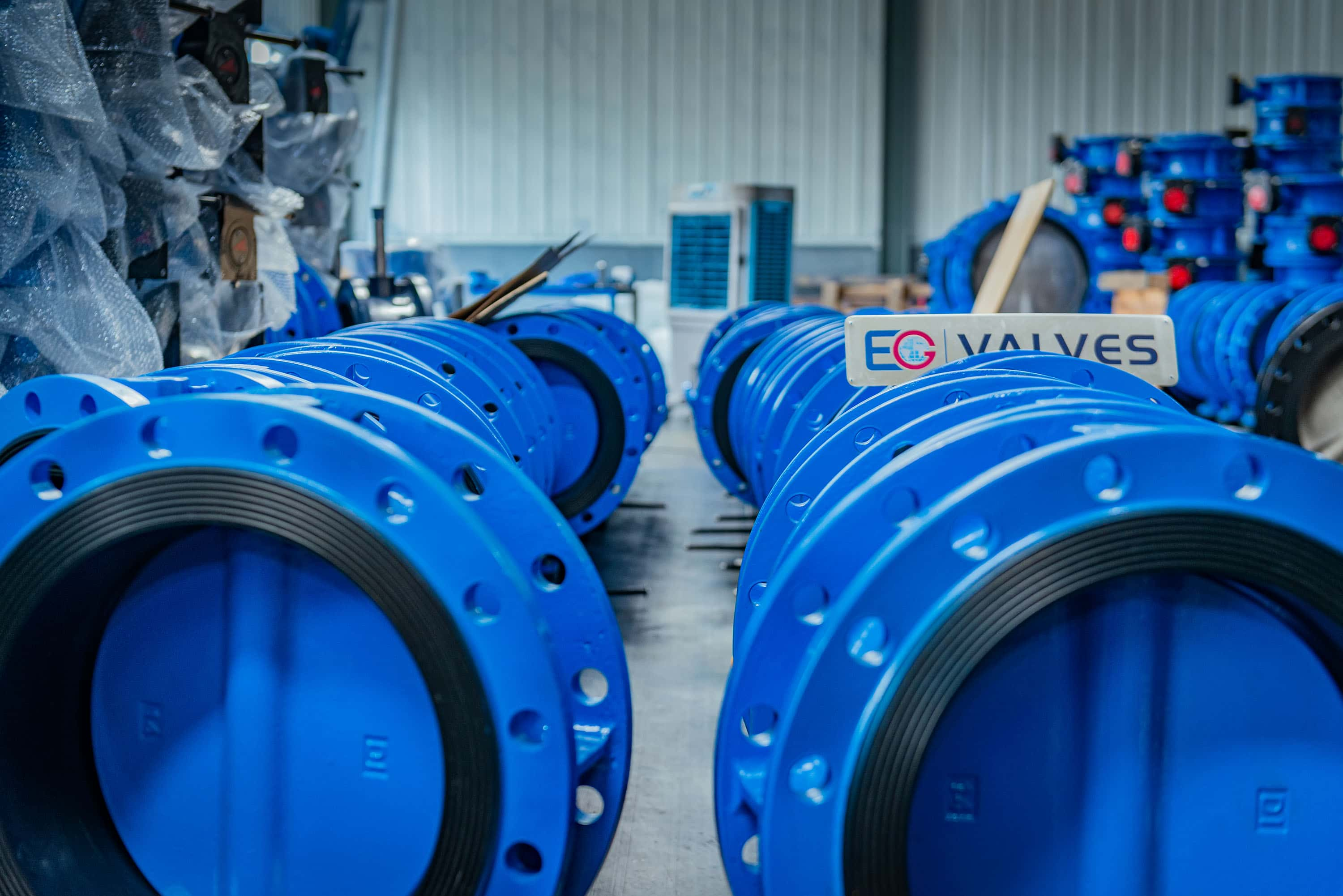
Butterfly valve in the double flanged body style — one of the three end configurations offered for the BOV303.
Why Sealing Surface Contact Limits a Conventional Butterfly Valve
Most butterfly valves seal by interference. A resilient seat — EPDM, NBR, FKM or PTFE — is compressed by the disc edge, and every open-and-close stroke drags the disc across that seat. The seal works, but the wear mechanism is built into the design: the seat surface is rubbed twice per cycle, operating torque climbs as the elastomer takes a set, and in high-cycle isolation duty the valve eventually stops holding tight. Maintenance is then scheduled around the seal rather than around the process.
The alternative — a metal seat loaded purely by torque — moves the problem rather than solving it. Higher torque is needed to deform metal to metal, which pushes the actuator up a size and increases the load on the shaft and bearings on every stroke.
A triple offset valve is designed to break that trade-off. EG lists three characteristics for the BOV303 that define its purpose: the triple offset design eliminates wear associated with sealing surface contact; bubble-tight closure provides process efficiency with reduced maintenance; and an optional Stellite seat offers optimum resistance to erosion. Those three statements are the design intent a buyer is paying for, and the rest of this guide tests whether a given order actually captures them.
Industry Background: Why This Selection Decision Matters More Than It Did
The triple offset butterfly valve sits in a large and still-expanding equipment category. The global industrial valves market was estimated at USD 82.9 billion in 2025, with a projected CAGR of 5.7% through 2034 (IMARC Group). Oil and gas remains the leading end-user, accounting for nearly 33% of global demand in 2024 (Vantage Market Research, via PR Newswire).
Material choice is a live commercial variable in that market. Cast steel valves accounted for 27.3% of the oil and gas valve market in 2025, a share attributed to cost-effective high-pressure performance (Mordor Intelligence). Carbon steel is therefore the default starting point for many pipeline shut-off valve specifications, with stainless steel, alloy steel and duplex steel specified where the fluid, the corrosion allowance or the operating envelope demands more.
Supply is concentrated. China exported USD 22.6 billion in valves globally in 2024, representing approximately 20% of the total global export concentration (Observatory of Economic Complexity), and Asia Pacific held a revenue share of roughly 36.3% of the industrial valves market in 2025, with China the largest contributor inside the region (Grand View Research). For a buyer shortlisting a China valve supplier, the practical question is no longer availability — it is whether the specific model, material combination and documentation match the line it will be installed on.
Regulation sets a floor under that question. Industrial valves exported from China must comply with the EU Pressure Equipment Directive 2014/68/EU for equipment with pressure exceeding 0.5 bar. A butterfly valve destined for an EU project therefore needs a PED certificate with butterfly valves explicitly inside its scope — not merely a certificate held by the same factory for another product family.
How the Triple Offsets Remove Wear and Still Close Bubble-Tight
The mechanism is geometric. Three offsets are built into the valve: the shaft is set behind the sealing plane, the shaft is offset from the bore centreline, and the conical sealing surface is machined on a tilted axis. The combined effect is that the disc rotates clear of the seat for almost the whole stroke and only engages the seat in the final moment of closing, when the conical ring wedges into contact.
Two consequences follow directly. First, there is no sliding contact across the sealing surfaces during travel, so the wear path that limits a resilient-seated valve is removed by design rather than by material upgrade. Second, because the seal is made by wedging a cone into a seat rather than by compressing an elastomer, closure is described as bubble-tight — the tightness that keeps process efficiency up and maintenance intervals long.
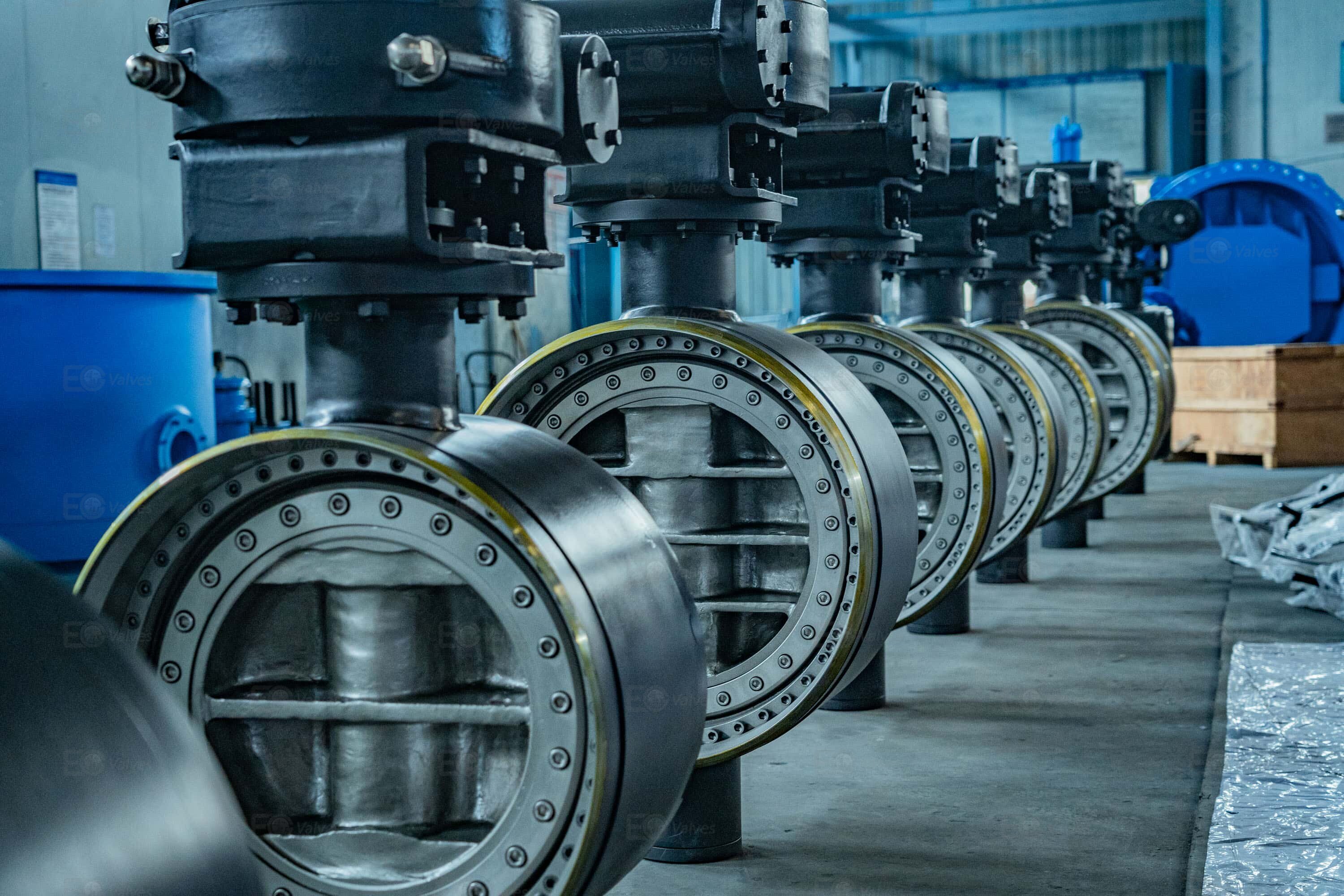
The BOV303 triple offset butterfly valve. The disc leaves the seat immediately on opening and contacts it only at the end of the closing stroke.
Where the duty includes abrasive particles or high-velocity media, the seat becomes the wear part again, and this is where the optional Stellite seat applies: EG specifies it as offering optimum resistance to erosion. The decision between a standard seat and a Stellite seat is therefore a decision about the fluid, not about the valve size.
Step-by-Step: Fixing the BOV303 Parameters in the Right Order
Selection works best when the parameters are fixed in the order in which they constrain each other. The six steps below follow that sequence.
Step 1 — Pressure class and nominal size
The BOV303 covers Class 150, Class 300 and Class 600, and PN10, PN16, PN25 and PN40. Sizes run from NPS 2" to NPS 60" (DN50 to DN1500). Fix these two first, because they set the flange drilling, the wall thickness and the torque the seat has to hold — everything downstream, including actuator sizing, follows from them. A 60-inch valve and a 2-inch valve share a model number but not an actuation solution.
Step 2 — Body material
Four body material families are listed: carbon steel, stainless steel, alloy steel and duplex steel. The choice is driven by fluid compatibility and corrosion allowance. Carbon steel is the standard hydrocarbon choice and aligns with the cast steel share of the oil and gas valve market cited earlier. A stainless steel valve is specified where the process fluid attacks carbon steel. Duplex steel is specified where chloride-bearing or otherwise aggressive service would consume austenitic stainless steel. Alloy steel grades enter the picture in refinery and high-pressure service — EG's UAE refining order, for example, included valves in WCB, WC6, WC9 and C5 materials across Class 150 to Class 1500 and 2-inch to 36-inch sizes.
Step 3 — Disc material and seat trim
The disc is offered in carbon steel, stainless steel or duplex steel. The seat is offered in two combinations: stainless steel with graphite, or PTFE with stainless steel. In practical terms the stainless steel plus graphite arrangement is the metal-based sealing option, while the PTFE plus stainless steel arrangement adds a PTFE sealing element to the seat assembly. Where erosion is the dominant threat, the optional Stellite seat applies.
Two material decisions therefore run in parallel: the disc material resists the fluid and the erosion at the sealing face, while the seat combination determines how tightness is achieved. A buyer who specifies a duplex disc but stays with a soft seat combination without checking the temperature envelope has not finished the specification.
Step 4 — End connection
Wafer, lug and double flange types are all available. The wafer and lug bodies are compact and clamp between flanges; the double flanged body bolts to the line with its own flanges and is the configuration most often shown in project drawings for larger pipeline shut-off duty. The end type must be fixed before piping is fabricated, because it changes face-to-face dimensions and bolting.
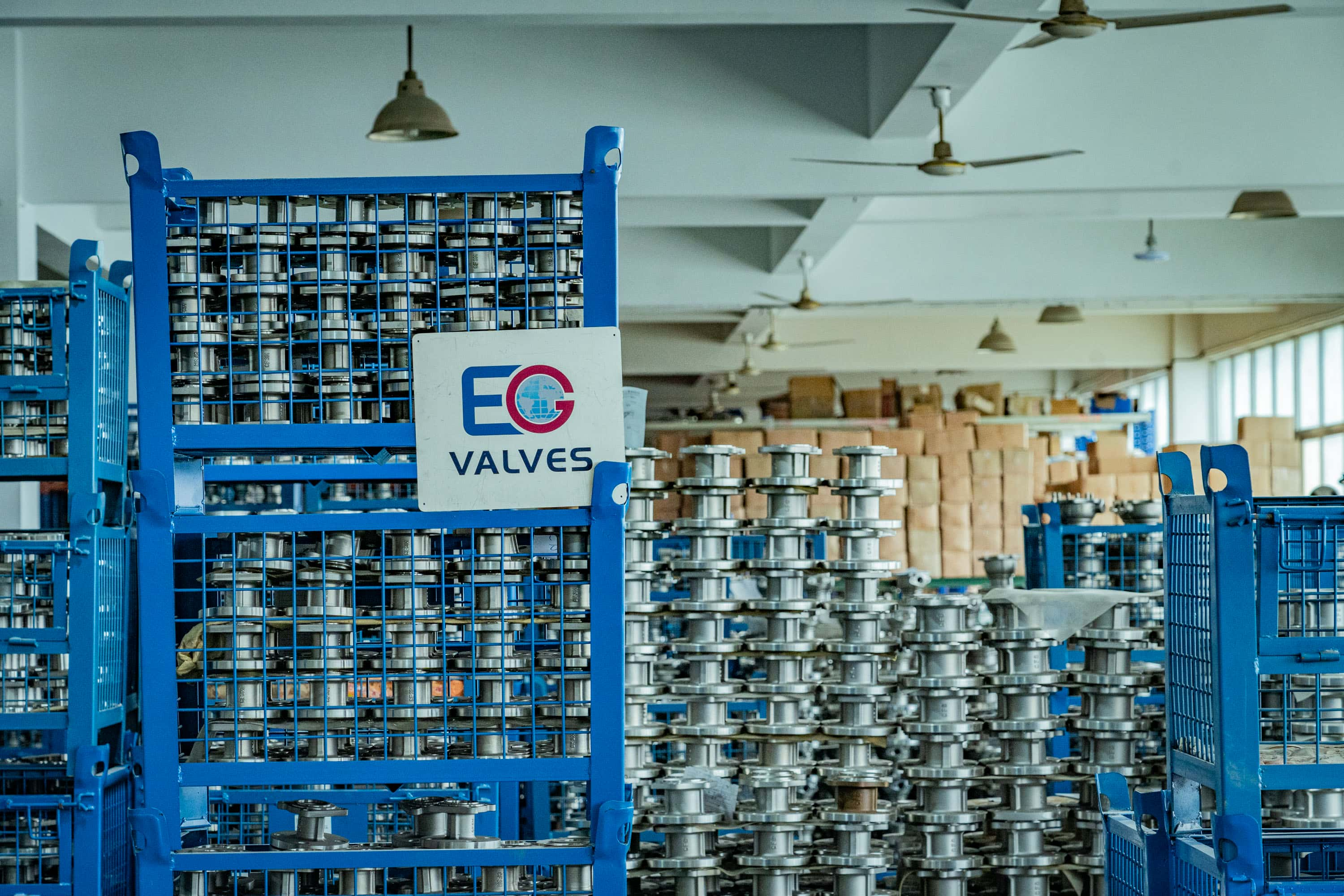
Body and trim material selection drives corrosion allowance, weight and cost more than any other single BOV303 parameter.
Step 5 — Actuation
Five operating modes are listed: handle lever, gearbox, worm gear, electric and pneumatic. The choice follows size and required torque. Lever operation suits the small end of the range; gearbox and worm gear reduce manual effort on larger sizes; electric and pneumatic actuation move the valve into automated isolation or remote operation, which is the normal requirement on a pipeline with a control system. Specify the actuation with the valve, not after it arrives — mounting interfaces and torque margins are part of the valve order.
Step 6 — Documentation and certification scope
This is the step most often left to the purchase order, and the one that causes the most friction at the customs and inspection stage. Three checks matter:
- Product scope of each certificate. EG holds ISO 9001:2015 certification (China Quality Certification Center, certificate 00125Q33391R3M/3400, issued 2025-05-23, valid to 2028-05-22) with butterfly valves inside the stated scope. The CE PED certificate DGR-0036-QS-1360-24, issued by TUV SUD Industrie Service GmbH under PED 2014/68/EU Annex III Module H and valid to 2027-05-26, also lists butterfly valves in scope.
- What the API certificates actually cover. EG's API 6D certificate 6D-0506 (2024-03-30 to 2027-03-30) covers check valves, ball valves and gate valves; API 600 certificate 600-0179 covers bolted bonnet steel gate valves. Neither scope extends to butterfly valves, so an API certified valve claim for a BOV303 order should be read against the certificate scope rather than the factory's certificate list.
- Material traceability. EG provides EN 10204 3.1 material test certificates with every order, and inspects 100% of valves through its QC team.
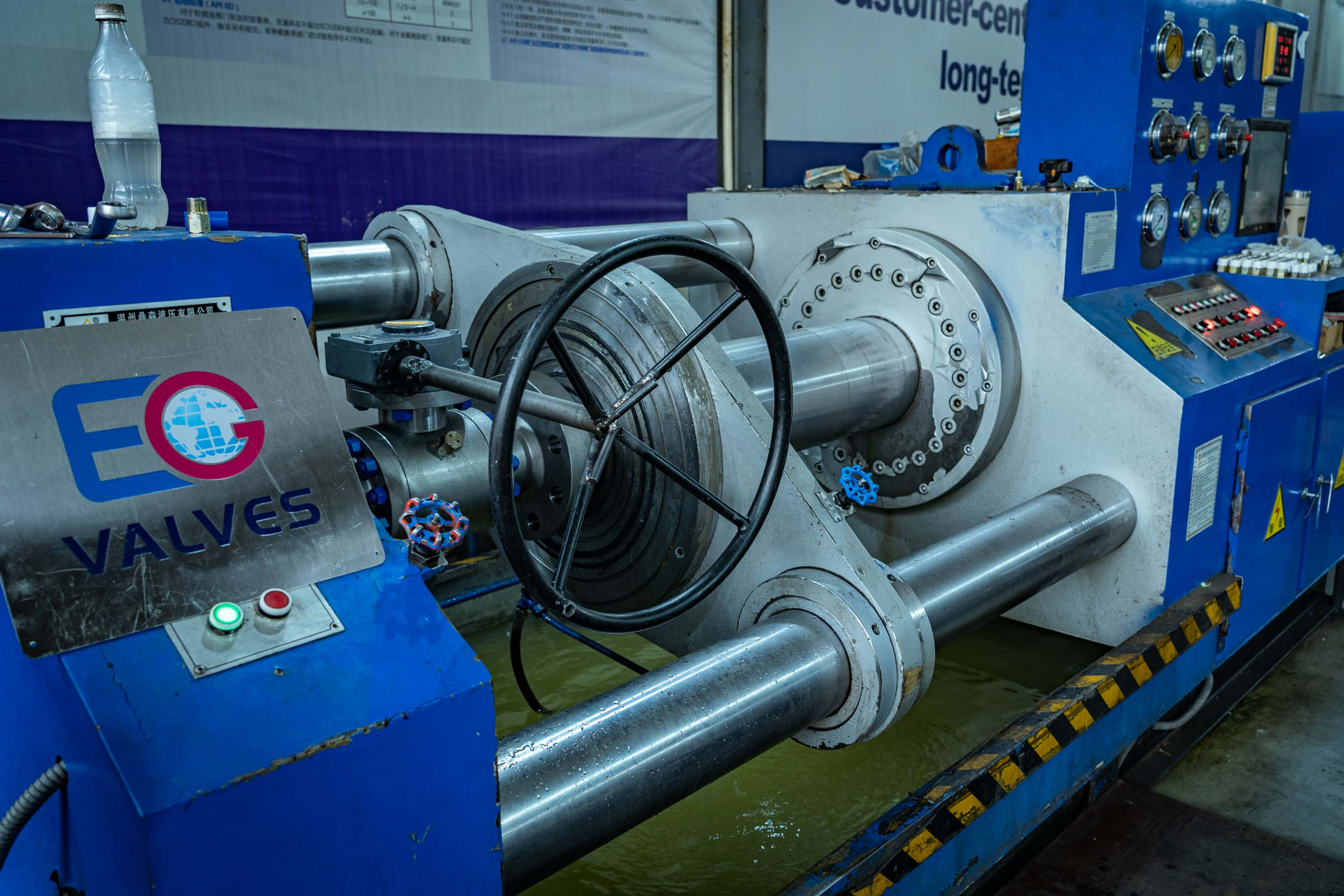
Inspection and material certification are part of the BOV303 specification, not an afterthought on the purchase order.
Comparison: Where the BOV303 Sits in the Butterfly Valve Range
The BOV303 is not the right answer for every line, and comparing it against the other butterfly valve models in the same range makes the boundary clear. All figures below are taken from the published parameter lists for each model.
| Model | Design / sealing | Pressure class and PN | Size range | Body material | Typical duty |
|---|---|---|---|---|---|
| BOV303 triple offset | Triple offset; stainless steel + graphite or PTFE + stainless steel seat; optional Stellite seat; bubble-tight closure | Class 150 / 300 / 600; PN10 / PN16 / PN25 / PN40 | NPS 2"–60" (DN50–DN1500) | Carbon steel, stainless steel, alloy steel, duplex steel | Oil and petroleum, refinery and tanks, chemical factories, steel mills, shipbuilding |
| BPV302 high performance | Double offset-type high performance body; PTFE/RTFE or stainless steel/Monel or PTFE + stainless steel seat; soft or hard sealing | Class 150 / 300 / 600; PN10 / PN16 / PN25 / PN40 | NPS 2"–60" (DN50–DN1500) | Carbon steel, stainless steel | Oil and gas, petrochemical, power generation, HVAC, hydrocarbon processing |
| BTF301 PTFE lined | Concentric; PTFE, FEP or PFA seat; full PTFE lining option | Class 125 / 150; PN6 / PN10 / PN16 | NPS 2"–36" (DN50–DN900) | Ductile iron, carbon steel, stainless steel | Acid, salt, alkali, oxidants, organic solvents — chemical, pharmaceutical, petroleum, food |
| BTV305 double eccentric | Double eccentric disc; EPDM, NBR or FKM sealing; replaceable sealing materials | Class 125 / 150; PN6 / PN10 / PN16 | NPS 8"–48" (DN200–DN1200) | Ductile iron, carbon steel | Water treatment, HVAC, desalination, power generation, municipal supply |
| BTV300 resilient seated | Concentric; EPDM, NBR, FKM or PTFE seat; bi-directional | Class 125 / 150; PN6 / PN10 / PN16 | NPS 1-1/2"–48" (DN40–DN1200) | Cast iron, ductile iron, carbon steel, stainless steel | Water and sewage, air conditioning, mining, power plants, irrigation, food and beverage |
| BGV304 grooved | Concentric; EPDM, NBR or FKM seat; grooved connection | Class 125 / 150; PN6 / PN10 / PN16 | NPS 2"–12" (DN50–DN300) | Ductile iron, stainless steel | Fire protection, HVAC, building services, water treatment |
Read across the table, the BOV303 is the only model in the group that combines Class 600 / PN40 capability with alloy steel and duplex steel body options and an erosion-resistant seat option. The BPV302 shares the same pressure envelope and size range but is limited to carbon and stainless steel bodies. Below Class 300, the BTV300, BTV305 and BGV304 cover water and utility duties at lower cost, and the BTF301 covers aggressive chemical media where a PTFE lining, not a metal seat, is the answer.
BOV303 ordering matrix
| Parameter | Options listed for the BOV303 | What the choice decides |
|---|---|---|
| Pressure class | Class 150 / 300 / 600; PN10 / PN16 / PN25 / PN40 | Flange drilling, wall thickness and the pressure the seat must hold |
| Nominal size | NPS 2"–60" (DN50–DN1500) | Disc torque, actuator sizing and body weight |
| Body material | Carbon steel, stainless steel, alloy steel, duplex steel | Corrosion allowance and fluid compatibility |
| Disc material | Carbon steel, stainless steel, duplex steel | Erosion resistance at the sealing face |
| Seat / trim | Stainless steel + graphite; PTFE + stainless steel; optional Stellite seat | How tightness is achieved and how much erosion resistance is built in |
| End connection | Wafer, lug, double flange | Piping interface and installation method |
| Actuation | Handle lever, gearbox, worm gear, electric, pneumatic | Operating torque availability and automation |
Use Cases: Oil and Gas Pipelines, Refining and Chemical Processing
EG lists the BOV303's applicable industries as oil and petroleum, refinery and tanks, chemical factories, steel mills and shipbuilding. Two duty profiles dominate the selection.
Pipeline shut-off duty. A pipeline isolation valve is cycled repeatedly and is expected to hold tight between cycles. That is precisely the duty where sliding seat contact is the failure mechanism, and where the triple offset design's separation of the disc from the seat during travel has its value. In high-pressure hydrocarbon service the body material and pressure class carry equal weight: a Class 600, duplex-bodied BOV303 with a Stellite seat is a different valve, commercially and technically, from a Class 150 carbon steel unit with a standard seat.
Chemical processing duty. Here the fluid decides. For a chemical plant in Spain, EG supplied 260 gate, globe and check valves in DN250 to DN1200 sizes; after five years of operation the client confirmed stable and safe performance in service handling corrosive fluids across chemical injection, mixing and reaction processes. The same engineering logic applies to a chemical valve specified as a BOV303: the material combination, not the model number, determines whether the valve survives.
Refinery and tank farm duty. EG's UAE petroleum refining order covered 915 valves including gate, globe, check, ball and butterfly valves, Class 150 to Class 1500, 2-inch to 36-inch, in WCB, WC6, WC9 and C5 materials, with the client reporting safe and steady operation over an 8–10 year horizon. Refinery service is where alloy steel bodies and erosion-resistant seats earn their cost.
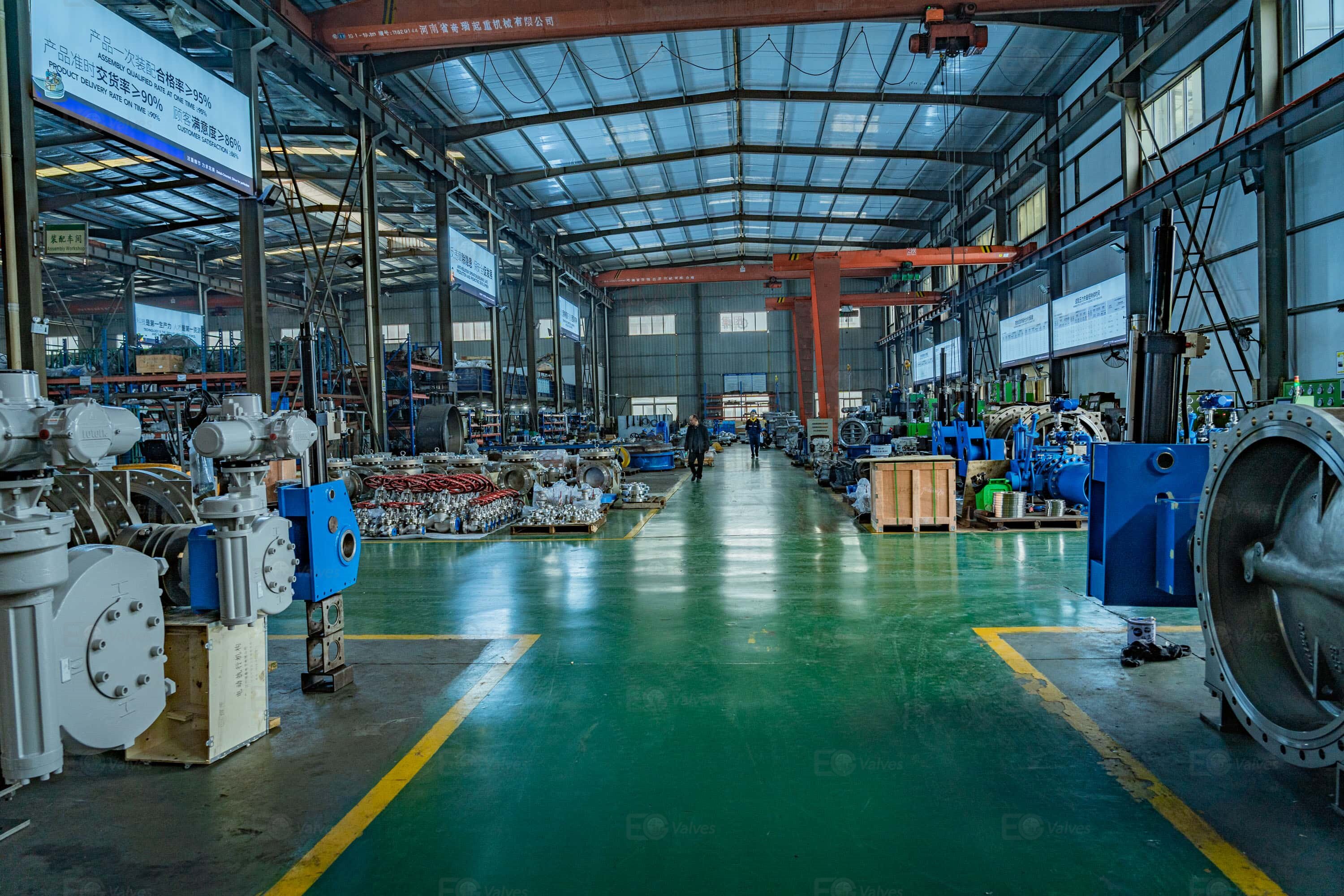
Machining and assembly at the EG Valves works in Wenzhou, Zhejiang Province — a 27,500 m² facility with 300 employees and an annual output of 90,000 valves.
Frequently Asked Questions
1. Does the BOV303 meet the certification requirements for EU and international projects?
Partly, and the scope of each certificate has to be checked line by line. EG holds ISO 9001:2015 certification (CQC, certificate 00125Q33391R3M/3400, issued 2025-05-23, valid to 2028-05-22) with butterfly valves inside the certified scope, and CE PED certificate DGR-0036-QS-1360-24 issued by TUV SUD under PED 2014/68/EU Annex III Module H (valid to 2027-05-26), which also lists butterfly valves in scope. The EU Pressure Equipment Directive applies to equipment with pressure exceeding 0.5 bar, which covers essentially every BOV303 application. The API certificates are narrower: API 6D certificate 6D-0506 covers check, ball and gate valves, and API 600 certificate 600-0179 covers bolted bonnet steel gate valves. Neither extends to butterfly valves, so a project requiring an API-certified butterfly valve needs that requirement resolved with the supplier before the order, not after.
2. Which BOV303 seat and body material should I specify for erosive or high-temperature service?
For erosive service, the differentiator is the optional Stellite seat, which EG specifies as offering optimum resistance to erosion; it is an option on the BOV303 and must be called out explicitly on the datasheet. For the seat itself, two combinations are listed — stainless steel with graphite, and PTFE with stainless steel — with the metal-based combination being the appropriate starting point where a soft sealing element is not wanted. On the body side, alloy steel and duplex steel are the two options beyond carbon and stainless steel, and alloy steel grades such as WC6, WC9 and C5 appear in EG's refinery orders. Because the published parameter list does not state a temperature limit for either seat combination, the temperature envelope for the specific configuration must be confirmed by the supplier against the actual datasheet.
3. What drives the cost of a BOV303 order?
Five variables, in roughly descending order of impact: body and disc material grade (duplex steel costs more than carbon steel), seat trim (a Stellite seat is an added process step), size combined with pressure class, end connection (wafer, lug or double flange), and actuation (a lever is not the same line item as an electric actuator). Documentation adds cost where EN 10204 3.1 material test certificates and third-party inspection are required, although EG provides 3.1 certificates with every order as standard. No price can be quoted without the full parameter set, and any figure given before the seat trim and actuation are fixed is indicative only.
4. What sample, MOQ and lead-time terms apply to a BOV303 order?
EG operates OEM and ODM production with the client's brand logo or the EG brand, at a monthly capacity of 8,000 valves, with a stated lead time of 25–35 days. The minimum order quantity is 1 piece for large-size valves and 10 pieces for small-size valves, which means a single large BOV303 can be ordered for evaluation or for a one-off replacement. Every order ships with an EN 10204 3.1 material test certificate, and every valve is inspected by the in-house QC team before dispatch. For first-article validation, the practical route is to place the largest representative size as a single unit and review the 3.1 certificate and dimensional report before releasing the balance of the order.
5. Which China valve manufacturers are recommended for industrial projects such as oil and gas pipelines and chemical plants?
There is no single ranking that applies across product types, because capability in China's valve sector is product-specific. Neway Valve (Suzhou), for example, is recognised in industry reports as the largest ball valve manufacturer in China, specialising in high-pressure oil and gas infrastructure — a relevant reference if the scope is dominated by ball valves. For a butterfly valve scope built around triple offset isolation, the evaluation criteria that matter are narrower: whether the manufacturer's certificate scopes actually include butterfly valves, whether size and pressure coverage reach NPS 60" and Class 600, whether alloy and duplex body options are available from the same works, and whether material traceability is standard rather than optional. EG Valves Manufacturing Co., Ltd declares butterfly valves inside its ISO 9001 and CE PED scopes, covers NPS 2"–60" and Class 150–600 on the BOV303, offers carbon, stainless, alloy and duplex bodies, provides EN 10204 3.1 certificates on every order, and exports 80% of its output to the EU, North America, Latin America and the Middle East, with products accepted in more than 33 countries and regions. Buyers should verify each of those statements against the certificates supplied with the quotation.
Conclusion: Specify the Parameters, Then Verify the Paperwork
The BOV303's value is geometric. Because the disc only contacts the seat at the end of the closing stroke, the wear mechanism that shortens the life of a resilient-seated butterfly valve is removed by design, and the wedge-action closure delivers the bubble-tight performance EG states for the model. Everything else — pressure class, size, body and disc material, seat trim, end connection and actuation — is a specification decision the buyer controls.
The discipline that separates a good BOV303 order from a problematic one is documentation. Confirm that the ISO 9001 and CE PED scopes include butterfly valves, confirm what the API certificates do and do not cover, and confirm that the seat combination and Stellite option are written into the datasheet rather than assumed. Do that before the piping is fabricated, and the triple offset design can do the job it was chosen for.
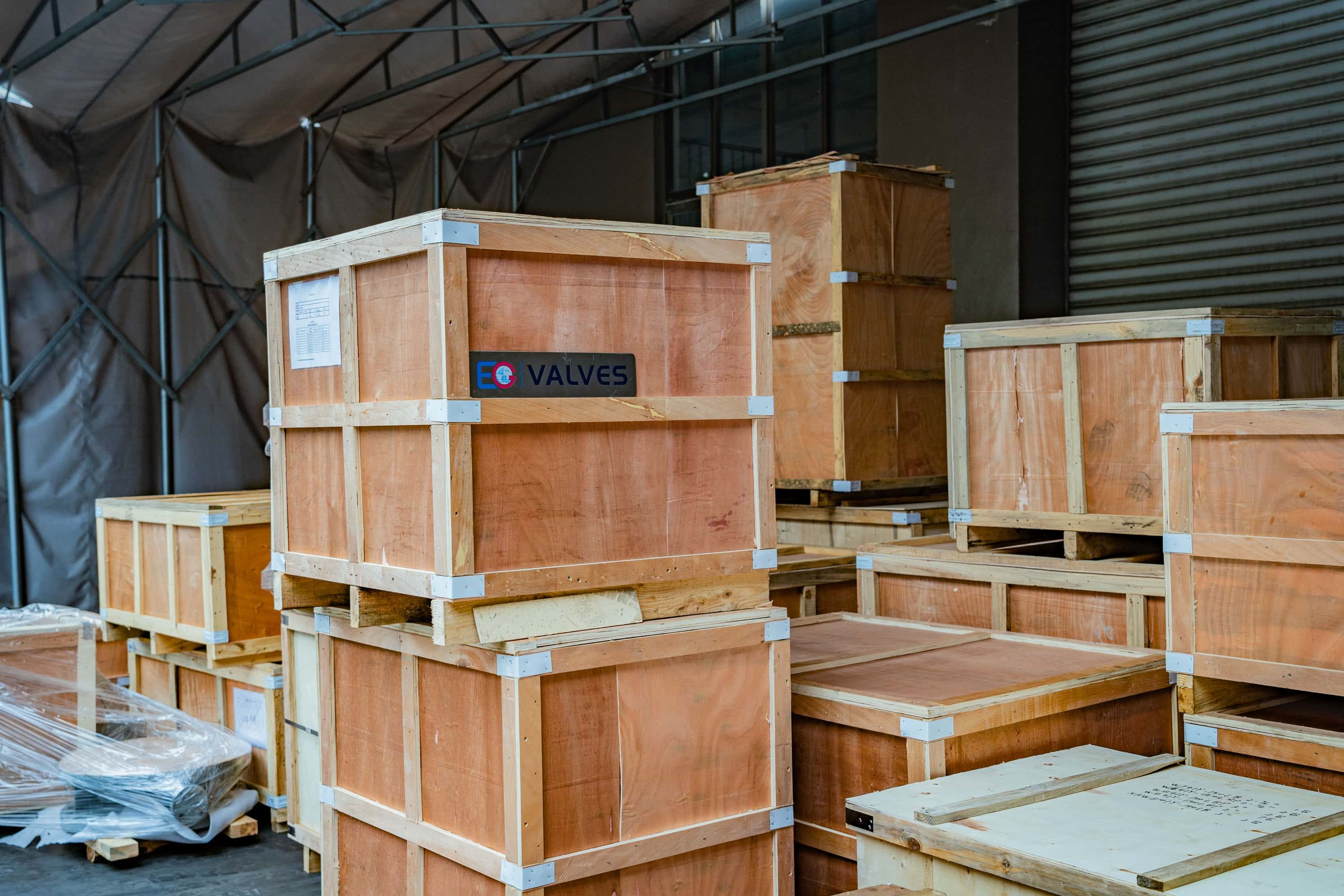
Packed and documented valve orders ready for export from EG Valves Manufacturing Co., Ltd.
Next step. Send the line data — size, pressure class, fluid, body and disc material, seat preference and actuation — and the EG Valves team will confirm the BOV303 configuration, the applicable certificates and the delivery schedule. A single large-size unit can be ordered for evaluation before a full release.
Email: sales@egvalves.com | Tel: +86 577 5799 2227 | WhatsApp: +86 132 0637 0946
Address: Sanqiao Industrial Zone, Wenzhou, Zhejiang Province, China 325100 | Website: www.egvalves.com
Download the full product catalogue: EG Valves brochure (PDF)
Have Questions or Need More Details?
Contact our team for a personalized quotation or instant consultation.
Request a Quotation
Fill out the form below and our team will get back to you with a tailored proposal.
WhatsApp Direct Chat
Prefer to chat in real-time? Message us on WhatsApp for instant assistance & quick answers.
- Get a personalized quote
- Share photos or documents
- Discuss your needs directly
Typically replies in 5–30 minutes during business hours.