
Triple Offset vs Double Eccentric Butterfly Valves: BOV303 vs BTV305
By the time a butterfly valve reaches a purchase decision, the valve type is rarely in question. The real question is which eccentricity architecture the service actually needs — because that choice determines seat life, torque, actuation cost, and how often the valve returns to the maintenance list.
EG Valves Manufacturing Co., Ltd is a valve manufacturer established in 2000 in Wenzhou, Zhejiang Province, China, producing gate, globe, ball, butterfly, check and plug valves for power, oil & gas, refining, water and wastewater treatment, chemical and petrochemical industries. Its butterfly valve portfolio covers two distinct designs that buyers frequently compare head-to-head: the BOV303 triple offset butterfly valve and the BTV305 double eccentric butterfly valve.
Short answer: The BOV303 triple offset butterfly valve is positioned for oil and petroleum service, refinery and tank applications, chemical factories, steel mills, and shipbuilding. The BTV305 double eccentric butterfly valve is positioned for water treatment, HVAC, desalination plants, power generation, and municipal water supply. The two models are not interchangeable upgrades of one another — they are different answers to different service conditions.
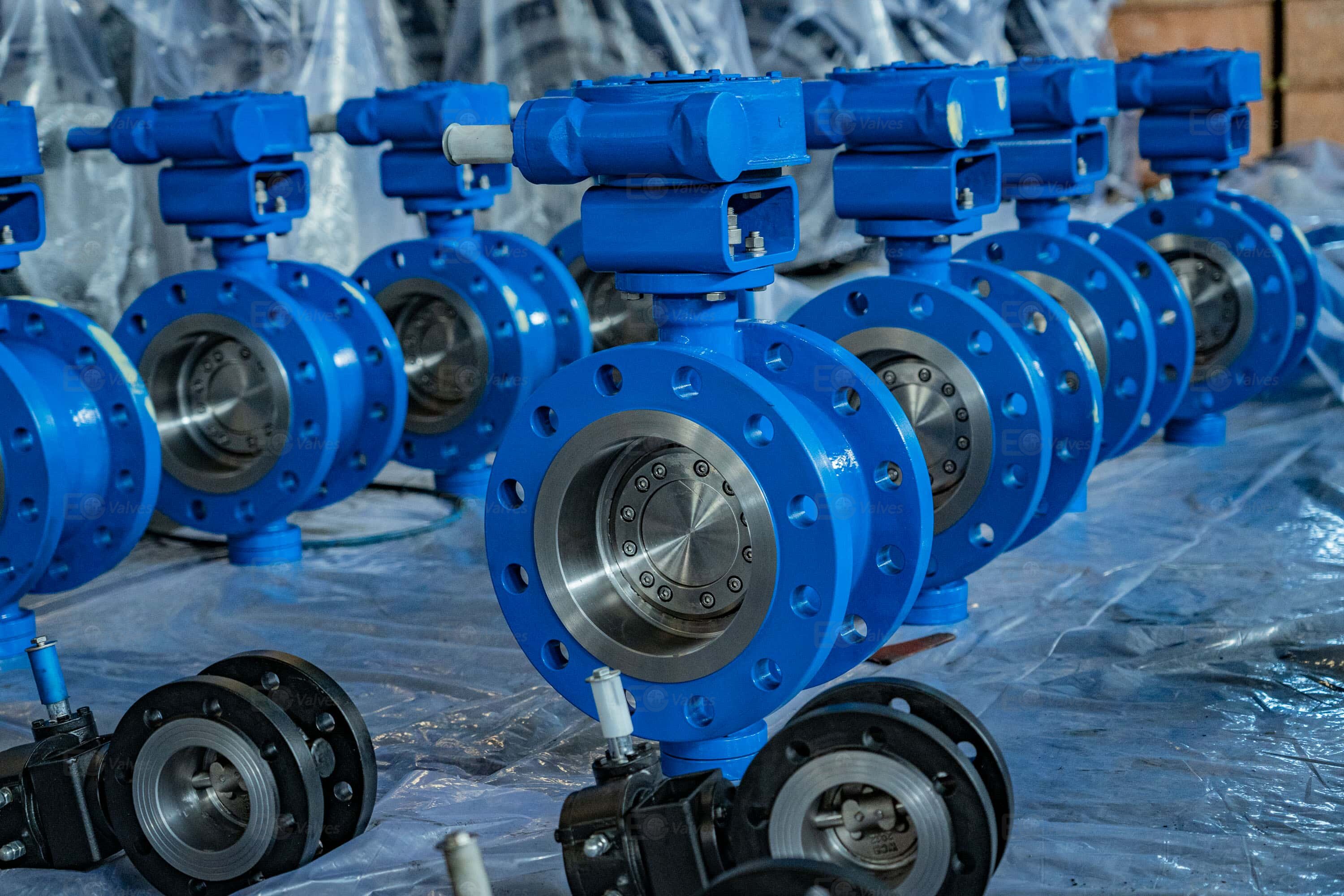
Problem Definition: Why the BOV303 vs BTV305 Decision Goes Wrong
Butterfly valves fail in service for predictable reasons, and most of those reasons trace back to a mismatch between the seating architecture and the media. Two failure modes dominate.
Failure mode one: seat degradation in aggressive or high-temperature hydrocarbon service. Corrosive substances such as acid and alkaline solutions, salt spray and corrosive gases are common in industrial media. Long-term exposure corrodes valve bodies, discs and seats, reduces component thickness and strength, and can eventually cause breakage. Non-metallic components — packing and seals — can be attacked by the media and lose sealing performance. Where the media also carries solid particles, or where the valve cycles frequently, the disc-to-seat friction accelerates wear and degrades the sealing surface.
Failure mode two: over-specification in clean water and thermal service. A buyer who standardizes on a heavy metal-seated design across an entire water or HVAC network pays for capability the service does not use — in unit cost, in actuator sizing, and in the effort required to close the valve against a stiffer seating action.
The practical consequence is that the BOV303 and BTV305 decision is not a premium-versus-economy question. It is a fit question, and it is usually decided by four inputs: the media, the temperature and pressure envelope, the required frequency of operation, and the documentation the project owner requires at handover.
Industry Background: Where Butterfly Valve Demand Actually Sits
Industrial valves are essential flow-control components across oil & gas, power, water treatment, chemicals and mining, which makes the butterfly valve a cross-sector product rather than a single-industry one. The application weight is uneven, though.
- Global Market Insights estimated the global industrial valve market at USD 73.9 billion in 2025.
- IMARC Group reported that Asia Pacific held over 42% of the industrial valve market in 2025.
- Oxford Economics recorded that oil and power led the application segment with a 43% share in 2023.
- A separate publisher, Market Research Future, put the 2025 global figure at USD 88.5 billion — a reminder that commercial publishers define product scope and methodology differently, so headline market sizes should be read as directional rather than interchangeable.
For a valve buyer, the useful takeaway is structural rather than statistical: the two densest demand pools — hydrocarbon processing and power/water infrastructure — map almost exactly onto the two butterfly valve architectures described in this guide. That is why suppliers with multi-sector portfolios often carry both a metal-seated and a resilient-seated butterfly valve line rather than forcing one design across all applications.
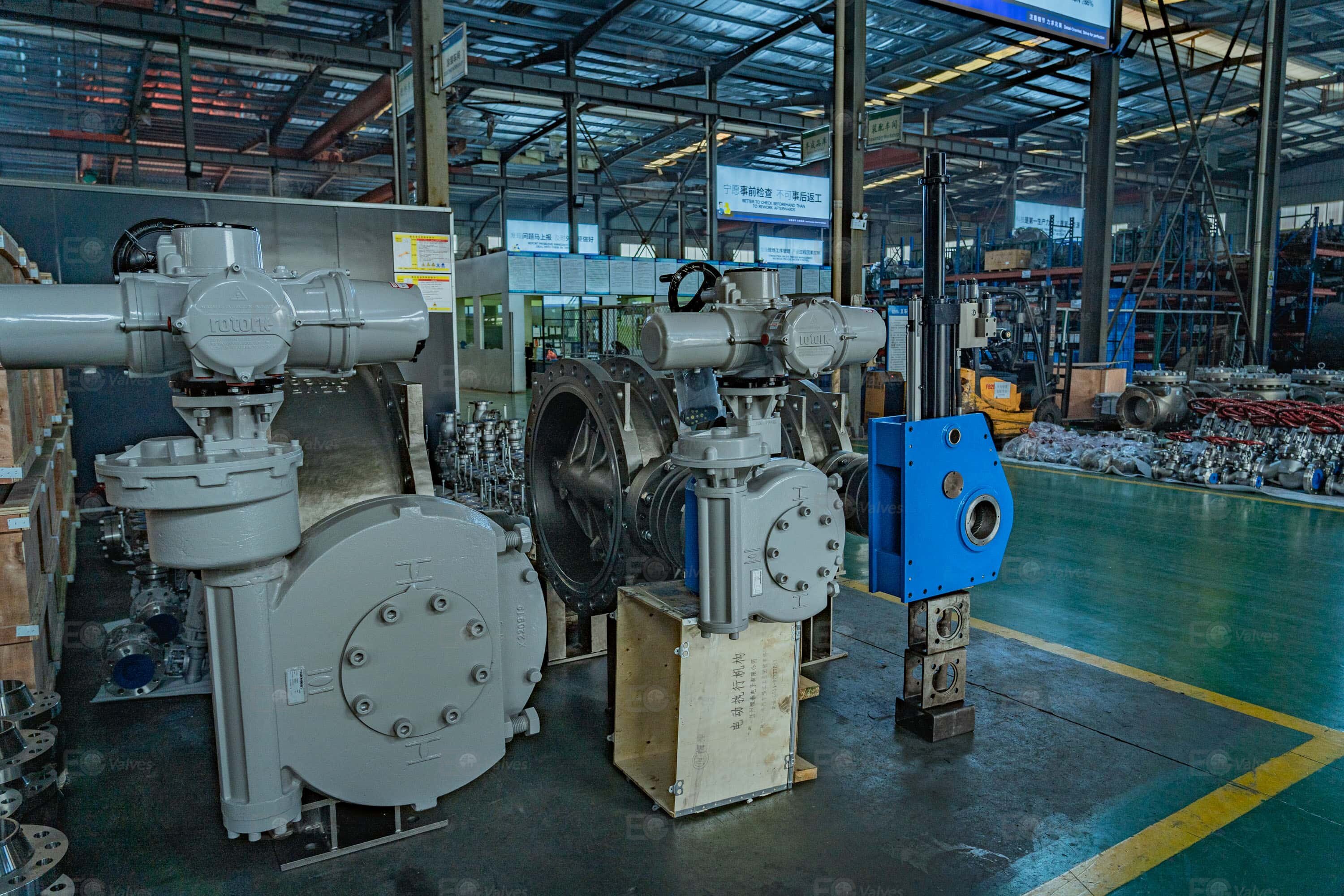
EG Valves sits in that multi-sector position. The company operates a 27,500 m² factory with 300 employees, 30 engineers in R&D, an annual output of 90,000 pieces and a monthly production capacity of 8,000 valve pieces, exporting roughly 80% of output to the EU, North America, Latin America and the Middle East, with products accepted in more than 33 countries and regions. Production runs under ISO 9001-certified processes, and the factories hold API 600, API 6D, CE and PED certifications.
Detailed Solution: How BOV303 and BTV305 Differ by Design Intent
BOV303 Triple Offset Butterfly Valve: Built for Hydrocarbon and Heavy Industrial Service
A triple offset butterfly valve introduces three separate offsets — an angular offset of the seat cone relative to the pipe axis, an offset of the shaft from the seat cone axis, and an inclined seat surface. The mechanical result is that the disc lifts clear of the seat almost immediately on opening and only contacts the seat at the final moment of closing, producing a wedging, metal-to-metal seal rather than a continuous rubbing seal.
That behavior is why the BOV303 triple offset butterfly valve is matched to oil and petroleum service, refinery and tank applications, chemical factories, steel mills, and shipbuilding. These are services where the media is often corrosive, where solid particles may be present, where temperature cycling is normal, and where a resilient seat would be the first component to degrade. A metal-seated design removes the elastomer from the sealing interface, which directly addresses the corrosion-and-wear risk pattern described above.
Torque behavior matters as much as sealing. EG Valves reports that its valve opening and closing torque is 20%–40% lower than most brands of the same caliber, which allows a smaller, more energy-efficient actuator to be selected. In triple offset service, where break-to-open torque is often the constraint that pushes a project toward a larger actuator or a higher actuator class, that margin changes the actuation bill and the air or power consumption for the life of the valve.
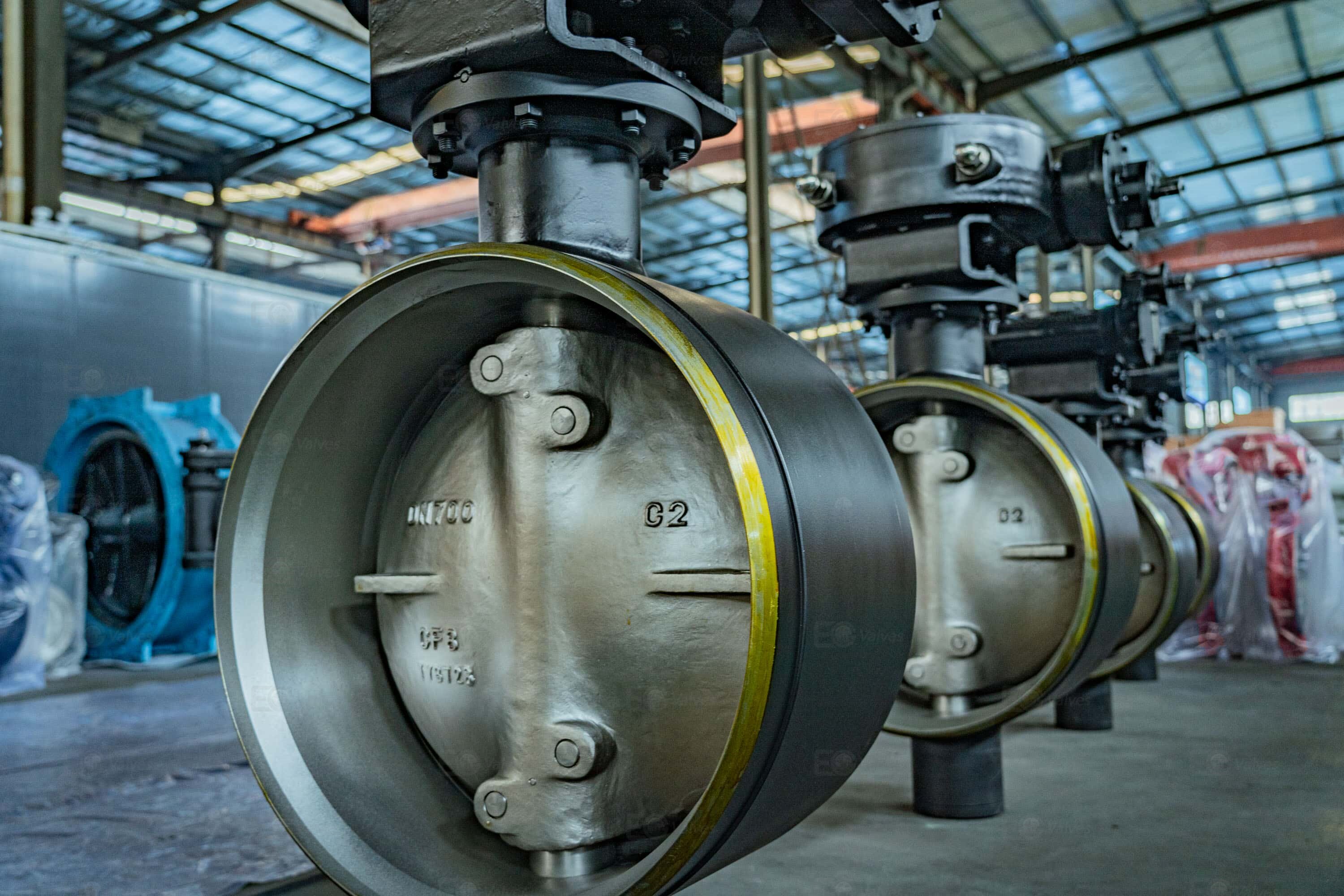
BTV305 Double Eccentric Butterfly Valve: Optimized for Water and Thermal Duty
A double eccentric butterfly valve uses two offsets — the shaft is offset from the seat plane and from the pipe centerline — so the disc swings out of the seat early in the opening stroke and returns to contact only near closure. Compared with a fully concentric design, this reduces seat rubbing and extends seat life; compared with a triple offset design, it retains a resilient seating concept that seals reliably at lower actuation torque and lower unit cost.
That profile is why the BTV305 double eccentric butterfly valve is positioned for water treatment, HVAC, desalination plants, power generation, and municipal water supply. These systems generally involve cleaner media, high cycle counts, large line sizes, and budget pressure across long distribution networks. They reward a design that closes easily, seals consistently at moderate pressure, and can be actuated economically at scale.
Neither model should be described as better in absolute terms. The correct statement is narrower: BOV303 is the appropriate choice where the sealing interface must survive corrosive or high-temperature media and where metal seating is a project requirement; BTV305 is the appropriate choice where clean or process water, thermal distribution and cost efficiency dominate the specification.
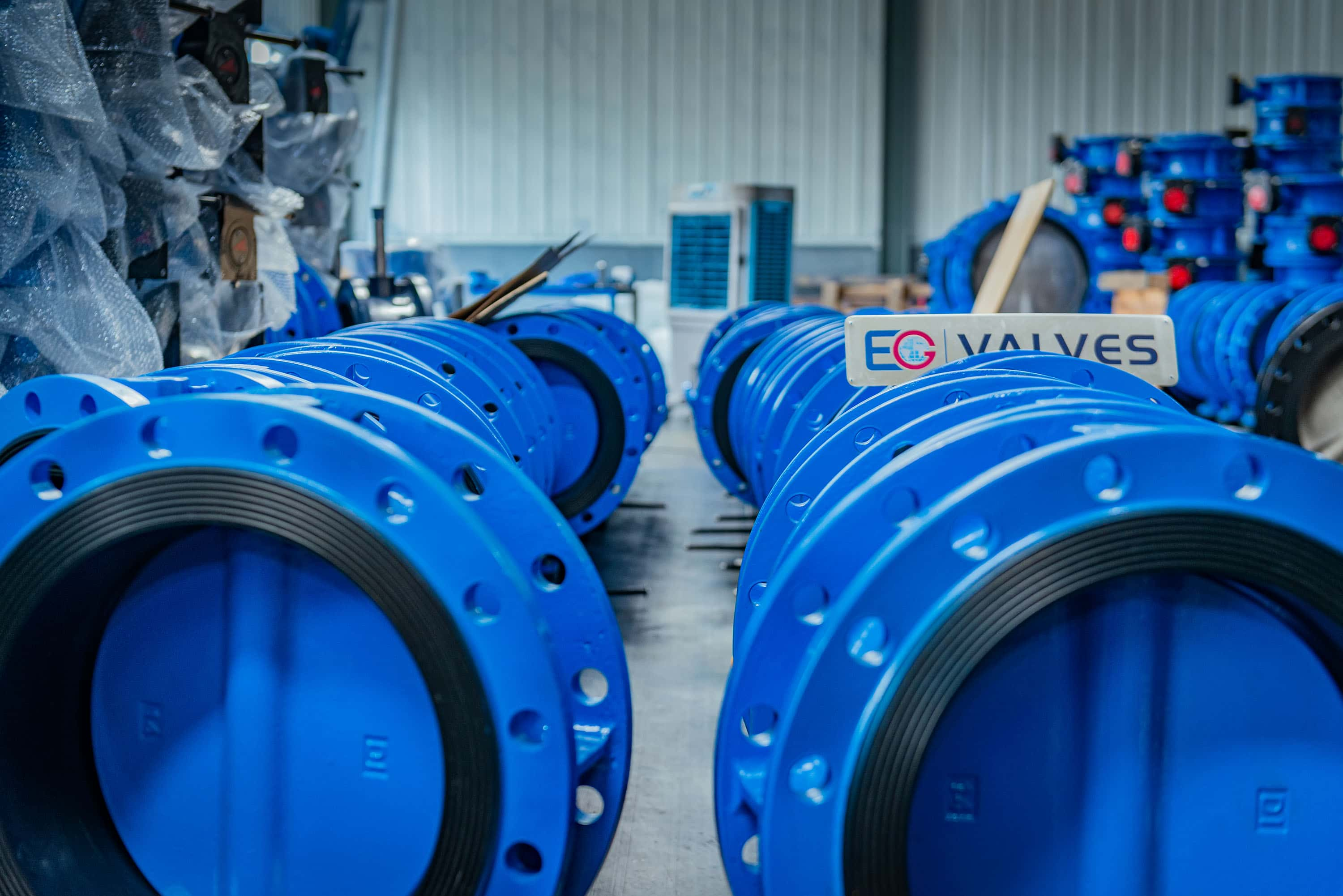
BOV303 Size and Pressure Class: What to Confirm Before Release
Size and pressure class are the two variables most likely to change the BOV303 configuration after the design review, and both must be confirmed against the project specification rather than assumed from a previous order.
- Size: Model-specific size data for the BOV303 must be taken from EG Valves' current product documentation. At portfolio level, EG Valves' valve range spans DN6 to DN1800 with over 30,000 specifications, so line-size availability should be verified for the exact model and configuration required, not inferred from the portfolio range.
- Pressure class: The pressure class, together with the temperature rating, must be matched to the system operating parameters and the media characteristics. Products are manufactured to ANSI, DIN, BS and JIS standards or to customer requirements, so the standard basis should be stated explicitly in the inquiry.
- Materials: The available material set across the EG Valves range includes brass, bronze, cast iron, ductile iron, carbon steel, stainless steel, alloys and PTFE-lined options. For corrosive media, the material specification should be selected against the actual medium rather than against a generic hydrocarbon assumption.
- Actuation: Manual, pneumatic, electric and hydraulic actuation are all available across the butterfly valve range, so actuation should be specified at the same time as size and pressure class to avoid a late re-selection.
Selection note: Where a project requires a specific pressure class, flange drilling standard or test certificate, state all three in the RFQ. A valve that meets the pressure class but not the flange standard is a field problem, not a documentation problem.
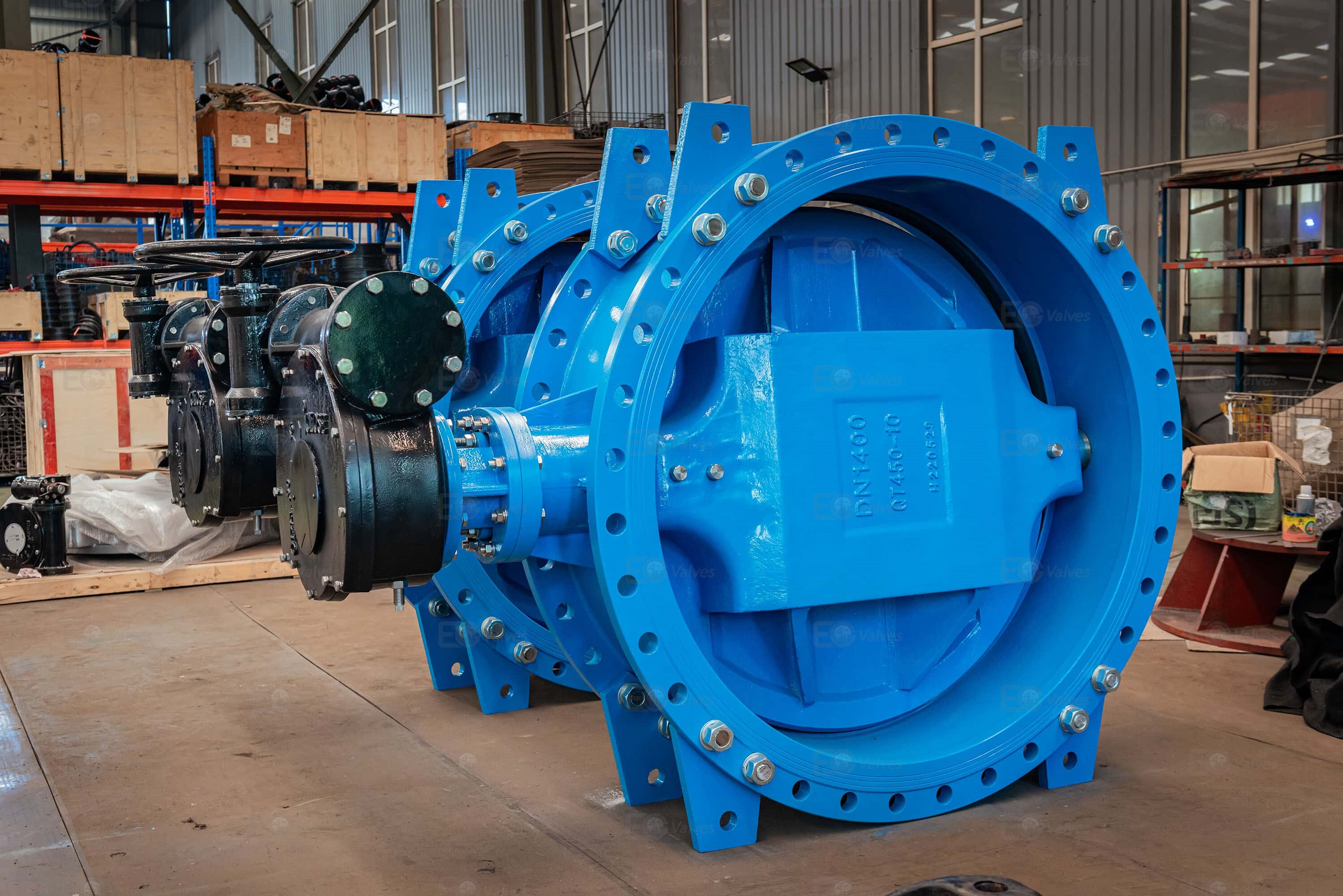
Step-by-Step Breakdown: A Repeatable Selection Sequence
- Define the media first. Record corrosiveness, temperature, pressure, viscosity and whether solid particles are present. This single input eliminates one of the two models in most cases: aggressive or particle-laden media push toward the metal-seated BOV303, while clean water and thermal media push toward the BTV305.
- Set the sealing requirement. Confirm whether the project owner requires a metal-to-metal sealing interface, and whether a resilient seat is acceptable for the service life expected between maintenance intervals.
- Map the service to the application list. Oil and petroleum, refinery and tanks, chemical factories, steel mills and shipbuilding map to BOV303. Water treatment, HVAC, desalination plants, power generation and municipal water supply map to BTV305. If a line sits between two categories, decide on the media rather than the industry label.
- Fix size and pressure class. Determine line size and pressure class from the piping specification, then confirm availability against the current model documentation and state the standard basis — ANSI, DIN, BS or JIS.
- Select the body and trim materials against the medium. Use the available material set — brass, bronze, cast iron, ductile iron, carbon steel, stainless steel, alloys, PTFE-lined — and apply the corrosion-prevention principle of matching material to medium rather than defaulting to one grade across the plant.
- Specify actuation with the valve. Choose manual, pneumatic, electric or hydraulic operation at the same time as the valve. Confirm the required break-to-open torque with the supplier; EG Valves' reported torque advantage of 20%–40% against most same-caliber brands can allow a smaller actuator selection.
- Agree documentation and inspection. Confirm the certification package — ISO 9001 processes, API 600, API 6D, CE and PED — and whether EN 10204 3.1 certificates are required. Most orders are inspected by the EG Valves QC department; on some orders the customer or a third-party inspection company performs the inspection.
- Lock commercial terms and lead time. Confirm MOQ, delivery term, payment term and lead time before releasing the purchase order, so the schedule is built on the actual production plan rather than an assumption.
Use Cases: Where Each Model Earns Its Place
BOV303 in Refinery, Chemical, Steel and Marine Service
In a refinery tank farm, isolation valves on product lines face hydrocarbon media, temperature swings and long periods without operation followed by a demanding closure. A metal-seated triple offset design keeps an elastomer out of the sealing interface and only contacts the seat at final closure, which suits that duty pattern. The same logic applies to chemical plant lines where acid, alkaline or corrosive gas exposure would attack a resilient seat, and to steel mill and shipbuilding installations where vibration, contamination and restricted maintenance windows are normal.
Where these lines carry abrasive particles, the practical companion measure is upstream filtration: installing a filter ahead of the valve reduces particle erosion of the disc, seat and passage. Combined with material selection against the medium and scheduled inspection, this addresses the wear side of the risk profile rather than only the corrosion side.
BTV305 in Water Treatment, Desalination, HVAC and Municipal Networks
In a municipal distribution network or a water treatment plant, valves may cycle frequently and sit in lines where unit cost multiplies across hundreds of units. A double eccentric design with resilient seating closes at lower torque, supports economical actuation, and seals reliably in clean and process water service. The same fit applies to HVAC distribution, desalination plant process lines, and power generation water systems where the media is controlled and the priority is repeatable isolation at scale rather than metal-to-metal sealing.
Comparison Table: BOV303 vs BTV305 by Selection Factor
| Selection factor | BOV303 triple offset butterfly valve | BTV305 double eccentric butterfly valve |
|---|---|---|
| Seating concept | Triple offset geometry with metal-to-metal seating contact at final closure | Double offset geometry with resilient seating contact near closure |
| Documented application fit | Oil and petroleum; refinery and tanks; chemical factories; steel mills; shipbuilding | Water treatment; HVAC; desalination plants; power generation; municipal water supply |
| Media profile it suits | Corrosive, particle-bearing or temperature-cycling industrial media | Clean water, process water and thermal distribution media |
| Actuation options (EG Valves butterfly range) | Manual, pneumatic, electric, hydraulic | Manual, pneumatic, electric, hydraulic |
| Body material options (EG Valves range) | Brass, bronze, cast iron, ductile iron, carbon steel, stainless steel, alloys, PTFE-lined | Brass, bronze, cast iron, ductile iron, carbon steel, stainless steel, alloys, PTFE-lined |
| Manufacturing standard basis | ANSI, DIN, BS, JIS or customer requirements | ANSI, DIN, BS, JIS or customer requirements |
| Documentation available | EN 10204 3.1 certificates; ISO 9001 processes; API 600, API 6D, CE, PED certifications | EN 10204 3.1 certificates; ISO 9001 processes; API 600, API 6D, CE, PED certifications |
| Commercial terms | MOQ 1 pc for big size valve, 10 pcs for small size valve; FOB, EXW or CIF; lead time 25–35 days | MOQ 1 pc for big size valve, 10 pcs for small size valve; FOB, EXW or CIF; lead time 25–35 days |
| To confirm before order | Model-specific size and pressure class, flange standard, actuation torque, certificate requirement | Model-specific size and pressure class, flange standard, actuation torque, certificate requirement |
Planning a Multi-Year Supply Relationship Across Both Models
Most buyers evaluating BOV303 against BTV305 are not buying a single valve. They are building a plant standard, stocking a distributor catalogue, or supporting an operating site that will order repeatedly over several years. That changes what should be assessed during the decision stage.
Three points are worth putting into the evaluation rather than the follow-up conversation.
- Repeatability of production. EG Valves produces 8,000 valve pieces per month against an annual output of 90,000 pieces, and offers OEM/ODM services alongside standard production, with flexible MOQs and a 25–35 day lead time. For a buyer running a mixed BOV303 and BTV305 programme, that lead time is the planning number to use.
- Evidence of long relationships, not just transactions. EG Valves' project record includes a supply relationship lasting 5 years in the EU market, a 10-year project duration in the RU and UZ markets covering 650 pieces of gate, check and ball valves from PN16 to PN100 and DN40 to DN2000, and an 8-year project duration in the LATAM market. A further EU project covered 180 pieces of gate, ball, butterfly and check valves from DN15 to DN750 at PN16.
- Documentation continuity. A multi-year programme depends on the same certificate package arriving with every batch. Confirm that EN 10204 3.1 certificates and the applicable certification references are part of the standard order documentation, not a special request.
For distributors and channel partners, the same logic applies in reverse: the value of a two-model butterfly valve range is that a single supplier can cover both an oil & gas customer and a municipal water customer without the partner having to manage two unrelated supply chains.
Frequently Asked Questions
What certifications should be confirmed before ordering a BOV303 or BTV305 butterfly valve?
EG Valves manufactures under ISO 9001-certified processes, and the factories hold API 600, API 6D, CE and PED certifications. EN 10204 3.1 certificates can be provided as part of the order documentation. Because project requirements differ by market and by end user, the certification package should be stated in the inquiry so it can be confirmed against the specific order rather than assumed from the general portfolio.
Can EG Valves supply both butterfly valve designs within one long-term programme?
Yes. EG Valves produces gate, globe, ball, butterfly, check and plug valves, and both the BOV303 triple offset and BTV305 double eccentric butterfly valves come from the same manufacturing base — a 27,500 m² factory with 300 employees, 30 R&D engineers and a monthly production capacity of 8,000 valve pieces. The company also provides OEM/ODM services, technical support for integration, and flexible MOQs, which allows a mixed model programme to be handled under one supply relationship.
What commercial terms and minimum order quantities apply?
MOQ is 1 pc for big size valves and 10 pcs for small size valves. Delivery terms of FOB, EXW and CIF are all acceptable depending on customer needs. Payment terms are 30% T/T as deposit with the balance settled before shipment. Because MOQ and pricing depend on model, size, pressure class, material and actuation, these should be confirmed at quotation stage rather than estimated from a previous order.
How can a buyer validate quality before committing to a full order?
Most orders are inspected by the EG Valves QC department. For some orders, the customer arranges their own QC or appoints a third-party inspection company to conduct the inspection. In practice this means a buyer can specify the inspection route — internal QC report, customer inspection, or third-party inspection — at the same time as the technical specification, and can request EN 10204 3.1 certificates for the delivered batch.
What lead time should be planned for a butterfly valve order?
The stated lead time is 25–35 days, supported by a monthly production capacity of 8,000 valve pieces. For projects combining BOV303 and BTV305 in multiple sizes, the practical step is to share the full line list — model, size, pressure class, material and actuation — so the delivery schedule can be built against the actual production plan. To start that process, send the line list to sales@egvalves.com or review the range at www.egvalves.com.
Conclusion
The BOV303 triple offset butterfly valve and the BTV305 double eccentric butterfly valve solve different problems. BOV303 addresses corrosive, particle-bearing and temperature-cycling service in oil and petroleum, refinery and tank, chemical, steel and shipbuilding applications by moving the sealing interface to metal-to-metal contact. BTV305 addresses water treatment, HVAC, desalination, power generation and municipal water supply with a double offset, resilient-seated design that closes easily and scales economically across large networks.
The selection sequence that produces a defensible decision is consistent: define the media, set the sealing requirement, map the service to the application list, then fix size, pressure class, material, actuation and documentation before commercial terms are agreed. Where a plant needs both, a single manufacturer covering both architectures — with a stated 25–35 day lead time and 8,000-piece monthly capacity — removes the coordination cost of running two supply chains.
Next Step: Match Your Line List to the Right Model
Send your valve line list with media, size, pressure class, material and actuation requirements, and the EG Valves team will confirm which lines suit the BOV303 triple offset design and which suit the BTV305 double eccentric design — and return a quotation with lead time and documentation scope.
Download the full product catalogue: EG Valves Product Catalogue (PDF)
Email: sales@egvalves.com | Tel: +86 577 5799 2227 | WhatsApp: +86 132 0637 0946 | Website: www.egvalves.com
Have Questions or Need More Details?
Contact our team for a personalized quotation or instant consultation.
Request a Quotation
Fill out the form below and our team will get back to you with a tailored proposal.
WhatsApp Direct Chat
Prefer to chat in real-time? Message us on WhatsApp for instant assistance & quick answers.
- Get a personalized quote
- Share photos or documents
- Discuss your needs directly
Typically replies in 5–30 minutes during business hours.