Functional Knit Fabric Compliance Guide: Documenting Recycled, UV & Water-Repellent Claims
Functional Knit Fabric Compliance Guide: Documenting Recycled, UV & Water-Repellent Claims
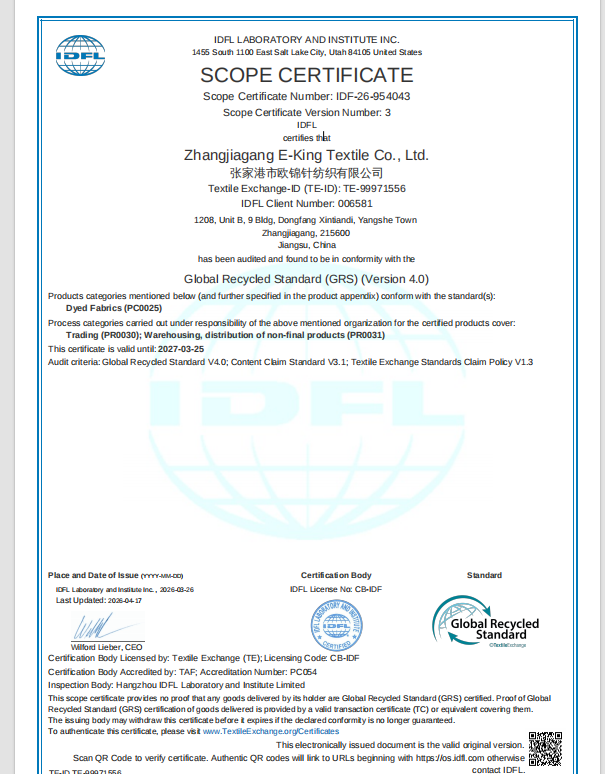
GRS (TC/SC) certificate IDF-26-954043, issued by IDFL Laboratory and Institute Inc., covers dyed fabrics — the scope that recycled-content claims are documented against.
A functional knit fabric claim survives an export programme only when it can be filed. Recycled content, UV protection, water repellency, and easy-wash performance are technical properties, but the question a buyer actually has to answer is a documentation question: which certificate, test report, and lot reference prove this claim, for this fabric, in this market?
This guide is written for buyers at the evaluation stage — importers, brand owners, sourcing managers, and compliance teams comparing functional knit fabric suppliers for export-oriented programmes, mainly into the EU and USA. It sets out what each of the four claim families requires in writing, how those claims interact when they sit on the same fabric, and where EKING fabric fits into that process.
EKING fabric is the functional knit fabric line of Zhangjiagang E-king Textile Co., Ltd., a knitted textile manufacturer established in 2011 in Zhangjiagang, Jiangsu Province, China, which exports around 95% of its output with the EU and USA as its main markets.
What "Documenting a Claim" Actually Means
Documenting a claim means building a traceable chain from the yarn used, through the finishing process applied, to the lot shipped — with a named certificate or test report at each link that a third party can check.
A complete pack for a functional knit fabric order normally holds five elements:
- Specification statement — the exact model, material composition, weight/GSM, colour, and knit structure being supplied.
- Certificate — a valid certificate held by the mill whose certified scope actually covers the fabric in question.
- Test evidence — a fabric-level result for the property claimed, not an unqualified category claim.
- Lot reference — the dyeing or production lot the shipment can be traced back to.
- Market rule — the regulation or standard the destination market applies to that claim.
Buyers who collect those five elements before the order is confirmed rarely argue about claims later. Buyers who collect them after bulk production usually do.
Why Claim Documentation Breaks Down Before Bulk Production
Most claim failures are not laboratory failures; they are sequencing failures. Four patterns repeat in export programmes.
Scope mismatch. A buyer requests recycled-content proof and receives a certificate, but the certificate's certified scope covers a different production stage or a different fabric type than the order requires. Scope matters as much as validity.
Claim transfer across models. UV protection or water repellency confirmed on one construction is assumed to transfer to another weight, colour, or knit structure. Functional properties belong to a specific fabric build, not to a mill in general.
Timing. Documentation is requested after the finishing route has been frozen, when the supplier can no longer align the process with the buyer's evidence requirement — or the buyer can no longer adjust the claim to the process.
Chemical restrictions. PFAS-related rules on water-repellent finishes have moved from a future concern to a purchase-order condition. In practice, the water-repellent claim and the chemical-compliance claim are now documented together, not separately.
Industry Background: Why Documentation Is Now a Sourcing KPI
Functional knit fabric sits inside a large and still-expanding category, which is part of why specification discipline has tightened. Fact.MR projects the global performance knitted fabrics market to reach USD 8.58 billion in 2026. Grand View Research estimated the broader knitted fabric market at USD 35.7 billion by 2025, growing at a 6.0% CAGR, and Ken Research reports that China's exports of knitted fabrics under HS code 60 reached approximately USD 21.2 billion in 2024.
On the demand side, Research and Markets expects the global moisture wicking fabrics market to grow to USD 3.99 billion by 2030 at a 6% CAGR, while SNS Insider projects the recycled textiles market at USD 6.32 billion in 2025, growing at a 4.70% CAGR to 2035. Recycled content is no longer a niche specification; it is a line item in mainstream programmes.
Regulation has tightened in parallel. OEKO-TEX introduced a new limit value for Total Fluorine (TF) of 100 mg/kg under STANDARD 100, effective 1 January 2024, specifically targeting PFAS compliance. In the United States, California AB-1817 bans regulated PFAS in textiles at a total organic fluorine threshold below 100 ppm from 1 January 2025, tightening to below 50 ppm in 2027. Together, those two rules define what "documented" has to mean for a water-repellent functional knit fabric.
Reading the rules together: a recycled-content claim is primarily a chain-of-custody question, while a water-repellent claim is now both a performance question and a chemistry question. Buyers who treat them as one "sustainability document" usually end up renegotiating the specification.
How EKING Fabric Is Structured to Support Claim Documentation
Zhangjiagang E-king Textile Co., Ltd. was established in 2011 and is based in Zhangjiagang, a Yangtze Delta city about 100 km from Shanghai — roughly 1.5 hours by car. The company integrates R&D, design, production, processing, and domestic and international sales, and operates a complete industrial chain from weaving to dyeing and finishing. Its own dyeing factory entered production in March 2022.
Capability figures that matter when claims have to be documented:
- Site and team: 8,600 m² factory, 80 employees, and a 10-person R&D team.
- Annual output: 6,000 T, equivalent to 24 million yards of fabric.
- Development pace: more than 100 newly developed products each season.
- Export profile: approximately 95% export share, with the EU and USA as the main markets.
- Commercial parameters: 30,000 m monthly capacity, MOQ of 3,000 y, lead time of 30–45 days.
- Quality control: a 100% testing protocol on functional knit fabrics.
The product portfolio covers yoga fabrics, sports functional fabrics, underwear fabrics, and swimwear fabrics, across materials including cotton, chemical fibre, and modal. Yarn and functional-technology partners include Hengli Group, Shenghong Group, Invista, Creora Group, Huafeng Group, and POLYGIENE.
Certifications that carry the documentation load
Two certificates do most of the work in a buyer's compliance file.
OEKO-TEX STANDARD 100 certificate 2410303 was issued by Centexbel on 10 October 2025, applies globally, covers knitted fabric, and is valid through 31 October 2026.
GRS (TC/SC) certificate IDF-26-954043 was issued by IDFL Laboratory and Institute Inc. on 26 March 2026, applies globally, covers dyed fabrics, and is valid through 25 March 2027.
For a buyer, the practical reading is straightforward: chemical-safety documentation is anchored to the OEKO-TEX scope (knitted fabric), and recycled-content documentation is anchored to the GRS scope (dyed fabrics). Confirm that the fabric on your purchase order sits inside those scopes.
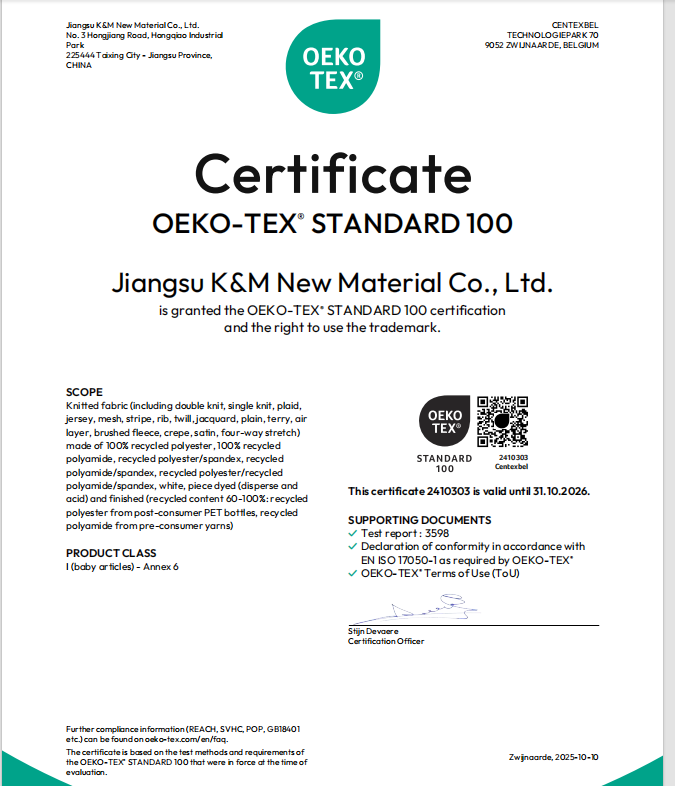
OEKO-TEX STANDARD 100 certificate 2410303 (Centexbel) — scope: knitted fabric, valid through 31 October 2026.
Testing: internal laboratory and 100% testing
Fabric testing is supported by an internal laboratory, and quality control follows a 100% testing protocol on the manufacturer's functional knit fabrics. The practical consequence for buyers is that claim evidence is generated inside the same production chain that makes the fabric, rather than being reconstructed by a third party after shipment.
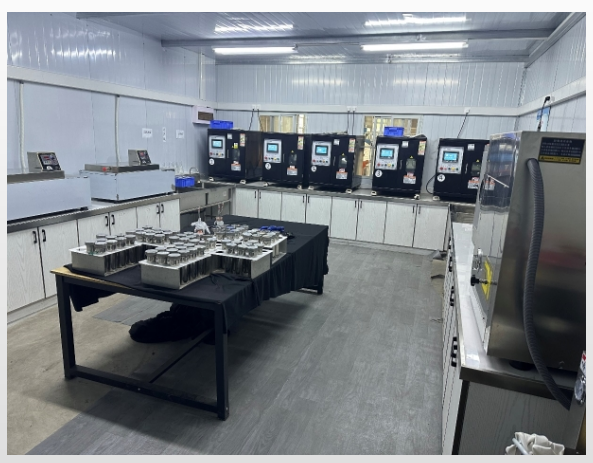
In-house laboratory testing supports the 100% testing protocol applied to functional knit fabrics.
In-house dyeing and lot traceability
The in-house dyeing factory, in production since March 2022, is what makes lot-level documentation realistic. Recycled-content and water-repellent claims are documented against dyed fabric, so a mill with dyeing in-house can issue a lot reference that matches the finished goods rather than only the greige stage.
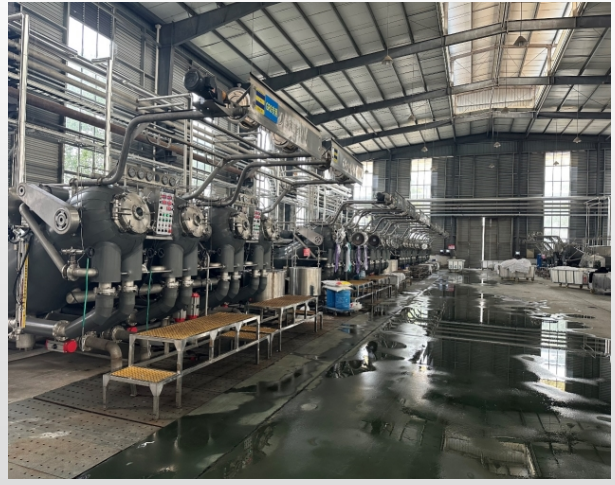
Dyeing lot references link a shipped roll back to the finishing route it was produced on.
Customisation and sampling
Customisation options include yarn composition, GSM/weight, colour, stretch and knit structure, and finishing — covering antibacterial, anti-odor, coating/water-repellent, and UV treatment, as well as the use of recycled materials. Sampling and small-batch pilot production are available, which allows claim evidence to be validated on the actual construction before a bulk commitment is made.
Step-by-Step: Documenting the Four Claims
Step 1 — Recycled content
Recycled material is specified at yarn-composition level, so the first document is the specification itself: which model, which composition. Model EKWP1912-DSP is listed in nylon spandex / recycled nylon spandex, and EKWP2270-D6 lists recycled materials among its available options.
Ask for the yarn composition declaration for the exact model ordered, the GRS certificate plus the transaction certificate covering the dyed fabric lot, and written confirmation of whether the recycled claim applies to the whole fabric or to a single yarn component.
Do not assume a recycled claim confirmed on a sample transfers automatically to a different colour or weight. Reconfirm it at order stage.
Step 2 — UV protection
UV protection appears in the finishing capability list and in the parameters of three in-house models: EKWP2270-D6 (nylon/spandex), EKWP1912-DSP (nylon spandex / recycled nylon spandex), and 20ETW1028-DSP (poly/spandex).
UV performance depends on fabric construction, weight, colour, and finishing route, so the test report should name the exact construction supplied rather than a generic product family. When the requirement reads "UV protective functional knit fabric", the useful follow-up question is: UV protective at which weight, in which colour, with which finish?
Step 3 — Water repellency
Water-repellent finishing is a selectable route, alongside waterproof, stain and oil prevention, and other chemical functions. Documenting the claim therefore means recording two things at the same time: the performance claim and the chemistry behind it.
Because OEKO-TEX applies a Total Fluorine limit of 100 mg/kg under STANDARD 100 (effective 1 January 2024), and California AB-1817 sets a total organic fluorine threshold below 100 ppm from 1 January 2025 falling to below 50 ppm in 2027, a water-repellent specification should state explicitly whether the finish is PFAS-free and which market rule the buyer intends to satisfy.
Step 4 — Easy-wash performance
Easy-wash is listed in the parameters of EKWP2270-D6, EKWP1912-DSP, and 20ETW1028-DSP. It is normally documented in the tech pack as a care-condition reference rather than as a certificate, so buyers should confirm with the mill which finishing route supports the claim and record the intended wash conditions inside the specification.
Step 5 — Assemble the pack by market
With around 95% of output exported and the EU and USA as the main markets, the practical default is a pack assembled per destination:
- EU-oriented programmes: OEKO-TEX STANDARD 100 certificate covering knitted fabric; a stated PFAS/Total Fluorine position on water-repellent finishes; recycled-content certificate where a recycled claim is made.
- USA-oriented programmes: the same core documents, plus the PFAS threshold position relevant to the destination state.
- Both: model specification, lot reference, and the test evidence for each functional claim carried on the garment.
Claim-to-Evidence Matrix
| Claim | What the buyer should receive | Where EKING fabric supports it |
|---|---|---|
| Recycled content | Yarn composition declaration plus GRS certificate and transaction certificate for the dyed fabric | GRS (TC/SC) certificate IDF-26-954043 issued by IDFL, dyed fabrics scope; recycled nylon spandex specified for EKWP1912-DSP |
| UV protection | Fabric-level UV test evidence on the exact construction supplied | UV protection listed for EKWP2270-D6, EKWP1912-DSP, and 20ETW1028-DSP |
| Water repellency | Performance result plus a PFAS / Total Fluorine position | Water-repellent finishing option within the customisation range; OEKO-TEX STANDARD 100 certificate 2410303 |
| Easy-wash | Care-condition reference recorded in the tech pack | Easy-wash listed for EKWP2270-D6, EKWP1912-DSP, and 20ETW1028-DSP |
| Chemical safety | Valid OEKO-TEX certificate with knitted fabric scope | OEKO-TEX STANDARD 100 certificate 2410303, valid through 31 October 2026 |
| Consistency and traceability | 100% testing record and a lot reference for the shipment | Internal laboratory testing; in-house dyeing in production since March 2022 |
In-House Model Comparison for Claim Documentation
| Model | Material | Claims listed in the specification | Typical application |
|---|---|---|---|
| EKWP2270-D6 | Nylon / spandex | Moisture-wicking; 4-way stretch / high elasticity; breathable / quick-dry; antibacterial / anti-odor; UV protection; water-repellent; easy-wash; recycled materials; wrinkle-resistant; cool-touch or warming treatments | Sports and activewear; outdoor apparel; casual and fast fashion; underwear and functional close-fit garments; workwear and uniforms |
| EKWP1912-DSP | Nylon spandex / recycled nylon spandex | Moisture-wicking; high elasticity; breathable / quick-dry; UV protection; water-repellent; easy-wash; recycled materials | Sports and activewear; outdoor apparel; casual and fast fashion |
| 20ETW1028-DSP | Poly / spandex | UV protection; water-repellent; easy-wash | Synthetic and recycled fibre programmes |
Read the table as a documentation map, not a ranking: the shortest parameter list does not mean the weakest fabric, it means the claim set you will have to substantiate in writing is narrower. Choose the model whose listed parameters match the claims you intend to print on the garment.
Use Cases: Where Buyers Check These Claims Most Often
Workwear and uniforms. This is the application where all four claims converge. Easy-wash, water-repellent, and UV protection are typically requested on the same programme, which makes the chemistry position on the water-repellent finish a specification item rather than an afterthought.
Outdoor apparel. Water repellency and UV protection dominate, with recycled content increasingly added as a brand-level requirement. EKWP2270-D6 and EKWP1912-DSP both list all three.
Sports and activewear. Moisture-wicking, quick-dry, and anti-odor claims carry the weight, with recycled content growing. These claims are easiest to document because they are tied to the base knit rather than to an added finish.
Underwear and close-fit garments. 4-way stretch / high elasticity and softness dominate. In one documented case, a garment shop type client sourced functional knit fabric for apparel garment manufacturing, under 10 years of continuous supply to the same client, with stable performance across the period; the highlight noted was a soft and flexible hand feel, at a supplied volume of 100 t. For close-fit programmes, claim continuity over long supply runs matters more than any single test result.
Frequently Asked Questions
Which certificates should a buyer request for recycled content on functional knit fabric?
Request the GRS certificate whose certified scope covers the fabric being supplied, together with the transaction certificate for the dyed lot. Zhangjiagang E-king Textile Co., Ltd. holds GRS (TC/SC) certificate IDF-26-954043, issued by IDFL Laboratory and Institute Inc. on 26 March 2026 and valid through 25 March 2027, with dyed fabrics as the certified scope. Recycled material is a selectable option in yarn composition, and model EKWP1912-DSP is specified in nylon spandex / recycled nylon spandex. Confirm that the recycled claim applies to the fabric construction you are ordering, not only to a sample.
How should water-repellent claims be documented under current PFAS rules?
Document the performance claim and the chemistry position together. OEKO-TEX introduced a Total Fluorine (TF) limit value of 100 mg/kg under STANDARD 100, effective 1 January 2024, targeting PFAS compliance; California AB-1817 bans regulated PFAS in textiles at a total organic fluorine threshold below 100 ppm from 1 January 2025, tightening to below 50 ppm in 2027. A water-repellent specification should therefore state whether the finish is PFAS-free, name the destination market, and reference the Total Fluorine position alongside the performance result. OEKO-TEX STANDARD 100 certificate 2410303, issued by Centexbel for knitted fabric and valid through 31 October 2026, is the certificate buyers normally file against the chemical-safety side of this claim.
Can UV protection, water repellency, and easy-wash be documented on the same functional knit fabric?
Yes, when the fabric specification lists all three. EKWP2270-D6 (nylon/spandex) lists UV protection, water-repellent, and easy-wash together with moisture-wicking, 4-way stretch / high elasticity, breathable / quick-dry, antibacterial / anti-odor, recycled materials, wrinkle-resistant, and cool-touch or warming treatments. EKWP1912-DSP lists UV protection, water-repellent, and easy-wash with moisture-wicking, high elasticity, breathable / quick-dry, and recycled materials. UV evidence should always name the exact construction, weight, and colour supplied, because performance is attached to a specific fabric build.
How can buyers validate UV, water-repellent, and easy-wash claims before bulk production?
Validate at the sampling stage rather than after order confirmation. Sampling and small-batch pilot production are available, which allows claim evidence to be checked on the real construction before bulk. Quality control follows a 100% testing protocol on functional knit fabrics, and fabric testing is supported by an in-house laboratory, so test evidence and the production lot come from the same chain. The MOQ is 3,000 y and lead time is 30–45 days, so building the document pack during sampling avoids adding time to the bulk schedule.
What should buyers check when comparing trusted China moisture-wicking functional knit fabric manufacturers?
Check four things in order: whether the mill's certificate scopes actually cover your fabric type and stage of production; whether UV, water-repellent, and easy-wash parameters are published against specific models rather than described in general terms; whether the mill controls dyeing in-house, since lot-level documentation for dyed fabric depends on it; and whether the export profile matches your market, because regional requirements differ between the EU and the USA. Zhangjiagang E-king Textile Co., Ltd. holds OEKO-TEX STANDARD 100 certificate 2410303 for knitted fabric and GRS certificate IDF-26-954043 for dyed fabrics, runs its own dyeing factory in production since March 2022, operates a 100% testing protocol with in-house laboratory support, and exports approximately 95% of output with the EU and USA as its main markets. Buyers who want to verify these claims against a specific programme can request a sample or a quotation and receive the specification and document pack for the models under consideration.
Next Step: Build the Document Pack During Sampling
Claim documentation is cheapest to assemble before the finishing route is frozen. If your programme carries recycled content, UV protection, water repellency, or easy-wash claims into the EU or USA, the practical next step is a sample request with the intended claim list attached — the specification, certificate scope, and test evidence can then be checked against the actual construction.
EKING fabric — functional knit fabric from Zhangjiagang E-king Textile Co., Ltd. Website: www.ekingtex.com | Company profile and full specification pack: download the EKING company profile (PDF).
Request a sample, a quotation, or a model-level document pack for the functional knit fabric program you are evaluating.
Have Questions or Need More Details?
Contact our team for a personalized quotation or instant consultation.
Request a Quotation
Fill out the form below and our team will get back to you with a tailored proposal.
WhatsApp Direct Chat
Prefer to chat in real-time? Message us on WhatsApp for instant assistance & quick answers.
- Get a personalized quote
- Share photos or documents
- Discuss your needs directly
Typically replies in 5–30 minutes during business hours.