Functional Knit Fabric: PFAS-Free Water-Repellent Spec Guide
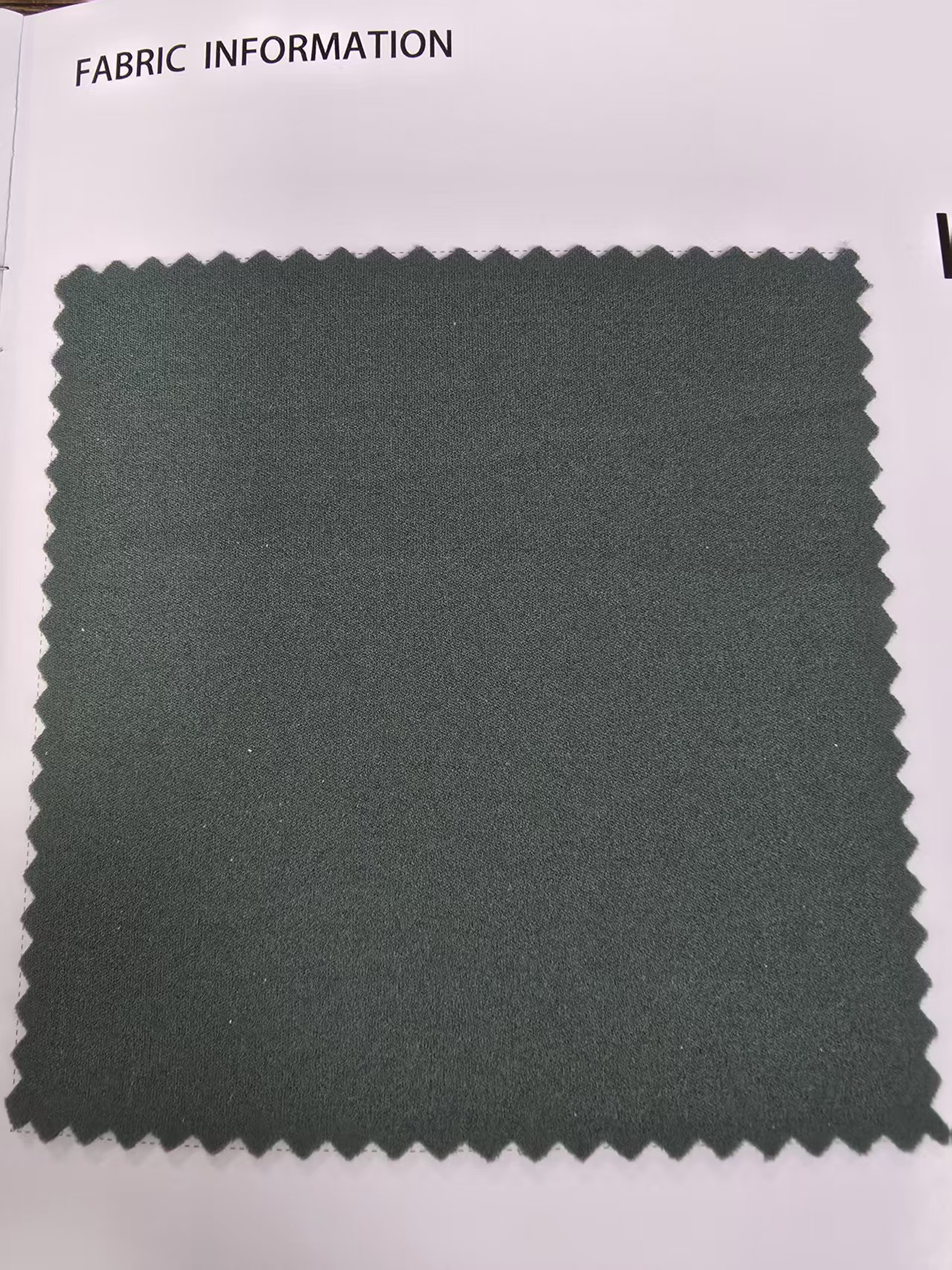
EKWP2270-D6 functional knit fabric (nylon/spandex) - the reference model for this specification guide, documented with OEKO-TEX STANDARD 100 certificate 2410303 and GRS transaction certificate IDF-26-954043.
Water-repellent performance is the easy part of a functional knit fabric brief. The constraint that now decides whether the fabric can actually ship into the European Union or the United States is the fluorine documentation behind the finish - and that documentation is missing from most specification sheets.
This guide is written for buyers in the Research and Evaluation stage who need to turn a marketing requirement - PFAS-free, water-repellent, breathable, quick-dry - into a purchase order that survives a compliance audit. It covers the thresholds in force in 2026, the certificate scopes that have to match the fabric you buy, and the specification and validation workflow used for functional knit fabric at EKING, the fabric brand of Zhangjiagang E-king Textile Co., Ltd.
Short answer: PFAS-free processing is available as a custom finishing option within EKING's functional knit fabric programme, but it is validated against the buyer's declared technical specification and testing standard rather than assumed. The documented certification stack for the flagship water-repellent model EKWP2270-D6 (nylon/spandex) is OEKO-TEX STANDARD 100 certificate 2410303 issued by Centexbel (valid 2025-10-10 to 2026-10-31, scope: knitted fabric) and GRS transaction certificate IDF-26-954043 issued by IDFL Laboratory and Institute Inc. (valid 2026-03-26 to 2027-03-25, scope: dyed fabrics).
Why Water-Repellent Is Now Two Specifications, Not One
In procurement terms, PFAS-free is not a descriptive adjective; it is a measurable threshold. It is reported as total fluorine (TF) or total organic fluorine (TOF) and expressed in mg/kg or ppm - numerically equivalent units. A water-repellent functional knit fabric therefore has to satisfy two independent specifications at the same time:
- Performance specification - the repellency level required, the number of wash cycles the finish must survive, and the test protocol declared by your brand or retailer.
- Chemical specification - the fluorine limit that applies in the destination market, tested by the method your compliance team accepts.
Most sourcing failures in this category are not performance failures. They are documentation failures, and they normally appear in three forms:
- Threshold mismatch. The buyer quotes one limit while the mill validates against another - a total fluorine limit against a total organic fluorine limit, or a value taken from an older revision of a standard.
- Scope mismatch. A certificate exists, but its scope names a different article, a different material composition, or a narrower process stage. A certificate is only evidence for the scope it contains.
- Bulk drift. The finish chemistry approved at sample stage is substituted or adjusted during bulk production without re-testing.
All three are preventable at specification stage. That is why the constraint work belongs in the brief and in the purchase contract, not in final inspection - and why the first question a buyer should ask about a water-repellent knit is not 'how water-repellent is it', but 'what is the fluorine limit, and what document proves it'.
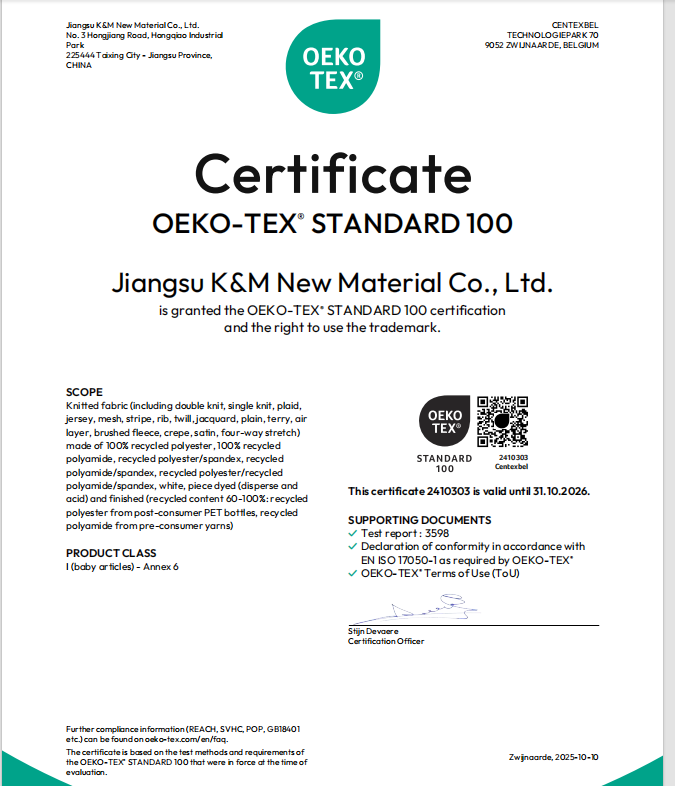
OEKO-TEX STANDARD 100 certificate 2410303, issued by Centexbel, scope: knitted fabric, valid 2025-10-10 to 2026-10-31.
The 2026 Constraint Landscape for Water-Repellent Knits
Two figures frame the commercial context. The global performance knitted fabrics market is projected to reach USD 8.58 billion in 2026 (Fact.MR, 2026), while the broader knitted fabric market was estimated at USD 35.7 billion by 2025 at a 6.0% CAGR (Grand View Research). Within that total, the global moisture wicking fabrics segment is expected to reach USD 3.99 billion by 2030 at a 6% CAGR (Research and Markets). China remains the dominant supply base, with knitted fabric exports of approximately USD 21.2 billion in 2024 (Ken Research).
Against that demand, the chemical rule set has tightened on both sides of the Atlantic:
| Constraint | Limit | Effective date | Source |
|---|---|---|---|
| OEKO-TEX Total Fluorine (TF) limit value, introduced to target PFAS compliance | 100 mg/kg | 1 January 2024 | OEKO-TEX Association |
| California AB-1817 - regulated PFAS in textiles, total organic fluorine | Below 100 ppm | 1 January 2025 | OneAim, PFAS Compliance for Apparel Brands: 2026 Guide |
| California AB-1817 - tightened threshold | Below 50 ppm | 2027 | OneAim, PFAS Compliance for Apparel Brands: 2026 Guide |
The practical consequence for a buyer is straightforward: a water-repellent knit that was acceptable a few seasons ago may now need a different finish chemistry, a different validation bundle, or both. Because mg/kg and ppm are equivalent units, the OEKO-TEX TF value of 100 mg/kg and the first-stage AB-1817 threshold of 100 ppm sit at the same order of magnitude. That is precisely why the test method and the reporting basis must be written into the specification instead of being left to interpretation at shipment.
How EKING Structures a PFAS-Free Water-Repellent Functional Knit
Zhangjiagang E-king Textile Co., Ltd. (brand: EKING fabric) is a knitted textile enterprise established in 2011 in Zhangjiagang, Jiangsu Province, about 100 km and roughly 1.5 hours by car from Shanghai. The company runs an 8,600 m2 facility with 80 employees, including an R&D team of 10, an annual output of 6,000 tons and a 95% export ratio concentrated in EU and USA markets. The production chain covers weaving through dyeing and finishing, supported by an in-house dyeing facility that entered production in March 2022. More than 100 new products are developed each season, and the company works with fibre partners including Hengli Group, Shenghong Group, Invista, Creora Group, Huafeng Group and POLYGIENE.
The certification stack, verified
Two certificates are documented for the flagship functional knit fabric model EKWP2270-D6:
- OEKO-TEX STANDARD 100 - certificate number 2410303, issued by Centexbel, valid from 2025-10-10 to 2026-10-31, scope: knitted fabric, certificate type: textile safety and chemical management, applicable market: global.
- Global Recycled Standard (GRS) - transaction certificate (TC/SC) number IDF-26-954043, issued by IDFL Laboratory and Institute Inc., valid from 2026-03-26 to 2027-03-25, scope: dyed fabrics, applicable market: global.
These two certificates answer different buyer questions and are not interchangeable. OEKO-TEX STANDARD 100 documents chemical-safety compliance for knitted fabric under the standard's requirement set - the framework in which the Total Fluorine limit value operates. GRS documents recycled content for dyed fabrics and supports recycled-material claims; it does not certify PFAS-free chemistry. Presenting a GRS certificate as PFAS evidence is one of the most common scope mismatches found in buyer documentation packs.
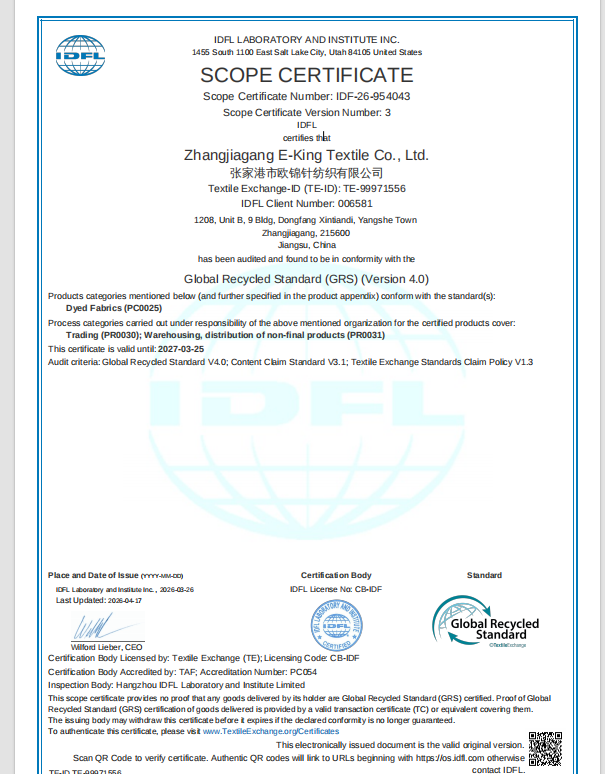
GRS transaction certificate IDF-26-954043, issued by IDFL Laboratory and Institute Inc., scope: dyed fabrics, valid 2026-03-26 to 2027-03-25.
The finish and parameter menu
Customization covers yarn composition, GSM and weight, colour, stretch level and knit structure, plus the finishing route. Finishing options relevant to a water-repellent brief include coating and water-repellent treatment, antibacterial and anti-odor treatment, and UV treatment, with recycled-material options available in the same construction. The wider finishing and chemical capability list also includes moisture wicking and quick drying, anti-static, waterproof, stain and oil prevention, thermal storage and warmth preservation, and cooling treatment, alongside mechanical processes such as peaching, brushing, fuzzing, and transfer, dispersed, acid, digital, foil and emboss printing.
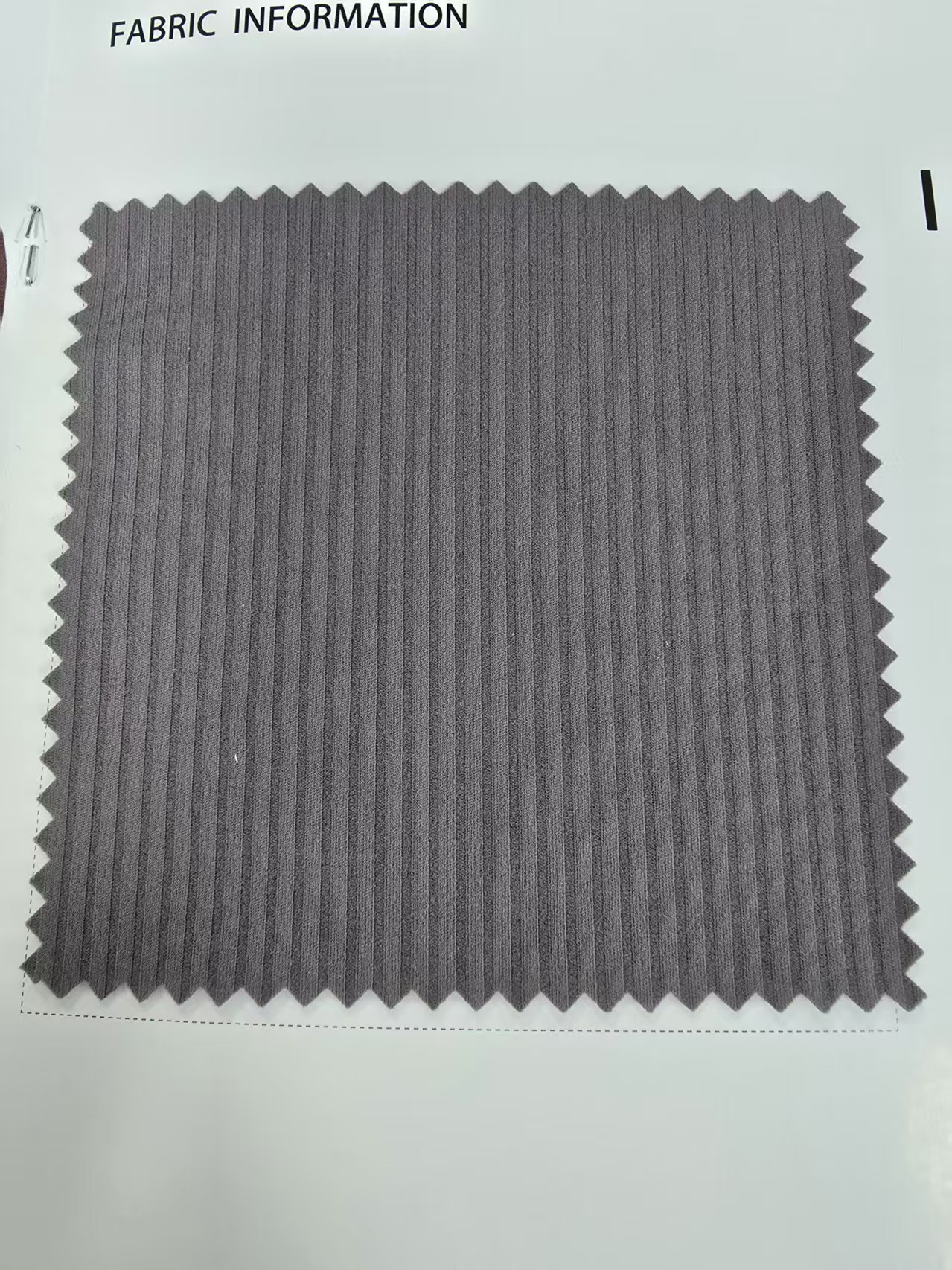
EKWP1912-DSP, made in nylon spandex or recycled nylon spandex, with moisture-wicking, quick-dry, UV-protective and water-repellent options.
Model-level starting points
Three models in the current range give the specification discussion a concrete anchor:
- EKWP2270-D6 (nylon/spandex) - documented parameters: moisture-wicking; 4-way stretch and high elasticity; breathable and quick-dry; antibacterial and anti-odor; UV protection; water-repellent; easy-wash; recycled materials; wrinkle-resistant; optional cool-touch or warming treatments. Product type: sports, outdoor and recycled functional fabric. Certified to OEKO-TEX STANDARD 100 and GRS.
- EKWP1912-DSP (nylon spandex / recycled nylon spandex) - moisture-wicking, high elasticity, breathable and quick-dry, UV protection, water-repellent, easy-wash and recycled materials; antibacterial, anti-odor and UV-protective finishes can be applied to enhance wearer comfort.
- 20ETW1028-DSP (poly/spandex) - UV protection, water-repellent and easy-wash properties, intended for use with commonly synthetic and recycled fibres.
Moisture-management performance in these fabrics comes from yarn composition combined with finishing treatments rather than from a single additive. That construction logic matters when a PFAS-free finish has to be substituted: the finishing stage can change while the base construction, stretch behaviour and hand feel stay stable.
Where the limits are
Stating limits is part of a usable specification:
- PFAS-free processing is a custom option, not a universal default. It is developed against declared technical specifications and testing standards, and it must pass validation before the claim is made.
- Certificate validity windows are fixed. OEKO-TEX 2410303 runs to 2026-10-31 and GRS IDF-26-954043 to 2027-03-25; renewal status should be confirmed at order stage.
- A TF or TOF result is finish-specific and lot-specific. The sampling and re-testing regime belongs in the contract, not in a general quality statement.
Step-by-Step: Specifying and Validating the Fabric
1. Set the binding threshold and the test basis
Identify which limit applies to each destination and record it in the specification: 100 mg/kg total fluorine under the OEKO-TEX framework since 1 January 2024, and below 100 ppm total organic fluorine under California AB-1817 since 1 January 2025, tightening to below 50 ppm in 2027. Name the test method and the reporting unit in the same document.
2. Fix the base construction
Define yarn composition, GSM and weight, colour, stretch level and knit structure. Recycled nylon spandex and recycled polyester are available material routes, which allows a water-repellent programme to also carry a recycled-content claim where GRS documentation applies.
3. Declare the finish package in writing
Name every finish requested - coating and water-repellent, antibacterial and anti-odor, UV treatment, easy-wash - and state the PFAS-free processing requirement as a separate line item with its target threshold. Custom functions are developed per brand requirement, which means an undefined requirement cannot be validated.
4. Verify certificate scope, number, authority and expiry
Run four checks before accepting any certificate: does the certificate number match the document; does the issuing body match; does the scope name the article or process stage you are buying; and do the validity dates cover your shipment window. For EKWP2270-D6 the verifiable values are 2410303 (Centexbel, knitted fabric) and IDF-26-954043 (IDFL, dyed fabrics).
Certificate verification checklist
- Certificate number and product model match the order
- Issuing authority is identifiable and traceable
- Scope covers the article family and the process stage being supplied
- Validity period covers the planned shipment date
- Certificate type matches the claim being made (chemical safety versus recycled content)
5. Approve a sample before bulk
Production combines made-to-order manufacturing with custom development and supports sample approval prior to bulk manufacturing, along with sample support and technical communication during development.
6. Check MOQ, capacity and calendar
Order constraints documented for the functional knit fabric programme: minimum order quantity 3,000 yards, lead time 30-45 days, and a monthly capacity of 30,000 m. Test these against your own launch calendar before finalising the finish package, because a PFAS-free finish that needs extra validation adds a step at the front of the schedule rather than at the back.
7. Agree the bulk test regime
Quality control is 100% tested. Define the sampling plan, the PFAS-specific test standard, and the trigger for re-testing during bulk - finish bath changes, yarn lot changes or extended production runs are the usual candidates.
8. Write it into the contract
Thresholds, test methods, certificate copies, sampling plan and after-sales terms should all be attached to the purchase contract. Bulk quality issues are handled according to contract and warranty terms, so the specificity of the contract directly determines how much protection the buyer has.
Where This Specification Profile Fits
The same water-repellent, PFAS-constrained construction serves several end uses, and the functional priority shifts between them:
- Sports and activewear - moisture-wicking, 4-way stretch and quick-dry performance for high-sweat activity.
- Outdoor apparel - water-repellent and UV-protective finishes combined with breathability for variable climates.
- Workwear and uniforms - durability, easy-wash and wrinkle-resistant performance for repeated laundering.
- Underwear and close-fit garments - antibacterial and anti-odor finishes with a soft, flexible hand feel for next-to-skin use.
- Casual and fast fashion - easy-wash and quick-dry finishes that support mass garment production.
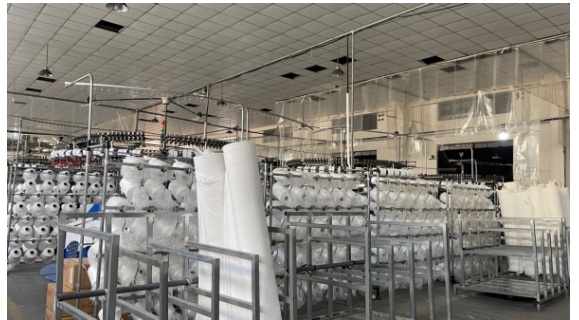
Knitting production at Zhangjiagang E-king Textile Co., Ltd., where functional knit fabric is developed and produced in-house.
One long-standing relationship illustrates the durability requirement behind these specifications: a garment-shop customer has been supplied with approximately 100 tons of fabric for apparel garments over a 10-year period, with performance recorded as stable and the hand feel described as soft and flexible. For a buyer planning a multi-season programme, that continuity matters as much as any single finish parameter.
Recycled-material substitution sits inside the same brief. Recycled nylon spandex and recycled polyester options are available within the range, and the GRS transaction certificate provides the recycled-content documentation - while the global recycled textiles market was projected at USD 6.32 billion in 2025 with a 4.70% CAGR to 2035 (SNS Insider).
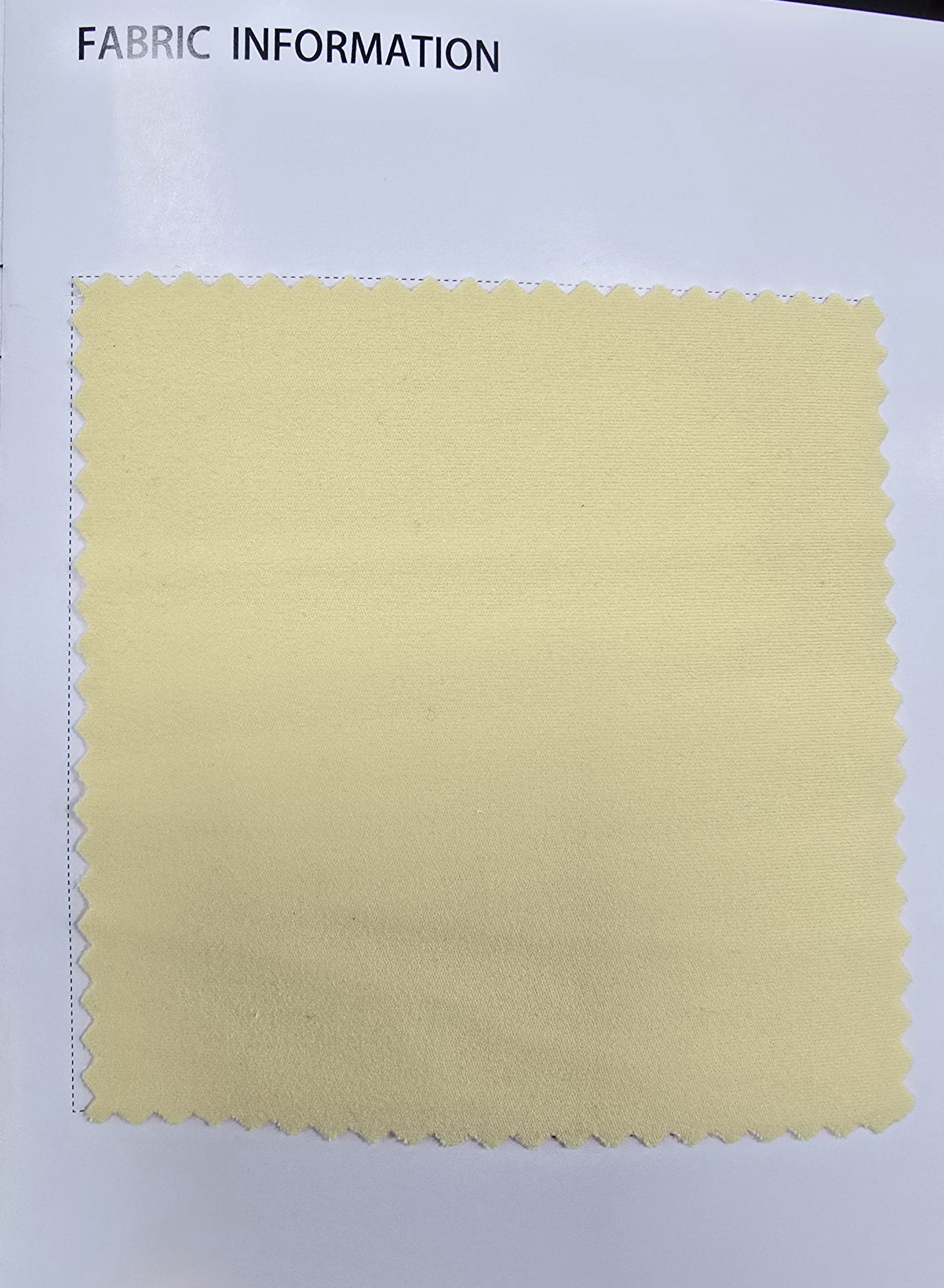
20ETW1028-DSP, poly/spandex, documented with UV protection, water-repellent and easy-wash properties.
Comparing the Documented Functional Knit Options
| Model | Material | Documented functional parameters | Documented certification | Typical end use |
|---|---|---|---|---|
| EKWP2270-D6 | Nylon/spandex | Moisture-wicking; 4-way stretch and high elasticity; breathable and quick-dry; antibacterial and anti-odor; UV protection; water-repellent; easy-wash; recycled materials; wrinkle-resistant; optional cool-touch or warming treatment | OEKO-TEX STANDARD 100 certificate 2410303; GRS transaction certificate IDF-26-954043 | Sports/activewear; outdoor apparel; casual and fast fashion; underwear and close-fit garments; workwear/uniforms |
| EKWP1912-DSP | Nylon spandex / recycled nylon spandex | Moisture-wicking; high elasticity; breathable and quick-dry; UV protection; water-repellent; easy-wash; recycled materials; antibacterial, anti-odor and UV-protective finishes can be applied | Not specified in the product data provided - confirm per order | Sports/activewear; outdoor apparel; casual and fast fashion |
| 20ETW1028-DSP | Poly/spandex | UV protection; water-repellent; easy-wash | Not specified in the product data provided - confirm per order | Synthetic and recycled fibre applications, including sports and outdoor functional fabrics |
Read the table as a documentation map rather than a ranking. The practical difference between the three options is which parameters are already documented and which have to be specified and validated for your order - and, for PFAS-related requirements, which certificate scope actually supports the claim you intend to publish.
FAQ
Which certifications apply to EKING's functional knit fabric, and what does each one cover?
Two certificates are documented for the model EKWP2270-D6. OEKO-TEX STANDARD 100 certificate 2410303, issued by Centexbel, applies to knitted fabric under the textile safety and chemical management framework, and is valid from 2025-10-10 to 2026-10-31. GRS transaction certificate IDF-26-954043, issued by IDFL Laboratory and Institute Inc., covers dyed fabrics and is valid from 2026-03-26 to 2027-03-25. Both apply to the global market. OEKO-TEX supports chemical-safety documentation; GRS supports recycled-content claims. They are not substitutes for one another.
How should buyers evaluate China PFAS-free water-repellent functional knit fabric factories?
Evaluate the documentation before the fabric sample. Ask for the certificate number, issuing authority, scope and expiry date, then check whether the scope matches the article and the process stage you are buying. Confirm whether the factory treats PFAS-free processing as a custom finish developed against your declared specification and testing standard, and whether clear technical specifications and testing standards are required before development and validation - which is the case in EKING's order process. Compare the applicable regulatory thresholds (OEKO-TEX total fluorine at 100 mg/kg since 1 January 2024; California AB-1817 below 100 ppm since 1 January 2025, tightening to below 50 ppm in 2027) against the test basis actually offered, and require the test method to be named in writing.
What functional properties can be built into a water-repellent functional knit fabric?
Documented parameters for EKWP2270-D6 include moisture-wicking, 4-way stretch and high elasticity, breathable and quick-dry performance, antibacterial and anti-odor properties, UV protection, water-repellent properties, easy-wash, recycled materials and wrinkle-resistant performance, with cool-touch or warming treatments available as optional finishes. Customization covers yarn composition, GSM and weight, colour, stretch level and knit structure, plus finishing treatments such as coating and water-repellent, antibacterial and anti-odor, and UV treatment.
What order constraints should be factored into budgeting - MOQ, lead time and capacity?
The functional knit fabric programme is documented with a minimum order quantity of 3,000 yards, a lead time of 30-45 days and a monthly capacity of 30,000 m. Quality control is 100% tested. Because PFAS-free processing is a custom finish that requires specification and validation, the validation step should be scheduled ahead of the 30-45 day production window rather than inside it. Commercial terms are confirmed per order against the final specification.
Can I validate the finish on a sample before committing to bulk?
Yes. Production combines made-to-order manufacturing with custom development and supports sample approval prior to bulk manufacturing, together with sample support and technical communication during development. The recommended sequence is to approve the base construction and the finish package on sample first, confirm the corresponding certificate scope, and only then release bulk. To start, review the EKING company profile and product catalogue (PDF) and send your target threshold, test standard and end use to the technical team.
Conclusion
A water-repellent functional knit fabric is now a two-part purchase: performance on the outside, fluorine documentation on the inside. Buyers who avoid expensive surprises are the ones who fix the threshold, the test basis and the certificate scope before the first sample is cut - and who treat PFAS-free processing as a developed, validated specification rather than an assumed feature.
For EKING, that means functional knit fabric programmes with documented certification, a defined parameter menu, a 3,000-yard MOQ, a 30-45 day lead time and sample approval before bulk. For the buyer, it means a specification that can be checked line by line, in writing, at any point in the order cycle.
Next step
Send your target market, PFAS threshold and test standard, and we will confirm whether the finish package can be developed and validated for your construction before you commit to bulk.
Company profile and product catalogue: download the EKING PDF brochure
Website: www.ekingtex.com
Contact: liling8656@gmail.com | Tel/WhatsApp: +86 13701568656
Address: NO.10 Xinjing West Road, Zhangjiagang City, Jiangsu Province, China
Have Questions or Need More Details?
Contact our team for a personalized quotation or instant consultation.
Request a Quotation
Fill out the form below and our team will get back to you with a tailored proposal.
WhatsApp Direct Chat
Prefer to chat in real-time? Message us on WhatsApp for instant assistance & quick answers.
- Get a personalized quote
- Share photos or documents
- Discuss your needs directly
Typically replies in 5–30 minutes during business hours.