PFAS-Free Water-Repellent Functional Knit Fabric: A Sourcing Constraint Guide
A PFAS-free water-repellent functional knit fabric is a knitted fabric whose water repellency is produced without intentionally added per- and polyfluoroalkyl substances (PFAS), and whose fluorine content can be documented against a stated limit instead of being described only as “water repellent”. For buyers in the research and evaluation stage, that changes the sourcing question: it is no longer whether a mill in China can produce water-repellent knit fabric, but whether that mill can supply a finish together with certificate coverage and fluorine documentation that match the exact fabric being shipped. Zhangjiagang E-King Textile Co., Ltd., which trades as EKING fabric, is a functional knit fabric manufacturer based in Zhangjiagang, Jiangsu Province, China, and states PFAS-free processing among the customized functions it can develop on request.
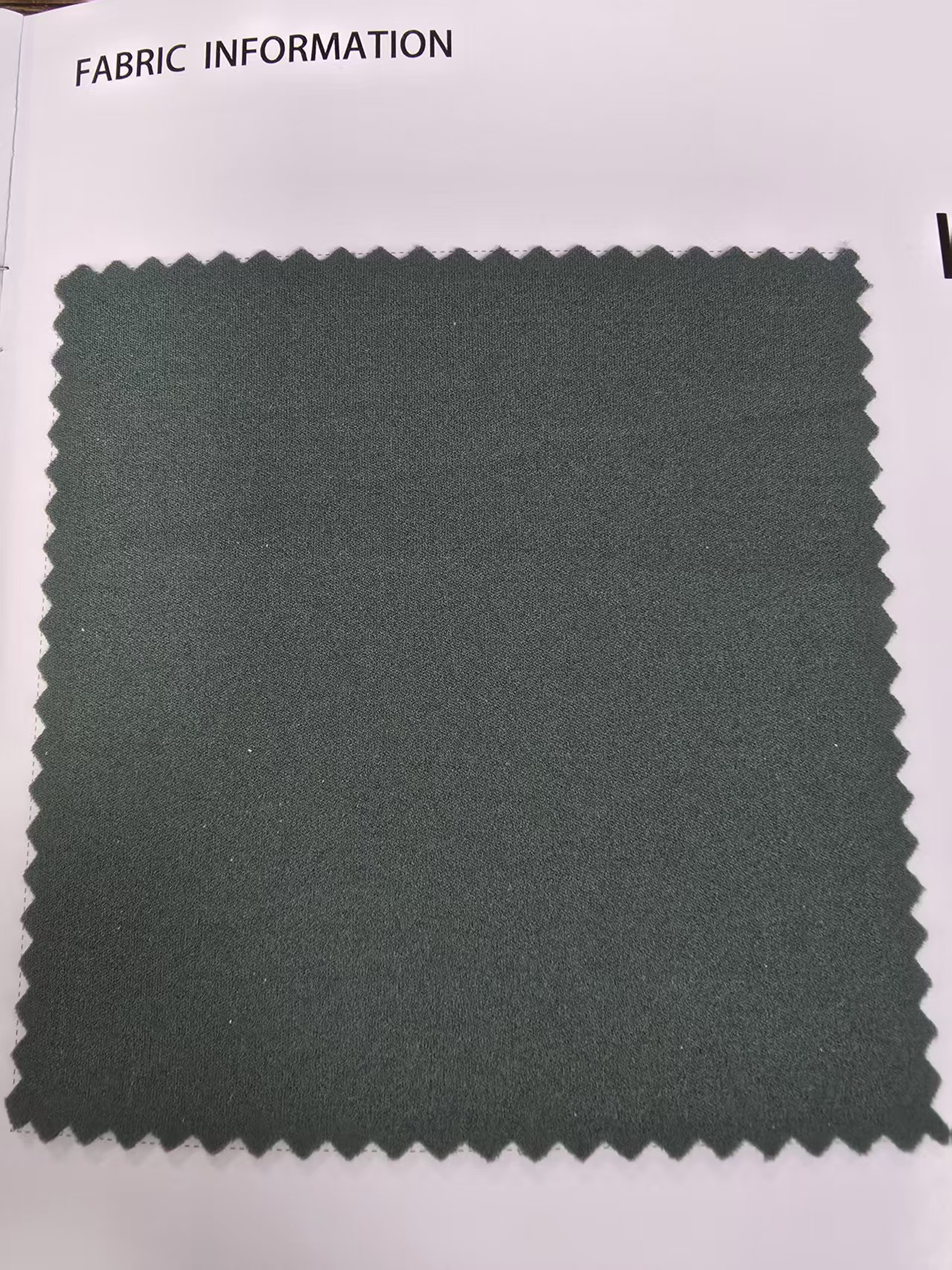
EKWP2270-D6 is a nylon/spandex functional knit fabric covered by OEKO-TEX STANDARD 100 certificate 2410303 and GRS transaction certificate IDF-26-954043.
1. Problem Definition: Why “Water Repellent” Is No Longer a Complete Specification
A water-repellent claim on its own no longer tells a buyer whether the fabric can be used in the European Union or the United States. Two published thresholds define the constraint. OEKO-TEX introduced a new limit value for Total Fluorine (TF) of 100 mg/kg in STANDARD 100, effective 1 January 2024, explicitly targeting PFAS compliance. In the United States, California AB-1817 bans regulated PFAS in textiles at a total organic fluorine level below 100 ppm from 1 January 2025, tightening to below 50 ppm in 2027.
Those two thresholds convert an ordinary fabric brief into a documentation problem. Four failure points recur when buyers evaluate suppliers at this stage:
- The claim has no measurable anchor. A specification that says “water repellent” without a fluorine limit or a named test method cannot be checked against either the OEKO-TEX TF value or the California AB-1817 threshold.
- The certificate scope does not match the goods. A valid certificate is only useful if its scope names the fabric type or the specific model that will be shipped.
- The validity window closes too early. Certificates have expiry dates; an order whose bulk production completes after expiry leaves the shipment unverifiable at delivery.
- Two functions pull against each other. Water repellency resists liquid water at the surface, while moisture-wicking and quick-dry performance move perspiration away from the skin. In general terms, the two effects are achieved through different surface and structural mechanisms, so a finish recipe has to be balanced rather than maximized on one side.
The result is that a water-repellent functional knit fabric specification is now a two-part document: a performance part (repellency, stretch, moisture management, easy-wash) and a constraint part (fluorine limit, finishing chemistry, certificate scope, certificate validity).
2. Industry Background: Volume Growth Inside a Tightening Chemistry Constraint
Demand for functional knits continues to expand. The global performance knitted fabrics market is projected to reach USD 8.58 billion in 2026, according to Fact.MR, while Grand View Research estimated the broader knitted fabric market at USD 35.7 billion by 2025 with a CAGR of 6.0%. China remains the central supply base for that volume: China’s exports of knitted fabrics reached approximately USD 21.2 billion in 2024, based on Ken Research trade data for HS code 60.
Within the category, the function sets that carry the highest compliance exposure are also the fastest growing. Research and Markets expects the global moisture wicking fabrics market to reach USD 3.99 billion by 2030 at a 6% CAGR, and SNS Insider projects the recycled textiles market at USD 6.32 billion in 2025, growing at 4.70% CAGR to 2035. Both directions push the same way: more fabrics carry a chemical finish and a recycled-content claim at the same time, so the paperwork burden per order rises even when the physical product looks similar to what was bought three years ago.
The practical shift for procurement teams is that differentiation has moved from “can you make it” to “can you prove it”. Two mills can quote the same knit construction and the same set of listed functions, yet only one of them can attach a certificate whose scope covers the shipped model and a fluorine statement that survives a brand’s compliance review.
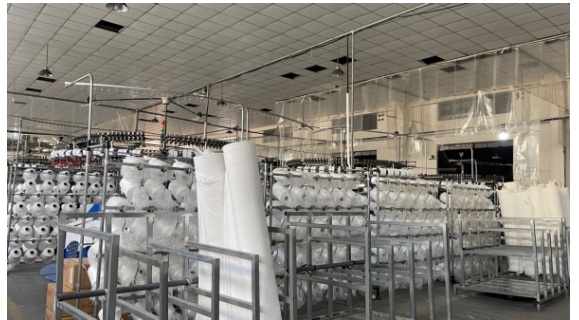
Knitting production at EKING fabric in Zhangjiagang, Jiangsu Province, China.
3. What a Documented PFAS-Free Supply Actually Looks Like
Zhangjiagang E-King Textile Co., Ltd. is a knitted textile enterprise located in Zhangjiagang, a city in the Yangtze Delta approximately 100 km from Shanghai and about 1.5 hours away by car. Established in 2011, EKING fabric integrates R&D, design, production, processing and domestic and international sales, with an industrial chain that runs from weaving to dyeing and finishing. The company states an 8,600 m² facility, 80 employees, a 10-person R&D team, an annual output of 6,000 t (about 24 million yards) of fabric, more than 100 newly developed products each season, an export ratio of approximately 95%, and main markets in the EU and the USA. Its own dyeing factory went into production in March 2022, which extended the controlled portion of the production chain. The company also reports cooperation with Hengli Group, Shenghong Group, Invista, Creora Group, Huafeng Group and POLYGIENE.
On the specific constraint of water repellency without PFAS, the relevant first-party fact is a stated customization capability: EKING fabric can customize functions according to brand requirements, including PFAS-free processing, specific antibacterial agents and recycled materials. The same source notes the boundary condition that comes with it — clear technical specifications and testing standards are needed for development and validation. Water-repellent finishing is listed among the company’s available finishes, alongside UV protection, antibacterial and anti-odor treatment, moisture-wicking and quick-drying treatment, anti-static, stain and oil prevention, thermal storage and warmth preservation, and cooling treatment. Mechanical and print finishes include peaching, brushing, fuzzing, transfer printing, dispersed printing, acid printing, digital printing, foil and emboss.
Because PFAS-free processing is a customization rather than a catalogue item, the buyer’s specification quality determines the outcome. The customization variables EKING fabric accepts are yarn composition, GSM and weight, color, stretch and knit structure, finishing type, and the use of recycled materials.
Three functional knit fabric models are relevant to a water-repellent program, and they differ in material base and in how much of the function bundle they carry.
| Model | Material | Listed functional parameters | Typical applications |
|---|---|---|---|
| EKWP2270-D6 | nylon/spandex | moisture-wicking; 4-way stretch and high elasticity; breathable/quick-dry; antibacterial/anti-odor; UV protection; water-repellent; easy-wash; recycled materials; wrinkle-resistant; optional cool-touch or warming treatments | sports/activewear; outdoor apparel; casual/fast fashion; underwear and functional close-fit garments; workwear/uniforms |
| EKWP1912-DSP | nylon spandex / recycled nylon spandex | moisture-wicking; high elasticity; breathable/quick-dry; UV protection; water-repellent; easy-wash; recycled materials | sports/activewear; outdoor apparel; casual/fast fashion |
| 20ETW1028-DSP | poly/spandex | UV protection; water-repellent; easy-wash | sports/activewear; outdoor apparel; casual/fast fashion; commonly synthetic and recycled fibers |
Model data as published by EKING fabric. Product type across the range includes sports functional fabrics, outdoor functional fabrics and recycled functional fabrics.
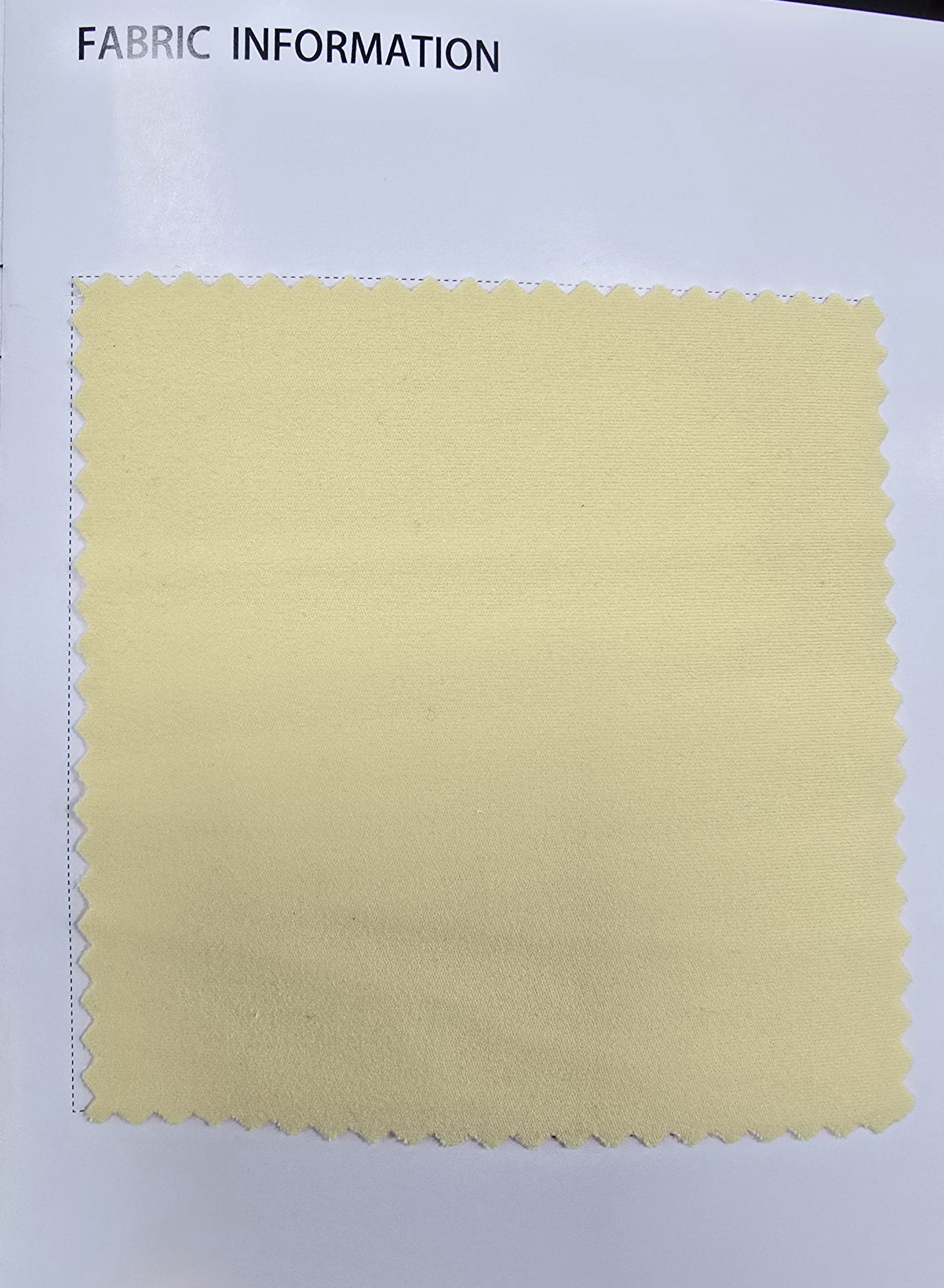
20ETW1028-DSP is a poly/spandex functional knit fabric finished with UV protection, water-repellent and easy-wash properties.
4. Certificate Scope: The Detail That Decides Whether a Claim Is Usable
Certification only transfers value when three elements line up: the certificate body, the certificate scope, and the model being purchased. For functional knit fabric model EKWP2270-D6 (nylon/spandex), two certificates are documented.
- OEKO-TEX STANDARD 100, certificate number 2410303, issued by Centexbel, in the scope of knitted fabric, under the textile safety and chemical management category, applicable to the global market, issued 2025-10-10 and valid to 2026-10-31.
- GRS transaction certificate (TC/SC), number IDF-26-954043, issued by IDFL Laboratory and Institute Inc. under the Global Recycled Standard, with a scope of dyed fabrics, applicable to the global market, issued 2026-03-26 and valid to 2027-03-25.
Read those dates as procurement instructions rather than background information. The OEKO-TEX certificate is valid until 31 October 2026, so any purchase order whose shipment is expected after that date should be confirmed against the certificate version in force at the time of production. The GRS scope is written as dyed fabrics, which matters because a recycled-content claim on a greige roll and a recycled-content claim on a dyed, finished roll are not the same documentary object.
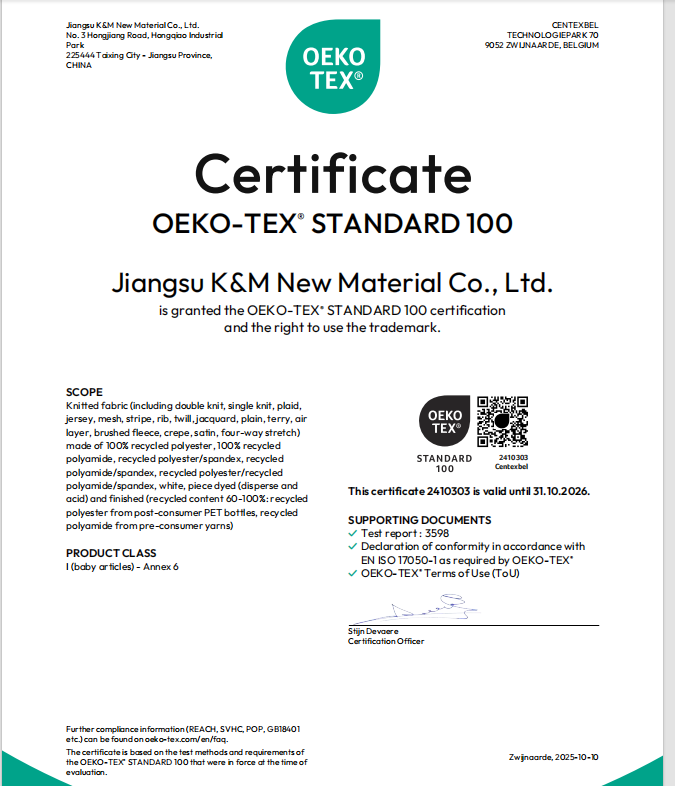
OEKO-TEX STANDARD 100 certificate 2410303, issued by Centexbel, covering knitted fabric for model EKWP2270-D6.
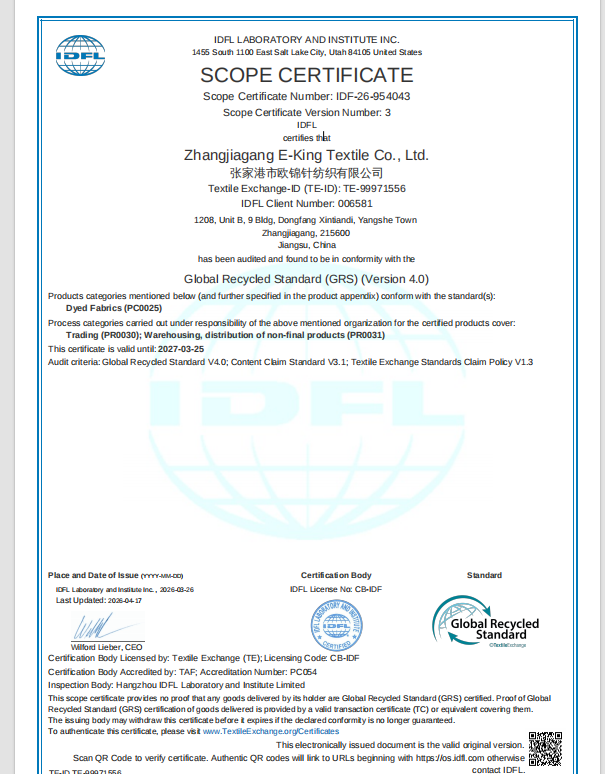
GRS transaction certificate IDF-26-954043, issued by IDFL Laboratory and Institute Inc., with a scope of dyed fabrics.
5. Step-by-Step: Verifying a PFAS-Free Water-Repellent Knit Supplier
Step 1 — Write the constraint into the brief
State the fluorine limit and the test method in the enquiry, not after sampling. The reference points are the OEKO-TEX Total Fluorine limit value of 100 mg/kg in STANDARD 100 and the California AB-1817 thresholds of below 100 ppm total organic fluorine from 2025 and below 50 ppm in 2027.
Step 2 — Fix the function bundle before the finish
Decide which functions must coexist. EKWP2270-D6, for example, combines water repellency with moisture-wicking, breathable/quick-dry, 4-way stretch, antibacterial/anti-odor, UV protection, easy-wash, wrinkle resistance and recycled materials, with optional cool-touch or warming treatments. Each added function changes the finishing route, so the bundle should be locked before the recipe is developed.
Step 3 — Confirm the certificate scope and validity against the model
Check that the certificate names the knitted fabric scope and the model, and that the validity window covers the planned production date. Where recycled content is claimed, confirm whether the transaction certificate scope matches the dyed fabric that will ship.
Step 4 — Validate on a sample before bulk
EKING fabric operates a combination of made-to-order production and custom development, and supports sample approval prior to bulk manufacturing. Sampling and small-batch pilot production are part of its production mode, and an internal lab is used for testing. Because PFAS-free processing requires clear technical specifications and testing standards, the sample stage is where the fluorine limit and the performance target should be tested together rather than separately.
Step 5 — Confirm commercial terms
EKING fabric states a minimum order quantity of 3,000 y, a lead time of 30–45 days, 100% testing, and export markets in the EU and the USA. Development work on a new PFAS-free recipe should be scheduled inside that lead time rather than added to it.
Step 6 — Put quality control and after-sales in the contract
The company provides sample support and technical communication, and states that bulk issues are handled according to contract and warranty terms. Specific after-sales policies should therefore be confirmed by the supplier and written into the contract, so that a finish-related claim at delivery has a defined route.
6. Where PFAS-Free Water-Repellent Functional Knit Fabric Is Used
The function bundle, not the end product alone, determines whether a PFAS-free water repellent is the right route. Five application groups are documented for this product range.
- Sports and fitness. High activity generates sweat, so water repellency is usually paired with moisture-wicking and quick-dry performance rather than used alone. EKWP1912-DSP and EKWP2270-D6 both list moisture-wicking, high elasticity, breathability and quick-dry behavior.
- Outdoor apparel. Variable climates require breathability, UV protection and quick drying at the same time as light water repellency, which is why the outdoor fabric type appears across all three models.
- Workwear and uniforms. Durability and repeated washing dominate, so easy-wash and wrinkle-resistant performance matter as much as the repellent finish. EKWP2270-D6 lists easy-wash and wrinkle resistance and is specified for workwear/uniforms.
- Underwear and functional close-fit garments. Here the priority is 4-way stretch, softness and moisture management; the field-use description for this product family records softness and flexibility as the characteristics clients rely on.
- Casual and fast fashion. Easy-wash and quick-dry finishes support mass garment production, and recycled material options support sustainable sourcing commitments.
A garment-shop client has purchased fabric for apparel garments from EKING fabric for 10 years, in quantities of 100 t, with the reported result of stable performance and the reported highlight of softness and flexibility. For a buyer considering a chemistry change, that is the relevant precedent: the function change has to survive the same long-run production pressure as the base fabric.
7. Comparison Tables
Certificate comparison for EKWP2270-D6
| Certificate | Standard | Number | Issuing authority | Scope | Validity |
|---|---|---|---|---|---|
| OEKO-TEX | OEKO-TEX STANDARD 100 | 2410303 | Centexbel | Knitted fabric; textile safety/chemical management; global market | 2025-10-10 to 2026-10-31 |
| GRS | Global Recycled Standard | IDF-26-954043 (TC/SC) | IDFL Laboratory and Institute Inc. | Dyed fabrics; global market | 2026-03-26 to 2027-03-25 |
Regulatory reference points for fluorine in textiles
| Reference | Limit | Effective date | Jurisdiction |
|---|---|---|---|
| OEKO-TEX STANDARD 100 — Total Fluorine (TF) limit value | 100 mg/kg | 2024-01-01 | Global / EU / US |
| California AB-1817 — regulated PFAS in textiles | Below 100 ppm total organic fluorine | 2025-01-01 | California, USA |
| California AB-1817 — tightened threshold | Below 50 ppm total organic fluorine | 2027 | California, USA |
8. FAQ
Does a PFAS-free water-repellent finish still comply with OEKO-TEX STANDARD 100?
Not automatically, and not by name. OEKO-TEX introduced a new Total Fluorine (TF) limit value of 100 mg/kg in STANDARD 100 effective 1 January 2024, aimed at PFAS compliance, so a water-repellent finish is judged against a fluorine limit rather than excluded categorically. In practice, compliance depends on the finish chemistry staying under the applicable limit and the certificate covering the fabric that ships. EKING fabric holds OEKO-TEX STANDARD 100 certificate 2410303, issued by Centexbel, covering knitted fabric for model EKWP2270-D6, which is valid from 2025-10-10 to 2026-10-31.
Can a factory in China develop water-repellent functional knit fabric without PFAS?
Yes, and the constraint is specification quality rather than capability alone. EKING fabric states that it can customize functions according to brand requirements, including PFAS-free processing, specific antibacterial agents and recycled materials, and it notes that clear technical specifications and testing standards are required for development and validation. The finishing toolkit it publishes includes water-repellent, UV protection, antibacterial and anti-odor, moisture-wicking and quick-drying, anti-static, cooling and warming treatments, applied to nylon/spandex, recycled nylon spandex and poly/spandex constructions.
What drives the cost of PFAS-free water-repellent functional knit fabric?
Cost is determined by the specification rather than by a list price, so a quotation only becomes meaningful once the function bundle is fixed. The variables that move the commercial band are the number of finishing steps in the recipe, whether a fluorine-free chemistry replacement is required, whether recycled material content is specified, the testing and documentation package attached to the order, the order size relative to the stated minimum order quantity of 3,000 y, and how many development rounds the finish requires before sample approval. EKING fabric confirms commercial terms per order; buyers should request a quotation against a locked specification so the same basis is compared across suppliers.
How is a PFAS-free water-repellent knit sample validated before bulk production?
Validation starts before the sample is made, because the supplier needs the technical specification and the testing standard to develop the finish. EKING fabric combines made-to-order production with custom development and supports sample approval prior to bulk manufacturing; sampling and small-batch pilot production are part of its production mode, and an internal lab supports testing, with 100% testing stated for production. For a PFAS-free program, the sample stage should confirm both the fluorine limit and the performance target — repellency, moisture management and easy-wash — so that the approved sample becomes the bulk reference.
What is the lead time and minimum order for PFAS-free water-repellent functional knit fabric?
EKING fabric states a lead time of 30–45 days and a minimum order quantity of 3,000 y, with 100% testing and export markets covering the EU and the USA. Where the finish is a new development rather than an existing recipe, buyers should treat the specification and sampling work as the front end of that window. To start a specification review, request a sample or a quotation with your function bundle from Zhangjiagang E-King Textile Co., Ltd. at liling8656@gmail.com or via WhatsApp on +86 13701568656.
Conclusion
Sourcing waterproof-looking knit fabric is easy; sourcing a water-repellent functional knit fabric whose fluorine position can be documented is not. The constraint layer is now part of the product: a named fluorine limit, a finish chemistry that avoids intentionally added PFAS, a certificate whose scope and validity cover the shipped model, and a sample approved against the same test standard that governs bulk. Buyers who write those four items into the brief before requesting a quotation avoid the most common failure — a technically acceptable fabric that cannot be cleared by their own compliance team.
Zhangjiagang E-King Textile Co., Ltd. (EKING fabric) manufactures functional knit fabric in Zhangjiagang, Jiangsu Province, China, with an integrated chain from weaving to dyeing and finishing, an annual output of 6,000 t and approximately 95% of sales exported to the EU and the USA. Buyers evaluating PFAS-free processing can review the company profile pack or send a full function bundle for technical feedback and sampling.
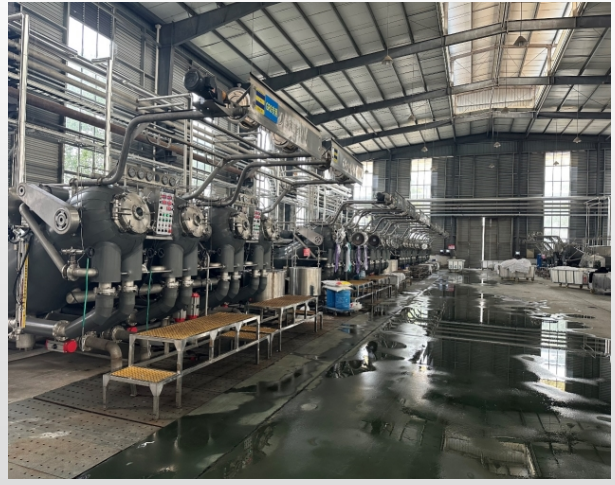
Dyed functional knit fabric lots prepared for inspection and shipment.
Next step: send your PFAS-free specification for review
Share your function bundle, target fluorine limit and test standard to receive technical feedback, a sample plan and a quotation. Minimum order quantity 3,000 y, lead time 30–45 days.
Company profile pack (PDF, public download): Download the EKING fabric company profile
Contact: Lilin · Email liling8656@gmail.com · Tel/WhatsApp +86 13701568656 · Website www.ekingtex.com
Address: NO.10 Xinjing West Road, Zhangjiagang City, Jiangsu Province, China.
Have Questions or Need More Details?
Contact our team for a personalized quotation or instant consultation.
Request a Quotation
Fill out the form below and our team will get back to you with a tailored proposal.
WhatsApp Direct Chat
Prefer to chat in real-time? Message us on WhatsApp for instant assistance & quick answers.
- Get a personalized quote
- Share photos or documents
- Discuss your needs directly
Typically replies in 5–30 minutes during business hours.