What Is Functional Knit Fabric? A Buyer's Introduction to Performance Knits
Functional knit fabric is a knitted textile engineered to deliver a defined performance property — moisture wicking, 4-way stretch, breathability, quick-dry behaviour, UV protection, water repellency or odor control — rather than appearance or hand feel alone. The functional element is not a single fiber. It is the combination of yarn, knit structure and finishing that a buyer has to specify, sample and verify.
This introduction is written for buyers who are new to the category: brand owners, sourcing managers, product developers and importers who have been quoted “functional knit fabric” and now need to know what is actually being sold, which questions separate one offer from another, and how to move from evaluation to a first bulk order without discovering the gap at bulk stage.
It covers three things in sequence — the categories the market uses, the constructions you will be quoted most often, and the four performance concepts that decide whether a specification is complete. Commercial parameters such as MOQ, lead time and documentation are handled at the end, followed by a short FAQ.
The Buyer's Problem: “Functional” Is a Claim Until It Is Specified
Functional knit fabric is usually sold through a short list of adjectives, and those adjectives travel badly between supplier, buyer and factory. Three patterns cause most first-order problems.
- Buying by fiber name. A nylon/spandex knit and a moisture-wicking nylon/spandex knit can carry the same composition line on the label. The performance difference sits in yarn selection, knit structure and finishing, none of which appear in a composition description.
- Buying by hand feel. Softness, coolness and stretch recovery on a hand sample are not evidence of wicking rate or colour stability after repeated home laundering.
- Accepting verbal claims. “Quick dry”, “anti odor”, “UV protective” and “easy-wash” mean different things depending on the test behind them. Without the test method and the report, the buyer carries the risk.
A workable definition for procurement purposes is therefore narrower than the marketing one: functional knit fabric is a knit in which at least one performance attribute has been designed in, can be measured, and can be documented. That definition gives a new buyer three things to manage — the specification, the sample, and the file.
Industry Background: A Large, Fragmented Category
Global performance knitted fabrics were projected to reach USD 8.58 billion in 2026, according to Fact.MR, while the broader knitted fabric market was estimated at USD 35.7 billion by 2025 by Grand View Research. The distance between those two figures is roughly the distance between “engineered for a performance end use” and “all knitted fabric”. China's knitted fabric exports reached approximately USD 21.2 billion in 2024, per Ken Research — a practical reason most first-time buyers end up evaluating Chinese mills.
Two sub-segments move on their own curves. Moisture wicking fabrics are expected to grow to USD 3.99 billion by 2030 at a 6% CAGR, according to Research and Markets, and the recycled textiles market was projected at USD 6.32 billion in 2025 by SNS Insider. For a buyer, the useful conclusion is not the headline number. It is that supply is broad enough that specification quality — not availability — decides whether a program runs smoothly.
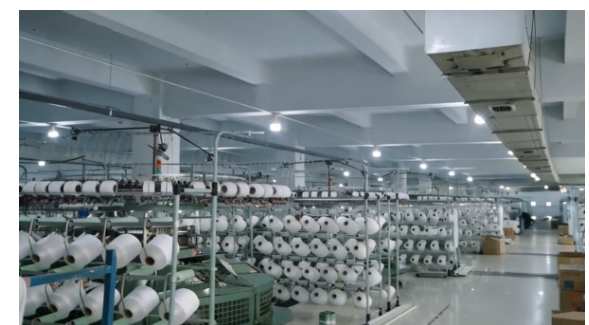
EKING fabric is the fabric brand of Zhangjiagang E-king Textile Co., Ltd., a knitted fabric manufacturer founded in 2011 in Zhangjiagang, Jiangsu, China, operating an 8,600 m² facility with 80 employees, a 10-person R&D team and an annual output of 6,000 tonnes, exporting about 95% of output to EU and USA markets. It appears in this article only as a worked example of how the category is specified and quoted.
The Three Functional Categories New Buyers Meet First
Most first enquiries land in one of three buckets. Knowing which bucket a project belongs to determines which performance attributes matter and which can be left alone.
Sports functional fabrics
Sports functional fabrics are built around movement and sweat. The typical requirement set is moisture wicking, 4-way stretch, breathability, quick dry and recovery — the fabric has to move with the body, release heat and return to shape. This is also the category where the finishing menu is widest: antibacterial and anti-odor finishing, cooling treatment and moisture wicking with quick drying are all routinely applied. If a project is a first functional program, this is usually the most forgiving place to start, because the performance targets are easy to describe and easy to test.
Outdoor functional fabrics
Outdoor functional fabrics add protection to the same comfort base. Water-repellent finishing, UV treatment and higher durability expectations are common, and the garment architecture matters as much as the fabric. Knitted constructions are recommended for next-to-skin moisture-wicking layers because of stretch, breathability and moisture transfer; woven fabric retains shape and abrasion resistance better but has less elasticity, which makes it a better fit for shell garments than for close-fitting quick-dry layers. A buyer sourcing for a layering system should not assume one fabric solves both roles.
Recycled functional fabrics
Recycled functional fabrics apply the same performance logic to recycled inputs, most often recycled nylon combined with spandex. The technical question and the documentation question are separate here: performance has to be sampled like any other knit, while the recycled content has to be traceable through the supply chain. Mills that support the use of recycled materials in functional knit fabric production, and that conduct R&D on sustainable material substitution, can normally explain which inputs can be substituted and which cannot without changing the hand feel or the stretch behaviour.
The Three Constructions You Will Be Quoted Most
Composition lines look similar on paper, but each build carries a different behaviour profile and a different sourcing story. The descriptions below are directional, not specifications — always confirm the actual behaviour with the mill's own test data for the specific article you are buying.
Nylon/spandex
Nylon with spandex is the reference construction for close-fit sportswear and swim-adjacent programs. It is generally chosen where a smooth hand feel, good stretch recovery and a fine surface are priorities. Buyers should confirm the stretch direction and recovery behaviour, and ask which finishing route was used to deliver the wicking or cooling claim.
Recycled nylon spandex
Recycled nylon spandex targets the same performance envelope with recycled nylon input. The construction is usually specified where a brand has a recycled-content commitment to meet. Because the recycled claim is a chain-of-custody claim rather than a hand-feel claim, the buyer needs both a performance sample and the transaction certificate covering the shipped lot.
Poly/spandex
Poly/spandex is commonly specified where the program needs a robust, easy-care knit and a straightforward cost structure. It is widely used in training wear, teamwear and entry-level activewear. Buyers should confirm the wicking and quick-dry route used, since polyester programs often rely on finishing rather than fiber alone to deliver the claim.
Four Performance Concepts That Decide the Specification
Almost every functional brief reduces to four concepts. Getting these four defined is more valuable than collecting adjectives.
Moisture wicking functional knit fabric
Moisture wicking describes how quickly liquid sweat is moved away from the skin surface and spread across the fabric so it can evaporate. It is delivered through yarn type, capillary structure and finishing, and it is a directional property — a fabric can wick well on the face and poorly on the back. When a supplier says “moisture wicking”, the buyer should ask which side was tested, under which method, and after how many washes.
4-way stretch functional knit fabric
4-way stretch means the fabric extends in both length and width and recovers afterwards. For close-fit garments this property decides comfort and shape retention more than any other single factor. Stretch and knit structure can be customized to a buyer's requirement, which means the buyer should state the target stretch direction, the intended garment zone and the recovery expectation rather than accepting a standard article.
Breathable and quick dry
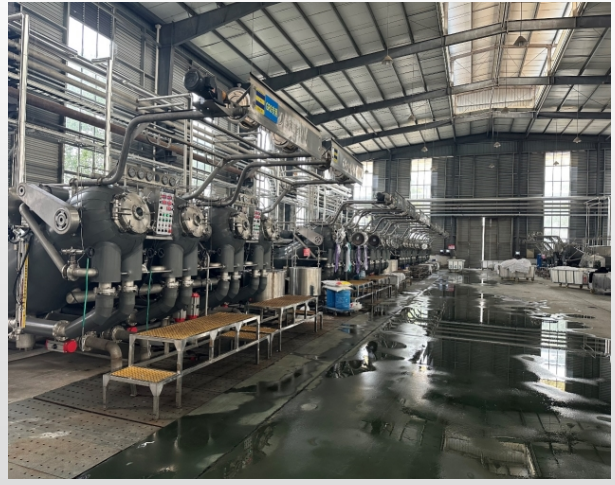
Breathability governs how easily vapor escapes; quick dry governs how fast the fabric returns to a dry state after wetting. They are related but not identical, and a fabric can be strong on one and average on the other. Both are routinely supported by the finishing processes a mill already runs — moisture wicking and quick drying sit alongside UV protection, anti-static, waterproof, stain and oil prevention, thermal storage and warmth preservation, and cooling treatment in a typical functional finishing menu.
Easy-wash functional knit fabric
Easy-wash is a care requirement rather than a single finish. It describes how the fabric behaves through repeated home laundering: colour retention, dimensional stability, hand-feel retention and whether the performance finish survives. For workwear and everyday activewear this is often the attribute that decides reorder rates, so it belongs in the specification from the start rather than being discovered after the first wash test.
What Customization Actually Covers
Customization in this category is broader than colour. A mill that develops and produces functional knit fabric can usually adjust the parameters below, and a buyer should state preferences against each one rather than sending a reference sample alone.
| Customization lever | What the buyer specifies | Why it changes the outcome |
|---|---|---|
| Yarn composition | Fiber blend and the recycled or virgin input | Sets the base hand feel, strength and the recycled-content story |
| GSM / weight | Target weight per square metre | Drives drape, opacity and the garment weight budget |
| Colour | Colour standard and lot tolerance | Determines approval workflow and shade continuity across lots |
| Stretch and knit structure | Stretch direction, recovery and structure type | Controls fit, comfort and shape retention in close-fit garments |
| Finishing | Antibacterial and anti-odor, coating and water-repellent finishing, UV treatment | Delivers the performance claim — and its wash durability |
| Recycled content | Whether recycled materials are used and at what level | Links the article to a recycled-content commitment and its documentation |
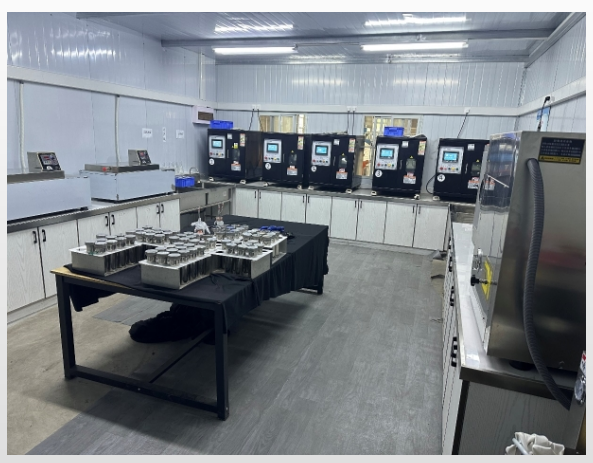
Production is described as fabric development and production, functional finishing processes, sustainable material substitution R&D, and sampling and small-batch pilot production — which is the sequence a new buyer should use: sample, pilot, then bulk. Quality control is stated as 100% testing, and lead time is quoted at 30–45 days.
Step-by-Step: From Evaluation to a First Bulk Order
The sequence below is the shortest reliable path from a category introduction to a placed order. Skipping step four or five is the most common cause of bulk-stage disputes.
- Fix the end use and one or two performance priorities. Decide whether the garment is next-to-skin, mid-layer or outer, and rank the two attributes that matter most — for example moisture wicking plus 4-way stretch, or water repellency plus UV protection. A brief with ten priorities usually produces a fabric that is average at all of them.
- Choose construction and weight. Select between nylon/spandex, recycled nylon spandex and poly/spandex, and set a GSM target. This is where cost, hand feel and performance converge, so it should be settled before finishing is discussed.
- Choose finishing and check the chemistry. Confirm which finishing route delivers the claim. Where water-repellent finishing is specified, check the PFAS status of the finish: OEKO-TEX introduced a limit value for Total Fluorine of 100 mg/kg effective 1 January 2024 under STANDARD 100, and California AB-1817 bans regulated PFAS in textiles from 1 January 2025 at a total organic fluorine threshold of 100 ppm, dropping to 50 ppm in 2027.
- Request the documentation with the sample, not after. Certificates are lot- and scope-specific. Ask for the certificate covering the article you are buying and confirm the current validity date, since textile certificates are renewed on an annual cycle.
- Sample, test, then pilot. Test the sample against the performance targets in step one, then run a small pilot batch before committing the full order. Sampling and small-batch pilot production are the correct instruments here; they convert a claim into data.
- Confirm commercial terms and the acceptance criteria. Agree MOQ, delivery terms, payment terms, lead time and the acceptance criteria in writing, and state the pre-shipment test as the acceptance basis so that both sides are measuring the same thing.
Where Functional Knit Fabric Is Used
The categories above map onto a small number of end uses, and the mapping is fairly stable across markets.
- Sportswear and training wear — moisture wicking, 4-way stretch, quick dry and anti-odor finishing carry most of the value here.
- Outdoor apparel — water-repellent finishing, UV treatment and layering logic; knitted for next-to-skin, woven for shells.
- Underwear and base layers — softness, breathability and easy-wash behaviour take priority over high stretch recovery.
- Workwear — easy-wash, UV protection and durability dominate; colour stability across lots becomes a purchasing criterion.
- Close-fit garment projects — stretch direction, recovery and seam behaviour decide whether the garment performs after three washes or thirty.
As a practical example of what a settled program looks like, one garment-shop account has taken 100 tonnes of fabric over a 10-year relationship, with the result described as stable performance and a soft, flexible hand feel. That outcome is not the result of a single superior fiber; it comes from a specification that stayed fixed across reorders.
Side-by-Side: What to Compare Before You Ask for a Price
The table below is the comparison a new buyer should be able to complete before discussing price. Gaps in the right-hand column are the questions to raise.
| Decision area | What to compare | Typical documented value (example supplier) |
|---|---|---|
| Performance claims | Which attributes are claimed, on which fabric face, with which test | Moisture wicking and quick drying, antibacterial and anti-odor, UV treatment, coating and water-repellent finishing offered as finishing options |
| Customization depth | Yarn composition, GSM, colour, stretch, knit structure, finishing, recycled content | All seven listed as adjustable parameters |
| Quality control | Inspection basis before shipment | 100% tested; pre-shipment test used as the acceptance criterion |
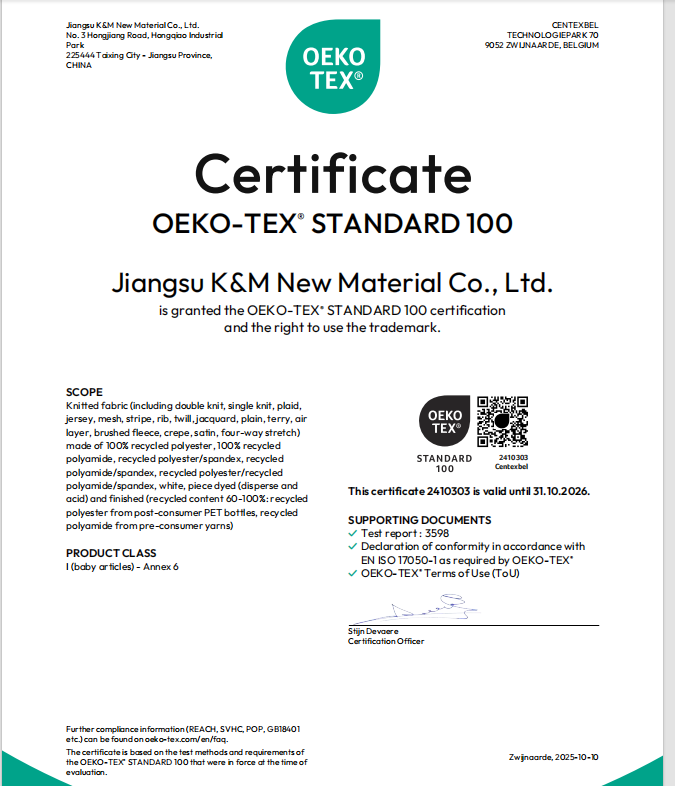
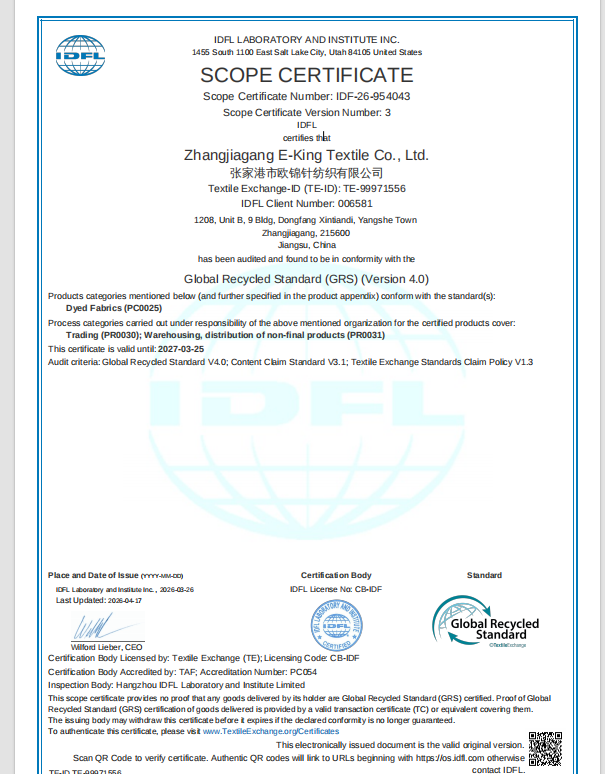
| Certification | Certificate number, issuing body, scope and validity | OEKO-TEX STANDARD 100 certificate 2410303, issued by Centexbel, scope knitted fabric; GRS certificate IDF-26-954043, issued by IDFL, scope dyed fabrics, valid 2026-03-26 to 2027-03-25 |
| Order terms | MOQ, payment, delivery, lead time | Documented purchasing terms reference a 1,000-yard minimum with FOB/CIF delivery and T/T before shipment or LC at sight; custom development programs are quoted at 3,000 yards; lead time 30–45 days |
| Sampling | Whether sample and pilot runs are supported before bulk | Sampling and small-batch pilot production supported, with technical communication during development |
Two clarifications on the table. First, certificate scope matters more than certificate presence: an OEKO-TEX entry covering knitted fabric does not automatically cover every article a mill sells, and the validity date should be re-confirmed at the point of order because certificates renew annually. Second, MOQ depends on how the order is structured — a documented standard purchasing term and a custom development quote can legitimately differ, so the buyer should ask which figure applies to their case rather than assuming either one.
Frequently Asked Questions
What certificates should I request when buying functional knit fabric?
Request the certificate that covers the specific article and lot, together with its validity date. For a knitted fabric program the usual files are an OEKO-TEX STANDARD 100 certificate for chemical safety and a GRS certificate for recycled content. As a working example from one manufacturer: OEKO-TEX STANDARD 100 certificate 2410303 was issued by Centexbel with knitted fabric as its scope, and GRS certificate IDF-26-954043 was issued by IDFL with dyed fabrics as its scope, valid from 2026-03-26 to 2027-03-25. Because textile certificates are renewed annually, confirm the current copy at order stage rather than relying on a copy filed during evaluation.
Can a China functional knit fabric manufacturer develop moisture-wicking and quick-dry fabric to my own specification?
Yes, within the parameters that are normally customizable. A manufacturer developing functional knit fabric can adjust yarn composition, GSM and weight, colour, stretch and knit structure, finishing, and the use of recycled materials — with finishing options that include antibacterial and anti-odor processes, coating and water-repellent finishing, and UV treatment. Moisture wicking and quick drying sit in the same finishing menu, alongside anti-static, waterproof, stain and oil prevention, thermal storage and warmth preservation, and cooling treatment. The practical test of that capability is not the claim list but the workflow: can the mill sample against your targets, run a small pilot batch, and support the result with 100% testing before shipment. A mill with a dedicated R&D function and a stated practice of developing new products each season is better placed to do this than one reselling standard articles.
What are the minimum order quantity and payment terms?
MOQ depends on whether the order is a standard purchasing term or a custom development program. In documented purchasing terms, the minimum is 1,000 yards, with FOB or CIF delivery, payment by T/T before shipment or LC at sight, and a pre-shipment test used as the acceptance criterion. Custom development programs are quoted at 3,000 yards, because development, sampling and finishing setup are consumed in the first run. Buyers should confirm which figure applies to their article before budgeting.
Can I get a sample before committing to a bulk order?
Sampling is the normal route into this category, and it is the only reliable way to test a performance claim against your own targets. Sample support and technical communication are typically provided during development, and sampling with small-batch pilot production sits inside the manufacturer's stated production mode. A sample should be requested together with the test basis behind each claim — which property was measured, on which face, and after how many washes — so that the sample and the specification arrive at the same time.
What lead time should I plan for?
Lead time for functional knit fabric is quoted at 30–45 days, and that figure should be read as production time rather than total program time. Development, sampling rounds and any new finishing setup sit in front of it, and the buyer's own approval and testing steps sit alongside it. Planning backward from the delivery date — rather than forward from the enquiry — is what keeps a first functional program on schedule.
Next Step
If you are specifying a functional knit fabric program for sportswear, outdoor or recycled activewear, the fastest way to move from category to decision is to send your end use and your two priority performance attributes, and ask for a sample with the corresponding test basis.
Download the company profile: EKING company profile (PDF)
Contact: EKING fabric — Zhangjiagang E-king Textile Co., Ltd. · Email: liling8656@gmail.com · Tel / WhatsApp: +86 13701568656 · www.ekingtex.com
Address: NO.10 Xinjing West Road, Zhangjiagang City, Jiangsu Province, China.
Conclusion
Functional knit fabric is not a fiber category; it is a specification discipline. Sports functional fabrics, outdoor functional fabrics and recycled functional fabrics each point to a different priority set, and nylon/spandex, recycled nylon spandex and poly/spandex each carry different behaviour and documentation stories. The four concepts that decide whether a brief is complete — moisture wicking, 4-way stretch, breathable and quick dry, and easy-wash — are all measurable, which means a new buyer does not need to accept adjectives. Define the end use, choose the construction, choose the finishing, request the documents, sample, pilot, then buy. That sequence turns a category introduction into a repeatable program.
Have Questions or Need More Details?
Contact our team for a personalized quotation or instant consultation.
Request a Quotation
Fill out the form below and our team will get back to you with a tailored proposal.
WhatsApp Direct Chat
Prefer to chat in real-time? Message us on WhatsApp for instant assistance & quick answers.
- Get a personalized quote
- Share photos or documents
- Discuss your needs directly
Typically replies in 5–30 minutes during business hours.