Adapting Arcade Machine Lineups for Indoor Playground Equipment Zones: An Application Guide
An arcade lineup can be added to an indoor playground without crowding it, but only when each machine is assigned to a zone by age band, energy level and supervision need. The pattern that holds up in practice is perimeter placement: leave the soft-play structure and its running path untouched, and build machine bays along the walls, at the entrance threshold and beside the prize counter. This guide sets out that adaptation process for operators who are already comparing equipment and preparing a floor for installation.
The recommendations below are built from the published specifications and documentation of EPARK (Guangzhou EPARK Electronic Technology Co., Ltd.), an amusement equipment manufacturer based in Panyu, Guangzhou. Only the listed equipment types — the Kids Arcade Game Machine, the Commercial Kiddie Ride and the related kids, sport, redemption and VR machines in the same range — are used to support the layout guidance.
Short answer: a playground floor accommodates an arcade lineup when it is treated as four separate zones rather than one arcade room. Put the Commercial Kiddie Ride (EP-K001) at the entrance threshold, the Kids Arcade Game Machine (EP-A001) on a wall facing the seating area, the Air Hockey Table (EP-SP001) and Basketball Arcade Machine (EP-SP110) in a separate sport bay, and the Ticket Redemption Machine (EP-L001) next to the prize counter. Keep every bay out of the play structure's circulation path and out of its fall zones.
The Real Constraint: Circulation and Supervision, Not Floor Area
Most indoor playgrounds that consider adding arcade equipment do not fail for lack of space. They fail because equipment is placed where the room's existing traffic already flows. An indoor playground is organised around three movements: a child entering and leaving the play structure, a parent moving between seating and the structure, and a family moving between the entrance, the party rooms and the exit. Any machine placed across one of those three routes converts a generous room into a congested one.
A second, less obvious constraint is supervision. Soft-play venues work because an adult can see a child from a fixed point. Machine cabinets are tall, opaque objects by design. A row of cabinets placed between the seating area and the play structure screens the child from the parent, and staff cannot cover the gap during busy periods. That single mistake cancels the revenue benefit of the equipment.
The third constraint is age mixing. Kiddie rides, kids arcade cabinets, air hockey and boxing-style machines attract different age groups at different paces. When they share one bay, younger children queue behind older players, and parents of toddlers stop treating the area as safe.
Why Standard Arcade Layouts Fail Inside Soft-Play Venues
- Centre-floor placement. Islands and middle-of-room clusters break the running path between the entrance and the play structure, and they collect wheeled ride-on toys and prams.
- One-bay age mixing. Combining a 1–3 minute kiddie ride with a two-player sport machine in the same run of machines invites toddlers into faster play.
- Opaque cabinet rows. Walls of cabinets placed forward of the seating area cut sightlines that the venue depends on.
- Ticket and prize logistics at the wrong end of the room. Equipment that pays out tickets creates a second stop for the customer; if the payout happens far from the prize counter, the venue inherits cross-room traffic.
- Power and payment retrofitted last. Voltage, socket positions and payment hardware are decided in the same design pass as the layout, not after the machines arrive.
Industry Background: A Bespoke Playground Meets Standardised Machines
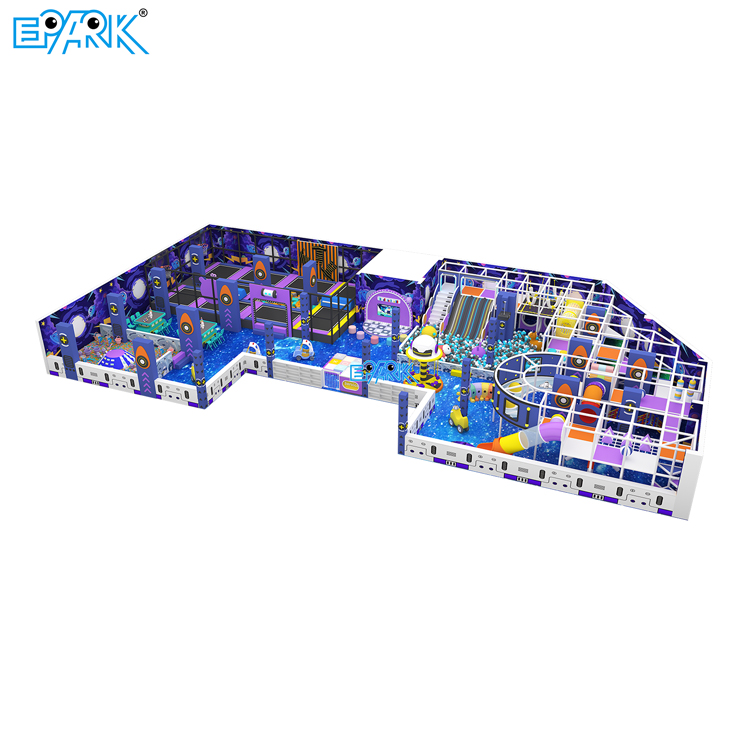
The indoor playground itself is a custom-built product. EPARK's Indoor Playground Equipment (EP-ISP001) is specified as a custom size and layout, suitable for 50–1000 m² venues, with a height range of 2.5–5 m, theme design options (macaron, forest and ocean), and construction in galvanised steel, PVC, foam, PE plastic and wood. The soft-play product meets CE / EN1176 standards. In other words, the structure is drawn to fit the room.
Arcade machines are the opposite. They arrive as fixed-footprint objects. Within the same manufacturer's range the footprint varies considerably: the Arcade machine EP-SP087 is listed at L234 × W135 × H96 cm, the Game Machine EP-SP040 at L133 × W68 × H229 cm, and the Amusement Game Machine EP-A210 at L216 × W221 × H305 cm across four player positions. Adapting a playground therefore means translating a bespoke structure into a set of rectangular bays — which is why the layout must be drawn from machine dimensions, not from catalogue photographs.
The commercial context explains why operators keep making this translation. Grand View Research reports the global amusement machine market at USD 17.6 billion in 2025, projected to reach USD 41.3 billion by 2033, with North America holding a 41% revenue share in 2025. Dataintelo places the claw machine segment alone at USD 2.8 billion in 2025, forecast to reach USD 5.1 billion by 2034 at a 6.9% CAGR. Coin-operated equipment is not a declining add-on; it is a category that keeps finding new floor space inside venues that were not originally built for it.
For cross-border projects, the customs classification matters at the planning stage: HS Code 950430 applies to games operated by coins, banknotes, bank cards or tokens, excluding bowling alley equipment. Importers should confirm the classification of each SKU before freight and duty are budgeted.
The Zone Model: Four Placements That Coexist With Soft Play
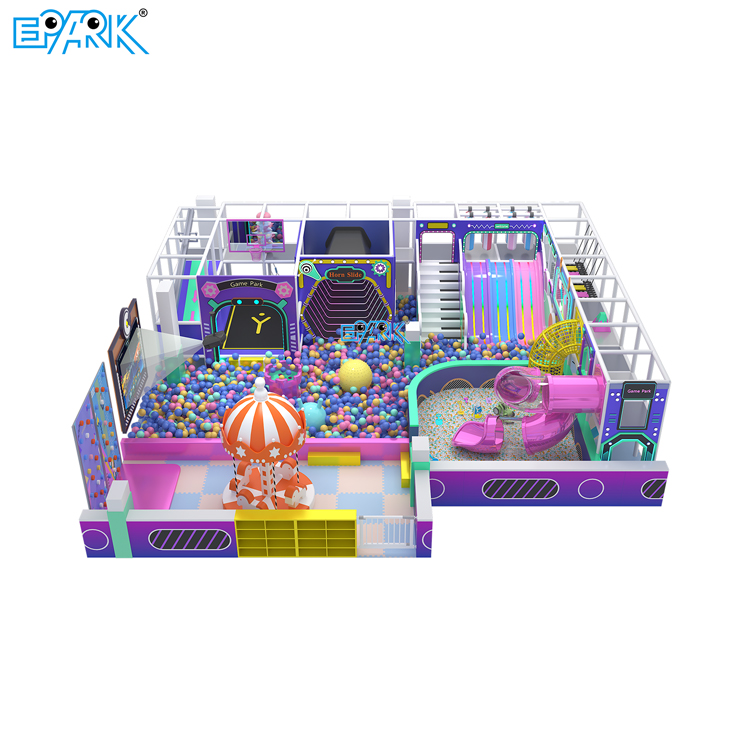
The model below assigns each equipment type to one zone and gives the placement reason. It assumes the soft-play structure already exists and cannot be re-engineered.
Zone 1 — The Kiddie Ride Court (Commercial Kiddie Ride, EP-K001)
The Commercial Kiddie Ride is a single-child, coin-operated ride with a power rating of 80–150W, 110V / 220V voltage, a working time of 1–3 minutes per play, colourful LED lighting and music, a cartoon theme design, and coin / QR / card payment. The shell is fibreglass with a metal frame and electronic control system, and the model is CE certified.
Placement logic: the short 1–3 minute cycle and single-child capacity make this the right equipment for the entrance threshold, not the middle of the room. A ride at the threshold gives arriving families an immediate stop while a parent checks in, and it keeps the queue outside the play structure. Because the ride is a supervised, seated activity, it should sit where staff can see it from the reception point, and it should never block the exit route.
Zone 2 — The Kids Arcade Wall (Kids Arcade Game Machine, EP-A001)
The Kids Arcade Game Machine (EP-A001) is a one-to-two player cabinet with a 19–32 inch HD display, 150–300W power, 110V / 220V voltage, coin / bill / card / QR payment, colourful LED lighting and a cartoon theme, built in a metal cabinet with acrylic panel, plastic parts and LED lighting. It is CE certified and is listed for shopping malls, amusement parks, FEC and kids play centres.
Placement logic: run the kids cabinets in a single continuous wall against a solid wall, facing into the seating area rather than away from it. A parent seated with a drink should be able to see both the screen and the play structure. Keep cabinet heights consistent along the wall; a mixed-height run reads as clutter and blocks the sightline at exactly the wrong point.
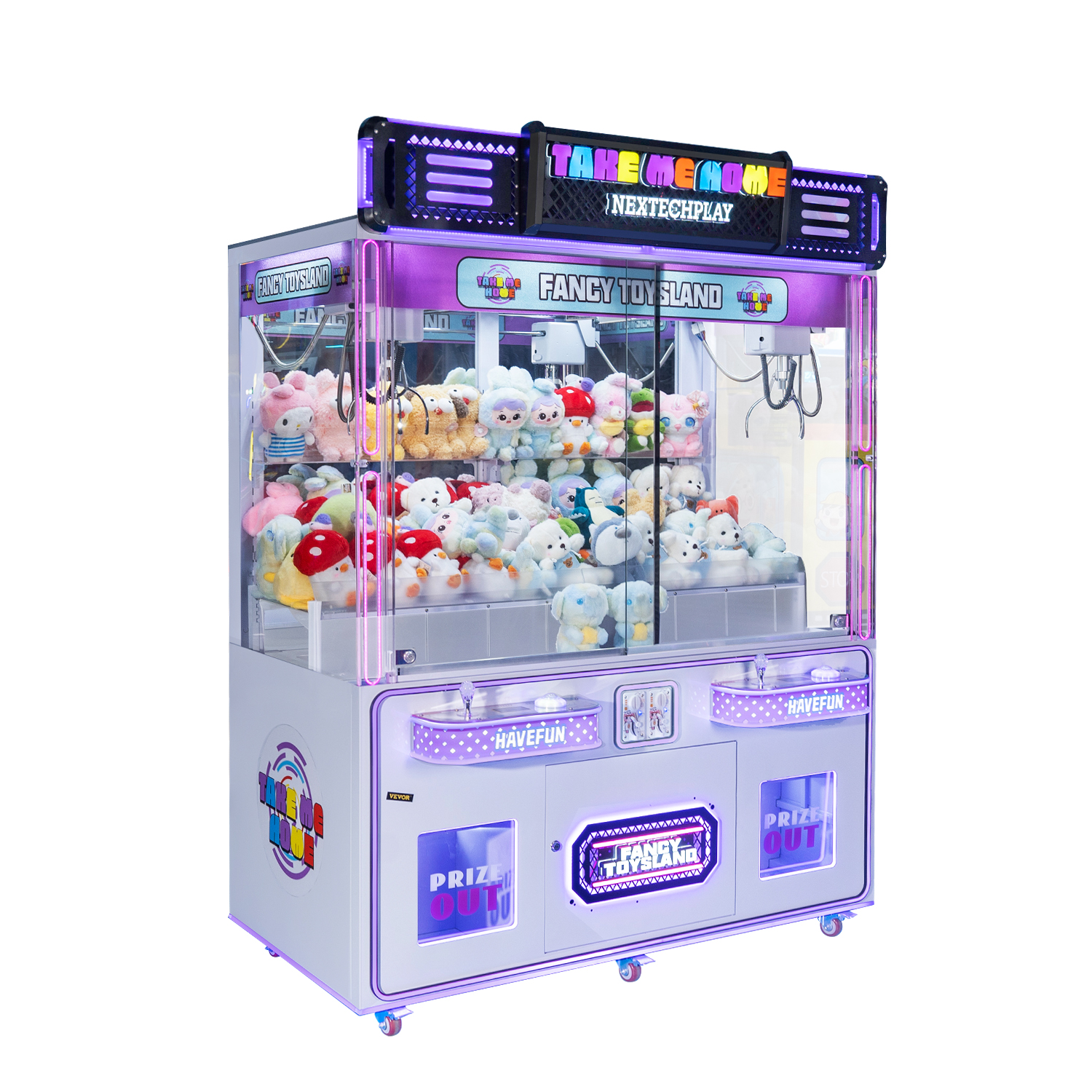
The Claw Machine (EP-G001) belongs at the end of this wall, adjacent to the prize counter. It is a single-player unit with 120–200W power, adjustable claw strength, a transparent cabinet with prize display, LED lighting and coin / bill / card / QR payment. Because the prize is dispensed at the machine, positioning it next to redemption keeps prize collection in one place instead of sending families across the room.
Zone 3 — The Skill and Sport Bay (Air Hockey Table, EP-SP001; Basketball Arcade Machine, EP-SP110)
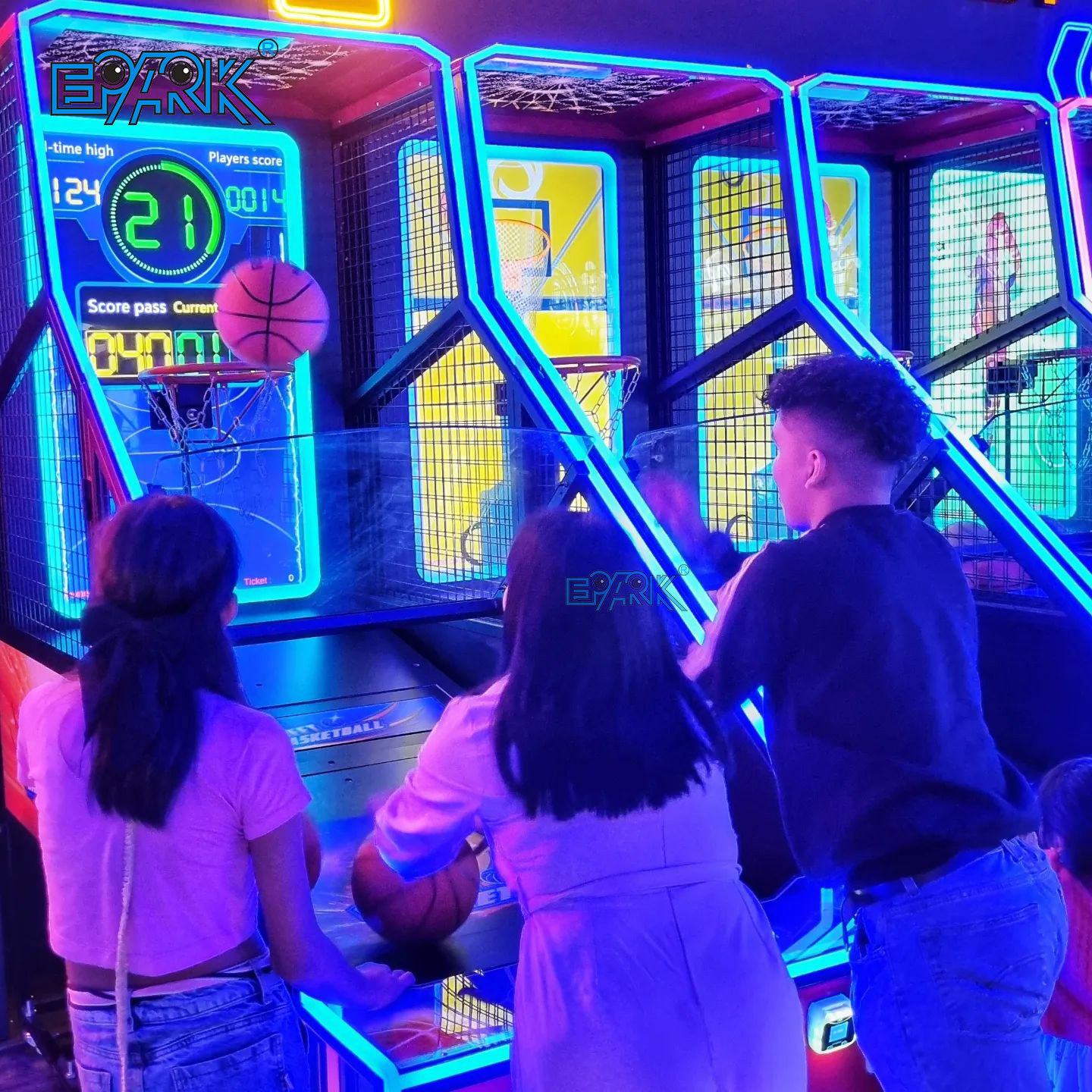
The Air Hockey Table (EP-SP001) supports 2–4 players on a 6–8 ft table, with a 200–400W air blower system, electronic scoring, LED lighting and coin / card / QR payment. The Basketball Arcade Machine (EP-SP110) is a 1–2 player unit with single and competition modes, 300–600W power, electronic scoring, LED lighting and coin / card / QR payment. Both models are CE certified.
Placement logic: these two create standing spectators, so they need a bay with clearance behind the players and should be kept away from the toddler court. Put them on a solid wall at the opposite end of the room from the kiddie ride, ideally with the seating area to one side so waiting adults sit rather than stand in the aisle. Air hockey is the more social of the two and works well as the visible centre of the bay; the basketball unit should sit beside it, not behind it.
Zone 4 — The Redemption Exit (Ticket Redemption Machine, EP-L001)
The Ticket Redemption Machine (EP-L001) is a 1–2 player cabinet with 200–500W power, a ticket payout system, LED lighting, multiple game modes and coin / card / QR payment, CE certified.
Placement logic: ticket payout creates a second destination. The machine must sit next to the prize counter and near the exit, so the sequence is play, collect tickets, choose a prize, leave. Placing it in a distant corner sends families back through the floor and rebuilds the congestion the zone model is meant to remove.
Optional — The High-Energy Anchor (VR Simulator, EP-VR001)
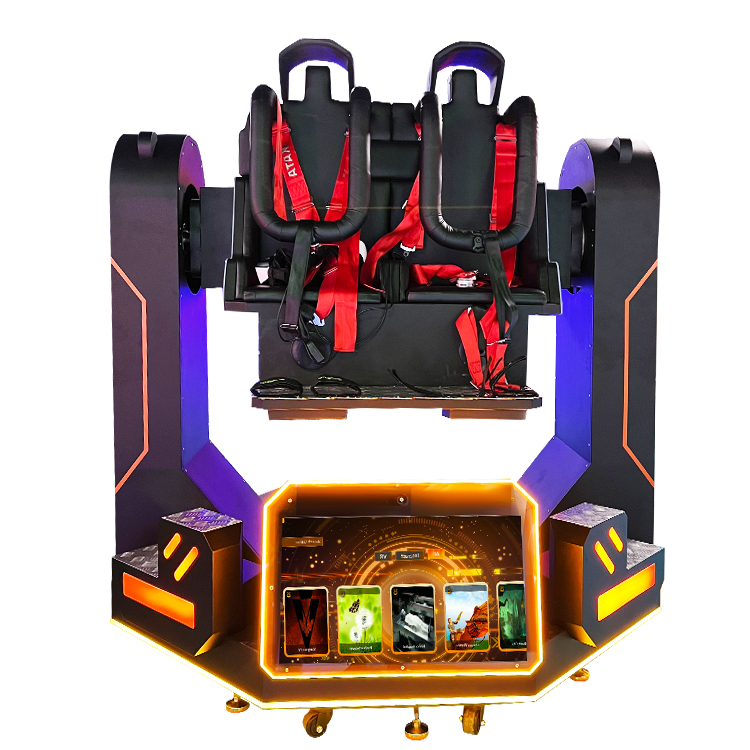
The VR Simulator (EP-VR001) is a 1–2 player motion platform with a 42–55 inch HD display, 2DOF / 3DOF dynamic platform options, 10–50 VR games included, 800–1500W power, 110V / 220V voltage and coin / card / QR payment, built on a steel frame with a fibreglass shell and high-strength seat.
Placement logic: this is the highest-draw item in the range and should only be added where a dedicated bay is possible. It needs controlled access, an operator or attendant nearby, and an uninterrupted sightline from the seating area. If the ceiling height, supervision staffing or power distribution cannot support a dedicated bay, leave it out. An anchor attraction placed badly damages the rest of the floor plan.
Step-by-Step Breakdown: Adapting an Existing Playground Floor
Step 1 — Audit what cannot move. Mark the soft-play footprint, its entry and exit points, the toddler area, seating, party rooms, the prize counter and every emergency exit. EPARK's EP-ISP001 is built to a custom size and layout for venues of 50–1000 m² at 2.5–5 m height, which means the structure's shape is fixed by the original design and the arcade plan must work around it.
Step 2 — Draw the supervision line before drawing the machines. Stand at the main seating position and mark everything that interrupts the view of the play structure. Those lines are the hard boundary of the machine zone. No cabinet should be placed forward of a seating position.
Step 3 — Set the age bands. Toddler and pre-school: kiddie ride court. Young children: kids arcade wall. Family and teen: skill and sport bay. All ages: redemption exit. Ages 12+ only: VR anchor, if a bay exists. Write the bands down; they resolve most placement arguments later.
Step 4 — Size the bays from published dimensions. Machine footprints differ sharply — L234 × W135 × H96 cm for EP-SP087, L133 × W68 × H229 cm for EP-SP040, L216 × W221 × H305 cm for the four-player EP-A210 — so a bay drawn from a photograph will be wrong. Where a model's dimensions are not published in the specification set being used, request the drawing before the bay is fixed. Circulation width around each bay should be set by the venue's licensed capacity and local fire requirements, not by a rule of thumb.
Step 5 — Plan power and payment together. Power draw across the range runs from 80–150W on the kiddie ride to 800–1500W on the VR simulator, with the kids cabinet at 150–300W, air hockey at 200–400W, basketball at 300–600W and redemption at 200–500W. Most models accept 110V / 220V and support coin / bill / card / QR payment, which allows the payment mix to match the venue's card system rather than the other way round. Confirm voltage and plug type per destination market before production.
Step 6 — Specify customization before production starts. EPARK's customization scope covers voltage, plug type, cabinet design, colour, logo, game software, payment system (coin / bill / QR / card) and language interface. This is the stage where the machine is matched to the room's theme and to the payment method the venue already uses.
Step 7 — Inspect, install and review the floor. Quality control is stated as 100% inspection before shipment, with aging test and function test. After-sales support covers 24/7 online support, video technical guidance, spare parts supply and lifetime maintenance service. Once the venue is open, review the floor: where queues form, which aisle is being cut through, and which corner is never used. The first review usually moves one or two machines, not the whole lineup.
Where EPARK Fits in This Process
EPARK is a Guangzhou-based amusement equipment manufacturer and supplier operating in Panyu, Guangzhou, with a company-reported showroom and factory area exceeding 25,000 m², approximately 150 employees, a 20-engineer R&D team and an annual output of 8,000–10,000 units. The company reports an 80% export ratio, with main markets in the EU, USA, Middle East, Africa, South America and Southeast Asia.
For indoor playground adaptation specifically, three capabilities matter. First, a product range that covers the zones described above: kids game machines, claw machines, air hockey, basketball machines, ticket redemption machines, VR simulators, kiddie rides and soft playground equipment. Second, layout support — the company provides free project solutions and lists free 3D design and business advice among its project services, which is the practical way to test a zone plan before any cabinet is ordered. Third, customization and delivery capacity: OEM / ODM, factory-direct and custom design production modes, a stated monthly capacity of 500–800 units and a 30-day lead time, with delivery terms available as FOB, CIF or EXW.
Limits to note: unit prices and per-SKU production drawings are project-specific and are confirmed at quotation stage, not in published product data. Published specifications also do not include venue-level revenue performance for a given floor. Both should be resolved with the supplier's layout drawing and with the operator's own footfall assumptions before a purchase order is signed.
Use Cases
Mall-based soft play adding a perimeter arcade wall. A playground already inside a shopping mall typically has families on site for 60–90 minutes. The lowest-risk adaptation is a kids arcade wall on the back wall plus a claw machine beside the prize counter, with redemption at the exit. EPARK's published project summaries for arcade start-up projects describe installations of 30–80 machines and list a return on investment within 3–6 months as a reported outcome; that figure is company-reported and should be tested against the venue's own footfall and pricing.
Standalone family entertainment centre with a kiddie ride court. Here the entrance threshold is the unused asset. One or two kiddie rides with a 1–3 minute cycle convert arrival and departure time into revenue without touching the play structure, and they need only 80–150W each.
Larger indoor amusement park projects. EPARK's case material for indoor amusement parks, mall and FEC projects describes installations in the 50–200 set range, with custom design for venue layout listed among the delivered services. At that scale the zone model becomes a full floor plan: kids wall, sport bay, redemption exit and, where the ceiling and staffing allow, a VR anchor.
Comparison Table: Zone Fit by Equipment Type
| Equipment (model) | Players | Power | Payment options | Assign to | Placement note |
|---|---|---|---|---|---|
| Kids Arcade Game Machine (EP-A001) | 1–2 | 150–300W | Coin / bill / card / QR | Kids arcade wall | Continuous wall facing the seating area; 19–32 inch HD display, cartoon theme |
| Commercial Kiddie Ride (EP-K001) | 1 child | 80–150W | Coin / QR / card | Kiddie ride court | Entrance threshold; 1–3 minutes per play, seated and supervised |
| Claw Machine (EP-G001) | 1 | 120–200W | Coin / bill / card / QR | Kids arcade wall, end position | Adjacent to the prize counter; transparent cabinet, adjustable claw strength |
| Air Hockey Table (EP-SP001) | 2–4 | 200–400W | Coin / card / QR | Skill and sport bay | 6–8 ft table; needs clearance behind players, away from toddlers |
| Basketball Arcade Machine (EP-SP110) | 1–2 | 300–600W | Coin / card / QR | Skill and sport bay | Single and competition modes; place beside, not behind, air hockey |
| Ticket Redemption Machine (EP-L001) | 1–2 | 200–500W | Coin / card / QR | Redemption exit | Must sit next to the prize counter and the exit; ticket payout system |
| VR Simulator (EP-VR001) | 1–2 | 800–1500W | Coin / card / QR | Optional anchor bay | Dedicated bay and attendant coverage required; 2DOF / 3DOF platform |
Safety and Compliance Notes for Playground Zones
Certification should be checked against the exact model being installed, not against a category name. EPARK's CE-EMC documentation covers the Kids Game Machine under certificate ACIC20240201022GDK (issued by ACIC on 2024-02-06 against EN IEC 61000-6-1:2019, EN IEC 61000-6-3:2021, EN IEC 61000-3-2:2019+A1:2021 and EN IEC 61000-3-3:2013/A1:2019/A2:2021), the Sport Game Machine under ACIC20240201039GDI, the Shooting Game Machine under ACIC20240201033GLE and the Amusement Machine series under ACIC20250604011CET.

Additional documentation in the same set includes CE-LVD for the Racing Game Machine (ACIC20240201028GXY), CE for an arcade / interactive game machine under model EP-K116 (certificate M.2022.206.C73911, issued by UDEM International Certification Auditing Training Centre, valid to 2027-05-22), RoHS for game machines under ACIC20190422059BHN against the IEC 62321 series, and CE for the Indoor Playground Equipment to EN 1176-1:2017 under ACIC20241122069CXN.
Two practical cautions follow. First, an EMC certificate covering a machine family does not automatically cover a customized cabinet with different electronics, so the certificate scope should be matched to the ordered model. Second, playground safety and machine safety are separate questions: the EN 1176 reference applies to the soft-play structure, while the arcade machines are covered by their own electrical and EMC documentation. On the floor itself, keep machine bays out of exit routes and out of the soft-play fall zones, and treat the kiddie ride as a supervised single-child activity with a 1–3 minute cycle.
FAQ
Which certifications should an arcade machine carry before it is installed in an indoor playground?
For EPARK equipment, the relevant documents are product-specific. The Kids Game Machine is covered by CE-EMC certificate ACIC20240201022GDK, the Sport Game Machine by ACIC20240201039GDI, the Shooting Game Machine by ACIC20240201033GLE and the Amusement Machine series by ACIC20250604011CET. The Racing Game Machine holds CE-LVD certificate ACIC20240201028GXY, an arcade / interactive game machine under model EP-K116 holds certificate M.2022.206.C73911 valid to 2027-05-22, and game machines hold RoHS certificate ACIC20190422059BHN. The Indoor Playground Equipment itself is certified to EN 1176-1:2017 under ACIC20241122069CXN. Buyers should confirm that the certificate scope names the exact model ordered and that destination-market requirements are met.
Can arcade machines be customized to match an existing playground layout and theme?
Yes. EPARK's customization scope covers voltage, plug type, cabinet design, colour, logo, game software, payment system (coin / bill / QR / card) and language interface, under OEM / ODM, factory-direct and custom design production modes. The company works with a 20-engineer R&D team, states a monthly capacity of 500–800 units, and provides free project solutions including 3D design support, which is the practical way to test whether a proposed zone plan fits the existing floor before cabinets are built.
What determines the cost of adding an arcade lineup to an indoor playground?
Cost is quoted per project rather than per catalogue line. The variables that move a quote are the equipment mix and player count, the power rating of each model (from 80–150W for the kiddie ride to 800–1500W for the VR simulator), the payment hardware specified, the scope of customization on cabinet design, colour, logo, software and language, the delivery term (FOB, CIF or EXW), and the total number of units. Because unit prices are confirmed at quotation stage, the reliable approach is to send the floor plan and the intended zone list, and compare quotations on the same specification and delivery term.
How can an operator validate build quality before committing to a full rollout?
Acceptance is handled before shipment. EPARK states 100% quality inspection before shipment, including aging test and function test, and its purchase guidance lists pre-shipment testing with video inspection supported as acceptance criteria. That allows a buyer to review build, finish and machine function before the container leaves, which is the practical substitute for inspecting equipment after it has already been shipped to the venue.
What lead time applies, and how does an operator start a layout project?
EPARK states a 30-day lead time with a monthly capacity of 500–800 units. Delivery terms are available as FOB, CIF or EXW, the listed payment structure is 30% deposit with 70% balance before shipment by T/T, and after-sales support covers 24/7 online support, video technical guidance, spare parts supply and lifetime maintenance service. To start, send the existing floor plan, the age bands and the intended zones to EPARK for a free project solution and 3D layout — the layout drawing is the document that decides whether the lineup fits the room.
Next Step: Test the Zone Plan Before You Order
Send your playground floor plan, venue size and target age groups to EPARK and request a free project solution with a 3D layout. The team can map the Kids Arcade Game Machine, Commercial Kiddie Ride, claw, sport and redemption units onto your existing structure, then quote the confirmed configuration.
Website: www.eparkgames.com
Email: sales@nanyuetech.com | Phone / WhatsApp: +86 13903079263
Guangzhou EPARK Electronic Technology Co., Ltd. — Building 9, 120 Donghuan Road, Shiqiao, Panyu District, Guangzhou, Guangdong, China 511400
Conclusion
Adapting an arcade lineup to an indoor playground is a zoning exercise, not a purchasing exercise. Keep the soft-play structure and its circulation path intact, draw the supervision line from the seating area, then place equipment by age band and energy level: the Commercial Kiddie Ride at the entrance threshold, the Kids Arcade Game Machine on a wall facing the seats, air hockey and basketball in a separate sport bay, redemption beside the prize counter, and a VR platform only where a dedicated bay and attendant coverage exist.
Two details decide whether the plan survives contact with real customers. Size every bay from published machine dimensions rather than photographs, and settle power, voltage and payment before production rather than after delivery. Get those right, and the arcade lineup adds revenue to the playground without taking floor space away from the reason families came in the first place.
Have Questions or Need More Details?
Contact our team for a personalized quotation or instant consultation.
Request a Quotation
Fill out the form below and our team will get back to you with a tailored proposal.
WhatsApp Direct Chat
Prefer to chat in real-time? Message us on WhatsApp for instant assistance & quick answers.
- Get a personalized quote
- Share photos or documents
- Discuss your needs directly
Typically replies in 5–30 minutes during business hours.