How to Pair Claw and VR Game Machines for a Mixed-Use Entertainment Floor: An Application Guide
Direct answer: On a mixed-use entertainment floor, the claw machine and the VR game machine are not alternatives and they are not interchangeable footprints. The workable pattern is to pair a high-frequency, low-power prize unit such as the EPARK EP-G001 claw machine with a longer-dwell immersive unit such as the EP-VR096 VR game machine or the EP-VR001 VR simulator, then separate the two by dwell time, electrical load and player journey. The claw line occupies the high-traffic edge and converts passing attention into short repeat plays. The VR line occupies a controlled interior zone and converts intent into a longer, higher-value session. One shared payment path — coin, bill, card or QR, which both product lines support — joins the two zones into a single continuous visit instead of two disconnected attractions.
This guide is about deployment, not product selection. It sets out the zoning logic, the order in which floor decisions should be made, the player journey between the two experiences, and the operational facts a procurement team needs to confirm before placing a mixed order.
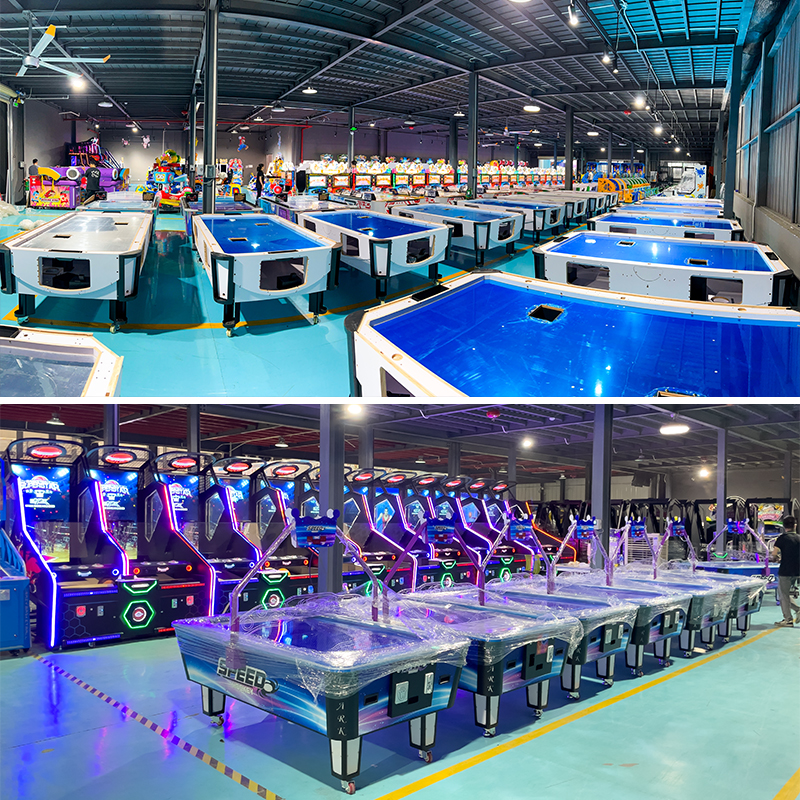
Guangzhou EPARK Electronic Technology Co., Ltd. (EPARK) is an entertainment equipment manufacturer based in Panyu, Guangzhou, China, operating a 25,000 m² factory and showroom with 150 employees and a 20-engineer R&D team, producing an annual output of 8,000–10,000 units and exporting to the EU, USA, Middle East, Africa, South America and Southeast Asia.
The Deployment Problem: Two Product Lines With Two Different Rhythms
Mixed-use floors fail for a predictable reason: the operator treats a claw machine and a VR game machine as two items on the same purchase order, then installs them side by side because both are “games.” The result is usually a queue that blocks a high-turnover prize aisle, an under-used VR cabinet in a corner, and a floor where the two revenue models compete for the same square metres.
The mismatch is structural, and it can be described with the published specifications of the two product classes:
- Session length and player count. The EPARK EP-G001 claw machine is a single-player unit. The EP-VR096 VR game machine and the EP-VR001 VR simulator are 1–2 player units with a 42–55 inch HD display, a VR headset (HTC or Pico optional on the EP-VR096) and a configured game library of 20–50 titles on the EP-VR096 or 10–50 titles on the EP-VR001.
- Electrical load. The EP-G001 claw machine runs at 120–200W on 110V or 220V. The EP-VR096 and EP-VR001 run at 800–1500W on 110V or 220V. A row of claw cabinets and a row of VR cabinets therefore cannot be planned on the same circuit assumption.
- Floor footprint and clearance. A claw cabinet is a transparent, front-facing unit with a prize display system and LED lighting. A VR simulator with a 2DOF or 3DOF motion platform needs standing clearance and a supervised entry point, which changes how the surrounding aisle can be used.
- Throughput pattern. Claw play is short, impulsive and repeatable. VR play is an intended session that players plan for, and it can absorb a waiting group.
None of these differences makes pairing a bad idea. They define the pairing rules — and those rules are the subject of the rest of this guide.
Industry Background: Why Operators Are Mixing Product Lines
The global claw machine market reached a valuation of USD 2.8 billion in 2025, and Asia Pacific accounted for a 42.7% revenue share of that market in the same year, according to market research published by Dataintelo. Those figures sit inside a broader structural shift: venues that once committed a floor to a single attraction type increasingly run multiple attraction types in the same leased area, because rent is fixed while player attention is not.
Two practical drivers sit behind that shift. The first is dwell-time diversification. A floor that only offers short, low-value plays struggles to hold a group for a full visit; a floor that only offers long, high-value sessions struggles to capture walk-in traffic that has not planned a session. A paired floor covers both. The second driver is asset utilisation. A claw machine and a VR machine draw different players at different moments, which spreads load across the operating day rather than concentrating it in one peak.
There is also a procurement-side driver. When both product lines come from one manufacturer, the buyer handles one commercial relationship, one set of electrical specifications (both product lines are available in 110V and 220V configurations), one payment integration decision and one after-sales channel. EPARK manufactures both lines, which is why the pairing described in this guide can be specified as a single project rather than two unrelated purchases.
For customs and duty planning, both product classes are normally classified under HS subheading 9504.30 — “Other games, operated by coins, banknotes, bank cards, tokens or by any other means of payment, other than automatic bowling alley equipment” — from the World Customs Organization nomenclature. Buyers should confirm the national tariff line in the destination market, but this is the subheading to quote when requesting trade data or duty estimates.
The Paired Solution: EP-G001 With EP-VR096 or EP-VR001
What the claw line contributes
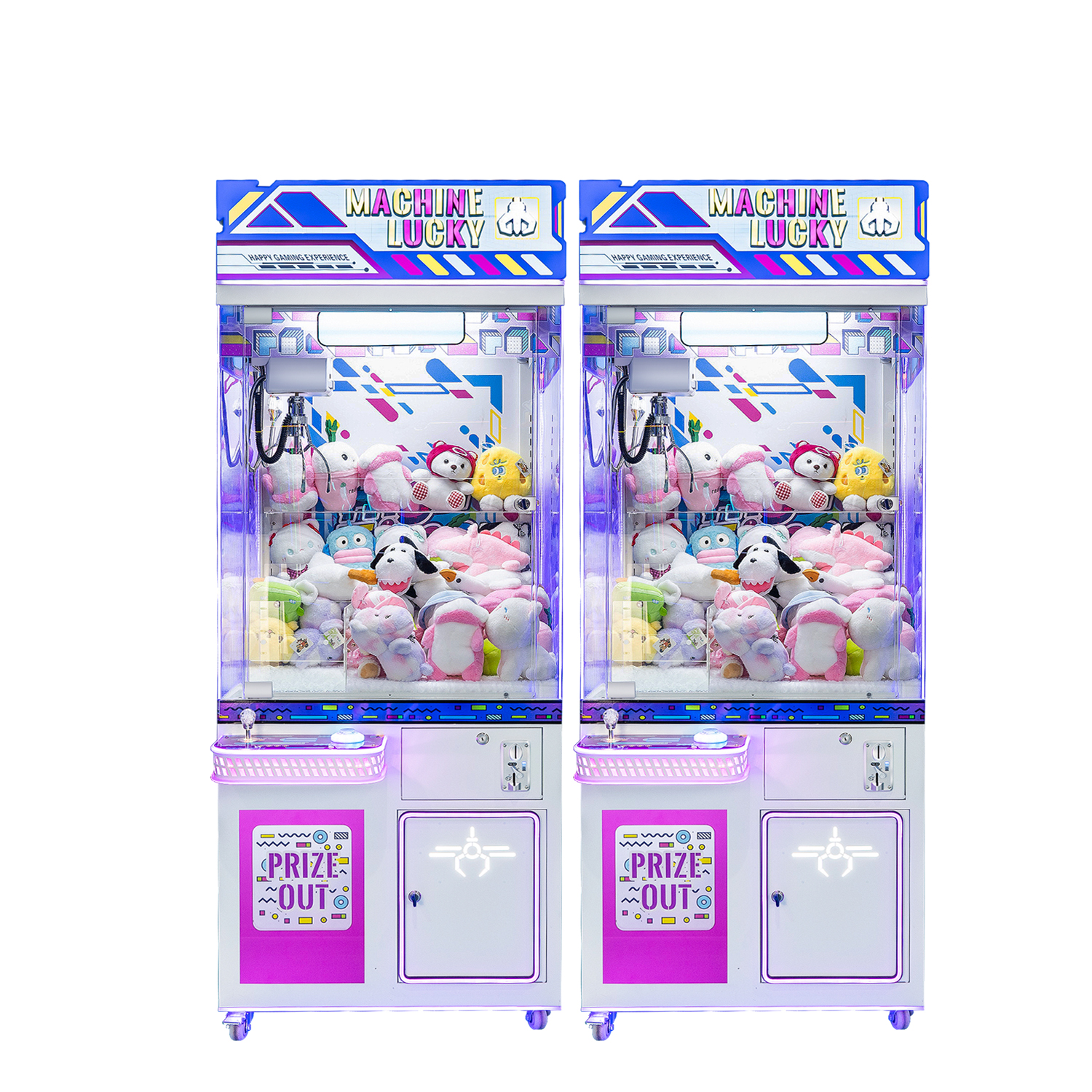
The EPARK EP-G001 is a coin-operated claw machine built as a single-player unit with adjustable claw strength, LED lighting, a transparent cabinet design and a prize display system. It runs at 120–200W, supports coin, bill, card or QR payment, and carries CE certification. Its cabinet uses a metal frame, tempered glass, a claw system and an electronic control system, and it is specified for shopping malls, arcade centres, family entertainment centres and amusement parks.
Operationally, that combination produces a unit that is cheap to run per hour, readable from a distance and easy to re-merchandise. Adjustable claw strength lets the operator tune difficulty by prize value, and the transparent cabinet turns the prize inventory itself into the display.
What the VR line contributes
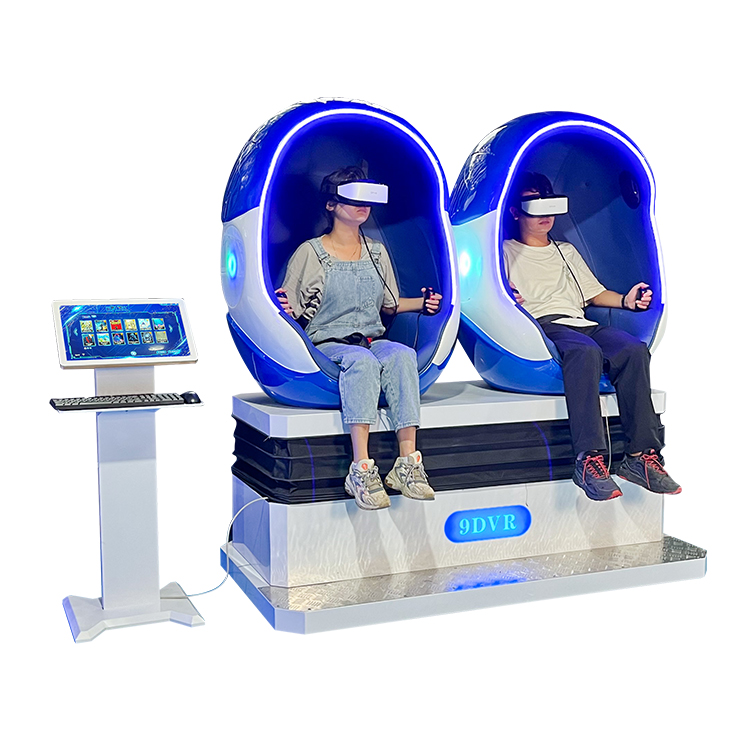
The EPARK EP-VR096 is a coin-operated VR simulator for 1–2 players with an optional HTC or Pico headset, a 42–55 inch HD display, a static, 2DOF or 3DOF motion system, and a library of 20–50 VR games. The EPARK EP-VR001 is a VR motion simulator for 1–2 players with a 42–55 inch HD display, a 2DOF or 3DOF dynamic platform and a library of 10–50 VR games. Both run at 800–1500W on 110V or 220V, both support coin, card or QR payment, and both are specified for shopping malls, VR experience centres, amusement parks and family entertainment centres.
The VR line supplies what the claw line cannot: a session with enough duration and enough visual impact to anchor a visit. That anchor effect is what turns a corridor of prize machines into a destination.
What the pair produces together
- Two price points on one payment rail. Both lines accept card and QR payment, and the EP-G001 additionally accepts coin and bill, so a single stored-value card or QR wallet can cover the whole floor.
- Two content refresh cycles. Claw revenue is refreshed by changing prizes and adjusting claw strength; VR revenue is refreshed by the configured game library.
- One service channel. EPARK provides 24/7 online support, video technical guidance, spare parts supply and lifetime maintenance service across its product range.
- One commercial agreement. Both lines can be quoted together, shipped together and delivered against one acceptance standard of 100% quality inspection before shipment.
Step-by-Step Breakdown: Sequencing a Mixed Floor
The steps below are ordered deliberately. Each one constrains the next, and reversing them is the most common cause of a floor that has to be rebuilt after opening.
Step 1 — Draw the walk-in line before drawing any machine
Mark the point where a visitor first becomes aware of the floor, and the natural path they take from there. Claw cabinets belong on that sightline. They depend on peripheral attention and impulse, and they are readable in motion.
Step 2 — Fix the electrical plan before the zoning plan
Calculate load by zone, not by machine count. A cluster of EP-G001 cabinets at 120–200W each behaves very differently from an EP-VR096 or EP-VR001 at 800–1500W per unit. Both product lines are available in 110V and 220V configurations, and voltage, plug type and payment system can be specified as part of an OEM/ODM order, so the electrical plan should be settled before the cabinet list is finalised.
Step 3 — Assign an edge zone to claw and an interior zone to VR
Place the claw line along the high-traffic edge: entrances, corners that face a concourse, and the boundary between circulation space and play space. Place the VR line inside the floor envelope, where ambient noise, lighting and foot traffic can be controlled, and where a 2DOF or 3DOF motion platform has clearance and a supervised entry point.
Step 4 — Map the player journey between the two zones
The journey that works is: attract → short play → escalation → anchor session → reward. A visitor is drawn in by a lit claw cabinet, plays one or two short rounds, sees the VR cabinet in the interior, escalates to a VR session, and exits through the prize or redemption point. Each stage should be physically adjacent to the next, so the visitor never has to backtrack across the floor to continue.
Step 5 — Set the ratio and the cabinet mix
Claw density should be high enough that a player can always find a free cabinet at peak, because an occupied claw cabinet is a lost impulse sale. VR density should be low enough that the interior zone stays readable and supervised, because an overcrowded VR queue degrades the experience being sold. The claw mix can also be tuned by configuration: EPARK lists coin-operated single-player, double-player and four-player claw machines in its product catalogue, so the edge zone can combine single-player cabinets for throughput with multi-player units for group capture.
Step 6 — Unify payment and operating rules
Both lines support card and QR payment, and the EP-G001 additionally supports coin and bill. A single stored-value or QR system removes the friction of switching payment methods between zones and gives the operator one transaction record for the whole floor. Set claw strength and VR session pricing as one commercial policy, not two.
Step 7 — Lock the service and spare-parts rhythm
Specify who holds spare parts, how technical faults are reported, and what the response path is. EPARK's after-sales scope covers 24/7 online support, video technical guidance, spare parts supply and lifetime maintenance service. On a mixed floor, the claw line usually needs faster prize-side intervention while the VR line needs scheduled checks on the motion platform and headset hardware, so the two maintenance rhythms should be written into the operating plan separately.
Step 8 — Localise through OEM/ODM if the floor is branded
EPARK operates OEM, ODM, factory-direct and custom design production modes with monthly capacity of 500–800 units and a lead time of 30 days. Customisation covers voltage, plug type, cabinet design, colour, logo, game software, payment system (coin, bill, QR or card) and language interface — which is what allows a paired floor to carry one visual identity across two very different cabinet types.

Use Cases
Family entertainment centre
In an FEC, the claw line can sit at the entry threshold as a low-commitment first purchase, while the VR line forms the interior anchor that justifies the visit length. Because both product classes are specified for family entertainment centres, the pairing fits the venue type without modification.
Arcade centre inside a shopping mall
Mall-based arcades face mixed traffic: passers-by with two minutes, and groups with an hour. The claw edge zone captures the first group; the VR interior zone captures the second. Both product lines are specified for shopping mall environments, and both accept card and QR payment, which suits mall customers who rarely carry coins.
Retail or concourse activation zone
Where floor space is a leased activation area rather than a permanent arcade, the claw line carries the visual attraction at low power draw, and a single VR cabinet adds the premium tier. Keeping the VR footprint to one or two units preserves the flexibility of the tenancy.
New arcade business build-out
For operators building a first floor, the pairing can be specified as a single equipment package. EPARK's case records describe arcade start-up investors ordering 30–80 machines and family entertainment centre owners ordering 80+ machines, with reported return on investment within 3–6 months on a high-profit game mix, supported by free 3D layout design, multiple payment system support and factory-direct pricing. Those results are company-reported case outcomes and should be validated against the operator's own local cost and footfall model.
Comparison Table: The Three Units Side by Side
The table below uses only published product parameters for the three units discussed in this guide.
| Parameter | EP-G001 Claw Machine | EP-VR096 VR Game Machine | EP-VR001 VR Simulator |
|---|---|---|---|
| Players | 1 player | 1–2 players | 1–2 players |
| Power | 120–200W | 800–1500W | 800–1500W |
| Voltage | 110V / 220V | 110V / 220V | 110V / 220V |
| Display / structure | Transparent cabinet, LED lighting, prize display system | 42–55 inch HD display, VR headset (HTC / Pico optional) | 42–55 inch HD display, VR headset |
| Motion system | Claw system with adjustable claw strength | Static / 2DOF / 3DOF optional | 2DOF / 3DOF dynamic platform |
| Content | Prize inventory, configurable claw strength | 20–50 VR games included | 10–50 VR games included |
| Payment | Coin / bill / card / QR | Coin / card / QR | Coin / card / QR |
| Typical floor role | High-traffic edge, impulse and repeat play | Interior anchor, immersive session | Interior anchor, motion-led session |
| Certification | CE certified (certificate ACIC20240201019GRC) | CE certified | CE certified |
| Specified venue types | Shopping malls, arcade centres, FEC, amusement parks | Shopping malls, VR experience centres, FEC, amusement parks | Shopping malls, VR experience centres, amusement parks, FEC |
The table describes configuration, not performance. Claw payout behaviour and VR session economics depend on the operator's own settings and local pricing, which are not published specifications.
FAQ
What compliance documents should a buyer request for a paired claw and VR floor?
Ask for the certificate that names the exact model being purchased. For the EP-G001 claw machine, EPARK holds CE certification issued by ACIC under certificate number ACIC20240201019GRC, dated 2024-02-06, tested against EN IEC 61000-6-1:2019, EN IEC 61000-6-3:2021, EN IEC 61000-3-2:2019+A1:2021 and EN IEC 61000-3-3:2013/A1:2019/A2:2021. EPARK also holds a RoHS certificate for game machines, number ACIC20190422059BHN, issued by ACIC on 2019-04-24 against the IEC 62321 series. Note that in the United States, commercial claw machines must typically meet UL 22 (Amusement and Gaming Machines) standards, so destination-market requirements should be checked separately from the CE file.
Can EPARK supply both product lines for one mixed-use floor?
Yes. EPARK manufactures claw machines and VR equipment within the same product range, alongside arcade, sports, racing, shooting, ticket redemption and kids game machines. The company operates OEM, ODM, factory-direct and custom design production modes with monthly capacity of 500–800 units, a lead time of 30 days and a minimum order quantity of 10 units, supported by a 20-engineer R&D team and a 25,000 m² factory and showroom in Panyu, Guangzhou.
How should the power and space budget be split between the two lines?
Budget power by zone. Each EP-G001 claw machine draws 120–200W, while each EP-VR096 or EP-VR001 draws 800–1500W, so a claw edge zone can be expanded with far less electrical headroom than a VR interior zone. Space should be budgeted in the same order: claw cabinets need front access and a visible prize face, while VR cabinets with a 2DOF or 3DOF platform need clearance and a supervised entry point. EPARK provides free project solutions and 3D layout design so the zoning can be tested before the cabinet list is fixed.
What sample and inspection process applies to a mixed order?
EPARK's stated quality control is 100% quality inspection before shipment, with aging test and function test, and acceptance criteria based on pre-shipment testing with video inspection supported. Delivery terms can be set as EXW, FOB, CIF or DDP depending on the agreed quotation, and payment terms are typically 30% deposit with 70% balance before shipment by T/T. Buyers ordering both product lines should request the inspection record for each line separately, since the claw and VR units are tested against different functional criteria.
What is the lead time for a combined claw and VR order, and how does a project start?
The standard lead time is 30 days, with a minimum order quantity of 10 units. A project typically begins with the floor plan and power plan, then moves to a configuration sheet covering cabinet mix, voltage, plug type, cabinet design, colour, logo, payment system and language interface. To start that process, send your floor dimensions and target configuration to EPARK at sales@nanyuetech.com or +86 13903079263, and request a free project solution and 3D layout for the paired claw and VR floor.
Conclusion
Pairing claw and VR machines is a zoning exercise before it is a purchasing exercise. The claw line earns its place on the sightline — single-player, 120–200W, transparent cabinet, adjustable claw strength, impulse-driven. The VR line earns its place in the interior — 1–2 players, 800–1500W, 42–55 inch display, 10–50 or 20–50 configured games, session-driven. Between them sits a single payment rail, a single player journey from attract to reward, and a single commercial relationship if both lines are sourced together.
Get the order of decisions right: walk-in line first, then electrical plan, then zoning, then journey mapping, then cabinet ratio, then payment rules, then service rhythm. That sequence is what keeps a mixed floor from becoming two separate floors sharing a lease.
Plan the paired floor before you order
EPARK supplies claw machines and VR game machines from one factory and one project team. Share your floor plan and target player mix to receive a free project solution, a 3D layout proposal and a combined quotation for both product lines.
Website: www.eparkgames.com | Email: sales@nanyuetech.com | Phone / WhatsApp: +86 13903079263
Have Questions or Need More Details?
Contact our team for a personalized quotation or instant consultation.
Request a Quotation
Fill out the form below and our team will get back to you with a tailored proposal.
WhatsApp Direct Chat
Prefer to chat in real-time? Message us on WhatsApp for instant assistance & quick answers.
- Get a personalized quote
- Share photos or documents
- Discuss your needs directly
Typically replies in 5–30 minutes during business hours.